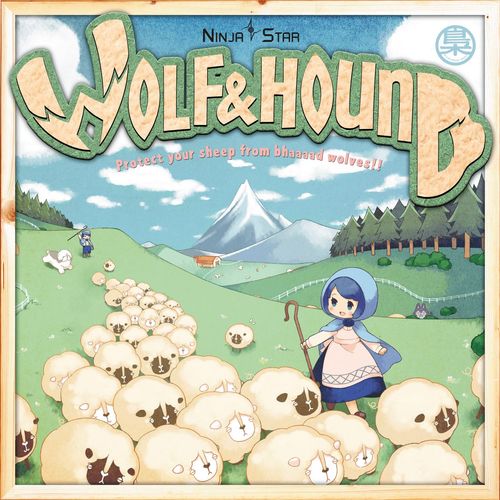
Wolf & Hound
Wolf & Hound Rulebook
Table of Contents
Table of Contents
- 1. Game Overview
- 2. Components Overview
- 3. Quick Start Guide
- 4. Game End Condition
- 5. Setup
- 6. Game Turn
- 7. Component Details
- 8. Animal Card Details
- 9. Recommended Card Combinations
- 10. 3 Player Rules
- 11. 2 Player Rules
- 12. Expansion Rules: Meat & Bone
- 13. FAQ
- 14. Game Tips
- 15. Designer's Cards
- Words from the Designer
1. Game Overview
"Wolf & Hound" is a partnership card game of protecting your flock of sheep from hungry wolves. You are a shepherd in the French Alps where wolves are becoming a problem, chasing your sheep away from your pasture. It is up to your reliable hound to go find your lost sheep and bring them back!
Each turn you will play a Number card which controls the movement of the Wolf or the Hound. Where the Wolf or the Hound moves determines the fate of your sheep. If there is a Wolf in your pasture at the start of your turn, then the Wolf chases away one of your sheep. If there is a Hound in your pasture at the start of your turn, then the Hound brings back the lost sheep.
Move them wisely to protect you and your partner's sheep, and chase away your opponent's sheep!
2. Components Overview
- 4 Player Cards: 2 for each team (front and back)
- 32 Number Cards: 16 Black cards and 16 White cards (front and back)
- 7 Expansion Number Cards: 4 Black cards and 3 White cards (these cards are not used in the base game)
- 24 Animal Cards (8 Wolf, 4 Hound, 2 Sheep, 4 Metamorphic, 2 Extra, and 4 Designer's cards) (front and back)
- 4 Player Aid Cards (front and back)
- 5 Game Boards and 4 sets of Fences: Pasture Board, Center Board and Fence Board (front and back)
- 16 Sheep Tokens: 8 white sheep and 8 black sheep
- 1 Rulebook: The booklet you are currently reading.
3. Quick Start Guide
Details aside, here are 5 things you need to know to get started!
3-1. What is "Wolf & Hound"?
- It's a 2 versus 2 partnership game.
- Save your Sheep from the hungry wolves.
- Don't lose all of your Sheep first.
- Your team wins if one of your opponents loses all of his / her Sheep first.
3-2. How do you gain / lose your sheep?
- Wolf will chase your Sheep away.
- Hound will bring back your lost Sheep.
(Diagram: Wolf card -1 sheep; Hound card +1 sheep.)
3-3. What can you do?
- You play a card from your hand. That's all!
- You move a Wolf or a Hound by playing a card. For example, if you play a Black [3], the Wolf card moves 3 steps clockwise.
3-4. When does the Hound or the Wolf activate?
- If they are in front of you at the start of your turn.
- In the example below, Wolf activated at the start of Player 4's turn. One of her Sheep was chased away by the Wolf.
(Diagram: [Player 3's turn] and [Player 4's turn] boards. Caption on Player 4's pasture: "Wolf chased my sheep away... :(" with "3 -1 sheep 2" marking the activation.)
3-5. How is the game played?
- The game is played in the following sequence.
- At the start of your turn, check if there are any Animal cards in front of you. If there are, then all these cards activate in order (see section 6-1).
- Play a Number card from your hand and move the matching Animal cards (see section 6-3).
- Draw a card from the deck of Number cards (see section 6-4).
- Round continues to the next player until the game end condition is met (see section 4).
4. Game End Condition
The game ends if either of the following 2 conditions is met.
- If one or more players have no Sheep tokens remaining at the start of Phase 2 (*):
- The team with players that have no Sheep tokens loses.
- If both teams have players without any Sheep tokens, then the team of the player without any Sheep tokens that is closest clockwise from the current player loses.
- If a player does not have any cards left in their hand:
- The game continues until Phase 1 (*) of the start player (Player 1). Each team counts the total number of Sheep tokens remaining and the team with more Sheep tokens wins.
- In case of a tie, then the Team Yellow (Players 2 and 4) wins.
*NOTE: Phases will be explained in section 6.
If you feel that one game is too short, then we recommend playing a best of 5.
(Diagrams: [Condition 1] and [Condition 2], showing players with 0 sheep and with 4 cards / 0 cards left.)
Cooperate with your partner! You can't win by yourself, so help each other out.
5. Setup
Finally, let's prepare for a game!
-
Shuffle and deal a Player card to each player.
- This determines the team and the seating order. Players sit in a clockwise order around the table starting with Player 1.
- Players 1 and 3 are in Team Blue. Players 2 and 4 are in Team Yellow.
- The game starts with Player 1.
Note: Alternatively, feel free to choose your teams instead of randomizing. Try to balance out the experience levels between the two teams.
-
Place 7 Expansion Number cards back in the box.
- These cards are not used in the base game.
- See section 12 if you are playing with "Meat & Bone" Expansion.
- Check to make sure that there are 32 Number cards.
-
Shuffle the Number cards and deal 4 cards face down to each player. Place the rest of the deck face down at the center of the Center board.
-
Each player takes 3 Sheep tokens from the supply. Place your Sheep tokens on your Pasture board inside your Pasture Fence.
- All remaining Sheep tokens go back in the box and are not used for the rest of this game.
-
Choose Animal cards to play with for this game. Place all chosen cards in front of Player 1.
- For your first game, or if any player is new to the game, choose Hound card 01 and Wolf card 01.
- Once all players are comfortable with the game rules, use the recommended card combinations in section 9.
[Initial Placement]
- Place your Player card in front of you. 2-1. You are dealt 4 Number cards. Keep these cards hidden from other players at all times. 2-2. Place the rest of the Number card deck face down in the middle of the Center board.
- Place your 3 Sheep tokens on your Pasture board inside your Pasture Fence.
- Place all of the chosen Animal cards in front of Player 1.
(Diagram labels: Number card discard area for each player, and each player's hand.)
6. Game Turn
Each player's turn consists of phases 1 through 4 below. The game is played in a clockwise order, starting with the start player (Player 1). Current player completes phases 1 to 4 below. After completing the following phases, the game continues with the next player until one of the game end conditions is met.
- Activation phase
- Check game end condition
- Play phase
- Draw phase
6-1. Phase 1: Activation phase (activating Animal cards)
- Skip this phase during the starting player's turn (the first turn of Player 1).
- Check if there are any Animal cards in front of you. If there are, then all these Animal cards in front of you activate in the following order:
- Sheep cards (Pink)
- Wolf cards (Black)
- Hound cards (White)
- If there are multiple cards of the same color, then the current player chooses the order in which these cards activate.
- The game does not end during this phase even if you or another player loses all their Sheep tokens. This check happens during "Phase 2: Check game end condition."
- Players cannot have negative Sheep tokens.
In general:
- Wolf card (Black) reduces a player's Sheep token by 1.
- Hound card (White) increases a player's Sheep token by 1.
- Sheep cards (Pink) have special abilities that are explained in section 8-3.
- Remember: BLACK = LOSE A SHEEP, WHITE = GAIN A SHEEP.
(Diagram legend: Wolf (Black) -1; Hound (White) +1; Others (Pink, Metamorphic cards, etc.).)
Example 6-1: Activating Animal cards
It is Player 1's turn. A Wolf card is in front of him. He had 3 Sheep tokens in his pasture but lost 1 Sheep token due to a Wolf card.
- A Wolf card was in front of Player 1.
- Player 1 had 3 Sheep tokens but now has 2 Sheep tokens.
[At the start of Player 1's turn] Caption: "Wolf chased my sheep away... :(" with Player 1's pasture showing 2 sheep.
6-2. Phase 2: Check game end condition
- The game ends if any player has 0 Sheep tokens in his pasture at this time. That player's team loses. See section 4 for more details on tie breakers and other game end conditions.
Example 6-2: When a player has 0 Sheep tokens
Player 1 lost 1 Sheep token in the previous phase. He now has no Sheep token left in his pasture, so the game ends. The winner is Team Yellow (Players 2 and 4).
6-3. Phase 3: Play phase (playing a card and moving Animal cards)
- Choose and play one card from your hand face up in front of you.
- All Animal cards that match the card's Card Type (color) move clockwise the number of spaces shown by the card's Movement Value.
- Place your used cards in front of you face up visible to all players. Keep them in the order they were played in.
Example 6-3: Moving Animal cards
It is Player 3's turn. A Hound card is in front of Player 2 and a Wolf card is in front of Player 3. She plays a White [3] card. The Hound card moves 3 spaces clockwise, ending its movement in front of Player 1. The Wolf card does not move since she played a White card.
- Plays White [3].
- Hound card moves 3 spaces clockwise.
- Hound card stops in front of Player 1.
NOTE: When playing a number card, all affected Animal cards will move. For example, when playing a Black card, all Black and Pink cards will move. This will be explained in detail in section 8.
6-4. Phase 4: Draw phase (draw a Number card into your hand)
- Draw one card from the deck of Number cards and add it to your hand.
- If the draw deck is empty, then you do not draw any cards.
- The game continues until a player has no cards in their hand. See section 4 for details on the game end conditions.
After completing all 4 phases, the current player's turn ends and the next player's turn begins starting with "Phase 1: Activation phase".
7. Component Details
7-1. Player card
- Initiative order: Player 1 is the start player. Players should be seated in a clockwise order.
- Team color: Players 1 and 3 are in Team Blue. Players 2 and 4 are in Team Yellow.
7-2. Number card
- Card type: There are two types of Number cards: Black cards (Wolf) and White cards (Hound).
- Movement value: Animal cards (mentioned below) will move based on this value.
- Number of cards in the deck: Number of cards / total number of cards in the deck.
7-3. Animal card
- Card name / Card number: You can identify cards by its card name and card number.
- Card type: There are 3 types of Animal cards: Wolf cards (Black), Hound cards (White), and Sheep cards (Pink).
- Movement modifier: Modifies the number of spaces this card moves during "Phase 3: Play phase." For example, if you play a Black [2] card and the Wolf card has a movement modifier value of [+1], then the Wolf card moves 3 (2+1) spaces. See section 8-2 for details.
- Special ability: See section 8 for details.
- Target: Target player(s) that is(are) affected by this card when it activates. See section 8-2 for details.
7-4. Center board
- Place Number cards deck at the center of the board.
- Animal cards move along the outer rim of the board.
7-5. Pasture board
- Place your Pasture Fence on the left side of the board.
- Sheep tokens are placed inside the Pasture Fence.
- Dark Forest area: When your sheep is chased away by a Wolf, take one Sheep token inside your Pasture Fence and place it in the Dark Forest area of your Pasture board. Your sheep is now lost in the forest!
(Diagrams: [When you lose a sheep] and [When you gain a sheep].)
8. Animal Card Details
8-1. Card types
-
Wolf card (Black): The hungry Wolf chased away one of your sheep! Move one of your Sheep tokens inside your Pasture Fence out to the Dark Forest. NOTE: You will never have fewer than 0 Sheep tokens. Please see FAQ Q8 in section 13 for an example.
-
Hound card (White): Your reliable Hound brought back the lost sheep! Move one of your Sheep tokens from the Dark Forest into your Pasture Fence. NOTE: You will never gain more Sheep tokens than what you started with. (In a basic game you start the game with 3 Sheep tokens)
-
Sheep card (Pink) [For experienced players]: Both Black and White Number cards move these cards. Sheep cards do not directly affect your Sheep tokens but instead change the way you play your turn.
-
Metamorphic card (Double sided) [For experienced players]: Metamorphic cards have different effects depending on which side is showing. The card flips over to the other side at the end of its movement if: a. It passes the start player (Player 1) or b. It stops in front of the start player (Player 1).
-
Extra card [For experienced players]: These cards have special abilities that are different than the ones explained above. They change the game quite a bit. Try using them once you are familiar with the basic game rules. See section 8-3 for details. NOTE: Extra card 02 is double sided.
-
Designer's card [For experienced players]: These are cards designed by Wolf & Hound kickstarter backers. They are very unique and are very fun to play with. Try using them to change up the game. See section 15 for details. NOTE: Designer's card 02-3 is double sided.
Example 8-1: Metamorphic card
It is Player 4's turn. She plays a Black [1]. The Wolf Metamorphic card 03 starts in front of Player 4 and moves to the front of Player 1. The card flips over to its other side, changing it to a Hound Metamorphic card. On Player 1's turn, the card is treated as a Hound card, meaning that he will gain a sheep. The card will move if he plays a White Number card.
(Diagram: Wolf (front) side and Hound (back) side.)
- A Wolf will transform into a Hound since the Metamorphic card moved to the front of Player 1. This fulfills condition (b) below.
- At the start of Player 1's turn, he will gain a sheep since the Metamorphic card now shows the Hound side (+1 sheep).
a. It passes the start player (Player 1) or b. It stops in front of the start player (Player 1).
8-2. Common effects
- Movement modifier: When this card moves, its movement is modified by this value.
- +1: This card moves one extra space.
- -1: This card moves one fewer space.
- 1/2: This card moves only half of the Number card's movement value (rounded down).
- Number card [1]: does not move
- Number card [2]: moves 1 space
- Number card [3]: moves 1 space
- Number card [4]: moves 2 space
- -1/2: This card moves half of the Number card's movement value counter-clockwise (rounded down).
- Number card [1]: does not move
- Number card [2]: moves 3 spaces clockwise (1 space counter-clockwise)
- Number card [3]: moves 3 spaces clockwise (1 space counter-clockwise)
- Number card [4]: moves 2 spaces clockwise (2 spaces counter-clockwise)
Example 8-2: "+1" Movement modifier
You are playing with a Wolf card with +1 movement modifier. Player 1 plays a Black [2]. The Wolf card moves 3 spaces (Black card [2] + "+1" modifier) clockwise, so it stops in front of Player 3. The rules are similar for -1 movement modifier.
Example 8-3: "1/2" Movement modifier
You are playing with a Wolf card with 1/2 movement modifier. Player 1 plays a Black [3]. The Wolf card moves 1 space clockwise, so it stops in front of Player 2.
1/2: This card moves only half of the Number card's movement value (rounded down)
- Number card [1]: does not move
- Number card [2]: moves 1 space
- Number card [3]: moves 1 space
- Number card [4]: moves 2 spaces
Example 8-4: Multiple Wolf cards ("Wolf card 01" and "Wolf card 06")
You are playing with a standard Wolf card and a Wolf card with 1/2 movement modifier. Player 1 plays a Black [3]. Both Wolf cards move (you must move all affected cards). The standard Wolf card (Wolf card 01) moves 3 spaces clockwise, while the other Wolf card (Wolf card 06) moves 1 space clockwise.
Example 8-5: "-1/2" movement modifier
You are playing with a Pink Sheep card 01 which has a -1/2 movement modifier. Player 1 plays a Black [3]. The Sheep card moves 1 space counter-clockwise (which is equivalent to 3 spaces clockwise). The card stops in front of Player 4.
-1/2: This card moves half of the Number card's movement value counter-clockwise.
- Number card [1]: does not move
- Number card [2]: moves 3 spaces clockwise (1 space counter-clockwise)
- Number card [3]: moves 3 spaces clockwise (1 space counter-clockwise)
- Number card [4]: moves 2 spaces clockwise (2 spaces counter-clockwise)
8-2. Common effects (continued from the previous page)
-
Target modifier: Some cards affect other players when they are activated. Remember that Animal cards only activates at the start of a turn if it is in front of the current player. When the card activates, the card may affect player(s) other than the current player.
- The current player
- Player sitting to the right of the current player
- Player sitting to the left of the current player
- Player sitting across from the current player (in other words, the current player's partner)
Example 8-6: Target "Left" player
It is Player 3's turn. There is a Wolf card 02 in front of her. This card targets the player to the left. Since Player 4 is sitting to the left of Player 3, Player 4 loses a Sheep token. Although there is a Hound 01 in front of Player 4, this does not activate since it is currently Player 3's turn.
(Diagram: [Player 3's turn] and [Player 4's pasture], marked "-1 sheep". Caption: "Targets the player to the left.")
NOTE: Animal cards activate at the start of your turn if they are in front of you. They are not activated at the start of the target player's turn. Therefore you do not activate Animal cards in front of the target player. You only activate Animal cards in front of you.
8-3. Special effects
- Skip (Sheep card 01):
- If this card activates, then the current player's turn ends immediately. Proceed on to the next player's turn.
- Sheep cards will always activate first, so other Animal cards in front of the current player will not activate.
Example 8-7: Sheep card 01 (Skip)
It is Player 3's turn. There is a Sheep card and a Wolf card in front of her. Sheep card activates first, which skips Player 3's turn. Since this happens before the Wolf card activates, she does not lose any sheep.
(Diagram caption: "My turn is skipped :(" / "But I don't lose my Sheep :D".)
8-3. Special effects (continued from the previous page)
- Cannot play Number 3 cards (Sheep card 02):
- If this card activates, then the current player may not play a Black [3] or a White [3] card this turn.
- If the current player cannot play any card because the only cards in their hand are [3]'s, then they reveal their hand at the start of "Phase 3: Play phase." Their turn ends immediately.
Example 8-8: Sheep card 02 (Cannot play Number 3 cards)
There is a Sheep card in front of Player 3 preventing her from playing a Number 3 card. She only has [3]'s in her hand as shown below. At the start of "Phase 3: Play phase," she announces that she cannot play and shows her hand to the other players. Her turn ends immediately and the game continues to Player 4's turn.
(Diagram caption: "All card are number '3'. She announces this and reveals her hand. Her turn ends immediately.")
-
Metamorphic cards (Double sided):
- These cards have an ability that activates during Phase 3: Play phase. The card will flip over to the other side when passing the start player (Player 1) at the end of its movement. See section 8-1 for details.
- The cards have their usual effect of gaining or losing Sheep tokens when they activate during "Phase 1: Activation phase."
- Special rules: When playing with 2 Metamorphic cards, there are times when both of them are the same color and they both end up in front of the same player. In that case, flip over one of the Metamorphic cards to the other side so that they show different colors.
NOTE: When playing with Metamorphic cards, it is possible that all Animal cards end up being the same color. In such cases you may play a Number card that doesn't match any of the Animal cards and not move any of them.
See Example 8-1 (p. 14).
-
Delayed Move - Grandpa Wolf (Extra card 01):
- This card is moved by both White and Black Number cards.
- This card moves counter-clockwise.
- This card does not move during "Phase 3: Play phase" like every other Animal cards. Instead, it moves at the end of the next player's turn. In other words, this card does not move based on the Number card you play this turn, but moves based on the Number card played in the previous player's turn.
He has experienced a lot during his lifetime. Card color doesn't matter to him anymore. He might be moving slowly and might be going in the wrong direction, but it's alright.
Example 8-9: Delayed Move (Extra card 01)
During the first turn of the game, Player 1 plays a White [2]. Extra card 01 does not move during his turn. The game continues to Player 2. He plays a Black [1]. At the end of his turn, Extra card 01 moves 2 spaces counter-clockwise. Now it is Player 3's turn. She loses 1 Sheep token since Extra card 01 is in front of her. At the end of her turn, Extra Card 01 will move 1 space counter-clockwise since Player 2 played a Black [1] in the previous turn.
-
Confused Hound (Extra card 02):
- This card is double sided similar to Metamorphic cards.
- If there are any other Animal cards in its place, then it will flip over to the other side at the end of a turn.
- When it is showing the front side, this card moves in a clockwise direction (just like the standard cards). When it is showing the back side, this card moves in a counter-clockwise direction.
- When this card activates, you will gain a Sheep token just like the standard Hound card.
He gets confused when he sees other animals!
Example 8-10: Confused Hound (Extra card 02)
Player 1 plays a White [4]. Extra card 02 moves 4 spaces clockwise, and thus comes back in front of Player 1. At the end of his turn, since there is also a Wolf card in front of Player 1, Extra card 02 flips over to the back side.
Player 2 then plays a White [1]. Extra card 02 moves counter-clockwise, so it stops in front of Player 4.
9. Recommended Card Combinations
There are many different combinations that will work. Here are a few of the recommended ones. Try out different card combinations and let us know what you think!
-
First play
- Hound card 01 + Wolf card 01
-
Beginner level (once everyone has played one game)
- Hound card 01 + Wolf card 01 + Wolf card 06
- Hound card 01 + Wolf card 03 or 04
- Hound card 03 or 04 + Wolf card 01
When playing with more than 1 Wolf card, we recommend using 4 Sheep tokens.
-
Experienced level (once everyone is comfortable with the rules)
- Hound card 01 + Wolf card 06 + Wolf card 03 or 04
- Hound card 01 + Wolf card 01 + Sheep card 01 or 02
- Any Hound card + Wolf card 06 + Wolf card 05
- Any Hound card + Wolf card 06 + Wolf card 03 or 04
- Metamorphic card 01 + Metamorphic card 02
- Metamorphic card 03 + Metamorphic card 04
-
Gamer level (if you like to strategize)
- Metamorphic card 01 + Metamorphic card 02 + Wolf card 06
- Metamorphic card 03 + Metamorphic card 04 + Wolf card 06
- Any Hound card + Any Wolf card + Extra card 01
10. 3 Player Rules
Although Wolf & Hound is best played with 4 players, sometimes you do not have enough players. When playing with 3 players add one dummy player.
There are several differences from the 4 player rules:
- Forming a Team
- Initial Sheep Count
- Game Setup
- Playing as a Dummy Player
- Game Flow and Game End Conditions
10-1. Forming a Team
The game is played as a 2 versus 1 match. The most experienced player should play as the single person team. Players will be divided as follows:
- Team Blue: Player 1 and 3
- Team Yellow: Player 2 (Experienced player) and 4 (dummy player)
10-2. Initial Sheep Count
Since the single person team is at a disadvantage, this team will start with more Sheep tokens.
- Team Blue:
- Player 1 (player to the left of dummy player): 2 sheep
- Player 3 (player to the right of dummy player): 3 sheep
- Team Yellow:
- Player 2 (human player): 4 sheep
- Player 4 (dummy player): 3 sheep
Each player should take 1 extra Sheep token when playing with 2 or more Wolf cards.
10-3. Game Setup
Deal 4 cards face down to each player including the dummy player. Stack the 4 cards dealt to the dummy player and place it next to his pasture. This stack will be referred to as the dummy deck. Do not rearrange this deck after the game has started.
(Diagram: [Initial Placement] for 3 players, showing 2 Sheep for Player 1, 4 Sheep for Player 2, 3 Sheep for Player 3, 3 Sheep for Player 4 (the Dummy Player), and the 1 Dummy Deck.)
10-4. Playing as a Dummy Player
In "Phase 3: Play phase" of the dummy player's turn, flip the top card of the Number card deck (not the dummy deck) face up and treat it as the dummy player's play. The flipped card is treated normally. After moving the corresponding Animal cards, leave the played card face up next to the dummy player's pasture. If there are no cards left in the Number card deck, then flip the top card of the dummy deck face up and treat it as the dummy player's play.
Exchange Call: Once during the dummy player's turn, the human player in the team (Player 2) may exchange the flipped card with the top card of the dummy deck. Use this ability if you do not like the played card!
If you decide to exchange the card, then flip the top card of the dummy deck and treat that card as the dummy player's play. The original card that was flipped from the Number card deck is added to the bottom of the dummy deck face down. Do not shuffle the dummy deck.
10-5. Game Flow and Game End Conditions
The game flow and the game end conditions are the same as the 4 player rules. In case of a tie, the single person team wins (Player 2).
11. 2 Player Rules
2 player rules are similar to the 3 player rules. If you haven't read the 3 player rules, please read them first. When playing with 2 players there will be 2 dummy players.
11-1. Forming a Team
The game is played as a 1 versus 1 match.
- Team Blue: Player 1 and 3 (dummy player)
- Team Yellow: Player 2 and 4 (dummy player)
11-2. Initial Sheep Count
Since the first player is at an advantage, this team will start with fewer Sheep tokens.
- Team Blue:
- Player 1 (human player): 2 sheep
- Player 3 (dummy player): 3 sheep
- Team Yellow:
- Player 2 (human player): 3 sheep
- Player 4 (dummy player): 3 sheep
Each player should take 1 extra Sheep token when playing with 2 or more Wolf cards.
11-3. Game Setup
These 3 steps are identical to the 3 player rules.
11-4. Playing as a Dummy Player
These 3 steps are identical to the 3 player rules.
11-5. Game Flow and Game End Conditions
These 3 steps are identical to the 3 player rules.
Summary table for 3 and 2 player rules
For 3 players:
| Player Number | Player or Dummy | Qty of Sheep Tokens |
|---|---|---|
| Player 1 | Player | 2 |
| Player 2 | Player | 4 |
| Player 3 | Player | 3 |
| Player 4 | Dummy | 3 |
For 2 players:
| Player Number | Player or Dummy | Qty of Sheep Tokens |
|---|---|---|
| Player 1 | Player | 2 |
| Player 2 | Player | 3 |
| Player 3 | Dummy | 3 |
| Player 4 | Dummy | 3 |
12. Expansion Rules: Meat & Bone
Preparation for playing with the Expansion: Use the 7 Expansion Number cards. Return the following 7 Number cards from the base game to the box. They are not used when playing with this Expansion.
These cards are not used: Black [1], [1], [2], and [3]; White [1], [2], and [3].
12-1. Expansion Number cards
- Black cards with Meat symbols (return these to the box): Black [1], [1], [2], and [3]
- White cards with Bone symbols (use these cards instead): White [1], [2], and [3]
12-2. Special rules for Meat & Bone
- Number cards with a Meat or a Bone symbol change the way a Wolf or a Hound moves when other players play Number cards.
- If the last card played by a player has a Meat or a Bone symbol, a Wolf or a Hound will stop its movement in front of that player instead of moving past them.
- A Meat symbol will stop the Wolf, and a Bone symbol will stop the Hound.
MEAT SYMBOL (BLACK CARD) STOPS THE WOLF. BONE SYMBOL (WHITE CARD) STOPS THE HOUND.
NOTE: A Meat or a Bone symbol does not affect Sheep cards.
Example 12-1: Wolf movement when playing with Meat & Bone
There is a Wolf in front of Player 1. Player 2 plays a Black [2] with a Meat symbol. The Wolf moves normally and stops in front of Player 3. (A Meat or a Bone symbol only affects other players)
Player 3 then plays a Black [4]. Normally the Wolf would move 4 spaces and stops in front of Player 3. However because there is a Number card with a Meat symbol in front of Player 2, the Wolf stops in front of Player 2.
Player 4 then plays a White card. The Hound moves normally and Wolf does not move.
Player 1 then plays a Black [2]. The Wolf moves normally and stops in front of Player 4.
Player 2 then plays a White card, which hides the Meat symbol on the Black card he played in his previous turn.
Player 3 then plays a Black [4]. Since there is no longer a Meat symbol on any of the last cards played by a player, the Wolf moves normally and stops in front of Player 4.
NOTE: A Meat or a Bone symbol only affects other players (in this case, Players 1, 3 and 4). It stays active until that player (Player 2) plays another card.
(Diagram: [Player 2's turn] and [Player 3's turn] boards illustrating the Meat symbol stopping the Wolf in front of Player 2.)
13. FAQ
13-1. Tie breaker and game end conditions
Q1: If multiple players have no Sheep tokens, then which team wins? A1: The team of the player without any Sheep tokens that is closest clockwise from the current player loses. Please refer to section 4 for more details. For 2 and 3 player rules, see section 10 and 11.
Q2: The game ended because a player had no cards left in his / her hand. If both teams have the same number of Sheep tokens remaining, then which team wins? A2: Team Yellow (Player 2 and 4) wins. Please refer to section 4 for more details. For 2 and 3 player rules, see section 10 and 11.
Q3: The game ended because a player had no card left in their hand. However, some other players have cards in their hands. Are these remaining cards discarded? A3: Yes, they are discarded and thus cannot be played. This can happen due to special effects such as "Skip your turn" and "Cannot play a [3] card".
13-2. Movement of Animal cards
Q4: For each Number card you play, is only 1 Animal card moved? A4: No, all matching Animal cards move when you play a Number card. For example, let's say that you are playing with 2 Wolf cards. If you play a Black Number card, then both Wolf cards move.
13-3. Effects of Animal cards
Q5: Will the current player be eliminated if he / she has 1 Sheep token left, and both a Wolf and a Hound are in front of him / her? A5: No, the player is not eliminated. The Wolf card will reduce his / her Sheep tokens to 0, but then the Hound card will increase his / her Sheep token back to 1.
Q6: If there is a "Skip your turn" card and a Wolf in front of the current player, then will he / she lose a Sheep token because of the Wolf? A6: No, the player does not lose a Sheep token. The Pink Sheep cards always activate first. His / her turn is skipped at that point, so the Wolf does not activate.
Q7: If there are multiple Animal cards in front of the current player, will the effects stack? A7: Yes, they will all activate and the effects will stack. For example, if there are 2 Wolf cards in front of the current player targetting that player, then he / she will lose 2 Sheep tokens.
Q8: What does it mean that you cannot have negative Sheep tokens? A8: For example, let's say you have 1 Sheep token left. 2 Wolf cards and 1 Hound card activate on your turn. Since Wolf cards will activate first, you will lose 2 Sheep tokens. You will lose your last Sheep token and now you have 0 Sheep tokens left. There is no more Sheep tokens to lose, so the second Wolf card does not do anything to you. The Hound card will then activate, so you will gain 1 Sheep token. At the end of "Phase 1: Activation phase," you will have 1 Sheep token in your pasture.
13-4. Expansion: Meat & Bone
Q9: Does a Meat or a Bone symbol take effect immediately after it has been played? A9: No, these symbols only affect other players. For example, let's say a Wolf card is in front of Player 1. If Player 2 plays a Black [2] with a Meat symbol, the Wolf moves and stops in front of Player 3 instead of stopping in front of Player 2. See example 12-1.
14. Game Tips
Spoiler alert! Skip this section if you prefer to analyze the game by yourself.
- Number cards are not distributed evenly. For example, there are more Black [3] cards then any other cards. This means that there is a higher chance that your opponent has one of these cards. It could be risky to move a Wolf to a location 3 spaces away from you or your partner's pasture.
- Number cards played by other players. It is beneficial to pay attention to the cards other players are playing. For example, if your opponent does not play a Black [3] when a Wolf is 3 spaces away from you or your partner's pasture, then it is likely that that player does not have a Black [3]. Don't be over confident since he / she could have drawn a Black [3] at the end of his / her turn.
- Last few turns of the game. During the last few turns of a game, pay attention to the cards you have in your hand, and the cards played by other players. You should be able to guess what other players have in their hand.
- Using different Animal cards. There are many different Animal cards to choose from. Some of them are trickier than others. Metamorphic cards can change the game quite a bit so be prepared if they are in the game!
- Choosing your partner. If you are new to this game, or if you are introducing this game to a new player, play a few games without changing the teams. You will gradually understand what your partner is thinking and will be able to make optimal team plays!
15. Designer's Cards
These are cards designed by Wolf & Hound kickstarter backers. They are very unique and are very fun to play with.
15-1. Designer's card 01: A Red Devil
- This Wolf moves 3 times faster than the usual Wolf! It is a mystery how this Wolf can move so fast!
- Number card [1]: moves 3 spaces clockwise
- Number card [2]: moves 6 spaces clockwise
- Number card [3]: moves 9 spaces clockwise
- Number card [4]: moves 12 spaces clockwise
15-2. Designer's card 02: A Blanket Wolf
When playing with a Blanket Wolf, use Designer's cards 02-1, 02-2, and 02-3. Also, we recommend starting out with 4 Sheep tokens each.
Designer's card 02-1: A Black Blanket
- This card moves and acts just like a normal Wolf (Wolf card 01). If there is a Black Blanket card in front of you at the start of your turn, then you will lose a Sheep token.
Your sheep cannot withstand the gross smell of the blanket and runs away!
Designer's card 02-2: A White Blanket
- This card moves and acts just like a normal Hound (Hound card 01). If there is a White Blanket card in front of you at the start of your turn, then you will gain a Sheep token.
Your sheep loves this fluffy blanket!
Designer's card 02-3: A Blanket Wolf
- This card is double sided similar to Metamorphic card.
- This card is not moved by a Number card.
- This card has the normal effect of a Wolf, which means that if this is in front of you at the start of your turn, you will lose a Sheep token.
- If there is a blanket card in front of the player with this card, then the Wolf flips over to the front side at the end of Phase 3: Play phase.
- While this card is showing the front side, the card does not move.
- If there are no blanket cards in front of the player with this card, then it will flip over to its back side at the end of "Phase 3: Play phase."
- While this card is showing the back side, the card move 1 space counter-clockwise at the end of every turn.
Happiness is a warm blanket. / "Alright, where is it!"
Example 15-2: Designer's card 02 (Blanket Wolf)
At the start of the game, all 3 cards are in front of Player 1. Player 1 plays a White [2]. The White Blanket card (02-2) moves and stops in front of Player 3. At the end of "Phase 3: Play phase," the Blanket Wolf card (02-3) stays on the front side there is a Black Blanket card (02-1) in front of him. At the end of his turn, the Blanket Wolf card does not move.
Player 2 plays a Black [2]. The Black Blanket card (02-1) moves and stops in front of Player 3. At the end of "Phase 3: Play phase," the Blanket Wolf card (02-3) flips over to the back side since there is no Blanket card in its place. At the end of his turn, the Blanket Wolf moves 1 space counter-clockwise.
At the start of Player 3's turn, she does not lose any Sheep token since there are both White and Black Blanket cards in front of her. She plays a Black [1]. The Black Blanket card moves and stops in front of Player 4. At the end of Phase 3: Play phase, the Blanket Wolf card flips over to the front side since there is a Blanket card in its place. At the end of her turn, the Blanket Wolf card does not move.
At the start of Player 4's turn, she loses 2 Sheep tokens since both the Black Blanket card and the Blanket Wolf card is in front of her!
NOTE: When playing with the Blanket Wolf set, we recommend playing the game with 4 Sheep tokens.
Words from the Designer
This game is a 2 versus 2 partnership game. I hope you enjoy the moments when you successfully assist your partner and the moments when your partner successfully protects you.
The basic rules are simple, but the game has a lot of variations. Try playing with the more advanced cards, and try to come up with a card combination not listed in this rulebook. I believe that there are plenty of ways to enjoy this game!
I would like to ask one favor of the veteran players. Please don't tell the new players what to do (you should help them without giving orders).
I've always felt that understanding a game's mechanics and figuring out how to play well is a big part of the fun.
Good luck and have fun!
Please check our website prior to playing the game for the most updated rules and errata.