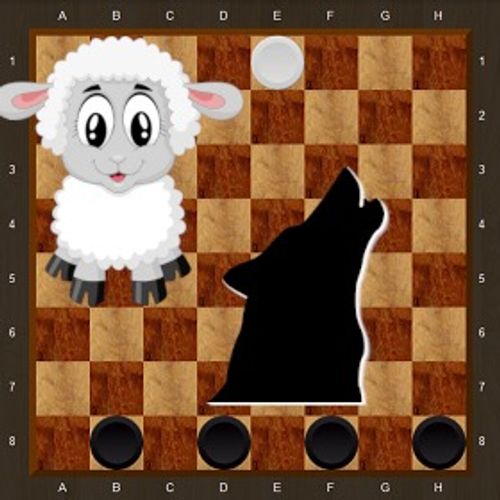
Wolf and Sheep
Wolf and Sheep Rulebook
Table of Contents
Table of Contents
Objective
Beware this is an asymmetric game:
- Black — Wolves: need to block the Sheep.
- White — Sheep: needs to pass through the wolves and reach their starting line.
Components
- A chess-like board.
- 1 white token (called "Sheep").
- 4 black tokens (called "Wolves").
Setup
- Wolves are placed onto fields B8, D8, F8, and H8.
- Sheep starts the game from E1.
8 W . W . W . W .
7 . . . . . . . .
6 . . . . . . . .
5 . . . . . . . .
4 . . . . . . . .
3 . . . . . . . .
2 . . . . . . . .
1 . . . . S . . .
  A B C D E F G H
On Your Turn
You can move:
- 1 piece at a time.
- Only diagonally (so you always play on the same cell color of the board).
- Only 1 step at a time.
- The sheep can move backward, not the wolves.
End of Game
Beware this is an asymmetric game:
- White victory: Sheep wins by reaching the other side of the board (8th row or 10th row according to played variant).
- White BGA auto victory: if there are not enough wolves in front of the sheep to block the sheep.
- Black victory: Wolves win by blocking the sheep such that it cannot move anymore (when the sheep has no legal move left).
Variants
- Board size
- Chess board: 8x8.
- Checkers board: 10x10 (+1 black token).
- Duration
- 1 round is a classic play as defined here.
- 2 rounds: one round with Player 1 as White vs Player 2 as Black, then one round with Player 2 as White vs Player 1 as Black.
User Preferences
- Board colors
- Tokens on dark cells: tokens are placed as in the pictures on the "black"/darkest cells of the board.
- Tokens on light cells: tokens are placed on the "white"/brightest cells of the board.
- Interface theme
- Standard: the same background as any classic board game like chess.
- Darker: a black background with 75% opacity.
Notes
Wolf and Sheep belongs to the family of traditional "hunt" games in which a small band of hunters tries to trap a single, more mobile prey piece — relatives include Fox and Geese, Fox and Dogs, Hounds and Hare, and Devil and Tailors. Because only diagonal moves are allowed, play stays confined to one color of squares on the board, as in checkers. There is no capturing by jumping and no stacking of pieces, either by jumping the opponent as in checkers or by moving onto its square to replace it.