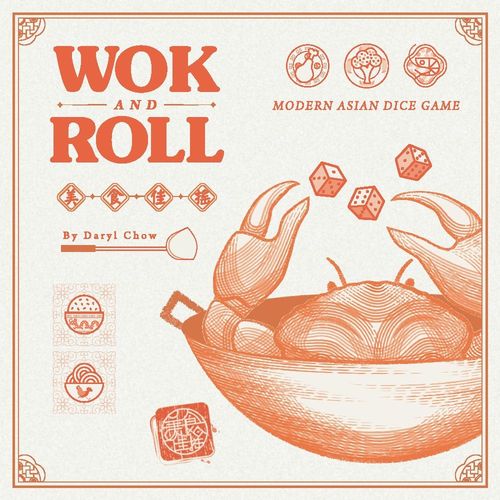
Wok and Roll
Wok and Roll Rulebook
Table of Contents
Table of Contents
Game Components
- 5 double-sided player menus
- 5 erasable markers
- 6 ingredient dice (4 white, 2 red)
- 1 dice wok-tray
- 8 House Special tiles
Aim of the Game
To score the most taste points for your restaurant by picking the right ingredients and cooking the best dishes.
Flow of the Game
The game takes place over a number of turns until the game end condition is met. Each turn, the player on turn goes to the market (roll the dice). All players will then use the ingredients from the market to cook dish servings (cross off their menu). The game ends in the turn when one player completes cooking 3 dishes or dish platters.
2 Ways to Wok and Roll
The rules below are for the Simple Menu. The rules for the Expert Menu on page 8 will explain which elements are different from the Simple Menu.
Game Setup
- Give each player a menu and marker. Flip to the Simple Menu and give your restaurant a name on the top right.
- Determine a starting player, preferably the last person to have cooked, and give them the 6 dice and the dice wok-tray.
Mains
Flow of a Turn
Each turn consists of:
- Going to the Market
- Cooking Dishes
Strategy Tip: Most dish servings require two of the same ingredient. If you are able to have one ingredient on the red dice and one on the white dice, your fellow players won't be able to cook that dish serving unless they have spare ingredients.
1. Going to the Market
The starting player on turn rolls all 6 dice (using the dice wok-tray provided). After their first roll, they have up to 2 more re-rolls (for a total of 3 rolls). They may re-roll any die, including any dice they previously set aside, regardless of colour.
Example 1: After Mei's initial roll (Red dice: Meat, Seafood; White dice: Rice, Vegetable, Meat, Vegetable), she selects 2 dice to re-roll the first time. Mei selects 3 dice to re-roll a second time. The ingredients from Mei's second re-roll are locked in.
Players may lock in their dice after any of their first 2 rolls. After the third roll, the dice are automatically locked in. These dice are now ingredients fresh from the market available for all players to cook dish servings from!
2. Cooking Dishes
Once the dice are locked in, players can start cooking! Using the ingredient symbols shown on the dice, players may now simultaneously cook up dish servings to the best of their ability. As a bonus for going to the market, the starting player may use all 6 dice (both red and white), while all the other players may only use the white dice. A dish serving may be cooked (crossed off) if the necessary ingredients are present in the roll.
Example 2: With the market showing Red dice: Noodle, Seafood and White dice: Noodle, Vegetable, Meat, Meat, Mei groups her ingredients to cook a Noodle and Meat dish. Looking at Mei's roll, Wong can only use the ingredients on the white dice. He decides to cook a Meat dish too.
Players may also use ingredients from their Fridge to cook dishes. In the Simple Menu, you start with 5 ingredients (Rice, Noodle, Vegetable, Meat, Seafood) and 1 Recipe Book in the Fridge to be used only once each in the whole game. If a player wishes to use these ingredients to cook their dishes, they cross off these symbols from their Fridge. There is no limit to the number of Fridge ingredients players may use in a turn.
Dish servings may only be crossed off from the top to the bottom (the only exceptions being the dish platters). Dish platters are denoted by dishes grouped vertically or horizontally in an outlined section (see Example 3). Once a dish serving is crossed off, it will remain crossed off for the rest of the game and gain the player taste points or bonuses. Each dish section has different effects, explained below:
Rice and Noodle Sections
No special effects besides earning taste points.
Meat and Vegetable Section
Players may cross off servings in the dish platters in any order. If an entire dish platter is completed (i.e. if all servings in the dish platter have been crossed off), the player earns bonus taste points (see Example 3).
If a player crosses off servings in the same row, completing an ingredient, they may circle the ingredient to be used immediately, as though it were an ingredient in their Fridge (see Example 4).
Example 3: A Meat dish platter has 5 servings, each requiring different ingredient combinations; crossing off all 5 servings in the platter earns the player +2 taste points, in addition to the taste points already earned for each serving.
Seafood Section
Players may cross off servings in the dish platters in any order. If an entire dish platter is completed (i.e. if all servings in the dish platter have been crossed off), the player earns bonus taste points.
Example 4: Wong rolls the dice. Using up 1 Vegetable from his Fridge, he cooks a Vegetable and Meat dish serving in the same row. This earns him 1 extra Rice, which he circles to indicate it is available for immediate use.
Specialty Skills
For two Recipe Books, a player may gain (outline) a passive conversion skill (hexagon) of their choice (see Example 5). This skill will allow them to utilise a Recipe Book as the listed ingredient from the moment the skill is gained (even in the same turn).
Example 5: Ana rolls the dice and doesn't go for any re-rolls. With her passive conversion skill that allows her to use any Recipe Book as a Vegetable, she cooks a Noodle and Vegetable dish serving.
The skill applies to any number of Recipe Books, including Recipe Books from your Fridge or elsewhere, but a single Recipe Book only becomes a single ingredient. If a player has multiple skills, they may choose to convert a Recipe Book to any of the ingredients they have conversion skills in, but a single Recipe Book may only become a single ingredient.
For three Recipe Books, a player may gain (outline) an end game bonus scoring (rectangle).
Players are free to outline any rectangle of their choice. Each rectangle states the bonus points to be gained at the end of the game (see Example 6).
Example 6: The end game bonus scoring choices are:
- Recipe Book / Specialty Skill = 2 taste points — gain 2 taste points for each Specialty Skill (hexagon or rectangle) the player has gained.
- Rice = 1 taste point — gain 1 taste point for every Rice dish serving that is crossed out.
- Noodle = 1 taste point — gain 1 taste point for every Noodle dish serving that is crossed out.
- Vegetable = 1 taste point — gain 1 taste point for every Vegetable dish serving that is crossed out.
- Meat = 1 taste point — gain 1 taste point for every Meat dish serving that is crossed out.
- Seafood = 1 taste point — gain 1 taste point for every Seafood dish serving that is crossed out.
In the example, with the Noodle Specialty Skill outlined, the player gains 5 more taste points from their Noodle section at the end of the game.
End of the Turn
When all players have cooked their dishes using the available ingredient symbols, the turn is over. Pass the dice clockwise to the next player to start a new turn.
End of the Game
The game ends in the turn when at least one player has completed a combination of any 3 dishes or dish platters. To complete a dish, you need to cross off all the dish servings in the column. To complete a dish platter, you need to cross off all the dish servings in the outlined section.
All players will continue playing till the end of that turn. Now, tally the scores from each food group section into their respective wok spaces. Add up the taste points from every dish serving that was crossed off. The player with the most taste points wins! In the case of a tie, the player who is furthest clockwise from the starting player of the game wins.
Scoring example: Wong's end game score is 55 taste points, tallied from his Specialty Skills and Fridge (19), Rice section (5), Noodle section (13), Vegetable and Meat section (10, including additional points for cooking 2 full dish platters), and Seafood section (8), for a restaurant named "Super Best Eats."
Dessert
This section will explain the rule additions for the Expert Menu. The flow of the rest of the game is otherwise the same as in the Simple Menu.
Game Setup
Randomly shuffle the 8 House Special tiles and deal one to each player. These tiles are placed face-up on the House Special space on their menu. The undealt House Special tiles will not be used in this game.
Unlocking Recipes
The Expert Menu introduces the concept of locked dishes. Players do not start with the ability to cook all the dish servings - some of them will need to be learnt in order to be cooked. These are signified by a lock symbol. Players may cook dish servings until they hit a lock. Therefore, if the lock is the first serving of a dish, they may not cook that dish serving until it is unlocked.
A lock may be removed by reading (using) 2 Recipe Books. Cross off the lock to show that the rest of this dish is now available to be cooked (Example 7). Players who have enough Recipe Books are free to unlock any lock from any dish at any time. You may also cross off a lock by crossing off a Recipe. But beware - this will result in negative points at the end of the game!
Example 7: Sufya rolls Recipe Book and Seafood on her red dice, and Meat, Seafood, Rice and Seafood on her white dice. She crosses off 1 x Recipe Book from her Fridge to unlock this Seafood dish. She has enough ingredients to cook the first Seafood dish serving.
Fridge
In the Expert Menu, you do not start with 5 ingredients and 1 Recipe Book in your Fridge as in the Simple Menu. Instead, you may use 2 ingredients (as noted by the Chef Hats), and may earn more as you complete your House Special dish servings.
House Special
The Expert Menu also introduces a House Special dish for each player. At the beginning of the game, one House Special tile is dealt to each player face-up. These dishes may only be cooked by the player who owns that recipe for a large number of taste points. Cooking the House Special also unlocks more ingredients from the Fridge to be used, up to 2 more for a total of 4 ingredients from the Fridge (see Example 8).
Example 8: After cooking his House Special twice, Samo earns a Chef's Hat and can now use a third Fridge ingredient.
Pantry
The Expert Menu introduces a Pantry in addition to the Fridge that you start the game with. You do not start with any ingredients in the Pantry, but they can be gained from cooking dish servings. When you cook a dish serving that has an ingredient symbol in the space, circle that corresponding ingredient in your pantry to be used (from top to bottom). You will also gain bonus taste points at the end of the game for the ingredients circled in your Pantry. Add up these bonus taste points in the wok space provided (see Example 9).
Example 9: At the end of the game, Sufya's Pantry earns her 17 taste points.
End of the Game
As with the Simple Menu, the game ends in the turn when at least one player has completed a combination of any 3 dishes (not counting the House Special dish). The player with the most taste points wins! In the case of a tie, the tied player sitting furthest clockwise from the start player is the winner. For a longer game, you may play until a player completes 5 dishes.
Dish Names
Rice Dishes
- Salted Fish Fried Rice (鹹魚炒飯)
- Chicken Fried Rice (雞絲炒飯)
- Pineapple Fried Rice (黃梨炒飯)
- House Special Fried Rice (招牌炒飯)
Vegetable Dishes
- Sambal Kang Kong (馬來風光)
- Mapo Tofu (麻婆豆腐)
- Broccoli with Scallops (西蘭帶子)
- Deep Fried Yam Ring with Vegetables (佛體飄香)
Seafood Dishes
- Poached Live Prawns (白灼生蝦)
- Buddha Jumps Over the Wall (佛跳牆)
- Hong Kong Style Fish (避風塘魚)
- Crab Roe with Seasonal Vegetables (蟹黃時菜)
- Kung Pao Fish Rice (宮保魚飯)
- Jellyfish with Smoked Pig Trotter (海蜇燻蹄)
- Fresh Prawns with Lo Mein (鮮蝦撈麵)
Noodle Dishes
- Sam Lo Hor Fun (三撈河粉)
- Xiamen Fried Noodles (廈門炒米)
- Luohan Fried Noodles (羅漢炒麵)
- House Special Fried Noodles (招牌炒麵)
Meat Dishes
- Sweet and Sour Pork (咕嚕肉)
- Roast Duck (琵琶鴨)
- Twice-Cooked Pork (回鍋肉)
- Prawn Paste Chicken (蝦醬雞翼)
House Special
- Chilli Crab (辣椒螃蟹)
- Fresh Squid Deep-fried (黃金鮮魷)
- Thick Rice Noodles Pan Fried with Beef (乾炒牛河)
- Braised E-Fu Noodles with Chives (韭黃伊麵)
- Singapore Vermicelli Noodles (星洲米粉)
- Fried Rice with 'Three Treasures' (三寶炒飯)
- Yangzhou Fried Rice (揚州炒飯)
- Shrimp Fried Rice (蝦仁炒飯)