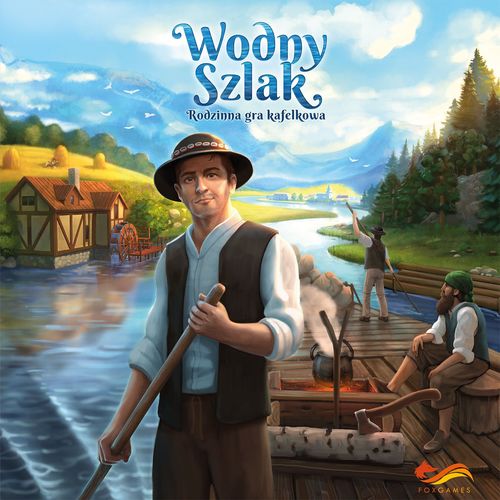
Wodny szlak
Wodny szlak Rulebook
Table of Contents
Table of Contents
Box Contents
- 60 square river tiles
- 4 rectangular starting tiles
- 4 helper cards
- 1 notepad for recording scores
Setup
- Prepare the number of square river tiles appropriate for the number of players:
- 4 players - use all 60 tiles,
- 3 players - use 45 tiles (remove all tiles with cows),
- 2 players - use 30 tiles (remove all tiles with cows and all tiles with sheep),
- 1 player - use 39 tiles (remove all tiles with cows and six randomly chosen tiles) - the solo variant rules are described at the end of the rulebook.
- Shuffle the tiles, deal each player three of them, and place the rest in a face-down pile in the middle of the table.
- Give each player one rectangular starting tile and one helper card containing the scoring rules.
Note: the box insert has compartments marked for storing the tiles with cows and sheep.
Gameplay
Each player builds their own river out of individual tiles chosen every round. Out of the three tiles they receive, they choose one and add it to their starting tile - following the rules described below. They pass the other two tiles to the player on their left, and receive two tiles in turn from the player on their right. They draw a third tile to go with those from the face-down pile in the middle of the table. They again choose one tile and add it to their river, and pass the two remaining tiles to their neighbor on the left. Play continues this way for 13 rounds, that is, until the pile of tiles in the middle of the table runs out. Players are then left holding two tiles each, which they no longer place.
Each subsequent tile added to a player's river must touch edge-to-edge with at least one previously placed tile. Tiles may touch along edges that the river runs through (Fig. 1A), or along edges without a river (Fig. 1B). However, an edge with a river may not touch an edge without a river (Fig. 1C).
The starting tile shows the place where two tributaries flow into the main river. The light arrows show the direction of the water flow. Depending on how a player connects the tiles they add to the starting tile, the river shown on them will flow in a particular direction (arrows in Fig. 2). Tiles that do not connect to the starting tile through the river have no defined direction of flow. In later rounds, when adding further tiles, a player may connect them to the river or leave them unconnected. At the end of the game, such unconnected fragments are treated as oxbow lakes, that is, parts of a former riverbed now filled with standing water.
For obvious reasons, the river cannot flow in a loop (Fig. 3A). Tiles can, however, be arranged as shown in Fig. 3B - except that no tile can then be placed in the remaining gap.
Scoring
Once the last tile has been placed, the points scored by each player are tallied. Points in the game can be earned for four elements: mills, sawmills, ports, and meadows.
Mills
On the pennant placed above each mill there is a number indicating its point value. On the left is a number of sacks of grain that must reach the mill for the player to score points for it. Sacks reach the mill if they are located upstream of it on the river (they can then float downstream to the mill). All mills and sawmills have bridges beneath which boats cannot pass. So if, for example, a sawmill lies between a sack and a mill, that sack will not reach the mill (Fig. 4). Delivering more sacks to a mill than required does not increase the points scored. Mills located on oxbow lakes do not score points, because there is no water flow at those places.
Note: some tiles feature both sacks of grain/wood and obstacles. The exact position of the sacks/wood relative to the obstacle is shown precisely by the icon.
Sawmills
Points for sawmills are earned the same way as for mills, except that wood (axe symbol) is delivered to them by the river instead of grain. Rafts of wood likewise cannot pass beneath bridges. Sawmills have a higher point value than mills, but axe and sawmill symbols appear less often on tiles than sack and mill symbols.
Ports
Each player scores points for their single longest bridge-free water route between two ports. There may be no mills or sawmills on this route, but the direction of the water flow does not matter (ports on an oxbow lake also score points). The player scores 2 points for every tile forming the longest route between ports (including the end tiles bearing the ports). The starting tile is worth as many points as an ordinary, single tile.
Meadows
Fragments of meadow are placed in the corners of tiles. If three or four such fragments touch each other, a meadow is formed. At the end of the game, each meadow made of three fragments is worth 3 points, and a meadow made of four fragments gives 6 points (Fig. 6). It does not matter whether the individual tiles belong to the river or to an oxbow lake.
Example Scoring
An example of scoring at the end of a game is shown in Fig. 7. The player collected the required number of sacks and axes for two mills and one sawmill. The second sawmill is located on an oxbow lake, so it scores no points. The player also formed three meadows and laid out a five-tile route between the ports.
Solo Variant
The solo variant uses 39 tiles. Remove all tiles with cows, plus six additional random tiles. The player may look at the discarded tiles. Place the remaining 39 tiles in a face-down pile, from which three tiles are drawn. Choose one and add it to your river; discard the other two. Then draw another three tiles, from which you again choose one. Play continues for 13 rounds - until the pile of tiles runs out. At the end of the game, tally your points and compare your score against the table.
| Score | Rank |
|---|---|
| < 25 | Right Tributary to Nowhere |
| 25-34 | Babbling Brook |
| 35-44 | Lazy Creek |
| 45-54 | Rushing Torrent |
| 55-64 | Little River by the Little Town |
| 65-74 | River That Flows From Afar |
| ≥ 75 | The Amazon! |