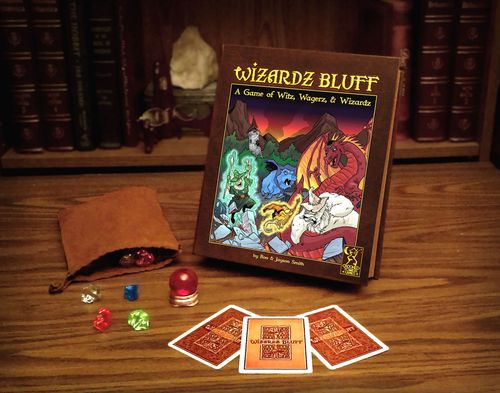
Wizardz Bluff
Wizardz Bluff Rulebook
Table of Contents
Table of Contents
Object of the Game
Players play the role of wizards who can transform into animals. Some animals are better than others, but all transformations require spellstones. Players try to outsmart their opponents in battles to win spellstones and elemental powers. The player with the most points after 3 rounds is the winner, and is named the Grand Master Wizard!
Components
- 5 Wizard decks – allows five players to play Wizardz Bluff. Each deck (brown backside) is a different color and includes: 1 Wizard scoring card, 2 plastic sliders, 1 Alchemist card, and 11 animal transformation cards.
- The Headmaster Token – the crystal ball is placed in front of the Headmaster player during their turn(s).
- 36 Spellstones – these plastic gems come in four colors of equal quantity and come with a cloth bag.
- 24 Magic Item cards – used by your wizard to cast spells during the battle.
- 40 Elemental cards – come in four colors and are collected by your wizard.
Setup
Optional: Place a game mat or soft tablecloth over your table before beginning your game. This improves play and protects your cards from scratches.
Step 1 – Separate the five wizard decks into different colors. The wizard decks include 12 playing cards (with dark brown backsides) and come with a wizard scoring card and two plastic sliders.
Step 2 – Separate the elemental cards into four colored decks face up nearby. (The four decks are Water, Air, Earth and Fire.)
Step 3 – Shuffle the magic item cards but place them facedown nearby. Draw three cards from the top of that deck and place them facedown in front of the deck. These three cards are magic items that wizards can buy from the Alchemist Shoppe.
Step 4 – Place the Headmaster token in front of the wisest (or oldest) player. Beginning with the Headmaster and proceeding clockwise, each player may:
- Select a wizard scoring card and a deck of 12 playing cards. Clip the plastic sliders over "00" and "0" on the wizard scoring card.
- Draw the following number of magic item cards from the top of the Alchemist Shoppe deck, depending on the number of players:
- 2 players = 2 magic item cards
- 3 players = 2 magic item cards
- 4 players = 1 magic item card
- 5 players = 1 magic item card
Step 5 – Finally, each player reaches into the bag and takes the following number of spellstones, depending on how many players are playing:
- 2 players = 5 Spellstones
- 3 players = 6 Spellstones
- 4 players = 6 Spellstones
- 5 players = 7 Spellstones
Note: If too many spellstones are taken, the player must put them all back and draw again. A player's spellstones and wizard scoring card are kept in front of them.
Rounds
The game is played for 3 rounds. A round is divided into approximately 12 matches. Every match a player plays a card. At the end of the round, players count spellstones.
Matches
Simultaneously, every player selects a card from their hand and places it facedown on the table in the "pot". This can be any card, and it represents what their wizard is secretly planning to do.
Spellstones
Players also place one of their spellstones on top of their card. Wizards use spellstones for two magical purposes: transforming into animals and buying magic Items. (The color and purpose of the spellstones will be explained.)
- If a player does not have a spellstone to play, they are out of the round and must wait until the next round.
Magic Items
Magic item cards are different from regular playing cards in that they do not require a spellstone to play. They are played at any time during the game (or as directed by the card) and are kept in hand. After they are played they are discarded to the bottom of the Alchemist Shoppe deck.
If two or more players play magic item cards simultaneously, priority goes to players in clockwise order, starting from the Headmaster. (To buy magic items see Alchemist.)
Winning a Match
After all players have placed a card and a spellstone in the pot, the Headmaster declares, "Flip!" and players flip their cards simultaneously. The player with the highest animal is the winner of the match. They are awarded all of the spellstones from the pot and given the Headmaster token for the next match. (For more details about the Headmaster, see the Headmaster section.) Each player discards their playing card facedown in their own discard pile and may not use it again for the rest of the round.
Example: Three wizards transform into a Fox(5), a Boar(7) and a Bear(9) individually. The Bear is the greatest animal in the battle and wins the match. The player that played the Bear wins all of the spellstones from the pot. Each player removes their card from the pot and discards it facedown into their own discard pile.
- If an Alchemist card is played, then that player visits the Alchemist Shoppe instead of battling. (See the Alchemist section.)
- If two or more cards tie, then read the section on Ties.
Mystical Animals
Mystical animals play a crucial roll in the game and are identified by a colored gem in their corner. The gems represent the four elementals: Water, Air, Earth and Fire. The three greatest mystical animals are the Griffin(10), the Unicorn(11) and the Dragon(12).
Rat / Plague
The lowest mystical animal is the Rat(2) and can only win a match if a Griffin, a Unicorn, or a Dragon is present. In this scenario, the Rat carries a mystical plague that infects all of the other animals. If no Griffin, Unicorn, or Dragon is present then the other animals are unharmed by the Rat.
Example 1: Three wizards transform into a Rat(2), a Boar(7) and a Griffin(10) individually. The Rat wins because a Griffin is present. The player that played the Rat wins all of the spellstones from the Pot.
Example 2: [no image] A Rat(2), a Boar(7) and a Bear(9) are played in the pot. Since there is no Griffin, Unicorn nor Dragon present, the Bear is the greatest animal in the match and the player that played the Bear wins all of the spellstones.
Alchemist
A player must play their Alchemist card (A) with a spellstone in the pot to buy a magic item. After all cards are flipped, the spellstone goes to the winner(s) of the pot. The player "visits" the Alchemist Shoppe by looking at the three magic item cards and choosing which one to buy. (The spellstone paid for the cost of the item.)
If no other Alchemist cards were played, the remaining two cards are returned facedown to the Alchemist Shoppe. A new magic item card is drawn from the top of the deck and placed in the empty spot to restock the store back up to three items.
If more than one Alchemist cards are played, players must take turns visiting the Alchemist Shoppe in clockwise order, starting from the Headmaster. The first player chooses one item and hands the remaining two item cards to the next player. The Alchemist Shoppe is replenished at the end of the match, so only up to three wizards can buy items per match. (One of the many perks of being the Headmaster!)
Note: If all players play the Alchemist card in a match, then all spellstones are left in the pot for the next match. Alchemist cards do not win spellstones from the pot.
Ties
In the event that two or more wizards with animal cards tie, a decision must be made to split the pot or to battle for the spellstones. The wizards involved in the tie must declare, "Truce!" or "Duel!" in a clockwise direction, starting from the Headmaster.
Truce
If all players involved in a tie agree to a truce, then the spellstones are divided equally among them. The first player in the tie (in a clockwise direction starting from the Headmaster) chooses a spellstone from the pot, followed by the others.
This continues until all players in the truce have an equal number of spellstones. Any spellstones left over remain in the pot for the next match.
- As a rule of thumb, the Headmaster player stays Headmaster after a truce, regardless of which animals won the pot.
Duel
If any player in the tie declares, "Duel!" - then all players in the tie must participate in the duel. A duel is a separate battle between quarrelling wizards and makes great spectator sport!
Every player in a duel plays an additional playing card and a spellstone in the pot. If a player has neither spellstone nor playing card, they are disqualified from the duel and all spellstones remain for the winner(s).
In the case of an ensuing tie, the wizards involved must once again declare, "Truce!" or "Duel!" in a similar fashion to resolve their quarrel. The Headmaster still moderates a truce or a duel, but the winner of a duel is awarded all of the spellstones as well as the Headmaster token.
Elemental Cards
Collecting Elemental cards is another way to earn points and increase your wizard's power in the elements. The four colored cards represent the four elementals:
- Water
- Air
- Earth
- Fire
An elemental card is only awarded to a player whose spellstone matches the color of the gem pictured on the corner of a winning Mystical animal card.
Example 1: A player places a red spellstone on their playing card. A Dragon (the mystical animal of fire with a red gem on its card) happens to win the match. All players who played red spellstones are awarded a red elemental card from the supply.
Example 2: A Bear(9), a Griffin(10), and a Unicorn(11) are played in a match. The Unicorn is the highest card and has a green gem icon, so all players who played green spellstones are awarded a green Elemental card.
The playing cards 3 through 9 (the Snake through Bear) do not have gem icons in the corners of their cards, so no elemental cards are awarded when they win a match.
Example 3: A Snake(3), a Fox(5), and a Bear(9) are played in a match. The Bear wins, but no elemental cards are awarded this match however.
When two or more winning mystical animals tie, all players that played the correct spellstone color win elemental cards. Players involved in a duel may win several elemental cards if they continue to tie, duel after duel.
Example 4: [no image] Two players tie with Dragon cards and declare a duel. Any player in the pot that played a red spellstone is awarded a red elemental card. In the duel the two players happen to tie again with Unicorns! If either player played a green spellstone, they are awarded a green elemental card.
Note: Elemental cards are always handed out clockwise around the table starting from the Headmaster. Players may choose to place their elemental cards face up or facedown in front of them. If a color of elemental cards from the supply runs out, no more elemental cards of that color are awarded until a player turns in a set.
Trading in Elementals
Elemental cards are collected by players and form a set. A set is worth 5 points and is turned in immediately at the end of the match. A complete set is:
- One elemental card of each color, or
- Three elemental cards of the same color
Example: A player completes a set of 1 blue, 1 white, 1 green, and 1 red elemental cards. Another player completes a set of 3 red elemental cards in a match. Both players immediately turn in their sets of cards and add 5 points to their wizard scoring cards. (For details on how to record points on your wizard scoring card see Scoring.)
Trading in Magic Items
Magic item cards can be substituted for elemental cards in order to complete a set for 5 points. Since magic item cards also come in four colors representing the four elementals, the elemental color must fit within the set.
Headmaster
The Headmaster is in charge of directing the match by saying, "Flip!" after all players are ready to reveal their cards. The Headmaster may not call, "Flip!" until all players have placed a card and a spellstone.
It's quite normal for players to hesitate during their crucial time selecting cards and spellstones. Spellstones and playing cards in the pot may be removed and replaced multiple times by players before the Headmaster says, "Flip". This practice is standard tradition but is discouraged if it happens too frequently. Players can agree before the game to allow a Headmaster to give a 5 or 10 second warning to dawdling wizards. A wizard may be asked to pay two spellstones instead of one when they arrive late to a match!
Being a Headmaster has other perks as well, such as having first priority in the Alchemist Shoppe when buying a magic item, or having claim on the first spellstone after a truce. The Headmaster may also settle disputes between players or be asked to clarify uncertainties in a rule or on a magic item as needed. The Headmaster has the final word in a match and players may not exchange their card or spellstone once the Headmaster calls, "Flip!"
Note: If the Headmaster themselves runs out of spellstones in the middle of a round, they are out and must pass their Headmaster token to the next winner of the match.
End of the Match
The match ends after players remove their playing cards from the pot and winners are awarded spellstones and elemental cards. Another match is played with the remaining cards in hand until all 12 cards are played, or until no two players can play against each other. At this point the round is over and players count their points.
End of the Round
-
Spellstones – Spellstones are worth 1 point each at the end of the round and players record their points on their wizard scoring cards. All spellstones are returned to the bag after they are counted.
-
Scoring – Players record their points on their wizard scoring cards by sliding the plastic sliders: one slider on the "tens" column and the other slider on the "ones" column. These two values are added together for the total score.
Example: A player has 13 spellstones at the end of the round. One plastic slider is slid to "10" and the other is slid to "3" - indicating a total of 13.
-
Alchemist Shoppe – Rotate the Alchemist Shoppe's inventory by drawing three magic item cards from the top of the deck and discarding the old ones to the bottom of the deck.
New Round
The Headmaster from the last match remains Headmaster and players play the same wizards by keeping their magic items, elemental cards and points from prior rounds. The game play continues for a total of 3 rounds as described from STEP 5 of Setup:
- All players draw new spellstones (clockwise starting from the Headmaster).
- All 12 playing cards from a player's discard pile are taken back up into their hand in preparation for the next round.
Note: New magic item cards are not drawn from the deck like at the start of the game.
End of the Game
After 3 rounds the player with the most points is named the wisest and wittiest Grand Master Wizard!
Tie: In the event of a tie between players at the end of the game, their remaining elemental cards and magic item cards are counted as 1 point each. If the players still tie, they may settle their feud with a final wizard's "Duel!" Each player selects a playing card from their deck and a spellstone (of no consequential color) and battles to the finish.
Variations
Beginner players may wish to play a simpler version of Wizardz Bluff. This can be done by removing the following cards:
- Beginner level – remove the elemental, Alchemist, and magic item cards
- Intermediate level – remove the Alchemist card and magic item cards