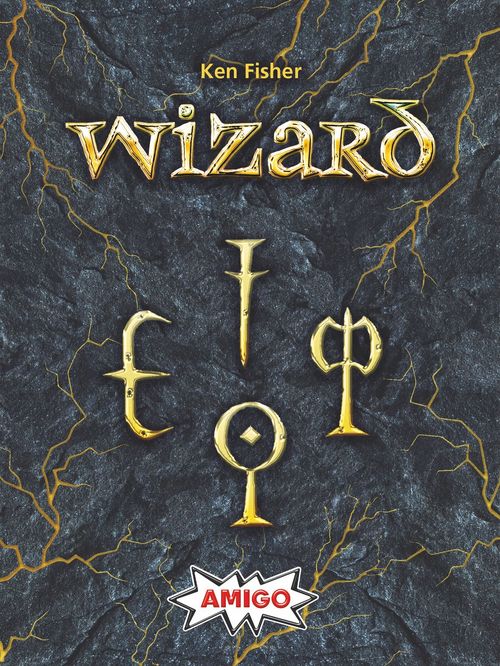
Wizard: Jubiläumsedition
Wizard: Jubiläumsedition Rulebook
Table of Contents
Table of Contents
Basic Rules
The Task
In this magical card game, the apprentice must predict, in every trick round, the exact number of tricks they will win.
"Trick" = Each player plays one card, in turn, into the middle of the table. These cards together are the "trick."
There are experience points for a correct prediction. Whoever has collected the most points by the end of the game wins, and rises one level up the ladder of success toward becoming a wise wizard.
Setup
One player is named the Confidant of the apprentices. The Confidant receives the Scorepad of Truth, writes down the names, and conscientiously records the experience points won by each player during the game as well. The Confidant then shuffles the character cards and deals them out.
The Character Cards
There are four different colors:
- People (blue)
- Elves (green)
- Dwarves (red)
- Giants (yellow)
The strongest card in each color is the "13," the weakest card is the "1." The four Wizard cards are always trump. They rank higher than any "13." The four Jester cards are never trump. They rank lower than any "1."
Dealing the Cards
In Wizard, the apprentices are dealt a different number of cards in every trick round.
- In the first round, only one card is dealt to each player. So in this round only one trick can be won.
- In the second round, two cards are dealt to each player. This round is about two tricks.
- In the third round, three cards are dealt to each player, then four cards, and so on, until in the final round all the cards are in play.
Cards that are not dealt to the players are placed as a face-down stack in the middle of the table.
After every trick round, the responsibility of dealing the character cards passes clockwise to the apprentice on the left.
Trump
After the character cards have been dealt, the top card of the stack is turned over and placed face up on the stack. This card determines the trump color for that trick round.
"Trump" = A trump is a card of the trump color. It beats any card of another color.
If the revealed card is a Jester, there is no trump color this round.
If the revealed card is a Wizard, the apprentice who dealt the cards determines a trump color — but only after looking at their own cards.
In the final trick round there is no trump, because there is no stack left to reveal a card from.
The Prediction
After every apprentice has looked at their cards, they must predict how many tricks they will probably win this round. In turn, the apprentices pass their predictions on to the Confidant. The apprentice to the left of the dealer begins.
The predictions are noted on the Scorepad of Truth. Before the first trick, the Confidant should repeat the predictions once more for everyone. It can sometimes be helpful to lay out the predicted amounts in the form of chips or similar tokens in front of each apprentice. This way, it is visible at all times during the game who still needs how many tricks.
The Battle for the Trick
The apprentice to the left of the dealer plays the first card for the first trick. The other apprentices follow clockwise.
A color that has been led must be followed. If that is not possible, the apprentice may play another color or a trump.
"Follow suit" = The player must play a card of the same color as the first card of the trick.
Note: Wizard and Jester cards may always be played, even if the player could follow suit.
The highest card wins the trick. Wizard cards are always higher than all other cards, even higher than the other trump cards. The winner takes the trick, places the cards face down in front of them, and opens the new trick by playing a card. Exception: in the first trick round, only one trick is played.
The trick is won by:
- the first Wizard card in a trick,
- or the highest card of the trump color,
- or the highest card of the color led first, if neither trump nor a Wizard is in the trick.
Special Rights of Wizards and Jesters
If a trick is opened with a Wizard card, the following apprentices may discard any card they like, including further Wizard and Jester cards. The trick always goes to the first Wizard. Wizard cards are trump, but they do not have to be played to follow suit in the current trump color.
If a trick is opened with a Jester card, any card at all may be played as the second card. Only the second card determines the color that must be followed. Jester cards always lose the trick. With one exception: if only Jesters are played in a trick, the first Jester card wins the trick. This is only possible with three or four players.
Awarding Experience Points
The apprentice who correctly predicted the exact number of tricks they won receives 20 experience points plus 10 points for each trick won.
Whoever guessed wrong loses 10 experience points for each trick they are over or under their prediction.
Example:
1st trick round
Thomas predicted he would not win the trick. He was right and receives 20 points. Ute wanted the trick but did not get it. She loses 10 points. Kevin predicted he would win the trick, was right, and receives 30 points with the trick.
2nd trick round
Thomas predicted he would win both tricks but only got one. Result: since Thomas did not predict correctly, he does not get the bonus of 20 experience points, and additionally loses 10 experience points for each trick he is off. Thomas is off by one trick, so -10 experience points. Ute wanted no tricks and was right. She receives 20 points. Kevin also predicted no tricks for himself, but got one, and therefore loses 10 points. On the pad, the points from the previous round are immediately added or subtracted. Thomas, for example, has 10 points (20 - 10 = 10).
The End
There are 60 character cards in the game. The apprentices keep playing until, in the final trick round, all the cards have been dealt out. With 6 players that is the 10th trick round, with 5 players the 12th trick round, with 4 players the 15th, and with 3 players the 20th trick round. The final trick round is still scored. The apprentice wizard with the most experience points has won.
Variants
Plus/minus One: As before, the predictions are passed openly to the Confidant. However, the total number of tricks wanted by all the apprentices must not match the number of tricks actually available. For example, if a round is about 5 tricks, then the apprentices together must predict either more than 5 tricks or fewer than 5 tricks.
Hidden Tip: All apprentices first secretly write down their predictions on a slip of paper. Once everyone has predicted, the numbers are passed openly to the Confidant. This way, no apprentice is influenced at all by their competitors' predictions.
Secret Prediction: All apprentice wizards secretly write down their predictions on a slip of paper. Only once the trick round is over are the predictions revealed.
Clairvoyance: In the first round, each apprentice holds their card, unseen by themselves, to their forehead, so that all apprentices except themselves can see the card. After all apprentices have seen the other apprentices' cards, they make a prediction. The battle for the trick, the awarding of experience points, and the further rounds proceed according to the normal rules.
Monochrome (for 3 or 4 players): Each apprentice wizard gets all the cards of one color, including the Wizard and the Jester. With three players, one color is sorted out and set aside. There is no trump color in this variant. All apprentice wizards shuffle their own stack of cards, place it face down in front of themselves, and draw four cards into their hand for the first trick round. In every following round, one more card is taken into the hand. Now all apprentice wizards must predict the number of their tricks; whether openly or secretly is decided before the game.
The following applies to the tricks: colors play no role. The apprentice wizard who played the card with the highest value into the trick gets the trick. If two or more cards of equal highest value are in the trick, the one played first of these is the highest. After every trick round, the cards are sorted by color again and returned to the respective apprentice wizard. The apprentice wizards shuffle all their cards before taking the new cards into their hand for the next trick round. Twelve trick rounds are played. After that, the game is over.
You have purchased a quality product. Should you nevertheless have reason for a complaint, please contact us directly. Do you still have questions? We are happy to help: AMIGO Spiel + Freizeit GmbH, Waldstraße 23-D5, D-63128 Dietzenbach, www.amigo-spiele.de, E-Mail: [email protected]
© AMIGO Spiel + Freizeit GmbH, D-63128 Dietzenbach, MCMXCVIII, MMXI, MMXIV, MMXVI. Version 2.0
The Wizard Anniversary Variant with New Special Cards
The six special cards and the 60 character cards are shuffled together. The anniversary variant is played with 66 cards. Because of this, cards remain even in the final trick round to determine a trump color. Otherwise, the familiar Wizard rules apply.
The special cards are played from the hand like any other card and then have the following effects:
Dragon
The Dragon can always be played, even if the apprentice could follow suit. The Dragon is the highest card in the game. It is higher than a Wizard and wins every trick it is in — with one exception (see Fairy)!
If the Dragon is revealed when determining a trump color, the apprentice who dealt the cards may determine a trump color.
Fairy
The Fairy can always be played, even if the player could follow suit. The Fairy is the lowest card in the game. It is lower than a Jester and loses every trick it is in — unless the Fairy and the Dragon are both in the same trick, in which case the Fairy wins the trick!
If the Fairy is revealed when determining a trump color, there is no trump color this round.
Bomb
The Bomb can always be played, even if the apprentice could follow suit. It causes a trick containing the Bomb to be won by no apprentice, and therefore it does not count toward anyone's trick prediction. The apprentice who played the highest card into a trick with the Bomb opens the next trick.
If the Bomb is revealed when determining a trump color, there is no trump color this round.
Werewolf
After a card (whichever it may be) has been revealed at the start of a trick round to determine a trump color, the player holding the Werewolf in hand must exchange the revealed card for the Werewolf and take the revealed card into their hand. This player determines a trump color for this trick round, or says "no trump." Only after that does the first player make their trick prediction.
If the Werewolf is revealed when determining a trump color, the apprentice who dealt the cards may determine a trump color.
Juggler
The Juggler has the value "7½" — that is, higher than a "7" and lower than an "8." When the Juggler is played into a trick, the apprentice must clearly state which color (including trump color) the card should take on. Once a trick with the Juggler has ended, every apprentice simultaneously passes one of their hand cards face down to the apprentice on their left. Then everyone takes their new card into their hand. The apprentice who played the highest card into a trick with the Juggler opens the next trick. The passing of cards is skipped if the trick with the Juggler was the last trick of a trick round.
If the Juggler is revealed when determining a trump color, the apprentice who dealt the cards may determine a trump color.
Cloud
The Cloud has the value "9¾" — that is, higher than a "9" and lower than a "10." When the Cloud is played into a trick, the apprentice must clearly state which color (including trump color) the card should take on. If the Cloud is among an apprentice's tricks at the end of a trick round, that apprentice must increase their trick prediction by +1 or decrease it by -1.
If the Cloud is revealed when determining a trump color, the apprentice who dealt the cards may determine a trump color.
Tip for Tacticians
Since the new special cards give a player more options, but also increase the annoyance factor, a playing group that prefers a more tactical game can bring fewer special cards into play. In that case, the Dragon and the Fairy should come into play together, or neither of them at all.
The publisher thanks Benjamin Brand, Jörg von Rüden, and Ken Fisher for the ideas for the special cards.
Wizard Around the World
The publisher AMIGO Spiel + Freizeit has sold more than 1,700,000 copies of Wizard worldwide from 1996 through the end of 2015. Wizard has been translated into 12 languages and is played on tables in more than 15 countries.
How Ken Fisher Became a Wizard
Ken Fisher from Toronto, Canada, first had the idea for the card game Wizard in his house on the shore of Lake Ontario, in the small town of Haliburton. He envisioned a card game he could play with his wife and his then still young son during quiet evenings.
But when friends of the family also took a liking to the game, he came to the decision to develop the game further so that more than three players could play at the same time. He looked for similar classic game principles and came across the game "Oh Hell," which is suitable for 3–6 players. Ken then modified some of the rules and added eight additional cards with special action possibilities.
The idea of calling the new cards Jesters and Wizards came at the time from Ken's son, Scott. He felt that the new characters fit well with those of a medieval court: knight, queen, and king.
Ken Fisher was no newcomer to the games industry. He had previously created the game "Superquiz." Over the years, the basic game version gave rise to six popular "Superquiz" books and three successful "Superquiz" board games. In addition, there was a version of this game that appeared regularly on puzzle pages in more than 50 different North American newspapers.
Although Ken Fisher was undeniably very successful in the games industry, for a long time he was unable to interest an established game publisher in his "Wizards" and get the game included in its lineup: card games were simply too difficult to establish on the market at the time.
Nevertheless, the enthusiasm he encountered wherever he played the game with friends or even with strangers encouraged him to publish it himself. The first 10,000 copies of Wizard were produced in June 1986. The response among players was so great that the game regularly went into new printings.
In 1991, the fronts of the cards received a new graphic design, which is still produced in the USA today, barely changed. It was not until 1994 that Ken Fisher found a professional producer at the New York Toy Fair, in the publisher "US Games" of Stamford, Connecticut, and its owner Stuart Kaplan. The quality of the cards was greatly improved, and the current card back was redesigned along with other small but important modifications.
Stuart Kaplan enthusiastically supported the sale of the game both domestically and abroad. In 1996, he also managed to find a partner in the German publisher AMIGO Spiel + Freizeit GmbH, which has since successfully marketed the "magical" game not only in Germany but worldwide.
In early 2003, the Wizard card game also conquered the internet with an informative website, which also offers an online game of "the wizard." This website then also became a catalyst for many Wizard tournaments and national championships, which since 2008 have led into a regular, annually held Wizard World Championship.
Ken Fisher on the New Special Cards
Every game must also have standard rules, so that a game can be played the same way everywhere and can therefore be compared. The official rules for Wizard were created and formulated after many tests, so that as many people as possible can have fun with the game. Even so, these rules are also "not set in stone."
The Wizard rules, too, "were made to be broken." There are many variants of the Wizard rules that have arisen through different playing groups. Some have by now also become part of the "normal" rules (to be found on pages 10 to 12).
The special cards in this anniversary edition, too, arose through players and are variants of the standard rules. There are certainly many more possibilities for inventing special cards. But Ken asks all friends of the Wizard game not to go so far as to completely redesign the basic game. That is why the special cards in this anniversary edition were included with the intention of maintaining the integrity of the game, while adding new challenges and a new feel to the game. A player's options are meant to be expanded by the new special cards. The more options a player has, the more strategic considerations they can make, and consequently the more the luck factor can be reduced — a factor that is already present in sufficient measure through the random shuffling of the cards and their distribution to the players.
Toronto (Canada), December 31, 2015 Ken Fisher, translated by Uwe Mölter
Greeting from Illustrator Franz Vohwinkel
The idea of turning a "small" game like Wizard into a game with a fantasy theme was, in 1996, still a groundbreaking new idea. Apart from the collectible card game "Magic: The Gathering," games in this category simply were not produced with such elaborate designs. The original version of the game consisted of a traditional Skat deck with the additional special cards Wizard and Jester. AMIGO showed a good deal of foresight and willingness to take risks at the time, taking the gamble of equipping Wizard with an expensive, illustrative design.
For me, that meant a chance to indulge my fondness for fantastical themes, and at the same time a tremendous challenge. AMIGO gave me largely free rein in realizing the artwork, and so many new ideas could be realized in the design of Wizard.
Dressing the four colors thematically as different peoples was the most obvious concept. Designing the cards as a continuous panoramic illustration, the various characters on the cards, assigning the characters' "professions" in ascending order to the card values while alternating between male and female characters, and deriving the symbols from the preferred weapons of each people — all of that was new and exciting for me.
I am very pleased that the publisher's courage back then has been rewarded with the extraordinary success of Wizard and its offshoots Wizard Extreme, Wizard Junior, and Witches. I am still proud today of my contribution to this extraordinary game and to the creation of the world of the wizards.
May the wizards be with you!
Seattle (USA), December 31, 2015 Franz Vohwinkel