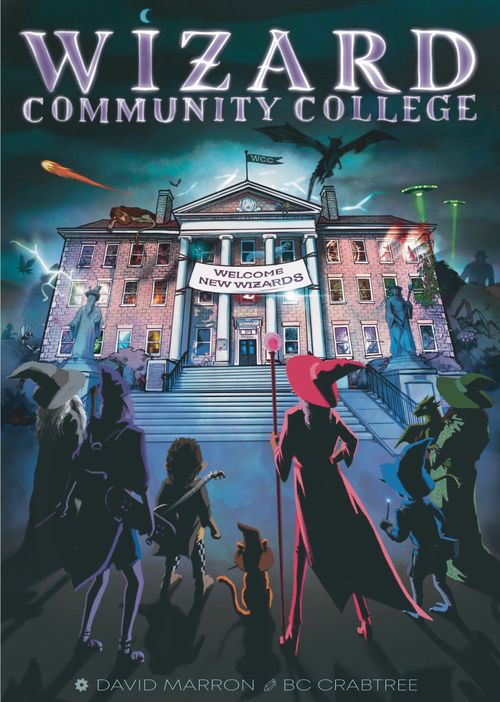
Wizard Community College
Wizard Community College Rulebook
Table of Contents
Table of Contents
School Rules (Standard Game)
3-8 players, 20 minutes
Overview
Wizard Community College is a roleplaying card game where you take on the identity of wizards going to college to try to learn (and hopefully master!) the art of magic. You will work together to cast spells and solve various problems. However, you have very little control over your magic, so the spells you cast will go terribly wrong most of the time. The objective of the game is to tell a fun story together, as well as to complete the objectives on the Event cards.
Setup
- Put all of the discs into the drawstring bag.
- Shuffle each of the Major Events, Spells, and Items decks. Return the Minor Events deck to the box.
- Each player chooses 1 of the 8 Character cards and chooses which side to put face up in front of them. (In a 3-4 player game, take another Character card so you have 2 in front of you.)
- Each player takes a Player Aid card and puts the "Player Aids 101" side face up in front of them.
- Each player chooses spells as follows: Draw 5 Spell cards. Choose the 3 Spell cards that look the most fun and place them face up in front of you. Discard the remaining 2 cards face up into a common discard pile.
- The player who last read rules out loud becomes the Reader and takes the Round 1 card. They randomly draw a card from the Major Event deck that says Term 1 on the back and read it aloud. Then starting with the player to their left and proceeding clockwise, each player may add a one sentence detail about the event, or say "pass" to skip adding a detail. (The detail can be anything, such as a description of an enemy, additional objects, or characters at the scene.)
Gameplay
After the last detail is added, players will take turns in clockwise order casting spells to try to complete the objectives that are on the Major Event card.
On a player's turn, they will become the Caster and attempt to cast a spell by performing the following steps:
-
Describe the spell you hope to cast based on the Spell cards in front of you. You can cast anything you can imagine based on the name and/or description of your cards. You may combine multiple Spell cards into a single elaborate spell. Keep any spell cards you cast in front of you. You may use those spells again in future turns. (You may also say a random incantation and draw the top card of the spell deck, but you must include that card in your spell and discard it afterwards).
-
Pull a disc randomly from the bag and put it in front of the player whose Character card matches its color. If you pull a disc of your own color or one that does not match any player's color, give it to a player of your choice who has the fewest discs already in front of them. The player who received the disc is the Resolver and will describe what actually happened when the spell was cast. (Do not return the disc to the bag.)
Disc Types
The symbol on the disc provides guidelines for what the Resolver should say.
- Miscast: Describe what happens when the spell fails in some way or something goes wrong. Examples: The spell only partly works, the spell has the opposite effect, the spell mostly works but something terrible happens.
- Wrong target: Describe what happens when the spell hits or affects the wrong thing. Examples: The spell hits someone/something unintended, the spell conjures the wrong thing, the spell summons something into the wrong place.
- Cast: Describe what happens when the spell generally works as intended and also add something new to the story. Examples: Add an unexpected consequence from the spell working, have an enemy do something.
- Overcast: Describe what happens when a more extreme result than originally intended occurs. Examples: The spell works too well, the spell is much bigger than intended, the spell hits more targets than intended.
When resolving a spell, try to not completely finish all aspects of the event during the first round. (Also try to not incapacitate or kill another player during the first round).
After spell resolution, the player to the left of the Caster takes the next turn.
End of the Round: When everyone has taken 1 turn, Round 1 is over and the Reader flips the Round card to the Round 2 side.
End of the Event: The event ends either when everyone agrees that the objectives have been completed or after 2 full Rounds (3 Rounds for 3-4 players). Then proceed to the Aftermath (whether the objectives were completed or not!)
Aftermath
After 2-3 rounds players will jointly describe the Aftermath of the event. Starting with the player to the left of whoever resolved the final spell, each player may add a sentence or two about the resolution of the event. (During the Aftermath, you may wrap up your story by saying what happens to your character, the group, or the college, and describe the consequences of any ongoing spells or failed objectives.) Then the Term ends and so does the game!
Want to keep playing with the same characters?
Play another Term by returning discs to the bag, giving each player an additional spell card, and then drawing a "Term 2" Major Event card and reading it.
College Career (Epic Game)
3-8 players, 90-120 minutes
Read the rules for the Standard Game on the reverse side first!
Overview
The Epic Game of Wizard Community College is for players who want a complete college experience where you play over 3 Terms in an epic 90 to 120 minute roleplaying game. It is necessary to read the Standard Rules first to learn how to play. All the rules of the Standard Game apply to the Epic game, though the Setup will be different and there will be additional content (i.e. Minor Events and Items).
Setup
- Put all discs in the bag and shuffle each of the Minor Event, Major Event, Spells, and Items decks.
- Randomly select 3 Major Event cards that have Term 1, Term 2, and Term 3 on the back. Choose cards with different center pictures on the back. Set those 3 cards face down in the middle of the table. Return the remaining Major Event Cards to the box.
- Each player takes a Player Aid card and puts the "Player Aids 101" side face up in front of them.
- Each player will create a character. To do this, choose a Character card and draw 3 Spell cards. Choose 1 of the Spell cards to put in front of you and discard the other 2. (In a 3-4 player game, take an additional Character card and slide it under your first card so that you can still see the colored border. You will become the Resolver when either of these two colored discs are drawn from the bag.)
- Starting with the player who thinks of something first and proceeding clockwise, each player will introduce their character. They may tell a brief backstory about how their character learned their first spell or first found out that they knew magic based on the spell card in front of them.
- The player who last read rules out loud becomes the Reader and takes the Round 1 card.
Gameplay
The Epic Game of Wizard Community College takes place over 3 Terms. During each Term, players will Attend Class, play a Minor Event, and then play a Major Event. After the 3 Terms are complete, the game is over and players will proceed to Graduation and the Epilogue.
Attend Class
Each player draws 3 Spell cards and chooses 1 to put face up in front of their character to represent the spell that they are learning in class this Term (discard the other 2). This means that at the start of the game, characters will have 2 Spell cards in front of them, their starting spell and the second spell they learned in class during Term 1. (If the Spell deck (or any deck) ever runs out of cards, shuffle the common discard pile to make a new deck.)
Minor Event
After each character has attended class and received an additional spell, the Reader will take the top card of the Minor Event deck that has the correct Term number on the back (when starting the game, the card must say Term 1-2 on the back because it is currently Term 1) and read it to the group. Minor Events are similar to Major Events in that the group of players are taking turns and casting spells together, but they are designed to be short and will always include exactly 1 Round of spellcasting. Taking a turn in a Minor Event works the same way as during a Major Event in the standard game: each player will say what spell they hope to cast, draw a disc from the bag, and then another player will resolve the spell.
Many Minor Events will award Item cards to players. If a player is awarded an Item, they generally draw 3 Item cards and choose 1 to put faceup in front of them (discarding the rest into a common item discard pile).
- If a card says to "vote" for a player, then, after everyone has taken a turn, the Reader will count to 3 and players will simultaneously point at someone else to vote for.
- If a card says that a player gets an item if they do something, the Resolver says whether that player gets the item.
- Item cards may be used along with or instead of casting a spell on a player's turn.
Major Event
After the Minor Event is completed, proceed to the Major Event for that Term. Do not return discs to the bag between the Minor and Major Event. The Reader passes to the player to the left, who takes the appropriate Major Event card and reads it aloud. At the start of the game, the Term 1 Major Event that is facedown in the middle of the table will be used. Play through the Major Event as you would in the Standard Game (adding a one sentence detail, playing 2-3 rounds of spells, and then describing the Aftermath).
End of Term
After the Aftermath of the Major Event is complete, the Term ends and players proceed to the next Term. After the first Major Event of the game, the current Term will move from Term 1 to Term 2. Pass the Reader to the player on the left and return all discs to the bag. Players will start the next Term by Attending Class to learn a new spell, then proceed to play through another Minor and Major event. Players will grow in power as they learn more spells over several Terms, but the events will also become more challenging. At the end of Term 3, the players will graduate from Wizard Community College and proceed to Graduation and Epilogue.
Graduation & Epilogue
After the Aftermath of Term 3, your characters graduate and receive degrees (assuming they are alive and still enrolled in the school)! Starting with the player who thinks of something first and proceeding clockwise, each player may give a brief epilogue describing what their character does after the events of Wizard Community College. After the Epilogue, the game ends!
Variants
Standard Game+
You can play the Standard Game with Minor Events and Items! (Game length: 30 mins) Simply follow the setup for a standard game, but do a Term 1-2 Minor Event before starting the Major Event!
Two Player Variant
To play with 2 players, you can play as normal with the following changes:
- Play up to 4 rounds
- The other player will always resolve your spell
- Each player may add up to two details, one at a time, during the Details Phase and Aftermath
- If a card says to vote, you may vote for yourself
Campaign Mode Rules
3-8 players, 12 total games, 120 mins per game
The Campaign Mode for Wizard Community College is 12 sessions of the Epic Game of Wizard Community College. The goal of the campaign is to tell a 12 year history of the college with each game representing a year in that history. This means that players will likely create many different characters over the course of the campaign, and each one will leave a mark on the school's legacy.
Components Needed
- A copy of Wizard Community College
- A writing implement such as a pen, pencil, or quill
- Paper, parchment, or scroll
Setup
To set up the first game, start drawing a campus map by taking a sheet of paper and drawing a small picture of the main building in the center of it (this represents the building on the box cover). You will be updating this map over the course of the campaign. Also set aside another sheet of paper to take notes on. The rest of the setup as well as the setup for all future games is identical to the setup for the Epic Game of Wizard Community College.
Gameplay
The Campaign Mode is played over 12 sessions. Each session, play the Epic Game of Wizard Community College following the normal rules (creating new characters, then playing through three Terms of Minor and Major Events). However, after the Aftermath of the Major Event of each Term you will write some notes about what happened during that term as well as update the map.
Writing Notes
Write the Year (Game number from 1-12) and Term number on a sheet of paper, and add some short notes about what happened, particularly focusing on anything that will permanently affect the campus for future years. Also note down any characters that were introduced and any disasters that weren't solved. The collection of these notes over 12 games will form the chronicle of the college. At the end of the first game, you should have notes for Year 1, Term 1 as well as Year 1, Term 2 and Year 1, Term 3 on the same sheet of paper.
Updating the Map
If your group has visited or interacted with a new location on campus, draw that location on the map and label it. You can draw it where you choose relative to the other buildings. You are also encouraged to note on the map any damage, destruction, or changes to any buildings or parts of campus that happen as a result of your actions.
Graduating Characters
At the end of Term 3, each player can choose whether to keep their character or to make a new character for the next session. If you choose to keep your character, during the Epilogue you should say what happens to them over vacation before the next year rather than what happens after they graduate or meet some other fate. If you choose to make a new character next session, describe your character's fate in the Epilogue as usual.
If you decide to keep your character, there are a few rules changes for a returning character:
- Skip the character creation step
- If your character has 5 spells and would ever learn a new spell, they must forget (and discard) one of their existing spells. These students can only carry so many spells in their head at a time!
End of the Session
At the end of each session, separate out the Minor and Major Events that you played through. In a 12 game campaign, you will play through all 36 Major Events once and each Minor Event twice. After 6 games, the Minor Events deck will run out and you will bring them all back into the game one more time.
Campaign Tips
- Make a lot of new characters. Not only is it really fun to play games with a fresh character and set of spells, characters who graduate or otherwise leave the college can come back as non-player characters in future games. That said, if you really want to play the same character every time who never graduates from community college for 12 years, you are welcome to do that!
- Reference previous games in the details phase. It is really fun to have characters and consequences from previous games show up in your current game, and the details phase at the start of a Major Event is a great time to mention those. If you end up making favorite recurring non-player characters, it is fun to bring them in for several events.
- Prioritize having fun over these rules. If there's something fun that your group wants to do, don't let these rules stop you from doing so!