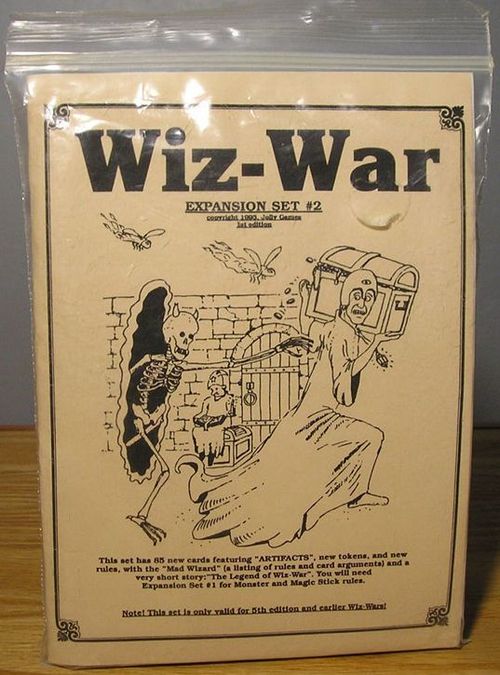
Wiz-War: Expansion Set #2
Wiz-War: Expansion Set #2 Rulebook
Table of Contents
Table of Contents
Artifacts
This is the new addition to Wiz-War. Artifacts are physical objects which, if left uncontrolled, would completely destroy the balance of the game. Fortunately, these are objects of such great power that they do not "like" to be owned by any one person for very long. In fact, if you want to steal an ARTIFACT from another player, all you need to do is walk into the same space that player occupies and say "I'm taking your ARTIFACT", or whatever you wish to say to get your point across. THIS IS NOT AN ATTACK. You can only take one per turn. That player, of course, could come back the following turn and take the ARTIFACT back if he is in a position to do so.
Alternatively, if a player seems too powerful with an ARTIFACT, and you cannot get close to him, you may WISH it out of existence. This is not a card. You may do it anytime. However, it requires a bit of a sacrifice. You lose 4 life-points (not Counteractible) and you must discard all your cards, except for cursed cards which say that they cannot be discarded. A small price to pay to keep those other Wizards from winning the game.
Monsters cannot carry any ARTIFACTS. Only Wizards can use them.
Other Stuff
Your turn continues even after taking an ARTIFACT from another player, but picking one up off the floor ends your turn.
Being INVISIBLE, under SHRINK, in a DUST CLOUD, MIST-BODIED, etc., has no effect on another player's ability to steal an ARTIFACT from you. There is no way to obscure the fact that you have an ARTIFACT for the taking.
You can only take 1 ARTIFACT away from one player per turn.
Shrinking the Deck
In creating this Expansion Set, we were given a tough choice; which spells should we dump to make room for more NUMBER cards? After a bit of reasoning, we decided not to shrink the set at all. Instead of the 70 spells we expected to provide in this set, you will find 88 spells. This creates a problem; not enough NUMBER cards in the deck.
Fortunately, there is a very easy solution. Remove 50 random spell cards from the deck, leaving all the PICK LOCK cards and NUMBER cards, then shuffle them. This reduces the total number of cards available and increases the possibility of getting a PICK LOCK or a NUMBER card. This should not interfere with the game since you rarely get through the whole deck in Wiz-War.
Transformations
In this set it is possible for you to change yourself into a Ghost, Vampire, or Werewolf, if you get the card for it. These DO NOT qualify you as a MONSTER! You are still a player. Various MONSTER control spells have no effect on you.
More on Monsters
In the basic Wiz-War set, MONSTERS didn't exist, so when attacks were described on the cards, they referred to Players or Wizards, not MONSTERS. Regardless, if a card says something like "Does damage to another player equal to NUMBER card played", you can take that to include MONSTERS. MONSTERS also take damage from stuff scattered about in the corridors just as players do, and can certainly be attacked by other MONSTERS.
To tighten up the definition of a MONSTER, these are creations that do damage to other players. The SLIME, the ANIMATE OBJECT, DECOY, and the BUCK are not considered to be monsters. ALTER EGO, SHADOW, FAMILIAR, and KILLER OOZE, by this definition, are MONSTERS.
For the few instances where MONSTERS can carry items, they can't use those items at all (unless the card specifically says otherwise).
Magic Sticks, Stones, and Artifacts
Magic sticks can be used once per turn, as the Expansion #1 rules say. Magic Stones can be used as many times as you want in a turn. ARTIFACTS can be used as many times as you like unless they are attacks, in which case you may only use them once per turn.
Last Minute Spell Corrections
DOUBLE BARREL should say "half-strength attacks", not "half strength spells", meaning that it works for physical attacks, too. FORCE OF THE JET-EYE is useable once per turn. EYE OF CLAREMONT is an attack. CREATE PIT (expansion #1) needs to be changed to say that you cannot create objects in it, but a FILL SQUARE WITH STONE will cancel it, with any objects within the PIT appearing on the floor above where the PIT used to be. For optional changes to PERMAWARP and BUDDY, see the Mad Wizard section.
Team Play Option
(thanks to Jeff Ingalis)
If you have 4 or 6 players, it may be fun to try team play. For 4 players, the 1st and 3rd are one team, the 2nd and 4th the other. For 6 players, use 3 teams of 2. In this version winning is determined by either killing off the other players, or by getting 3 of the opponents' treasures on either of your team's home bases in any combination. The rule about not attacking yourself now also applies to your teammate (unless the teammate is under someone else's control). Discussion of strategy is allowed, but you may not reveal or trade cards with your teammate unless in L.O.S.
Two Player Variant
For better board access for two players, cross the B and C exits on the 2 boards (see the diagram in the basic set). Thus, each player has a B exit and a C exit in his sector. It's a lot more fun this way. A lot of people have also suggested throwing out the BUDDY spell for the two-player game. That's your choice!
Doors Variant
You can, if you like, play with the optional rule that within each sector a Wizard can open his doors without a key. This evidently works very well. Suggestion by Tracy Johnston.
Pac-Wiz Variant
If you're REALLY bored, try this; put a penny on each space on the playing board, then race to see who can collect the most, using spells in the standard fashion as you go. In this version, you don't end your turn when you pick up a penny. There are no "treasures".
Extra Counters
There are many instances in Wiz-War where you need counters that you don't have because you used a spell like REUSE SPELL. If this is the case, use one of the blank tokens in the set as that counter. You might want to save the cardboard from this set and cut it into token-size pieces for later use.
Trap Cards
This edition has a few more TRAP type cards, and like the first set, if you get one on the initial deal, discard it and redraw.
General Notes
The exclusive use of "HE" in these rules and on the cards is not supposed to be a slight to female players, it's just more convenient than the various he/she/person variants that exist, and usually takes up less space.
The Mad Wizard
This is a not-exactly comprehensive collection of questions that have been asked about Wiz-War over the years, which we answer here to help clarify interactions between the cards and nuances of the rules. Most of these explanations will seem self-evident to any of you, but at some time, someone asked. They are here for reference only if you need them. They are not thoroughly cross-referenced... we would suggest that if an argument involves 2 cards, look up both cards because the answer could be listed under either one. If a card isn't listed, that's because no one ever had a question about it! If you have more questions, be sure to write us. We'll answer them and add them to this list next edition, or make rules or card changes to clarify the issue.
Rules Arguments Stuff
Spell Priority: There is some question as to whether Counteractions or Attacks work first, especially in a case like SHIELDSTONE vs. FIREBALL. Counteractions always work first. Thus, if someone was hit with a FIREBALL while they were carrying a BLOODSTONE, the BLOODSTONE would reduce the damage done by a point before it was destroyed. If you have 2 Counter-actions you want to use, you decide for yourself which one activates first.
Dumping Cards and Physical Objects: This is explained pretty well in the basic rules, but everybody seems to forget you can do it. If you want to discard a physical object, it is NOT necessary to dump it on the board, you can just discard it to the discard pile. The board would get very crowded otherwise. This includes ARTIFACTS, if you think someone is about to take one from you and there's nothing you can do about it.
Picking Up Objects: No, you can't pick up 2 objects at the same time, even if they're in the same space.
Throwing Objects: The basic rules imply, without explicitly stating, that you can throw objects, but not treasures. That's true! You could take a Magic Stone and throw it into a pit, 3 spaces away, if you wanted. Throwing objects at other players does not do any damage unless a card, such as HEAVE-HO, says so.
Death: The second-hand killing of a Wizard, say by falling walls or controlled MONSTERS, does not get you his cards, nor does a MONSTER get cards by killing a player!
Magic Stick: These don't have to be displayed. When you first charge it with a NUMBER card, the NUMBER card gets discarded, so it no longer counts as part of your hand.
Treasure: If a player is eliminated, any treasure on his home base does NOT count toward eliminating the player to whom that treasure belongs.
Line-Of-Sight: If you "barely nick a corner" of a wall, this is still NOT line-of-sight. A VISIONSTONE could see through the corner, but if you "nicked two corners", the VISIONSTONE would not work.
Lost Turns: These will accumulate if you get hit by a "lost turns" spell while under the effect of another "lost turns" spell. Also, if you lose a turn while under a duration spell, this still uses up a turn of the duration spell.
Players As Objects: There is some confusion in the rules which will probably not be resolved until next edition as to whether players and MONSTERS can be treated as objects or not, for purposes of spells such as DRAG and a few others. Unfortunately, this is not well defined anywhere. The basic rules state that players ARE also objects, but there are some places where this is clearly not reasonable, like TELEPORT OBJECT and ANIMATE OBJECT, though these explicitly say that players and MONSTERS are not included. Use common sense and house rules. You will rarely run into this as a problem, but you could. Obviously, if a card says a MONSTER can carry objects, it is NOT referring to other players!
Mixed Mode Cards: Some cards have multiple spell designations in the upper left corner (ATTACK, NEUTRAL and COUNTERACTION) with some combination of spell types shown. Generally speaking, if you cast a spell on someone when that someone doesn't want you to, it's an ATTACK. If you cast the same spell on yourself, it's a COUNTERACTION or NEUTRAL. Since the rules stipulate that you can cast a COUNTERACTION out of turn or during your normal turn, the COUNTERACTION/NEUTRAL is redundant (and eliminated on later editions). Some spells, such as SHRINK and INVISIBLE are listed as NEUTRAL, but become ATTACKS when you cast them on other players. If you wish to use the text literally on the cards, then this is not a problem, as the cards state that you cast them on yourself, but unfortunately we made a rule in the first expansion that said you can cast such spells on opponents also. The cards that say "SELF" instead of "LOS" can be interpreted the same way. All the cards with "SELF" marked on them have been changed to "LOS" in later editions, primarily because you are obviously in LOS with yourself, and the card specifies that you cast the spell on yourself.
Completely Ridiculous: If a Wizard has 8 stones, and you cast STONE DEAD with a 6, ADD, 5, AMPLIFY, AMPLIFY, REUSE SPELL, AMPLIFY again, then he takes 704 points of damage (-1 for BLOODSTONE, of course). Amusingly, this would not kill him because he also would possess SOULSTONE. Thanks to Mark Spangler, with the addition of a couple of new stones in this set, this could be worse!
Some of the Spells and Associated Arguments
ABSORB: This is only for one attack, it does not work against 3 points of damage from multiple attacks in one turn.
ABSORB SPELL: This does not work on Magic Sticks or Magic Stones, or Artifacts. When played versus a REUSE SPELL, ABSORB SPELL takes priority, since it makes no sense doing it the other way! Also ABSORB SPELL defeats a CARD ERASURE, as Counteractions take effect before Attacks. ABSORB SPELL has no effect on objects or the spells they produce, such as Magic Sticks, Magic Stones, and Artifacts. ABSORB SPELL will not work against ANTI-ANTI, since ANTI-ANTI is not used against the player, but rather his spell.
ADRENALINE: This lets you attack 2 times in a turn, it doesn't let you use objects twice in a turn when the particular object says that it can be used once a turn.
AMBER PENDANT: Yes, the token says "AMBER AMULET". You obviously cannot put an object (like a Magic Stick) in the AMBER PENDANT. It has to be a spell. A "neutral duration spell" certainly does not include things like CREATE WALL, or INTERRUPT, but would include SHRINK and INVISIBLE.
AMPLIFY: With SLOW DEATH, it causes 2 pts. per turn damage. If AMPLIFY is used with SHIELDSTONE, SHADOWSTONE, WIZARDBLADE, or other permanent objects, note that it only affects that object for one use of the object, not permanently. AMPLIFY can be used with a 1 point spell (one without a NUMBER card) to make it worth 2 points. AMPLIFY does not affect NUMBER cards going into POWER BATTERY, it only affects the power as you use it to cast spells.
ANTI-ANTI: Will work against SHIELDSTONE, but not SOULSTONE.
BIG MAN: Can be punched from an adjacent square, or attacked by MONSTERS from an adjacent square. If he steps over something, like a PIT or KILLER OOZE, it uses 2 movement points.
BLINK: See TELEPORT or TELEPORT SPELLS.
BLIND: Even if you're BLIND, you can still move your MONSTERS okay, since they aren't LOS controls, anyway. Also non-LOS spells are not affected by your being blind. If you try to cast a spell on someone, if it goes the right direction, then it hits him. If you cast a spell that was supposed to go three spaces away, and you accidentally point it at the wall next to you instead, since the spell can't go the intended distance, it dissipates. If you are trying to attack one player while you are BLIND and the spell ends up going toward another player, it misses him.
BOOK OF SPELLS: This cannot hold items and objects. Just spells and NUMBER cards. Discard them if you draw objects, redrawing to fill to 5 cards. These may be used in any combination you like with the cards in your hand. REFLECTED spells will blast you, not the book.
BRAINSTONE: This has a loophole. If you drop it and pick it up, you get two new cards, then get to draw 2 more at the end of your turn.
BUCK: Can be attacked by a MONSTER in an adjacent square, or punched by a Wizard in an adjacent square.
BUDDY: Some people think this should be an ATTACK. If you want to play it that way, fine. Some people also think it should be burned. Some people play it as a duration card, so you could make it a house rule to be one. Most people hate it.
CLAW OF MARS: This does not allow you to use objects more than once per turn if the object says it can be used only once per turn. It will, however, let you punch someone three times, or use 3 different attacks.
CREATE BIG BLACK BAT: It can carry, but not use objects, not even passive objects like AMBER PENDANT with a Counteraction. Obviously a BAT with a BRAINSTONE can't draw cards.
CREATE FAMILIAR: It can carry a spell, not an object.
CREATE PIT: Yes, you can drop objects in here, even while you are jumping over the PIT. No, contrary to what the card says, you can't create objects in or on a PIT, which eliminates all those bizarre questions about creating SOLID STONE over a PIT and having it fall down, or making a WALL sideways over a PIT, and such. TINY SWAP can't be used to do this either, as this would qualify as creating an object in a space where an object already is, which is against the basic rules. FILL SQUARE WITH STONE cancels a PIT, and any objects inside the PIT at the time appear at the top, on the floor, so nothing gets "squashed". It takes a whole turn to climb out of, as well as into, a PIT, and your movement would end adjacent to the PIT. You could still add NUMBER cards to your movement in such a case, though. Boy, has this card caused a lot of headaches. You can jump diagonally across a PIT if it's at an intersection, but it still takes 2 movement points to get across. A player outside and adjacent to the PIT has LOS into the PIT, but a player in the PIT has no LOS outside of the PIT (except in the very rare instance where someone jumps or flies over and he uses an INTERRUPT to cast an attack... you get the idea). If a PUSH OBJECT is used to shove a treasure in on someone in a PIT, they take 2 points damage just as normal from a PUSHED OBJECT.
DESTROY WALL: Works just fine on door-sections, too.
DISEASE: The instructions on this one are confusing even to me. The sentence that says "Disease is short-lived, you must infect a player every turn for it to do any damage" can easily be misinterpreted. If you walk into a space with another player while the spell is active, they take damage. They do not "catch the disease", thus the disease is short-lived. If you want the player to take more damage from disease, you enter his square again on a following turn (or remain in the same square if he does not move).
DOOR-TO-DOOR: The range of area-of-effect spells such as FEAR counts up to where one side of the door is, then finishes counting at the other end of the warp.
DOUBLE BARREL: Should say "half-strength attacks", not "half strength spells", thus a physical attack would work also.
DRAG: This will work on Players and MONSTERS just fine. It will also work with AROUND THE CORNER.
DUST CLOUD: This will work on players or monsters. If someone tries to physically attack someone else in a DUST CLOUD, they must roll the die to see if they hit (a 1 in 4 chance). Since DUST CLOUD blocks L.O.S., an L.O.S. spell cannot be cast upon a player in DUST CLOUD, or by a player who is in a DUST CLOUD to a place outside of the DUST CLOUD. Spells cast upon oneself still work fine, though, and no roll is required.
EMPATHY: If used as a Counteraction, the duration of the spell starts when cast and ends at the beginning of one of the turns of the player that attacked you. If used against CHAOS, it is quite ineffective, since it does what CHAOS does anyway.
EXPLODING ENERGY: This only affects NUMBER cards carried by the wizard, not items he carries, such as POWER BATTERY or RING OF POWER.
EXTEND: Does not work on already-active spells.
FEAR: If a player plays GO AWAY on someone where that person would have to move into FEAR's radius, treat it as though the player ran into a dead end. FEAR wins. Since FEAR is cast on yourSELF, it is not Counteractible. FEAR even scares your own MONSTERS off. FEAR also takes priority over someone who is UGLY. The 3 spaces away is measured as a wizard walks (if he could walk through walls), not diagonally.
FILL SQUARE WITH SLIME: Sure, you can leave items in Slime, but you can't teleport someone there or create something else inside. This is per the rule that you can't create an object where there is already an object. HANDFUL OF TACKS would work just fine in SLIME, as it isn't a spell. Only water will damage the SLIME, so other attacks are useless. Spells stuck in SLIME only go off once, not many times. SLIME is a big cube filling the corridor, and offers no LOS, nor can it be flown over.
FIRE IMP: Will attack MONSTERS as well as players. If put in line of sight with a KILLER OOZE, it will shoot it every turn until 5 points have accumulated on it and killed it.
FORCE OF THE JET-EYE: To be used only once per turn.
GIFT FROM BELOW: Sure, you can use Counteractions on this. Even Reflections will work, although no one will take any damage.
HANDFUL OF TACKS: These work just fine on MONSTERS, too, as do other hazards.
HEAVE-HO: In the very rare occurrence of a passage-loop, where HEAVE-HO would travel forever, we've limited it to a maximum of 10 spaces. AROUND THE CORNER has no effect on HEAVE-HO, as it is cast on yourself, not the treasure. HEAVE-HO does 3 points of damage, which are counted as spaces as the wizard walks.
HOWLING VACUUM: This has no effect on a PERMAWARP if the other end of the warp is in another sector. If it is in the same sector, passage through the warp can, if possible, be counted as the shortest path possible to the wizard casting the spell. An opponent will be pulled through a WALL OF FIRE, if that is the shortest route, or a DUST CLOUD, or a WALL OF FOG, etc.
HYPNOSIS: Yes, this means you don't have to draw cards for your opponent at the end of his turn. If REFLECTED, both players can control each other for their next turns. This spell lasts a player's turn, so is in essence a duration spell.
IDIOT: "What am I doing here" is a joke. You don't really have to say it. It's also the IDIOT's choice as to whether he takes a short path through a WALL OF FIRE (for example), or a long path around it. He can avoid obstacles.
ILLUSION WALL: Just because you see a Wizard create an ILLUSION WALL does not mean you know it's a fake, nor can you figure it out by watching another Wizard walk through. You must roll to see if you believe it when you see it. If you do believe it, it acts just like a real wall for you, so even if you throw a dagger at it, the dagger would do 3 points of damage to the wall and fall to the floor on your side of the wall. You can even punch an ILLUSION WALL to pieces. If you destroy an ILLUSION WALL, this does not destroy it for everyone, just you. You can't see through an ILLUSION WALL even if you know it's fake.
INTERRUPT: If a player runs by in front of you, and you want to blast him with a spell, state that you are casting your INTERRUPT as he passes in front of you and you can cast the spell upon him.
INVISIBLE: If a spell misses you while you are invisible, it hits nothing: it dissipates into nothingness.
JANITOR: Just like it says, all tokens, even DESTROYED WALLS, get removed.
KILLER OOZE: This is a monster. No, it does not block LOS, it just lays in a layer on the floor, and is not moveable. Only fire, and no other type of attack, will hurt the ooze (except MONSTER BANE, for 5 points).
LIGHTNINGBLAST: If this gets FULLY REFLECTED, you lost the rest of your turn and can't draw cards (in addition to damage).
LOAD STONE: Like it says, you can't discard it (which includes dropping it, which is in essence discarding it), but this means you have to dump it on another player, including SWAP OBJECT — TELEPORT OBJECT would not work, as you are not giving it to another player. Likewise, a player can take it from you by accident with a THOUGHT STEAL.
MASTER KEY: Will not work with a JAMMED LOCK.
MEDUSA: Basically, you've turned to stone for a while, along with all the stuff you've been carrying (except for ARTIFACTS, of course). You can't use any spells, ARTIFACTS, Magic Sticks or Magic Stones during MEDUSA. Being immune to damage does not mean you cannot be attacked with, let's say, a SWAP. A person under MEDUSA cannot take damage from a TRAP card, although the terms of a TRAP have to be taken care of at the first opportunity. Anyone under MEDUSA would also be immune to SLOW DEATH and IT for the duration.
MENTAL SWAP: If you were really rude, you could dump all your cards except for MENTAL SWAP, and then trade hands. Of course, the other player might do a FULL SHIELD.
MISTBODY: Not affected by THORNBUSH or ROSEBUSH. A falling WALL would not hurt you. You can still use objects, even while misted. If you drop or throw something, it becomes unmisted.
MONSTER BANE: If you cast this against a monster that does not have any specific life points, like SHADOW or FIRE IMP, then you only get 1 point from the monster.
NO SPELL: Works only on the player, not his magic items.
PERMAWARP: With area effect spells such as FEAR and BOMB, you would count up to where the PERMAWARP is, then count the remainder of the effect's distance in an area around the other end of the PERMAWARP. I've also been told PERMAWARP is much too powerful. If it seems so to you, play it so it activates immediately upon being drawn, meaning a player cannot hold it until the perfect moment to win the game, but must choose the best place to locate it based upon where he is at the time.
POWER DRAIN: If REFLECTION is used against it, they cancel, since you both lose and gain the same number of points.
PSYCHIC STORM: This will certainly affect the caster if he is dumb enough to stand within range. FULL REFLECTION of this spell will only protect the one player using it, but cause a SECOND psychic storm to form where the caster stands. REFLECTION, likewise, would cause a half-damage STORM originating at the caster's location, also reducing damage to the user of REFLECTION by half, but leaving the spell at full power against anyone else that happens to be in range of the original spell. In the strange case where more than one player reflects it, damage is cumulative, so this is one case where the spell could do more damage to the caster than the opponent.
RELOCATE SECTOR: No, you can't have 2 sets of two boards each, isolated. The entire board must remain connected after a RELOCATE SECTOR. AUTOWARPS do not suddenly appear after RELOCATE SECTOR is used. Opposite board edges connect, nothing more.
REMOVE CURSE: This will stop permanent spells, even LIFESAVER, on a player. It does not affect magic items, such as ARTIFACTS, magic sticks, or magic stones, or an ANIMATED OBJECT.
REVERSE: Against POWER DRAIN, both players will get points.
ROSEBUSH: See THORNBUSH.
SHIELDSTONE: No, it does not work as a "1" without a NUMBER card, and says so right on the card.
SHRINK: If a spell misses you while you are shrunk, it dissipates into nothingness.
SLOW DEATH: REMOVE CURSE works just fine on this. Once it has been activated, FULL SHIELD and REFLECTIONs would have no effect on it, as they only work when a spell is cast, not on subsequent effects of the spell. If SLOW DEATH is REVERSED, the player receives a point for every card drawn. ABSORB against SLOW DEATH will only stop the damage incurred by one card, since ABSORB is meant to work for one attack.
SOULSTONE: If hit by a FIREBALL and you only have, for example, 4 points left, since it is a Counteraction it will do its job first, thus you would only take 1 point of fire damage, since the last 3 must be taken with physical damage, but then the stone would be destroyed because some fire damage got through at all.
SPEED: With Speed cast on you, your controlled MONSTERS get an extra turn, too. Also, Speed can be cast anytime during your turn, but not after you pick up an object. This means you could cast it, pick up an object, draw cards, then take your extra turn. You can't use SPEED to help you attack someone on the first round of turns.
TELEPORT: If you use this spell as a Counteraction, the Attack has no chance of hitting you.
TELEPORT OPPONENT: If REFLECTED, opponent chooses where he wishes to send you. You may finish your normal movement after he moves you (unlike a regular TELEPORT).
TELEPORT SPELLS: Going with the rule that you cannot create objects on a space that already has something in it, you can't teleport stuff into occupied squares. BLINK explicitly violates this rule, but oh well. Cards overrule the rules.
THORNBUSH: Could be punched from an adjacent square without damage to the Wizard.
THUMB-OF-GOD: If your set says this card is LOS, ignore that. It can be aimed anywhere on the board. If you really, really hate this card, and you own the set, remove it from the game.
TINY SWAP: Though not intended to be used this way, it is possible to use TINY SWAP to move yourself since you are in your own line-of-sight. Yes, this is a much more powerful version of TRADER. No, you can't put one of the objects swapped in a space occupied by another object.
UGLY: Not permanent, no. People move away even though it's not their turn. This is instantaneous, no duration. It will affect all players in LOS since it is cast on yourself; there is no "roll to hit" on players who are INVISIBLE, SHRUNK, etc., if they are in LOS.
VISIONSTONE: We've said this before; you can't DRAG a solid object through a wall. Generally, this applies to some other spells, too. VISIONSTONE allows you to cast through a wall, but it does not allow solids to pass through. You can still, of course, create objects and monsters on the other side of a wall; it's the spell that goes through the wall, not the object that you are creating! VISIONSTONE works fine on doors, but not SOLID STONE. It will not help you see through other LOS-blocking things, such as a THORNBUSH or DUSTCLOUD. REFLECTED spells will not get back to you, as the person doing the REFLECTING cannot see through the wall.
WALKING DEAD: FULL SHIELD and REFLECTIONs have no effect on this after it's started, as they only work when a spell is first cast, not on subsequent effects of the spell.
WALL OF FIRE: This blocks LOS even for a FIRE IMP. WALL OF FIRE does not destroy Magic Stones as Fireball does. Damage done by a WALL OF FIRE is not considered an attack on you, thus REVERSE has no effect on the damage. You may not cast it on top of an ILLUSION WALL as that violates the rule about creating an object in an occupied space.
WARD: This is to be played when a player picks up a treasure, you can't use it after a player has been carrying a treasure.
WATERWALL: If used as a Counteraction against a fire-based spell, it still washes Wizards back 2 spaces if in range. The movement of a WATERWALL does not constitute a counteraction; that is, if the backwash from a WATERWALL would wash you out of LOS of a non-fire-based Attack, it doesn't move you fast enough to prevent damage. Its effect against fire is based on the fact that it suddenly appears right in front of the FIREBALL or on top of the WALL OF FIRE. It need not be cast the same turn as WALL OF FIRE to destroy it. WATERWALL pushes away from the point of creation, so players on opposite sides are pushed opposite directions. You could conceivably use it just to move yourself an extra 2 spaces during a turn, if you like. If you are in a space with another player and you use a WATERWALL, you are both moved the same direction. Waterwall will NOT move you around corners; you smack into the wall at the corner instead. If used on Handful of Tacks, they are removed entirely from the board, not just washed back. The Waterwall itself WILL move around corners, even though it won't push people around corners, so if someone is within the 2 space range around a corner, the Waterwall will still get them.
WIZARDBLADE: This is most certainly an object. However, the damage it does is like a spell attack, but since it is an object, ABSORB SPELL has no effect on it. REFLECTIONS will work, putting magical damage back upon the user. NO SPELL would stop WIZARDBLADE for its duration. You have to supply a new Number card each time you use Wizardblade. You have to discard each Number card as it's used in each attack.
WRAITH: Yes, he can be attacked physically, with a DAGGER, punch, etc.