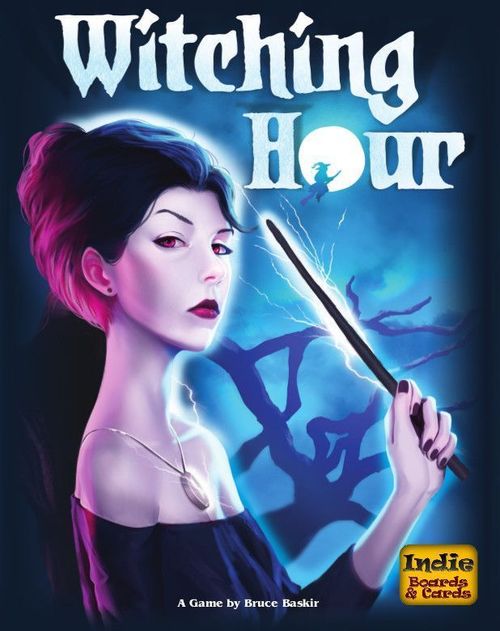
Witching Hour
Witching Hour Rulebook
Table of Contents
Table of Contents
Object of the Game
Witching Hour is a card game in which you play sets of cards to attack your opponents or use a card's special power to try and gain an advantage! If your opponent cannot match the number of cards in your attack, they must take those cards into their Hex pile. The more cards in your Hex pile at the end of a round, the more points you will score.
The player with the lowest score at the end of three rounds is the winner!
Components
5 Hex pile markers, 55 Score tokens (20 x 1, 20 x 3, 10 x 10, 5 x 25), 5 Player aids, 56 Cards: The cards in Witching Hour represent the implements the players will use to hex their opponents. The cards have six important sections:
- Icon: Each card has a different icon, which is useful for grouping cards when sorting your hand.
- Image
- Type
- Ability: This is the effect of the card. For a full description of abilities of all the cards check out page 6.
- Point value: These numbers represent how many points you will score for this card, based on how many copies of it are in your Hex pile at the end of the round.
- Quantity: This number represents the total number of copies of this card that are in the deck.
Setup
- Give each player a Hex pile marker and a player aid. Place them on the table in front of you.
- Shuffle all the cards together facedown, then deal out a number of cards depending on the number of players. For a two- to four-player game, deal 13 cards to each player. For a five-player game, deal 10 cards to each player.
- Set the remaining cards facedown in the middle of the table as the discard pile.
- The youngest player starts the game.
- Note: Remove Book cards from the deck in a two-player game.
Gameplay
Witching Hour is played over three rounds. A round ends when each player, but one, has run out of cards in their hand. At the end of the round, players will reveal the cards in their Hex pile and score points based on how many of each card type they have.
On your turn, you will do one of two things: Make an Attack or Play a Card.
Make an Attack
First, choose an opponent with cards in their hand to attack. This player is referred to as the Defender. Then play any number of cards from your hand faceup to the middle of the table, following one very important rule: All the cards you play must be the same type.
The Defender now has the opportunity to block the attack. To block an attack, the Defender must play the same number of cards as the Attacker. The cards used to block must all be the same type, but they do not need to be the same type as the cards used to make the attack. The Defender may choose not to block an attack.
If the Defender blocks the attack, place all of the cards used by the Attacker and the Defender facedown into the discard pile.
If the Defender does not block the attack, the Defender places all of the attack cards facedown into their Hex pile, under their Hex pile marker.
Play a Card
Some cards have an ability that starts with 'Play this card into your Hex pile.' On your turn, you may reveal one of these cards and place it into your Hex pile to resolve the card's ability.
Most of these cards allow you to take another turn. You will take that turn as soon as you finish resolving this card. For a full description of abilities of all the cards check out page 6.
The Chalice card has an ability that reads 'Play this card into any player's Hex pile.' The card works the same as other cards that specify 'your Hex pile,' except you may place it into another player's Hex pile instead.
Please note: You are not allowed to look at the cards in your Hex pile during a round. To help keep everything separate, be sure the cards in your Hex pile remain under your Hex pile marker until you score them at the end of the round. This prevents the cards being used in an attack from being mixed up with the cards in a player's hand or Hex pile.
Round End
The round ends when only one player has cards in hand at the end of any player's turn. That player places all of the remaining cards in their hand into their Hex pile.
The round may also end if no player has any cards in hand at the end of a turn.
Players score cards in their Hex pile at the end of each round.
Scoring
All players reveal all the cards in their Hex pile, and then score points for each type of card they revealed, based on the number of cards they have of that type.
Scoring example: Lauren has four Bells, one Candle, one Book, and two Mirrors: she will score 5 + 1 + 0 + 2 = 8 points.
The number of points a set of cards scores is found in the point value section of the card. If you only have one copy, you score the first number for that card. If you have two copies, you score the second number shown, and so on… The last number represents the highest quantity scored for that card. All higher quantities score the same amount.
Please note: Each type of card only scores once regardless of the number of copies of that card you have.
Players announce how many points they scored and then take score tokens equal to that amount and place them facedown in front of them. The number of points you score in a hand is public information until the start of the next round. If your score for the first round is negative, you score zero points. If your score is negative in any other round, you subtract those points from your score. Your total score at any point in the game cannot go below zero.
After scoring is complete, shuffle all the cards back together facedown and deal each player the same number of cards as were dealt at the start of the game. The player who last had cards in their hand in the previous round will start the next round. Repeat this process for the third and final round of the game.
End of the Game
After the third round, the players will total their score from all three rounds. The player with the lowest score wins the game. If there is a tie, all players play additional rounds until there is only one player with the lowest score. This may cause one of the previously non-tied players to win the game.
Abilities
Bell
This card cannot be used to block an attack.
Book
Instead of making an attack on your turn, you may place a Book into your Hex pile. Look at an opponent's hand, take a random card from it, and add it to your hand. Then, take another turn. Note: Remove Book cards from the deck in a two-player game.
Candle
You may add exactly one Candle card to any attack you make or any attack you block. Adding a Candle boosts the number of cards in that attack or block by one.
For example, if you attack with three copies of a card and one Candle, your opponent would need to block with four cards. You may still make an attack with any number of Candle cards if there are no other cards in the attack.
Cauldron
Instead of making an attack on your turn, you may place the Cauldron into your Hex pile. Take two random cards from the discard pile. Look at them. Place one card facedown into your Hex pile and place the other facedown into any other player's Hex pile. Since it is not considered an attack, you may place one of the cards into a player's Hex pile even if they have no cards in hand. That player will not know which card they received until the end of the round.
Chalice
Instead of making an attack on your turn, you may place a Chalice into any player's Hex pile. Since it is not considered an attack, you may place a Chalice into a player's Hex pile even if they have no cards in hand. You may play a Chalice into your own Hex pile. If you only have one Chalice in your Hex pile at the end of a round, you will subtract 3 points from your score.
Familiar
When you are attacked, you may place a Familiar card from your hand into your Hex pile to block the attack, discarding the cards used for the attack.
For Example, Thomas attacks Mary with three Mirror cards. Mary plays a Familiar from her hand to block the Attack. Mary places the Familiar card facedown into her Hex pile and discards the three Mirror cards.
A Familiar card cannot be used to block attacks involving Toadstool cards.
Hourglass
Instead of making an attack on your turn, you may place the Hourglass into your Hex pile. Look at your Hex pile, take a card from it, and add it to your hand. Then, take another turn.
Mirror
If you block an attack with Mirror card(s), the attack is reflected and the Mirror cards used to block are discarded. The Attacker becomes the Defender and may choose to block the reflected attack or take the attacking cards into their Hex pile. The Mirror cards (and Candle card if applicable) used to block the attack are immediately placed facedown into the discard pile.
If the reflected attack is also blocked using Mirror cards, the attack is once again reflected – the roles of Attacker and Defender are reversed, the Defender may block and the Mirror cards are discarded.
For example, Peyton attacks Sarah with three Book cards. Sarah blocks with three Mirror cards, the Mirror cards are discarded and Peyton must block or take the three Book cards. Peyton blocks with two Mirror cards and one Candle card from his hand. Those two Mirror cards and one Candle card are discarded, and Sarah must once again block an attack of three Book cards. She cannot, and takes the three Book cards facedown into her Hex pile.
Skull
Instead of making an attack on your turn, you may place a Skull into your Hex pile. If you do, look at the discard pile, take a card from it, and add it to your hand. Then, take another turn.
Toadstool
Attacks involving Toadstool cards cannot be blocked. After attacking with a Toadstool card, the Attacker must add a random card from the discard pile to their own Hex pile without looking at it. The Attacker must do that for each Toadstool card played during that attack.
Toadstool cards have no special effects when used to block.
Round of Play Example
Abby, Bob, and Candy are playing a three-player game. At the start of the game, they are each dealt 13 cards. The rest of the cards are placed facedown in the discard pile in the middle of the table. Abby starts the game because she is the youngest. Abby decides to attack. She may attack either Bob or Candy. Abby chooses to attack Candy with three Bell cards. Candy decides to block the attack by playing three Candle cards. The three Bells and three Candles are placed facedown in the discard pile. Abby and Candy now have 10 cards in hand. Bob still has 13.
It is now Bob's turn because he is to the left of Abby. Bob plays a Skull card, which allows him to look through the discard pile and add one of the cards to his hand. He has to place the Skull card in his Hex pile, which may cause him to score points later if he collects another one. Bob selects one of the Candle cards from the discard pile and places it into his hand. The Skull gives Bob another turn immediately after it's played. At the end of Bob's first turn, he still has 13 cards in hand because his Skull was replaced with a Candle.
Bob takes his next turn and attacks Abby with three Chalice cards and one Candle card. Exactly one Candle card can be added to any attack. Abby has the opportunity to block this four-card attack with four cards of the same type. Abby does not have four cards of the same type, nor three and a Candle, so she accepts the attack. She places the four attack cards in her Hex pile, facedown under her Hex pile marker. At the end of Bob's second turn, he has 9 cards in hand. Abby and Candy still have 10.
It is now Candy's turn. Candy decides to attack Bob with three Familiar cards. Bob chooses to block that attack with three Mirror cards. The ability of the Mirror causes that attack to be reflected back to the Attacker. Bob's three Mirror cards are discarded as they have been used to block. Candy now has the option to block the three Familiar cards. Candy blocks with two Toadstool cards and one Candle card. The Familiars, Toadstools, and Candle are all placed facedown in the discard pile. Candy now has 4 cards in hand. Abby still has 10, and Bob has 6.
It is now Abby's turn. Play continues until the end of a turn in which only one (or no) players still have cards in hand.