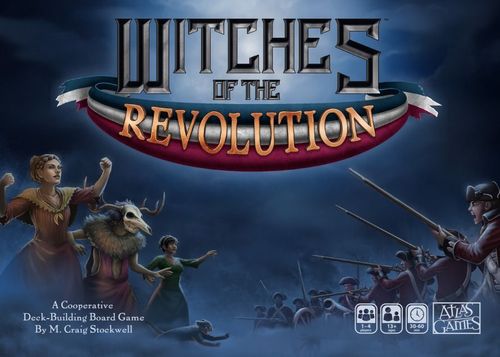
Witches of the Revolution
Witches of the Revolution Rulebook
Table of Contents
Table of Contents
Winning & Losing
The players win by completing four Objectives. Their victory score depends on where the Liberty Track marker is when they achieve their final Objective.
The players lose if...
- An Event card reaches the Event Line loss space for that number of players, or
- The Liberty Track reaches maximum Tyranny, or
- The last card in the Event deck is added to the Event Line and the players don't win by the end of that turn.
Card Anatomy
Witch/Recruit Cards
Each Witch/Recruit is a Seeker, Dedicant, Celebrant, Steward, Relic, or Blessing. Witch/Recruit cards are "Witches" when in a Coven deck, or "Recruits" while on the board. Card parts: Name, Stars, Magic Icons, Special Ability. Liberty and Peril icons repeat behind the effect text for emphasis.
- Relics must be banished when used, but assist with full resources.
- Seekers: "Play to Act again on your turn."
- Dedicants: "When assisting with a Dedicant, you may also assist with a Seeker."
Event Cards
Parts: Name, Magic Icons (Costs), Liberty or Peril Icon, Type Glyph, Effect, Hard Event (Spatter).
There are eight types of Event cards. Each is marked with a glyph identifying its type: Brewing, Channeling, Enchanting, Familiars, Hexes, Rituals, Unaligned, and Catastrophe.
- Unaligned Events have an Unaligned icon instead of magic icons.
- Catastrophes have a Catastrophe icon instead of magic icons, as well as a darker background to remind players that those cards have continuous effects.
Objective Cards
There are four types of Objectives: Familiars/Hexes, Brewing/Rituals, Enchanting/Channeling, and Catastrophe/Unaligned. Types are distinguished by their icon pairs. Parts of an Objective card: Name, Marker Symbols, Boon.
Preparing to Play
- Prepare the Board: Lay out the board. Place the Moon Track marker and the Liberty Track marker on their start spaces.
- Distribute Coven Decks & Draw Starting Hands: Give each player 15 Seeker cards with the same illustration. (Return unused Seekers to the box.) Each player shuffles this starting Coven deck and draws a five-card hand, or six in a solo game. Players keep their Coven decks and discard piles near them, not on the board.
- Prepare the Recruit Deck: a. Find the six Blessing cards and set them aside. b. Shuffle the other Recruit cards together. c. Deal a Recruit card face up into each of the three board spaces marked "Recruit Card." d. Divide the remaining Recruit cards into three stacks of nine cards each. e. Shuffle a random Blessing card into each of these three stacks. (Return the remaining Blessings to the box.) f. Place the three stacks on top of each other and set the resulting deck face down on the board space marked "Recruit Deck."
- Place Objective Cards: Randomly select one Objective card of each of the four types. Place them face-up on the four board spaces marked "Objective Card." (Return the unused Objective cards to the box.)
- Place Objective Markers: Place Objective markers of the number and type shown on each Objective card in the spaces beneath the Objective cards.
- Prepare the Event Deck: For your first game, return the hard Event cards (marked with blood spatters) to the box. Shuffle the remaining 40-card Event deck and place it face-down on the board space marked "Event Draw Pile."
- Choose a Starting Player: The players decide who'll take the first turn.
Varying the Game's Difficulty
There are ten cards of each Event type, five that are hard (blood spatter) and five that are easy (no spatter).
- To play the easiest game, use only easy Events.
- To play the hardest game, use only hard Events.
- To vary the difficulty, choose how many easy and how many hard events to randomly select from each type. For example, choosing one hard and four easy events from each type will result in a relatively easy game. As long as five cards of each type are chosen, to make a 40-card Event deck, easy and hard Events can be mixed in any ratio.
- You can play with a random difficulty by choosing five cards at random from among each type.
Taking Turns
Witches of the Revolution is played in turns. Each player does all five steps of the turn sequence before the next player takes their turn. Turns continue until the game ends in victory or defeat.
Turn Sequence Steps:
- Add a Recruit
- Add an Event
- Act and/or Recruit
- Discard (optional)
- Draw (optional)
Step 1: Add a Recruit
Skip this step on the first turn of the game.
Flip the top card from the Recruit deck. If it's a Blessing, follow its instructions and then put it in the Recruit discard pile. Otherwise, put it in the leftmost Recruit space, sliding other face-up cards to the right as needed to make room. If all three Recruit spots were occupied, the rightmost Recruit is forced into the Recruit discard pile.
If the Recruit deck runs out of cards, skip this step for the rest of the game.
Step 2: Add an Event
Flip the top card of the Event deck into the first Event Line space, sliding other face-up cards to the right as needed to make room.
Example of Adding an Event: A new Event card is drawn and placed into space 1. The "Benjamin Church..." card is pushed to space 2 and the "Redcoat Supply Train..." card is pushed to space 3. However, the "Witch Hunter Boguet..." card is not pushed, because it doesn't need to be.
If moving an Event card fills the space marked as a loss for the number of people playing, the Revolution fails and the players lose.
If the newly flipped card has a "When Flipped" effect, resolve that immediately. Some effects "banish" cards. Banished cards are placed in the Recruit discard pile.
If a card with a Liberty icon moves into the second, fourth, or sixth Event Line space, move the Liberty Track marker one space toward Tyranny for each such move.
If a card with a Peril icon moves into the third or fifth Event Line space, choose and banish one face-up Recruit card for each such move.
Step 3: Act and/or Recruit
In this step, the player whose turn it is may Act, Recruit, or do both. If they do both, they may do them in either order.
- Acting lets a player try to overcome an Event from the Event Line.
- Recruiting lets a player take a Recruit from one of the three Recruit spaces by paying its cost.
The Seeker ability "Play to Act again on your turn" gives someone who plays it an extra Act. An extra Act can come in any order within this step. Extra Acts can't be used to Recruit.
Acting
To overcome an Event in the Event Line, the player must play enough Witch cards from their hand so that the magic icons played meet or exceed that Event's cost. Most Events have two different cost options. One or the other cost must be paid, not both.
Example: "Brigands Ravage Farmsteads" has four Channeling and four Enchanting icons. Either four Channeling icons or four Enchanting icons must be played to overcome it.
Unaligned Events and Catastrophes have a single cost shown as a number, rather than multiple options shown as icons. They can be overcome using any combination of icons that meet or exceed the number.
Example: "British Propaganda Spreads to Farmsteads" is Unaligned, and shows "6." It requires six icons of any type or combination of types.
Catastrophes say "+ P" on them. This means "...plus the number of players." Example: "Troop Reinforcements Shipwrecked" is a Catastrophe, and shows "9+P." In a three-player game, it requires twelve icons of any type or combination of types.
Players can cooperate to overcome Events. To win, they will almost certainly have to.
When a player Acts, each other player can assist them by playing a single Witch card. An assisting card provides only a single one of its pictured icons, no matter how many icons it bears. For example, a Seeker with a Brewing icon and a Hexing icon could provide one Brewing or one Hexing, but not both. Relics, on the other hand, contribute all of their icons when assisting, as their effect text says.
Cards played to overcome an Event are discarded to their owners' individual Coven discard piles. Relics are an exception. Relics are banished when used (i.e., sent to the Recruit discard pile).
Finally, the overcome Event is discarded.
When overcoming an Event, the players may pay double the normal cost in icons. If they do, they remove (and claim as trophies) two Objective markers, which may be different if the Event permits.
When an Event is overcome, remove an Objective marker from one of the Objectives on the board. You can remove any marker that matches any icon shown on the Event that was overcome. You do not need to choose the icon type used to overcome the Event. If no relevant marker remains, no markers are removed.
When an Objective marker is removed, the player whose turn it is keeps that marker. It becomes an Objective trophy. Objective trophies can help resolve future Events and reduce recruiting costs. See "Objective Trophies."
When a Liberty Event is overcome, the Liberty Track is adjusted. See "The Liberty Track."
Recruiting
To Recruit, a player chooses a card from one of the three Recruit spaces, pays its cost using cards from their hand, then adds it to their Coven deck.
Costs are listed and paid in stars. For example, two Seekers (one star each) could pay for one Dedicant (two stars). Cards spent to Recruit are banished (i.e., placed in the Recruit discard).
Recruited cards are placed on top of any Coven deck, so will almost always be the next card that player draws.
Recruiting costs are often modified. For example, as the board shows, a card in the third Recruit space costs one less star than normal. As another example, all cards cost one more star when the Liberty Track marker is in the Score 2 space.
One discount bears explanation: A card in the second Recruit space costs one less star if one of the cards paying its cost shares at least one magic icon with it.
Cards that cost no stars -- Relics, for example -- can be taken without spending cards. Taking a free card does use a player's Recruitment opportunity for the turn, though.
Recruiting often reduces the size of a player's Coven deck. Since reshuffling advances the Moon Track -- which makes future Events harder -- recruiting wisely is important.
Step 4: Discard
The player whose turn it is may discard any number of cards from their hand (including none).
Step 5: Draw
The player whose turn it is may draw from their Coven deck until their hand is full (usually five cards). This is optional, but a player can't draw fewer cards than would fill their hand. That is, they must fill their hand completely or skip drawing entirely.
If there are no cards in a player's deck when they must draw a card...
- The player's Coven discards are shuffled to form their new deck.
- The Moon Track marker is advanced one space.
- An Event is added to the Event Line, exactly as in the "Add an Event" Step.
- That player continues drawing.
The five-card maximum hand size is sometimes modified. Other than changing the number a player draws to, the rules for drawing remain the same: The player must fill their hand or skip drawing.
Players only draw on their own turns. Players who play, discard, or lose cards from their hand on someone else's turn don't draw cards until their own turn's Draw Step.
Miscellaneous Rules
Objective Trophies
Once players have collected Objective trophies (by Acting to overcome Events), they can spend them in two ways:
- On their own turn, a player may spend any number of Objective trophies to produce the magic icons shown, as though from a Witch card, to help overcome an Event. (Unaligned and Catastrophe trophies generate generic icons that can only be used to overcome Unaligned and Catastrophe events.)
- On any player's turn, players may collectively spend any number of Objective trophies to reduce the cost of a Recruit, for the benefit of the player whose turn it is. For every two trophies spent, a Recruit's cost is reduced by one star.
Spent Objective trophies are returned to the box. There is no limit to the number of Objective trophies a player may have, nor do they count as cards against a player's hand limit.
Achieving Objectives
Players must achieve four Objectives to win. An Objective is immediately achieved when its last Objective marker is removed. For example, "Resurrect Benjamin Franklin" has three Brewing and four Ritual symbols printed on it, so it's achieved when the players have removed all three Brewing markers and four Ritual markers from it.
When an Objective is achieved, resolve its boon immediately, then flip it face-down. When the last Objective is turned face-down, the players win.
Increasing Event Costs
The Moon Track and some Event effects increase the costs of Events. Increased costs are always of the same type as the base cost. For example, if an Event normally costs four Hexing or four Ritual icons, and costs are increased by two, it requires either six Hexing or six Ritual icons instead. If an Unaligned Event costs five Unaligned icons, and costs are increased by two, it requires seven icons of any type or combination of types.
Witch & Relic Special Abilities
Witches and Relics have special abilities, which can be used on their owner's turn, or whenever the ability specifies. For example, Seekers say, "Play to Act again on your turn." This can obviously only be done on its owner's turn. However, Dedicants say, "When assisting with a Dedicant, you can also assist with a Seeker." Since players don't assist on their own turn, this is clearly played when another player is Acting.
Unless it specifies otherwise, a card used for its special ability is placed in its owner's Coven discard pile.
Banishing Cards
Banished cards are placed in the Recruit discard pile, and will not return to play.
Solo Play
Solo play is the same as play with multiple players, with one exception: The default hand size is six cards, rather than five.
As a solo player, you'll be able to take advantage of more recruiting opportunities, but won't have access to any assistance at all when you Act against Events.
The Moon Track
When a player reshuffles their Coven discards to form a new deck, the Moon Track marker is moved one space, as the witches' power diminishes with the waning of the moon. If the marker reaches the end of the Moon Track, it no longer advances.
The number that appears on the Moon Track marker's current space is a number of additional icons that must be paid to defeat every Event the players try to overcome. See "Increasing Event Costs."
The Liberty Track
The Liberty Track shows how much Liberty the colonists are enjoying, or how much Tyranny is oppressing them.
The Liberty Track marker moves one space towards Tyranny when a Liberty Event (marked with a Liberty icon) moves into the second, fourth, or sixth Event Line space. It moves two spaces towards Liberty when a Liberty Event is overcome.
Some Liberty Track spaces have special effects on the game, as shown on the board.
If the players win, the Liberty Track marker's position at the moment of victory is their score (1-7) for that game.
For an Easier Game
Witches of the Revolution can be difficult to win. If it's too difficult for your tastes, try these two simple adjustments.
- Increased Blessings: Add six Blessings to the Recruit deck during setup, instead of just three. Shuffle two into each stack of nine cards.
- Free Reshuffles: Allow each player one free reshuffle of their Coven deck, without advancing the Moon Track or drawing a new Event. Give each player some kind of token they can return to the box when they do so, to prevent losing track.
Common Questions
Should we play with our hands face-up? It's up to your group. There are no restrictions about what information players can share.
What if a card contradicts the rules? The card takes precedence.
If an Event effect reduces hand size, do players have to discard right away if they have more cards than the new limit? No, hand size is only checked when players are drawing cards, during the Draw Step.
Can a player Act against an Event on their turn without playing any Witch cards, to let other players assist and overcome the Event that way? Yes!
Can players assist with Objective trophies? No. Only the player whose turn it is can spend Objective trophies to help overcome Events.
Can Catastrophe Objective trophies be used to overcome Unaligned events, and vice versa? Yes. Both types of trophies generate generic icons, and generic icons can be used to help overcome both of those types of Events. (All six other types of trophies can be used to overcome Catastrophes and Unaligned Events, too.)
Can players continue after they've won, to increase their victory score? No, the game ends as soon as the fourth Objective is completed. To increase your victory score, delay completing your fourth Objective until you can garner more Liberty. You are not required to remove an Objective marker when you overcome an Event.
When using Objective trophies to reduce a Recruit's cost, does it help if the icons on the trophies match the Recruit? No.
Do the Objectives that allow "freely reshuffling" also add an Event to the Line and advance the Moon Track, as reshuffling normally does? No, free reshuffles don't have those drawbacks.
Does the Tyranny effect "No effects reduce recruiting costs" stop players from using Objective trophies to reduce the cost of a Recruit? Yes, that Tyranny effect also restricts the use of Objective trophies.
What if a card affects "one player," but the players can't agree on whom it should affect? The player whose turn it is chooses.