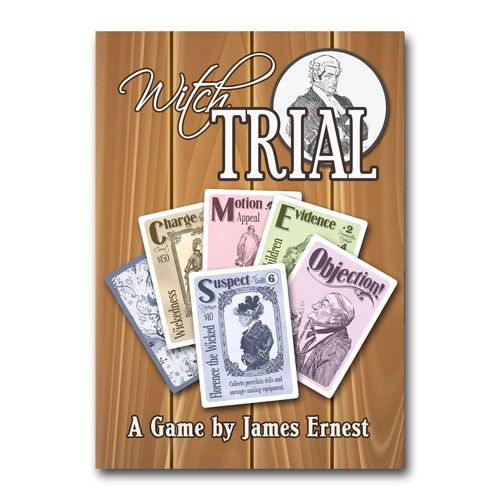
Witch Trial
Witch Trial Rulebook
Table of Contents
Table of Contents
Components
To play Witch Trial, you will need to print the Board and Card files. You can also buy a spiffy version of the deck, in a box and everything. You will also need:
Players: 3 to 7. Playing Time: 45 Minutes
Dice: Two six-sided dice.
Money: Paper money or chips in denominations of $5 and up, roughly $3000 total. Note: The "Money" in Witch Trial actually represents prestige. It is well known that lawyers have never been in business exclusively for the money, but also for the betterment and enrichment of society. And besides, prestige also means more money.
Board: This is a simple one-page board representing the Courtroom.
The board has space for one Suspect and one Charge card, a stack of money ("Court Fees"), and the Jury.
In a pinch you can even get by without the board, as long as you remember where everything belongs, and you have a way to track the Jury Value.
Jury Marker: A pawn, penny, or some other marker to place in the Jury Box, to track the Jury Value.
Cards: There are 90 cards in five types, including Suspects, Charges, Evidence, Motions, and Objections.
Suspects represent the suspected witches who will go on trial. These cards may also serve as witnesses.
Charges combine with the Suspects to form Cases.
Evidence can be played on either side of the trial to influence the Jury.
Motions represent various courtroom tactics such as appeals, bribes, courtroom drama, etc.
Objections counteract the Motions.
To Begin
Each player starts with $50. Put the rest of the money in the bank, and nominate a banker to handle it.
Shuffle the deck and deal a starting hand of six cards to each player.
Deal a lineup of five face-up cards, leading away from the deck. This line runs across the bottom of the Courtroom.
Determine randomly who will go first. Play will proceed to the left.
On Your Turn
On each turn, you may do exactly one of the following: Buy a card, Create a case, Defend a case, or Prosecute your own case (by appointing a public defender).
1: Buy a Card. You may buy one card from the lineup. The first card is free, the next card costs $5, the next $10, $15, and the last is $20. The card you buy goes into your hand.
When you buy a card (or take the free card), you also get to draw one card from the deck.
The money you pay for the card goes into the Court Fees area in the Courtroom.
After you buy a card, the cards above it slide away from the deck, becoming cheaper, and a new $20 card is added from the deck. This happens after you draw. (This timing only really matters if the deck is empty.)
After you buy a card, your turn ends.
Note: There is no limit to the size of your hand. If you use a lot of cards in one trial, it may take several turns to replace them, so make sure you're getting value out of every one!
2: Create a Case. This world is filled with suspicious characters and heinous crimes to pin on them. However, you can't just go around accusing people willy-nilly.
A case is comprised of one Suspect and one Charge. To build a case, you must either combine a Suspect from your hand with a Charge in the lineup, or a Charge in your hand with a Suspect in the lineup.
Once the case is made, the Suspect and Charge sit on the table in front of you as your pending case. You can have only one pending case at a time, which means you are not allowed to create a new case if you already have one.
Creating a case doesn't cost anything, and it doesn't get you a free card from the deck.
The cards in the lineup move down as described above, and a new $20 card is added immediately.
Creating a case ends your turn.
The Lineup: When you buy a card, you also draw one.
3: Defend a Pending Case. If there is a pending case in front of any other player, you may choose to defend it. This case goes to court as described under "Going to Trial," below. After the trial, your turn ends.
4: Prosecute Your Case. If you already have a pending case in front of you, you may choose to select a public defender at random, as follows:
Every player but you rolls two dice. The player who makes the lowest roll must defend your case. (Tied players roll again.) The case goes immediately to trial, as described below. After the trial, your turn ends.
Ending your Turn: You will probably have performed one of the four actions described above, but it is also legal to pass your turn. Passing usually only happens at the end of the game, when there are no more clear actions for a player to take.
After your turn is over, the turn passes to the left.
Going to Trial
Trials happen frequently, and they are the only way to make money (er, "prestige"). When a trial begins, place the Suspect and Charge into the Courtroom.
Only the Prosecutor and Defender will be involved in this case; the other players are spectators.
Step 1, Pay the Defender: Every Suspect has a "Defense" budget, which is paid immediately from the bank to the Defender. This is true whether the Defense volunteered to defend the case on their turn, or had it thrust upon them as a public defender on the Prosecutor's turn.
Step 2, Stock the Court: Each Charge has an amount of "Court" money written on it. Add that amount to the Court Fees area in the Courtroom, from the bank. This money, along with any money that was already there, will go to the winner of the case, or will be divided in a plea bargain.
Step 3, Set the Jury Value: At the end of the trial, the deliberation of the Jury will be represented by a roll of two dice, modified by a number called the Jury Value.
The Jury Value represents how many jurors currently believe that the defendant is guilty. It is tracked using a marker (such as a pawn or penny), placed in one of the twelve spaces in the Jury Box. The higher the Jury Value, the more likely the Suspect will be found guilty.
The Jury Value can never go higher than 12 or lower than 1, so if anything would move the Jury Value outside this range, the extra value is ignored.
To set the Jury Value at the beginning of the trial, add the Guilt of the Suspect to the Severity of the Charge. This will always give you a number between 2 and 12.
Note: Charges have certain Suspects who are more or less likely to have committed them. For example, Smuggling is usually worth 5, but it is worth +2 if it is paired with Lewis the Bum or Mad Gertie Hayes. If you are trying Lewis the Bum for Smuggling, the Charge has a Severity of 7, and Lewis has a Guilt of 4, so the Jury starts with a value of 11.
When the trial is over, the Prosecutor will roll two dice and add the result to the Jury Value. If the total is 13 or higher, the Suspect is found guilty, and the Prosecutor wins the case. If not, the Suspect is found innocent, and victory goes to the Defense.
The Jury Value is a good indicator of how the Jury will vote, but it's rarely a guarantee.
Step 4, The Prosecution Makes A Case: The Prosecution acts first in the trial, and may play any number of cards in any sequence. After the Prosecution rests, the Defense will become active, and can play all the same kinds of cards. Finally, the Prosecutor gets one more play.
Step 5, The Defense Makes Their Case: After the Prosecution rests, the Defense becomes the active player and may perform all of the same actions described above.
After playing all their cards and resting, the Defense may offer a plea bargain to the Prosecutor under the same rules described above.
Step 6, The Final Argument: After the Defense rests, the Prosecution is allowed to play one more card, which is called the final argument. This card can be Evidence, a Witness, a new Charge, or a Motion. The Prosecution may then offer one final plea bargain before letting the jury deliberate.
Note: If your final argument is a Motion that meets with an Objection, it does not count as your last card. You may still play one more card.
Step 7, Roll the Jury: After both parties have rested, if no plea bargain has been made, the Prosecution rolls two dice and adds them to the Jury Value.
If the total is 13 or higher, the Prosecution wins. If it is 12 or lower, the Defense wins.
The winner of the case takes all the money in the Court. The Suspect and Charge cards are discarded, along with all other cards played on this trial, and the turn passes to the left.
Note that the Prosecutor always wins if the Jury value is 11 or 12. On the other hand, there is no Jury Value so low that the Defense has a guaranteed win. The Prosecutor is the favorite if the Jury Value is 6 or higher.
Functions of the Cards
In no particular order, here are the definitions of all card types as they apply to prosecuting or defending a trial. When prosecuting or defending a case, the active player may play any number of these cards, in any order.
Evidence: Evidence cards have two numbers: one value if played by the Prosecution, and another if played by the Defense. In both cases, this value represents the effect that the card has on the Jury.
When you play Evidence, the Jury Value changes by the appropriate amount. For example, when a Prosecutor plays Friends, he raises the Jury Value by 2 points (to a maximum value of 12). If a Defender played Friends, she would reduce the Jury Value by 3.
It's appropriate to explain how the evidence supports your case. Depending on how you look at it, the existence of Friends could suggest that the accused is guilty (because her acquaintances are themselves suspicious) or that she is not (obviously no criminal would have so many friends).
Witnesses (Suspects): Suspect cards can be played as Witnesses during a trial. These cards work a little like Evidence. However, they are less predictable.
When you play a Witness, you must roll one die and compare the result to the Guilt of the Witness. If you roll equal to or higher than this value, the Witness changes the Jury Value by its Guilt: positive when played by the Prosecution, negative when played by the Defense. If you roll lower than the Guilt, the Witness does nothing.
For example, the Defense calls Alsace Lorraine (Guilt 2) as a Witness. The Defender rolls one die. On a 1, she has no effect. On a 2-6, she subtracts 2 points from the Jury Value. (If the Prosecution played the same card, she would add 2 points instead of subtracting.)
Charge: You can play a new Charge to replace the current one. No matter who plays it, the new Charge will alter the Jury Value by the difference between its own Severity and the Severity of the previous Charge.
For example, if a Charge worth 2 is played to replace a Charge worth 5, the Jury Value will go down by 3. ( 2 - 5 = - 3 ) This play clearly benefits the Defense, so only the Defense would normally make it. The reverse, replacing a 2 with a 5, would benefit the Prosecution.
When a Charge has a modified Severity when paired with a particular Suspect, remember to use that value when comparing the two Charges. For example, if Lewis the Bum was first accused of Golfing (Severity 3), but the Charge is trumped up to Smuggling (5, but +2 for Lewis), then the Jury Value will go up by 4 points. (7 - 3 = 4)
Note: New Charges do not affect the amount of money in the Court. They only change the Jury Value.
Motions: Motion Cards are all different, and they all describe what they do. However, the following clarifications may be useful:
The "you" on a Motion card refers to the player who plays it. "Your opponent" refers only to the other lawyer in this trial.
To "throw a case out" means to stop trying the case immediately and discard all the cards, including the Suspect and Charge.
Objections: An Objection cancels the effects of a Motion, and causes the Motion card to be discarded.
Each time a player plays a Motion, their opponent must be given a chance to play an Objection in response. Objection is the only card that can be played out of turn, and it can be played only by the opposing lawyer.
Unlike other cards, Objections stick around. Instead of discarding an Objection, you must hand the Objection to the player whose Motion you cancelled.
An Objection cancels all the effects of a Motion. For example if Drama is played and Objected to, the player doesn't get to re-roll the Jury Value, but also is not forced to rest. You cannot object to a motion once it has been carried out, for example, after the dice roll for Drama.
Because of the existence of Objections, it is polite to pause briefly before carrying out the effects of any Motion, to give your opponent a chance to Object to it.
Note: You cannot Object to an Objection, because Objections only cancel Motions.
Discard Note: All cards played in a trial must remain on the table until the trial is over, so they are not technically in the discard pile until the trial ends. This includes cancelled Motions. Therefore, Short Memory can only recover cards that were played previous to the start of this case.
Plea Bargaining: When they are finished playing cards, the active lawyer must rest. At this point, and not before, this player may try to negotiate a plea bargain. This is a deal by which the money held by the Court would be divided in any way agreeable to both parties.
If the bargain is accepted, the trial ends and the money is divided. If not, the trial continues.
You can only offer a plea bargain after you have rested. If you start bargaining, or make any offer that suggests a deal, you must rest whether you meant to or not.
Strategy
Witch Trial requires shrewd lawyering and negotiating skills. After a few games you will learn which cards, and therefore which hands, are better for prosecuting and defending. If you have a lot of small Charges, or Evidence that's good for the defense, seek out and defend the richest clients you can find. If your hand is better suited to prosecution, do what you can to create and win a valuable case.
If your case relies on a random factor such as a high-valued Witness, or a Motion that might be canceled, play that card first. Depending on how it comes out, you can decide whether it's worth playing the rest of your hand.
Effective plea bargaining is the key to success. Understand your odds of winning a given case, and don't be too greedy when negotiating. Unless you need the full amount to win the game, taking part the money is always better than taking none of it.
Objections can be a strong deterrent, but don't let the players who hold them succeed without ever playing them! Remember that there is a silver lining to having one of your Motions canceled: at least you get to take the Objection.
Ending the Game
The game ends when the deck and the lineup are out of cards and there are no more pending cases on the table, or when it is clear that no more cases can be created or tried.
It is possible that players will take a few "pass" turns during the endgame if the lineup is empty; however, it's usually wiser to defend a case rather than do nothing.
At the end, the lawyer with the most money wins. Which is to say, the lawyer with the most prestige.
Extended Game Rules (The Double Pass)
In games with 6 or 7 players, you may wish to recycle the discards once, and pass through the deck a second time. If you don't, the game will have very few rounds.
If you like this option, make sure to agree beforehand that you are playing the two-pass game.
Also, when you reshuffle, do it at the right time: you must shuffle the discards and replace the deck at the moment when the Lineup or a player needs to take another card, and not before. This ensures that the discard pile is in place as long as possible when someone needs it for Short Memory.