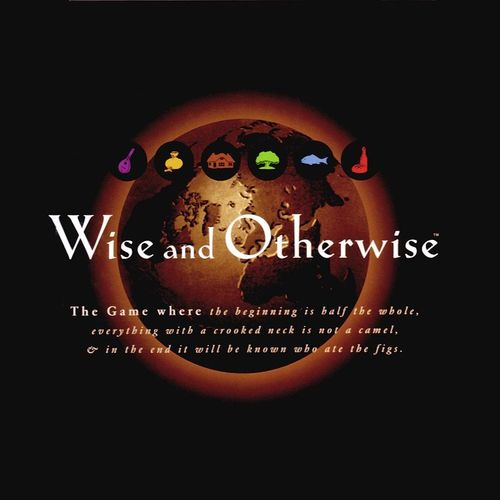
Wise and Otherwise
Wise and Otherwise Rulebook
Table of Contents
Table of Contents
Equipment
A game board, a card box with 2,500 sayings on 500 cards, writing pads, six pencils, one die, and six player pawns.
Object of the Game
Wise and Otherwise contains long-lost, unpredictable, and often hilarious old sayings from all over the world. Players are given only the first part of a saying, then everyone thinks up and writes down their own made-up ending. The idea is to make up an ending that will fool other players into thinking yours is the actual old saying. You'll get points when other players vote for your ending, and points when you guess which is the real one. The player with the most points at the end of the game wins.
Look at the example saying on the back of the game box and you'll see that your made-up ending can be as simple, wise, witty, or wacky as you like – anything you think might fool other players.
Preparation
Each player is given a writing pad and a pencil. One player acts as Scorekeeper. Players choose their pawns and place them on the matching-color Start positions on the game board.
Start of Play or The Beginning is Half the Whole
Each Player rolls the die and the player who rolls the highest number becomes the first Reader. The Reader takes a card from the front (the Wise and Otherwise end) of the card box. Looking only at the front of the card, the Reader chooses one of the sayings to play.
The Reader first reads aloud the line with the saying's origin, then reads aloud the beginning of the saying. All players except the Reader write the beginning of the saying on their writing pads, then proceed to make up and write down their own ending to go with the beginning.
Turning to the real ending on the back of the card, the Reader writes down the entire saying on the writing pad and returns the card to the back of the card box.
Guessing Which One or Everything With a Crooked Neck is Not a Camel
Each player writes their name and pawn color on their completed saying and passes it to the Reader, who looks to make sure it can be read clearly. The Reader thoroughly shuffles all the made-up sayings together with the real old saying, and numbers them randomly, 1 2, 3, etc.
The reader then reads each entire saying aloud by number, making sure not to give anything away. The sayings are read aloud once or twice more.
Beginning from the Reader's left, players state in turn which saying they think is the real one. As each player votes for a saying, the Reader writes that player's initials in one of the scoring squares on the chosen saying. After everyone has voted, the Reader reads the sayings aloud once more, revealing who wrote each one and, in turn, the real old saying.
Scoring
| Points | Awarded |
|---|---|
| 2 points | to each player for every vote their made-up saying receives. *Players don't receive points for voting for their own saying. |
| 2 points | to each player who votes for the real old saying |
| 3 points | to the Reader if no one votes for the real old saying |
| 3 bonus points | to every player who lands on the 10th space on the scoreboard |
The Reader and the Scorekeeper tally all points and the Scorekeeper moves the pawns up the board accordingly. Play continues with the player to the Reader's left becoming the Reader for the next round.
Winning the Game or In the End It Will Be Known Who Ate the Figs
As soon as a player crosses the Finish the game is in its final round, but – the game is over only after all players are awarded their points for that round. The Scorekeeper should write down any score higher than twenty. The winner of the game is the player with the most points at the end of the final round. In the event that two or more players tie then it can truly be said… All the Wit of the World is Not in One Head.
If more than six people wish to play Wise and Otherwise, it is suggested that some players form teams of two, taking turns writing, and collaborating on voting.
Two Person Play
Players take turns being the Reader. As in regular play, the Reader selects the beginning of a saying without looking at the back of the card. Then the Reader makes up and writes down, on separate sheets of the writing pad, two endings to the saying. After completing the made-up endings, the Reader looks at the real ending on the back of the card and writes the entire saying down on a third sheet. The made-up sayings are shuffled together with the real saying, numbered, and read out loud to the other player, who must then decide which saying is the real one. The Reader is awarded 4 points if the other player chooses one of the made-up sayings. The other player is awarded 4 points for guessing the real old saying.
Notes on Play
Players may vote for their own saying as a strategy to fool other players, but don't receive points for their own vote.
Players may make up words with the idea of fooling other players into thinking that a saying containing a word they don't recognize just might be the real one.
The Reader should spell words that may be confusing or have more than one meaning. During play, dictionaries and other references should not be used.
In the event that two or more sayings are identically worded and one of them is the real one, players who vote for the made-up saying get 2 points, as though they had voted for the real one. All other points are awarded as usual. If there is any variation in wording the sayings are considered to be distinct from one another. (Small variations in wording may have great differences in meaning.) If two (or more) sayings are identical and neither is the real one, then a vote for one saying is also counted as a vote for the other saying.
The sayings in Wise and Otherwise are old, and many date back to ancient times : be careful about using slang or other obviously modern lingo, situations, objects, etc.
When writing your ending, keep in mind that real old sayings can sometimes seem funny, odd, or even unbelievable. Also, old sayings are almost always metaphorical. For example, The kabob must be turned to cook means travel is necessary for a person to gain wisdom and experience. By constantly asking one can reach China means where there's a will there's a way, and The snake must be straight to enter the hole means honesty is the best policy. In other words, let wit and imagination be the salt and pepper in your soup.
If a player is quite sure they recognize a saying chosen to play, another saying should be selected instead.
Players decide what constitutes a reasonable time in which to make up an ending, without necessarily imposing any fixed time limit. In the extreme circumstances that a player is unable to come up with an ending, they should withdraw from play and stand on their head for the duration of that round in the hope that increased blood flow to the noggin will produce brain waves in accordance with the creative requirements of the game.
The ideal playing environment for Wise and Otherwise is a living room or other area where players can take maximum advantage of seating and space for maximum creativity and comfort. Remaining vertical is optional. In the extraordinary event that a horizontal player falls asleep, they may continue to play as long as they are still able to create plausible endings.