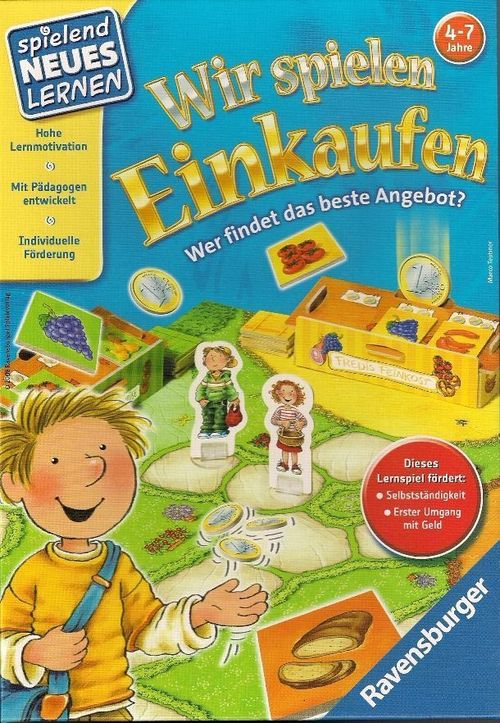
Wir spielen Einkaufen
Wir spielen Einkaufen Rulebook
Table of Contents
Table of Contents
Components
- 1 game board made of four parts
- 4 market stands, each made of two parts
- 36 goods cards
- 52 coins
- 4 game pieces
- 4 stand bases
- 4 purses
- 6 shopping lists
- 1 die
Before the First Game
Take all of the game material out of the box. Carefully punch out the four board parts, the goods cards, the coins, the shopping lists and the purses from their punch-out sheets. Assemble the market stands as shown in the assembly instructions printed on the tops of the market stands. The yellow and blue stands use those tops that show two times two and once three coins as prices. Join the four board parts together and place the market stands in the correspondingly coloured recesses at the edge of the board. Insert the game pieces into the stand bases.
Once assembled, the market stands should not be taken apart again. Simply place them carefully next to each other in the box when you pack the game away.
Tip for introducing the material (for parents):
- Spread the green, blue and orange goods cards out on the table. Ask your child to sort the different goods into groups such as baked goods, meat products, and fruit and vegetables. Talk with your child about where the different foods can be bought (for example, bread at the baker, sausage at the butcher).
- Next, let your child sort the yellow cards into the different groups as well, and point out that a wide variety of foods can also be bought in one place, for example in a supermarket, at a delicatessen stand or in an organic shop.
Basic Game
Shopping game for 2 to 4 children from age 4.
Goal: Buy all the goods on your shopping list and be the first to get back home.
Preparation
The goods cards have different colours depending on their goods group. Sort the cards by the categories listed here:
- Orange goods cards: baked goods
- Green goods cards: fruit and vegetables
- Blue goods cards: meat products
- Yellow goods cards: mixed goods / delicatessen
Place the sorted cards face down as a stack next to the stand of the same colour, namely at the spot where the storage boxes are drawn on the board. For example, place the blue cards next to the butcher Maxi's meat stand, and so on (see page 2).
Now take the top three cards from each stack. Place them face up next to each other on the display surface of the stand. The small coin symbols above the goods show how much each item costs.
Note: If you look closely, you will see that some types of goods are a little more expensive than others. For the meat products at the butcher and the especially good food at the delicatessen stand, you need to plan for a little more money. Fruit, vegetables and baked goods, on the other hand, can be cheaper.
Each player receives one shopping list, one purse and eight coins. Place your coins on the storage compartments of your purse. Put the remaining coins into the box. Get the die ready and place your game pieces on the house (Wohnhaus). Your shopping round starts from there.
Note: Look carefully at your shopping lists. What do you need to buy? Compare the goods on your list with the offers on the market stands. Compare the prices carefully!
Getting Started
The youngest player begins. Play then continues clockwise. When it is your turn, roll the die and move your game piece the corresponding number of spaces on the board. You may choose the direction yourself.
Note: The bank and the coloured spaces where the market stands are located also count as movement spaces and must be included in the count. When you want to go to a stand, to the bank or home, you do not have to land on that space exactly. You may let any excess die points lapse.
Buying
When you reach a stand where you want to buy something:
- Check how much the goods cost. Do you have enough money?
- First pay by putting the coins into the coin slot on the market stand.
- Now take the paid goods from the display surface and place them next to the matching goods symbol on your shopping list.
- Check whether you want to buy any further goods at this stand. You may do so now, as long as you still have enough coins for them.
Restocking
- When your purchases at this stand are finished, the stand must be restocked. First, slide the remaining goods of the stand one or two spaces to the left. The arrow on the display surface shows you the direction.
- Then fill the empty spaces with fresh goods from the supply stack that lies next to the stand.
- Once the stand has been restocked, your turn is over. If new goods are now on display that you need, you can only buy them on your next turn.
- Be careful! The fresh goods are initially still expensive, but some goods have become cheaper.
Basically: if the offer at a stand is favourable right now, you may skip rolling the die and stay where you are there.
Tip for parents: Ask your child to watch closely how the prices change during play, and to take this into account when shopping.
No Needed Goods at Any of the Four Stands
If none of the four stands has any goods that you still need to buy, you have the option of exchanging all of the goods at one stand:
- Go to the stand that sells the relevant type of goods, or to the general goods stand (Gemischtwarenstand), which has all goods.
- You may now take all three goods cards from the market stand and place them under the supply stack next to the stand. Then take the top three cards from the supply stack and place them on the display surface of the stand.
- Is a good now on display that you want to buy? Splendid! Then grab it and buy it!
The Bank
If you no longer have enough money for the goods you still need, you have bought too expensively and must take a detour via the bank.
- Roll the die and move to the bank space. Excess die points lapse.
- Once you have reached the bank space, roll the die once more. Depending on the number you roll, you may take that many coins from the box, but no more than will fit on your purse. For example, if you roll a three, you may take three coins. In the next round you can then continue moving and shopping.
Once you have bought all the goods on your shopping list, roll the die and move your game piece back to the house.
End of the Game
The game ends as soon as a player has bought all the goods on his or her shopping list and has walked back to the house. That player wins the game. The other players may of course continue shopping, until everyone has arrived home with a full shopping bag.
Tip for parents: Go to a weekly market with your child and let them buy different things on their own. This builds their self-confidence.
Expert Variant
Shopping game for 2 to 4 children from age 6.
Shopping experts can play the expert variant by estimating for themselves, before the game, how much money they will need for their purchases. The expert variant is prepared and played like the basic game, except that before the game starts, no coins are placed on the purses.
The youngest player begins by taking one coin from the box and placing it on his or her purse. After that, each player in turn may take one coin per round. This continues until you believe you have enough money for your purchases, or until your purse is full. Instead of taking another coin, you may then roll the die and set off with your game piece. The other players may still continue taking money until each of them feels they have enough and starts to move.
Managing money pays off! If you still have money left at the end of the shopping round, you may take a bus part of the way home: in addition to the number you roll, you may give up leftover coins and move one space further for each coin.
In this variant you may only visit the bank after you have already bought the first item. Once you have bought all the goods, you may no longer withdraw money from the bank on the way home.
The game ends as soon as a player has bought all the goods on his or her shopping list and has walked back to the house. That player wins the game.
Tip for experts: Each player starts with only six coins. When shopping, you now need to pay even closer attention to how prices develop.