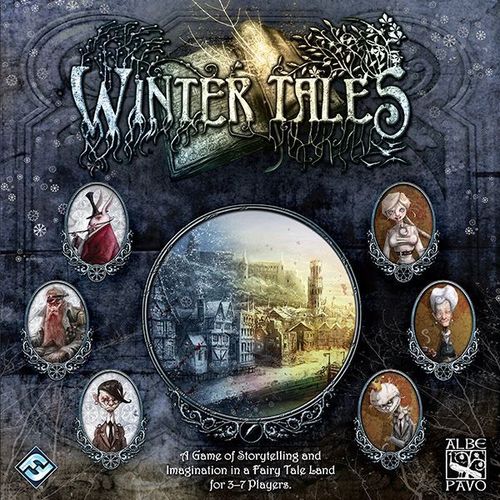
Winter Tales
Winter Tales Rulebook
Table of Contents
Table of Contents
From the Authors
Winter Tales is a storytelling game. It is neither a strategy game nor a resource management game. If you like to use your imagination and tell stories to spend a memorable evening with your friends, then this is the game for you. If you really want to appreciate this game, let yourself go and create with your friends a story to remember.
Don't let the size of this rulebook scare you off: most of it describes the setting, and there also are many lengthy examples. Read through this booklet once and start playing using the Summary Sheet, and you will see that the game is actually quite easy to learn.
Let your imagination run free and look for new interpretations for the Story cards you play, always listening carefully to what your fellow players are telling. Winter Tales can be an extremely gratifying game, so dive into the setting and let the story carry you along. Each game of Winter Tales will be a memorable experience, because you are creating the story!
The basic rules are simple, but you may integrate them with the Modules you will find at the end of the rulebook, which add new mechanics, strategies and story ideas. If, at the end of a game, you are satisfied and think you have created a beautiful story, regardless of having won or lost the game itself, then our efforts will have been worth it.
Basic Rules and Modules
This rulebook is divided into:
- Basic Rules
- Power Module
- Objective Module
- Skill Module
The Basic Rules of Winter Tales contain very simple mechanics, giving you all the freedom you need to unleash your imagination, without worrying too much about rules and strategies. These rules are thought for those who like role playing and storytelling, or for those who are looking for a family game, which often needs simple rules.
Expert gamers who like a more competitive approach may implement any and all Modules, which offer interesting new mechanics, allowing for a more strategic and competitive game, without taking anything from the storytelling, which is the true heart of Winter Tales.
Share Your Stories With Us
Have you created an interesting story in one of your games? Publish a short summary on the dedicated page of Winter Tales' official website, at www.wintertalesboardgame.com
Overview
The Game
Winter Tales is a storytelling board game for 3 to 7 players. In each game, the players will recount the subtle but merciless war between Fairy Tale characters, who stand for hope and freedom, and the Soldiers of Winter, who embody wickedness and oppression. Each player will belong to one of the Factions in play and will take control of some of its characters, fighting either for the return of Spring or to snuff out all hope and to further the arrival of an everlasting Winter.
Each game of Winter Tales is different, because each time you are telling a new story and creating a shared plot, in the first true social storytelling board game.
Storytelling
Winter Tales is not about the mere movement of pawns on a map or the use of skills and rules. The game involves the player on a much deeper level, making him the author of a shared story.
Even though each part of this rulebook indicates some storytelling guideline, the following suggestions will help make the game smoother and the story more plausible, in the end making the game more fun.
Listen to Others
Storytelling in Winter Tales is a shared experience. As such, it is much more fun if players listen to each other, accepting suggestions and ideas from others and trying to merge all their plots into one common story. If each player were to concentrate on his own characters, not taking in suggestions and ideas from others and writing a different story, the game would be no fun at all.
Coordinate Your Stories
The easiest way to create a truly engaging and interesting story is if players coordinate their telling, recalling what happened before and merging it into one's plot, even when the rules do not require it. It is much more fun to connect the recollection of a battle to the last completed Quest, looking for ways to justify this connection. Even better would it be to try and create links between the Memories generated by Quests.
Choose a Style
A game of Winter Tales may be completely different from all others played before not only because it tells a completely different story, but also because players may choose how to tell it. Choose to tell a drama, adding touches of anxiety and desperation, or a pulp story, with violence and gore. Do you prefer comedy or horror? You may choose whichever style you prefer, which will give each story its own unique flavour.
Let the Game Inspire You
The game itself may offer many ideas. Look at the board and let inspiration flow: who lives in that house amidst the church's ruins? Who comes from that far away castle, perched on a peak above a distant village, towards the mountains? What is carved on the obelisks in the cemetery?
Setting
Following the victory in the War of Autumn, the Regime of Winter has clutched the Land of Fairy Tales in its cold grasp. Fuelled by hate and fear, Winter aims at extinguishing the flame of Love and the light of Hope under a blanket of snow and the never-ending chill of a winter night. In the winding alleys and the small houses desperately clinging to the hillside, frightened Fairy Tales move in the shadows, knowing they cannot allow all Hope for the future to be snuffed out by the cold, and ready to fight to drive Winter away and let Spring come again.
Wintertown
(Setting prose on the town omitted; see source note.)
Locations
The board shows the following locations (flavour descriptions omitted):
- The Fair of Wonders
- Winter Prison: the new Headquarters of the Regime. Its dark dungeon cells accommodate the enemies of the Regime, and the howling siren at the top of the tallest tower announces the Soldiers' arrival and summons the Regime to meetings.
- Memory Lane Cemetery
- Mad Hatter Asylum: the home of the Mad Hatter, warden of the Re-education Psychiatric Ward.
- Oaks Park
- Dorothy's Mansion
- Nightmares Factory: the productive firm founded by the White Rabbit.
- Puppets Theatre: once a place for smiles and laughter, now shut down by the Regime.
The Characters
(Character backstories are flavour text and are omitted; the names, factions and card icons are transcribed.)
The Fairy Tales (Spring side)
- Alice (after Wonderland)
- Pinocchio, the Puppeteer
- The Scarecrow King
- Grandma Dorothy
- The Tin Man
- Grumpy
- The Little Match Girl
The Soldiers (Winter side)
- Mangiafuoco, the tyrant
- Wolf, the veteran
- The Fox and the Cat
- Snow White, Queen of Winter
- The White Rabbit
- Candlewick
- The Mad Hatter
Basic Rules
Overview of Play
Playing a Game and Goals
Before starting a game, the Players determine which Faction they will belong to and which characters they will control. Each Chapter is divided into Turns, during which Players will activate their characters one at a time, trying to complete Quests. While one Player is having their Turn, the others will have the opportunity to step in, initiating Battles and springing Traps to try and hinder the Acting Player. Each successfully completed Quest becomes a Memory, that will have a significant impact on the rest of the game! The creation of the right amount of Memories will trigger the Epilogue, which will include all generated Memories in the story and determine the winning Faction.
The Factions
During a game of Winter Tales, each Player belongs to one of the following Factions:
- Spring: this includes the Fairy Tales, who represent all that is good and positive in the world. Defeated in the Conflict of Autumn, this Faction now wages a partisan war to end the rule of the Regime of Winter and allow for the return of Spring.
- Winter: the cruel Regime that grips Wintertown in its evil clutches includes evil and ruthless Soldiers, who aim at crushing the Resistance and rule over the Town in an endless winter.
- Writer: used only in games with an odd number of Players, this Faction always includes only one Player, whose goal is to keep the balance between the other two warring Factions, by controlling characters from both Factions. The Writer wants the story to go on, and thus doesn't want either Faction to win over the other.
Winning Conditions
The Faction that wins the Epilogue wins the Game. Spring and Winter win if the Epilogue ends in their favour, while the Writer wins if the Epilogue ends with a draw.
Length of a Game
The standard length of a game is 3 Memories. Once the third Memory has been generated, the Epilogue is played and the game ends.
Longer games (optional rule): Players may choose to play a longer game, using more Memories. The length of the game is determined by the starting position of the Epilogue tile (to the right of the last used Memory cell, see Setup). If, for example, Players decide to play to the 5th Memory, the Epilogue tile will be placed on the 6th cell. Each Memory ideally adds 30 minutes to the game (so a 4 Memory game will last about 2 hours).
Components
- Characters: Winter Tales includes 14 characters, 7 Soldiers of Winter (from now on Soldiers) and 7 Fairy Tale characters (from now on Fairy Tales), each represented by a card. Players keep the cards in front of them on the ready side. Once a character is activated, the card is flipped to its backside. The icon on the lower left side of the card is used in the Skill Module.
- Game board: contains a map of Wintertown. The Town is divided into several Locations, connected by streets that include Squares (see Locations and Squares). Below the map there is the Memory Track, where cards will be placed to act as Memories. The rightmost space outside the Memory Track is used to place the Epilogue tile in a 7 Memory game. Icons on the Memory Track spaces are used in the Objective Module.
- Character figurines: each character is represented on the board by a cardboard figurine mounted on a plastic base (black for Fairy Tales, white for Soldiers), used to indicate the character's position on the map. When a character is incapacitated during the course of the game, the figurine is laid down on its side.
- Story Cards: used when facing Battles and Quests. Each Story Card has two sides, one for Spring and the other for Winter. Story Cards are played on the Spring side when used in favour of Fairy Tales (and against Soldiers) and on the Winter side when used in favour of Soldiers (and against Fairy Tales). The side shown by cards in the draw deck has no influence on the game.
- Neutral cards: used to indicate which Memories are in favour of neither Spring nor Winter.
- Faction counters: useful for reminding Players which Faction they belong to.
- Objective cards: used in the Objective Modules.
- Quest counters: the game includes 8 Quest counters for the 7 Quest types. 6 Quests are represented by only one counter, the background of which shows the colour of one of the Factions. The Great Artefact Quest is represented by two counters, one for each Faction.
Setup
Before starting a game:
- Place the game board in the middle of the table.
- Put all Story cards in one pile and place it on the side of the game board.
- Place the Epilogue tile on the 4th space of the Memory Track for a normal length game (3 Memories), or on the 5th, 6th, 7th or 8th space for a longer length game (4, 5, 6 or 7 Memories).
- Take as many Faction counters as there are Players, half for Spring and half for Winter. If the number of Players is odd, add the Writer Faction counter to the rest. Each Player takes one counter at random and places it in front of themselves. Starting with the younger Spring Player and continuing clockwise around the table, all Players seat themselves alternating one Spring and one Winter Player. If there is the Writer, he will sit last.
- Decide who the Story Arbiter will be (see Story Arbiter, Golden Rules). He receives the Story Arbiter counter. Note: the Story Arbiter should be either the owner of the game or the Player who knows the rules best.
- Each Player, starting with the youngest, chooses one character from the Character deck and places it in front of him, also choosing where to place the corresponding Character Figure on the map, either in a Location (Fairy Tales) or in a Square (Soldiers) that contains no other Character. He or she then passes the deck to the next Player of the same Faction, until all Players have the right number of Characters, based on the following table.
| Each Spring Player | Each Winter Player | Writer | Not used | |
|---|---|---|---|---|
| 3 players | 4 Fairy Tales | 4 Soldiers | 2 Fairy Tales, 2 Soldiers | 1 Fairy Tale, 1 Soldier |
| 4 players | 3 Fairy Tales | 3 Soldiers | - | 1 Fairy Tale, 1 Soldier |
| 5 players | 2 Fairy Tales | 2 Soldiers | 1 Fairy Tale, 1 Soldier | 2 Fairy Tales, 2 Soldiers |
| 6 players | 2 Fairy Tales | 2 Soldiers | - | 1 Fairy Tale, 1 Soldier |
| 7 players | 2 Fairy Tales | 2 Soldiers |
- Take the 4 Quest counters for Spring and select one at random. The youngest Spring Player decides in which Location to place it (see Quests). If present, the Writer places the Quest counter.
- Take the 4 Quest counters for Winter and select one at random. The youngest Winter Player decides where to place it (see Quests). If present, the Writer places the Quest counter.
- Either the Writer (if present) or the Story Arbiter begins the Story, introducing the goals for both Quests on the board, but leaving it as open-ended as possible.
- Each Player draws 4 Story cards. The Writer draws as many Story cards as there are Players in one of the Factions.
- The youngest Spring Player takes the Acting Player counter and starts the first round.
Chapters
Each Chapter in a game of Winter Tales consists of:
- Several Player Turns
- One End of Chapter Phase
1. Player Turn
On his Turn, a Player must activate one of his characters. Each character may be activated once per Chapter.
If the Acting Player still has one or more ready characters, he or she must choose one and activate it. If the Acting Player has no ready Character, his or her Turn ends immediately: the Acting Player counter is passed along clockwise to the next Player, who then completes his or her Turn and so on as long as there is at least one ready Character in play.
Activation
A Character may be activated at one of two possible moments:
- during the Turn of its owner, as long as it is the Acting Player, OR
- while another Player faces a Quest.
When a Player activates a Character, he or she:
- turns its card to the active side;
- draws 3 Story cards;
- may perform one or more Movements (see Movement below);
- may perform an action (see Actions below);
- discards down to 7 Story cards.
Whenever a Character is activated, the Player must contextualize and justify the activation (see Set the Scene and explain) in the Story.
Movement
A Character may be moved through Squares and Locations, represented on the game board by contoured spaces and bright circles on streets, respectively. To move the Character 2 spaces, the Player discards one Story card.
From the author: discard less useful Story cards to move your Character.
(Optional) Plot Movement: the Player inserts the movement itself in the story, connecting what he is telling to the image depicted by the Story card he discarded.
Actions
Once a Player has activated a Character, he or she may perform one of three different actions, depending on whose Turn it is.
During the Turn of the Acting Player, he or she may:
- Generate a new Quest: the Player chooses one new Quest from those available for the Faction his or her Character belongs to and places the corresponding Quest counter according to the "Counter placement" section of the chosen Quest.
- Start a Quest: if the Character ends its movement in a Location or Square containing a Quest counter of the same Faction, the Player may put the Ongoing Quest pawn on the counter and start facing the Quest (see Quests).
During another Player's Turn, a Player cannot perform any of the actions above, but may:
- Take part in a Quest: if the Character ends its movement in a Location or Square containing both a Quest counter and the Ongoing Quest pawn, the Player may take part in the Quest.
Interrupts
While a Character of another Player is moving, it may be interrupted to:
- Initiate a Battle (Soldiers only): if a Fairy Tale moves into a Location or Square containing a Soldier, the latter's controller may initiate a Battle to try and block the Fairy Tale's movement and incapacitate it (see Battles).
- Spring a Trap (Fairy Tales only): if a Soldier moves into a Location or Square containing a Fairy Tale, the latter's owner may spring a Trap to try and block the Soldier's movement and incapacitate it (see Traps).
Opportunity
Opportunity actions may be performed at any time, by any Player who can, both in his or her Turn and in another Acting Player's Turn. The Actions the Player may choose from are:
- Saves: if the Character moves through a Location or Square containing an incapacitated Character of the same Faction, its owner may revive the Character, pick up its figurine and put it back on its feet.
- Objectives: Objectives are used in the Objective Module.
2. End of Chapter Phase
The Chapter ends when all Characters have been activated.
Each Player draws 4 Story cards (the Writer draws as many Story cards as there are Players in one of the Factions). All Character cards are turned back to their ready side.
From the author: Most of the time, the Acting Player will play a Character by activating it, while a Player of another Faction will play an Interrupt. When a Quest is being faced, however, even Players other than the Acting Player may perform an activation, to move one of their characters and have it take part in the Ongoing Quest. Since they are moving the Character, this movement may also be interrupted (possibly even by the Acting Player).
Telling the Story
The Golden Rules
The following rules have been implemented with the aim of improving the quality of the story by cooperating with the other Players. These simple guidelines should be followed at all times, especially when telling the story.
1. Help One Another
Players are free and encouraged to help each other while telling the story. If a player is having difficulties in telling something (or if they are telling something out of place in the current setting), all players are encouraged to help him or her to create the best possible story: competition is supposed to be limited to actions (the choice of which is made by the single player), but the beauty of the story is something all players should work for together.
Example: Achille is facing the "Love that melts the snow" Quest with Alice. He moves the Character to Oaks Park, where the "Love that melts the snow" counter is and meets the Scarecrow. Andrew starts his telling:
"Alice slipped out of her cell asking herself for which lucky strike the jailor had forgotten to lock it. Running away from the Asylum, she ended up at Oaks Park."
"Wait," says Clara. "Wouldn't it be nicer if Alice had received an unsigned note telling her to go to Oaks Park?"
"Nice one," replies Achille. "It might be the Scarecrow allowed her to escape. Being a psychologist, he may have been able to enter the Asylum."
"I can also give you a nice way to justify this," Daniele says. "We have just generated the Freezing Horror Quest in the Asylum. Maybe the Scarecrow found out that the Freezing Horror was to be generated by experimenting on Alice!"
"Cool," says Achille. "So maybe you then can make an Armed Retaliation to this escape. Nice idea, I'll accept your suggestions!"
2. Set the Scene and Explain
Each time a Character is activated, the Player must set the scene and explain in the story how the Character intervenes. Ask yourselves some specific questions, since the answers could lead to a coherent story, so it is always useful to keep in mind:
- where the Character is: not only the Location, but also what it has been doing and thinking, its posture etc.;
- why the Character is stepping into the story and how this is linked to what is going on: what makes it act, in what way is this connected to the plot? Out of context actions do not help the story. The Character may have a specific reason, maybe even a specific goal, to step in;
- how the Character steps into the action: how will it act? Does it have a plan?
Pay attention to the context: where is the story taking place? Which other Characters are there? Set the story in a specific context.
3. A Nice Story Comes First
Quality in Winter Tales is what matters most and it is what you should strive for when problems arise. If everybody agrees about some detail that would not be allowed by the rules, these may well be overlooked in the specific case, in order to make the story better.
Story Cards
Story Cards are the heart of Winter Tales and are used in all storytelling mechanics. The images were made by children and reflect pure imagination, hopes and dreams, be them good or bad.
Story Cards must be kept hidden from your fellow Players (for example by forming one single pile in your hands or in front of you, to hide the total number of cards you have). Each card shows the same image on both sides, in two different colors: this makes it easier for Players to remember whether the Card has been played for the Fairy Tales (Spring side) or for the Soldiers (Winter side).
When playing a Story Card, you must always put what the Card represents in the story you are telling, explaining the concept it represents and to which it is linked. You are not bound to translate the image into an object, but can use it to represent a feeling or sensation connected to it.
Examples of Story Cards (the captions printed on each side suggest possible uses): Spring: "Stars lighting your way in the night", "Glowing eyes in the dark woods", "Hopeful lights shining in the dark", "Salt spread on the road to melt the ice". Winter: "Wounds on Alice's skin caused by the cold", "A snowfall that suffocates all hope", "Sparks that will start a fire", "Bullet holes on the walls of Dorothy's Mansion". Spring: "A bottle to be opened to drink to Life", "A canteen in memory of a mountain-loving grandfather", "Thinking about drinking with friends", "Bread and wine to keep warm". Winter: "A vial of cyanide hidden in Grumpy's flask", "Drowning one's sorrows in alcohol", "Poison to pollute the wells of Wintertown", "A Molotov cocktail to be thrown at the Puppets theatre". Spring: "A gentle song being played on the piano", "A cart where to hide from the Soldiers' patrols", "An anonymous package with a bomb to blow up the prison", "Setting the table for a dinner with guests". Winter: "The funeral of a Tale at the cemetery", "Leading one's enemies into a trap", "A lonely supper, remembering long gone friends", "Nightmares that do not make one sleep at night".
REMEMBER: do not interrupt the story to play a Story card. Just play the card at the moment you are expressing the concept depicted on it, as to make it clearer for other Players and to avoid interrupting the story.
From the author: the images depicted on the Story cards were created by two children of 5 and 9. These images give you as much freedom as you may possibly need. We have no desire to constrain your imagination! It is up to the Players (and mostly to the storytelling Arbiter) to stimulate a player to read in the Cards something that may help the story, should they have trouble finding it.
General Rules
Story Arbiter
All players cooperate to create the best story possible, but it's up to the Story Arbiter to decide what direction the story should take. The player who is nominated Story Arbiter always has the last word in matters pertaining to the flavour of the plots created by other players, whenever they cannot agree on one common road (as per Golden Rule 1. Help one another): the Arbiter must be impartial and must strive to create the best possible story. He or she should be well versed in both the rules and the Characters' stories.
Remember: the Story Arbiter may not change the mechanics of the game, but only indicate the right direction for following the story, prompting other players to change those parts of the story that clash with the setting or which may be considered distasteful.
Locations and Squares
Locations
Wintertown is full of weird Locations. There you may feel strongest either the dark presence of Winter or the soft murmur of Spring. These Locations are where the conflict takes place, and from them Tales and Soldiers get the strength they need to fight their war.
Each Location is represented by:
- its name;
- a small Power slot to contain the appropriate Power counter (see Power Module);
- a bigger Main slot with the depiction of the Location, to contain both Characters and Quest counters.
Each Location may contain at most one Quest counter. There is no limit to the number of Characters that may find themselves in that Location at one time.
Squares
Aware of the plots being hatched in the shadows by the Resistance, established a strict curfew in Wintertown. The shady town Squares are now under the domain of the Soldiers, while Fairy Tales wearily sneak along between Locations.
Town Squares, represented by a haloed circle connected by streets, see Characters passing by while activated. Squares may contain neither Quests nor Powers. The Square in the middle of the game board (the one with the statue of Mangiafuoco) is still considered a Square like all others. There is no limit to the number of Characters that may find themselves in a Square at one time.
Quests
There is a time and a place to tell a story. But there also is a reason. Quests represent the chances that Characters may take to win against the enemy Faction and create favourable Memories. Quests are the most important inspiration for the stories of Winter Tales.
Quests are faced by Players to generate favourable Memories for their Faction.
Quest Generation
The Player who wishes to generate a new Quest chooses a Quest counter among those of his or her Faction that has not already been used (the Writer may choose from any Faction's Quests). Placement of the counter depends on the Quest type chosen. Look at the "Counter placement" section of the Quest Data to know where to place the counter. Each time a Quest is created the Player must insert it in the Story, leaving all main features of the Quest as open ended as possible, so as not to inhibit the other Players from continuing the Story.
If the Quest counter needs to be placed in a specific Location, put it in the Main slot of the corresponding Location. A Quest counter may never be placed in the Main slot of a Location that already contains another Quest counter.
Each Quest may be generated once per game.
Remember: Quests that are placed on the board during the setup will be inserted in the Story by the Players who place their Quest counters (or by the Writer).
Example (Quest Generation): Edoardo is the Acting Player. He activates Pinocchio, draws 3 Story Cards and declares his intention to generate a new Quest. He chooses the Great Artefact Quest and looks for a Location to place the Quest counter. He may not place it in the Nightmares Factory, since its slot already contains the Freezing Horror Quest counter. He could place it in any other free Location, such as Oaks Park. He decides and places it at the Fair of Wonders, turning the counter on its "Spring" side. He then begins the Quest Plot.
"Pinocchio walked along the walls of Winter Prison, trying to keep warm in his overcoat. Seeing him like that would make a passer-by think he was trying to stay out of the wind sweeping the streets, but he was actually looking through the Prison's narrow windows, looking for weak spots to be used to hit the place and ruin the plans of the Regime. While his mind created intricate plans of rebellion and assaults on the fortress, he could not help but think that the Fairy Tales needed something more than just weapons. They needed a relic to inspire the Resistance in the revolution that was brewing. Pinocchio knew the place to start looking for such an item was the Fair of Wonders!"
Quest Types
The Quest counter indicates what the objective and the theme of the Quest are. When facing a Quest, stick to the following guidelines.
A New Hope (Spring)
- Counter placement: the Quest counter may be placed in any Location.
- Objective: find something to raise hope for the return of Spring. It may be a place, an object, a living thing or even a Character.
Examples: Grumpy makes candles to light up Wintertown. The light shed by the candles is so bright and warm that it drives fear from the hearts of the people. / Alice knows the secret of Oaks Park, where flowers were planted that will bring Winter to an end when they bloom.
Love that Melts the Snow (Spring)
- Counter placement: the Quest counter is placed under a Fairy Tale Character figurine of choice. The counter will move along with the figurine.
- Objective: create a deep connection between two Fairy Tales. It may be a strong friendship, parental love or true love.
Examples: Pinocchio falls in love with Alice and decides to use his Love to save her from her madness. / A great friendship is shared by Grumpy and the Tin Man, drinking buddies.
From the Author: the Fairy Tale under which the Quest counter is placed feels a very deep love, so strong it can melt snow. Completing the Quest will reveal who the Fairy Tale loves so deeply.
The Safe House (Spring)
- Counter placement: the Quest counter may be placed in any Location.
- Objective: find a safe house guaranteeing shelter and protection. It must be a secluded and protected place, which may represent a haven from the Soldiers' attacks, a heart-warming house or the headquarters of the Resistance, where members meet and conspire.
Examples: the basement of Dorothy's Place is turned into the headquarters of the Resistance. / Alice builds a tree house in Oaks Park, where she grows multi-coloured flowers.
The Great Artefact (Both Factions)
- When generated: the Quest counter may be placed in any Location.
- Objective: get your hands on a truly powerful object. It may be the search, the discovery, the creation or whatever other action which allows the Faction to own a Great Artefact to help them in the struggle against the enemy.
Examples: Pinocchio carves the Spring Flute in a block of wood and uses it to call out to the warm southern wind. / Candlewick discovers something in the Wintertown Ossuary. It is an eyeglass that allows the wearer to see a person's soul and discover their secret fears.
Freezing Horror (Winter)
- Counter placement: the Quest counter may be placed in any Location.
- Objective: create or discover a real, dark, grim threat pending on Wintertown to strike at the Fairy Tales wherever they may be, leaving only horror and fear in its wake.
Examples: The happiest and most pure child in town is corrupted and experimented upon at Nightmares Factory to become the great corrupter of Hope for the Fairy Tales. / A red snow, distilled from pure hatred in the laboratories of Nightmares Factory and spread through the air, starts falling on the Fairy Tales, bringing terror, hatred and chaos to Wintertown.
Winter Propaganda (Winter)
- Counter placement: the Quest counter may be placed in any Location.
- Objective: win against the Fairy Tales, destroying their morale and cutting support from the townsfolk. It may be misleading news or actions, or disinformation being spread around town. It is a psychological attack of Winter against the Fairy Tales to destroy their will to fight, their hopes of winning and the support of the general population.
Examples: a message goes around depicting Snowwhite as the magnanimous Lady of Winter and it captivates townsfolk and Fairy Tales alike, luring them to a world of eternal darkness. / A slander about Grumpy's Candle Factory aims at covering the town in the darkness and fear of the long winter nights.
Armed Retaliation (Winter)
- Counter placement: the Quest counter is placed under the figurine of the target Fairy Tale.
- Objective: hit the Fairy Tales in revenge or sabotage them, trying to inflict as much damage as possible and to weaken the defences of the Resistance.
Examples: the wolf leads an assault on the Fairy Tales safe house in Oaks Park. / The Mad Hatter captures Alice and locks her in the deepest dungeon of the Asylum.
Facing a Quest
One of the Player's Characters must be present in the Location containing a Quest counter of its Faction.
1. The Quest Begins
The Acting Player may start a Quest by declaring his or her intention to complete it. The Player takes the Ongoing Quest pawn and places it on the Quest counter. He or she then begins the Quest plot, connecting it to the introduction told by whoever has generated the Quest, and describing how the Character intends to complete it.
- Important: when you introduce the Quest, you have to link your story to the Bookmark, if present (see BOOKMARK, pag. 20).
Example (The Quest begins): Clara had previously generated the "A New Hope" Quest in Nightmares Factory, telling how Pinocchio looked out of the highest window of the Puppets Theatre and saw that the pile of rubbish at the back of the factory seemed to emanate a warm and comforting light. It is now Edoardo's turn as Acting Player: he activates Grumpy, who is in the Fair of Wonders, draws 3 Story cards and decides he will face the Quest. First of all, Edoardo must set the scene and explain Grumpy's part in the Quest.
Example (continued): Edoardo's Grumpy plot continues: "...petal, falling like a lonely snowflake. The fact was strange in itself, but what was even weirder was that the petal did not seem so much to be falling, but to be floating around, following a specific route, and it started glowing more and more the farther it got from him. Grumpy decided to follow the floating petal, pushing his way through the crowd of the Fair." Edoardo discards a Story card, takes the Character figurine and moves it to the Square and from there to the Asylum. He discards another card and moves Grumpy into another Square and, from there, onto Nightmares Factory. Now Edoardo takes the Ongoing Quest pawn and places it on the A New Hope Quest counter and begins his Quest. "Grumpy was dumbstruck, when he noticed the glow was not coming from the petal, but from something at the top of a big pile of rubbish at the back of the factory."
2. Activation of More Characters
Once the Acting Player has finished the introduction, starting from the Player on his left, all other Players clockwise around the table have the chance to activate one of their Characters and move it towards the Quest Location to have it take part in the Quest. All players that activate one of their Characters in such a way have to add to the plot, telling how and why their Characters intervene. They then move the Characters (the movement may be intercepted by Characters of the opposite Faction with Battles or Traps). The Characters belonging to other Players may take part in the Quest only if they are able to move to the Location of the Ongoing Quest pawn. Taking part in an Ongoing Quest is the only Action that other Players than the Acting Player may perform.
From the Author: it is possible not to activate a Character only during the completion of a Quest started by another Player. In your Acting Player Turn you must activate your Characters.
*Example (Activation of more Characters): Francesca (Winter) sits on the left of Edoardo and her Characters are the White Rabbit and the Fox and the Cat. Since both Characters have already been activated, she should not be able to act. The White Rabbit, however, already is in Nightmares Factory, so she will have the opportunity of having it take part in the Quest. Both Characters belonging to Giovanni (Writer) are ready, so he could well intervene in favour of one of the Factions, but he is satisfied with the balance that has been reached so far and decides not to act. Play now passes to Achille (Spring) and he decides to activate the Tin Man, who is in Winter Prison. Achille draws 2 Story cards and tells of the Tin Man's part. "The Tin Man lay abandoned close to a destroyed tank. He had shortly reopened his eyes after the long sleep he had let take him, when he noticed his arms and legs were frozen stiff. With horror he looked as soldiers took him and put him in a cart full of trash. He could do nothing to avoid being taken, but the soldiers seemed unaware that he had awoken." Achille discards one card to move the Tin Man to Nightmares Factory. On his way he passes Candlewick, who belongs to Benedetta (Winter). Since she has no Story cards, however, she cannot initiate a Battle. Achille goes on:
"The Tin Man felt fear grip him when he saw the soldiers were taking him to Nightmares Factory and he imagined horrible experiments on his frozen body. Then, with great relief, he was thrown into a huge pile of rubbish. At least I'm in no danger, he thought. And then, suddenly, he felt warmth spread through his body. Something was alive here..."
Benedetta has already activated her Wolf, so she must pass, since she has no ready Character. Clara (Spring) is left with only one card. While she could activate Dorothy, she would have to discard 3 cards to get her to Nightmares Factory from Memory Lane Cemetery, so she decides to keep her ready for another time. Daniele (Winter) is the last player, but he finds himself in the same situation as Clara. Moreover, having no cards in his hand, even activating his Madhatter he would have no cards left once he moved him to Nightmares Factory, so he resigns to doing nothing. Play goes now back to Edoardo, who can begin the Quest itself.
Example (Edoardo begins the Quest): "Curious, Grumpy walked closer to see what was creating the reassuring glow (while saying "reassuring glow" Edoardo plays his first Story card on the Spring side) and noticed that it came from a small flower growing from the top of the pile of rubbish. Moreover, while all trees and plants throughout Wintertown were frozen and withered, around the pile a few green blades of grass were appearing, while on the bushes and plants around it the first shoots were sprouting. Hope surged through Grumpy's soul and he got closer to the pile of rubbish, intending to find out what was generating the glow." Edoardo thus closes his part, leaving it open ended to allow other Players to step in.
3. The Acting Player Begins
Once all Players have been offered the possibility of activating and moving one of their Characters, it is the Acting Player's turn to start a short plot, during which he or she may play a number of Story Cards on his or her Faction's side, explaining the interpretation of each image.
The plot must follow these simple narrative guidelines:
- It must follow the guidelines outlined in the "Objective" section of the Ongoing Quest.
- No character may die or be eliminated from the game.
- The ending must not be told at this time. The plot must remain as open ended as possible.
There is no time limit in which to complete this phase, but Players should play one card every two or three sentences, keeping the plot as lively as they can.
It sure looks like a lot of things you need to remember, but you will notice it's actually quite simple. Who is the Main character? Where is he or she? What does he or she intends to do? How has the story come to this? Always remember that a Quest is just a chapter in the bigger story, so it must not have any definitive results, such as the death of a Character.
4. Other Players Step In
Once the Acting Player has finished telling his or her part of the story, all other Players, starting with the next one on the left and going clockwise around the table, will have the opportunity to step into the Quest with the Character they have activated, OR with another Character that is already present in the Location where the Ongoing Quest counter is, even if the same Character has been previously activated in the same Chapter.
The intervening Player continues the story where the Acting Player left it, either helping in the Quest (playing Story cards on the same side as the Acting Player) or trying to hinder it (playing Story cards on the opposite side). He or she may play any number of cards to do this. The Player will tell how the Character takes part in the Quest to help or hinder the Acting Player. The plot, however, must be left open ended and must not have any definitive consequences at this stage.
Example (Other Players step in): Francesca (Winter) decides to step in with her White Rabbit, which has already been activated in this Chapter, but is in Nightmares Factory. Francesca tells her part: "While Grumpy walked closer to the rubbish pile, he did not see the shadow spying on him from a high window behind him. The White Rabbit was looking down, and he had already alerted the Factory guards. He left the window, walked slowly down the steps and opened the door, stepping out into the courtyard. 'Well, well, look who we have here. Did you really think I wouldn't hear your noisy footsteps? Look around you, dwarf! You have nowhere to go.'
Example (continued): "Meanwhile, the guards were moving to surround Grumpy. 'I see you like that flower. How cute. It's a pity, is it not, that my guards are about to take that pile of rubbish and throw it, along with our precious flower, in the furnace of my factory! Who knows, maybe melting those down will help me in creating some new weapon I can use to crush your pitiful rebellion. And as for you, you're so pathetic I won't even get my own hands dirty. Guards, give him a lesson and throw him out of my land!' Poor old Grumpy shook in fear while the guards approached him."
Giovanni chose not to take part in the Quest, so it is now up to Achille and his Tin Man.
Example (continued): "The guards were about to grab poor old Grumpy, when suddenly the sun stopped shining. A solar eclipse was hiding the light, and the White Rabbit laughed at this sign, that he considered favorable for the Regime. His laughter was short lived, however, and was soon to be transformed into a mask of terror: something was emerging from the pile of rubbish, something like a metal face shining with the same warm glow as the flower. And after the face came a colossal body, shining like Spring, it's arms and legs like new and with a heart beating like a drum in his desire for revenge. The Tin Man was back, and now the Fairy Tales had a powerful paladin on their side, ready for war. The Tin Man jumped to the aid of Grumpy, and the stricken guards turned and ran." Since no more Players can step in (Benedetto, Clara and Daniele have been force to pass), play goes back to Edoardo, who will now play his last card.
5. The Acting Player's Last Card
When every other Player has had the chance of taking part in the Ongoing Quest, the Acting Player may play a last Story card, telling of the last effort of the Character to successfully complete the Quest. The plot must be left open ended.
Example (continued): Edoardo plays the last card: "Grumpy saw the Tin Man emerge from the pile of rubbish like a long lost hero come to bring justice and punishment upon the wicked Soldiers of Winter. He saw the champion that the Fairy Tales had been waiting for."
6. The Quest Ends
Now the Acting Player must end the Tale, concluding the plot created during the Quest.
Count all the Story Cards played for this Quest: if the Story cards of the Acting Player's Faction are more than those of the opposite Faction, the Quest is a success, while if the Story cards of the opposite Faction are more than those of the Acting Player's Faction, the Quest is a failure. Should there be the same number of Story cards for both Factions, the Quest ends with a draw and will favor no Faction. Whatever the conclusion is, the Acting Player must conclude the Quest plot, giving it a positive, negative or neutral ending, depending on which Faction won.
Example (continued): Spring Players used 6 cards, while Winter Players used 5, so Spring wins the A New Hope Quest. Edoardo must now end the plot. "The Tin Man trampled the guards, freeing poor old Grumpy. The even White Rabbit turned on his heels and ran for his life, hiding in the factory while a powerful light of hope glowed around the colossal hero. Grumpy just knew it: spring now had a champion on its side, a warlord, a new hope."
7. Consequences
The Ongoing Quest pawn and the Quest counter are removed from the Location.
The player who played the most cards in the winning Faction chooses one Story card that he believes is most representative of the concluded Quest (in case of a draw the Writer will choose, if present, or the Acting Player). This card becomes the Memory bound to this Quest and is placed on the first free space of the Memory Track. The Bookmark counter is placed on this Memory card (see Memories and the Bookmark).
If the Quest ended with a draw, place a neutral card in the first free Space of the Memory Track, with the Bookmark counter on it.
From the Author: the neutral Memory card has no evocative design. No specific concept is connected to that Memory, but players should recall in their plot the theme of the Quest ended with a draw.
Example (continued): The Quest has ended, and Edoardo chooses the Story card that better represents the outcome, the glow surrounding the Tin Man and places it in a free space on the Memory Track (one the left of the Epilogue Tile). He then places the Bookmark counter and the Quest counter on this card.
Memories and the Bookmark
Quests are not an end in themselves, but are a part of the greater conflict between Spring and Winter. Memories represent the most important plots and the relevant happenings, which can be used to connect one Quest to the next and must be included in the Epilogue.
Memories determine how the war goes between the two Factions, and most of all they will determine the winning Faction at the end of the Epilogue. Also they influence the story, creating a connection between the stories, thought the use of the Bookmark.
1. Memories
Whenever a Quest is completed, it becomes a Quest Memory. Place the Story Cards you have chosen at the end of the Quest on a free space of the Memory Track on the left of the Epilogue Tile (see Consequences) on the side of the Faction that won the Quest. The Quest counter goes on top of this card. As the story goes, the Memory is made of the concept illustrated by the Story card just as it has been told: remember to listen closely to what the other Players are telling!
From the Author: identifying a successful Quest is easy: just look at the cards and the counters on the Memory Track. If the card and the counter are the same color, the Quest was a success, else it was a failure.
2. The Bookmark
The Bookmark is the thread that keeps the different plots together. Place the counter on the card identifying the last finished Quest, it stands as a reminder of which concept will have to be taken into account while beginning the plot of the next Quest. The bookmarked card may not be freely reinterpreted, but the concept used must be recalled and connected to the new plot. Telling of the connection between the new Quest and the bookmarked Memory is compulsory. Should the Acting Player forget or not be able to do this, the Quest will automatically be considered a failure. Concepts related to the Memory become threads for the new story being told and will have to be taken into account both in future Quests and in the Epilogue at the end of the game.
From the Author: Battles and Traps do not generate Memories and are not used in connection with the Bookmark. They are purely action oriented events that do not contribute to the creation of the story. The Bookmark forces Players to create a thread tying all Quests together. This imaginative effort has the goal of having the Players create a fluent and coherent story. It would be much easier to tell each plot without recurring to the Bookmark rules, but the events told would not be connected to one another, making a much less convincing and satisfying story.
Example (continued): In the following Chapter, Giovanni decides to activate Snow White, who is in the Puppets Theatre, to face the Freezing Horror Quest at Memory Lane Cemetery. She draws 3 Story cards and starts the plot, connecting it to the previous Quest Memory card (A New Hope), which has the Bookmark counter on it. "Snow White, surrounded by her servants, was sitting in the box, assisting to the performance recalling the triumph of Winter at the end of the Conflict of Autumn. Her personal guards already had advised her that the Tin Man had come back and of the Light of Hope that surrounded the great warrior, but she wasn't worried and continued to look at the performers, sure that the final victory would go to Winter. Just as the Battle of the Mist was being re-enacted, during which the armoured troops of the Regime had taken by surprise and subsequently destroyed the main enemy stronghold, in Snow White's ice cold mind a new, terrible idea was born: she would call forth the ghosts of Winter's armoured grenadiers to snuff out the Tin Man's Light in the cold, damp mists and rust his body and armour with their freezing horror. To wake the lost Heroes from the Battle of the Mist there was no better place than Memory Lane Cemetery." The scene is set and the Quests are connected, so Snow White can now be moved and Giovanni can begin the plot for the Freezing Horror Quest.
Battles
The Eye of the Regime is always vigil and ready to catch a glimpse of any plan being plotted against it. The Soldiers of Winter are always lurking in the shadows, ready to attack the unwary Fairy Tales.
The Soldiers can initiate Battles to stop Fairy Tales from moving and even to incapacitate them. A Winter Player may initiate a Battle when the Fairy Tale's movement passes through a space where there is a Soldier he or she controls. The Character may be used to initiate a Battle even if it has already been activated during the same Chapter.
Each Battle is divided into rounds:
1. Winter Attack Round
The Player controlling the Soldier plays one Story card on the Winter side, telling how the Character tries to capture, assault or torment the target Fairy Tale. The plot must follow these simple rules:
- It must not bring to the death or elimination of a Character.
- It must be left as open ended as possible and not brought to a conclusion at this time.
2. Spring Defence Round
The Spring Player may defend his Character using the same method: he or she plays a Story card on the Spring side and tells how the Character tries to escape, confront or annul the Soldier's attack. The same rules seen above apply to this plot.
3. Subsequent Rounds
The two Players alternate Rounds attacking and defending, all the while continuing the plot. This ends as soon as one of the Players cannot or does not wish to play a card. In this case the Battle is over.
4. Battle Winner
The winner of the Battle is the last Player to play a Card. The winner must end the plot, telling of how his or her Character is able to be successful on the enemy.
From the author: play the cards in a Battle one on top of the previous one. This way you will always have a clear idea on how the Battle is going and who the winner would be, should the Battle end at that moment.
5. Consequences
If the Soldier wins the Battle, the Fairy Tale's movement stops and the Character becomes incapacitated (see "Incapacitated Character" under "Incapacitated Characters and Saves"). The Winter Player may also place the Fairy Tale in a Location or Square of choice, but only if he or she can justify this movement in the plot. If the Fairy Tale wins, nothing happens, and it can continue its movement.
Battle Example: Clara is moving Granny Dorothy from Oaks Park to Memory Lane Cemetery, where the Freezing Horror Quest has been started. Clara activates the Character, draws 3 Story cards and discards one to move it into the Square dividing the two Locations, where Daniele's Mad Hatter is. Daniele interrupts her, blocking her movement from the road and initiating a Battle.
"A lantern in his hand, he stooped over the orphan, looking him deep in the eye. The had barely left the old dirty mill where he had bought the boy to experiment on when he saw her reflected in the huge child's eye. Granny Dorothy appeared in the glade behind him, pushing through the snow and the half buried rubble. He turned around and their eyes met. He knew she had recognized him: both his top hat and his bloody overall were unmistakble. He was the Mad Hatter, the manager of the Institute for the Criminally Insane. He walked towards the old lady, who seemed intent onto not drawing attention on herself. Pity, he never missed anything. "<
Traps
The Fairy Tales could never face the Soldiers in open battle. Town Squares are controlled by the Regime, but inside the buildings, in dank and dark basements and dusty attics, the Resistance schemes and attacks those Soldiers foolish enough to unwarily enter those hidden sanctuaries.
Traps are sprung by the Fairy Tales to block the movement of Soldiers and to incapacitate them. A Spring Player may spring a Trap whenever a Soldier enters the same Location as one of his or her Characters. The Fairy Tale may spring the Trap even if it has been previously activated in the same Chapter. If the Location contains more Fairy Tales who wish to spring the Trap, the Players controlling them must agree on who will do it. Only one Trap may be activated for every entrance of a Soldier in a Location.
Each Trap is divided into rounds:
1. Spring Trap-Springing Round
The Spring Player chooses the Story card that will represent the Trap and puts it temporarily aside. He or she then prepares the Trap, taking a few Story cards and hiding them under the Character card. Some will be placed Spring side up, others Winter side up. Only the Spring side cards will count towards the total of the Trap cards when it is finally sprung.
The Player then starts a plot describing towards which Trap the Character tries luring the Soldiers using the illustration of the Trap on the Story card selected at the beginning.
The plot should follow the same rules as a Battle:
- It must not bring to the death or elimination of a Character.
- It must be left open ended and cannot be concluded at this time.
2. Winter Defence Round
The Winter Player plays any number of Story cards Winter side up, telling how the Soldier tries to evade the Trap placed by the Fairy Tale. The answer must follow the same rules as the previous round.
3. Conclusion
The Spring Player shows how all the cards hidden under the Character card, and counts those on the Spring side. The Trap card does not count towards the total.
If there are more Winter cards, the Trap has no effect and the Soldier may complete its movement and activation.
If there is the same number of Winter and Spring cards, the Trap is sprung and the movement blocked: the Soldier is placed back on the square it started moving from. The activation ends there.
If there are more Spring cards, the Trap is sprung, the movement is blocked and the Soldier is incapacitated (see "Incapacitated Character" under "Incapacitated Characters and Saves").
In any case, the Trap Card and all other cards used in the two rounds are discarded (both the Spring cards hidden under the Character Card and those played by the Winter Player). The side who won must end the plot, telling what the effects of the trap were.
Trap Example: Benedetta activates Candlewick, who is in the Square between the Asylum and Oaks Park. She draws 3 Story cards and decides she will move Candlewick to Memory Lane Cemetery. She discards a card and starts the movement. Achille, who controls Alice in Oaks Park, tries to block his movement springing a Trap. Achille plays the Trap Card (a fake letter) and begins the plot.
"Some time ago, Alice had sent a letter to Candlewick hinting at the presence in Oaks Park of a press used by the Fairy Tales to print their propaganda against the Regime. Busy with all his schemes, Candlewick had not acted upon the letter, but now, passing through the park, he saw a small hut hidden in the trees and, remembering the letter, decided he would check it out. Little could he know that Alice had prepared a Trap to imprison him."
Now Achille organizes all cards in his hand to form a pile and places it under the Character card. Since he still has 3 cards, he places 2 Spring side up, using them for the Trap, while keeping the last one on the Winter side. Benedetta must now defend Candlewick against the trap, but she does not know how many cards Achille played for the Trap. Benedetta begins her part:
"Candlewick approached the hut among the trees, proceeding warily on the frozen snow. And stooped down to look through the keyhole. The small building was all but empty, and he immediately knew it was a trap to delay or, even worse, imprison him. He started retracing his steps, slowly. Someone would pay dearly for this."
Benedetto played 2 cards, but still doesn't know how many Achille has spent on his Trap. He reveals the cards under the Character card, ignoring the Trap card itself. Two cards are on the Spring side, so the Trap ended in a draw: Candlewick's movement is blocked, but the Soldier is not incapacitated. Achille must now end the plot.
"Cold rage took hold of Candlewick. He would track down the fools who had dared consider him so stupid as to fall for such a simple trick! He shouted for the guards who had just entered the park and ordered them to disarm the Traps and take them away to be inspected. He would find the culprit of such an arrogant attack on the best spy of the Regime. He became so focused on his investigation that he actually forgot the reason he had wanted to reach Memory Lane for."
Incapacitated Characters and Saves
A Fairy Tale is incapacitated if it loses a Battle against a Soldier. A Soldier is incapacitated if it falls into a Trap sprung by a Fairy Tale.
1. Incapacitated Character
When incapacitated, a Character's figurine is lain on its side on the board. An incapacitated Character can neither move nor perform actions. It may only perform a Save on itself.
2. Saves
A Save is an Opportunity action that may be performed by a Character on itself or on another Character of the same Faction to remove the Incapacitated condition. In order to perform such action the Player must play 2 Story cards and tell how the Character is saved from its condition. If the action is performed on another Character, the savior must be in the same Location or Square where the incapacitated Character is.
Example (Saves): Edoardo activates the Scarecrow, draws 3 Story Cards and moves it from the Puppets Theatre to Winter Prison (where the incapacitated Dorothy is). He starts the plot. "The Scarecrow used to infiltrate the Prison. He knew that someday Granny would end up in the clutches of the Mad Hatter, and he knew that when this happened there would be no hope for her. So use waited for the prisoners' lunch hour and put a few drops of a special sleeping drought in Dorothy's bottle. The ailment would make her fall into a deep sleep, similar to that of death. When the guards found Dorothy's body in her cell they put her in a BARA. The Scarecrow ended up being the one to take her to rest in the Cemetery, so he was able to take Granny away from the prison, slipping her right under the guards' nose."
The Epilogue
The Epilogue is the final act in the game. It starts as soon as the last free space in the Memory Track is filled with a Memory, and it ends the game.
1. The End Begins
The Player who begins the Epilogue is the one who placed the last Memory card on the Track. He or she takes the Epilogue Tile and places it in front of him.
Remember: once the Epilogue has started it will not be possible to activate Characters and perform interrupts or opportunities. Players will simply use those cards they still have in their hands.
The Epilogue Player plays his remaining Story cards, describing how his or her Characters try to inflict the final blow on the opposite Faction and win the war. The Epilogue Player must connect his Epilogue plot to the concept illustrated by the bookmarked Memory and begins to tell the plot, during which he or she may play any number of Story cards, explaining each concept as he or she plays cards.
The plot must follow these rules:
- It must aim at closing all opened Quest plots.
- Must be left open ended and cannot be concluded at this time.
The Epilogue involves all Characters, wherever they may be.
2. Other Players Step In
Once the Epilogue Player has finished his part, all other players, going clockwise around the table, have one chance to step in, following the same rules and acting in the same way. They play Story cards on their Faction's side and tell their part in favor of their Faction. Whichever Player contributes to the Epilogue must connect his or her part to one of the Memories on the Track.
3. And the Winner Is...
When every Player has used his cards and contributed to the Epilogue plot, the winner is determined. The Story cards played for each Faction are counted, and the Players add +3 for each favorable Memory in the Track. The Faction with the highest number of cards wins the Epilogue.
In case of a draw, the Epilogue is won by the Faction that started it, unless the Writer is present (see below).
The Faction that wins the Epilogue wins the game. Once the winning Faction has been found, the Epilogue Player concludes the story, closing all side plots and bringing the main story to an end according to the Epilogue.
4. Here Comes the Writer
The Writer always steps in last in the Epilogue. The Writer may play at most half of his or her cards rounded down, in favor of one Faction or the other. The Writer wins only if the struggle between the Factions ends in a draw.
5. (Optional Rule) Epilogue Bookmark
Each player must connect his part to the Memory where the Bookmark counter is. When a Player ends his part, he or she moves the Bookmark to another Memory of his or her liking.
Example (Epilogue): The Memories in the Memory Track are: "A New Hope", completed by Fairy Tales: The Tin Man, glowing in the warm light of Spring, has come to defeat the Soldiers and end Winter forever. "The Safehouse", completed by Fairy Tales: Dorothy has discovered a hidden glade in Oaks Park, to which Soldiers seem to be unable to find a path. Nature itself protects that sanctuary from the chilly Winter winds. "Armed retaliation", completed by Soldiers: Mangiafuoco has burned down the Puppets Theatre while a play by Pinocchio was being performed that was considered subversive. Daniele (Winter) has just completed the last Quest (Armed Retaliation), that caused the arson of the Puppets Theatre, and this started the Epilogue. Once the last Quest is complete, he begins to tell his part, connecting the events of the Epilogue to this last Quest and playing the cards he still has in his hand.
"The flames were raging in the Puppets Theatre and Mangiafuoco observed as the soldiers of the Regime searched the townsfolk, rounded up while they attended the impudent, subversive performance. Mangiafuoco gave the order and everything was taken from the attendees, then they were escorted to the Mad Hatter's Asylum, so that under the loving care of the Psychiatrist the dangerous cancer of revolt, insinuated in their naive souls by the rebel Pinocchio, could be eradicated. He looked at the mound where the folk's belongings were being piled up by his soldiers, Mangiafuoco's gaze was caught by the script of the play, which had ended up on the ground during the search. There were many similar scripts around it, waiting to be burned to ashes, but that specific one had drawn the tyrant's eye because it was far to bulgy to contain only the plot for that hideous play. Mangiafuoco barked an order and a soldier picked up the document and handed it over. He opened in disgust and saw an envelope slip out. It contained a few pages densely written. And then an evil smile creased the malignant face illuminated by the fire: the plans of the Resistance were finally in his grasp. That night, Mangiafuoco read the plans and was delighted to discover that the signal for the last strike of the rebels was to be announced by the bell tower, that would ring 13 times at the convened time. There was nothing left to do but to prepare a trap to end the Resistance in one last crushing blow."
Edoardo (Spring) is left with no cards, so even if his Scarecrow has not yet been activated, can do nothing, is forced to pass and will not take part in the Epilogue.
Francesca (Winter) can now continue the story in favour of Winter. She decides she will connect to the Safe House Memory. "That same evening the White Rabbit went to see Mangiafuoco to commend him for the afternoon's actions. The bottle of his favourite brandy was enough to loosen the tyrant's tongue, and the two of them could freely discuss about how to use the plans of the Resistance against them. Suddenly the White Rabbit had an epiphany: they would draw the populace in one place, secretly surrounded by the soldiers of the Regime, and then they would allow the thirteen strokes of the bell to be heard. The rebels would rise up together, comforted by the fact they were all together but not know to be herded in a trap created just for them. Then would the soldiers step in and choke the rebellion once and for all, with a last swift squeeze. That was not all, moreover: the White Rabbit knew exactly how and where to draw them out to. Each year, at the time of Winter Solstice, a concert was held in Wintertown to celebrate the crest between winter and the slow, inexorable comeback of Spring. The concert would usually be held in the Puppets Theatre, but the White Rabbit had a great idea for an alternative venue. He smiled to this brother in arms. 'Do not keep them from having the concert, let them celebrate in Oaks Park, where we know they hide. Make them feel safe and let them play unsanctioned music. When they are relaxed and sure of themselves, then will we strike!'"
Play would normally now go to Giovanni who, however, being the writer will go last in the Epilogue, after everyone else have had their chance.
Achille (Spring) chooses the A New Hope Quest as the link between the Memories and the Epilogue. "It was just his that put the Resistance on edge. The Regime had never allowed the townsfolk to play music that had not been approved, nothing different from the gloomy military fanfares of Winter, forcing the people to bow down in deference. The rebel spies were unleashed and it did not take them too much for Pinocchio to notice strange movements around the bell tower, while troops were moving in the shadows, amassing in the Park. The Regime was certainly up to something. Time was running out. It was not that difficult to understand what Mangiafuoco had in mind. Giving permission to celebrate the Solstice Concert was just too suspicious not to set their minds on edge. New plans were made and dispatches were sent to the members of the Resistance, telling them to stay safe and be ready to strike against the soldiers preparing the ambush. The Tin Man would have attacked the armoured troops head on and would have cut off the retreat at the gates of the Park. Once the soldiers found themselves surrounded, the hunters would become the hunted!"
Benedetta (Winter) has no cards left helping Daniele to successfully complete the Armed Retaliation Quest and she also must pass.
The last Player before the Writer is Clara (Spring), who decides she will link her part to the Safe House Quest. "The partisans of Spring where taking their places, while Dorothy listened to the sweet melodies coming from the concert in the secluded glade. Sitting with her eyes closed, she felt her perceptions spread out from her body. She felt the pale rays of the winter sun become warmer and warmer, the rustle of new shoots coming back to life, she thought she could hear the soldiers grin, hidden in the bushes or the beating of the thousand hearts of her fellow partisans, ready for the revolution. The old lady smiled: today the usurpers would be defeated, today the Regime would fall."
Giovanni is the Writer and, in order to win, must try and keep the balance, ending the Epilogue in a draw. At the moment, the Spring Players have played 6 Story Cards and also have an advantage of 1 Memory in the Track, for a total of 9 in the Epilogue. Soldiers have played 7 cards, so Spring is 2 ahead. In order for the two Faction to tie, Giovanni would have to play 2 cards in favour of Winter. He has 3 cards in his hand, but the rules specify the Writer may only play half of his cards, rounded down, in the Epilogue. This means he could play at most 1 card for Winter. He can't bring the story to an end that would make him win the game, so he decides he will not step in and lets Clara end the story.
"The plan of the Resistance worked perfectly. Anticipating his victory, Mangiafuoco had the bell ring thirteen strokes. The Soldiers readied themselves for the assault, but the Fairy Tales caught them by surprise and while the Soldiers threw down their weapons and surrendered, a warm Sun illuminated the Park. Up in the branches of a Cherry tree, frozen stiff in the winter chill, one single green shoot poked out of the wood: Spring had come."
Power Module
When the Power Module is in use, each successful Quest grants the player who completed it the possibility of using a special Power.
Activating Powers
The Power is activate if the Quest has been successfully completed by its Faction (as usual the Soldier can get Powers of both Factions). The Power may be represented by a specific Power counter. When a Power is activated, follow the Power description for indications on where to place its counter. A Location may only contain a Power counter in the corresponding Power space.
From the Author: Quest successfully completed for their Faction are easily recognizable, because the colour of the Memory card is the same as that of the Quest counter on it.
The Powers
Should a Power require a counter, the number of counters needed is indicated after the Power's name.
A New Hope: 1 counter
Place the Power counter face down on the Character card of the Fairy Tale that found/detains the power of Hope. The Player to whom the Character belongs may, once per Chapter, turn it back to its ready side after an activation, thus being able to activate it twice in the same Chapter.
Love That Melts The Snow: 2 counters
Place the Power counter on the Character cards of the two Fairy Tales that are now united. When one of the Characters is moved, the other may be moved with it for free. The two Characters may move together even if one of them is incapacitated. Moreover, the two connected Characters play Battles and Traps as one, so that both Players controlling them may play cards during a Battle or Trap in which they are involved.
The Safe House: 1 counter
Place the Power counter in the Power space of the Location where the Quest was completed. Once the Power has been activated no Fairy Tale is incapacitated anymore when losing a Battle, but instead they are placed in the Location containing the Power counter. The Freezing Horror counter may not be placed in the Location with this Power.
The Great Artefact: 1 counter
The Faction that completed the Quest may assign the Power counter to one of the Characters who took part in it. Each time that Character is played in a Quest or Battle plot, the Player it belongs to will always have the opportunity to playe the Memory connected to the Quest, explaining it in the plot. Do not remove the card from the Memory Track. The Player controlling the Great Artefact Power counter may pass it to another who has a Character in the same Location, but onlfy if he or she can justify it in the plot.
Freezing Horror: 1 counter
If the Player with this Power has no Soldiers left to activate, he or she may choose to use the Freezing Horror. When using the Power, the Player may move the Power counter in the Power space of any Location, immediately initiating a Battle with any Fairy Tale present in such Location. The first Card played for the Battle is the Memory connected to the Freezing Horror (do not remove the card from the Memory Track).
Winter Propaganda: no counter
Activate a Soldier wherever it is to use the Power. Turn the Character Card of a ready Fairy Tale to its activated side. That Character cannot be used in this Chapter. This Power must be used on Fairy Tales that have not yet been activated and may not target Characters that are being activated.
Armed Retaliation: no counter
When using the Power Module, target either a Fairy Tale or a Power granted to a Spring Player. The target is destroyed. If it is a Power, remove it from the game and change the color of the connected Memory. If the target is a Character, remove it from the game, it has fallen to the cruel Winter. This Power is the only way to definitively eliminate a Character. In no case may both a Character and a Power be eliminated at once. Should the target Character have a Power counter on it, the Armed Retaliation always destroys the Power.
The Fairy Tale returns: if the Armed Retaliation eliminated a Character, a Player may decide to skip a Turn and create a plot, playing 3 Story cards, telling how the eliminated Fairy Tale escapes the ordeal and comes back. The Character is placed in any Location (described in the plot), but its card is placed on its activated side, and may only be used again in the next Chapter.
Objective Module
Each Player has a secret Objective that, once completed, becomes a Memory.
Setup
After step 4 of the Setup phase (see Setup) and following the same order as that step, each Player draws in secret an Objective card of his Faction. He or she looks at the Objective card and keeps it face down in front of him or her. The Writer draws 2 Objectives, one for Spring and the other for Winter.
Objectives
War is not made only of grand battles, but also of daily skirmishes. The war between Spring and Winter is no different and is not made only of Quests, but also of secret Objectives.
The Objectives are completed by Players to create Memories for their Faction. Unlike Quests, Objectives do not grant Powers (when this and the Power Module are both in use) when completed.
From the Author: Quests are the main way for a Faction to obtain significant advantages in the struggle against the enemy, but Objectives are more numerous and easier to complete.
1. Completing Objectives
Objectives may be completed at any time in the game, when the right conditions are met. When a Player completes an Objective, he or she declares it, shows his card to confirm the completion and tells a brief plot using the theme indicated on the card and creating a link to the Bookmarked Memory. This way, a new Memory is formed.
2. Objective Memories
When a Memory is formed by an Objective, the Player places the Objective card on the Memory Track in one of the spaces indicated by the Objective icon. Only the three spaces with the Objective icon may be used to store Objective Memories. In the story, the Memory is made by the plot linked to the Objective as it has been told. Pay attention to the other Player's plots. It is of utmost importance to create an intriguing story.
3. Overwriting Memories
When placing a Memory created by completing a Quest, a Player may place it on an Objective Memory, overwriting it, whatever the colour of both Memories. Quest Memories may never be overwritten.
4. Game Length
When using the Objective Module, the game length must be of at least 5 Memories.
Remember: in any case, only the 3 Memory Track spaces with the Objective icon may be used to store Objective Memories.
The Objectives
The Reward (Winter): 2 cards
- Conditions: incapacitate a Fairy Tale at the end of a Battle.
- Themes: an advantage obtained through a direct assault on the Resistance, revenge for the actions of a Fairy Tale, intimidation.
Examples: Wolf shows himself to be the most formidable warrior, defeating the Tin Man in a duel / The Mad Hatter uncovers the plans of the Resistance when he submits Dorothy to electroshock Therapy.
The Spy (Winter): 2 cards
- Conditions: when a Fairy Tale moves through a Location or Square containing one of your Soldiers, reveal this card and place it face up in front of you. When a second Fairy Tale moves through a Location or Square containing one of your Soldiers, the Objective is completed.
- Themes: spying to follow the movements of Fairy Tales and obtain their secrets, tailing suspects, filing a suspect.
Examples: Candlewick discovers the position of the Fairy Tales' hideout / Mangiafuoco identifies the citizens that work with the Resistance.
The Attack (Winter): 2 cards
- Conditions: discard 2 Story cards while your character is in the indicated Location.
- Themes: the destruction of a Resistance hideout, sabotage, espionage.
Examples: Candlewick poisons the pantry in Dorothy's Place. / Snowwhite brands the Puppets' clothing in the Puppets Theatre with the symbol of the Regime.
The Garrison (Winter): 1 card
- Conditions: Soldiers are present in more different Locations than Fairy Tales.
- Themes: a roundup during which important documents are uncovered, a show of force to spread terror.
Examples: the White Rabbit finds and destroys all accesses to a network of tunnels through which Fairy Tales used to move around the town. / Wolf performs mass arrests to punish the population who aids the rebels.
The Rescue (Spring): 1 card
- Conditions: perform a Save action on an incapacitated Fairy Tale.
- Themes: freeing an imprisoned rebel, adding a wounded friend, healing him when sick. The plot for this Objective depends directly on the Battle that incapacitated the Character.
Examples: Alice treats a wounded Pinocchio, bitten by Wolf. / Grumpy helps the Scarecrow escape from Winter Prison.
The Resistance (Spring): 2 cards
- Conditions: incapacitate a Soldier with a Trap.
- Themes: imprisoning a Soldier with a trick, wounding it or rendering it unconscious.
Examples: Alice modifies the Electroshock machine and takes revenge for the tortures inflicted by the Mad Hatter by shocking him. / The Scarecrow lures the White Rabbit in a cellar and locks the door behind him.
The Connection (Spring): 4 cards
- Conditions: move through the Locations indicated on the Objective card. When the Fairy Tale moves to one of the Locations, reveal the Objective card and place it face up in front of you. If the Fairy Tale is able to reach the other Location during the same activation, the Objective is complete. If not, the card remains in front of you, and you may try to complete the Objective in another Chapter.
- Themes: a secret message, an important piece of information, handing over an artefact useful to the Resistance, the secret delivery of a new weapon.
Examples: The Tin Man takes the knight Puppet from the Theatre and puts it on the grave of his friend the Cowardly Lion. / Pinocchio transports a secret concoction, found in the Fair of Wonders, intending to pour it in the fuel tanks of Nightmares Factory.
Skill Module
When using this Module, all Characters will have a specific skill. To know which skill the Character has, look at the icon on the lower left of the Character card.
The Skills
The Character Skills are always in effect. They must be used in the plot, telling briefly how the Character uses its Skill.
- Objective (Alice + Candlewick): during the activation of the Character, the Player may use the Skill to discard the current Objective (only if not yet completed) and choose another one of the same Faction. Remember: if the Objective Module is not in use, consider Alice and Candlewick as though they had no Skill.
- Alice: "Objective": There is something more than delirium in Alice's madness. Where the simpletons hear only ramblings, others sense some kind of clairvoyance.
- Candlewick: "Objective": Nothing escapes Candlewick. Thanks to his innate skill to discover the hidden threads, he is able to clearly sense the enemy's weaknesses.
- Quest (Scarecrow + Mangiafuoco): whenever the Character takes part in a Quest, its Faction gains +1 in the count of the Story cards that determine the winning side.
- Scarecrow: "Quest": His above average intelligence and acuteness make the Scarecrow a formidable weaver of schemes to corrode the foundations of the Regime.
- Mangiafuoco: "Quest": His superior intelligence, added to his incredible charisma, make Mangiafuoco an infallible commander. It is thanks to these gifts that he can thwart any scheme of the Resistance.
- Trap (Pinocchio + The Fox and The Cat): whenever the Character is involved in a Trap, it gains +1 in the count of the Story cards that determine the winning side.
- Pinocchio: "Trap": Revolution is not fought with propaganda and ideas alone. Worthy successor of his father, Pinocchio has become an ingenious creator of weapons and traps alike.
- The Fox and The Cat: "Trap": The natural cunning of a fox, united to the guile of a cat, make this pair a terrible agent of the Regime and an enemy who is almost impossible to outsmart.