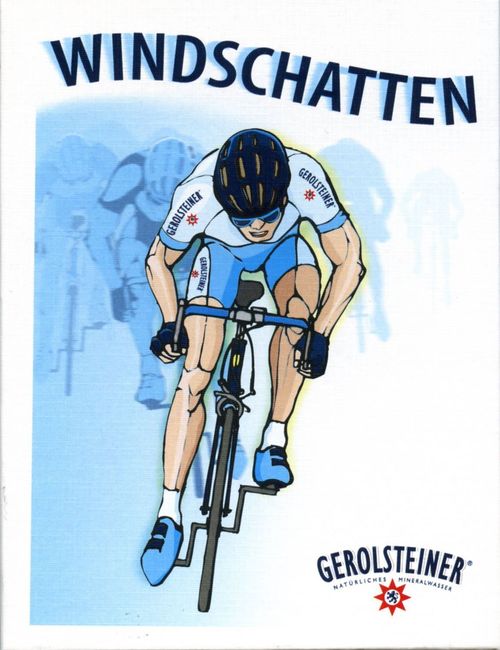
Windschatten
Windschatten Rulebook
Table of Contents
Table of Contents
Contents
- 12 cyclist cards
- 12 cyclist chips
- 12 perseverance chips
- 12 mineral water chips
- 1 "start/finish" card
- 11 track cards
- 1 die
- rules
Cyclists
Each team consists of 3 cyclists: a Mountain Specialist climbing uphill well, a Sprinter fast on a flat road and a Generalist in very good physical condition.
Each cyclist has a card that the player keeps in front of himself and a chip that is moved on the track cards. On each cyclist card the condition is marked with the small perseverance chip.
Track cards
Each track card has 18 spaces. Moving forward, left, or right costs one movement point. Moving backwards or diagonally is not allowed.
- Each track card represents a flat road, a hill or a mountain.
- The yellow arrow in the direction of movement tells whether a hill/mountain is an uphill or a downhill and the point values indicate how much to add or subtract from the die roll.
- The Mountain Specialist has the advantage when going uphill and the Sprinter has the advantage on the flat roads. On downhills and on the start/finish card, all cyclists are equal.
- The yellow-white of each card represents the inner part of the turn. These sides don't gave to match up. The cyclists on the inside of the curve have some advantages.
- The red-white bordered spaces on the track cards are dangerous and cost the cyclists one point of condition if they end their turn on the space. Riding over such a space does not result in a point loss.
- On some track cards, the Gerolsteiner banner waves near the outside lane. Here cyclists can fill up on mineral water. Whenever a cyclist ends his turn on one of the blue-bordered spaces, he gains back some of his lost condition points.
Setup
- The start/finish card is put into the centre of the table. The colours mark the starting spaces for each team.
- Shuffle the remaining track cards to form a draw deck.
- Draw 4 cards and place them next to the start card to form the track in any manner agreeable to all players.
- High roller select his colour and takes the matching cyclist cards, chips and 3 perseverance chips. Place these chips on the highest numbered space on each cyclist card. Place your 3 cyclist chips on your team's starting spaces.
- Next, each player in clockwise order chooses and sets up his team.
- With fewer than 4 players, slide the rear cyclists forward to take up the empty spots after all cyclists have been placed.
- Each player receives 3 mineral water chips with the values 2, 3, and 5.
The race
- Each round all cyclists move once.
- The movement sequence is based on the position of their cyclists on the track.
- Each round the leading cyclist begins. Then the cyclist in the 2nd position etc.
- If 2 or 3 cyclists are next to each other, always begin with the cyclist closer to the yellow-white border (exception: see Drafting).
- The cyclist in turn rolls the die. He may move up to the sum of the die roll + the value of the track + any applicable ability on his card.
- A cyclist can also spend up to 3 condition points each round. These are treated exactly like points rolled on the die.
- A blocked cyclist loses his turn.
As soon as the last cyclist leaves the start card, it is mixed face down with 4 of the remaining track cards. These 5 cards are immediately added to the end of the track face up. As soon as the finish card is revealed and added, the end of the race is certain. Any remaining track cards are discarded.
Drafting
- In order to move easier and save his condition points, a cyclist can use the draft of the cyclist in front of him, by announcing "Drafting" to his competitors immediately after the cyclist in front of him moves.
- The original movement sequence changes – you move in the draft as if it were your turn.
- Drafting adds one point to the value rolled on your die.
- Advantages: The Sprinter and the Generalist can climb more easily uphill and the Mountain Specialist can make up some of the distance lost to the Sprinter on the flat road.
- Disadvantages: Drafting must always end on the space directly behind the leading cyclist. On a bad roll, you have to use condition points to reach your destination space.
- NOTE! You cannot take back your announcement to draft after you roll the die!
- NOTE! A drafting path can end directly on a red-white danger space and cost one point of condition!
- All of the cyclists behind a lead cyclist can announce "Drafting". So a whole column can quite easily pull ahead of the rest of the field.
Condition
- The Sprinter and the Mountain Specialist start with 7 condition points, the Generalist has 9 due to his good condition.
- In each round, a player can add up to 3 condition points to the result of his die roll. These are taken off on the cyclist card (move the perseverance chip).
- If a cyclist ends his turn on a red-white danger space, one point is deducted from his condition.
- Condition can be filled up again, if the cyclist ends his move exactly on one of the blue-bordered spaces beside the Gerolsteiner Banner.
- The player can use one of his 3 mineral water chips. For the indicated value (2, 3, or 5) the cyclist adds condition (move the perseverance chip). Each mineral water chip may only be used once.
- A cyclist who loses his last condition point must give up and withdraw from the race.
Scoring
The race ends when 5 cyclists have crossed the finish line. The 1st cyclist scores 5 points, the 2nd 4 points etc.
The team with the most points wins!
The Tour Variant
3 stages are run: a Mountain stage, a Sprint stage and an Endurance stage. After each stage, all victory points are noted. The basic rules of the play remain the same, but when laying the track, the following is to be considered:
- In the first Mountain stage 3 mountain and 3 hill and 1 level cards are used. Only one downhill may occur.
- In the Sprint stage 3 level, 2 hill and 2 mountain cards are used. Only one uphill may occur.
- In the final Endurance stage 3 mountain, 3 hill, and 3 level cards are used. No more than three 3 downhills may occur. (Printed as "three 3 downhills" on the sheet; the count is not corrected here.)
With the Tour Variant players must divide their mineral water chips over the entire route. No used mineral water chips are returned after the end of a stage.
The team that scores the most victory points after the end of the 3 stages is the winner!