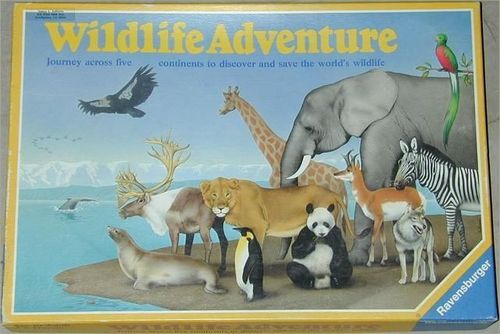
Wildlife Adventure
Wildlife Adventure Rulebook
Table of Contents
Table of Contents
Object of the Game
Three expeditions into the animal world take place simultaneously. Each player can take part in all three expeditions. Just like a naturalist he must search for a particular number of animals and in the process learn something about their individual circumstances.
The winner is the player who manages to influence the expedition routes the most skilfully in order to collect the highest number of animal cards.
Preparation
Lay the route extensions, chance cards and obstacles next to the board.
The playing board is laid in the centre of the table. The route extensions (arrows) are sorted into their colours and laid in easy reach of all players. The chance cards are shuffled and laid face-down next to the board. The three obstacles are also placed near the board.
Dealer is in charge of travel vouchers.
Players decide who shall be the dealer. The dealer must see that all rules are adhered to and also be in charge of the travel vouchers and animal cards. He may also take part in the game.
2 or 3 players = 12 animal cards. 4 to 6 players = 8 animal cards. 10 travel vouchers per player.
The animal cards are shuffled and dealt out unseen to all players:
- with 2 or 3 players each receives 12 animal cards
- with 4 to 6 players each receives 8 animal cards
The dealer also hands each player 10 travel vouchers.
Lay 6 animal cards face-up next to the board.
The dealer now lays 6 animal cards face-up at the edge of the playing board for all to see. These are the open discovery missions, which may be carried out by any of the players. The habitats of these 5 animals must be at least 3 route extensions away from the start point. The dealer checks this and exchanges cards for others in the stack if necessary.
Play
Animal cards = destinations which each player must reach.
The animal cards which the players have received give them destinations which they must try to reach on the expeditions during the course of the game. Players should sort their cards according to colour, so that they can more easily locate the animals.
The colours of the route extensions serve only to differentiate between the three expeditions. The three expeditions do not belong to any particular player. In fact players can take part in all expeditions by laying down the various route extensions. In this way the players all determine together the courses which the expeditions take. However, each player tries to influence the various routes so that he can reach his destinations as quickly as possible.
Rules of the Expeditions
All expeditions commence at the starting base.
Players decide who shall go first. Each player takes his turn in a clockwise direction round the board. All 3 expeditions commence at the starting base in Europe.
Lay 1 route extension each turn.
The first player takes a route extension of any colour and places it on any one of the four lines leading away from the start. In this way he marks out the first stretch of the first expedition on the board. The tip of the arrow should always point forward to the next space – i.e. to the place which the expedition has now reached.
Choose whether to begin an expedition or continue one.
Now the next player takes his turn. He can choose whether to start a new expedition or to continue the first one. If he decides to continue the first expedition, he must take a route extension of the same colour and lay it at the tip of the first arrow.
(Diagram: route extensions may only be laid at the tip of the arrow — the free end of an expedition.)
If the player decides to begin a new expedition, he chooses a different coloured route extension and lays it on any of the three free lines leading away from the start. In this way all three expeditions set out from the starting base. As long as at least one of the expeditions hasn't been started, players can still choose whether to commence an expedition or to continue one. As soon as all three have been started, players simply have the choice of which expedition to continue and in which exact direction. In this way players can alternate between expeditions.
Lay only at the free ends!
New route extensions may only be placed at the free end of an expedition. So each of the three expeditions has just one place where route extensions can be laid. Players must never branch off from a point earlier in the expedition.
(Diagram: no branching off — a route extension may not fork away from an earlier point in the expedition.)
Choose which direction to go. Exception: Parallel routes.
Players are free to choose the direction a particular expedition should take. However, laying a route extension parallel to an existing expedition requires the use of travel vouchers (see below under "Travel Vouchers").
A route extension must be laid.
Players must always lay a route extension on their turn, so long as this is possible. However, a player is not compelled to use his supply of travel vouchers in order to continue an expedition, e.g. to lay parallel route extensions or to remove obstacles.
Expeditions are not confined to one continent.
An expedition is not limited to one particular continent. For example, if an expedition set out in the direction of Africa, it can easily be diverted across the sea to South America and from there on to India or Australia, etc.
When all route extensions are used up, the expedition is over.
An expedition is completed when all the route extensions of its colour have been used up. When this happens, only expeditions which still have unused route extensions can be continued.
Reaching Destinations
An animal is reached: Read out the card and lay it down.
Each player tries to direct the routes so that the expeditions reach spaces for which he holds animal cards. Whenever an expedition reaches a space where the animal card is held by one of the players, this player immediately shows the card and reads out the information on numbers and reasons behind the problem. Then the player places the card face-up in front of him.
By reading the information aloud and then laying the card down, the player indicates that he has completed one of his discovery missions.
It does not matter whether the owner of the relevant animal card placed the last route extension or whether it was placed by another player.
The game now continues as normal.
No laying down of cards when the expedition has moved on.
If a player fails to notice that he should have read out and laid down one of his animal cards, he cannot do so once the expedition has moved on from this particular space. As long as it is still there, he may fulfil his mission. Otherwise, he must wait until an expedition once again reaches this space.
The Open Discovery Missions
Open discovery missions may be fulfilled by any player.
The animal cards which lay face-up at the edge of the board are discovery missions which can be fulfilled by any of the players. Whoever lays a route extension which leads right to one of these animals can claim the card. As before, he reads out the information on the card and then lays it face-up with any others representing missions he has completed.
The open discovery missions are not then made up to 6 cards again.
Meanings of the Spaces on the Board
There are five different types of spaces on the board:
Animal spaces
These have a different colour for each of the continents. This colour is repeated on the animal cards to make finding the whereabouts of the animals easier.
Red spaces
Take a chance card! Cards with a black star can be saved for later.
When a player lays a route extension which leads to a red space he must take the top chance card.
Chance Cards with a black star need not be used immediately. A player may decide to keep the card and use it at a more favourable moment. If he does keep it, it must be laid face-up next to him for all to see.
Use all other cards immediately!
All other chance cards must be used straightaway and their instructions followed.
Used chance cards are returned to the bottom of the pack.
Green spaces
Lay another route extension.
A green space means that the expeditions are making particularly fast progress. The player who lays a route extension leading to a green space may immediately lay another one to whichever expedition he chooses.
Blue spaces
The player receives 3 more travel vouchers or all other players receive another animal card.
When an expedition reaches a blue space the player concerned has two choices of action:
- he receives three more travel vouchers from the dealer,
or
- all other players receive a further animal card from the dealer, i.e. another discovery mission.
Arrow spaces
Continuing the expedition to the other side of the board.
Using these six spaces an expedition can cross from the left-hand side of the board to the right and vice versa. However, the expedition must always continue at the same level on the board – from Space I to Space I, from II to II etc.
The Travel Vouchers
Maximum of 3 travel vouchers per turn.
Each player can hand in his travel vouchers to the dealer for a variety of reasons. On any one turn a player may use a maximum of three vouchers. The player may use his vouchers both before and after he makes his move.
For one travel voucher either move obstacles or exchange an animal card.
For one travel voucher he can either:
- place one or more obstacles on the board,
- move one or more obstacles,
- swap one animal card for a new one. To do this the player places the card he is exchanging at the bottom of the pack. He then takes the top card from the pack.
For two travel vouchers either lay an extra route extension or remove a route extension or lay a parallel route extension.
For two travel vouchers a player can either:
- lay another route extension
or
- remove any route extension from the end of one of the expeditions and return it to the pile
or
- lay a route extension parallel to an existing one.
(Diagram: a looped arrangement of route extensions illustrating parallel routes running alongside and against an existing expedition.)