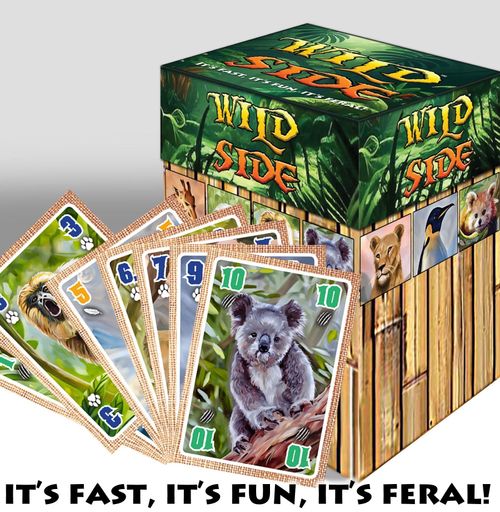
Wild Side
Wild Side Rulebook
Table of Contents
Table of Contents
Winning the Game
Play continues until each player has led a round twice or, for a shorter game, once. The player with the fewest penalty points at the end of the game is declared the winner.
Setup
-
Prepare the Cards:
- Shuffle the cards by "washing" them, mixing them thoroughly, on the table face-down.
- After washing the cards, leave them scattered and each player selects 20 cards facedown without looking.
-
Establishing Hands:
- Each player places 4 cards face-down in a row in front of themselves.
- Next, they place one card from the remaining 16, face-up on top of each of these facedown cards.
- Count the remaining cards. Each player should have 12 additional cards in their hand, totaling 20 cards (4 face-down, 4 face-up, and 12 in your hand). You can now look at the 12 in your hand.
-
Consolidate the remaining card pile. This now becomes the discard pile.
-
Determine the Lead Player: Players draw one card from the discard pile. The player with the highest value card drawn becomes Player #1. In the event of a tie, those involved draw again. Record all player names in clockwise order on a score sheet. The lead player will rotate clockwise one player in subsequent rounds.
-
Designate Roles: Appoint one player to be the Scorekeeper to track penalty points and another as the "Ranger". The "Ranger" will help clear the central pile to the discard pile during play.
Gameplay
-
Starting a Round: The lead player will start a central pile by doing one of the following two actions:
A) Play one to four cards of equal value from your hand and/or from the face up cards in front of you. Declare the number of cards played and end your turn. Example: If you put down two 4's, declare "Two Fours".
B) Play a run of two or more cards of the same suit. There are four suits in four different colors: claw marks (green), feather (orange), paw (blue) and wing (red). A run is any number of 2 or more cards in descending numeric order, ending with the lowest number on top.
Once the cards are played, their turn ends moving to the next player.
-
Subsequent Turns: Players may take the same actions as above but cards played to the central pile must be equal to or lower than the card currently on top of the central pile. They can play an equal value card up to 4 of a kind, any card of lesser value up to 4 of a kind, a run of 2 or more cards, or a Honey Badger. The player will declare what's on the central pile after playing their card(s). Example: the central pile has two 4's; You play add one 4. You would declare "Three fours".
Playing a Run: Runs must include 2 or more cards in the same suit/color in descending sequential order. The first card of the run must begin with a card equal to, or sequentially lower than the top card of the central pile. The suit/color of the central pile card does not matter, however the run of cards the player lays down must be in the same suit/color. EXAMPLE: The central pile has a blue 10. The player could continue a run with a red 9-8 or start a run with a green 10-9.
Playing a Honey Badger: Instead of the actions above, a player may play a single Honey Badger card onto the central play pile. Honey Badgers do not have a number so may be played on any card value.
Clearing the Central Pile: If a player plays a single Honey Badger or creates four of a kind (equal value) on top of the central pile, the central pile is cleared to the discard pile. Creating four of a kind may be done by playing four cards of equal value or matching your played cards to what is already on top of the central pile, but the total number of equal value cards on top of the central pile and from the current player may not exceed four.
Number of Rounds in a Game
Play continues until each player has led a round twice or, for a shorter game, once.
End of Game
After your determined number of rounds ends, tally up the penalty points and the player with the lowest total wins.