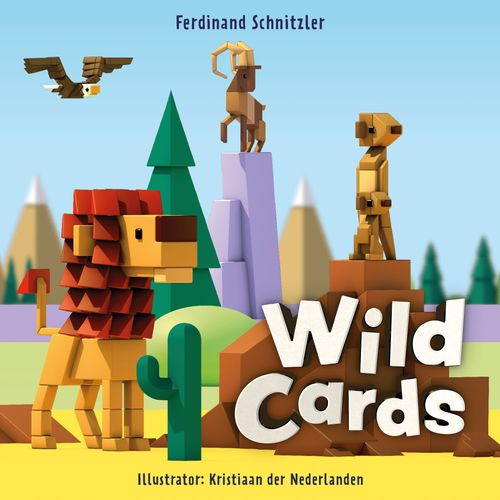
Wild Cards
Wild Cards Rulebook
Table of Contents
Table of Contents
Game Components
- 25 Score tokens: 15x 1, 4x 2, 4x 4, 2x 8
- 6 Leader cards: peacock, squirrel, eagle, ibex, lion, and meerkat
- 5 Refill hand cards
- 1 Talisman card
- 42 Animal cards: 7x each of peacock, squirrel, eagle, ibex, lion, and meerkat
- 46 Habitat cards: values 1-4; 14x each of forest, savannah, and mountains, and 4 wild cards
Game Setup
With 2 players you will play against virtual player Leo (see Virtual Player Leo), so set up a game for 3 players in this case.
- Form a supply of score tokens within reach of all players.
- Split the cards by type into Leader cards, Refill hand cards, Animal cards, and Habitat cards.
- Place the 6 Leader cards as a common supply within reach of all players.
- Shuffle all Animal cards and form a face down draw pile. Depending on the player count (3, 4, or 5) remove 14*, 6, or 2 Animal cards. Without looking, put them back into the box. You won't need them this game.
- * In a 3-player game, we suggest removing 1 Animal card of every species (a total of 6 cards), and then removing 8 more cards randomly.
- Reveal a number of Animal cards from the draw pile, 1 less than the number of players. Line them up on one side of the draw pile. This is the open display. So, depending on the player count (3, 4, or 5) build an open display with 2, 3, or 4 Animal cards.
- Shuffle all Habitat cards and form a face down draw pile within reach of all players. Leave space for a discard pile.
- Deal 7 Habitat cards and 1 Refill hand card to each player. Put the remaining Refill hand cards in the box. Keep your cards secret. The number of cards in your hand should always be visible to all players.
- Hand card limit: You can never have more than 10 Habitat cards in your hand. Whenever you would draw more cards, simply stop drawing at 10.
- Make some space in front of you for your collection. This is where you will place the Animal cards you collect.
- Decide who gets the Talisman card. Have them place the Talisman card face up in front of them.
Goal of the Game
Outbid your opponents and collect animals on display in order to make your collection the most valuable among the players. Attract the Leader of a species to unlock its power. You win if you have achieved the most points at the end of the game.
Gameplay
Wild Cards is played over the course of several rounds and ends immediately when you cannot fully refill the open display with Animal cards.
A round consists of 4 phases, played one after the other by all players as follows:
- Place bids
- Resolve Refill hand cards
- Acquire Animal cards
- Prepare the next round
1. Place Bids
Every player places a face down card from their hand as a bid in front of them. The number on the card determines the value of the bid. Alternatively, you may choose to place your Refill hand card face down in front of you. Keep your bid private. Bluffing is strongly encouraged.
When everyone has placed their bid, they reveal their chosen card simultaneously.
2. Resolve Refill Hand Cards
If your bid was a Refill hand card, choose and discard any number (even zero) of Habitat cards from your hand to the discard pile. Draw new Habitat cards until you have 7 Habitat cards in your hand again. Then take your Refill hand card back into your hand. This ends your turn.
If the Habitat card draw pile ever runs out of cards, take the discard pile, shuffle it and form a new face down draw pile.
3. Acquire Animal Cards
If you bid the Habitat card with the highest value, you go first choosing 1 Animal card from the open display. In case of a tie see Resolving Bidding Ties.
Choose an Animal card or pass
If your bid was 2 or higher, you will have to pay extra Habitat cards. Add Habitat cards from your hand to your bid, until your bid consists of as many cards as your initial bid.
Leave all bids and payments on the table, they are put onto the discard pile in phase 4.
Take the chosen Animal card and add it to your collection.
Hint: Organize your collection by species. Fan out the cards to make sure everyone can see the number of animals you have of each species.
Example: Milú would like to acquire a peacock from the open display. Since she bid a forest Habitat card with a value of 3, she has to pay two extra cards from her hand. She chooses a forest card and a wild card. As her entire bid matches the natural habitat of the peacock, Milú receives score tokens worth 2 points and adds the peacock to her collection.
If you don't want to take an Animal card, or there are no cards left in the open display, you may take your bidding card (and possible extra payment) back into your hand and then draw 2 cards from the Habitat card draw pile. Important: remember the hand card limit!
Claim a Leader card
Now check whether or not you receive the Leader card of the species you just acquired. If you have collected the most Animal cards of this species (or matched the amount the current owner of the corresponding Leader card has), you immediately receive the Leader card for this species.
Each species has its own power that you may use as long as you own its Leader card. These powers may overrule the basic rules of the game. They are explained in detail under Leader Cards. If applicable, you may use the power of the Leader card in the same round that you have received it.
It is possible that you have to hand over a Leader card to another player in the same round you have received it.
Extra points for natural habitats
Each animal has its own natural habitat (forest, savannah or mountains). If all bid and payment cards used to acquire the Animal card are of the animal's natural habitat, you immediately receive 2 points. Take the respective score token(s) from the supply.
Wild cards - Habitat cards with a rainbow - always count as the animal's natural habitat!
The next player chooses an animal card
Next up is the player with the second highest bid and so on. Repeat this process until all players have completed their turn.
Please note: every round there will be at least 1 player who won't be able to choose an Animal card from the open display.
Resolving bidding ties
If two or more players placed a bid with the same value, the tied players will need to determine who gets to choose an Animal card first as follows.
If the players bid 2 or higher, they will take their extra payment card(s) from their hand and put them face down next to their bid. Reveal these cards simultaneously and compare the total value of each tied player's bid. The player with the highest bid wins the tie and chooses an Animal card from the open display first.
If that doesn't resolve the tie, the player who in clockwise order sits closest to the owner of the Talisman card wins.
Example: Nathan and Amélie each bid a 3. A tie! Both place their payment of 2 extra Habitat cards face down next to their bid. Nathan reveals a 3 and a 2 for a total of 5. Amélie simultaneously reveals a 2 and a 1 for a total of 3. Nathan wins the tie and chooses an Animal card from the open display before Amélie does.
4. Prepare the Next Round
After resolving all bids, put all bid and payment cards face up onto the discard pile. Animal cards from the open display that were not acquired are put back into the box. Then, depending on player count (3, 4, or 5) reveal 2, 3, or 4 new Animal cards and form a new open display next to the draw pile. If you cannot completely refill the open display, the game ends immediately.
If the Talisman card was used this round to resolve a bidding tie, place the Talisman card in front of the next player (in clockwise order).
Leader Cards
Leader cards grant you useful powers. Use these Leader powers wisely. In case of conflict, Leader card powers overrule the general rules!
If applicable, you may use the power of a Leader card in the same round that you have received it.
Below is an overview of the 6 Leader cards that come with Wild Cards.
Peacock
This Leader card scores 3 points at the end of the game (instead of 1).
Squirrel
If your bid was the Refill hand card, draw back to 10 Habitat cards (instead of 7).
Ibex
You may take your bidding card back into your hand (unless it was a wild card) when all players' bids and payments are put onto the discard pile in phase 4. The Habitat cards you used as extra payment still have to be discarded.
Eagle
When you bid, you may place 2 face down cards (instead of 1) from your hand. Wait for the other players to reveal their bids, then reveal 1 of your two bidding cards as your final bid. Take the other card back into your hand.
Lion
You always win ties in bids. So when tied, you always get to choose an Animal card first.
Meerkat
If your bid was the Refill hand card, you may exchange 1 Animal card from your collection with 1 Animal card from the open display. Resolve this effect in phase 2 before resolving any other Leader card power and before moving to phase 3!
After the exchange you immediately receive a Leader card if you now have at least the same number of cards as the player with the most cards of the species acquired.
You immediately lose a Leader card if you now have zero cards or fewer cards of the species given away than another player. Hand it to the player with the most cards of that species or, if not applicable, return it to the common supply.
Example: Lara has the meerkat Leader card. During phase 1, she played her Refill hand card, and triggers her meerkat Leader's power in phase 2. She uses it to exchange an ibex from her collection with a squirrel from the open display. After that she has the majority of squirrel cards and claims the squirrel Leader card. She immediately uses the squirrel Leader's power, as it is also triggered by playing the Refill hand card: She draws back to 10 Habitat cards.
Full Round Example
Phase 1: Place bids. Nathan places a Habitat card with value 4 as his secret bid, Milú a 2, and Amélie a 1. They reveal their cards simultaneously.
Phase 2: Resolve Refill hand cards. Nobody played a Refill hand card.
Phase 3: Obtain Animal cards. Nathan goes first. His bid of 4 requires him to pay 3 extra Habitat cards. He chooses 3 cards from his hand and adds them to his bid. He chooses an ibex card from the open display and adds it to his collection. Nobody had an ibex in their collection yet, so he instantly claims the ibex Leader card.
Milú resolves her bid in the same way, taking the last card from the open display: an ibex as well. She now has the same number of ibexes in her collection as Nathan does and therefore claims his ibex Leader card.
Since Amélie goes last and the open display is empty, she cannot take an Animal card. She takes her bidding card back and draws two cards from the Habitat draw pile.
Phase 4: Prepare the next round. All bids and payments are put onto the discard pile. The open display is refilled and the next round begins with phase 1: Place bids.
End of the Game
As soon as you cannot completely refill the open display with new Animal cards from the draw pile (in phase 4), the game ends. Discard your hand to the discard pile and proceed to Final Scoring.
Final Scoring
Add up your total score as follows:
- The species you have collected the most Animal cards of is worth 2 points per card.
- The species you have collected the second most Animal cards of is worth 1 point per card.
- Important: You may only score one species per category above, even if you have the same number of cards of several species.
- Each Leader card you own is worth 1 point, except for the peacock leader, which is worth 3 points.
- Add the total value of your score tokens.
Whoever achieved the highest total score wins. In case of a tie, the tied player with the most Animal cards in their collection wins the tie. If there is still a tie, the tied players share their rank.
Virtual Player Leo
You can add virtual player Leo to a game with 2, 3, or 4 players. In a 2-player game that's even a requirement! When you add Leo, set up the game for 1 extra player. You will play for Leo. Leo plays by slightly different rules:
- For starters, Leo will only be dealt 5 Habitat cards plus a Refill hand card. Shuffle Leo's cards and place them as a face down draw pile on the table.
- Leo does not play to win. Don't award Leo score tokens or count his final score.
- When placing bids (phase 1) draw the top card from Leo's draw pile. This is their bid.
- When Leo's bid is a Refill hand card, resolve it in phase 2 by discarding Leo's entire draw pile. Then draw 5 new Habitat cards, add Leo's Refill hand card, shuffle, and place them as a face down draw pile on the table again.
- When Leo gets to choose an Animal card (phase 3), they always pick the one closest to the Animal cards draw pile. Leo never pays extra Habitat cards.
- Leo claims Leader cards, but never uses them.
- Leo always wins ties, unless one of the other players has the lion Leader card, in which case that player wins.
- Leo never receives the Talisman card.
Leader Cards Overview
- Lion: You always win ties in bids.
- Meerkat: Play your Refill hand card to swap 1 animal from the display with 1 in your collection.
- Squirrel: Draw back to 10 Habitat cards when you play your Refill hand card.
- Peacock: This Leader card scores 3 points at the end of the game (instead of 1).
- Eagle: Place 2 bid cards and decide after the others revealed their bids which to use.
- Ibex: Take your bidding card back after use (except wild cards).