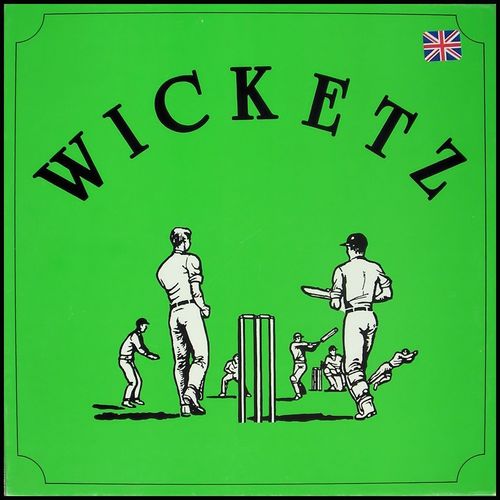
Wicketz
Wicketz Rulebook
Table of Contents
Table of Contents
Equipment
Wicketz contains one playing board, 246 different playing cards, a card dispenser, models of cricketers, umpires, wickets and sight screens, two rotating indicators, a scorebook, a pace/spin selector and four cue cards.
The Game
To be played between two teams, each team being represented by one or more players, or by a single player, trying perhaps to achieve a target.
The Duration
Can be decided before commencing. An average 40 over game will last about one to one and half hours for each innings, but longer games can be played, including a two-innings game. The cards should be shuffled prior to the first game played (after removing the four stroke direction cue cards) and placed in the card dispenser.
Setting Up
Place on the board the sight screens (locations A & J/I); the wickets and the umpires (one adjacent to the bowling wicket and the other at the square leg position, along the top line of E1). Finally locate the bowling and catching indicators and the pace/spin selector.
The Teams
Toss a coin for choice of innings. One player will operate the bowling indicator to produce the type of delivery and his opponent will play the batting cards.
The Bowling Side
Select pace or spin (using the selector), which can be altered if desired after any over, whenever it is decided to use either Fast/Medium or Spin bowling. The bowler will then set his field either for attacking or containing purposes. The fielders can occupy any zone but the wicket-keeper must be in A0 or A1 and the bowler in J0 or I0.
The bowling indicator will produce:
| To command respect | Loose deliveries |
|---|---|
| Good Length | Half volley |
| Yorker | Full Toss |
| Googly | Long hop |
| Bouncer | No Ball |
| Wide |
Note: The segment BOUNCER/GOOGLY shows that one of these apply according to whether pace or spin is being bowled.
Delivery Assessment
- Good Length: Exactly that, treat with respect.
- Yorker: Pitched in the block hole.
- Googly: Cleverly disguised spinner.
- Bouncer: Intimidating but can be hit.
- Half Volley: Loose balls which can be hit, usually producing safe runs.
- Long Hop: (no separate entry printed)
- Full Toss: (no separate entry printed)
- No Ball: Have a go at this one, the batsman can only be dismissed by a run out. Add one run to the extras if not scored from. (This part of the rule is subject to change.)
- Wide: Add one run to the extras.
The Batting Side
Place on the board 1 in front of the wickets, their opening batsmen (nos. 1 & 2) and when the game begins, will, after each delivery from the bowling indicator, nominate any one of the batting strokes (initially using the cue card as a helpful guide).
Of these twelve strokes, nine are attacking and three are defensive.
After declaring a stroke, a card will be selected from the card box which will show the end result to that particular stroke.
Avoiding Action can be declared as an alternative to a batting stroke but only when a bouncer has been bowled.
Stroke Direction
See directions on cue cards.
Reading the Cards
The cards are headed WICKETZ and are numbered 1 or 2; card 2 is headed CATCH. Each card lists the twelve strokes plus Avoiding Action, with a lettered or starred code in the central column and a result in the right-hand column. The figures 57 and 170 printed at the foot of the two cards are as printed on the source page.
Card 1:
| Stroke | Code | Result |
|---|---|---|
| Cut | P | Bowled if yorker |
| Square Cut | ★ | 1 bye |
| Cover Drive | N | Bowled if good length |
| Off Drive | L | - - |
| Straight Drive | I | L.B.W. if good length |
| On Drive | H | Run out if occupied |
| Pull | ★ | Played and missed |
| Hook | E | L.B.W. if yorker |
| Leg Glance |
Card 2 (CATCH):
| Stroke | Code | Result |
|---|---|---|
| Cut | O | - - |
| Square Cut | N | - - |
| Cover Drive | M | - - |
| Off Drive | L | - - |
| Straight Drive | ★ | Played and missed |
| On Drive | G | Bowled if good length |
| Pull | D | - - |
| Hook | E | L.B.W. if good length |
| Leg Glance |
★ Denotes no score (apart from extras and dismissal decisions).
The right-hand column should be read initially, but if this does not apply then the central column is read in conjunction with the numbered 'window' display. This combination indicates the position to which the ball has been played.
If there is no fielder in this position then the runs shown on the card are given to the player. If a fielder is in the position then no runs can be scored and if the card is marked CATCH then the catch rule will be enforced.
The Catch Rule
If a fielder is in a position displayed on a 'catch' card then this becomes a potential catch. Whether the catch is held or dropped is decided by rotating the catch indicator. Obviously the objective of the batsman is a 'not-out' result, indicating a dropped catch. To introduce a batting skill factor where higher order batsmen tend to give less frequent or more difficult catches, the earlier batsmen are allowed more chances of achieving a 'not-out' result.
However, if after the permitted number of lives the batsman has not produced a 'not-out' result, then he will be deemed to have been caught out.
Therefore:
- Batsmen 1, 2, 3 & 4 are allowed three lives.
- Batsmen 5, 6 & 7 are allowed two lives.
- Batsmen 8, 9, 10 & 11 are allowed one life.
The only deviation from this rule is that when the delivery is a bouncer then only one life is allowed, regardless of the batting order.
The Overthrow Rule
When the card reads "add overthrow/s", if the zone indicated is occupied by a fielder this will result in one run (assuming a missed stump throw), but if the zone is unoccupied (then, because the fielder has to arrive) the overthrow will be added to the one already scored by the batsmen, resulting in 2 runs.
The Result
Will be recorded after each ball. At the conclusion of each over (6 balls), the six cards, or more if wides or no-balls have been bowled, can be placed to the rear of the box. The innings will continue in this fashion until the side is dismissed at the fall of the tenth wicket or if the prescribed number of previously agreed overs has been bowled.
During Play
When an odd number of runs is scored (including byes and leg-byes, but not wides and no-balls) and also at the end of each over, the batsmen will change ends.
When a batsman is dismissed the numbered rotating base will be altered to accommodate and identify the incoming batsman.
A Set Field
For a single player could be: A0 for spin (or A1 for pace), Q2, P1, M2, L1, J0 (or I0), H2, F2, E1, D2, B2.
Transcriber note: the source page renders the letter-number codes "Pl" and "El" in this list; they are read here as P1 and E1 to match the board zone codes used elsewhere in the rules. Check against the printed manual.
The Merit
For a 40 over game in Wicketz per innings would be:
| Runs | Rating |
|---|---|
| 275 | Brilliant |
| 250 | Very Good |
| 225 | Good |
| 180 | Fair |
| 150 | Poor |
| Below 150 | Back to the practice nets! |
Advanced Optional Rules
Bowling Variations
If the players are agreed, then the following additional aspects of cricket can be included which will allow the bowler to bowl and to set fields to the leg or off side of the field. This will mean that the bowler will have the option of three variations of attack.
These are:
- On the wicket with split field placing.
- On the off side.
- On the leg side.
The field placings will confirm the bowler's intentions and, although these individual positions can be varied, the style of delivery will be constant for the over. In the cases of (2) and (3) a pre-spin of the bowling rotating indicator is required. If the pre-spin result indicates 'red' (circumference line) then the bowling line is good but if the arrow points to 'black' then the delivery has strayed off line and can be taken advantage of by the batsman.
Providing the line is good then the only attacking strokes the batsmen can play are:
| Leg Side Deliveries | Off Side Deliveries |
|---|---|
| Leg Glance | Cut |
| Hook | Square Cut |
| Pull | Cover Drive |
| On-Drive | Off Drive |
| Straight Drive | Straight Drive |
Defensive strokes remain unchanged.
'Wild Card' Variation
Following an over in which only two runs or less have been added to the score, the batsman, during the duration of a spin (minimum 2 revolutions) will select a card and place it face up on the board. This can also be perused by the bowler. The batsman will turn over the card when the spin is completed. He can then use this card at any time during that over.
This may help the batsman to 'build' an innings or 'farm' the bowling, providing the opposing side have not combated his ploy.
Fielding - Restrictions
Example: During the first 15 overs only 2 fielders will be allowed to operate in the '0' and '1' zones. However, the number of overs and fielders can be varied and agreed on prior to the start of the game.
Fielding - Saving Runs
When a '4' card appears and a fielder occupies the '2' or '3' area in that lettered line, he will then have been judged to have saved the boundary and the batsman will be credited with 1 run.