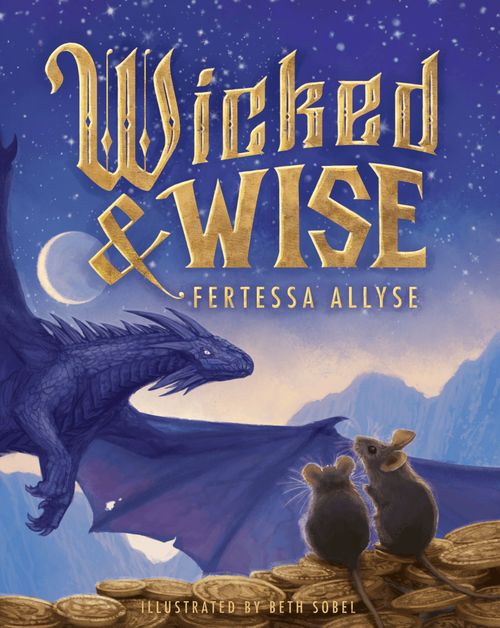
Wicked & Wise
Wicked & Wise Rulebook
Table of Contents
Table of Contents
Game Objective
Your objective is to work with your team to gain more coins than any other team during the game. You can gain coins by meeting your chosen goals, using certain treasures, and using certain card abilities.
This is a trick taking game. If you haven't played a trick taking game before, don't worry! That will be explained later.
Player Count
Wicked & Wise plays differently at each player count. Before you start playing, you'll need to choose a mode based on the number of players - see the Player Count Guide for a breakdown of the different modes and the different roles players can take. While the teams and roles change based on player count, most of the rules remain the same.
Roles
- Dragon: Only the Dragons' cards count towards winning each trick. Dragons can never use the abilities on the card that they play; they only play their cards for the numbers.
- Mouse: Each Mouse plays one card for its ability. When played, the ability occurs immediately. The Mouse manages coins for the team. The Mouse cannot win the trick.
- Dual: Plays as both a Mouse and a Dragon.
Contents
- 60 Basic cards (4 suits, 15 of each suit)
- 15 Gem cards
- 64 Goal cards (3 teams, plus 4 Beginner goals)
- 7 Role cards
- 17 Treasure cards
- 3 Reference cards
- 2 Table Talk cards
- Lead and Gem Tokens
- Coins (1, 2, 5, 10)
Card anatomy: a Basic card shows its suit, value and (in the case of a card used by a Mouse) its ability. A Gem card has a Gem icon and a card ability. A Goal card shows the goal, the location to place coins gained if the goal is not met, the location to place coins gained if the goal is met, coins won in a 2 team game, coins won in a 3 team game, and the team count or Beginner icon. A Treasure card shows its ability. A Role card shows the role and team and the player count. A Table Talk card gives talking rules. Some cards note "Low cards win in this trick."
Suits: the basic suits are Flames, Star, Rose and Magic. Gem is the trump suit.
Game Setup
- Create a deck of role cards based on player count, then either deal out the role cards randomly OR allow players to choose their role and team. Players should sit diagonally across the table from their partner, if possible.
- The Dragon on Team 1 will be the starting player. Give them the Lead token.
- Choose a Table Talk card for this game. Each card provides different rules for talking about cards and strategy during the game.
- Separate the Gem Cards from the Basic Cards and shuffle each deck. Place both decks next to each other in the center of the table. Place the Gem token in front of the Gem to differentiate the Gem deck from the Basic deck.
- Shuffle the Treasure Deck and place it next to the Gem and Basic decks.
- Deal 10 basic cards to each Dragon and 7 basic cards to each Mouse.
- Separate the goals out into four decks based on their card backs; Team 1, Team 2, Team 3, and Beginner.
- There are three types of goal cards in each Team deck: 2 team only, 3 team only, or two and three teams. The 2 Team only and 3 Team only cards will have either a 2 or 3 icon in the bottom right corner.
- If playing with only two teams, return all Team 3 Goal cards and the 3 Team only goal cards to the box.
- If playing with three teams, return all 2 Team only goal cards to the box.
- If this is a learning game, deal the Mouse of each team a Beginner goal face-up. This is for Round 1 only. Otherwise, place the Beginner goals back in the box.
- Each Dragon receives their team's deck of goals and shuffles the deck.
- Place the Reference cards on the table within reach of the players.
Game Setup - Specific Player Counts
- In a 3 or 5 player game, for the Dual player, deal 10 cards out for their Dragon hand and 7 cards out for their Mouse hand (played face-up).
- In a 2 player game, deal each player 10 cards for their Dragon hand and deal one shared Mouse hand of 5 cards and place it face-up between the players.
- In a 2 or 3 player game, after dealing out all cards, take 3 cards from the gem deck and add them to the basic deck, then shuffle the basic deck.
See the Wicked & Wise Player Count Guide for Setup Examples.
Gameplay
The game is played over 3 rounds of 5 tricks each.
Each round is made up of the following sections:
I. Choosing Goals II. Trick Taking III. Goal Evaluation IV. Round Cleanup
I. Choosing Goals
At the start of each round, the Dragons will draw goal cards and choose which goal cards to secretly pass to their Mice. Each Mouse then chooses which of the goals to keep out of the goals they received. Mice (and Duals) all reveal their chosen goal(s) simultaneously, then announce their chosen goals.
All goals that were drawn and not chosen are placed in each team's goal discard pile.
The number of goals the dragon can pass and the number the mouse can choose change each round.
Skip this step for the first round of a Beginner Game.
| Round | Cards Drawn | Dragon Passes | Mouse Chooses |
|---|---|---|---|
| 1 | 4 | 2 | 1 |
| 2 | 4 | 2-3 | 1-2 |
| 3 | 4 | 2-4 | 1-3 |
II. Trick Taking (5 Tricks)
To start the Trick Taking portion of the round, the Dragon with the Lead Token will play a card to start the trick (which is called leading). The suit of this card is called the lead suit. Then, the next Dragon will play one card, and so on, until each Dragon has played one card. Then, all the Mice will play one card and activate that card's ability, starting with the Mouse on the leading Dragon's team. Once all Mice have played one card, all the Dragons will play a second card in the same order that they played their first cards. [The play of two cards by each Dragon and one card by each Mouse is collectively known as the trick.]
Each player, Mouse, Dragon, or Dual, must follow suit if they can, i.e. players must play a card in the lead suit, if they have one.
If a player cannot follow suit, then that player may play any card from their hand.
Examples:
- The Lead Dragon plays a Star. You have at least one Star in your hand, so you must play a Star.
- The Lead Dragon plays a Flame. You do not have a Flame in your hand. You may play any card you want, so you elect to play a Star.
When all Dragons have played two cards and all Mice have played one card (for its ability), the Dragon who played the highest card in the lead suit wins the trick. An exception is made if any Dragon played a Gem card, which is considered the highest (trump) suit. Mice cannot win a trick. Each suit has a card from 1 to 15.
If there were multiple Gem cards played, the Dragon who played the highest Gem card is the winner. Treasures can cause exceptions to how the winner is chosen. See the Treasures section below for more information.
Dragons play their cards for their suit and value, Mice play cards for their ability.
All treasures are evaluated based on the cards played by all roles, not just the Dragon. All used treasures are discarded.
The winning team of this trick then:
a. places the cards of this trick (including those played by mice) into their team's collection area, and then b. chooses to take either two coins or one treasure. The losing team(s) will get whichever option was not picked. When taking treasure, the Dragon draws two cards from the treasure deck, picks one to keep and discards the other. The Dragon places the chosen treasure on the table in front of them face-up.
If there are three teams and the winning team takes coins, the team that played later in the current trick chooses their treasure first.
Finally, pass the Lead Token to the Dragon or Dual to the left of the player holding the Lead Token. That player leads a card to start the next trick, unless there have already been five tricks in the round, in which case the Trick Taking portion of the round is over and gameplay moves to Step III, Goal Evaluation.
Treasures
As the game progresses, the teams will gather treasures that will be used during the Trick Taking portion of the round. A Dragon can only use treasures before they have played any cards to the current trick. To use a treasure, the Dragon will turn the treasure by 90 degrees. Dragons can use multiple treasures at the same time.
Each treasure has a specific ability that can either change how the trick works or allows the team the possibility of gaining coins. Treasures that allow teams to gain coins are evaluated immediately after rewards are chosen and before the next trick begins. All Treasures used are discarded at the end of the trick.
A team can have a maximum of 3 treasures (2 in a 5 or 6 player game) at one time, and may play multiple treasures on a turn. Discard down to the maximum number of treasures before moving on to the next step.
III. Goal Evaluation
If a team meets their goal, they gain the reward listed on the card. If not, they lose half the amount listed for the reward, rounded down.
If any mice placed coins on a goal after playing a 10, 11, or 12 basic card, they either gain the coins placed on the card or discard the coins back to the bank.
The used goals are discarded. If it is the third round of the game, the game is over.
IV. Round Cleanup
Round cleanup happens in the following order:
- Dragons discard any remaining cards from their hand and all cards won during the tricks.
- Mice do not discard any of their remaining cards, but may pass up to 4 to their partner.
- The discarded cards are shuffled together (including discarded gem cards) with the remaining cards in the basic deck and this deck becomes the new basic deck.
- Dragons draw cards until their hand size is 10, Mice draw cards until their hand size is 7.
- Duals discard their Dragon hands; they do not pass cards from their Mouse hands. Duals then draw 10 cards for their Dragon hand and draw cards for their Mouse hand until it is size 7. All basic cards are placed face-up for the Dual player's Mouse hand and all gem cards are played face-down.
- The team with the least amount of gold is given the Lead Token and leads the first trick of the next round, until three rounds have been completed. In the case of a tie between teams with the least gold, the team with the least treasures is given the Lead Token. If there's still a tie, teams flip a coin for the Lead Token.
End of the Game
Each round consists of five completed tricks. After three rounds the game is over. Each team now counts up all of their coins. The team with the most coins wins. If teams have the same amount of coins, then the team with the most remaining treasure wins. If there is still a tie, players must switch up their teams and play again.
Four Player Example
Team 1 includes María (Dragon) and Fertessa (Mouse), Team 2 includes Finley (Dragon) and Jorge (Mouse).
Finley is leading the first trick. Finley leads with the 4 of Flames, María plays the 5 of Flames, then it's Jorge's turn, as he is Finley's partner.
Jorge plays the 3 of Flames, which gives him the option to either trade a card with his partner, draw 1 gem card, or draw 2 basic cards. He chooses to draw 1 gem card. Fertessa then plays the 7 of Stars; this shows the other players that she has no Flames cards, as she would have had to follow suit if she had any card of the Flames suit. The 7 of Stars allows Fertessa to either draw 1 gem card or two basic cards, then she can swap one card with her partner. She chooses to draw 1 gem card, then she gives one of her cards face-down to her partner, María. María looks at the card that she was given, then passes a card back to Fertessa.
Now it is back to the Dragons' turns, with Finley playing their second card of the trick, the 8 of Flames. María plays the 2 of Gems.
Team 1 wins the trick, as María played the highest card of the Gem suit, even though she did not follow suit. However, Team 2 now knows that María doesn't currently have any remaining Flames cards and they can use that information in the future.
María takes all 6 cards played this trick and puts them in her area face-down. Then, María and Fertessa decide that they want a treasure, so they draw two treasures and choose one to keep and one to discard. Jorge doesn't have a choice, he must take two coins. Now it's time for María to lead the next trick.
Summary of the Trick Taking Section
- Dragon with the Lead Token plays 1 card to lead the trick.
- All other Dragons (and Duals) play 1 card, following suit if possible.
- Mice (and Duals) play 1 card, following suit if possible, and use their played cards' ability.
- All Dragons (and Duals), starting with the Lead Dragon, play a second card following suit if possible.
- The trick is evaluated and the Dragon who played the highest Gem card or highest card that followed suit (if no Gem card was played) wins the trick.
- Treasures are evaluated and coins are gained based on the cards played.
- The winning team of the trick takes all of the cards played in the trick and places them in front of them face-down.
- The winning team of the trick chooses two coins or 1 treasure.
- The losing team(s) get the option that the winning team did not pick.
- The Lead Token is passed to the Dragon or Dual to the left of the player that last had the Lead Token.
Wicked & Wise Role & Player Count Guide
Roles and Teams
There are three possible roles in Wicked & Wise:
- Dragon: Both the Dragon and the Mouse will be playing cards, but only the Dragons' cards count towards winning the trick. Dragons can never use the abilities on the card that they play; they only play their cards for the numbers.
- Mouse: The Mouse will be the only partner touching the money when spending or gaining coins. Each Mouse plays one card for its ability after all Dragons have played their first card in the trick. When played, the ability occurs immediately. The Mouse's card does not go towards winning or losing the trick, but is collected along with all played cards by the winner of the trick.
- Dual: When a player is playing as the Dual, they will be playing as both the Dragon and the Mouse on the same team. They will have their Dragon cards in their hand and their Mouse cards open on the table for all teams to see. However, they must keep any Gem cards in their Mouse hand face-down.
The available roles are based on the chosen player count.
| Player Count | Roles | Teams |
|---|---|---|
| 2 players | Two Dragons | Each player as a separate team with a shared Mouse hand |
| 3 players | One Dragon, one Mouse, one Dual | One team of Dragon and Mouse, one team of the Dual |
| 4 players | Two Dragons, two mice | Two teams, with each team having one Dragon and one Mouse |
| 5 players | Two Dragons, two mice, One Dual | Three teams, with two teams having one Dragon and one Mouse and one team having a Dual player |
| 6 players | Three Dragons, three mice | Three teams, with each team having one Dragon and one Mouse |
First Time Playing?
The Dragon role is great for first time players, while the Mouse role is better suited for players familiar with trick taking games. The Dual role is for advanced players and should not be used by those who have not played before.
Player Count Differences
2 Player: Each player will be playing as a Dual, but with a shared, face-up Mouse hand between them. The Mouse hand size is only 5 cards (not 7). The active Dragon refills the Mouse hand if it gets below 4 cards and gets to see all cards before placing them in the Mouse hand. When gem cards are drawn for the Mouse hand, the player drawing them gets to see the card, then it is placed face-down into the Mouse hand.
3 Player: One team will be made up of the traditional Dragon and Mouse players and the other team will be one Dual player. The Dual player will be playing as both the Dragon player and the Mouse player. The Dragon cards will be held in their hand, while the basic Mouse cards will be played face-up so all players can see that team's Mouse cards. Any gem cards in the Dual's Mouse hand are played face-down and only the Dual player can check their value.
The 3 player setup is similar to the 5 player setup but without the Dragon 2 and Mouse 2 players.
4 Player: There are no rule changes for 4 players. The 4 player setup is similar to the 5 player setup but without the Dual Dragon and Mouse hands.
5 and 6 Player: Instead of having two teams, there are now three.
Each team may only have two treasures.
Winning the Trick: When a trick is won, the winning team may still choose to take two coins or one treasure. The losing teams will get whichever option was unpicked, with the team that played later in the current trick choosing their treasure first, if the winning team chose to take coins.
5 Player: Two of the teams will be made up of the traditional Dragon and Mouse players and the third team will be only one Dual player. The Dual player will be playing as both the Dragon player and the Mouse player. The Dragon cards will be held in their hand, while the Mouse cards will be played face-up so all players can see that team's Basic Mouse cards.
Set-up diagrams: In the 5 player set-up, the table holds Dragon 1 hand, Mouse 1 hand, Dragon 2 hand, Mouse 2 hand, the Dual Dragon hand and the Dual Mouse hand (7 cards, with basic cards face-up). In the 2 player set-up, the table holds Dual 1 hand, Dual 2 hand and the Shared Mouse hand (5 cards, with basic cards face-up).
All Dragon 3 Player Variant
Each player will be playing as both a Dragon and a Mouse. The Mouse hand of 7 cards will be open and shared between all players. Gem cards are drawn face-down for the Mouse.
Tiny Gamer Variant
Some young gamers might be too busy hoarding gold to care about goals and that's okay! This variant is for them.
Changes to the regular rules:
- Keep all goal cards in the box
- Skip the Choosing Goals and Goal Evaluation sections
- Each Round has 3 tricks instead of 5
- Dragons will only draw up to 6 cards at the start of each round.
- Any abilities that deal with goals will immediately give the coins on the card or 3 coins, if no amount of coins is listed on the card.