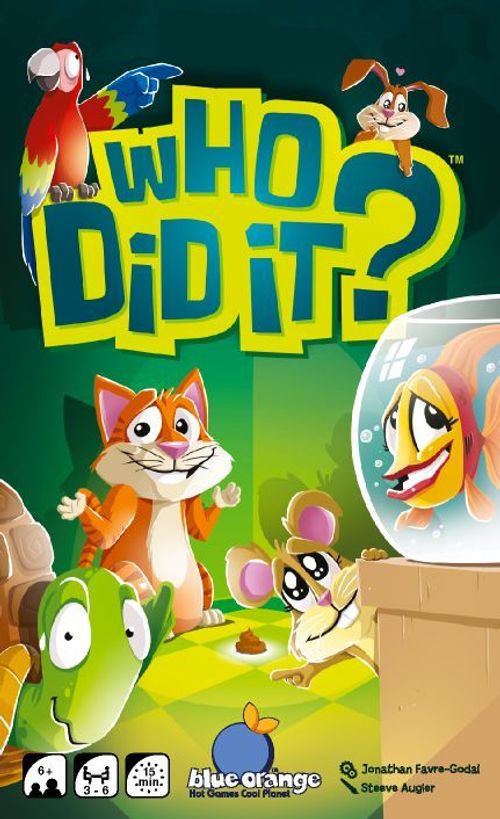
Who Did It?
Who Did It? Rulebook
Table of Contents
Table of Contents
Contents
- 36 Cards (6 sets of 6)
- 13 Poop Tokens
- 1 Travel Pouch
- Illustrated Rules
Object of the Game
Defend the innocence of your 6 pets by getting rid of all your cards. Quickly find the right card as they are accused, lay it down first, and then pass the blame to another animal. To avoid being the owner of the guilty pet, make sure to act fast and remember which animals were already proven innocent. Each round, the owner of the guilty pet collects a poop token. At the end of the game, the player with the least amount of poop tokens wins.
Set-Up
Have everyone pick a color and take the 6 matching pet cards in their hand. Put the unclaimed colors aside.
Take the poop tokens out of the pouch and place them off to the side; they will be used to track the guilty party at the end of each round.
You are now ready to find the pooper!
Playing the Game
The youngest player starts the game by putting down the pet of their choice in the middle of the table and saying, for example:
"It was not my turtle that pooped in the living room, but I think it was someone's hamster"
Everyone else must now race to find their hamster card and be the first to place it on top of the turtle card that is on the table, proving the innocence of their hamster.
The first player to place the correct card then passes the blame and accuses another animal by saying, for example:
"It was not my hamster that pooped in the living room, but I think it was someone's fish"
Everyone else then races again to find their fish card, place it down first to prove its innocence, and pick a different animal to pass the blame on to.
Important: The player who just accused a new pet is not allowed to place a card during that turn.
Play continues this way until a guilty animal is found (see End of a Round).
If a player puts down their last card and successfully passes the blame to another animal, play continues without them for the remainder of the round; all of their animals are innocent and therefore they do not own the pooper.
NOTE: You are allowed to save your pet from being blamed, and then accuse the same type of pet from another player. For example:
"It was not my cat that pooped in the living room but I think it was someone else's cat"
End of a Round
A round ends when an animal is found to be guilty. An animal is guilty when their owner fails to pass the blame onto someone else's animal, leaving the blame on their own pet(s). There are two ways this can happen:
1st Scenario: If a player tries to pass the blame to another animal, but nobody has that card left in their hand (meaning everyone has proven the innocence of their pets of that type), then there is no animal left to blame and the animal on the card that was just placed is guilty! Have everyone show their cards as proof, and give the guilty owner a poop token.
2nd Scenario: When only one player has one or more animal cards left (meaning everyone else has gotten rid of their cards), this player owns the guilty pet as there is no one left to take the blame. Give them a poop token.
Summary: Successfully passing the blame means you accused an animal and at least one other player had that animal card to put down. Failing to pass the blame (and getting a poop token) means you accused an animal and nobody had that animal card to put down.
End of the Game
As soon as one player has collected 3 poop tokens, the game ends. The player with the least amount of poop tokens wins. If there is a tie, players share the victory!
Feeling Pooped?
Get creative! Here are some suggestions that are guaranteed laughs.
- Who pooped in the kitchen?
- Who peed on the jacket?
- Who farted in the car?
Can you think of any more?