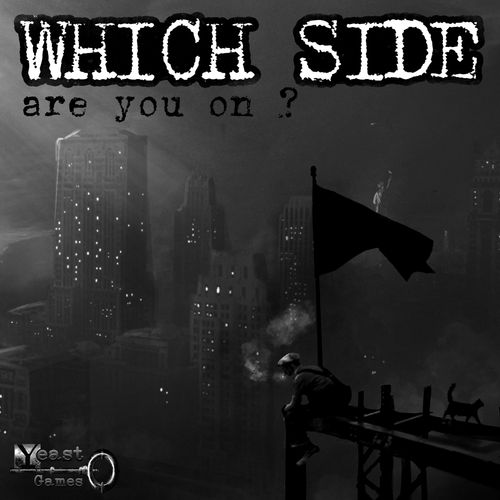
Which Side?
Which Side? Rulebook
Table of Contents
Table of Contents
Goal of the Game
"WHICH SIDE" is a cooperative game in which you struggle together against the employers. You will be working to survive and agitate in order to fight against employer offensives, represented by cards, while simultaneously avoiding disease, injury, prison, and misery.
Victory
The workers (players) win the game when they meet certain conditions indicated by the scenario and the difficulty: the workers need to control a number of means of production, have one (or more) gauge moved to the maximum towards the left and have no defeat condition be activated until the end of the turn.
Defeat
Several conditions can lead to defeat:
- Employers' Strength reaches 10 and the players do not meet the victory conditions at the end of round.
- A player no longer has a playable character before phase "I.2) Working to survive" (in prison, HEA 0 or dead).
- 3 exceptional measures are active during phase "II.1) Employer actions".
Game for 1 to 3 Players
Which side is designed to portray 4 struggling Tenements:
- In a single-player game, all 4 Tenements are used;
- In a two-player game, each player uses 2 Tenements;
- In a three-player game, the fourth Tenement is managed communally by all players;
- Some scenarios and a mode are designed to play with a maximum of 2 players.
Components
- 4 individual trays
- 38 dollar bills
- 24 resource tokens (x4, x8, x26 dollar denominations; 6 of each of four resource types)
- 12 Location tiles
- 10 Premises
- 37 Misfortune cards
- 40 Incident cards
- 10 Solidarity cards
- 10 Employers' Strategy cards
- 25 Employer Plans cards
- 16 Difficult Employer cards
- 21 Normal Employer cards
- 1 6-sided die
- 1 Employers' Action Board
- 50 colored markers
- 21 colored tokens
Components Description
Individual Board. It represents your home. There is the state of the characters; the level of unsanitary conditions (UNS), risk (RIS), and police threat (PT); as well as the cost of living and any special custom rules.
Premises. Premises are upgrades that players can purchase for their Tenement. The purchase cost and the rent are variable. They grant a night action except Liberal Lawyer and Bonesetter which can be used only by the characters.
Employers' Action Board. At the top, the Employers' Strength (ES) indicates the count of turns. It can never go towards the left. Below, three gauges represent labor regulations: working hours (WH), working conditions (WC), and wages (WA). On the right is the takeover of the means of production. These are victory goals that players must achieve.
Game Board. It is represented by place tiles that have two sides, where side B is the upgraded side. They are used for the actions of the workers.
- Workplaces (x4): Triangle Shirtwaist Factory, Newtown Creek Dye Industry, Woolworth Building, Newark Cardboard Workshop
- Politically important places (x5): Greenwich Village, Labor Union IWW, Labor Union ILGWU, Bierhalle, Ferrer Center
- Specific places (x3): Tenderloin, Wes Pen, East River Docks.
Playing cards. (Cards with the "complex" symbol have a complex difficulty level.)
- Misfortune cards represent problems related to everyday life.
- Incident cards affect Tenements according to their level of risk (RIS), police threat (PT), unsanitary conditions (UNS), or money.
- Solidarity cards are the only cards with a positive effect.
Employer cards. They represent the actions of the employers against the players, there are several types.
- The "Employers' Strategy" cards: global actions of the bosses spanning 2 or 3 turns. They are completed by multiple "Employer Plans" cards.
- Employer Plans cards, in connection with their Employers' Strategy card:
- Identical name to the corresponding Employers' Strategy card.
- The number of Employer cards drawn (2 types of difficulty: one symbol for Normal, one for Difficult).
- Some cards introduce an additional condition for the turn (note that this one cannot be countered, contrary to the general effect of the card).
- The resources needed to counter the card.
- The overall effect of the card if it is not countered.
- The normal and difficult Employer cards represent specific actions taken by the employers.
- "Coup de force": Resolve the effect then discard the card.
- Exceptional measure: Apply the effect, which remains active until the card is discarded and put a white marker on it to show that it is active.
Gauges and control indicators
- Each player has 8 (9 for Chinese) gauge markers of his color: one for the risk (RIS); one for the police threat (PT); one for unsanitary (UNS) conditions; one for the cost of living; one for the health (HEA) of each character.
- 8 white markers: 4 for the employer influence board (1 for each gauge); 1 for the current Employers' Action board; 3 for active exceptional measures.
- 9 black markers: 8 to indicate the objectives of the control of the means of production that have been carried out, and 1 for the ...(text cut off in the source).
Characters' Tokens and Night Action
- They are represented by colored cylinders, there are 5 or 6 depending on the Tenement.
- There are also 3 black cylinders to be used with certain Solidarity cards.
The resources. There are five different resources used to survive and to fight against the bosses.
- MONEY: the unit is the dollar; it is personal and cannot be exchanged between players.
- UNION AND ANARCHIST AGITATION: The anarchist agitation counts as 2 union agitations. It cannot be divided, and any unused surplus is lost.
- PROPAGANDA OF THE EXAMPLE: allows the organization of strikes.
- PROPAGANDA OF THE DEED: allows sabotages.
Resources are conserved from one turn to the next.
Set Up
- Choose a scenario, see the scenario booklet.
- Install the Location tiles with "face A" upwards in the center of the table, according to the chosen scenario. Workplaces (x3) go on top; place the specific places (x3) in the middle; place the politically important places (x3) at the bottom.
- Each player chooses a Tenement (individual board). They take the board and the corresponding tokens and place them in front of them. The starting health (HEA) of the characters, the unsanitary conditions (UNS), and the dollars are indicated by the scenario.
- Place the Employers' Action board on one side and place the gauge markers (see scenario).
- Shuffle the cards (see scenario), then place each deck of cards face down: Misfortunes; Solidarity; Incidents; Normal Employer cards and Difficult Employer cards.
- Arrange the "2-step" and "3-step" Employers' Strategy cards in separate piles. Position them as indicated in the scenario.
- Sort the Employer Plans cards by name and place them on the side of the game board face up.
- Shuffle and then reveal the first two premises and place them side by side face up. Place the others next to them, face down.
- Turn over the first Employers' Strategy card. Place the corresponding Employer Plans cards next to it and put a white marker on the first card (Step 1). Then turn over the Employer cards as indicated on the first Employer Plans card.
- Start the struggle!
General Concepts
Health (HEA)
Each character has three health levels (HEA2 to HEA0).
- HEA2: The character is in great shape and costs $1 upkeep.
- HEA1: The character is injured or ill, so their upkeep increases to $2.
- HEA0: The character is bedridden and must stay in the Tenement, so they can no longer act and their upkeep is $2.
Unsanitary (UNS)
The unsanitary conditions gauge represents the state of the Tenement. It has effects on the HEA of the characters indicated on the Individual Board. If a Tenement suffers UNS + 1 when it is already at 5, one of its characters must suffer HEA-1. A Tenement with UNS 0 is protected once per turn from a HEA-1.
Iconography
For better readability, certain terms are iconographic.
Death of the Character
A character can die under certain conditions. In this case, the token and its marker must be removed from the game. They no longer have an upkeep cost.
The Prison
- A character can be sent to prison for various reasons. Put the character on the "Arrest" box. There is no limit to the number of characters in prison.
- In phase "I.2.a) working to survive", move the characters from the "Arrest" box to the "Jail" box.
- During phase "II.2) life continues" moving the characters from the "Jail" box to their Tenement.
- You always pay for the upkeep of your characters in prison (Western Penitentiary tile).
- A character with HEA 0 cannot be sent to prison. If they fall to HEA 0 while in prison, or their Tenement falls into Misery, they die (send them to the "Dead" box).
How the Game Unfolds
"WHICH SIDE" lasts for a maximum of 10 turns. Each is divided into 2 main parts: "I, the daily life of the workers", and "II the Employers' action". They are composed of several phases.
Determine the first player. The order of play is clockwise. At the end of each game turn, the second player becomes the first player.
I) The Daily Life of Workers
This part is divided into 4 phases:
- The misfortunes of life
- Working to survive
- Survive
- Struggle for a better tomorrow
1) Misfortunes of Life
Each player, starting with the first, draws a misfortune card and applies its effect to another player. They cannot apply it to themselves.
The designated player must be able to suffer the full effect. If this is not possible for any player, the card is discarded. Note that it is possible to play a misfortune card that causes a player to lose $ on a player who does not have any, causing them to fall into misery.
Example: The Russian player drawing the "Useless Spending" card has, as does the Italian and US player, some Dollars. He cannot apply it to himself, but if he decides to apply it to the Chinese who has no dollars, the latter would fall into misery. He prefers to avoid this. He chooses to apply it to the Italian player.
2) Working to Survive
It's time to go to work in factories or agitate in political locations.
A) Prison
Move the characters from the Arrest box to the Jail box.
Example: The American player moves Bessy from the Arrest box to the Jail box.
B) Daily Actions
Each player, in turn, places one of their characters on a free space on a location tile or their individual board. They immediately adjust their RIS, PT, and UNS gauges, or pay the $ (but do not gain any winnings yet).
Warning:
- Some locations are gendered (woman or man), it is impossible to put a character who does not correspond to the right gender.
- Other locations may have limitations to one worker per Tenement (color), or require a number of characters from different Tenements.
- It is impossible to perform an action that causes you to exceed the maximum of a gauge. Likewise, if the player does not have enough $, then he cannot take an action requiring payment.
- A character with HEA 0 cannot do anything.
- A character in prison cannot do anything apart from the action available on the Western Penitentiary Tile.
- The Western Pen's Anarchist agitation slot can only be used by a character in Jail.
- [B-side only] If a character is placed on the location to move an employer gauge to the left, then the tile is unusable for the phase. You cannot perform this action if one of the other slots on the tile is already in use.
Example 1: The Russian player places his male character on the Newtown Creek Dye Industry job site. He directly adjusts his RIS marker, increasing by three.
Example 2: The US player uses her character in the Jail box, to perform some Anarchist agitation. She pays $1 and increases her PT gauge by 1. The Chinese player also in the Jail box will not be able to take any action this turn.
Example 3: The Chinese player has to place a character and he would like to go and help improve Greenwich Village, but cannot because he already has one of his characters on the site. He cannot go to work at the Woolworth Building because a character is in the "Workers' Control" slot. He decides to go to Tenderloin, on "23rd South Street to 42th North Street" and raises his RIS and PT gauge by 1.
C) Night Action
In addition to their characters, each player has a single night action (Clandestine workshop; Home sewing; Smuggling). When everyone has played their characters, everyone can perform their night action in the places where they have done day work or in their own premises (on their individual board). Don't forget to adjust the gauges. These locations are indicated by a moon. Only one night action can be performed there.
Example: The Italian player has one of her characters on the working space of the Triangle Shirtwaist Factory tile; she decides to put her night action on the "home sewing" slot. Since there is no RIS or PT, it does not move its gauges. No other player will be able to do it, even the Russian player who also has a character in that Factory.
D) Reap the Fruits of One's Labor
- The players get their winnings: Dollars; Union agitation; Anarchist agitation; Sabotage; Strike and Unsanitary conditions, according to the locations occupied by their characters.
- If characters were placed at spaces in order to control or improve a location (two at a workplace and three at a political location), then the tile is turned over to the B side.
- If a character is in a "control of the means of production" slot, then move the working gauge (WH; WC; WA) of their choice to the left (except for the Employers' Strength).
Street tile: TENDERLOIN. There are two actions on this tile. For each of them, each Tenement can only put one character.
- "23rd South Street to 42nd North Street" (petty crime and prostitution): roll a die and apply the result indicated on the tile (win $ or go to the Arrest box).
- "Robbery in the bourgeois neighborhood, reappropriation of wealth": roll a die for each character, everyone wins the best result. On a 1, the character goes to the Arrest box, but still wins the dollars.
Examples:
The Russian player has his character on the Newtown Creek Dye Industry laborer work, he gets $4. The US player has her character on the Western Pen Anarchist Agitation and she gains 1 Anarchist agitation. The US player has her character on the housework of her Tenement. She, therefore, lowers her UNS gauge by 1.
3 characters (Chinese; Russian and Italian) are on the "Robbery in the bourgeois neighborhood, reappropriation of wealth" slot. They each roll 1 die, they roll 3; 5, and 1 for the Italian player. Each player with a character on the slot wins $5, the Italian player puts him on the "Arrest" box, but he still wins the $ (this is a political and solidarity heist). The American won nothing because she didn't participate.
3 characters (Chinese, American, and Italian) are on the upgrade slot of the Greenwich Village tile. The tile is then turned over to face B.
The Russian player is present in the "workers' control" of the Woolworth Building. He decides (after consultation or not) to move the Salary gauge one notch to the left.
The Italian player takes her night action on her local political café. She, therefore, recovers Propaganda of the example (strike).
Side B Effects of Political Places
- Ferrer Center Side B: Turns 1 Agitation into 1 "Propaganda of the example" per turn
- Bierhalle Side B: Allows to place a premise. Rent = $0
- Labor Union - ILGWU Side B: +1$ on all female work slots
- Labor Union - IWW Side B: Maintenance $0 for all prisoners
- Greenwich Village Side B: Cost of "Anarchist Agitation" = $0
3) Survive
A) Life Incidents
The first player draws the number of Incident cards indicated by the working conditions (WC) gauge (Employers' action board). These cards will affect the players according to the RIS; PT; UNS gauges and the number of $. Note that in the event of a tie, all concerned are affected.
Example: The first player draws two incident cards as indicated on the Working Conditions (WC) gauge. The first card is "Factory accident", players compare their risk (RIS) gauge. The Chinese player has the most, one of his characters suffers HEA -1. The second card is "Police rampage", the players compare their Police Threat (PT) gauge, it is the American and Italian players who have a tie with 6 and therefore suffer UNS + 1.
B) Cost of Living
Players must pay the cost of living which is calculated as follows: rent + character upkeep: $2 for the rent of a Tenement; $0 or $1 for the premises; $1 per character ($2 if HEA 1 or 0); various modifiers. If a player cannot pay their cost of living, they fall into a situation of misery.
Example: The Russian player calculates his cost of living: He pays $5 upkeep for his characters. 3 in HEA 2 (3x1 $) and 1 in HEA1 (1x2 $). He adds his tenement rent ($2) and that of his premises ($1). He also applies the special Russian rule which increases his cost of living by $1. It is therefore $9 (he places a marker on the cost of living gauge). He has $15, spends $9, he has $6 left after this phase.
Example: The American player calculates her cost of living: He pays $6 upkeep for her characters. 1 in HEA 2 (1x1 $) and 3 in HEA 1 or 0 (3x2 $). She adds her tenement rent ($2) and she suffered the misfortune card "Rent error" (+ $2 rent) and that of her premises ($1). It is therefore $11 (she places a marker on the cost of living gauge). She has $6, so being $5 short she's now in misery.
C) Misery
You fall into misery as soon as you can't afford a cost in dollars. This can happen during phases: "I.I) the misfortunes of life"; "I.3.a) incidents of life"; "I.3.b) cost of living"; "II.1) Employer action". A player in misery must immediately repay his debt.
So they're going to sell what they can: first of all, the equipment they find in their premises, which reduces the debt by $2; then they resell their pots, blankets, etc., which increases their UNS and lowers the debt by $1 per point spent; finally, they will sell clothes, food, etc., which lowers the HEA of their characters at the rate of HEA -1 for every dollar collected. (Note that going from 4 to 5 in UNS is the last thing you do).
If the player has characters in the Jail box (not in Arrest box), they are executed (they die).
The player ends the misery at $0.
Example: Let us take the case of our US Tenement. She is $5 short after calculating her cost of living. She will have to reimburse them. First of all, she sells her premises and discards it for $2. Then she increases her UNS by 1 which leads her to 4 and decides not to go to 5. This earns her $1. She still has $2 to reimburse; she lowers the HEA of 2 characters to get the $2 missing. Unfortunately for her, one of her characters is in the Jail box. They die and can no longer be played.
4) Struggle for a Better Tomorrow
The players will fight against the Employer cards and try to gain control of the means of production by pooling their resources. Actions can be done in any order.
A) Fight Against Employer Cards and Employer Plans Cards
The players pool their resources to counter the Employers' cards. If the conditions are met and spent, then the Employer Plans card must be turned over. If it cannot be defeated, it remains face-up to keep count of the fight against the Employers' Strategy, which lasts several turns.
Be careful, it is impossible to fight against Employers' Strategy cards that are not in progress (without a white marker).
Example: The players decide to fight against the Employer card "Salary Offensive" and the Employer Plans card. They use $1; 2 union agitation; 1 strike to discard the "Salary Offensive" card and $3; 1 anarchist agitation; 1 strike to counter the Employer Plans card. They leave the Employer card "Degradation of worker surveillance" face-up, which will take effect during phase II. "Closure of a workplace" remains active and still takes effect.
B) Control the Means of Production (once per turn)
The objectives for control of the means of production are located on the Employers' Action board. The cost to acquire them is indicated there. Once acquired, place a black marker on it. Each control of the means of production can only be done once per game.
Example: The players decide to take control of one of the means of production. They pool $2 and 1 sabotage. They place a black marker on the location to indicate that appropriation has been carried out and to total the number of appropriations carried out.
C) Doctor (once per turn per Tenement)
You can pay a doctor to heal a character for $2. The quality of care depends on the UNS of the Tenement.
- UNS 0 or 1: HEA + 2 (Fast healing)
- UNS 2 or 3: HEA + 1
- UNS 4 or 5: HEA + 0 (Healing impossible)
D) Premises
Only the revealed premises can be purchased. For some Dollars ($), the player can purchase a premises and place it in the space provided in their Tenement. He can buy another one as a replacement but can never own two. The old one is discarded and earns nothing.
- LIBERAL LAWYER: This is not a night action. When a character has to go to prison, it allows the player to place that character in the premises. He will be able to play normally during phase "I.2.B) working to survive". There can only be one character at a time.
- TRADITIONAL MEDICINE: Cost of doctor $1
- BONESETTER: Heals any character 1x/turn
II) Misfortunes of Life
(Heading printed as such in the source; the part is the Employers' action, "II the Employers' action".)
This part is divided into 3 phases:
- Employer actions
- Life goes on
- Employer offensives
1) Employer Actions
A) Normal and Difficult Employers' Cards
- Apply the effects of Employer cards that have not been defeated.
- "Coup de force": Resolve the effect then discard the card.
- Exceptional measure: Apply the effect (which remains active until the card is discarded) and put a white marker on it as a reminder.
At this point, if 3 Exceptional Measures are in play, the players are defeated.
Example: "Degradation of workers' surveillance" has not been defeated, so it is taking effect. We put a white marker on it because it is an exceptional measure. Its effect lasts until it is defeated. All players, therefore, have RIS minimum +2 from the next turn. "Workplace closure" is still active and continues to affect the players.
B) Employer Plans Cards and Employers' Strategy
- Apply the effect of the Employer Plans card if it has not been defeated.
- Move the white marker from the current Employer Plans card to the next one.
- Employers' Strategy ends when the white marker has to move away from the last Employer Plans card. This phase must then be resolved: Count how many Employer Plans cards have been defeated (cards turned over) and apply the corresponding effect according to the instructions on the employer's planning card in play:
| Result | 2 steps | 3 steps |
|---|---|---|
| Victory | 2 steps defeated | 3 steps defeated |
| Partial victory | NA | 2 steps defeated |
| Partial Defeat | 1 step defeated | 1 step defeated |
| Defeat | 0 step defeated | 0 step defeated |
Example: The players have solved 2 Employer Plans cards while the corresponding Employers' Strategy card has 3 stages. They get a partial victory. Nothing is happening. If they had defeated 3 cards, they would have obtained a solidarity card. If they had defeated only one card, they would all have a female character with HEA -1. If they hadn't defeated any cards, all-female characters would have had HEA -1.
Draw a solidarity card (optional). The first player draws 2 cards and everyone agrees to keep only one, the other being discarded. A character obtained thanks to a solidarity card does not influence the RIS, PT, UNS gauges during his actions, unless he works in a Tenement or a premises.
2) Life Goes On
- The characters in Jail return to their Tenement.
- If there are two premises left face up, discard the oldest (the most to the right). Draw premises so that two are visible.
- If a Tenement at 5 in UNS then one of the characters there suffers HEA -1.
3) Employer Offensives
- If no Employer Strategy card is active, draw one. Once the Employer Strategy card is drawn, look for the two or three corresponding Employer Plans cards and place them side by side, in the order of appearance (step 1, step 2, then possibly step 3). They have effects at each stage and requirements for defeating them. Put a white marker on the first (step 1).
- Then draw the Employers' cards (normal and difficult) as indicated on the Employers' Strategy card.
End of Turn
- Players reduce their RIS and PT levels to a minimum. Some effects increase the minimum of the Tenements' gauges. For example, when you see PT min +2, you should lower your Police Threat to 2 instead of 0; or to 1 instead of -1 for Russians). Be careful, these effects are cumulative (RIS min +1 and RIS min +2 corresponds to RIS min +3)
- Employers' Strength is increased by 1.
- Start a new turn.
Scenarios
Generic Scenario and Variants
This is a generic scenario that uses all the game elements without sticking to real historical events. For sure, all elements still historical ones, and the story a plausible one.
Generic Scenario – New York 1910
1-4 Players. Level of difficulty: Normal
Starting conditions:
- Place the 9 location tiles "Side A" at the center of the table: 3 workplaces (except East River Dock) at the top; 3 politically important places at the bottom; then Tenderloin, Wes Pen, and East River Dock at the center.
- Good health for all workers (HEA 2);
- UNS 2.
- Employers' gauges: ES 1 and normal conditions (grayed out).
- $2 per Tenement.
Card organization:
- Remove the "COMPLEX" cards from the incident and misfortune cards; use normal and difficult Employer cards.
- Employer's planning: Shuffle the 2-step and 3-step plans separately, take two from each deck and then shuffle them. These are the 4 cards that will constitute the employer's offensives of this game.
- Solidarity cards; Normal employers cards; Difficult Employers cards; Incident cards; Misfortune Cards: Shuffle these packages.
Conditions of victory: Obtain control of 6 means of production & get one of the work gauges moved to the maximum towards the left
Variants
To increase the replayability and allow you to take on new challenges, here are some changes you can make to the "New York 1910" scenario.
I) A tutorial of the game. This variant allows one to play a short game to learn the game. It does not offer the full "Which Side?" experience.
Starting conditions: Employers' gauges: ES 5 and normal conditions (grayed out).
Conditions of victory: Obtain control of 4 means of production.
II) A desperate situation. This variant allows you to play a game of 6 rounds of the rescue operation kind: "In these neighborhoods, workers are depoliticized and fail to organize against the bosses' offensives. An anarchist arrives and helps them organize".
Starting conditions: Employer's gauges: ES 5 and normal conditions (grayed out)
Special rules:
- Pick an Employers' Strategy card and the corresponding Employer Plans cards at random and apply the negative results. Then remove them from the game.
- Pick 1 normal Employer card and 1 difficult Employer card and put them into play (without a marker). Immediately apply any "Coup de force", but not any exceptional measures.
Card organization: Pick 2 Employers' Strategy cards of 3 stages, then shuffle them. These are the 2 cards that will constitute the employer offensives of this game.
III) Ironworker. This variant increases the difficulty of the game and is applicable in all scenarios (even historical ones).
Card organization: Mix the COMPLEX cards with the other cards.
Victory conditions (at your choice):
- Obtain control of 8 means of production & get one of the labor gauges at the maximum on the left.
- Obtain control of 6 means of production & get 3 labor gauges at the maximum on the left.
- Define your own objectives for the number of controlled means of production and the number of gauges at the maximum on the left.
IV) Unforeseen circumstances. This variant is sufficient on its own or can be combined with Ironworker. It broadens the range of possibilities in the starting conditions. You can roll a D66 once or several times and you apply all the results. Note that the more you shoot this D66, the more complex setup will be. (A D66 is a six-sided die rolled twice, once for tens, a second time for ones).
| D66 | Result |
|---|---|
| 11-13 | 1 Employers' gauge +1 to the right, choose, or pick randomly and stack with other results or not. |
| 14-15 | 2 Employers' gauges +1 to the right, choose, or pick randomly and stack with other results or not. |
| 16 | 3 Employers' gauges +1 to the right, choose, or pick randomly and stack with other results or not. |
| 21-22 | 2 injured characters (HEA -1), choose, or pick randomly and stack with other results or not. |
| 23-24 | 2 characters in prison, choose, or pick randomly and stack with other results or not. |
| 25 | 1 character in each Tenement is injured (HEA -1) |
| 26 | 1 character in each Tenement goes to prison |
| 31-33 | ES 2 |
| 34-35 | ES 3 |
| 36 | ES 4 |
V) Duo mode. This is a variant that allows 2 players to play with their tenement, and it applies to the generic scenario "New York, 1910". (Note that the two-player historical scenario uses the same rules adjustments as the Duo mode)
1-2 players. Level of difficulty: Normal
Starting conditions:
- Place the "side duo" of the Employers' Action Board.
- Place 6 "side A" location tiles: 2 work tiles at the top; 2 political tiles at the bottom; Tenderloin and Western Pen in the middle. Do not use East River Dock.
- Choose your Tenements.
Card organization: Remove cards: employer cards "Fire in a politically important place" (x2); "Closure of a working place".
Special rules:
- Employer cards:
- $ and AGIT / 2 rounding down
- strike & sabotage / 2 rounding up
- Misfortune cards: it is possible to apply them to yourself
- Develop the politically important places: 2 workers from different Tenements instead of 3
- Take control of workplaces: 1 Tenement worker instead of 2
Conditions of victory: Obtain control of all means of production.
Scenarios of Historical Inspiration
I) New York Shirtwaist Strike (November 1909 – February 1910)
On November 23, 1909, more than 20,000 Hebrew-speaking immigrants, mostly women in their 20s, launched an 11-week general strike in the New York textile industry. This is the "Revolt of the 20,000," the largest women-led strike in U.S. history.
The unrest was not a total victory, but the workers and their union, the International Ladies Garment Workers Union (ILGWU), founded in 1900 by Jewish, Russian, and Polish immigrant women, achieved some concrete advances: 52-hour workweek; 4 days of paid vacation per year; a ban on union discrimination; free supply of tools; fair scheduling of work in the off-season; wage negotiations.
By the end of the strike, 85% of workers in the textile industry had joined the ILGWU. This industrial union fought long battles over a long period of the 20th century and had up to 250,000 members.
1-4 players. Level of difficulty: Easy
Starting conditions:
- Place the 9 location tiles "Side A" in the center of the table: 3 workplaces (Shirtwaist Factory; Woolworth Building; Dyes industries) at the top; 3 politically important places (Bierhalle; Union ILGWU; Greenwich Village) downstairs; then Tenderloin, Wes Pen and East River Dock in the center.
- Good health for all workers (HEA 2); UNS 2
- Employers' gauges: ES 1 and normal conditions (greyed out)
- $3 per Tenement
Card organization:
- Remove the "COMPLEX" cards from the Incident and Misfortune cards; use normal and difficult Employer cards.
- Employer planning:
- "Pressure on local authorities" - 2 steps
- "Anti-union legislation" - 2 steps
- "Challenge to Industry Laws" - 3 steps
- "Wage reduction law" - 3 steps
- Solidarity cards (Put on top of the package): 1 / Clara Lemlich; 3 / Rose Schneiderman
Conditions of victory:
- Obtain control of 5 means of production & get the WA gauge moved to the maximum towards the left.
- Ironworkers: obtain control of 8 means of production & the WA gauge moved to the maximum towards the left.
II) The New York Winter Fires (November 1910 – March 1911)
Despite the progress of the Revolt of the 20,000 and the frequent fires in the industrial sector, employers did not improve the working conditions of women workers and still find ways to restrict their rights. For example, to prevent women workers from taking a "pee break," the doors of the workshops are locked from the outside; and to keep costs down, the staircase of the fire escape is often connected to a wooden platform.
The winter of 1910-1911 was particularly fatal. As early as November 25, 1910, a major fire broke out in a cardboard box factory in Newark, New Jersey. Three months later, on March 25, 1911, the Triangle Shirtwaist Factory burned to the ground, proving even more fatal. But what remains most remarkable from this period, despite the living conditions endured by the workers, despite the disastrous working conditions leading to many accidents, is the class justice.
On December 27, 1911, the trial of the employers Max Blanch and Isaac Harris began. Their defense, by one of the best lawyers in New York, has successfully cast doubt on the testimony of the witnesses. After less than two hours of discussion, the jury came back and declared them innocent. The insurance companies reimbursed them more than their estimated damages.
1-4 Players. Level of difficulty: normal
Starting conditions:
- Place the 9 location tiles "Side A" in the center of the table: 3 workplaces (Shirtwaist Factory; Newark Cardboard Workshop; dye industry) on top; 3 political places (Union IWW; Union ILGWU; Greenwich Village) on the bottom; then Tenderloin, Wes Pen and East River Dock in the center.
- Good health for all workers; UNS 2
- Employer gages: ES 1 and normal conditions (greyed out)
- $2 per tenement
Card organization:
- Remove "COMPLEX" cards from Incident and Misfortune cards; use normal and difficult employers (except "fire in the Tenements").
- Employers' Strategy:
- "Newark cardboard workshop fire" - 2 levels; "Undefeated" effect: the "Newark cardboard workshop" workplace is destroyed and removed from play.
- "Pinkerton raid against the Salvation Army" - 3 steps.
- "Triangle Shirtwaist Factory fire" - 3 steps; "Undefeated" effect: the workplace "Triangle Shirtwaist Factory" is destroyed and removed from the game.
- "Pressure on local authorities" - 2 steps
- Solidarity cards (place on top of the packet): 1 / Oscar Joseph Brown and Captain Van Volkenburg; 3 / Visit from Rose Schneiderman
- Normal Employers cards: Shuffle the "Fire at a political location" cards with 7 randomly picked cards and place them on top of the packet.
- Difficult employer cards: Shuffle the "Fire in the Tenements" card with the 4 remaining randomly picked cards and put them on top of the packet
Conditions of victory: Obtain control of 6 means of production & get the WC gauge moved to the maximum towards the left. Ironworkers: obtain control of 8 means of production & get the WC gauge moved to the maximum towards the left.
III) L'explosion de la gare centrale (19 décembre 1910 jusqu'au printemps 1911)
(Title printed in French in the English source.)
New York is shocked by a gas explosion that killed ten people.
The shockwave of the large Central Station explosion, which at first sounded like dynamite, was felt more than 2 km away. New York, December 19.
The heart of Manhattan Island was shaken this morning by a terrible gas explosion at the Central Station power plant. Ten people, including two women, were killed, 125 were injured and the damage is estimated at $2 to $3 million.
Unfortunately for you, members of your Tenement were also affected by the accident and the necessary treatment cost you your last savings. This winter couldn't have gotten off to a worse start.
1-4 players. Level of difficulty: Difficult
Starting conditions:
- Place the 9 location tiles "Side A" in the center of the table: 3 workplaces (Shirtwaist Factory; Woolworth Building; Dye Industry) on top; 3 politically important places (Union IWW; Union ILGWU; Ferrer Canter) on the bottom; then Tenderloin, Wes Pen and East River Dock in the center.
- Good health for all workers except 1 in each Tenement gets HEA 1; UNS 3
- Employer gages: ES 1 and normal conditions (greyed out)
- $0 per tenement
Card Organization:
- Employers Planning.
- "Abusive and unjustified controls" - 2 steps.
- "Pinkerton raid against the Salvation Army" - 3 steps
- "Scandal in food production" - 2 steps
- "Challenge to Industry Laws" - 3 steps
- Solidarity Cards: We only draw one each time (no selection)
Conditions of victory:
- Obtain control of 6 means of production & get one of the working gauges moved to the maximum towards the left.
- Ironworkers: obtain control of 6 means of production & get two of the working gauge moved to the maximum towards the left.
IV) The Strike of the Coat Makers (Cloakmakers) – The Great Uprising (July – August 1910)
On July 7, 1910, 60,000 workers in the textile industry walked off the job, supported by the ILGWU, although this time the strikers were predominantly men. The demands are in line with the anarchist movement of 8 hours a day, 5 days a week, but the negotiations and the agreement ('Peace Protocol') signed by the lawyer Louis D. Brandeis, restrict the workers' demands: 50 hours a week, an increase in the minimum wage, 10 days of paid leave and the possibility for unions to hire people in factories.
The peace protocol is hailed in the name of "industrial democracy," of "social harmony." Reformist unionist Samuel Gompers of the American Federation of Labor (AFL) says of the event that it was more than a strike, but an industrial revolution. For his part, attorney Brandeis explains that the purpose of the protocol was to create a relationship between employers and employees that he calls "industrial democracy." He made it clear that he did not want to introduce the socialist notion of popular control of industry.
Revolutionary trade unionists, anarchists, and many socialists, for their part, point to the vagueness of the text and suffer from the slowness of the arbitration committees. Their means of struggle are so limited that union leaders like John A. Dyche, treasurer of the ILGWU, become unofficial strikebreakers.
1-2 players. Level of difficulty: Normal
Starting conditions:
- Place 6 location tiles "Side A": 2 work tiles at the top (Shirtwaist Factory; Newark Cardboard Workshop); 2 political tiles at the bottom (Union IWW; Union ILGWU); Tenderloin and Western Pen in the middle.
- Good health for all workers; UNS 2
- Employers' Power board: use the "duo mode" side
- Employers' gauges: ES 1 and normal conditions (greyed out)
- $2 per Tenement.
- Tenements: Italians & Americans
Cards organization:
- Remove the "COMPLEX" cards from the Incident and Misfortune cards; use normal and difficult Employer cards.
- Employers' Strategy: Shuffle the 2-step and 3-step plans separately, take two from each deck and then shuffle them. These are the 4 cards that will constitute the managerial offensives of this game.
- Solidarity cards; Normal employer cards; difficult employer cards; Incident cards; Misfortune Cards: Shuffle these decks.
Conditions of victory: Obtain control of all means of production & get the WT gauge moved to the maximum towards the left