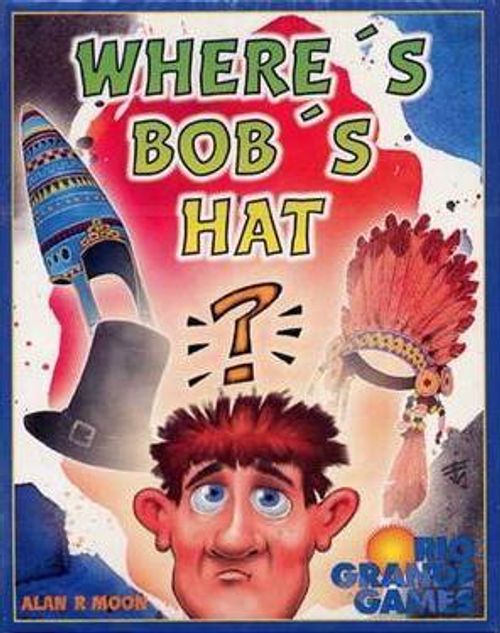
Where's Bob's Hat?
Where's Bob's Hat? Rulebook
Table of Contents
Table of Contents
Contents
- 60 playing cards - 1-20 blue, 1-20 red, and 1-20 black
- 2 Bob's Hat cards
- 20 bid cards - (five sets of 4 cards; each set has one each of blue, red, black, and gray)
- 4 trump cards (one each of blue, red, black, and gray)
- rule booklet
Preparation
Each player takes one set of bid cards.
The youngest player is the starting player. He takes the 4 trump cards, the Bob's Hat cards, and the deck of playing cards.
The game is played over several hands. With 3 players, play 12 hands; with 4 players, play 10 hands; and with 5 players, play 8 hands. Players may choose to play more or fewer hands if they like.
Choose one player to be the scorekeeper. He will keep track of the players' scores during the game using a score sheet similar to the one shown in these rules. He may copy the example or create his own using the example as a model.
Playing the Game
The game is played in hands. The youngest player is the dealer for the first hand. After the first hand, the deal passes to the left around the table, each player taking the deck, the 4 trump cards, and the Bob's Hat cards on his turn.
The dealer shuffles the 4 trump cards and turns the topmost card face up. This is the trump suit for the hand. Each card in the trump suit is a trump. If the gray card is turned up, there is no trump suit.
The dealer shuffles the deck. For the first hand of the game, each player is dealt five cards. On the second hand, each player is dealt six cards. On the third hand, each player is dealt seven cards, and so on.
After looking at his cards, but before any player bids, the dealer chooses a Bob's Hat card for this hand. He places one of the Bob's Hat cards in the middle of the table, either the +10 card or the -10 card.
Bidding
Each player studies the cards in his hand. Based on his cards and the trump suit, each player decides what his objective for the hand will be. Then, beginning with the dealer and proceeding clockwise around the table, each player must make a bid.
A player bids by placing one or more of his bid cards face up on the table in front of him. He places his other bid cards face down to the side.
The three colored bid cards are "most" cards and indicate a bid to take the most cards in the suit of that color. If a player bids a most card, he must take more cards in that suit than every other single player. The gray card indicates the player expects to take the fewest cards. If a player bids fewest cards, he must take fewer cards than every other single player.
Taking Tricks
Each round consists of a number of tricks equal to the number of cards dealt to each player. The dealer leads to the first trick by choosing a card from his hand and playing it face up in the center of the table. Each other player in turn, clockwise around the table, must choose a card from his hand and play it to the trick face up in the center of the table, but not directly on top of the other cards played.
A player must play a card of the suit that was led. If a player does not have a card of the suit that was led, he may play any card from his hand instead.
After each player has played one card, the player who played the highest card in the suit that was led takes the trick. If there is a trump suit, however, and one or more players play a trump card, the player who played the highest trump takes the trick, regardless of the suit led.
The blue, red, and black 14 and 15, all have a picture of Bob's Hat on them. Each time a player takes a trick with one or more of these cards, he takes the Bob's Hat card (from the center of the table or from the player who is holding it) and places it face up in front of him. If there are no 14's or 15's, Bob's Hat remains unfound and the Bob's Hat card remains where it was.
When a player takes a trick, he places the cards face down in a pile on the table in front of him. He then leads to the next trick. The rules for subsequent tricks are the same as for the first, except that the player who leads to the trick is the player who took the last trick. Play continues in this manner until all the cards have been played.
Scoring
At the end of each hand, each player must establish whether he has successfully made his bid or not.
If a player bid a most card, he makes his bid if no other player took an equal or greater number of cards in the suit. He scores 5 points plus the number of cards he took in the suit. A player who fails to make a most bid scores -5 points (minus 5 points) and gets nothing for any cards he took in that suit.
Example: Anna bids most blue. She takes 4 blue cards, Bob takes 3 blue cards, and Chris takes 1 blue card. Anna makes her bid and scores 9 points: 5 points for making the bid and 4 points for the 4 blue cards she took. If Anna takes only 3 blue cards, she fails to make her bid (she ties with Bob) and scores -5 points.
If a player bids fewest cards, he makes his bid if no other player took an equal or lesser number of cards. He scores a number of points equal to the number of cards dealt to each player that hand. A player who fails to make a fewest cards bid scores minus points equal to the number of cards dealt to each player that hand.
Example: seven cards are dealt to each player. Bob bids fewest cards and takes 3 cards. Anna takes 12 and Chris takes 6. Thus, Bob makes his bid and he scores 7 points. If both Bob and Chris take 3 cards (and Anna 15), Bob misses his bid and he scores -7 points.
The result of each bid is calculated separately. It is possible for a player to make one or more bids and fail to make one or more others in the same hand.
Example: Chris bids most blue and most red. She makes the most blue bid taking 8 blue cards, but she fails to make the most red bid. Chris scores 8 Points: 13 for the most blue bid (5 points for making the bid and 8 points for taking 8 cards) and -5 for missing the most red bid.
The player with the Bob's Hat card at the end of the hand, scores either +10 or -10 points in addition to any other points he scored for the hand. He then places Bob's Hat card back in the middle of the table. If no player found Bob's Hat in this hand (there were no 14's or 15's in play), no one scores the points for Bob's Hat. The Bob's Hat card does not count as a card taken when determining success of a fewest card bid.
The scorekeeper records all the scores for each hand. Players may have minus scores.
Game End
The winner is the player with the highest score after the last hand of the game.
Sample Score Sheet for 5 Players
| hand # | player 1 | player 2 | player 3 | player 4 | player 5 |
|---|---|---|---|---|---|
| #1 score | |||||
| #2 score | |||||
| sub-total | |||||
| #3 score | |||||
| sub-total | |||||
| #4 score | |||||
| sub-total | |||||
| #5 score | |||||
| sub-total | |||||
| #6 score | |||||
| sub-total | |||||
| #7 score | |||||
| sub-total | |||||
| #8 score | |||||
| total |
Optional Rules
Double fewest cards - A player may bid double fewest cards by playing 2 fewest bid cards (he simply borrows an opponent's fewest bid card for the hand). He then scores plus or minus double the normal number of points.
No bids - Each player may make one no bid per game. The player still plays the hand and simply tries to hinder the chances of his opponents. The player does not score for the hand.
Secret bidding - All players select their bid cards in secret and reveal them simultaneously. This will change the game as players will not be able to see previous players' bids before making their own.
Negative scoring - If a player fails to make his bid, he scores -5 points plus -1 for each card he took in the suit he bid. This, of course, will cause much lower scores in the game.
Unusual Situations
-
A player may bid most cards and fewest cards in the same hand. It is possible, though unusual, to make both bids.
-
If a player bids most cards and there are no cards of this suit dealt to anyone, the player makes his bid. If two or more players bid most cards in such a suit, they all make their bids.
-
If a player reneges (does not play the suit led when he has card(s) in the suit), the player scores -15 Points and the hand is replayed with the dealer shuffling and redealing the cards.