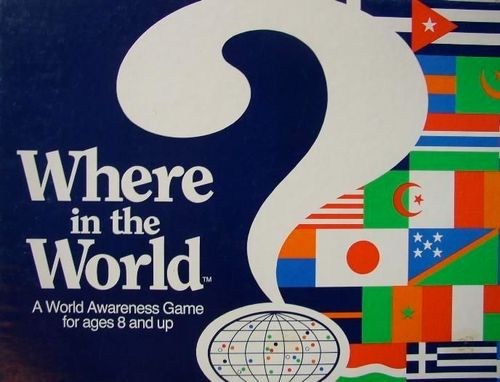
Where in the World?
Where in the World? Rulebook
Table of Contents
Table of Contents
The Games
- Crazy Countries 1: A simple card game like Crazy Eights that teaches the names and locations of countries.
- Crazy Countries 2: A card game for learning country facts—the capitals, major languages, major imports, and so on.
- Statesman: A board game for locating countries and their regions.
- Diplomat: A board game for learning facts about countries in a region.
- Ambassador Junior: Players compare facts about countries around the world.
- Ambassador Senior: Players make up clues to relate geography to current events.
Object of the Games
Build your knowledge of countries by answering questions in six different games. The most advanced game, Senior Ambassador, invites players to contribute their own country clues based on current events reported in the news media.
Players
2 to 6, ages 8 and up
Game Materials
- 3 Boards Depicting 6 Regions (Africa, Asia, Europe, North America, South America, and Oceania)
- Country Cards, color-coded by region (orange for Asia, yellow for Africa, and so on). The number in the upper right corner is the rank by area compared to other countries in the region. Example: Italy is the 9th biggest nation in Europe and so ranks nine. The number also matches the country's location on its Region Board.
- 6 Wild Cards
- 1 Spinner/Bodies-of-Water Reference Board
- 120 Playing Pieces. Each player picks a color.
Rules for Level 1: CRAZY COUNTRIES 1
Players: 2 to 6, ages 8 and up
Materials: Any 3 decks of Country Cards and all 6 Wild Cards
Object: As in Crazy Eights, be the first player to run out of cards. Then match countries to their regions in the Winner's Round.
- To Start: Shuffle all the cards and deal 7 cards, face down, to each player. Sort your cards by region, but don't show them to other players. Put the rest of the deck (the "draw pile") face down in the center. Turn over the top card. That's the "discard pile." The player to the left of the dealer goes first.
- To Play: Take turns discarding cards, each time stating the name of the country and region on the card. To discard, you must play
- a card of the same region as the top card of the discard pile, or
- a card from another region but with the same size number (look in the upper right corner of the card), or
- a wild card.
- Wild Cards: When you play a wild card, announce the region of your choice. The next player must play a card from that region.
- If You Can't Play: Draw 1, 2, or 3 cards until you get a card to play. If you can't play after drawing 3 cards, the turn passes to the left.
- If the Draw Pile Runs Out: Take the top card off the discard pile and keep it face up. Reshuffle the rest of the cards and place them face down to form a new draw pile.
- Running Out of Cards: The first player to run out of cards plays the Winner's Round. The player to the left draws 5 cards and, one at a time, names the countries on the cards.
- To Win: As the 5 countries are named, the player in the Winner's Round must correctly name 3 out of 5 of their regions. If you don't succeed, add the cards you missed to your hand, bury the cards you named correctly in the discard pile, and keep playing until someone wins.
Rules for Level 2: CRAZY COUNTRIES 2
Follow the rules for Crazy Countries 1 with these variations:
-
To Start: Agree on one of the following categories: Major Religion, Literacy Rate, Major Export, Major Import, Major Seacoasts, Major Languages, Population Range (see charts in this booklet). Example: If you chose "Major Religion" and the top card on the discard pile says, "Christianity," then "Christianity" becomes the fact-in-play.
If you chose "Major Import" or "Export", decide if you want to play by the type of export or import (natural resource, agricultural, manufactured, human resource or energy)—all of which are on the charts in this booklet–or by the specific export or import (oil, wood, tourism, etc.).
-
To Discard: You must have a card that
- matches the region and the fact, or
- matches the region but not the fact (the same region remains in play; the fact changes), or
- matches the fact but not the region (the same fact remains in play; the region changes), or
- is a wild card.
State the region, country, and fact-in-play each time you discard.
-
Wild Cards: When you play a wild card, you can change the region or the category (from "Religion" to "Export," for example).
-
If the Draw Pile Runs Out: Pass the turn until a player can discard. If no one can discard, the last player to have played names a new region or category. The turn passes to the left.
-
To Win: Be the first to play all your cards. In the Winner's Round, name the region and any category fact for 3 out of 5 Country Cards.
Variation: Each time players discard a Country Card, they must first identify the country on its Region Board.
Rules for Level 3: STATESMAN
Players: 2 to 6, ages 10 and up
Materials: 1 Region Board, matching Country Cards, 5 Playing Pieces per player, Spinner
Object: Score the most points by correctly identifying countries on a Region Board.
- To Start: Agree on a Region Board (Asia, Africa, and so on). Find the Country Cards for that region. Shuffle them and place the deck face down near the Region Board. Each player takes 5 Playing Pieces of a single color. Also decide which level every one will be playing on the spinner. Green is easier for younger players.
- To Play: The dealer draws the first card and reads the country aloud to the player on the left. The player must
- locate the country on the Region Board (the number in the upper right corner matches the number on the Region Board), or
- spin the Spinner and identify the fact for the category where the pointer lands. (Example: If the Spinner points to "Literacy Rate," the player must state whether the literacy rate is high, medium, or low for the country.)
- If the Player is Correct: He or she places a Playing Piece on the country and keeps the Country Card.
- If the Player is Wrong: The dealer points out the location of the country, reads the facts on the card, and puts it at the bottom of the draw pile.
- Taking Turns: The play passes to the left after each guess. Keep playing until someone runs out of Playing Pieces.
- Scoring: Each Country Card is worth the number in the upper right corner, which is also its area in relation to the other countries in that region. Example: Canada, the biggest country in its region, is worth 1 point. Smaller countries, which may be less familiar to players, are worth more points.
Variations: To simplify the game, limit the Country Cards to the 10 biggest countries in a region (numbers 1 to 10 in the upper corner). For more challenge, play with two or three Region Boards and double the number of playing pieces in step 1.
Rules for Level 4: Diplomat
Players: 2 to 6, ages 12 and up
Materials: 1 Region Board, the matching Country Cards, 5 to 8 Playing Pieces per player, Spinner (optional)
Object: Score the most points by identifying category facts about countries.
The game plays like Statesman with the following variations:
- Choosing a Category: Each player chooses a category (Major Religion, Capital, etc.) or lets the Spinner decide on a category. More than one player can choose the same category.
- To Play: The Dealer draws the first card and announces the country to the player on the left. The player must name his or her category fact for that country. Example: The player's category is "Capitals." The country is Nauru. The player must name the capital of Nauru (Yaren District).
- If the Player is Correct: He or she puts a Playing Piece on the country, keeps the Country Card, and takes another turn.
- If the Player is Wrong: The dealer tells the correct answer and returns the card to the bottom of the draw pile. The turn passes to the left.
- Scoring: As in Statesman, total the scores as soon as someone runs out of Playing Pieces. The highest score wins. The winner must switch categories for the next round of play. The other players may choose to keep or switch their categories.
Variations: Play until a pre-set time limit is up, until all the countries in play have been claimed, or up to a pre-set score. For more challenge, play with two or three Region Boards and their matching Country Cards.
Rules for Level 5: Diplomat
Editor's note: the printed heading for this level reads "Diplomat", and its rules refer to "Junior Ambassador". The game this level describes is Ambassador Junior (item 5 in The Games). The heading and wording are kept as printed.
Players: 2 to 6, ages 12 and up
Materials: 1 or more Region Boards, matching Country Cards, 5 to 8 Playing Pieces per player, Spinner (optional)
Object: Score the most points by identifying countries based on their facts.
- To Start: Decide on which regions to learn. Shuffle the Country Cards for those regions and place them face down.
- To Play: The dealer draws the top card and does not name the country. Instead, he or she names any single category and fact about the country, including the size number. (Variation: Spin the Spinner to choose a category.) Example: The dealer draws Singapore and says, "The Major Seacoast is the South China Sea." The player on the left must guess the country. If the clue is a size number, the player must locate the country on the Region Board.
- If the Player is Correct: He or she places a Playing Piece on the country, keeps the Country Card, and takes another turn.
- If the Player is Wrong: The dealer names the country and puts the card on the bottom of the draw pile. Play passes to the left.
- To Win: Keep playing until someone has run out of Playing Pieces, the draw pile is exhausted, or a pre-set time has elapsed. The highest scorer wins. (See SCORING under "Rules for Level 3: Statesman.")
Rules for Level 6: Senior Diplomat
Editor's note: the printed heading for this level reads "Senior Diplomat", and its rules refer to "Junior Ambassador". The game this level describes is Ambassador Senior (item 6 in The Games). The heading and wording are kept as printed.
Follow the rules for Junior Ambassador, but substitute your own current events clues for the categories on the cards. Here's how to play:
- To Prepare: One week in advance, players collect clues on countries from newspapers, magazines, television news programs, documentaries, and other sources. Write out and initial your clues (including the country) on index cards. The clues should be posed as a question whose answer is the name of a country. Example: In April 1993, Eritreans voted to break off from what nation? (Answer: Ethiopia.)
- To Set Up: At the end of the week, organize the clues by region, and then alphabetically by country. Locate the Country Cards that match the clues. (Don't play with Country Cards for which there are no clues.) Shuffle the Country Cards and place them face down.
- To Play: The dealer draws a card and reads any clue that relates to that country. The player on the left must name the country and locate it on the Region Board.
- If the Player is Correct: He or she places a Playing Piece on the Region Board, keeps the Country Card, and takes another turn.
- If the Player is Wrong: The dealer names the country and places the clue on the bottom of the pile for that region. The person who wrote the clue takes the next turn. (The player on his or her right becomes the new dealer.)
- To Win: The end of the game and scoring are identical to Junior Ambassador.
Region Charts
The charts in this booklet list, for each region, the countries by population, the monetary units, literacy rate, major languages, major religions, major seacoasts, and the major exports and imports.
North America
Countries (by population)
- Under 1,000,000: Antigua and Barbuda; The Bahamas; Barbados; Belize; Dominica; Greenland; Grenada; St. Kitts & Nevis; St. Lucia; St. Vincent & the Grenadines
- 1-10 Million: Costa Rica; Dominican Republic; El Salvador; Haiti; Honduras; Jamaica; Nicaragua; Panama; Trinidad and Tobago
- 11-50 Million: Canada; Cuba; Guatemala
- Over 100 Million: Mexico; United States
Monetary Unit: (alphabetically) Bahamian dollar, balboa, Barbados dollar, Belize dollar, Canadian dollar, colon, Cuban peso, Danish krone, Dominican peso, East Caribbean dollar, gold cordoba, gourde, Jamaican dollar, lempira, Mexican peso, quetzal, Trinidad and Tobago dollar, U.S. dollar
Literacy Rate: Medium (1 country), High (23 countries)
Major Languages: (alphabetically) Creole, Danish, English, French, Greenlandic, Hawaiian, Spanish
Major Religions: Anglican, Christianity, Hinduism, Inuit spiritual beliefs, Lutheran, Methodist, Protestant, Roman Catholic
Major Seacoasts: Arctic Ocean, Caribbean Sea, Gulf of Mexico, North Atlantic, North Pacific
| Natural Resources | Agricultural Products | Manufactured Goods | |
|---|---|---|---|
| Major Exports | Ferronickel; Gold; Mineral products; Oil; Oil products; Salt | Bananas; Coffee; Fish; Fish; Food; Nutmeg; Sugar | Capital goods; Machinery; Manufactured goods; Motor vehicles and parts; Textiles |
| Major Imports | Crude oil; Oil; Oil products; Raw materials | Animals; Food | Consumer goods; Industrial supplies; Machinery |
Europe
Countries (by population)
- Under 1,000,000: Andorra; Iceland; Liechtenstein; Luxembourg; Malta; Monaco; Montenegro; San Marino; Vatican City
- 1-10 Million: Albania; Armenia; Austria; Azerbaijan; Belarus; Belgium; Bosnia & Herzegovina; Bulgaria; Croatia; Czech Republic; Denmark; Estonia; Finland; Georgia; Greece; Hungary; Ireland; Kosovo; Latvia; Lithuania; Macedonia; Moldova; Norway; Portugal; Serbia; Slovakia; Slovenia; Sweden; Switzerland
- 11-50 Million: Netherlands; Poland; Romania; Spain; Ukraine
- 51-100 Million: France; Germany; Italy; United Kingdom
Monetary Unit: (alphabetically) Belarussian ruble, denar, dram, euro, forint, hryvna, Icelandic krona, koruna, krona, krone, kroon, kuna, lari, lats, lek, leu, lev, litas, Maltese lira, manat, marka, Norwegian krone, pound, Slovenian tolar, Swiss franc, Yugoslav dinar, zloty
Literacy Rate: High (46 countries)
Major Languages: (alphabetically) Albanian, Armenian, Azerbaijani, Belarusian, Bosnian, Bulgarian, Catalan, Croatian, Czech, Danish, Dutch, English, Estonian, Finnish, French, Frisian, Georgian, German, Greek, Hungarian, Icelandic, Irish, Italian, Latin, Latvian, Lithuanian, Macedonian, Maltese, Montenegrin, Norwegian, Polish, Portuguese, Romanian, Russian, Serbian, Slovak, Slovenian, Spanish, Swedish, Turkish, Ukrainian
Major Religions: Christianity, Eastern Orthodox, Evangelical Lutheran, Greek Orthodox, Islam, Lutheran, Macedonian Orthodox, Protestant, Roman Catholic, Serbian & Ukrainian Orthodox
Major Seacoasts: Adriatic Sea, Aegean Sea, Arctic Ocean, Baltic Sea, Black Sea, Caspian Sea, Celtic Sea, Denmark Strait, English Channel, Gulf of Bothnia, Gulf of Finland, Ionian Sea, Irish Sea, Mediterranean Sea, North Atlantic, North Sea, Norwegian Sea, Sea of Azov, Tyrrhenian Sea
| Natural Resources | Agricultural Products | Manufactured Goods | Human Resources | Energy | |
|---|---|---|---|---|---|
| Major Exports | Fuel; Metals; Oil; Oil products | Fish; Food; Tobacco products | Building materials; Engineering products; Iron & steel products; Machinery; Manufactured goods; Metal products; Mineral products; Mining Products; Textiles; Transport equipment; Wood products | Tourism | |
| Major Imports | Crude oil; Minerals; Oil; Oil products; Raw materials; Timber | Food | Consumer goods; Engineering products; Machinery; Manufactured goods; Mineral products | Electricity |
Oceania
Countries (by population)
- Under 1,000,000: Fiji; Kiribati; Marshall Islands; Micronesia; Nauru; Palau; Samoa; Solomon Islands; Tonga; Tuvalu; Vanuatu
- 1-10 Million: New Zealand; Papua New Guinea
- 11-50 Million: Australia
Monetary Unit: (alphabetically) Australian dollar, Fiji dollar, kina, New Zealand dollar, Pa'anga, Solomon Islands dollar, tala, U.S. dollar, vatu
Literacy Rate: Medium (1 country), High (9 countries)
Major Languages: (alphabetically) Bislama, English, Fijian, Kiribati, Marshallese, Melanesian, Native dialects, Nauruan, Palauan, Samoan, Tobi, Tongan, Tuvaluan
Major Religions: Atheism, Christianity, Hinduism, Protestant, Roman Catholic
Major Seacoasts: Coral Sea, Indian Ocean, North Pacific, Solomon Sea, South Pacific
| Natural Resources | Agricultural Products | Manufactured Goods | |
|---|---|---|---|
| Major Exports | Coal; Oil; Phosphates; Timber | Copra; Cultured pearls; Dairy products; Fish; Food; Shellfish; Sugar | |
| Major Imports | Fuels | Food | Machinery; Manufactured goods |
South America
Countries (by population)
- Under 1,000,000: Guyana; Suriname
- 1-10 Million: Bolivia; Colombia; Paraguay; Uruguay
- 11-50 Million: Argentina; Chile; Ecuador; Peru; Venezuela
- Over 100 Million: Brazil
Monetary Unit: (alphabetically) bolivar, boliviano, Chilean peso, Columbian peso, guarani, Guyanese dollar, nuevo sol, peso, real, Surinamese dollar, U.S. dollar, Uruguay peso
Literacy Rate: High (12 countries)
Major Languages: (alphabetically) Aymara, Creole, Dutch, English, French, German, Guarani, Italian, Mapudungun, Portuguese, Portunal, Quechua, Spanish, Urdu
Major Religions: Christianity, Hinduism, Islam, Nondenominational, Protestant, Roman Catholic
Major Seacoasts: Caribbean Sea, North Atlantic, North Pacific, South Atlantic, South Pacific
| Natural Resources | Agricultural Products | Manufactured Goods | |
|---|---|---|---|
| Major Exports | Copper; Aluminum; Natural gas; Oil | Food; Soybeans & derivatives; Sugar; Beef | Machinery; Textiles |
| Major Imports | Crude oil; Raw material | Machinery |
Asia
Countries (by population)
- Under 1,000,000: Bhutan; Brunei; Maldives
- 1-10 Million: Bahrain; Cyprus; East Timor; Israel; Jordan; Kuwait; Kyrgyzstan; Laos; Lebanon; Mongolia; Oman; Palestinian Occupied Territory; Qatar; Singapore; Tajikistan; Turkmenistan; United Arab Emirates
- 11-50 Million: Afghanistan; Cambodia; Iraq; Kazakstan; Malaysia; Nepal; North Korea; Saudi Arabia; South Korea; Sri Lanka; Syria; Taiwan; Uzbekistan; Yemen
- 51-100 Million: Iran; Myanmar (Burma); Thailand; Turkey; Vietnam
- Over 100 Million: Bangladesh; Indonesia; Japan; Pakistan; Philippines; Russia
- Over 1 Billion: China; India
Monetary Unit: (alphabetically) afghani, Bahrain dinar, baht, Brunei dollar, Cyprus pound, dong, Jordanian dinar, Kuwaiti dinar, kyat, Lebanese pound, manat, Nepalese rupee, New Israeli shekels, New kip, Ngultrum, Omani rial, Pakistan rupee, peso, Qatari riyal, renminbi, rial, ringgit, riyal, ruble, rufiya, rupee, rupiah, shekel, Singapore dollar, som, somoni, Sri Lanka rupee, Syrian pound, Taiwan dollar, taka, tenge, tugrik, Turkish lira, U.A.E. dirham, U.S. dollar, Uzbekistani sum, won, yen, yuan
Literacy Rate: Low (1 country), Medium (7 countries), High (39 countries)
Major Languages: (alphabetically) Arabic, Armenian, Bahasa Indonesian, Bahasa Malaysia, Baluchi, Bengali, Burmese, Chinese, Dari, Dhivehi, Dutch, Dzongkha, English, Farsi (Persian), Filipino, French, Greek, Hebrew, Hindi, Hokkien, Japanese, Kazakh, Khalkha Mongol, Khmer, Kirghiz, Korean, Kurdish, Lao, Maithali, Malay, Mandarin, Nepali, Pashto, Portuguese, Punjabi, Russian, Sindhi, Sinhala, Tajik, Tamil, Tetum, Thai, Turkish, Turkmen, Urdu, Uzbek, Vietnamese
Major Religions: Animism, Atheism, Buddhism, Christianity, Christian Orthodox, Hinduism, Islam, Judaism, Roman Catholic, Taoist
Major Seacoasts: Aegean Sea, Andamnan Sea, Aral Sea, Arctic Ocean, Barents Sea, Bay of Bengal, Bering Sea, Black Sea, Caspian Sea, Celebes Sea, East China Sea, Gulf of Aden, Gulf of Aquaba, Gulf of Mannar, Gulf of Oman, Gulf of Thailand, Gulf of Tonkin, Indian Ocean, Mediterranean Sea, North Pacific, Persian Gulf, Phillippine Sea, Red Sea, Sea of Japan, Sea of Okhotsk, South China Sea, South Pacific, Strait of Malacca, Sulu Sea, Taiwan Strait, Timor Sea, Yellow Sea
| Natural Resources | Agricultural Products | Manufactured Goods | Energy | |
|---|---|---|---|---|
| Major Exports | Copper; Crude Oil; Metals; Minerals; Natural Gas; Oil; Oil products; Wood products | Coffee; Cotton; Fish; Food; Opium | Electrical equipment; Equipment; Jewelry; Machinery; Semiconductors; Textiles | Electricity |
| Major Imports | Crude oil; Fuel; Gold; Oil; Raw materials | Food; Live Animals | Capital goods; Consumer goods; Machinery; Textiles | Electricity |
Africa
Countries (by population)
- Under 1,000,000: Cape Verde; Comoros; Djibouti; Equatorial Guinea; Sao Tome and Principe; Seychelles; Western Sahara
- 1-10 Million: Benin; Botswana; Burundi; Chad; Congo; Eritrea; Gabon; The Gambia; Guinea; Guinea-Bissau; Lesotho; Liberia; Libya; Mauritania; Mauritius; Namibia; Sierra Leone; Somalia; South Sudan; Swaziland; Togo; Tunisia
- 11-50 Million: Algeria; Angola; Burkina Faso; Cameroon; Côte d'Ivoire; Ghana; Kenya; Madagascar; Malawi; Mali; Morocco; Mozambique; Niger; Rwanda; Senegal; South Africa; Sudan; Tanzania; Uganda; Zambia; Zimbabwe
- 51-100 Million: Dem. Rep. of Congo; Egypt; Ethiopia
- Over 100 Million: Nigeria
Monetary Unit: (alphabetically) birr, Burundi franc, Cape Verdean escudo, cedi, CFA franc, Congolese franc, dalasi, dinar, dirham, Djibouti franc, dobra, Egyptian pound, franc, Guinean franc, Kenya shilling, Kwacha, leone, Liberian dollar, Libyan dinar, lilangeni, Malagasy franc, maluti, Mauritian rupee, metical, naira, nakfa, Namibian dollar, new kwanza, ouguiya, pula, rand, Rwanda franc, Seychelles rupee, Somali shilling, tala, Tanzanian shilling, Tunisian dinar, Ugandan new shilling, Zimbabwean dollar
Literacy Rate: Low (4 countries), Medium (18 countries), High (32 countries)
Major Languages: (alphabetically) Afar, Afrikaans, Amarigna, Arabic, Asante, Bambara, Bantu dialects, Bhojpuri, Chichewa, Chinyanja, Chiyao, Creole, Crioulo, Dagomba, Dioula, Emakhuwa, English, Ewe, French, German, Hausa, Igbo, Isizulu, Isixhosa, Italian, Jola, Kinyarwanda, Kirundi, Kiswahili, Krio, Major African dialects, Malagasy, Mandinka, Mina, Ndebele, Oromigna, Portuguese, Pulaar, Sangho, Sesotho, Setswana, Shona, SiSwati, Somali, Soninke, Spanish, Swahili, Wolof, Yoruba
Major Religions: Animism, Christianity, Hinduism, Islam, Indigenous beliefs, Protestant, Roman Catholic, Vodoun, Zionist
Major Seacoasts: Gulf of Aden, Gulf of Guinea, Gulf of Suez, Indian Ocean, Mediterranean Sea, Mozambique Channel, North Atlantic, Red Sea, South Atlantic
| Natural Resources | Agricultural Products | Manufactured Goods | |
|---|---|---|---|
| Major Exports | Copper; Crude oil; Diamonds; Gold; Iron ore; Metals; Oil; Oil products; Phosphates; Platinum; Rubber; Uranium ore | Cashews; Cocoa; Coffee; Cotton; Fish; Food; Live stock; Peanut products; Tea; Tobacco | Re-exports; Textiles |
| Major Imports | Fuels; Oil; Oil products | Food; Livestock | Capital goods; Consumer goods; Machinery; Manufactured goods; Textiles |
Sources of Data
CIA World Factbook 2012
The World Almanac and Book of Facts, 2012 Edition (World Almanac Education Group, Inc.)