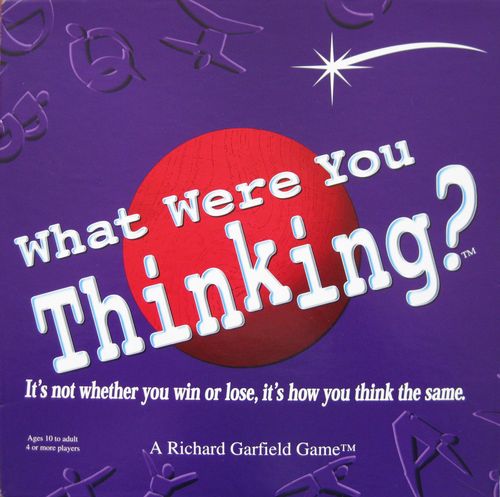
What Were You Thinking?
What Were You Thinking? Rulebook
Table of Contents
Table of Contents
Components
2,000 questions on 250 double-sided cards, a game board with a spinner, 6 pawns, 6 pencils, and a notepad.
Object
Guess the most common answer to each question in order to avoid moving up the penalty track. When someone gets to the top of the penalty track, everyone else wins!
Overview
Players take turns asking questions from the question cards. Everyone writes answers to each question, and everyone whose answer agrees with the majority is "right." If no one else answers the same way you do, you may find yourself on the fast track out of the game. (This is not a good time to express your individuality.)
Setup
Sit in a circle around the board. Everyone should have a pencil, paper, and a pawn. (If you want to play with more than six people, the extras can use coins, paperclips, or other small items instead of pawns.) Each player should put his or her pawn on the square marked Begin. Pick someone to go first.
Play
The first player spins the spinner. When the spinner stops on a colored space, that player draws a question card, looks on the card to find the question whose color matches, and reads it out loud. If the spinner stops on a black space, just follow the instructions. Each player, including the questioner, then writes an answer. Some questions call for several answers (usually five) while others require just one. You may not respond with more answers than the card calls for.
Once the question has been read, don't discuss your answers until everyone is finished writing. Always try to put down the right number of answers—even a truly bizarre answer scores better than nothing.
Scoring
When everyone is done writing, the player who read the question reads all of his or her answers aloud. As each answer is read, players who came up with the same answer raise their hands (including the reader). Each person whose hand is raised gets 1 point for each raised hand.
Scoring Example: The question is "Name your favorite amphibian." You write lizard. It turns out lizards are not really amphibians, but when you read your answer out loud and raise your hand, two other people raise their hands because they also wrote lizard. You and those two other people each get 3 points because three people provided the same answer. (If no one else had chosen lizard, you would have received only 1 point.)
Once the first reader has read all of his or her answers, the next player reads any of his or her answers that have not already been given. Keep going until all answers have been read.
The Penalty Track
When all the answers for a particular question have been scored, each player adds up all the points he or she scored on that question. (Of course, if the question had only one answer, you won't have anything to add.) The player with the fewest points moves his or her pawn one square up the penalty track on the right-hand side of the board. If more than one player ties for low score, those players all move their pawns one square up. If everybody gets exactly the same number of points, celebrate your togetherness by leaving all the pawns right where they are.
After pawns have been moved, the player to the left of the previous questioner resumes play by spinning the spinner and drawing a new question card.
Winning the Game
When any pawns advance from the 6 square to the final What Were You Thinking? square, the game is over. All players whose pawns are not on the What Were You Thinking? square are declared the winners and can congratulate themselves on their mindreading ability.
Settling Disputes
Sometimes you might wonder whether or not two similar answers should count as a match. These problems are best settled by mutual agreement—after all, the right answer in What Were You Thinking? is the most popular answer! Here are some guidelines if you need help:
A specific answer doesn't match a general answer, so ginger ale doesn't match soda.
Two differently phrased answers that mean the same thing count as a match. For example, on a "Fact or Fiction" question, fact, true, and yes all count as matches. Einstein matches Albert Einstein, and the actress who played Princess Leia matches Carrie Fisher—although Princess Leia does not match Carrie Fisher.
Optional Rules
Your group might want to make the loser of the game perform some penalty: clean up the table at the end, get drinks and snacks for everyone, or sing a silly song. Be sure to agree on the penalty before the game begins.
For a shorter game, play until someone gets to the 5 square instead of all the way to the What Were You Thinking? square.
Go with the flow!