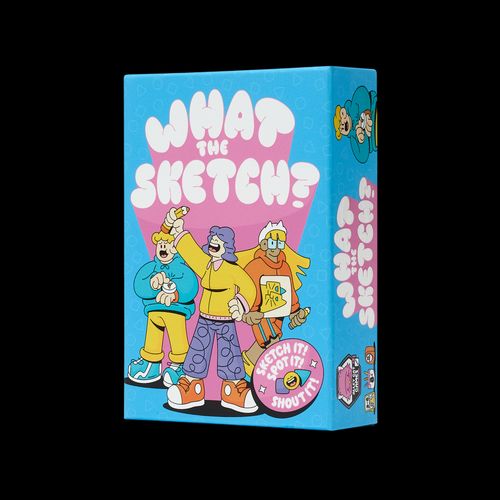
What the Sketch?
What the Sketch? Rulebook
Table of Contents
Table of Contents
Components
- 54 cards
- 36 points tokens
- 6 whiteboards and 6 dry wipe pens
- 60 second timer (provided by players)
Instruction Reference
The art teacher may only describe objects using lines, shapes, and patterns. The reference sheet lists the vocabulary of lines, shapes, and patterns players can use:
- Line
- Semicircle
- Circle
- Rectangle
- Isosceles (triangle)
- Oval
- Parallelogram
- Rhombus
- Triangles: Equilateral, Right-angled
- Trapezium
- Pentagon
- Square
- Hexagon
- Kite
- Windowpane
- Chevrons
- Polka Dots
- Horizontal (stripes)
- Stripes
- Vertical (stripes)
- Checkers
Getting Ready
Each player takes a whiteboard and pen. Shuffle the cards into a deck in the centre of the table. The last player to have created a piece of art becomes the starting player, and is the first art teacher.
How to Play
Each round one player is the art teacher and all other players are students. The role of art teacher passes clockwise between rounds.
During each 60-second round, the art teacher picks what to draw from their card and begins secretly drawing it. At the same time, they give instructions for what to draw. As students draw, they guess aloud what they're drawing. The first student to get it right scores points with the art teacher.
Winning the Game
The game is played over a number of rounds:
For 3–4 players, play 2 rounds each. For 5–6 players, play 1 round each.
Whoever has the most points at the end of the game wins.
Playing a Round
1. Pick a level and object
The art teacher takes the top card of the deck and picks an object from the card. Each object is worth either 1, 2, or 3 points, depending on their difficulty. They keep the card secret, and set a 60-second timer.
2. Draw and instruct
The art teacher starts the timer and draws the object, hiding it from the students using the game box. As they draw, they give instructions to the students about what to draw. The students must follow the directions in an attempt to create a drawing of the same object.
The art teacher may only tell the students what shapes to draw. They can only mention shape, position, and patterns. Descriptions must always be abstract. They must not name any specific physical object.
For example, if the art teacher is drawing a snake, they may talk about wiggly parallel lines, but must not mention 'snake' or any other distinct object, even one that is unrelated to the word. If the art teacher breaks this rule, they cannot gain points that round (students may still gain points).
3. Draw and guess
As they draw, students can shout what they think the object is, based on their drawing. Any student may guess at any time. If a student correctly guesses the word within 60 seconds, both they and the art teacher score 1, 2 or 3 points according to the difficulty of the word. Keep track of your points using the tokens.
If no student correctly guesses before the time runs out, all students reveal their drawings and may discuss between themselves. They have one opportunity to guess as a group, scoring 1 point each if correct. In this case, the art teacher scores no points.
Game End
After all the rounds have been played, everyone counts their points. The player with the most points wins! Players share the victory if tied.