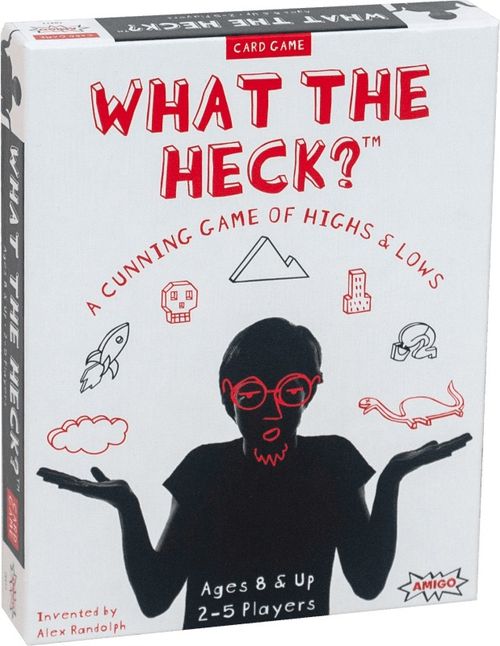
What the Heck?
What the Heck? Rulebook
Table of Contents
Table of Contents
Contents
75 Number Cards (5 sets numbered 1 to 15)
10 Mouse Cards (numbered 1 to 10)
5 Buzzard Cards (numbered -1 to -5)
Instructions
Designer: Alex Randolph · Artist: Wilfried Gebhard
Ages: 7 and Up · Number of Players: 2 - 5
Average Playing Time: 20 minutes
Object of the Game
By cleverly playing their number cards, players try to accumulate the most points by winning mouse cards and avoiding buzzard cards.
Set Up
Separate the blue cards from the green cards. The green cards (number cards) should then be separated by color. Give each player a set of number cards numbered 1 to 15 of the same color. These cards will become their bidding hand. Shuffle the blue cards (mouse and buzzard cards) and place them face down in a pile where all players can reach them. Choose a player who will be designated to turn over the top card of the pile for each round. This player turns over the top card to start the game. In our example, the 5 mouse card is shown.
Let's Play!
The top card from the pile has already been turned over. Now, based on how much each player wants to bid, they choose one of their number cards and place it face down in front of them. The number card with the highest value will win this mouse card. Once each player has chosen a number card to play and has it face down in front of them, all players simultaneously turn over their cards. In the example below, Player B played the card with the highest value. As a result, that player takes the mouse card he has won and places it in front of him (to make the game more challenging, you can choose to put the cards you have won face down, so that what remains in the pile to be bid on is more of a mystery).
Example: The pile shows the 5 mouse card. Player A plays 7, Player B plays 9, Player C plays 4, Player D plays 6. Player B has the highest bid and wins the 5 mouse card.
All number cards played in the first round are now out of play and each player should have 14 betting cards left in his hand.
Beat the Buzzard!
If the card that was turned over from the pile is a buzzard card, with a value from minus 1 to minus 5, each player chooses one of their number cards to play, with the lowest bid taking the buzzard card. In the example below, Player C played the card with the lowest value and must take the buzzard card.
Example: The pile shows a -4 buzzard card. Player A plays 11, Player B plays 7, Player C plays 6, Player D plays 10. Player C has the lowest bid and must take the -4 buzzard card.
Play Continues in the Same Manner
- Turn over the top card from the pile
- Each player chooses a number card to play and puts it face down in front of them
- Everyone turns over their bidding cards simultaneously
- Highest bid wins the mouse card, lowest bid has to take the buzzard card
- After each round, number cards that have been played are removed from the game
What if There's a Tie?
If two or more players have played the same number card (of the same value), these cancel each other out. When mouse cards are up for grabs, in the event of a tie, the player with the next highest bid wins the mouse card. When trying to avoid getting a buzzard card, if two or more players play the same number cards that have the same lowest value, the next highest card must take the buzzard card.
As in the example below, if all number cards played cancel each other out, then they are all put out of play. As the next illustration indicates, the next card on the pile is turned over and placed next to the previous one that had been turned over, but no one won it because all of the number cards cancelled each other out. Now you are playing for the sum of both cards that have been turned over. If the sum of the two cards equals zero or more, use the mouse card rule with the player who played the highest number card winning both cards.
Illustration: A tied round is crossed out on the pile — a "6" number card was matched by another "6" — so no one wins it. The next card is turned face-up beside it: a "3" mouse card, which is now played for together with the tied round. A second tied pair, two "5" number cards, is shown crossed out the same way.
Example: Two mouse cards, a "3" and a "4," have been turned over together (sum = 7, zero or more). Player A plays 13, Player B plays 12, Player C plays 12, Player D plays 11. The mouse card rule applies and the highest number card wins both mouse cards.
If the sum of both cards is negative, the buzzard card rule applies with the person playing the lowest number card having to take both cards.
Note: if all number cards cancel each other out for the last round (the 15th card from the pile has been turned over), no player wins this card and it is out of play.
Ending the Game
Once all animal cards have been collected, the game is over. Each player adds up his positive points (mouse cards), and subtracts his minus points (buzzard cards) to arrive at his final point total. The player who has accumulated the most points wins.
Two Player Version
Each player should remove three of their number cards (without looking at them). Three animal cards should also be removed from the pile and set aside face down. The game is played with the remaining twelve cards according to the regular rules to obtain the most points.