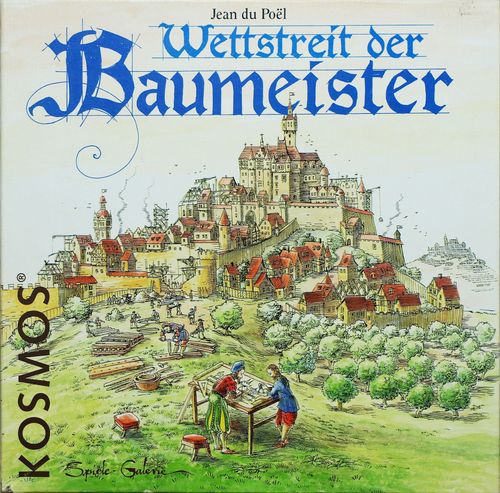
Wettstreit der Baumeister
Wettstreit der Baumeister Rulebook
Table of Contents
Table of Contents
Goal of the Game
The player whose city has most points at the end wins.
Game Materials
- 40 building cards
- 20 gold (3 Thaler) coins
- 30 silver (1 Thaler) coins
- 4 building tents
- 5 black saboteur stones
- 1 die
Game Preparation
- Before the first game is played carefully remove all the parts from their frameworks.
- The 40 building cards are mixed thoroughly and placed in two stacks, with 20 cards per stack, in the middle of the table - one stack is face up, the other is face down.
- Each player gets the three parts that belong to a building tent, puts it together and places it in front of them.
- Each player takes 10 Thalers worth of coins. During the game, players keep their money secret behind their building tents.
- The remaining coins forms a cash supply in the middle of the table.
- The five saboteur stones are placed in the middle of the table.
Randomly determine the starting player by the roll of the die. Play proceeds clockwise.
The Building Cards
- The table shows the five different building types that occur with different frequency, with different values.
| Type | Number | Value |
|---|---|---|
| Corner Tower | 5 | Each: 2x1, 2x2, 3 |
| Tower | 10 | 2x1, 2x2, 2x3 |
| City Gate | 10 | 2x2, 3x3, 3x4, 2x5 |
| Town Hall | 6 | 2x5, 2x6, 2x7 |
| Church | 8 | 4, 2x5, 2x6, 7, 8, 9 |
- The inside of the building tent also shows how many cards there are of each building type.
- City gates have a money symbol (one or two coins) and produce additional revenues during the game.
- Towers and Corner Towers have a shield symbol, used protect themselves against attacks by the saboteur.
- All building cards show their point value at the right of the card.
Game
On a turn a player may perform three game moves in the following order. The first two steps are mandatory, the third is optional:
- Determine Revenues
- Place a building card up for auction
- Build or sabotage
Players use their money to buy building cards and lay them out in the course of the game to form a cityscape. In the end the cities that are laid out are assessed and the winner is determined.
Course of a Game Turn
1. Determine Revenues
- The player rolls the die. With a result from 1 to 5, the player receives that many Thalers from the cash reserve.
- If a player has already laid out city gates in the course of the game, an additional 1 Thaler is received for each coin on the city gates.
- If the saboteur appears as the die result (black dot), the player receives Thalers only for city-gates. Instead of any other income, the player takes a saboteur from the reserve and places it visibly for all to see. If no more saboteurs lie in the reserve, the player may take away a saboteur from any player.
2. Building Card Auctions
The player places a building card up for auction - either the uppermost card of the open deck or the uppermost card of the concealed stack.
a) Auction of the Open Stack
The auctioneer selects the face-up card on top of the open deck and places an opening bid on it. The other players can increase the bid in turn or can pass. Whoever passes is eliminated from the auction. If all have passed, the player offering the most money gets the card, takes it into hand and must pay the bid in coins.
b) Auction of the Hidden Stack
Only the auctioneer looks at the top card and must do a first bid without betraying which building card it is. In seat sequence, each player increases the bid or passes. If the bidding returns to the auctioneer, the name of the building type is announced, but not the building value. (The notes on the inside of the building tent helps with this.) The auction proceeds normally. The highest bidder gets the hidden card and takes it into hand.
If the auction doesn't go into a second bidding round (i.e., nobody has outbid the auctioneer) the card is placed into the auctioneer's hand without the other players knowing the details on the building card.
c) Payment
The top bidder pays the offered amount to the cash supply and the auctioneer. One-half goes into the cash supply, the other half goes to the auctioneer, with any odd value going to the bank. If the auctioneer makes the highest bid the full sum is paid into the cash supply.
Insolvency: If the high bidder can not pay the offered amount, all that player's coins must be revealed and placed in the cash supply as a penalty. The player with the second highest bid receives the building card and pays his/her last bid. If the auctioneer is the one who cannot pay the offered amount, that player does not get the half amount in this case. The whole amount for this auction goes into the cash supply.
3. Build or Sabotage
a) Builds
- When building for the first time, the player must lay out at least three acquired building cards face up. Building may begin with a Corner Tower, but this is not mandatory.
- Players may build upon their own city later by placing new cards against those already laid out. Once placed, cards may not be repositioned or exchanged.
Exception: The saboteur can create a gap in a cityscape. This may be filled in again during the building phase by a new card of course.
Building Rules
- The cards must be placed together side by side so that a cityscape forms.
- One may never lay more than three cards out at one time.
- Everyone may build only one city.
- Each city may contain only one town hall.
- Two buildings of same type may never stand side by side. Tower and Corner Tower are regarded as buildings of same type. (The colours of the building symbols help with this.)
- The city may be completed only in the final round, i.e. only then may the second Corner Tower or both Corner Towers be placed.
Tip: Don't wait too long before laying out your building cards, because the sooner you begin to lay out city gates, the higher your revenues will be. Also remember that you may only lay out three cards per game turn.
b) Sabotaging
- Instead of building a player can play a saboteur, provided one was obtained previously. Only one may be played per game turn!
- The saboteur is used against a displayed building belonging to the opposing player with the fewest shields (on Towers and Corner Towers). If several players have equally few shields, the sabotaging player may select one from among these players.
- Alternatively a player may use a saboteur to sabotage the concealed building card of another player (see "Sabotage Against Cards in the Hand").
- A saboteur may not be played against the player's own cityscape.
1. Sabotage Against Displayed Buildings
- The player places a saboteur on the building that is to be attacked and rolls the die. The following results are possible (see also the inside of the building tent):
Sabotage throw:
-
Black dot: The saboteur is successful. The building card is removed from the city. The card is placed under the smallest (either the face up or concealed) stack in the middle of the table. If the two stacks are of equal size, the saboteur may choose which stack.
-
1 or 2: Failure. The saboteur causes no damage.
-
3, 4 or 5: The saboteur is exposed if the owner of the building pays the value of the attacked building card in coins to the player who used the saboteur. If the attacked player can not or does not want to pay the first player, the building is destroyed and is put under the smaller stack.
-
In all cases the saboteur is placed back in the reserve after the attack.
2. Sabotage Against Cards in the Hand
- If a player has five or more cards in hand, a saboteur may be played against this player, no matter how many shields the player possesses. A defence is therefore not possible.
- The defending player's cards are mixed and held out face down to the attacker. The attacker selects one of them, shows it to all players and puts it under the smaller stack of building cards. The saboteur is returned to the reserve.
Saboteur Variant
Instead of attacking the weakest city, any city may be attacked. The target building is selected and the die is rolled. If the number rolled is greater than the number of shields in the defending city, the selected building is destroyed. The black dot always succeeds. If the number rolled is less than or equal to the number of shields, the attack fails.
After the placement of the saboteur token, but before the die is rolled, the attacking player may agree to accept a number of Thalers from the defending player to call off his sabotage. If an agreement is reached the money is paid.
In all cases the saboteur is placed back in the reserve after the attack.
Game End
- As soon as a player has auctioned the last card from one of the two stacks of building cards, this player performs the last build or sabotage.
- After this build or sabotage there is a final round. Each player may place up to three building cards from their hands. Only now may a city be locked completely, i.e. with one or both of the missing Corner Towers.
Scoring
The cities now are assessed as follows:
- Each building card counts the printed point value.
- If a city is complete, i.e. there are no gaps and there is a Corner Tower both on the left and right, extra-points can be scored.
Extra Points
- If the city is complete and there is a Town Hall exactly in the middle, the city scores 10 extra points. (To achieve this the city must therefore have an odd number of building cards.)
- If the city is complete and there are an equal number of Churches on each side of the Town Hall (zero churches doesn't count, of course), the city scores 5 extra points. (The churches do not have to be in the same position on the two sides.)
- If the city is complete and the Corner Towers on both the left and right ends are the same value, the city scores 5 extra points.
- Each building card that is still in a player's hand counts as a minus value.
- Coins and saboteurs are worth nothing at the end.
Whoever achieves the highest score has won the contest of the master builders.
Scoring Examples
(The example illustrations are not reproduced; the point calculations are given.)
Example 1: Cards in hand: values 1 and 2.
- Building Values: 2 + 8 + 7 + 3 + 6 + 2 + 4 + 2 + 3 + 2 = 39
- Extra points: Town Hall not in the middle = 0; Equal Churches on either side = 5; Same Corner Tower value = 5
- Penalty for cards in hand: 1 + 2 = -3
- Total Points: 46
Example 2: Cards in hand: none.
- Building Values: 3 + 7 + 5 + 9 + 3 = 27
- Extra points: Town Hall in the middle = 10; Equal Churches on either side = 5; Same Corner Tower value = 5
- Penalty for cards in hand: 0
- Total Points: 47
Example 3: Cards in hand: none.
- Building Values: 1 + 9 + 2 + 4 + 7 + 6 + 3 + 2 = 34
- Extra points: No extra points because of gap = 0
- Penalty for cards in hand: 0
- Total Points: 34
Example 4: Cards in hand: values 5 and 7.
- Building Values: 2 + 3 + 1 + 3 + 7 + 8 + 2 + 4 + 6 + 1 = 37
- Extra points: No extra-points, since right Corner Tower is missing = 0
- Penalty for cards in hand: 5 + 7 = -12 (as printed: "= 7")
- Total Points: 30 (as printed)