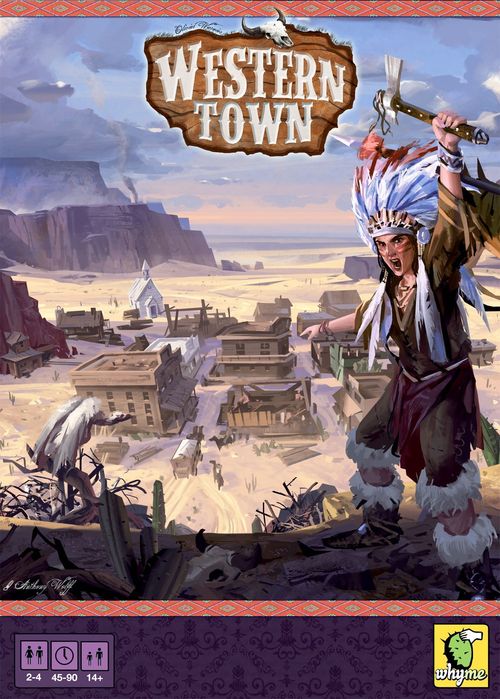
Western Town
Western Town Rulebook
Table of Contents
Table of Contents
- Components
- Set-up
- Play Areas
- Description of the Major Components — Board, Tiles and Building Cards
- Adding Buildings
- The «western town» Card
- Start of the Game
- Phase 1 — Prepare the Cards
- Phase 2 — Play Two Cards
- Phase 3 — Exploit
- Phase 4 — Income
- Phase 5 — lincoln's Visit
- End of the Round
- End of the Game
- Indian Raids
- «Double Duel» Mode
- Short Game
- Player Aid — Sequence of Play
Components
- 108 cards — 8 lincoln, 4 western town and 24 cards per player.
- 126 cubes — 28 yellow, 26 white, 22 pink, 24 gray, 16 brown, 6 red and 4 orange.
- 4 individual boards
- 2 Indian Camp tiles
- 68 building tiles — 17 tiles per player.
- 2 lead marshal & grand manitou markers
- 12 double-sided «Home» & «destroyed» markers
- 20 quantity markers — 12 Inhabitants, 4 exported Gold and 4 Cowboys.
- 1 Indian die
- 1 rulebook and 3 player aids in 3 languages
8 and 10mm cubes. The 8mm cubes represent a quantity of 1. Large 10mm cubes, a quantity of 4.
Set-up
The game set-up starts with each player setting up their board representing their city and preparing cards and tiles.
Set-up — Each Player ...
1. Places his player board in front of him. He chooses his color from yellow, red, blue or black and takes the twenty-four cards and seventeen tiles in that color.
To distribute his twenty-four cards, each player ...
2. Takes the six cards with a cactus at the bottom right into his hand.
3. Buildings in reserve: Takes the twelve cards with an orange or green star at the bottom right and stacks them to form his reserve. He places the twelve tiles with a star in a stack in the same place.
4. Constructible buildings: Takes the homestead card - without a cactus - and places it in the corner of the board. He places the five remaining cards with the five matching tiles above his player board.
5. Starts with three Cowboys - three gray cubes - and places them on the indicated location on the board.
6. Starts with seven Peace pipes - three small and one large white cube - and places them on the indicated location on the board.
7. Randomly picks one of four western town cards and keeps it hidden.
Tiles with a star: the back of a tile with an orange or green star is always a homestead which has a bi-color star. This will help you find them easily.
The player color is shown on the victory point icon at the bottom left of the tile.
Now continue with the common set-up.
Set-up — Common Elements ...
8. The roles. A randomly chosen player takes on the role of lead marshal; he takes the small tile representing Lincoln. The player to his right assumes the role of grand manitou and takes the small tile representing the Indian camp.
9. The stack of lincoln cards. The lincoln card with a 5 is placed in the center of the table. Draw four cards at random from the remaining seven lincoln cards and place them face down in a stack on top of the 5 card. Put the other lincoln cards back in the box without examining them.
10. The indian camp. Place the large Indian camp tile in the center of the table. Place the Indian die nearby along with the Orange and Red cubes representing the Indians. Place a white «Peace pipe» cube per player in the indicated space on the camp.
11. Cube stock. The gray, pink, yellow and brown cubes form the common pool. The grays are the Cowboys, the pinks represent the Inhabitants, the browns Wood and the yellows Gold.
12. The remaining white cubes placed in the center of the table are only used as change as necessary for the players' white cubes.
Play Areas
During the game players have cards in hand, the cards face down in piles near their board, referred to as inactive cards, and cards played on the table, referred to as table cards.
13. Inactive cards. During the game inactive cards are placed face down here.
14. The player's table. During the game played cards will be placed here, superimposed and slightly offset.
Exported gold and gold in town: the gold stored in town on the marshal building is used to pay for construction and to use the effects of certain cards. This is not the same as the exported Gold at the top left of the board, which is used to count victory points.
Description of the Major Components — Board, Tiles and Building Cards
In western town players construct new buildings to expand their city. To do that, they use the effect of a building: the carpenter - see its effect in detail under «focus on construction» -. When a building is constructed, the appropriate tile is added to the board and the corresponding card added to the player's hand.
The tile has a construction cost and, in some cases, requires the presence in town of a minimum number of «Homes».
Homes
During the game the players will accumulate Homes in their town represented by pink and black Home symbols. Whenever a player has to count the number of Homes, add up the number of times these symbols appear on the town's buildings and then add any bonus earned during the game. For certain effects, only pink Homes will be counted.
Players also accumulate Inhabitants in their city, recorded with the Inhabitant symbol.
Note - Home and Inhabitant are two different concepts!
Building Card
You will find details of each card on the player aid.
- The played effect is shown in the center of the card (A). Example - The gold mine produces one Gold and then, if the player discards two resources from Wood or Inhabitants, he receives two additional Gold.
- The effect shown underneath (b) is the exploit effect. The gold mine produces one Gold.
- At the top left (c), the potential gain from the card is shown. The gold mine produces a Lure and a Gold.
- Green cards are special, they do not have any played or exploited effects, but provide a consistent effect (D) and an effect triggered by placing the tile (e). Example - the constant effect of the blacksmith makes it possible, when the city is attacked by the Indians, to receive two Cowboys immediately. Moreover, it acts as a permanent additional Peace pipe. When the tile is placed, the player receives a Cowboy, then he may discard Wood and/or Gold to receive an equal number of additional Cowboys.
- The bottom portion repeats the color of the card (f) required for certain effects, the information on the tile and the type of card (g) for easy sorting.
Building Tile
The cost and the minimum number of Homes for its construction is shown at the bottom right (A). The gray Home indicates that all Homes, whatever their color (pink or black) are counted.
Example - the bank costs a Wood and either a Wood or a Gold. In addition, there must be at least seven Homes in the town.
The building provides: a number of Homes (B), victory points (C) and a storage capacity (D).
Example - the bank adds two additional Homes to your town. At the end of the game, it is worth two victory points and two additional points for every two gold exported. Finally, it can store four Gold.
The Board
The player places his city's Inhabitants in (a), and his Cowboys in (b). He places the city's Gold on the marshal building (c) and the Wood on the carpenter (d). Any Gold he manages to export will be placed in (g). The town has a stock of Peace pipes (e) which will be gradually transformed into Lure and thus will move onto (f).
Each space can receive a new building. There are 11 of them as shown by (h), each one containing a number from 4 to 6. Some spaces also indicate an effect triggered when a building is placed on them - see «focus on construction» -.
During the game the player places inactive cards on (i) and plays cards on his table area (k).
Adding Buildings
Buildings with orange and green stars from the reserve are used to renew the game, they add to the set of constructible buildings.
The lead marshal randomly draws two cards from the 8 buildings with an orange star in the stock (A). He reveals them and adds them, along with their matching tiles, to the top of the board (B).
He then draws two further buildings with an orange star from the 6 remaining. He reveals them and removes them from the game. He takes the two matching tiles, turns them over to their homestead side, and adds them to the homestead area (c) next to the board.
The other players do likewise: they add the same two cards and tiles, remove the same two cards and add the same two homestead tiles next to their board.
The operation will be repeated at the beginning of the second round during «phase 1.a - add buildings» using the 4 remaining cards with orange stars in the stock.
At the beginning of the third round, the operation will be repeated one last time with the 4 buildings with a green star remaining in the stock.
The «western town» Card
The players reveal their western town card. They add the building tile shown in the lower right of the card from their constructible buildings to an empty space marked with a 4 on their board and add the corresponding card to their hand.
They take the indicated resources from the stock and place them on the marshal building, the carpenter and the Inhabitants area.
Example: With Marshal Bright, Robin starts with two Wood which he puts on his carpenter, two Gold which he puts on his marshal building and three Inhabitants which he puts on the appropriate area of the town. He also starts with a homestead tile placed on a 4 space on his board, and immediately takes the homestead card into his hand.
The player who starts with a homestead takes one of the two homestead tiles and the card. The second tile is left near the corner of his board.
The western town cards used here may be put back in the box or set aside, they won't be used again in the remainder of the game.
The game can begin ...
Start of the Game
A game of western town consists of five rounds, each composed of five phases.
Phase 1 — Prepare the Cards
1.a — Add Buildings
At the beginning of rounds 2 and 3 only, players add buildings to the set of constructible buildings as described above - see «adding buildings» -.
1.b — The Top Card of the lincoln Pile Is Turned Over
It tells the players what the President's expectations are in this round.
He has three kinds of expectation. He may wish for many Inhabitants, increased Attraction (Lure) or finally a lot of Gold to be exported.
1.c — Constitution of the Players' Hands
Each player discards cards from his hand to bring it down to 4, 5 or 6 cards. The number of cards kept is equal to the smallest number visible on the spaces on his board. The discarded cards are called inactive and are stacked face down near the board. Inactive cards are no longer used in the current round: only the cards held in hand and those acquired during the round may be played and/or exploited.
The number of cards retained is not changed by the possible destruction of a building - see «Indian raids» -.
Example: Robin keeps four cards since it is the lowest number visible on his board. Once he has filled the last box with a 4, he will be allowed to keep five and possibly six cards. As he had nine cards in all, Robin puts the five inactive cards that he doesn't wish to play in this round in a pile face down.
Phase 2 — Play Two Cards
Phase started by the lead marshal. He chooses a card from his hand, plays it face up on his table and applies the played effect.
He then chooses his second card and places it face down on his table. At the same time, the next player clockwise chooses his first card and places it face down on his table. They reveal their cards at the same time and apply the played effect.
The player who just played his first card continues in the same way and so on until the grand manitou - the last player in the current round - plays his second card on its own.
This way, each player will have played two cards.
If the order of resolution of played effects has an importance on the game (for example a player choice is important for the other player), they are applied clockwise starting from the lead marshal.
A player may only play a card if the town contains at least one undestroyed building with the same name - civic pride having no associated building is always usable -.
In the rare cases where a player cannot play a card - destroyed building, conditions not fulfilled, etc. - He shows his hand to his opponents and plays one of his cards face down without applying its effect.
Example with three players:
- The lead marshal Robin starts this phase and plays a single card. He applies the played effect.
- Then Robin and Alexander simultaneously play a card. They reveal their cards at the same time and apply the played effect.
- Then Alexander and Theo simultaneously play a card. They reveal their cards at the same time and apply the played effect.
- The grand manitou Theo ends this phase and plays a single card. He applies the played effect.
Focus on Construction
The carpenter can build other buildings.
The construction symbol represents laying a new tile in the town. If the player chooses this effect, he must adhere to all the rules concerning laying a new building:
- Check that the minimum number of Homes required is met.
- Pay the construction cost.
- Place the tile on an empty space in the town and, if necessary, apply the effect of «laying on the board» shown:
- (a) Receive one Gold.
- (b) Receive two Inhabitants.
- (c) If the player wishes to, he may discard two Inhabitants in exchange for one Wood.
- (d) The player must roll the Indian die - see «Indian Raids» -.
- Then take the corresponding card into the hand and, if required, apply the effect of «laying the tile».
Only buildings above the player's board may be constructed. Those in the stock may not.
Only the construction of the first homestead provides a card. The stack of homestead tiles, which is completed in phase 1.a, however, allows several to be constructed.
There are some buildings without a cost. Placing them is free but they nevertheless need a construction action to be built.
Once built, a building cannot be moved.
The effect of «laying on the board» is applied before the effect of «laying the tile».
When a building is present on this 6 space, the player receives an additional Home.
Example:
- (A) Robin has just played carpenter, he has a Wood and four Gold.
- (B) He wants to build the warehouse. He has enough resources to pay the cost of construction. And with three pink Homes and two black Homes in his town has at least the five Homes needed for its construction.
- (c) Robin pays a Wood and a Gold. He puts the tile on a 5 space whose «placing on the board» effect is to receive one Gold. He receives a Gold. He then adds the warehouse card to his hand. If the card had a «laying the tile» effect, he would apply it now.
Phase 3 — Exploit
Each player has played two cards in the previous phase. There remains a third and final card to play but the players can also benefit from the actions of their immediate neighbors and make the most of their buildings ...
Phase started by the lead marshal. He has the choice between:
- Play a third card from his hand, and then apply the played effect.
- Use a card from his hand or one still face up on his table, and apply the exploit effect. He can only do that if a town immediately adjacent to his table has a face up card with the same name. In that case, he turns the targeted card over while showing the exploiting card from his hand or his table.
- Definitively pass. Before passing, a player must have played his third card. The first player to pass immediately becomes the lead marshal, the player to his right becomes the grand manitou.
Then the next player clockwise makes his choice from among the same possibilities. The exploitation phase continues until all players have passed.
The neighboring towns are those immediately adjacent to the right and left of the player. In a 4 player game, therefore, the player «diagonally opposite» cannot be the target of an exploit action.
An exploited card remains in place; either it remains in hand, or it remains on the table. The targeted card is the one turned over.
A player may only exploit a card if his town contains at least one undestroyed building with the same name - civic pride having no associated building is always usable -.
Once a player has played his third card, he can obviously no longer make that choice, so he either has to continue with an exploitation or pass.
The cards of a player who has passed may still be targeted for exploitations by his neighbors.
A player can only exploit a card if it will produce an effect… It is therefore not possible to exploit a card «gratuitously» simply in order to turn it over. In our example, Robin could not exploit using the marshal unless he had at least two gold in his town.
A player can not use an exploit effect on himself.
If the conditions allow it when it's his turn again, a player can exploit the same card again.
Example: In this 3-player game, it's Robin's turn to exploit. His choices are:
- (A) He can play a third card: his marshal or his gold mine. In this case he would apply the played effect.
- (B) He can use the carpenter on his own table on Alexander's face up carpenter. In this case, Robin would apply his carpenter's exploit effect and it would remain face up on the table, unlike Alexander's which would be turned over. Robin already has a face down card, civic pride (C). Although Alexander also has a civic pride on the table, Robin cannot exploit it.
- (d) He can use the gold mine in his hand on Theo's face up gold mine. In this case, Robin would apply his gold mine's exploit effect and take it back in hand, and Theo would turn over his gold mine. Robin could then, when play comes round to him again, play this gold mine as described in (A) or exploit it again if, for example, Alexander had played his gold mine in the meantime.
The last choice, to pass, is not possible as he hasn't yet played a third card.
Phase 4 — Income
Phase played simultaneously by all the players.
4.a — Income
Players receive the bonuses shown at the top left of all their cards that are still face up on their table.
Example: In this example, Robin still has a homestead and barber face up at the end of the exploitation phase. He receives two Lure, as well as an Inhabitant and either a Wood or a Gold.
Earning a Lure means moving a white cube from the Peace pipe box to the Lure box. If it doesn't have any more Peace pipes available, the town can no longer earn any Lure. To lose a Lure means moving the cube in the opposite direction.
4.b — Discard Resources
Then, the players discard any excess resources.
By default, a town can only store:
- 4 Gold
- 3 Wood
- 8 Cowboys
These limits may be increased by the construction of buildings such as the bank or the second carpenter.
The location of the resource does not really matter: a town with 6 Gold, which has a bank, can keep everything on the marshal.
Phase 5 — lincoln's Visit
Phase conducted by the lead marshal.
The player who has the most points calculated according to the expectations on the lincoln card receives a visit from Lincoln: he takes the card and places it face up in front of him. In the event of a tie, the lead marshal decides which town receives the President's visit.
The points calculated for each expectation are:
- One point for each exported Gold.
- One point per Lure.
- One point per 4 Inhabitants.
The lincoln card provides an additional Home to the player who wins it: he receives a «Home» marker as a reminder.
Each lincoln card is evaluated independently: previous cards have no effect on the allocation of the current card.
If the lead marshal is one of the tied players, he can naturally choose to take the card himself!
Example: Robin is the lead marshal. He must assign the lincoln card showing a preference for Inhabitants and Gold exported. Robin has two exported Gold (A), giving him 2 points, and eleven people (B), giving him another 2 points (11/4 rounded down). With a total of 4 points, he is behind Theo and Alexander who both have 6 points. Robin decides to make lincoln visit Alexander's town. Alexander wins the card, which he keeps face up near his board. He takes a «Home» tile to remind him that the card provides this bonus.
The lincoln card bearing the number «5» does not cause a Presidential visit and is therefore not assigned to anybody. It is simply discarded instead.
End of the Round
If there is at least one card in the lincoln pile, the game continues:
- Players reform their hands by combining their inactive and played cards.
- They start a new round from phase 1.
If the pile of lincoln cards is empty, it is the end of the game…
End of the Game
The game ends when the stack of lincoln cards runs out (i.e., the last card of the pile, the «5» lincoln card, has been discarded).
Each player counts his points:
- (A) Count up the number of Homes. The players are ranked by the number of Homes. Each player earns as many points as players ranked behind him. Then the player(s) with the most Homes earns 3 additional points.
- (B) Each player then adds up the points in their town. Each building tile shows how many points they are worth - you will find details of each tile on the player aid -.
- (C) The lead marshal groups the 4 lincoln cards and lists the number of times that each expectation appears. The players multiply their points in each category by the appropriate number.
The player(s) with the most points wins!
The «destroyed» marker on a building has several negative effects:
- It deducts a Home from the player's total.
- It deducts two points from the player's score.
- It divides the destroyed building's points value by two.
See «Indian Raids».
The four lincoln cards show all players the same coefficients to be applied. The only advantage to winning one is to receive an additional Home.
Example:
- (A) Robin has a total of 8 Homes but his «destroyed» marker cancels out one of them, so he only scores for seven Homes. He ranks second and therefore receives one point since only Theo is ranked behind him. Alexander with nine Homes receives 3 + 2 = 5 points. Theo scores no points.
- (B) Robin scores 4 points with his saloon. The gunsmith normally provides 2 points per set of two Cowboys, but it provides only half of his 6 points as it is destroyed. The warehouse provides six points with an «export» marker and the barber scores 2 points. He then deducts two points because of his «destroyed» marker. A total of 4 + 6/2 + 6 + 2 - 2 = 13 points.
- (C) The lincoln cards show exported Gold 3 times, so the 2 Gold exported by Robin are multiplied by 3 for a total of 6 points. Lure appears 4 times, so Robin's 7 Lure are multiplied by 4 for a total of 28 points. Finally, Inhabitants appear twice on the lincoln cards, so Robin with 3 sets of 4 people scores 3 x 2 = 6 points.
Robin therefore has a grand total of 1 + 13 + 6 + 28 + 6 = 54 points.
Indian Raids
The camp represents the Indian threat that hangs over the towns.
When an action shows the Indian die symbol, the Indian die is rolled. Each face adds at least one Indian to the camp, which attacks in two cases:
- when the camp receives its 2nd Orange Indian, or
- when the camp receives its 3rd Red Indian.
One face of the Indian die causes the addition of a Red Indian then an Orange one. Another face of the Indian die causes the addition of an Orange Indian then the die is rerolled.
Example: The camp already has two Red Indians. Robin played marshal, so he must roll the Indian die. Robin rolls the die, adds an Orange Indian and re-rolls. Robin rolls the die again, adds a Red Indian and stops. An attack immediately takes place.
The reinforcement of the Indians in the camp is always carried out one by one: as soon as a raid condition is met, any other Indians waiting to be added are ignored and the attack occurs. With certain combinations of cards the player must roll the Indian die several times in the same turn. There too, when a raid occurs, the other die rolls are forgotten.
Which town is attacked:
- If the last added Indian is Orange, the attacked town is that of the player who added it.
- If the last added Indian is Red, the attacked town is the one with the fewest Peace pipes. In the event of a tied number of Peace pipes, the grand manitou decides which town will be attacked.
All the Indians in the camp attack the town, regardless of their color.
The grand manitou chooses their targets using the following rules:
- A target can be a building that isn't already destroyed or, if there is at least one, the Inhabitants.
- All the Indians of the same color attack the same target at the same time.
- A target can be attacked only once during a raid.
The player can defend his town with his Cowboys:
For each target selected by the grand manitou, the attacked player decides whether to defend or not:
- If he defends, the number of Cowboys he must discard depends on the target's location:
- For the six buildings in zone 4, each Cowboy discarded will cause two Indians to flee: 2 Cowboys are discarded to repel an attack by three Indians.
- Elsewhere - other buildings, Inhabitants - each discarded Cowboy will scare away an Indian.
- If he does not defend the attacked building, place a «destroyed» marker on the building. It cannot be played or exploited as long as the marker remains in place.
- If he fails to defend attacked inhabitants, the player loses four Inhabitants and a Lure.
Any Indians used against the target are discarded, regardless of whether it was defended or not. If at least one Indian remains unused, the grand manitou must choose a new target.
Once the raid has ended, the attacked player receives a Peace pipe, if one is available, from the Indian camp and adds it to his Peace pipe box.
The number of raiding Indians only affects the difficulty of defending and not the result of the attack.
Only this part of town, i.e. the six buildings in the center, are easily defended with a Cowboy against two Indians.
A town with fewer than four Inhabitants who are attacked loses them all if it does not defend them.
To remove a «destroyed» marker, the player must use the effect of a carpenter or a civic pride.
A «destroyed» building does not lose any resources that are stored there. It can also continue to receive and spend them. If a green building has a «destroyed» marker on it, it loses the permanent effect until it is removed.
If the grand manitou's own town is attacked, he still controls the Indians, and may minimize the effects of the attack, but must nevertheless adhere to the rules concerned.
The buildings on the board are also targets for the Indians. The gold mine, being outside Zone 4, is an easy target, with a defense of one Cowboy for each Indian. The three other starting buildings (marshal, carpenter and homestead) are in zone 4 and are therefore targets that defend themselves by discarding one Cowboy for two Indians.
Example: The addition of the third red Indian (a) causes the attack. Therefore, either Robin or Alexander, each with a single Peace pipe (b), will be the Indians' target. Theo has three Peace pipes. Alexander is the grand manitou and so naturally decides that the Indians attack Robin. He takes all the Indians from the camp and separates them into two groups: one of three reds, the other of a single orange (a).
Alexander decides to attack first the inhabitants (c) in Robin's town with the single orange Indian. Robin could defend with a single Cowboy, but he decides not to defend. He therefore loses a Lure and four Inhabitants.
Alexander then attacks Robin's saloon (D). He would like to defend it, but with only one Cowboy he cannot, despite his saloon being in zone 4, as he is a Cowboy short! The saloon is destroyed. Robin will have to repair it before being able to play or exploit it again.
All the Indians are discarded, the camp is now empty. Robin receives a Peace pipe from the camp's stock (e).
«Double Duel» Mode
The material makes it possible to play an alternative with four players: the double duel.
Players play with a single deck of lincoln cards and work together to maintain the same pace so that their «phase 5 - lincoln's visit» match.
When the lincoln card is assigned, the players simply take the «Home» marker and leave the lincoln card on the table, away from the stack of lincoln cards, in preparation for the end-game scoring.
For the remainder, the players play with their own Indian camp, their own starred buildings and starting configuration.
Short Game
western town can be played in a shortened version. Recommended for beginning players, the game will be quicker and the tactical and strategic options more limited.
The following changes are used:
- Remove the number 5 lincoln card from the pile. There will therefore only be 4 rounds instead of 5.
- Instead of the operations described in the «adding buildings» section, remove the four green cards with green stars from the game. Each player takes the 4 matching tiles, turns them to their «homestead» side, and puts them on the homestead card above their board. At the beginning of the game, each player's stock thus contains only the 8 buildings with brown stars and the 8 corresponding tiles.
- Only two orange buildings are added at the beginning of the second round during «phase 1.a - add buildings» as follows: the lead marshal randomly draws two cards from the buildings with orange stars from among the 8 in his stock. He reveals them and adds them, along with their matching tiles, to the top of the board.
- The stock is not used any further.
Player Aid — Sequence of Play
Set-up & adding buildings. The players set up the game. The lead marshal adds two constructible buildings and two homesteads.
Phase 1 - prepare the cards
- 1.a - add building: At the beginning of turns 2 and 3 only, players supplement their set of constructible buildings.
- 1.b - lincoln's card: The top card of the lincoln pile is turned over.
- 1.c - constitution of the players' hands: The players keep 4, 5 or 6 cards in hand.
Phase 2 - play two cards. The lead marshal plays a solo card, then the players play a card in pairs. The grand manitou plays his second card. The played cards are put on the player's table.
Phase 3 - exploit. The lead marshal starts and can:
- play his third card
- exploit a card from his hand or his table on the card of same title used by one of his neighbors
- definitively pass.
Then the next player clockwise makes his choice from among the same possibilities. Phase continues until all players have passed.
Phase 4 - income
- 4.a - income: Players receive the bonuses shown on the top left of their card.
- 4.b - discard resources: The players discard any excess resources.
Phase 5 - lincoln's visit. The player with the highest score based on lincoln's expectations takes the card. If the pile of lincoln cards is empty, it is the end of the game, if not a new round starts from phase 1.