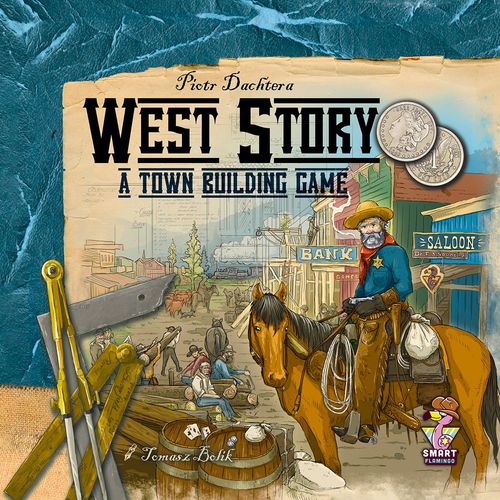
West Story: A Town Building Game
West Story: A Town Building Game Rulebook
Table of Contents
Table of Contents
Components
- 89 cards (+ 36 cards from stretch goals / expansion)
- 4 hat markers (in each player color)
- 4 score markers (in each player color)
- 4 × 12 black markers
- 4 player aid cards
- 13 automa cards (for solo mode and 2-3 player games)
- 24 cows
- 4 × 8 town discs (in each player color)
- 8 villain tokens
- 8 wild tokens
- 2 dice
- 64 dollars (coins) and 8 gold coins
- 6 railroad certificate tiles
- 1 main board
- 4 player boards
The final number of specific components may vary slightly due to game development.
Game Setup
- Each player takes:
- A. one of the player boards
- B. score marker in their color (to be put on "0" on the score track)
- C. 12 black markers
- D. 8 town discs in their color
- E. hat marker in their color (put on "0" spot of their hat track)
- F. 1 cow (put at the bottom spot in their herd)
- G. 4 coins.
- Prepare the main board:
- H. Put 12 coins in the gold pan (in the top-right corner of the board).
- I. With 2 players, take 4 town discs in an unused color and cover the top-left symbol in each of the towns.
- J. Shuffle 6 railroad certificates and put random 4 of them in two face-up stacks (two certificates each) in the top-left area of the board. Return the rest to the box.
- K. Shuffle villain tokens and randomly put them face down on 6 villain spots. Put 1 coin on each of the villain tokens.
- Pick 5 types of buildings from the building deck (6 copies each) to create a deck of 30 building cards for this game. For example, you may choose: Workshop, Trappers Hut, Ranch, Hotel and Bank. Return the rest to the box. Make sure you have at least two buildings with a cost of 4+ coins and at least two other buildings with a cost of 4+ hats.
- Shuffle each of the 3 decks separately to create production deck (all 32 cards), scoring deck (all 27 cards) and building deck (30 cards as explained above). Draw 4 cards from each deck to create the card market.
- Put remaining coins and cows in reach of the players.
- The player who wants to start the most, takes the dice and becomes the first player.
Game Round
A. Roll the Dice
First player rolls the dice and keeps them next to the player board (visible to all players).
B. Production (all players simultaneously)
The dice define which actions all players will now mark and execute on their player boards (see below for what happens if an action is already marked on a player board and for other details).
Players mark and execute actions from their player boards simultaneously to get coins, hats (cowboys), cows, victory points or other benefits.
C. Player Turns
Once all players have marked their actions and collected resources, they now play their turns in the turn order (starting from first player).
Each turn, player may buy up to two cards from the market (which are then put on the player board). In addition to that, player may also trade with a town, pick up a certificate, and is also in some cases forced to face a villain!
D. Pass the Dice
Once all players have played their turns, the richest player (as for coins) becomes the first player — gets the dice and 1 coin from the gold pan. It's Wild West!
The coins in the gold pan serve as a game length counter.
The game ends when at the end of a round a coin cannot be taken from the gold pan.
In case of a tie, the coin is discarded and the dice are passed (to the left) to the closest tied player.
Production
(all players simultaneously)
-
Mark an action in the top row based on the yellow die value and an action in the bottom row based on the green die value.
If an action in a row is already marked, move right to the first available action in the row and mark it! (in some cases, move around from action #6 to #1 and further if needed)
If you have just marked two actions with the same symbol (e.g. revolver) in the top and the bottom row, you get a combo! You can freely choose and mark one additional action with the same symbol from your player board!
If you are unable to mark an additional action, add a cow to your herd (see below)
Wild animal cards (e.g. Mustang) have a wild symbol which matches any other symbol when marking actions. Anytime such a card gets marked and executed, you get a combo! (as the wild symbol matches any other symbol marked in the other row). That means you can mark and execute one additional action with the same symbol as the one marked in the other row.
Each building card has a pair of symbols which provides a higher chance for a combo! But you can execute only one combo per turn.
-
Execute the actions you just marked (in any order)
Get coins, hats, cows, victory points or other benefits.
If you are getting hats, move the hat marker to indicate how many hats (cowboys) you have available this turn. Every time you have 4 or more hats available, get a bonus coin. Hats are reset to "0" once player turn is over.
If you are getting cows, add them to your herd. Some cows provide instant coin bonuses when added to the herd. Cows from your herd can be used as either coins or hats!
You are limited to 6 hats and 6 cows. Get 1 victory point for each next one, instead.
If you are getting victory points during production, move the score marker accordingly.
If you have just executed a building with hourglass, you may use its ability during your upcoming turn.
-
Remove black markers from full rows
If at this point any row on your player board is full (6 markers), remove all the markers from the row.
Player Turn
1. Face a villain!
If at the beginning of your turn your score marker is present in an area with a villain token, you have to face the villain! (more details on that below, see Villains).
2. Trade with a town
Now, you can trade with a town in the area where your score marker is currently present (more details on that below, see Town Trades).
3. Purchase cards
As the main step of the turn, purchase up to two cards for your player board. With each purchase, pay coins and/or reduce available hats accordingly on the hat track. Cows from your herd can be used as either coins or hats!
For each card purchase you skip, add a cow to your herd (you can skip first and then buy)
Put each card on an empty unmarked spot or on top of an unmarked card on your player board. If victory points are printed on the cards you've purchased, move the score marker accordingly.
Wild animal cards as well as cards with certain symbols may provide additional victory points at the end of the game.
Refill the card market when you are done purchasing cards.
4. Reset your hat track to "0"!
You can't keep the cowboys for later. They ride away!
Villains
When a score marker enters an area with a villain token, flip it face up immediately.
If your score marker is present in an area with a villain token at the beginning of your turn, you have to face the villain!
Fight. Use hats and coins to remove the token! You can use cows as a replacement for missing hats or coins. Each villain token provides victory points at the end of the game. Also, pick up any coin(s) lying on the token.
Pay. If you are unable to remove the token (or don't want to), pay coins (or cows) to the villain! Put those on the token. Next player facing the villain has a chance to fight to pick up all the coins (cows) along with the token (or pays). In a very rare case when you cannot either fight or fully pay, pay as much as you can (including cows).
Fort Worth area has a villain token on the other side — player faces the villain only from that side. Dodge City area has two villain tokens — one on each side of the score track.
All your cards will count for final scoring, including the ones covered by other cards!
Town Trades
Once per turn, before purchasing cards, you can trade with a town in the area where your score marker is currently present, to execute one more action from your player board and to get additional victory points at the end of the game.
Pay the trade cost (hats and coins) to put a disc on an available town symbol and mark and execute an action with the symbol on your player board (you can only trade if you are able to mark an action with the symbol). The action execution doesn't trigger a combo, but if at this point any row on your player board is full (6 markers), remove all the markers from the row.
During the game, you can trade with one town up to three times and you receive victory points at the end of the game based on the number of your discs in the town (e.g. 1/3/6 in Fort Worth).
You can trade even if you haven't defeated a villain in your area
You can trade with Fort Worth even before getting any victory points.
When you are trading to execute a wild animal card action, you get an additional bonus depicted at the wild symbol in the town.
When you are using the quadruple symbol in a town, you may execute an action with any of the four symbols.
Railroad Certificates
Anytime during your turn, if your score marker is in the top-left area (desert, without a town to trade with), you may decide to buy one of the railroad certificates. Pay 4 coins to pick up a certificate from the top of a stack or 6 coins to pick up from the bottom. You can always check all the certificates. Put the certificate on the player board, covering your printed symbol.
At the end of the game, if you own a certificate, you score 3 victory points per each pair of the certificate symbols on all the cards you have purchased during the game. Otherwise, you score 2 victory points per each card with the symbol printed on your player board.
Gold Panning
Each player reaching 42 victory points on the score track (or more) picks up a coin from the gold pan (unless it's empty).
Thus, the length of the game depends on how fast players get to the lake area on the score track.
In the rare case when two or more players reach the point in parallel (during production phase) and there is not enough coins in the supply to give a coin to everyone, players get missing coins from the main pool.
Game End
The game ends when at the end of a round a coin cannot be taken from the gold pan.
In addition to victory points players have collected during the game, they get:
- victory points from villain tokens (see: Villains)
- victory points from town trades (see: Town Trades)
- victory points from symbols on cards (see: Railroad certificates)
- victory points from wild animal cards
Check all cards collected during the game on your player board, including the ones covered by other cards.
The player with most victory points wins. In case of a tie, the player with most victory points from villain tokens wins. If there is still a tie, the player with most total number of coins and cows wins.
Additional Notes
Use cows as either coins or hats for everything during the game (e.g. town trade costs or villains).
Once per turn, when purchasing cards, you can spend 1 hat to reset a row of cards on the market. Choose 1-4 cards you want to replace and add them (in random order) to the bottom of the corresponding deck. Refill the card market.
Wild symbol is only used for getting a combo when marking actions. It is not treated as a replacement for other symbols, thus it's not counted in the end game scoring for certificates, most frequent symbol for Eagle, nor a certain symbol for Bank ability. Town trades with the wild symbol can be done if and only if an animal card gets executed.
Cards provide benefits only when they get executed (there are no passive benefits).
You can trade with towns as long as you have available town discs.
Stretch Goals and Expansions
In the campaign we plan several stretch goals. The following ones are included in the prototype:
-
Uncatchable villains. There is an uncatchable villain which leaves player without an option to fight - you always pay one coin (cow). Once it collects a total of 4 coins (cows), it is discarded. Return coins (cows) back to the main supply.
-
Wild tokens. Put a number of wild tokens equal to the number of players on "12" on the score track and the same number on "22" on the score track. Each player reaching 12 and 22 victory points on the score track (or more) picks up a wild token.
In future rounds, if there isn't a combo from the dice roll, player may decide to spend wild token to mark and execute the third action on the player board with one of the symbols from the dice roll (or get a cow if there isn't a possible combo).
Solo Mode / Automa
Work in progress...