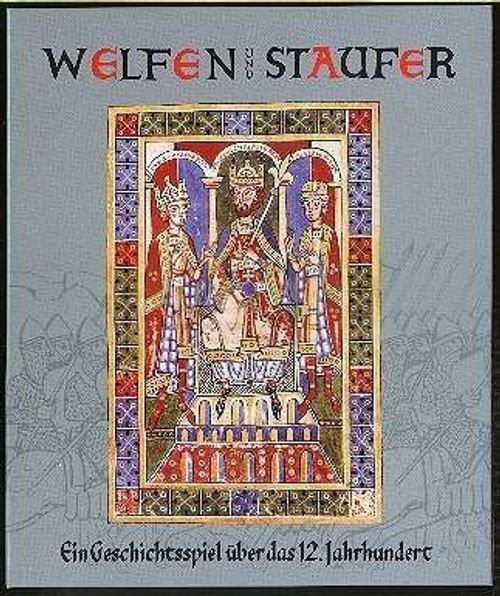
Welfen und Staufer
Welfen und Staufer Rulebook
Table of Contents
Table of Contents
- Explaining the Game Materials
- 1. The Board
- 2. The Cards
- 2.1 The "Heraldic" Cards
- 2.1.1 The Guelf/Ghibelline (Welfen/Staufer) cards 001 - 006
- 2.1.2 The nobles/clerics cards
- 2.3 The fief cards "Reichslehen" (= imperial fiefs) / "standard cards" 058 - 064
- 2.4 The fief cards "Kirchenlehen" (= clerical fiefs / "unarmed cleric cards") 065 - 066 and 068 - 074
- 2.5 The crown cards 075 - 079
- 2.6 The event cards
- 2.7 The additional cards for the scenarios
- 3. The Counters
- Basic Game
- Additional Rules
- A. Hidden Partisans
- B. Events "Feuds and the Death of Clerics"
- C. Events "Invaders" and "Plague"
- D. Marriage
- E. The Slavonic People of the Elbe-Oder Region
- F. Advanced Election and Coronation Rule
- G. Outcome of Battle (modifies 6.2)
- H. Using the "Dragon Counter" to change Destiny
- I. Treason and Promoting a Noble to a Higher Rank / Reinforcement Cards
- Scenario 1138: The Wrong Successor
- Scenario 1148: A Failed Reconciliation
- Scenario 1176: A Refusal in Upper Italy
- Scenario 1192: The Flight of Richard the Lion Heart
- Scenario 1198: A Child as King
- Glossary of the Nobles and Clerics of 12th Century Germany
- Chronology of the Guelf-Ghibelline Conflict in the 12th Century
- Addenda
- Map and Chart Plates
Explaining the Game Materials
1. The Board
The map board depicts the map, the pilgrimage box, the election-and-coronation box and the army group boxes.
1.1 The Map
On the map one can see the Holy Empire* of the 12th century with the three kingdoms of Burgundy, Italy and Germany with their frontiers, and also the frontiers of the various Duchies, Markgravedoms and Landgravedoms. In addition, the map shows the regions of the four main tribes, the Franks, the Saxons, the Swabians and the Bavarians. The map also shows the area of Bohemia.
The Alps and the rivers of Central Europe are natural barriers which can only be crossed by passes or bridges. The roads made movement faster and more secure. Frontiers and rivers divide the map into movement areas for the counters which are used in the game.
Co-ordinates on the sides of the map help the players find the location of any fortresses which are named on the various cards which are used in the game.
All Central European cities and towns which had been founded by 1138 are shown on the map, as are the most important cities/towns of Italy and Burgundy, together with the most important castles belonging to nobles and clerics. The symbols used to represent these usually include the heraldic arms of their rulers, shown either by a banner or a shield. Cities, towns and castles are known collectively as "fortresses".
The fortresses.
- City: intrinsic strength = 300. May be reinforced up to a maximum of 800.
- Town: intrinsic strength = 200. May be reinforced up to a maximum of 500.
- Moated castle: intrinsic strength = 150. May be reinforced up to a maximum of 250.
- Castle: intrinsic strength = 150. May be reinforced up to a maximum of 250.
- Castle belonging to either the Guelf/Ghibelline factions: intrinsic strength = 150, and may be reinforced up to a maximum of 250.
- Unfortified settlement (= village / "hut", which may be upgraded to a town).
- Unfortified settlement in the Elbe/Oder Slavs region.
- Bridge/river crossing.
- Pass (Alpine area only).
1.2 Election/coronation box
See 10, Election/coronation of a King.
1.3 The pilgrimage box
See 9.
1.4 The Army Group boxes
Place the Army Group counters here prior to deploying them on the map.
2. The Cards
All cards are numbered for ready reference.
2.1 The "Heraldic" Cards
These cards represent those counters which bear the same heraldic arms. They show the arms and banner of a noble/cleric, together with his name and title. The number in the bottom left-hand corner shows the counter's strength points. Each card includes the names of fortresses (with co-ordinates), which indicate the rulership of its specific noble there, and also those sites where he has the right to found a town. A coloured shield in the bottom right-hand corner shows the noble's/cleric's right to vote as a representative for a specific tribe at the King's election (red = Franks, yellow = Swabians, blue = Bavarians, green = Saxons).
2.1.1 The Guelf/Ghibelline (Welfen/Staufer) cards 001 - 006
Each card indicates to which counter it is related: "Welfe 1, 2 or 3" and "Staufer 1, 2 or 3".
2.1.2 The nobles/clerics cards
These cards include the 50 most powerful nobles and clerics of 12th century Central Europe.
Some special icons mean:
- Duke (icon).
- Palatine or Markgrave or Landgrave (icon).
- Mitre: the counter represents a cleric. If he is also an Archbishop, this is indicated by the pallium at top right.
All nobles without an icon on their cards are Counts.
A noble or cleric who has possessions and rights in two tribal regions has two coloured shields in two colours at the bottom right of his card. He has only one vote, but the player may decide for which tribe the noble's/cleric's vote shall count (see 10.1).
Any information printed on the cards in italics means that this is applicable only in one or more of the scenarios, and is otherwise ignored in the basic game.
2.3 The fief cards "Reichslehen" (= imperial fiefs) / "standard cards" 058 - 064
2.4 The fief cards "Kirchenlehen" (= clerical fiefs / "unarmed cleric cards") 065 - 066 and 068 - 074
2.5 The crown cards 075 - 079
2.6 The event cards
67, 85, 91, 104 and 110.
2.7 The additional cards for the scenarios
80 - 84, 86 - 90, 92 - 103, 105 - 109 and 111 - 112.
3. The Counters
3.1 The neutral counters
60 wooden disks, in natural-coloured wood, are each labelled on both sides (columns 1 - 12 of the labels from the label sheets).
3.1.1 Noble and cleric counters
Fifty-three counters "nobles and clerics" (columns 1 - 10, rows 1 - 10 and columns 11 - 12, here rows 1 - 3) on both sides. Each side of the counter is labelled with the same arms (shield): Ghibelline (light background) and Guelf (dark background).
3.1.2 Special counters
Columns 11 and 12, rows 4 - 6, each labelled on both sides, viz.: princess + "King Richard", princess + "treasury", "dragon" + "crown". Only the "crown" counter is used in the basic game.
3.1.3 Markers for destroyed fortresses
Columns 11 and 12, rows 7 to 10, each labelled on both sides: "1" + "5", "2" + "6", "3" + "7" and "4" + "8".
3.2 The Ghibelline (Staufer) counters
All 20 wooden disks coloured white are labelled on one side only with the labels from columns 13 and 14, rows 1 to 10.
3.2.1
Ghibelline (Staufer) counters 1, 2 and 3 (the Staufer arms on the light background) represent the Ghibelline princes 1, 2 and 3 (in the basic game: cards 1, 2 and 3).
3.2.2
Army Group counters Ghibelline/Staufer I, II and III (the Staufer arms on a red background).
3.2.3
Four special counters, which are used in scenarios (labelled on one side only, as are all other white disks): Byzantines (double-headed Imperial Byzantine eagle), Beatrix of Burgundy, the Markgrave of Monferrat and the Ghibelline Crusaders (cross).
3.2.4
Ten markers for castles conquered by the Ghibellines (Staufer arms on green background).
3.2.5
The blank white reverse side is used to mark towns occupied or founded by the Ghibellines.
3.3 The Guelf (Welfen) counters
All 20 wooden disks coloured black are labelled on one side only with the labels from columns 15 and 16, rows 1 to 10.
3.3.1
Guelf (Welfen) counters 1, 2 and 3 (the Welfen arms on the dark background) represent the Guelf princes 1, 2 and 3 (in the basic game: cards 4, 5 and 6).
3.3.2
Army Group counters Guelf/Welfen I, II and III (the Welfen arms on the red background).
3.3.3
Five special counters which are used in scenarios (labelled on one side only as are all other black disks): Normans, the Lombard League (white banner with red cross), Matilda of England, Fulc-Este (white eagle on blue shield/azure, an eagle argent) and the Guelf Crusaders (cross).
3.3.4
Nine markers for castles conquered by the Guelfs (Welfen arms on green background). The blank black reverse side is used to mark towns occupied or founded by the Guelfs.
Basic Game
1. Introduction
In the year 1137, Emperor Lothar III died at Breitenwang on his way back to Germany after his second expedition to Italy. Soon after, he was buried at Koenigslutter (Lower Saxony). His only daughter Gertrude was married to the Guelf (Welfe) Henry the Proud, Duke of Bavaria and Saxony. Before his death, the Emperor handed over the Insignia of the Empire (the Crown, Holy Lance, the Imperial Sword etc.) to his son in law with the intention of designating him as his successor to the throne. However, at the same time, the Guelfs' opponent, Conrad III of Hohenstaufen (Ghibelline) recognised that he himself had the opportunity to become King. But German kingship in that period depended on a constitutional election held by the nobles of the four great tribes (Franks, Swabians, Bavarians and Saxons).
2. Preparation of the Game
Each player rolls a die. The player rolling the higher number receives the Ghibelline (Staufer) cards 1, 2 and 3, while the other player receives the Guelf (Welfen) cards 4, 5 and 6. Then the heraldic cards (Nos. 7 to 56) are shuffled and each faction receives five additional cards. Players place these cards face-up in front of them. The remaining heraldic cards are further shuffled together with the cards 58-66 and 68-74 and are placed face-down as the "neutrals" card deck. The King's cards (75-79) are kept to one side for use later in the game. All other cards are set aside and are not used in the basic game. Players then take the noble counters corresponding to the heraldic cards which they have received, and place each of these in the castle/town mentioned on the corresponding card (for this initial deployment, each prince/noble counter must be placed on the first-mentioned fortress on its corresponding card)[1]. The "Army Group" counters are placed in the "Army Group Box" at the bottom right of the game board (see 8).
[1] Frederic Barbarossa (card No. 3) is placed at Hohenstaufen H6. Henry the Lion (card No. 6) is placed at Luneburg B6. It is only at the beginning of the game that the counters must be placed on the first-mentioned fortresses on their corresponding heraldic cards. If during the game new nobles/clerics come into the game, or pilgrims return or successors arrive, the player has a free choice of any castle or town mentioned on the corresponding card for the noble counter in question.
3. Victory Conditions
The game ends as soon as a Guelf (Welfe) or a Ghibelline (Staufer) has been crowned German King in the Palatine Chapel at Aachen. [A prince can only be crowned (see 10.2) if he has already been elected (see 10.1).]
4. Game Turn
The Ghibelline player always starts the game. During the first game turn, players are not allowed to attack counters or fortresses which belong to the opposing player.
Ghibelline (Staufer) player's turn:
- Pilgrims/Fate of captives (see 9).
- Movement and action of all "noble counters"/army group counters (see 5 and 6).
- Form, join, leave or disband an army group.
- Election or coronation of a King (see 10).
- Declaration of new allied clerics or nobles/enfeoffment with "flag cards" or "unarmed clerics cards" (see 7).
Guelf (Welfen) player's turn [same as Ghibelline (Staufer)]:
- Pilgrims/Fate of captives (see 9).
- Movement and action of all "noble counters"/army group counters (see 5 and 6).
- Form, join, leave or disband an army group.
- Election or coronation of a King (see 10).
- Declaration of new allied clerics or nobles/enfeoffment with "flag cards" or "unarmed clerics cards" (see 7).
The counters may either move and perform an action, or perform an action and move.
5. Movement
5.1 Movement in open terrain
The map is divided into areas by natural boundaries (rivers and alpine mountains) and by political borders (various black and coloured lines)[2]. Roads do not divide an area. Counters may move one area in each game turn. Rivers may only be crossed by bridges (see 5.2.1); it is impossible to move within the alpine area except by using roads (see 5.2.2).
5.2 Movement on roads
The most important military roads of the 12th century are depicted on the map. Movement along military roads is significantly faster than movement in open terrain. However the roads are controlled by castles and towns and are also interrupted if a not yet founded town (hut) or a destroyed fortress is situated on the road. A counter may move along a road as far as possible, and in this case, it does not matter how many borders it crosses. Fortresses, bridges and passes only interrupt the movement if they are not controlled by the phasing player's faction.
[2] In two cases, the situation on the map is not obvious. Toul (H2) and Veldenz (F3) do not divide an area. Both belong to the surrounding area and they cannot block movement, e.g., a counter may move from "Ober-Lothringen" and may move to the Trier area and may reach Koblenz, even if Veldenz is not controlled by the counter's faction. A counter may move from Luxemburg to "Oberlothringen" and in the next turn on to "Burgund" even if Toul is controlled by the other player.
Example of movement on the board. The area is bounded by the river Rhine in the east and in the northeast, the frontier between the Swabian and Frankish tribes in the south (1) and the border within a tribal area (2) in the west and in the northwest. The counter with the heraldic insignia of a lion can move in one step to the adjacent areas A, B or C. If he wants to move to D or E or F, his party should either control Mainz, Worms or Speyer as appropriate, or if the fortresses - if neutral - allow him passage.
Once movement on a road is completed, the counter is always placed alongside the road to show that in open terrain, it is impossible to stop the movement of the other player's counters along the road outside fortresses.
5.2.1 River-crossings/bridges
All bridges are controlled by their respective fortresses, and they can only be used if the fortress itself is controlled by the faction wishing to cross, or if it has allowed the passage (see 5.3). The crossing of a river by a bridge which is not connected to a road (e.g., "Wien"/Vienna H12) follows the same rule. River crossings from huts (e.g., Wittenberg C8 or Innsbruck J7/8) do not exist (and the same remark applies to destroyed fortresses as well). The river crossing only comes into existence once the town has been founded, or, in the case of a destroyed fortress, when it has been rebuilt (see 6.4).
5.2.2 Movement in high (alpine) mountains
Counters can only move through high (alpine) mountains by using roads. In high (alpine) mountains counters stay on the roads if they cannot move further, and they can therefore block the movement of enemy counters.
5.2.3 Alpine passes
In the game, each pass is controlled by the fortress on the open side of the symbol. On the crenellated side it is impassable unless the controlling fortress on the other side of the crenellation belongs to the faction which is crossing or agrees to the passage. Otherwise, historically even for great armies passes were impassable (see 5.3).
5.3 Passage through neutral fortresses and through France and Hungary
Passage through neutral castles and towns: Roll 1xD6 once for each counter. A result of 4-6 means successful passage. If the request for passage has been successful, the counter can continue its movement and can ask for passage from other neutral fortresses. If such a request is rejected, the counter cannot move any further, but it can carry out an action, provided that it has not carried out an action previously in the same game turn (see 6).
Example: The counter "Zahringer" (card 17) wants to move from Freiburg (I4) across the Rhine and requests neutral Strassburg for free passage. This is rejected. Therefore the counter cannot move via Rheinfelden to Bern in this same game turn, but it can attack the castle of Wurttemberg which is situated in the same area.
Passage on the road via France or Hungary. It is possible to obtain passage through France or Hungary (successful on a roll of 4-6 on a 1xD6).
Passage through huts. A hut situated on a road indicates that the road is insecure at this point. Therefore every counter has to test for passage by rolling 1xD6. The counter may pass if the result of the die roll is 2-6. This is valid for all huts, even for those sites where the noble or cleric who is represented by the counter has the right to found a town.
Example: The Archbishop of Salzburg (I9) wants to attack Klagenfurt (J10). He may pass Lueg, because he is the owner of Hohenwerfen, but to move through Gastein or Mautendorf, he has to request free passage and make the necessary die-rolls because the roads there are insecure until towns have been founded on these sites.
It is also necessary to make a die-roll (1xD6) if the road is blocked by a destroyed fortress (the die-roll is successful on a result of 2-6).
6. The Actions
As long as a player is unable to elect a King, he tries to gain neutral nobles and clerics. This happens if he is successful in conflict (see 6.2) or if he has economic success (in the game represented by founding towns - see 6.4). It is also very useful to control road junctions and river crossings by conquering castles and towns or by founding new towns at strategic sites, to prepare for an election and a coronation and, of course, to create problems for the opposing player. In his game step 2, each player may act with all his counters which can either act singly or in combination with other counters.
6.1 The strength of a counter
In all actions, of course, the strength of the counters in relation to those of the opponent is a precondition for its success.
The strength of any one counter is not the same in all areas or situations. If a counter is in an area where there is a castle or town mentioned on its heraldic card, or on a "standard card" or on an "unarmed cleric card" which is assigned to it, the strength of this counter (= a specific noble/cleric) is reinforced in this area by the strength of this fortress (each castle +150, each town +200, each city +300). This strength is valid in all types of action (battles against other nobles/clerics, attacks against other fortresses, efforts to found a town) and also in defence.
Example: The Archbishop of Mainz (= Mayence, card No. 7) has 150 strength points printed on the card. In the area of western Franken (with Mainz, Worms etc.) he has 350 strength points, because he gets the support of the fortress of Mainz. If he crosses the Rhine and moves into the area of north-west Franken (with Frankfurt, Sayn etc.) he has only his basic strength of 150. If he moves further north into "Hessen", his strength will be again 350 because he is strengthened by Fritzlar, as well as in western "Thuringen", where he is reinforced by Erfurt.
Reinforcement by fortresses for the Guelf (Welfen) and Ghibelline (Staufer) counters. Every counter is reinforced by all fortresses in an area with the same heraldic arms or banners. Exception: If there is more than one Guelf or more than one Ghibelline counter in the same area, the reinforcement by the fortresses is only valid for that counter on whose heraldic card this fortress is printed. The other Guelf/Ghibelline counter/s remain at the basic strength printed on their cards.
Example: Frederic Barbarossa (= Staufer 3) is in the area Neckar-Donau (= Danube) and has a strength of 450 (= castle of Waiblingen + castle of Hohenstaufen + castle of Ulm). Konrad III (card No. 2) moves into the same area. Now the strength of Barbarossa decreases to "0"[3]. Even the strength of Konrad III would not be reinforced by the three castles, because these castles all belong to the third Ghibelline, "Friedrich von Schwaben" (card No. 1, "Staufer 1"). Of course, players should avoid such situations.
[3] Were he to retreat into one of the castles, his strength in defence would increase to 150.
6.2 Conflict
One or more counters of the same faction may attack any opposing (= including neutral) fortress or enemy counter in the same area.
-
The attacker declares which fortress or which counter he intends to attack and with which of his counters he is attacking. (As long as a counter already has its own fortress in the area, one of these fortresses has to be attacked).
-
The relative strengths are ascertained. For each 50 strength points of superiority, the player receives a modifier of +1 to his die roll (to a maximum of +8) as a bonus.
-
Each player rolls 1xD6. If one of the players has a bonus, he adds this to his result. The results are compared.
-
+3 or better means: A Victory. A fortress which has been seiged/stormed is conquered. (Place an occupation marker or a destruction marker). If a defeated counter has no fortress (belonging to his own faction) in the same area, it is captured (see 9). The victor draws a card from the "neutrals" deck. The fate of all combatants has to be ascertained (for the victor, use "Fate I". For the others, use "Fate II").
Every other result means: B. The combat results in a draw. Ascertain the fate of all combatants by using "Fate II".
We recommend that players use the game equipment in order to understand the sense of the rules by the following examples:
a) Attack against a fortress which is not defended by other counters. If, in an area, there are no nobles or clerics (counters) belonging to the opposing faction, a fortress of the opposing faction in that area will defend itself with its intrinsic strength (castle: 150, town: 200, city: 300).
Example 1: The Duke of Zahringen (card 17, with 350 strength points), as a member of the Ghibelline faction, and without any other allied counters in the same area, attacks the otherwise undefended town of Metz (H2). The Ghibelline player rolls 1xD6 and adds a bonus of +3 to the die result. If, in this instance, the town is neutral, the Guelf player rolls 1xD6 on its behalf. The result will be either A or B.
b) Attack against a fortress which is defended by a counter within the fortress.
Example 2: The same situation, but Metz is not neutral because it now belongs to the Guelf faction. Inside Metz is the Guelf partisan, the Count of Zollern (card 49 with 50 strength points). The Guelf number 350 and the Ghibelline 250. The bonus reduces to "2".
c) Attack against a fortress whose ruler is in the same area.
Example 3: Same situation as in example 2, but Metz is also defended by Dagsburger (card No. 30), whose card also shows the arms of Metz. The latter is in open terrain. Dagsburger is reinforced too by his castle of Dagsburg which is in the same area. This results in Ghibelline: 350, Guelf: 200+50+50+150. Now there is a Guelf bonus of "2".
d) Attack against a single counter in open terrain. A noble or cleric who is inside a fortress reinforces only that particular fortress.
Example 4: The Duke of Zahringen together with the Count of Luxemburg (card No. 44) and the Bishop of Strassburg (card No. 35) attack the Dagsburger in open terrain. Because he already holds the fortresses of Dagsburg and Metz in this area, the attackers have to decide for a fortress. They choose Dagsburg. Ghibelline: 350+100+100 = 550 against Guelf: 50+200+150 = 400. This results in a Ghibelline bonus of +3.
Had they decided to attack Metz, the Count of Zollern would support the Guelf cause, 550:450, and the Ghibelline bonus would be reduced to +2.
(If the Dagsburger were inside Dagsburg castle and if the Ghibelline were to attack Metz, the Dagsburger would not defend the town).
6.3 Conquest, occupation and destruction
If a fortress is conquered, the conqueror has a choice between occupation or destruction.
6.3.1 Occupation of a conquered fortress
The player places an occupation marker on either an occupied castle or an occupied town. It is also possible to place a family member/noble counter. As long as the family member/noble counter remains on the fortress, it cannot take part in any action other than to defend the fortress which it is occupying. If the counter leaves the fortress and moves perhaps to another area, the counter may be replaced by an occupation marker instead.
6.3.2 Destruction of a conquered fortress
Immediately after the conquest of a fortress, the new owner may decide to destroy it rather than occupy it. The destruction marker with the lowest available numeral is placed on the fortress.
6.3.3 Reconstruction of a destroyed fortress
Destroyed fortresses will be rebuilt in due course. The destruction markers appear in the game in order "1" to "4". If all four destruction markers have already been placed and another fortress is to be destroyed, the marker with the lowest number (here "1") is removed and placed face-down (it will now show the number "5") on the newly destroyed fortress. (The formerly destroyed fortress - the one which had the destruction marker showing "1" - is now rebuilt. This fortress is now neutral, unless one of the factions has a card for it demonstrating ownership). If yet another fortress is destroyed, the same thing happens to the No. 2/ No. 6 destruction marker etc. After using No. 8, the cycle carries over to No. 1.
6.4 Founding a town
The founder must have at least 300 strength points in the area of the new town. For each full 300 strength points, he can make one attempt by rolling 2xD6. If the result on any of these rolls is "8" or better, the town is successfully founded and a marker of his faction (use an occupation marker, turned face-down) is to be placed on the "hut-sign".
- It is within a player's interests to pay attention to the possibility of receiving reinforcements to his strength points from fortresses which he owns and which are in the same area where the town is to be founded.
- If a cleric or noble has 600 strength points, he can make two attempts with 2xD6, from 900 onwards, three attempts and with 1,200 onwards four attempts etc. However, the same noble/cleric is not allowed to found more than one town in the same game turn. In addition, if any attempt results in a "2", further rolls are not permitted for that particular "hut sign" in the same turn.
Who is allowed to found a town? A noble or cleric may try to found towns at all hut signs mentioned on his card(s). It is also possible for them to upgrade their own castles to towns.
Each tribal Duke is allowed to found towns at any hut sign within his Duchy. (e.g., Duke of Swabia, card 1: He may found Donauworth, Dinkelsbuhl, Memmingen and Mulhausen. Duke of Franken, card 2: He may found Gelnhausen, Wimpfen, Heidelberg and Kaiserslautern. Duke of Saxony and Bavaria, card 5: He may found Hannover, Kiel, Landsberg, Munchen, Linz, Imst, Nauders, Innsbruck, Kufstein, Gastein, and Mautendorf. The Duke of Bohemia may found Pilsen and Budweis.)
Counters assigned to an Army Group (see 8) cannot found towns (however, see optional rule E).
6.5 Power/strength in alpine terrain
Fortresses in alpine terrain (high mountains) also reinforce their owners.
The alpine region is divided into four areas. An area is defined as being connected by roads within the alpine region:
- Alpine area 1: just Nizza (N3/4) for the Count of Provence.
- Alpine area 2: Grenoble, Susa, Aosta, Sitten and Briancon.
- Alpine area 3: Chiavenna, Chur, Disentis, Locarno.
- Alpine area 4: all other fortresses in the alpine region.
Example: The Markgrave of Steier (25) attacks (J7/8). 100 strength points are printed on his card. Within alpine area 4, the Markgrave is reinforced to a total of 400 strength points (100 + the castles of Steier and Graz, both situated inside alpine area 4).
Recording of actions
Each player puts his cards in front of him on the table. If it is his turn and he has finished the movement and action for one counter, he turns the cards assigned to that counter face-down. After having finished his turn he once again turns all cards face-up. An alternative is to transfer the cards whose movement and/or action have been completed from the left to the right side.
7. What happens if new cards enter the game after a successful action?[4]
Immediately after any successful action the player draws the uppermost card from the "neutrals" card deck. (He may examine it immediately, but he can only declare it at stage 5 of his game turn).
7.1 "Heraldic cards"
If the newly-won partisan is a noble or a cleric, its corresponding counter is placed on one of the fortresses noted on the card or in the open terrain next to such a fortress. He may be attacked in the opponent's turn, and may himself move or perform actions in his own subsequent turn.
7.2 Other cards
Other cards have to be assigned to a noble or cleric of the player's faction or to a Guelf/Ghibelline family member himself. It does not matter if a fortress has been occupied or destroyed. (If it had already been occupied by the player's own faction, the occupation marker can be removed and used subsequently elsewhere).
- One cannot assign a card to a noble or cleric who is either on his way to the Shrine of St. James at Santiago de Compostela or who is in captivity.
- One cannot assign a card to a noble or cleric who has been declared in the same game turn.
- One may re-assign cards to a noble or cleric of one's faction provided that these have already been assigned to a Guelf or Ghibelline family member. This must be done in step 5 of one's turn.
- One cannot re-assign cards from an allied cleric or noble to another which have already been assigned, or re-assign such cards from an allied noble or cleric to a Guelf or Ghibelline family member.
7.2.1 Standard cards (= Imperial fiefs)
These may be assigned to any noble or cleric.
7.2.2 "Unarmed cleric cards" (= clerical/church fiefs)
These may only be assigned to nobles.
Example: The Guelf player has drawn three cards in his game turn; No. 64 (standard card), No. 71 (unarmed cleric card) and the Count of Holland (43). In former game turns he had already declared the Duke of Brabant (No. 16), the Markgrave of Baden (26), the Bishop of Halberstadt (41) and also the Palatine of Saxony (26) who is on his way to Santiago de Compostela and the Count of Wurttemberg (48) who is a captive of the Ghibellines. He can assign Chur (71) only to Brabant (16) or Baden (26) or to one of the family members (4, 5 or 6). The Imperial fief of "Formbach" (64) can also be assigned to the Bishop of Halberstadt.
Tactical hint: To assign an Imperial fief or a Clerical fief to a noble or cleric improves the chance that - in the case of succession - the successor will follow the same faction. (see data sheet "Succession").
8. Combining counters in fortresses or in Army Groups
Usually the counters move separately, fight separately and, of course, can be attacked separately.
In a fortress, it is possible for several counters of the same faction to stay there simultaneously. They are stacked and reinforce the intrinsic strength of a castle (= 150), town (= 200) or city (= 300).[5] However, the reinforcement is limited: castle 150 + 100, town 200 + 300, city 300 + 500. Any force inside a fortress which exceeds these maximum strengths of 250, 500 or 800 respectively is only counted as being valid up to the maximum number.
In open terrain and on alpine roads too, several counters may be combined into Army Groups which have - theoretically - no maximum strength limitation. Two to six counters may form an Army Group. Each faction may build up to three Army Groups and operate them at the same time. In an Army Group, nobles and clerics move and fight together. Use the appropriate numbered army group counter on the mapboard to represent the counters forming that particular army group.
After action and movement of all counters, in step 3 of each player's game turn several counters in the same area may build an Army Group, leave or join an already existing one or disband it. When forming an Army Group, or when counters join it, the counters are placed in the appropriate locations in the Army Group box at the bottom right of the game board.
- The strength of an Army Group in combat is a total of the strength points of its individual members (cards and eventually assigned extra cards).
- Counters belonging to an Army Group (or stationed in another fortress) cannot automatically defend their fortress(es) in the same area.
- Counters belonging to an Army Group (or stationed in a fortress) cannot found towns.
- Counters belonging to an Army Group (or stationed together with other counters in a fortress) cannot be attacked separately.
- In cases where an Army Group requests passage only one die roll is made for the entire Army Group (not once for each counter belonging to it).
- If "fate" has to be determined, a separate dice roll has to be made for each counter belonging to the engaged Army Group.
- Nobles and clerics in an Army Group may not act individually: it is not possible for the members of an Army Group to go on pilgrimage to Santiago de Compostela. (In the case of an Army Group, Fate I "D" always means "C", and Fate II "D" always means "E".) [This is the author's new rule for the English language rules].
[4] This rule can be modified by optional rule A "Hidden Partisans".
[5] They reinforce with their strength noted on their cards. Reinforcement by other owned fortresses in the same area is not valid inside a fortress.
9. Fate, succession, pilgrimage and captivity
Fate. In any struggle, it may happen that nobles/clerics die - or they may fall into desperate straits and change their modus vivendi for a time. To show this in the game, for each noble/cleric engaged in any conflict, the player rolls 2xD6. A victor's result can be read from "Fate I". All other results are read from "Fate II". If a noble or cleric dies, roll the dice once more in order to determine the successor.
Succession. If a Guelf or Ghibelline family member dies (e.g., cards 1, 2, 3 or 4, 5, 6), the counter disappears from the game, but the card with all the dead Prince's possessions and strength points is assigned to another family member. In all other cases, the player who lost the counter rolls 2xD6, and checks the possible results on the data sheet. Here, there is a certain degree of importance as to whether the player had assigned "fief cards" (= "standard cards" or "unarmed clerics cards") to the dead noble, and also as to whether the fortresses noted on the dead noble's card(s) are not occupied by the opposing player.
Pilgrimage.
- Pilgrimage is never undertaken voluntarily - players only undertake pilgrimages due to certain results as noted on the data sheet.
- For each pilgrim in your faction, determine the distance he travels along the pilgrimage route by rolling 2xD6.
- A pilgrim will pass other pilgrims on the route if his movement dice-roll demands it.
- If the result of the dice-roll takes the pilgrim past the "11" spot, the pilgrimage has been completed and the counter is placed upon its "heraldic card". In step 5, "Declaration of new allied clerics or nobles", the counter is then transferred either to a fortress belonging to it on the map board (the fortress may be one noted on his heraldic card or even one noted on his "enfeoffment card", i.e., a standard card, or even to one on an "unarmed clerics card", should it have had either of these types of card assigned to it), or to open/alpine terrain in the area of such a fortress.
The possible events during a pilgrimage. Some of the spots on the pilgrimage route are circled in red. If a counter lands on one of these, the player has to follow the instructions printed in its vicinity:
| Number | Event |
|---|---|
| 2 | "The pilgrim is murdered by unscrupulous outlaws" - see succession. |
| 4 | "The pilgrim has lost his way completely - return to '1'". |
| 8 | "The pilgrim is captured by rascally bandits. He can only continue the pilgrimage if another pilgrim of his own faction passes '8'. In that case he can at once roll the dice to continue on his journey" - see also "captive's fate". |
| 9 | "The pilgrim dies of exhaustion" - see succession. |
| 11 | "The pilgrim becomes acquainted with a neutral pilgrim and convinces him of the good cause of his party. At once draw a card from the 'neutrals' card deck". |
Captivity. The consequence of a combat result "A" will be one or more captives. The counter of a captive is assigned to a counter of the victor's party which is in the same area, and is moved together with him (however, this must not be an Army Group counter). In the movement and action phase of this player, the captive may be assigned to any other counter of this player or even to a fortress, which in this case has to be marked by an occupation marker. Control of the captive may not be changed at any other time.
The player to whose party the captive belongs rolls 2xD6 in step 1 of his game turn in order to determine the captive's fate. A captive may be freed:
- As a consequence of a dice result "captive's fate".
- If the fortress in which he is being held captive is conquered or destroyed.
- If the noble/cleric who is guarding him is no longer able to continue this role (captured/dead/pilgrim).
10. Election and Coronation
As soon as one of the players succeeds in crowning one of his Princes in the Palatine Chapel at Aachen, he wins and the game ends.
10.1 King's election
In mediaeval Germany it was not possible for a King to be crowned without first being elected by an assembly of nobles and clerics from the four main tribes.[6] All such assemblies convened within the borders of the Franks.
From the 13th century until the end of the Holy Empire soon after the battle of Austerlitz, the right to vote was restricted to the Electors - and the place of voting was the single town of Frankfurt on the Main.
The player has to rule a town inside the Frank tribe's border (coloured red on the map board). He declares that he will elect the King there and places the "King's Peace" marker (= crown) on that town. The marker remains there until the beginning of that player's next turn, to indicate that the assembly cannot be attacked by the other player. Then he places all the counters who move to that town in the "Election Box" ("Wahl-Kronungsfeld") at the top right of the map board. These counters are placed two-by-two, Franks (red), Bavarians (blue), Swabians (yellow) and Saxonians (green). One of the six German Archbishops and the candidate himself must be included amongst these counters. If a noble/cleric can vote for two tribes, the player has to decide for which of them.[7] The vote of the Archbishop and that of the candidate have to be considered.
The elected Prince receives card No. 75 "Elected German King". He can try to get the crowns of Germany, Burgundy and Italy.
The other player may possibly elect one of his Princes as "anti-King". He receives card No. 76 giving him the same rights to be crowned King of Germany, of Burgundy and of Italy.
10.2 The coronation of a German King in the Palatine Chapel at Aachen
Only an elected German King (card No. 75 or card No. 76) can be crowned. He has to move to Aachen together with an escort of not less than 1,200 strength points. On his way to Aachen, he may pass (without rolling dice) through unoccupied, undestroyed fortresses marked with the King's heraldic insignia (black eagle on gold/yellow - viz. "Or, an eagle sable"). The town of Aachen will permit him to enter, provided it is not occupied by the other player.[8] If the player has an uninterrupted road connection to the area "Lothringen-Maas-Rhein" and if Aachen is not occupied by the opponent, he will have an extra move to it and will win the game immediately.
[6] It was not sufficient to be the son of a King to receive the Kingship as one's inheritance. The institution of the King's election was, of course, far from being democratic. But in the context of constitutional history it is of some importance in the direction of constitutional government. We really do not know if the institution of the King's election is a heritage from early mediaeval tribal, pagan society. However, we do know that it was strengthened in the era of the Church reform movement in the eleventh and twelfth centuries, when the institution of electing a Bishop by an assembly of local canons was successfully introduced.
[7] Some nobles/clerics have possessions in more than one tribal region, and the shield-icons at the bottom right of their card(s) are therefore of different colours. In the Election, the player has to decide for which of the tribes such a noble/cleric votes. There is also the chance to obtain more options to vote by the assignment of "standard-cards" and/or "unarmed cleric's cards". In all these cases the player has to decide. Each noble/cleric has just one vote.
[8] Even if Aachen has been destroyed, he may nevertheless be crowned. This is because destruction only means that the fortifications have been destroyed.
10.3 The King's Rights (This rule is only valid in scenarios)
The crowned King has the right to pass through all Imperial towns and Imperial castles. The crowned King is the one who receives reinforcements from Imperial fortresses in an area. He can upgrade any Imperial castle to a town and he can found towns at any "hut symbol" site in the Kingdom.
10.4 Coronation as the King of Burgundy
A Ghibelline (Staufer 1, 2 or 3) or a Guelf (Welfe 1, 2 or 3) can be crowned King of Burgundy in an allied or conquered town in that Kingdom under the following conditions:
- He must have either card No. 75 or card No. 76.
- Within the Kingdom of Burgundy he must control fortresses with a total intrinsic strength of 1,200+.
- If the foregoing preconditions have been fulfilled, he may move - accompanied by an Archbishop - to a Burgundian town where he will be crowned. He receives card No. 79.
10.5 Coronation as the King of Italy
A Ghibelline (Staufer 1, 2 or 3) or a Guelf (Welfe 1, 2 or 3) can be crowned King of Italy in an allied or conquered town in that Kingdom under the following conditions:
- He must have either card No. 75 or card No. 76.
- Within the Kingdom of Italy he must control fortresses with a total intrinsic strength of 1,500+.
- If the foregoing preconditions have been fulfilled, he may move - accompanied by an Archbishop - to an Italian town within Lombardei (= Lombardy) where he will be crowned. He receives card No. 78.
Coronation as Emperor of the Holy Empire
- A crowned German King (card No. 77) or Anti-King (card No. 80) may be crowned at Rome by the Pope.
- Preconditions: The player has to control fortresses in Italy with a total intrinsic strength of 2,000+ by alliance or occupation.
- He may then move to Rome with an army of not less than 1,000 strength points, and receives card No. 89.
Special cases
If neither of the players gains victory within three hours, the winner is the one who has more strength points than his opponent (total sum of all cards + all controlled fortresses at their intrinsic strengths).
It sometimes happens that more than one noble/cleric is capable of founding the same town. In all such cases the following Russian proverb is valid: "He who comes too late will be punished by life".
Additional Rules
A. Hidden Partisans
How to play with face-down cards (modifies rules 7 and 9).
When a player receives a new card from the "neutrals" deck, he may examine it, but need not declare it immediately. If he so wishes, he may declare it at any subsequent turn of his choice in the game.
Advantage: The opposing player will not know how close you are to election and coronation.
Disadvantages: Until the card is declared, the strength points of the noble/cleric named on the card cannot be used for military actions or for the founding of towns. Further, his fortresses, bridges and passes cannot be passed without risk, and he cannot be reinforced by fief cards (= "standard cards" and "unarmed clerics cards"), nor can he take part in an election/coronation.
The noble/cleric can be declared in step 5 of any game turn. This means that the card is turned face-up, and the corresponding counter is placed on an owned fortress which is mentioned on his card, or in the area of such a fortress.
Rule 7.1 is modified: The noble/cleric can only be declared if at least one of the fortresses mentioned on his card remains unoccupied/undestroyed.
Rule 9 is modified: A noble/cleric returning from a pilgrimage is placed on one of the fortresses mentioned on one of his cards or in the free area associated with such a fortress. If all such fortresses are either occupied or destroyed, he becomes neutral. His card(s) is/are returned to the "neutrals" deck which is reshuffled.
Passive declaration of a hidden partisan. A player may declare a hidden partisan during his opponent's turn if the opponent attacks a fortress of the hidden partisan. In this case, the card is turned face-up and the corresponding counter is placed inside the attacked fortress. If, because of the changed circumstances, the attacker prefers not to proceed with the attack, this counter cannot take part in another action during this game turn.
The cards which are received at the beginning of the game cannot be treated as hidden partisans and must be declared at once.
Fief cards (= "standard cards" and "unarmed clerics cards") cannot be treated as hidden partisans, and have to be assigned in accordance with the normal rules (i.e., at step 5 in the same turn in which they are received).
B. Events "Feuds and the Death of Clerics"
(This rule is incompatible with additional rule A).
It was characteristic of the situation pertaining to political and military leadership in the middle ages that it was impossible for a lord to impose his will upon his vassals for an extended period of time, and to compel them to act as he wished. The vassals' own interests, and the necessity in a society which did not have fixed rules for the peaceful solution of conflicts in which such vassals had to defend themselves and their properties or where they had to defend their own protégés and their properties, or where they had to defend their honour against the force of arms, all conspired to make such a fact inevitable. Such a situation indeed made it nearly impossible for any party - even for a king - to impose his will unconditionally for an extended period of time.
In the game, the political realities of this fact are shown by the events "feud" and "the death of clerics".
Another step is added to the game turn before step "1".
0. "Events": roll 2xD6. The result of this dice roll is interpreted in the following way:
- If the two numbers on the dice are equal ("1" and "1", "2" and "2" etc.) this means that no such event happens in the player's game turn.
- If the result (= sum of the two dice) is "5" or higher, a noble is engaged in a feud.
- If the result is "3" or "4", news arrives that a cleric has died.
If the above dice-roll indicates that a noble is engaged in a feud or that a cleric has died, a further dice roll has then to be made in order to determine which noble or cleric is involved. Events are valid for all nobles and clerics who are active in the game, and it does not matter which player rolled the dice or which player's turn it is.
"5 - 12": Feud
The noble is engaged in a feud and has to return to his ancestral seat (= the first-mentioned fortress on his card). If this fortress is destroyed or occupied, it is the next one mentioned. The counter is placed either inside the fortress or in its associated area (owning player to decide), and the noble's fate (according to "Fate II" on the data sheet) has to be determined. If the noble dies, his successor then has to be determined.
Provided that at least one of the noble's fortresses remains undestroyed or unoccupied, the player may prevent his vassal from engaging in the feud. In this case, the noble is not moved and remains where he is, and no dice-roll is made to determine his fate, but a destruction marker is placed on the undestroyed/unoccupied fortress. If a noble is confronted with a feud, and all his fortresses are already destroyed and/or occupied, he immediately changes allegiance to the opposing party.
Feud table (roll the yellow die, then the white die):
| Yellow | White | Noble | Card |
|---|---|---|---|
| 1 | 1 | Duke of Bohmen | 13 |
| 1 | 2 | Duke of Ober-Lothringen | 14 |
| 1 | 3 | Duke of Karnten | 15 |
| 1 | 4 | Duke of Brabant | 16 |
| 1 | 5 | Duke of Zahringen | 17 |
| 1 | 6 | Duke of Limburg | 18 |
| 2 | 1 |
"3" or "4": Death of a Cleric
News of the death of a cleric (successor is to be elected - see data sheet).
Cleric table (roll the yellow die, then the white die):
| Yellow | White | Cleric | Card |
|---|---|---|---|
| 1 | 1 | Archbishop of Mainz | 7 |
| 1 | 2 | Archbishop of Koln | 8 |
| 1 | 3 | Archbishop of Trier | 9 |
| 1 | 4 | Archbishop of Salzburg | 10 |
| 1 | 5 | Archbishop of Bremen | 11 |
| 1 | 6 | Archbishop of Magdeburg | 12 |
| 2 |
C. Events "Invaders" and "Plague"
Events which had nothing to do with the Guelf-Ghibelline conflict may have important consequences.
The five "event cards" (67, 85, 91, 104 and 110) are added to and shuffled together with the "neutrals" card deck. The player who draws such a card places it at once face-up and rolls 2xD6. The results (invasion, trouble or plague) can be seen in the following table.
If an event results in movement and action for any counter, such a counter may not make any further movement or undertake any further action in the same game turn.
After the results of an event card have been determined, the player who drew it draws another card, and the event card itself is returned to the card deck which is then re-shuffled.
Event table (roll 2xD6):
- "2" Invasion by the French King against Lyon (L2), [Cambrai (F1)] with 600 knights.
- "3" Invasion by the Duke of Burgundy against Besancon (J3/4), [Dole (J3)] with 300 knights.
- "4" Invasion by the Duke of Silesia against Kottbus (C9), [Bautzen (D10)], [Glatz (E11)] with 300 knights.
- "5" Trouble: Dithmarschen (strength 150) threatens Segeberg (A6), [Kiel (A6)], [Hamburg (A6)], [Erthenenburg (A6)].
- "6" Invasion by the Obodrites (strength 500) against Segeberg (A6), [Kiel (A6)], [Hamburg (A6)], [Erthenenburg (A6)]. If the Obodritic castles of Ratzeburg, Mecklenburg, Werle and Schwerin have all been captured, a result of "6" means "Trouble: Stedingen (strength 150) threatens Oldenburg (B4)".
- "7" Plague in Italy! Dice rolls have to be made according to the "Fate I" table for all nobles and clerics in Italy to determine respectively whether they have died, survived or have to go on pilgrimage. (Nobles and clerics in the Italian Alps in Chiavenna, Locarno, Garda and Susa are not endangered by the plague).
- "8" Invasion by the Danish king against Kiel (A6), [Lubeck (A6), Rostock (A7), Segeberg (A6), Hamburg (A6)] with 600 knights.
- "9" Trouble in Friesland (strength 200) threatens Groningen (B3), [Brederode (C1), Oldenburg (B4)].
- "10" Invasion by the Hungarian king against Hainburg (H12), [Wiener Neustadt (I12), Marburg (J12), Graz (J10), Wien (H12)] with 500 knights.
- "11" Invasion by the Count of Flanders against Antwerpen (E1), [Brussel (E1), Namur (E1)] with 500 knights.
In cases of "troubles" or "invasion", it is possible for the invaders or the rebels to be defeated with the help of nobles and clergymen who are active in the game. Where the defence is successful, the players are rewarded with a card drawn from the "neutrals" deck.
The enemy attacks the first-mentioned fortress. If there are no defending nobles/clerics, the fortress defends itself, but only with its intrinsic strength. If the first-mentioned fortress has already been destroyed, or if it has not yet been founded, the next mentioned fortress is the one involved in the troubles.
The players can decide in the following order:
- The noble/cleric who is the owner of the threatened fortress (provided that this noble/cleric has not yet been moved or performed an action in this current game turn).
- Other nobles/clerics or Army Group counters belonging to the phasing player (again, provided that these nobles/clerics/Army Groups have not yet been moved or performed an action in this current game turn).
- The other player may send nobles/clerics/Army Group counters.
Those who want to defend a fortress have to reach it within one move. All neutral fortresses permit the movement without asking for passage/demanding a die roll. (They are not allowed to interrupt such movement).
After all movements have been completed, the result of the battle is ascertained. (Remember the dice-roll of fate afterwards.)
- If the invaders were successful, a destruction marker is placed on the fortress.
- If the defenders were successful, two cards are drawn from the "neutrals" deck. If all defenders belong to the same faction, this faction receives both cards. If the defenders belong to both factions, each faction receives one card.
D. Marriage
Marriage politics means the strengthening of a political alliance between two noble dynasties. Normally a marriage alliance was the basis of a political alliance.
This cannot be shown in a game where several dozens of noble families are represented. But the player may imagine that the alliances with neutrals in the game often had marriage as a fundamental link in real history. These were not only marriage alliances of a neutral noble family with the Welfen (Guelf) or Staufer (Ghibelline) families, but of neutrals allied to one of the factions by marriage alliances with other neutrals etc.
However, women were not mere pawns to be used solely for the purposes of marriage alliances. In the 12th century in particular, there are examples of important women who were sovereigns. One of the most remarkable examples of this was that of Eleanor of Aquitaine, the mother of Richard the Lion Heart and mother in law of Henry the Lion. As a consequence of her own decisions she was successively Queen of France and Queen of England.
Less well known are other important female rulers in the Germany of that period. The territories of the Schauenburger, the Ascanians, the Luxembergers and of the Hessian-Thuringian Ludowinger were all ruled for long periods by women. Even the Duchy of Saxony had only remained in Welfen (Guelf) hands because of the energetic and intelligent rule by the Empress Dowager Richenza.
Sometimes noblewomen were even military leaders. In 1159, Empress Beatrix, the wife of Frederic Barbarossa, recruited a contingent of knights in Burgundy and personally led it across the Alps to Italy to support the Emperor. Countess Mathilda of Schauenburg and Holstein personally led the successful defence of Segeberg against the Welfen (Guelf), while Markgrave Eilika was famous because she successfully besieged several castles.
Additional game materials. The four counters with female portraits (two neutral, one white and one black). In order to win the game, after a king has been crowned, he has to be married to one of the four princesses.
The counters are placed at Freiburg (I4), Dole (J2), Vohburg (H7/8) and on the open terrain area east of Utrecht. As long as a princess is placed on a fortress, this fortress can neither be attacked nor be asked for passage.
The cards 17, 28, 94 and 110 are separated from the neutrals deck and shuffled together. As soon as one of the players has received card No. 77, he draws one of these cards. He must not show it to the other player.
From this point onwards, this player may move an Army Group counter to the area where the princess counter is placed. The player puts the card face-up and the princess joins the Army Group. If the card is 17 (Zahringen) or 28 (Vohburg), these counters too join the Army Group. In the other cases, the Army Group is strengthened by card 94 or card 110. The opposing player may then attack the Army Group. If the Army Group is destroyed, the princess counter and the assigned card are removed from the game.
The princess and the King have to move to one of their own or an allied bishopric town together with two Archbishops or up to four Bishops (one may substitute two Bishops for an Archbishop).
The other cards for marriage opportunities come into the game if a player gains cards 80, 78 or 79.
E. The Slavonic People of the Elbe-Oder Region
Brandenburg, Mecklenburg and Eastern Holstein had regained their independence and had reverted to paganism after the great Slavonic uprising of 983, but as a consequence of the Slavonic Crusade of 1147, these areas, among others, were again subdued and forcibly christianised over a period from the 1140s to the 1160s.
Counters may only remain in Mecklenburg if, during the same game turn, the castles of Ratzeburg, Schwerein, Mecklenburg and Werle have all been conquered. If the conquest of one of these castles is unsuccessful, all counters have to leave the area although destruction markers are placed on the conquered castles. (The same rule is valid in the case of Brandenburg, but here there are only two castles: Havelberg and Brandenburg.)
If the last castle in Mecklenburg is conquered, the player receives three instead of just one card from the "neutrals" card deck.
If the last castle in Brandenburg is conquered, the player receives two instead of just one card from the "neutrals" card deck.
If all castles in either Mecklenburg or Brandenburg are either conquered or destroyed, any noble or cleric may move into this region.
Towns can be founded after the conquest by any noble or cleric who is powerful enough. Even Army Groups may found a town.
F. Advanced Election and Coronation Rule
a) Addition to 10.1. If an Elector for one tribe is missing, he can be substituted by five additional Electors from other German tribes. (In this case a total of 12 Electors have to be assembled.) Only one Elector may be substituted in this way.
b) Instead of 11.2. [Sic: the printed cross-reference "11.2" is as in the source; the basic coronation rule is 10.2.] An elected German King has the right to be crowned at Aachen. He must be accompanied by:
- two Archbishops
- two Dukes
- two Dukes/Markgraves/Counts Palatine/Landgraves
(i.e., a minimum of 7 counters, including that of the candidate himself).
Two Bishops may substitute for an Archbishop and two Markgraves/Counts Palatine/Landgraves may substitute for a Duke. Two Counts may substitute for any one of the nobles in the third group above.
G. Outcome of Battle (modifies 6.2)
One or more counters of a faction which are together in the same area may attack an enemy/neutral fortress or an enemy counter which is also in the same area.
The conflict is not decided by a dice duel. Instead the attacker (phasing player) rolls 2xD6. The outcome can be seen from the following table which expresses the attacker's strength as a proportion of that of the defender.
Battle outcome table (rows: attacker : defender strength ratio; columns: dice result of 2xD6):
| Attacker : Defender | 2 | 3 | 4 | 5 | 6 | 7 | 8 | 9 | 10 | 11 | 12 |
|---|---|---|---|---|---|---|---|---|---|---|---|
| 100 - 149% | E | E | E | D | D | C | C | C | B | B | B |
| 150 - 199% | E | D | D | C | C | C | B |
- A: A major victory for the attacker. If a fortress was under siege, it is captured. An occupation marker or a destruction marker is placed on it (see 6.3). If the defeated side has no other fortress (owned or allied) in the same area, he is captured (see 9). The victor draws a card from the "neutrals" card deck. The fate of the nobles and clerics involved in the conflict has to be decided according to "Fate I" for the victor and "Fate II" for the defeated.
- B: A minor victory for the attacker. If a fortress was under siege, it is captured. An occupation or a destruction marker is placed on it. If the defeated side has no other (owned or allied) fortress in the same area, a single counter is captured (see 9), an Army Group is disbanded and the victor decides for any single counter a neighbouring area to which it has to retreat. The victor draws a card from the "neutrals" card deck. The fate of the nobles and clerics involved in the conflict has to be decided according to "Fate I" for the victor and "Fate II" for the defeated.
- C: The outcome of the conflict is undecided. The fate of all nobles and clerics involved in the conflict has to be decided according to "Fate II".
- D: A minor victory for the defender. If the defeated side has no other fortress (owned or allied) in the same area, a single counter is captured (see 9), an Army Group is disbanded and the victor decides for any single counter a neighbouring area to which it has to retreat. The victor draws a card from the "neutrals" card deck. The fate of the nobles and clerics involved in the conflict has to be decided according to "Fate I" for the victor and "Fate II" for the defeated.
- E: A major victory for the defender. If the defeated side has no other (owned or allied) fortress in the same area, he is captured (see 9). The victor draws a card from the "neutrals" card deck. The fate of the nobles and clerics involved in the conflict has to be decided according to "Fate I" for the victor and "Fate II" for the defeated.
H. Using the "Dragon Counter" to change Destiny
At the beginning of the game, the "Dragon Counter" is placed in the Pilgrimage Box, "10". It will come into the game if a pilgrim reaches "10". The player takes the dragon counter, and may use it to re-roll the dice if his original roll was unfavourable in the case of "Fate I", "Fate II" and "Succession". It cannot be used for combat, town founding, passage or captivity.
The dragon counter is for single use only. Once it has been used, the player replaces it in the pilgrimage box, and he has a free choice of placing it on "10", "7", "6", "5", "3" or even "1". It can then be taken from there by the first pilgrim who reaches this number.
If a player, in case of an Election, requires the crown counter (the reverse of the dragon counter is the crown counter), he takes the dragon counter even if the other player has it and has not used it. Once the crown counter has been used, the dragon counter is then replaced in the pilgrimage box (i.e., the player requiring it as the crown counter does not have the right to use it as the dragon counter).
I. Treason and Promoting a Noble to a Higher Rank / Reinforcement Cards
(This additional rule is proposed only for use in combination with additional rule C and scenarios 1176 and 1192).
If the player who has a crowned King draws an event card (67, 85, 91 or 110), this card does not result in an event. Instead, he assigns this card to a noble or cleric who is already allied. The noble/cleric is reinforced by the number printed on the card. As long as he lives, he cannot leave the royal service, even if feuds within the area of his fortress holdings. If he dies, his successor follows the King's party.
When is a reinforcement card returned to the "neutrals" card deck?
- If an Emperor or King dies, all reinforcement cards are returned to the "neutrals" deck which is then shuffled.
- If the noble/cleric to whom the card has been assigned dies, there is no dice roll. The successor succeeds with all his predecessor's possessions and joins the King's party, but the reinforcement card is returned to the "neutrals" deck which is shuffled.
If a player who controls an Emperor draws one of the reinforcement cards 104 or 110 (each of which is marked with a crown icon), he can use this card in yet another way. The Emperor entices one of the Dukes of the opposing faction into disloyalty by crowning him King.
Who can be enticed into disloyalty? Any Duke, except a family member of the Guelf/Ghibelline party, and a Duke who has already been reinforced, can be enticed in this way.
Because the higher rank of the newcomer leads to envy and jealousy among the other Dukes of the Emperor's party, one of them goes over to the opposing faction. The opposing player can choose one of the Dukes of the Emperor's faction except for a Guelf/Ghibelline family member, a Duke who has been reinforced and the Duke whom he has just lost.
Scenario 1138: The Wrong Successor
Historical Background
The conflict between the Guelfs and the Ghibellines began as early as 1125 as a result of the King's election at Mainz. It was then that Lothar of Supplingburg, was elected because Henry the Black, the Guelf Duke of Bavaria had changed sides, although before the meeting he had been closely allied to the Ghibelline brothers, Duke Frederic of Swabia and Duke Conrad of Franconia.[9] The Salians had been Kings and Emperors for 101 years. Their private possessions were inherited by the Ghibellines, whilst the Imperial possessions were inherited by the new King. The difference between these two types of property were difficult to distinguish, and was in fact decided only after several years of civil war. With Guelf support, Lothar was successful in Germany and Italy against the Anti-King, Conrad III. Lothar rewarded his son in law with Saxony as a second duchy to Bavaria. To this he later added Spoleto and Toscana in Italy. With three duchies spread across the Empire, in the extreme north, the extreme south and the centre, Henry became the foremost of the Empire's Princes. This should have made it easier for him to follow his father in law as King, but it also led the other nobles and clerics to mistrust him and to fear the Guelfs' superiority.[10]
It is said that when the Emperor was on his deathbed in Breitenwang (Tirol), he handed the Imperial regalia over to Henry. After burying the Emperor at Koenigslutter, the princes decided to elect his successor at Pentecost 1138 in Bamberg.
Victory Conditions
Before starting the game, the players choose between A and B.
- A. The game ends, and is won by a player as soon as he crowns one of his Princes at the Palatine Chapel at Aachen. If neither player is successful in doing this by the end of IV 1139, the players compare their strength points.
- B. The game ends, and is won by a player as soon as he crowns one of his Princes as Emperor in Rome (see 10.6). If neither player is successful in doing this by the end of 9/1140, the players compare their strength points.
The player with the higher die result takes the Ghibellines (Staufers).
Setting up the Game
Use cards 1 - 20, 22 - 55 and 58 - 79.
- If "B" has been chosen, cards 56 and 57, 80, 82, 83, 86, 95 to 98, 111 and 112 are additionally used.
The Ghibellines (Staufers) receive:
- Card 1: Friedrich (II) Duke of Schwaben (= Swabia) - counter "Staufer 1".
- Card 2: Konrad (III) Duke of Franken (= Franconia) - counter "Staufer 2".
- Card 3: Friedrich (Barbarossa) - counter "Staufer 3".
- Card 9: Archbishop of Trier.
- Card 10: Archbishop of Salzburg.
- Card 16: Duke of Brabant.
- Card 23: Markgrave of Osterreich (= Austria).
- Card 41: Bishop of Halberstadt.
- Card 46: Saarbruken.
- Card 50: Sulzbach, with 73 (Bamberg).
- Card 54: Arnsberg.
The Guelfs (Welfen) receive:
- Card 4: Heinrich der Stolze (Henry the Proud), Duke of Bayern (= Bavaria), Sachsen (= Saxony) and Spoleto, Markgrave of Tuszien (= Toscana) - counter "Welfe 1".
- If "B" additionally with 111 and 112.
- Card 5: Welf VI - counter "Welfe 2".
- Card 6: Heinrich (der Loewe) - counter "Welfe 3".
- Card 18: Duke of Limburg.
- Card 20: Count Palatine of Sachsen (= Saxony).
- Card 25: Markgrave of Steier.
- Card 28: Markgrave of Vohburg.
- Card 47: Calw.
- Card 53: Schauenburg.
- Card 55: Oldenburg.
In addition, they receive five further arbitrarily drawn "heraldic cards".
The Guelfs place an occupation marker on Nurnberg (G7).
The following "heraldic cards" are set apart from the others and placed face-up on the table (see Additional Rule "L"):
| Card | Heraldic card | Card | Heraldic card |
|---|---|---|---|
| 27 | Askanier (= Ascanians) | 31 | Ludowinger |
| 19 | Wittelsbacher | 52 | Andechs |
| 43 | Holland | 34 | Bishop of Utrecht |
| 29 | Habsburg | 35 | Bishop of Strassburg |
| 11 | Archbishop of Bremen | 12 | Archbishop of Magdeburg |
| 15 | Spanheimer (with 62) | 51 | Tirol |
| 24 |
and (cannot be chosen before IV 1138): 7 Archbishop of Mainz; 8 Archbishop of Koln.
All remaining cards are shuffled and used to form the "neutrals" card deck. The coronation cards 75 - 80 and 86 are placed face-up in full view.
Special Rules for the Scenario 1138. The rules of the basic game apply, unless they are superseded by the special rules which will take precedence. The scenario is played with Additional Rules E, F, G and the following:
J. Passes in the high mountain (alpine) region
At the beginning of each winter quarter, the first player rolls 2xD6 to determine whether the passes are open or closed:
- 2-6: The passes are blocked and cannot be used by anybody. Counters in the alpine region cannot be moved and cannot be activated.
- 7-12: The passes are open and can be used.
K. Conflicts in Italy (only used if using victory conditions "B")
Pisa (N7) and Florence (N8) are allied against Lucca (N7) and Sienna (O8). If a player attacks one of these towns/cities, he also fights against its ally. If one of the fortresses is captured, the opposing alliance allies with the successful conqueror.
Example: The Ghibellines attack Sienna, capture it and place an occupation marker on the fortress. They may therefore place a white alliance marker on Pisa and Florence.
L. Involvement in conflicts between nobles/clerics
After a successful action, the players may gain an ally who is in conflict with another noble/cleric, instead of drawing a card from the "neutrals" deck. In this case, however, the other player at once takes the other noble/cleric.
Example: The Ghibelline capture Ravensburg, and instead of drawing a card from the "neutrals" card deck, they choose the count of Andechs and place the counter at Andechs, Plassenburg or Brixen or in a free area there. The Guelf player therefore immediately receives the Wittelsbacher and places the counter at Wittelsbach or Freising or in a free area. (If the Ghibelline player had chosen "Wittelsbacher", the Guelf player would have received Andechs).
In every game turn "3", each player can make use of rule "L" once.
M. Chronicle
The death of a Guelf/Ghibelline and the successful founding of a town is recorded in a chronicle. If a noble/cleric becomes neutral and later returns to the game again, a city can be marked if it has already been founded.
Beginning the Game. After the towns have been marked and the counters have been placed, the Ghibelline player begins. It is he who rolls the dice to determine whether the passes are open or not. From April 1138 onwards, enemy fortresses may be attacked.
What did really happen in 1138 AD? Because both the Archbishop of Cologne and the Archbishop of Mainz were killed during the Italian expedition, and because their successors had not yet been elected or installed, Archbishop Albero of Trier presided over the King's election. Rather than wait until Whitsunday, he convened an assembly at Koblenz on 7th March which elected the Ghibelline Konrad as Konrad III. Soon afterwards, Konrad was crowned.
Henry the Proud reacted in an indecisive and unpolitical manner. Although he handed over the regalia of the Empire, he refused to recognise the Ghibelline's title as King. He did not seek to be elected as Anti-King, nor did he attempt to gain any allies - as indeed, he had not done prior to the Koblenz election. It was this behaviour which earned him the surname "the Proud".
As a result, Konrad III placed him under the ban of the Empire, and bestowed Bavaria on the Babenberger Leopld IV and Saxony on the Ascanian Albert the Bear. It was only at this point that Henry reacted, and with the help of his energetic mother in law, the Empress dowager Richenza, he forced Albert the Bear and his followers to submit to him. Soon after, Henry died unexpectedly, but even this event did not stop the civil war. Richenza continued the resistance in order to save Saxony for her grandson, Henry the Lion. Welf VI fought against the Babenberg Duke and defeated him at Valley.
King Konrad III then laid siege to Weinsberg and captured the castle.[11] Even so, the war continued without a clear result. A compromise was not possible until the death of Richenza, the Saxonian regency of Gertrud and the death of Leopold IV all occurred in the same year. In 1142, the 13 years old Henry the Lion was invested as Duke of Saxony, and his mother married the Markgrave of Austria, Henry Jasomirgott and brought him the Duchy of Bavaria. This agreement brought peace for a short time.
[9] Frederic and Conrad were grandsons of the Salic Emperor Henry IV (1056 - 1106), and heirs of Emperor Henry V (1106 - 1125). The Ghibellines (Staufers) depended on a secure alliance with the Guelfs (Welfen) because Frederic was married to Judith, daughter of Henry the Black and the sister of Welf VI and Henry the Proud. However, Henry the Proud was promised to Gertrud, the only child of Lothar and Richenza. This caused the alliance to change.
[10] In mediaeval Christianity, it was considered necessary for a King to have the quality termed "Koenigsheil", which depended decisively on military success. Henry seemed to have it. He conquered Ghibelline Speyer in 1130, and four years later, he conquered Ulm, thus causing the Ghibellines to submit to Lothar. He also led an army successfully in Italy in 1137.
[11] According to mediaeval chronicles, from the Weinsberg battle cry "Hie Welf! : Hie Waibling!", there resulted the faction names of Welf = Guelf and Waibling = Ghibelline.
Scenario 1148: A Failed Reconciliation
Historical Background
After the death of Duchess Gertrud, the period of reconciliation between the Guelfs and the Ghibellines came to an end. Welf VI no longer recognised the right of the Babenbergers to the Duchy of Bavaria, and Henry the Lion demanded Bavaria for the Guelfs. The Empire was further shaken by several other conflicts between clerics and nobles, and the King sought support by forming an alliance with Byzantium, the other great European empire. Henry the Lion was able to profit from the reconciliation with the Ascanians, as both the Guelfs and the Ascanians were able to improve their own position in the Elbe Slavs region, in Mecklenburg and Brandenburg. Deeply impressed by the preaching of Bernard of Clairveaux, King Konrad III made a vow to lead a Crusade into the Holy Land to roll back the Muslim offensive (in 1146, the Crusaders had lost Edessa in what was then northern Syria, presently south-east Turkey). For a while, all conflicts in the Empire had been solved by setting aside all ambitions and by all parties accepting the status quo. As a Crusader, Konrad was even able to have his son Henry (VII) elected and crowned as German King and as his designated successor. Had he returned home as a victorious Crusader, Konrad would most probably have been in a very strong position.
However the Second Crusade ended in a complete disaster, and Konrad's prestige was at its nadir. To his contemporaries, he appeared to have lost the aura of "Koenigsheil". This led him to attempt to regain his military prestige and honour by means of an alliance with Byzantium, in which he attempted to fight against the Norman king, Roger of Sicily. Parts of southern Italy, which the alliance tried to conquer, would have been transferred to the Greeks of Constantinople, but King Roger was aware of the forthcoming Greek-German attack. When Welf VI visited Sicily on his way back to Germany, King Roger spent a great deal of money and promised effective support for the Guelfs against the Ghibellines. Later, Louis VII of France joined the anti-Ghibelline/anti-Byzantine alliance, and the King of Hungary too lent his sympathy. Because Henry the Lion wished to marry Clementia of Zahringen, even the great power wielded by the Zahringers would eventually reinforce the anti-Ghibelline alliance.
Victory Conditions
The Ghibellines win if they defeat the Normans and if Konrad III is crowned Emperor in Rome.
The Guelfs win if they crown a Guelf Prince in the Palatine Chapel at Aachen as German (anti-) King.
If neither of the factions succeeds by September 1150, the winner is the one who has more strength points than his opponent (total sum of all cards + all controlled fortresses at their intrinsic strengths). Any strength points contributed by the Normans and the Byzantines are not taken into consideration.
Setting up the Game
The cards 1-3, 5-80, 82-84 and 86 are used.
Mecklenburg (A7) is marked with destruction marker "1". Ratzeburg (A6) and Schwerin (A7) are marked as Guelf castles.
Staufer (Ghibelline).
Ghibelline Crusaders on their way home (2 Army Groups in Friaul K/L9)
- Card 2: Konrad III with 75, 77 and 78 - counter "Staufer 2".
- Card 19: Wittelsbacher.
- Card 23: Babenberger, Duke of Bayern (Bavaria) and Markgrave of Osterreich (Austria), with enfeoffment card 67.
- Card 26: Markgrave of Baden.
- Card 31: Landgrave of Thuringen (Thuringia).
- Card 37: Bishop of Passau.
- Card 46: Saarbrucken.
- Card 52: Andechs.
Staufer (Ghibelline) in Germany
- Card 3: Friedrich Barbarossa (with card 1) - counter "Staufer 1".
- Card 50: Sulzbach.
- Card 28: Markgrave of Vohburg.
Ghibelline allies in Italy. The Ghibelline player places alliance markers on Genua and Pisa.
- Card 82: Markgrave of Monferrat.
Guelf (Welfen).
- Card 5: Welf VI - counter "Welfe 2".
- Card 84: Heinrich der Lowe - counter "Welfe 1".
- Card 17: Duke of Zahringen.
- Card 20: Count Palatine of Sachsen (Saxony).
- Card 25: Markgrave of Styr (Styria) with 62.
- Card 53: Schauenburg.
- Card 55: Oldenburg.
- Card 83: Welf-Este.
The Guelfs have the right of free passage through France and Hungary (without rolling a die).
Conflicts between nobles/clerics (rule L).
- Card 9: Archbishop of Trier : card 59: Count Palatine of the Rhine.
- Card 14: Duke of (Ober-) Lothringen : card 30: Dagsburger.
Conflicts in which players may interfere from I/1150 on (rule L).
- Card 51: Tirol : card 15: Duke of Karnten.
- Card 24: Markgrave of Meissen and Lausitz, with Mark Bautzen (60) : card 27: Askanier.
Succession.
- Successor of Welf VI: his son Welf VII. Card and counter of Welf VI are used. The death of Welf VI has to be recorded in the calendar column "chronicle".
- Successor of Welf VII: no successor, but Heinrich der Lowe (Henry the Lion) inherits all his cards.
- Successor of Heinrich der Lowe (Henry the Lion): Welf VI or, if he is already dead, Welf VII.
- Successor of King Konrad III: his son Heinrich (Henry) with king cards 75 and 77. Card and counter of Konrad III are used. Konrad's death has to be recorded in the calendar column "chronicle".
- Successor of King Heinrich: Friedrich Barbarossa, but without the king cards.
- Successor of Friedrich Barbarossa: Konrad III or, if he has already died, King Heinrich receives Friedrich Barbarossa's cards.
Additional Rules for the Scenario 1148
Additional rules E, F, G, K, L, M, N are valid and obligatory. As an option, the scenario can be played with additional rules B and C.
This scenario is played with the following modification of additional rule D: The couples are pre-determined: Adele von Vohburg with Friedrich Barbarossa, and Clementia von Zahringen with Heinrich der Lowe. The princess counters are placed on Vohburg (G/H7) and Freiburg (I4) respectively. In each case, the fortress may not be attacked until the marriage has taken place. For purposes of this rule the cards 17 and 28 are set to one side. Immediately after a marriage has taken place, the player receives the respective card and counter (the Guelf player will receive the card and counter of the Zahringer, the Ghibelline player the card and counter of the Vohburger).
Additional rule N: Normans and Byzantines
The Norman army is represented by the black counter with the Norman knight, the Byzantine army by the white counter with the double-headed eagle. These two armies can only be moved inside Italy.
From 4/1149 onwards, it is decided whether Roger of Sicily attacks or not. The Welfen (Guelf) player rolls 2xD6. If the result is "6" or less, a "0" is written in the column headed "Army Strengths" and the procedure is repeated during the following game turn.
If the result is "7" or more, this means that Roger attacks. The Guelf player places the Norman counter in the area "Spoleto" or "Mark Ancona" and decides which fortress the Normans will attack.
The initial intrinsic strength of the Norman army is 1,000. The result of the attack is determined. If and when the attack is successful, a black marker will be placed on the fortress. If an attack is unsuccessful, the strength of the Normans decreases (-200 for each such unfavourable result), but the counter does not have to retreat.
Note: There is no "fate" roll of the dice for the Normans.
For every fortress captured by the Normans, the Guelf player draws one card from the "neutrals" deck.
If the Ghibelline King goes in person to Italy in order to attack the Normans, he will be supported by the Byzantines - the King can go on an Italian expedition. The Ghibelline counters come together in an area north of the Alps, west of the River Rhine and south of the River Danube (Donau). The counters have to be distributed between the Staufer Army Groups I and II[12] and can immediately move across the Alps (as an extra move) into Italy.
When both Ghibelline Army Group counters reach either Romagna or Mark Ancona or Friaul or Mark Verona, the Byzantines join the army. They unite and the other counters are placed in the Army Group box. The Byzantines counter is moved. Initially, the Byzantines reinforce the army by 500 strength points. For all Ghibelline nobles and clerics in the Army Group, a dice roll has to be made to determine their fate after any military action in which the Army Group is involved.
For every region which is completely controlled (= all fortresses allied or occupied), the Norman or the Byzantine army respectively is reinforced:
| Region | Reinforcement |
|---|---|
| Mark Ancona | +200 |
| Spoleto | +300 |
| Romagna[13] | +300 |
| Friaul | +100 |
| Patrimonium Petri | +300 |
| Toskana | +400 |
| Lombardei | +1,200 |
| Mark Verona[14] | +300 |
If one fortress is lost, the bonus is no longer valid for that particular region. The respective strengths of the Normans and the Byzantines are written in the column "army strengths".
O. Large Armies
If the superiority of an attacker against a defender is more than 1,000 strength points, the attacker may fight two battles one immediately after the other in the same turn. If the result of a battle has been A or B (according to Additional Rule G), then another enemy counter or fortress inside the same area may be attacked (movement is not permitted between the two attacks). If the result was C, then the same enemy can be attacked for a second time. If the result was D, then another attack by the same force in the same game turn is not allowed.
If the same counter fights twice in the same game turn the fate, of course, has to be checked on both occasions for every noble/cleric.
[12] The intention of this rule is that there should only be one Army Group counter available to the Ghibellines north of the Alps.
[13] Romagna is controlled by Rimini, Ravenna, Faenza, Bologna, and Ferrara.
[14] Mark Verona is controlled by Vicenza, Padua, Este, Verona and Garda. Calendar sheet. The scenario uses a record chart with these columns: game turns, Welfen, Staufer, passes (open / closed), army strength (Normans, Byzantine), subsidies from the King of France, and chronicle. The game turns recorded are IV 1148, I 1149, 4 1149, 5 1149, 6 1149, 7 1149, 8 1149, 9 1149, IV 1149, I 1150, 4 1150, 5 1150, 6 1150, 7 1150, 8 1150 and 9 1150.
P. Subsidies from France (1148) or England (1198) for the Guelfs
Subsidies are represented by the neutral counter labelled with the treasure chest. The Welfen (Guelf) player may roll 2xD6 in every game turn to determine whether subsidies are forthcoming.
- 2-4 (Z): The King is no longer willing to interfere in this conflict. No more subsidies in this game. (This is to be recorded on the calendar sheet).
- 5-7 (YY): The King is displeased. No subsidies in this game turn. You may ask for subsidies again in the next game turn.
- 8-12 (Y): The King wishes to help the Guelfs. The Guelf player decides where to place the subsidies counter.
The subsidies counter is worth 300 strength points. It may be placed:
- a) on any Guelf counter and reinforce it by +300 either for an action or if it defends against a Staufer (Ghibelline) attack.
- b) on a Guelf fortress which will therefore be reinforced by up to +300 (up to the maximum strength).
The subsidies counter must be assigned in the same game turn that it is received, and is for single use. If the counter or fortress upon which it had been placed is involved in any military action, offensive or defensive, successful or unsuccessful, the subsidies counter is replaced. The player can only request a new subsidy when the previous one has been used up.
Starting the Game. The Guelf player starts the game. He rolls the dice to decide whether the passes are open or not. With the beginning of game turn I/1149, the players may attack each other's counters and fortresses.
What really happened. When Konrad III returned from the Crusade, Welf VI was not successful in winning over other nobles and clerics for an uprising against the Ghibellines.[15] In February 1150, he attacked the Ghibelline castle of Flochberg in Swabia Henry waited for him with superior forces and defeated him decisively but Konrad's efforts to impose the ban of the Empire upon Welf VI and to carry out an imperial war against him were unsuccessful because the other nobles did not support it.[16] Friedrich Barbarossa, the nephew of both the King and of Welf VI, successfully mediated a peace agreement which was favourable to Welf VI. King Konrad's situation remained weak. Since the autumn of 1149, the Crusader had suffered from malaria.[17] Soon after his glorious victory at Flochberg, the designated successor, young King Henry (VII) who was already engaged to be married to the daughter of the Byzantine Emperor, died suddenly. (Of course, there were rumours of poison, as in all such cases, but nothing could be proved.) Heinrich der Lowe (Henry the Lion) demanded the restitution of the Duchy of Bavaria. He was strong enough to refuse to obey the orders summonsing him to an Imperial Diet. He even tried to dislodge the Babenberg Duke of Bavaria. To counter-attack and win back the initiative, Konrad made a sudden attack upon Braunschweig. He failed. The great war in alliance with the Byzantines against the Normans did not materialise. In 1152, Konrad planned an expedition to Italy, hoping to be crowned Emperor in Rome, but he died of malaria just before it was due to set out.
[15] Welf VI had sworn an oath to lead a rebellion against Konrad III. He even left hostages behind in Sicily with King Roger. On his way back from Sicily to Germany, his suite had been captured in Rome, and during this incident, the original letters of King Roger had been lost. The Norman king announced massive support for the Dukes of Saxony and Zahringen if they participated in the uprising.
[16] In particular, the Duke of Zahringen opposed these efforts, and besides, the timing was unfavourable. Because the expedition would have occurred in March, in Lent, many nobles and clerics saw serious religious obstacles.
[17] To mediaeval Christians, illness was God's punishment for mortal sins (according to Pope Gregory the Great in the sixth century). A severe illness led to doubts about the "Koenigsheil".
Scenario 1176: A Refusal in Upper Italy
Historical Background
The long era of co-operation between the Welfen (Guelfs) and the Staufer (Ghibellines) came to a sudden end, when in January/February 1176 Henry the Lion (= Heinrich der Lowe) refused to give military support to the Emperor in his war against the Lombard League.
On the feast day of Epiphany the Duke bade farewell to Mathilde at Brunswick (= Braunschweig), and after a long and hard journey on horseback arrived at Chiavenna in Italy near the border of the Swabian tribe in order to meet his cousin, the Emperor. Empress Beatrix and the Guelf bailiff, Count Jordan of Blankenburg were witnesses to the dramatic scene which then followed.
Barbarossa's situation was critical. A truce with the Lombard League had ended, and a peace treaty seemed unattainable. The Emperor felt that he had no alternative to leading an army to fight in Lombardy. His only good chance of victory would have been the military support of his mightiest vassal with a Saxon-Bavarian contingent. However, the Emperor's urgent pleas did not change the Duke's position. In vain, Barbarossa even fell to his knees before Henry. Some historical sources add other dramatic details to the scene: the bailiff, Jordan of Blankenburg is recorded as saying "Let the crown of the Empire lie before your feet, Sire - it will be on your head soon", while Beatrix is said to have helped her husband to his feet with the words "Rise, Sire, and remember this fall. May God remember it too".
It is also said that, had Barbarossa handed over the Imperial town of Goslar to the Guelfs, Henry would have agreed to support the Italian expedition.
In Northern and Central Italy during the second third of the twelfth century, a strong movement of rich urban land owners, merchants, notaries and the urban middle classes rose up against the feudal town governments. In most cases, such town governments consisted of Bishops and Archbishops. New, republican constitutions, often directly based upon ancient models (especially upon the classical Roman republican constitution) were proclaimed and installed in many towns.[18] Emperor Frederic I tried to enforce the traditional imperial rights against such towns. It seems that his first target was the regular payments from the towns with which he would have been able to create a solid financial basis for the Ghibelline Kingship in the whole Holy Empire. In this, he was able to make use of the dissensions and rivalries which existed between the various towns.
Since his election as German King, Frederic had made it clear that he regarded himself as having equal status with the Pope. Then, in 1159, there was a controversial Papal election. Barbarossa supported Victor IV. The latter was in favour of the Emperor's position regarding the relations between lay and clerical power. Opposing this position was the reform Pope, Alexander III, who
[18] From a historical perspective, this Northern and Central Italian communal movement, which later spread to southern Burgundy, had been the origin and the first climax of political and social urban movements in the Middle Ages. These later included the Rhinean League, the Hanseatic League, the Swabian League and the iuration (= "swearing an oath") communities, especially the Swiss Confederation. The Upper Italian communes were the model for later self-governing towns with republican constitutions in the north.
had been supported by the majority of the Cardinals and the clerics of France, England, Norman-Sicily, Hungary, Spain, Norway, Ireland, Venice, the Lombard League and the Crusader States. On the other side were only Germany,[19] Bohemia, Burgundy, the Italian towns loyal to the Emperor together with Denmark and Poland whose sovereigns had sworn oaths of fealty to Barbarossa.
Barbarossa was remarkably unsuccessful with his anti-Popes. Victor IV died after a pontificate of only five years, and Pascal III died only four years later. With every death of an anti-Pope, Alexander's prestige grew.
The situation became really dangerous for the Emperor when the hard-pressed North-Italian towns allied with Pope Alexander. This alliance with the Holy See favoured the alliance among the towns and opened the way for international acceptance.
Henry the Lion had always supported the Emperor. In exchange the latter had allowed him a free hand in his duchies. This was a great disadvantage for the nobles and clerics in Saxony and Bavaria, but their complaints about Henry's inconsiderate territorial expansion were made to an Emperor who turned a deaf ear to them.
The Guelf-Ghibelline co-operation seemed so stable that in 1165, an Anglo-German alliance was sealed by a marriage between Mathilde, the daughter of Henry II of England, and Henry the Lion, the cousin of the Emperor. It was by this alliance that, for a time, Barbarossa was able to win over the King of England to the party of the anti-Pope.[20]
Historians and other writers have often assumed that the break between the Emperor and the Duke had been planned for a long time by Henry the Lion. If so, he would have conspired against the Emperor together with his parents in law ever since his visit to England in 1168. During a visit to Byzantium in 1172 he would have sounded out the possibilities for a broad, anti-imperial secret alliance.[21] Henry the Lion would have preferred a Guelf-Norman-Angevin empire to a (south-) German-Italian-Burgundian one.
In this scenario, we assume a situation in which Henry actively wants to break with the Emperor. He has the initiative and can systematically carry out anti-Ghibelline policy in Germany. He is able to ally with Pope Alexander and form an alliance with the Upper Italian communes after Barbarossa had been defeated at the battle of Legnano on 29th May by the army of the Lombard League and had been forced to remain in Central Italy.
In this scenario, the Emperor does not have the option of coming to a compromise with the Lombard League and with Pope Alexander. (The game also assumes that Welf VI supports Henry the Lion. In fact history indicates that this would have been unlikely to have happened.[22])
[19] The huge Bavarian church province of the Archbishopric of Salzburg was an exception. The Archbishop and his suffragans remained loyal to Alexander III from the beginning of the schism.
[20] In May 1165 at the Imperial Diet of Wurzburg, even English envoys swore an oath in the name of their King never to recognise Pope Alexander or any other Pope elected by his party. Five years later, King Henry II of England made his peace with the Pope. He had been considered responsible for the murder of Thomas Becket, the Archbishop of Canterbury. To atone for his guilt and to strengthen his position, Henry II had accepted Pope Alexander's demands. From then on, England was loyal to Alexander's party.
[21] On his pilgrimage route to Palestine at Easter 1172, he had stayed at Byzantium and had been received by Emperor Manuel I with the ceremonial due to a king, despite the fact that his highest rank was that of Duke. It is obvious that this flattery was designed to influence him against his imperial cousin, but it is unlikely that it was successful. Henry tried to form an alliance between the two Empires against Pope Alexander and the Lombard League, and he had promised that Ancona would be ceded to Byzantium if Manuel would join an alliance against Pope Alexander. In fact, this was against Barbarossa's policy of never allowing Byzantium a bridge-head in Italy. Did he do this as a result of a lack of information, or was it the result of a conspiracy?
[22] Welf VI was resolutely anti-Ghibelline until 1152, but was then reconciled with Friedrich I, who made him Duke of Spoleto. In 1167, his only son, Welf VII, had fallen victim to the great malaria epidemic which raged in Italy. From that year on, obviously, Welf VI had no further political goals, and preferred to cultivate an expensive way of life. His lifestyle appears to have been very luxurious, and he was very generous with pious donations, so that his expenditure soon exceeded the revenues of his imperial fiefs to an enormous extent. Accordingly, early in the 1170s, he handed back his Italian fiefs to the Emperor in return for payment. He had earlier offered the inheritance of his South German possessions to his nephew Henry the Lion in exchange for a sum of money. Henry had accepted this offer, but had never paid the money, undoubtedly thinking that his uncle would have no alternative. This was a remarkable misjudgement, as Welf VI had received the money from Frederic Barbarossa, his other nephew. With the death of Welf VI, the Guelf possessions in Swabia and Franconia (represented by Weinsberg and Ravensburg in the game) had fallen into the hands of the Ghibellines.
[23] For the purposes of this calculation, at the end of the game any communes belonging to the Lombard and Verona Leagues which remain unoccupied, together with the strength of the army of the Lombard League are all subtracted from the Staufer (Ghibelline) result.
End of the Game / Victory Conditions
The Guelf player has won if a Guelf Prince has been crowned German King at Aachen and if he has also been crowned Burgundian King. The Ghibelline player has won if he prevents a Guelf coronation in Burgundy by the coronation of a Staufer (Ghibelline) King of Burgundy and if he occupies Aachen. If neither player is successful in doing this by the end of IV/77, the players compare strength points.[23]
Setting up the Game
The player with the higher die-roll result takes the Guelf (Welfen).
The cards 1, 5, 7-16, 18-26, 28-55, 57, 60-83, 85-89, 91-97, 104 and 110-112 are used in this scenario.
Ghibelline (Staufer) Faction.
Army Group "Staufer I"
- Card 1: Friedrich Barbarossa with 1, 75, 77, 78, 86, 94, 111 and 112 - counter "Staufer 1".
- Card 7: Archbishop of Mainz.
- Card 9: Archbishop of Trier.
- Card 12: Archbishop of Magdeburg.
- Card 38: Bishop of Munster.
- Card 82: Markgrave of Monferrat.
The counters "Staufer 3", Beatrix of Burgundy, 7, 9, 12, 38, and 82 form the Army Group "Staufer I". The counter is placed in the area Mark Ancona. (Fate "D" means that a noble or cleric is placed in the area "Patrimonium Petri".)
- Card 8: Archbishop of Koln.
- Card 52: Count of Andechs.
The counters 8 and 52 are placed in Mailand (L5). They are prisoners of the Lombard League.
- Card 92: Konrad the Pfalzgraf (Count Palatine) - counter "Staufer 2"[24].
- Card 93: Friedrich V of Schwaben (Swabia) with 72 and 73 - counter "Staufer 3".
- Card 32: Bishop of Wurzburg.
- Card 50: Count of Sulzbach with 66.
- Card 81: Askanier.
Guelf Faction (Welfen).
- Card 88: Heinrich der Lowe with 61 and 63 - counter "Welfe 1".
- Card 11: Archbishop of Bremen.
- Card 20: Pfalzgraf (Count Palatine) of Sommerschenburg.
- Card 31: Landgrave of Thuringen.
- Card 41: Bishop of Halberstadt.
- Card 53: Count of Schauenburg.
- Card 83: Count of Fulc-Este.
- Card 89: Count of Savoyen.
The following nobles and clerics will support Heinrich der Lowe because they are supporters of Pope Alexander. They enter the game if the Guelf player declares his loyalty to Pope Alexander.
-
Card 10: Archbishop of Salzburg.
-
Card 37: Bishop of Passau.
-
Card 5: Welf VI - counter "Welf 2".
Towns already founded in 1176:
- Related to card 88 (Welfe 1): Luneburg (B6), Landsberg (I7), Munchen (I7), Lubeck (A6).
- Related to card 24: Leipzig (D8) (Wettiner).
- Related to card 1: Hagenau (H4), Ulm (H6) (both are imperial towns).
- Related to card 8: Andernach (F4) (Staufer).
- Gelnhausen (imperial town, Staufer marker).
Castles:
- Ghibelline (Staufer) castles: Nimwegen (D2), Havelberg (B7) and Brandenburg (C8).
- Guelf (Welfen) castles: Ratzeburg (A6), Werle (A7) and Schwerin (A7).
Destroyed fortresses in 1176: Spoleto (O9), Mecklenburg (B8), Susa (L4).
Heraldic cards set apart from the others (placed face-up on the table; see Additional Rule "L"):
- Card 20: Babenberger, Duke of Osterreich (Austria) with 67.
- Card 13: Premyzlids with 60 +.
- Card 25: Traungauer with 62 and 64. Graz is marked as a town.
Special Succession Rules.
- If Friedrich Barbarossa (1) dies, Henry VI (card 99) is the heir. He had already been elected and crowned in 1169 and receives all cards except No. 86. Instead of the counter "Staufer 1", the counter of Beatrix as Regent is used. She starts in whatever area her husband has died. If the Empress is Regent, she is treated as a knight and in case of combat, her fate has to be decided.
- If Beatrix is no longer in the game, Friedrich V (card 93) is the heir. The cards 75, 77 and 78 have to be surrendered.
- If Friedrich V dies, "Konrad der Pfalzgraf" (= Conrad the Count Palatine, card No. 92) is the heir. If "Konrad der Pfalzgraf" dies before Barbarossa, Beatrix or Friedrich V, the counter is replaced and the card 92 is treated as a fief/standard card and is to be assigned to another noble or cleric.
- If Henry the Lion dies, Henry of Brunswick is the heir with Mathilde as Regent. In this case, instead of the counter "Welfe 3", the Princess counter is moved (the same conditions as for Beatrix are valid).
- If Welf VI dies, Henry the Lion or his heir will inherit the possessions of Welf VI.
Additional Rules for Scenario 1176
The scenario is played with the additional rules F, G, J, L, Q and R (optional rules: B and C with I).
Q. Lombard League (Lega Lombarda)
The Emperor's army is in Central Italy. It has been defeated and the Emperor has been weakened. During game turn 1 (June), only card 1 is assigned to the counter "Staufer 1" (the others, 75, 77 etc. are placed face-down). After finishing game turn 1 he may activate one of these cards (as well as after each of the following game turns).
The members of the Lombard League and the Veronese League are marked on the map with the flag of the Lega Lombarda (red cross on white).[25] The counter "Lega Lombarda" (representing the army of the Lombard League consisting of the contingents of all members) is placed in the open terrain near Mailand (L5/6).
If any other counter enters the area where the "Lega Lombarda" counter is placed, the Guelf (Welfen) player may move the counter and carry out an action. The strength of the "Lega Lombarda" counter is 2,000 plus the intrinsic strength of all Lombard League fortresses in the area.
The strength of this counter decreases if any Lombard League fortress in any area is captured or destroyed (for any city, -300; for any town, -200; for the castle of Garda, -150). Under no circumstances may the "Lega Lombarda" counter enter any region other than those of "Lombardei", "Mark Verona" and "Romagna", and they are not allowed to move into the alpine mountains on the road to Chiavenna.
The Ghibelline (Staufer) may engage parts of the Lombard League army if they move forces on the alpine road immediately south of Chiavenna. For any Ghibelline strength point the "Lega Lombarda" counter is reduced to a relation of 2 : 1 (200 Ghibelline strength points south of Chiavenna lead to a reduction of the Lombard League counter to 100). If the Ghibelline army group has fought the "Lega Lombarda" counter and already occupies the area, other Ghibelline counters may enter the area.
The Lombards are allies of the Guelf (Welfen)[26] [9]. The Guelf may reinforce the "Lega Lombarda" counter if they move their own counters into the area (such reinforcement counters are stacked together with the "Lega Lombarda" counter, and of course, they have free passage through the fortresses controlled by the Lombard/Veronese League). If the Guelf have reinforced the "Lega Lombarda" counter, they can control the counter (movement and action).
Pavia, Genua, Pisa, Ravenna and Florenz (Florence) are allied with the Ghibellines and are marked accordingly.
Game turns, strength of the "Lega Lombarda" counter and passes (record chart; x marks as printed):
| Game turn | Strength of "Lega Lombarda" counter | Passes open | Passes closed |
|---|---|---|---|
| June 1176 | 2.000 | x | |
| July 1176 | x | ||
| August 1176 | x | ||
| Sept. 1176 | x | ||
| IV. 1176 | |||
| I. 1177 | |||
| April 1177 |
R. Schism
All clerics cards which are not already mentioned above are separated from the "neutrals" card deck and form a special "clerics" card deck. If the Guelf (Welfen) player so wishes, he may declare support for Alexander III.[26]
[24] Heidelberg was not a town in 1176. Place a marker "castles captured by the Ghibellines" on it.
[25] Genua, Spoleto and Trier have similar heraldic designs but are not, of course, members of the Lombard League.
[26] However, where the game ends by comparing strength point totals, the strength of the Lombards is not added to the Guelf (Welfen) result.
The Guelf then receive the cards 10, 37 and 5, and 1x D6 is rolled for each card from the "clerics" deck by each player. The player rolling the higher number wins the card. In the case of a tie, the Guelf player gets the cleric's support.
Starting the Game. The Guelf player is the first to place all his counters on the board. From July 1176, the Guelf may attack the Ghibellines. The Ghibellines may attack the Lombard League even in June. The Guelf player rolls the dice to determine whether the passes are open or not.
What did really happen after the battle of Legnano? Like most twelfth century battles fought between Christian powers, this was not one which resulted in the complete destruction of the defeated side or which left them with only the option of unconditional surrender. The Emperor was able to retreat and to rally the remainder of his forces. However, the defeat made Friedrich I realise that he had to seek a compromise with the Italians. It is possible that he thought that he might be faced with an alliance between the Guelf, the Lombard League and Pope Alexander. To the surprise of his contemporaries, his first treaty with Pope Alexander III was signed in November 1176 at Anagni. Barbarossa agreed to forsake the anti-Pope and to renounce all Italian possessions which were claimed by the Pope (i.e., Romagna, Spoleto, Ancona, Toscana and the non-feudal possessions of Mathilda of Canossa). He was also obliged to end the war with the Lombard League. Pope Alexander released him and all his partisans from excommunication and recognised him as Emperor and his son Henry VI as Emperor-designate. What is more, the Pope even accepted all clerics who had been partisans of the Emperor and the anti-Pope.[27]
Friedrich Barbarossa stood his ground on the matter of the Lombards. This forced the Pope, who had been the ally of the Lombard League, into a compromise: 15 years truce. In order to gain the Emperor's consent, Alexander himself had to offer to renounce the revenues from the Matildan possessions for these 15 years. The treaty was signed on 1st August 1177. The Emperor remained in Upper Italy for a long time, finally moving on to Burgundy in 1178 where he was crowned King of Burgundy in Arles. It was not before October 1178 that he returned to Germany.
It was there that Henry the Lion was in conflict with Bishop Ulrich of Halberstadt and Archbishop Philipp of Koln (Cologne). When these two clerics formally accused him before the Emperor, the latter allowed the complaint to take its course. Henry the Lion refused to recognise the often repeated and prolonged citations, obviously because he trusted in his powerful position and because he could not imagine the possible consequences. He was condemned to the ban of the Empire because he refused to pay a fine of 5,000 marks. Barbarossa inaugurated the feudal law court procedure. Henry continued to refuse to defend himself in court, and he had been condemned to the loss of all his imperial fiefs. In April 1180, at the Imperial Diet of Gelnhausen, Henry's imperial fiefs had been distributed to other nobles. Bavaria had been reduced and had been handed over to the Wittelsbacher, Styria (Steiermark) became a new duchy, the Counts of Andechs received the Duchy of Croatia, Damatia and Merania (more of a title than real territory).
Westfalia was separated from Saxony (Sachsen) and the Archbishop of Koln (Cologne) became its Duke. The youngest son of the Ascanian Albrecht der Baer (Albert the Bear) became Duke of the rest of Saxony. By this - with the exception of the Ghibelline Swabia (Schwaben) - all the old tribal duchies had been split and weakened. The number of dukes in Germany had nearly doubled in the period from the era of the Ottonians and Salians to the beginning of the Hohenstaufen dynasty. No longer would a single duke be able to wield sufficient power to challenge the authority of the Ghibelline (Staufer) King or Emperor.
In June 1180 - as the law required - one year after the imposition of the ban of the Empire, Henry was condemned to the "upper ban of the Empire", and he was legally dispossessed of all his properties. Immediately after this sentence had been passed, an imperial army expedition (Reichsheerfahrt) marched to execute its terms. This lasted for over a year, but the military initiative was always on the side of the Ghibellines. In November 1181, a defeated Henry the Lion attended the Imperial Diet at Erfurt and submitted to the Emperor. The family properties in the area of Brauschweig and Luneburg were restored to him on the condition that he leave the Empire for five years of exile at the court of his father in law in England.
[27] The only German bishop who was dismissed was Gero of Hildesheim, a cleric who had been installed by Henry the Lion. This shows that, even in 1176, Barbarossa was resolutely determined to act against his vassal.
Scenario 1192: The Flight of Richard the Lion Heart
Historical Background
After the death of Emperor Frederic I (Barbarossa) there had been no succession crisis. The Emperor's son had already been elected and crowned in his father's lifetime and he was the Regent when Frederic departed for Palestine on the Third Crusade.
At the beginning of his reign, Henry VI was supported by the Princes. However, his reign differed radically from that of his father. While Barbarossa always considered the interests of his vassals when he tried to extend royal power, Henry rigorously enforced his own ambitions.[28]
His efforts were far reaching and even extended the borders of the Holy Empire. In 1189, William, the Norman King of Sicily, died. Henry demanded the crown for his Norman-Sicilian wife. In southern Italy, Henry and Constance received oaths of allegiance from the nobles and clerics, but on the island itself, Tancred of Lecce had been elected by the nobles and crowned by the Archbishop of Palermo with the Pope's support. The latter even released the South-Italian nobles from their oaths to the Ghibellines. The Pope feared that the Patrimonium Petri would be completely overwhelmed by an Emperor were the latter to unite Northern Italy with Sicily.
The Sicilian-Norman King, Tancred formed an alliance with the English-Norman King, Richard the Lion Heart, and the latter supported the ambitions of his brother in law to re-establish the Guelfs' position in Northern Germany.
The situation was unfavourable for Henry. It seemed impossible for him to succeed in his Sicilian ambition and to be crowned Emperor.
Henry found a solution by handing over an old and faithful ally to its enemies in order to achieve the Imperial Crown. Tusculum, a town in Latium, had urgently requested Imperial troops against Roman ambitions. Henry sent the troops, but he handed the town over to the Romans, who then razed it.[29] Henry gained the crown, but he lost prestige among his allies. His efforts to obtain the Sicilian crown in the same year, 1191, ended in chaos and disaster when his army was struck down by malaria near Naples. Many died, the Emperor himself fell ill, the Empress was captured and taken to Sicily and Henry of Brunswick, son of Henry the Lion and the Emperor's hostage was able to flee to Germany.
There, in the North, Henry's prestige had fallen to a very low level. Emperor Henry had refused to accept an already-elected Bishop of Luettich (Liege), who was a member of the Brabanter family. Henry invested another person as Bishop. (This was a violation of the Concordat of Worms of 1122.)[30] The elected Bishop had to flee to France, only to be murdered there by some Knights of the Bishop of Luettich. To his contemporaries, it seemed obvious that the Emperor was responsible for this deed. The Archbishops of Mainz, Koln (Cologne) and Trier, The Dukes of Bohemia, Brabant, Zahringen, and Saxony, the Markgraves of Meissen and Brandenburg, the Landgrave of Thuringia and many other nobles and clerics left the Emperor's party.
Only the Swabian-Frankish basis of the Ghibellines, some Bishops, their close relatives and the Duke of Austria remained loyal to the Emperor.
The Emperor's great hope was a secret treaty with King Philippe II Augustus of France. Because Richard the Lion Heart, King of England had quarrelled with the French King, the latter had determined to arrest him on his way home from the Crusade.
This is the starting point of the scenario.
End of the Game / Victory Conditions
The game ends with the end of turn IV/1193, and the player with the most strength points wins the game. Some events according to rule S may result in an earlier decision.
Setting up the Game
The player with the higher die result takes the Ghibellines (Staufers).
The cards 6-16, 18, 21-22, 24, 26, 28-49, 51, 53-55, 57, 60-63, 85-87, 89, 91-92, 94-102, 104-105, 107-112 are used.
Ghibelline Party.
- Card 99: Heinrich VI with 71, 72, 73, 74, 75, 77, 86, 94, 111, 112 - counter "Staufer 1".
- Card 100: Konrad von Schwaben - counter "Staufer 2".
- Card 92: Konrad der Pfalzgraf (the Count Palatine) - counter "Staufer 3".[31]
- Card 14: Duke of Ober-Lothringen.
- Card 98: Babenberger.
- Card 32: Bishop of Wurzburg.
- Card 33: Bishop of Luettich.
- Card 40: Bishop of Hildesheim.
- Card 41: Bishop of Halberstadt.
- Card 51: Tirol.
- Card 81: Savoyen.
- Card 82: Monferrat.
Guelf Party.
- Card 100: Henry the Lion - counter "Welfe 1". [Printed as in the source: card 100 is also printed in the Ghibelline list above for Konrad von Schwaben.]
- Card 6: Heinrich von Braunschweig - counter "Welfe 3" (counter to be placed at Braunschweig C6).
- Card 8: Archbishop of Koln, with 67.
- Card 9: Archbishop of Trier.
- Card 13: Przemyzlid, with 60.
- Card 16: Brabant.
- Card 87: Zahringer.
- Card 81: Ascanian, with 85.
- Card 24: Wettin.
- Card 31: Ludowinger.
- Card 37: Bishop of Passau.
- Card 38: Bishop of Munster.
- Card 39: Bishop of Paderborn.
- Card 42: Abbot of Fulda.
- Card 44: Luxemburg.
- Card 43: Holland.
- Card 83: Fulc-Este.
and "Richard Loewenherz" (= Richard the Lion Heart) counter.
The following standard card is to be placed face-up:
- Card 61: "Grafschaft Stade". If a player draws card 11 Archbishop of Bremen, he gets card 61 in addition. It is assigned to the Archbishop of Bremen.
All other cards are to be shuffled and placed face-down to form the "neutrals" card deck.
To play this scenario, it may be necessary to use some further markers other than those provided in the game equipment in order to mark all newly founded towns.
The following towns are to be marked as Guelf possessions: Ertenenburg (= Lauenburg B7), Luneburg (C7), Havelberg (C8), Brandenburg (D9), Leipzig (E9), Meissen (E9), Bautzen (E10), Andernach (F4), Lowen (E2), Bern (J5), Fribourg (J4) and Glaz (F12).
The following towns are to be marked as Ghibelline possessions: Kaiserlauten (G5), Krems (H11), Graz (J11), Sitten (K4).
The following towns are Imperial Towns, and are therefore Ghibelline: Lubeck (B7), Neuss (E4), Kaiserswerth (E4), Muhlhausen (E7), Gelnhausen (F6), Eger (F8), Hagenau (H5), Ulm (H6), Muhlhausen (I4) and Metz (H3).
The following fortresses have to be marked with destruction markers 1, 2, 3 and 4: Sulzbach (G8), Bardowiek (C7), Halberstadt (D7) and Spoleto (H3).
Special Succession Rules.
- If Henry the Lion dies, Henry of Brunswick (Heinrich von Braunschweig) is his heir. If he dies, this fact is noted and another Guelf is his successor. If this Guelf also dies, the game is lost for the Guelf faction.
- If Henry VI dies, his cards are inherited by the two Konrads, except the "King's cards" (75, 77, 86). If one the Ghibelline Konrads dies, the cards are to be treated as "standard cards" and can be assigned to any person. If all three Ghibellines are dead, the game is lost for their faction.
The rules of the basic game apply, unless they are superseded by the special rules, which will take precedence.
The scenario is played with the additional rules F, G, L and S. (Optional rules: B and C with I).
S. The King's Flight
Beginning with game turn IV/92 (Ghibellines' turn, step 3) the Guelf player writes on a sheet of paper if and where King Richard has landed in Italy. It is possible for him to land in area of Italy adjacent to the Adriatic Sea.[32] (During the game turns following the landing, the Guelf player writes
[28] After the death of the childless Landgrave Ludwig, he tried to occupy Thuringia and Hessen as imperial domains, instead of handing them on to the Landgrave's brother. This led to wide opposition among the German Princes, and Henry had to retreat from his position.
[29] In later years, Frascti was founded on the site of the destroyed Tusculum.
[30] The Concordat of Worms was the result of a long standing conflict between the Pope and the Emperor. In Germany since the 10th century, the high-ranking clerics were Imperial Princes and an important basis of power for the King. Previously, the Bishops and Abbots had been chosen by the King, but from the middle of the 11th century, as a consequence of the reform movement in the Church, they had to be elected according to Canon Law, and after their election, they received their fiefs from the King. In the Concordat, the King accepted this procedure, but the Church conceded that he could attend the election, and have a deciding vote if there was no majority.
[31] There is a mistake on card 92 "Konrad der Pfalzgraf": 1192 "Staufer 3" instead of "Staufer 2".
[32] Of course, he may not land at Krain, which is not part of the Italian Kingdom. As in the Basic Game one may not enter areas outside the Holy Empire with the exceptions noted above in 5.3.
down the route which Richard is taking. In each Guelf game turn, step 1, the sheet is turned face up and it is determined whether he remains free or has been captured.
Any Ghibelline counter and any fortress controlled by the Ghibellines in an area the King moves from or moves into is a danger to Richard the Lion Heart. For each single obstacle 2xD6 are rolled:
- 2-4: the King is captured.
- 5-12: the King remains free.
If Richard the Lion Heart is captured in an area in which there is a Ghibelline counter, the Richard counter is at once placed beneath it. The captive's fate is decided according to rule 9).
But if there is no Ghibelline counter in the same area, the counter is placed in the fortress in which he has been captured until the next game turn, when a Ghibelline counter may capture him. The Guelf player writes down a possible route for the King should he be able to continue his flight successfully.
In the next game turn, 2xD6 are once again rolled. On a result of 5-12, the King is free and can be moved (the counter is once again removed from the board). On a result of 2-4, the King remains inside the fortress for another game turn.
Richard the Lion Heart can move through neutral or even enemy fortresses without rolling dice for free passage, but it has to be decided whether he is recognised. For each fortress which he passes, 2xD6 are rolled. A dice result of 2-4 means that he has been recognised and the movement ends for this game turn. The counter remains on the board until the next round, when the procedure is repeated and the King may continue on his way.
As long as Richard the Lion Heart is in a fortress, he may be either freed by the Guelfs or captured by the Ghibellines.
The Guelfs may escort the King (the Richard the Lion Heart counter joins a Guelf Army Group or builds one together with at least one other Guelf counter). If this happens, it is no longer necessary to keep a written record of his whereabouts. The King can then not be captured by the Ghibellines until this Army Group has been defeated.
If Richard the Lion Heart reaches a North Sea port (Hamburg, Stade, Bremen or Antwerpen), he has a secure return to England. The game ends, and the Guelf player receives an additional 1,000 strength points (representing expected English subsidies).
If Richard the Lion Heart is captured by the Ghibellines, the counter remains on the board as a captive assigned to a Ghibelline counter. Richard is treated in accordance with the rule concerning captives (see 9) and must be guarded, can be liberated or flee. In the latter two cases, his flight continues as noted above.
The results M and N in the table "captive's fate" mean that the King has agreed to pay the ransom. The game ends at once and the Ghibelline player receives an additional 1,000 strength points.
The game also ends with an additional 1,000 strength points for the Ghibellines, if they succeed in moving their captive to the Imperial castle of Trifels (G/H 4). If they so wish, the Ghibellines can also end the game with only 500 additional strength points after moving the King to Durnstein (H 11).
Calendar for the scenario 1192. Additional rules: F, G, J, L, S. Optional: B, C, I. The record chart has the columns game turn, Welfen (Guelf), Staufer (Ghibelline), passes (open / closed) and King Richard Lion-Heart. Its rows, with the King Richard entries as printed, are:
| Game turn | King Richard Lion-Heart |
|---|---|
| July 1192 | |
| August 1192 | |
| September 1192 | may land |
| IV 1192 | may land |
| I 1193 | may land |
| April 1193 | may land |
| Mai 1193 | may land |
| June 1193 | may land |
| July 1193 | has to be landed |
| August 1193 | |
| September 1193 | |
| IV 1193 |
The King's Route (record chart): area of landing / route of Richard the Lion Heart / move to area / street / passed fortifications / bridges / passes. Rows: September 1192, IV 1192, I 1193, April 1193, Mai 1193, June 1193, July 1193, August 1193, September 1193.
Starting the game. The Guelf player is the first to place all his counters on the board. From August 1192 on, enemy fortresses and counters may be attacked.
What did really happen in 1192 - 94 AD? In December 1192, King Richard, in Vienna and disguised as a pilgrim, had been recognised and was captured by Duke Leopold of Austria and Styria.[33] [6] Leopold imprisoned him at Durnstein castle. In March 1193 the Duke delivered his hostage to the Emperor. Henry VI held him in honourable arrest. In a trial - today, we would call it a show trial - the King of England was sentenced to pay a ransom of 100,000 marks. The Emperor threatened to hand the King over to his liege lord,[34] Phillipe II Augustus of France. This threat resulted in another 50,000 marks and the acceptance of feudal duties towards the Emperor. In February 1194 Henry received the tremendous sum of 150,000 marks and released King Richard. When it became obvious that Richard had to submit to Emperor Henry VI, the Guelf alliance against him collapsed.
Henry the Lion was able to make use of a fortuitous event in order to effect a reconciliation with the Emperor and so avoid another exile - or even worse. His son, Henry of Brunswick, and the only child of the Ghibelline Palatine Konrad had fallen in love and had married. (This was one of the rare examples of a love match amongst the noble marriages during the 12th century.)
For the Babenbergers and for Austria, their alliance with the Emperor resulted in a lot of money, which, amongst other things, they used to improve the fortifications of Vienna and to found Wiener Neustadt.
[33] Richard had also insulted Leopold during the Third Crusade when he had thrown the banner of Austria (gules a fesse argent) into dust of Akkon over a quarrel about plunder.
[34] In the second half of the 12th century, great parts of France belonged to the King of England as hereditary fiefs (i.e., the Duchies of Normandy, Brittany, Aquitane and Gascony, and also the Counties of Main, Anjou, Touraine, Poitou and Auvergne). The King of France was the feudal lord for these fiefs.
[35] The Archbishops of Mainz and Bremen, the Bishops of Hildesheim, Halberstadt and Passau, the Duke of Austria and Styria, the Duke of Brabant, the Palatine by Rhine, the Landgrave of Thuringia, the Markgrave of Meissen and the Count of Schauenburg and Holstein.
Scenario 1198: A Child as King
Historical Background - Autumn 1197
On 28th September 1197, Emperor Heinrich VI (Henry VI) died of malaria at Messina in Sicily. At this time, some ten years after Saladin had expelled the Christians, he was on his way to Palestine to reconquer Jerusalem. Numerous other German princes[35] had already arrived in the Holy Land. A solution to the question of the succession had already been found. In 1196, Friedrich II, who was then only a two year old boy had been elected by the German princes.[36]
Having received the news of the death of his imperial brother, Duke Philipp of Schwaben (= Swabia) and of Spoleto had travelled to Sicily in order to escort his nephew, the elected King Friedrich II, to Germany, but this intention had been frustrated, and Philipp had had to return to Germany without the boy. First, Constance, the Empress Dowager and then, following her own unexpected death, Pope Innocent III, who was the boy's guardian, had prevented him from doing this. Both had different reasons, but the same aim: they wanted Friedrich to be sovereign of Sicily, but not to be Emperor of the Holy Empire.
Philipp saw his own role as that of Regent to, and guardian of his nephew, and did not intend his own election. As far as we know, he administered the Ghibelline possessions and the imperial fiefs under his family's control with absolute loyalty to his nephew, hoping that he would, some day, be able to take the child to Germany.
The anti-Ghibelline party, on the other hand, intended to elect a non-Ghibelline candidate. In 1198, the anti-Ghibelline elements were as follows:
- The Guelf and other mighty princes in North Germany, such as the Ludowingers and the Wettins. They had been under great pressure during the reign of Heinrich VI.
- Duke Berthold von Zahringen and the Bishop of Strassburg, both formerly Ghibelline partisans. The extremely quarrelsome Ghibelline Otto of Burgundy had been the reason for them changing their loyalties.
- King Richard the Lion Heart, who had a score to settle with the Ghibelline family.
- The Archbishop of Koln (Cologne). He represented the economic interests of the citizens of the greatest town in Germany. Their very profitable trade via the Rhine and over the North Sea to the Thames had brought them riches and considerable economic well-being. Even their financial links had been very close (in those days, the silver mark of Cologne had been a kind of standard, international currency in Western Europe). So Cologne wanted political relations between England and Germany to be as close as possible, but of course, this was not possible with a Ghibelline king on the German throne.
The main problem for the anti-Ghibelline faction was to find a qualified candidate. King Richard the Lion Heart insisted on one of his Guelf nephews. However, of these, only Heinrich the Count Palatine (= Pfalzgraf) ranked as a German prince, and he was on Crusade when the crisis reached its climax.
Accordingly, attempts had then been made to persuade the Duke of Zahringen, Berthold V to allow himself to be elected as German King. He had already agreed to his candidature when it occurred to him that his campaign to be elected would cost him a great deal of money.[37]
They had to sell their own properties to be released, and after these events, both entered a monastery. So Berthold indirectly contributed to the extinction of the Zahringer as he himself remained childless.
This is the situation which is the starting point of the scenario.
[36] The kingship of a child was not unknown in mediaeval Europe, but it was rare. The ruling opinion was that it should be avoided. Heinrich VI had obtained the election of his son as compensation because his efforts to win the consent of the princes for a change in the "constitution" had been refused. He had wanted the princes to abandon their rights to elect the king. He had been planning a hereditary monarchy along the lines of those in France, England, Denmark etc., and he had also suggested that the princes too should have hereditary rights of succession in the matter of imperial fiefs.
[37] It is recorded that his Electors demanded 6,000 marks. He left the assembly and left his two nephews as hostages for the payment. But once home in Swabia he came to an agreement with the Ghibelline. They ceded Breisach and the bailiffship of Schaffhausen (both were newly founded towns in those days) to him for the payment of only 3,000 marks, but with the guaranteed income from the towns. He left his nephews in captivity and did not spend any money for their freedom.
Victory Conditions
Before starting the game, the players choose between A, B and C.
- A. The game ends, and is won by a player as soon as he crowns one of his Princes at the Palatine Chapel at Aachen. In this scenario, this need not necessarily be a Guelf or a Ghibelline (of course the crown cards and also cards 91 and 92 cannot be inherited).
- B. The game ends with the end of IV 1198, and the players compare their strength points.
- C. The game ends and is won by a player as soon as he crowns one of his Princes or partisans as Emperor in Rome (see 10.6).
Each player rolls a die. The one with the higher result takes the Ghibellines (Staufers).
Setting up the Game
The cards 7-16, 18, 21-22, 24, 26, 28-29, 31-49, 51, 53-55, 57, 60-63, 65-83, 85-87, 89-91, 94-98, 101, 103-111 are used.
Ghibelline Faction (Staufers).
- Card 106: Philipp von Schwaben (= Swabia) - counter "Staufer 1". [Ravensburg and Weinsberg are marked with markers type 3.2.4 as "Ghibelline castles". He also receives the cards Augsburg (72), Chur (71), St. Gallen (74), Bamberg (73) and Burgund (94).]
- Card 10: Archbishop of Salzburg.
- Card 12: Archbishop of Magdeburg.
- Card 33: Bishop of Luettich.
- Card 36: Bishop of Konstanz.
- Card 42: Abt (= Abbot) of Fulda.
- Card 53: Schauenburger with Stade (61).
- Card 81: Ascanian.
- Card 101: Wittelsbacher.
Ghibelline (Staufer) Crusaders. The cards are distributed to the player, the corresponding counters are all placed in the area "Mark Ancona" in Central Italy. All these Ghibelline counters are stacked, and the counter "Ghibelline Crusaders" is placed on top of them.
- Card 7: Archbishop of Mainz.
- Card 11: Archbishop of Bremen.
- Card 40: Bishop of Hildesheim.
- Card 41: Bishop of Halberstadt.
- Card 42: Babenberger.
Guelf Faction (Welfen).
- Card 103: Otto IV - counter "Welfe 1".
- Card 90: Wilhelm - counter "Welfe 2".
- Card 8: Archbishop of Koln (= Cologne) with reinforcement card 67.
- Card 9: Archbishop of Trier.
- Card 13: Przemyzlids with "Mark Bautzen" (60).
- Card 35: Bishop of Strassburg.
- Card 38: Bishop of Munster.
- Card 39: Bishop of Paderborn.
Guelf (Welfen) Crusaders. The cards are distributed to the player, and the counters are all placed in the area "Mark Verona" in Upper Italy. All these Guelf counters are stacked, and the counter "Guelf Crusaders" is placed on top of them.
- Card 3: Heinrich von Braunschweig with 59 - counter "Welfe 3".
- Card 31: Ludowinger.
- Card 16: Brabant.
- Card 24: Wettiner.
Neutral Crusader. The card 39 (Bishop of Passau) is shuffled into the "neutrals" card deck. If it enters the game before the Crusade has come to an end, the counter is added to either the Guelf or the Ghibelline stack, depending on the player drawing it.
The counters "Staufer 2" and "Staufer 3" are not used in this scenario.
To play this scenario, it may be necessary to use some further markers other than those provided in the game equipment in order to mark all newly founded towns and, perhaps in oder to differ between Ghibelline towns and imperial towns.
The following towns are to be marked as Guelf possessions: Luneburg (C7), Lowen (E2), Leipzig (E9), Meissen (E9), Bautzen (E10), Andernach (F4), Glatz (I2), Fribourg (J4) and Bern (J5).
The following towns are to be marked as Ghibelline possessions: Lauenburg (= Erthenenburg B7), Havelberg (C8), Brandenburg (D9), Kaiserslauten (G5), Krems (H11) and Graz (J11).
The following towns are imperial towns and therefore Ghibelline: Lubeck (B7), Neuss (E4), Kaiserswerth (E4), Muhlhausen (E7), Altenburg (E8), Gelnhausen (F6), Eger (F8), Rothenburg (G7), Metz (H3), Hagenau (H5) and Ulm (H6).
The following castles are to be marked as Ghibelline castles: Ravensburg (I6) and Weinsberg (G5/6).
Calendar for the Scenario 1198.
The record chart has the columns A, B and C (victory conditions), game turn, Staufer, Welfen, English subsidies (Z, YY or Y, rule P), return of the Crusaders (yes / no) and passes (open / closed). Additional rules: F, G, J, L, P, T; optional B, C, I. Its game turns are IV 1197, I 1198, April 1198, Mai 1198, June 1198, Juli 1198, August 1198, September 1198 and IV 1198.
Special succession rules. If Heinrich von Braunschweig dies (counter "Welfe 3" with card 59), the counter is removed from the game. The dice are rolled to decide the succession. If the successor follows the Guelf party, the card and counter remain in the game. If he follows the Ghibellines or becomes neutral, the card is regarded as a fief card which can be assigned to any partisan.
If Otto IV dies, the counter is replaced and the card is assigned to Heinrich von Braunschweig.
If Otto IV and Heinrich von Braunschweig and eventually, his successor, have died, counters and cards are removed from the game while the markers remain. The player is free in his decision whom to elect and crown.
If Philipp von Schwaben dies, the markers remain, the "heraldic cards" are replaced as well as the counters. The fief cards can be assigned to other partisans of the Ghibelline faction, while the imperial towns become neutral. The Ghibelline player is free in his decision whom of his noble partisans he wants to be elected and crowned.
The scenario is played with the additional rules F, G, J, L and P. (Optional rules B and C with I).
T. Return of the Crusaders
The Crusaders are stacked and marked with the Guelf and Ghibelline Crusader markers as noted above. However, they cannot act or move, and they cannot be attacked by either player.
While the Crusaders remain stacked in this way, the Ghibelline player, at the beginning of each of his game turns, rolls 2xD6 in order to determine whether the Crusade continues or not.
-
Result 2 - 8 = X
-
Result 9 - 12 = W
-
W. The Crusade has come to an end. The Crusader markers are removed, and every counter can be moved by the players.
-
X. The Crusade continues. The fate of each noble, lay and clerical has to be determined according to "Fate I" (but a result of "D" = "E").
Beginning the game. After the towns have been marked and the counters have been placed, the Ghibelline player begins. From I 1198 onwards, enemy fortresses may be attacked. During game step 1, the Ghibelline player rolls the dice to determine whether the Crusaders return. In winter turns (I or IV), he also rolls the dice to determine whether the passes are open or not. At the beginning of his game-turn, during game step 1, the Guelf player rolls dice in order to determine whether he receives subsidies from England or not.
What did really happen in 1198 AD? The intentions of the anti-Ghibellines to elect a king, and the fact that it was impossible to accompany Friedrich II as king to Germany forced Philipp to offer himself as a candidate. In March 1198 he was elected at two Imperial Diets in Thuringen (Thuringia), first as Friedrich II's guardian, and a few days later as King.
By this coup, the initiative switched from the Guelf to the Ghibelline again, and some of the Guelf partisans showed that they could change loyalties, although the Ghibellines had the problem that they were unable to go to Aachen, as this was under the control of the Guelfs.
In this situation, the Guelf faction elected Otto IV, the second son of Heinrich der Lowe (Henry the Lion). This was unusual because he was not even an Imperial Prince (i.e., he had not been invested with an imperial fief, as were all his predecessors and many of the Guelf faction's partisans). Otto IV was born in either 1176 or 1182. He had grown up in Normandy and later at the English court. Since 1190 he had been - except for the duration of the Crusade - permanently in the suite of his mother's brother, King Richard the Lion Heart. The childless king made him Earl of York and possibly also Count of Marche, which was one of the king's continental possessions. Together with Richard, he too was a prisoner of Henry VI in 1193. Then in 1196, he received the county of Poitou from Richard. The king was the embodiment of all virtues and vices of 12th century knighthood. His nephew, Otto IV, was treated as a son by the Plantagenet king, and to some contemporaries, it seemed as if he had been formed in Richard's image. On 9th July, Otto IV was elected at Koln (Cologne). He was backed by the money which he had received from the sale of Poitou and by additional English subsidies. On 12th June he was crowned at the Palatine Chapel at Aachen by the Archbishop of Koln. (At the right locality, by the correct Archbishop, but with counterfeit imperial regalia.)[38]
With the original imperial regalia, but at an illegal locality (Mainz), Philipp had been crowned on 12th July by the Archbishop of Tarantaise (a town in Burgundy).
Pope Innocent III made use of the conflict over the German throne in order to eliminate the imperial possessions in Central Italy and thereby to annex Spoleto, Mark Ancona, Toscana and Romagna to the "Partimonium Petri". Otto IV recognised the Pope's claim (in secret, but not in public) and bound himself to act always in accordance with the Pope's policy against the Upper
[38] Some of the items from these imitations have survived and can be seen at Braunschweig (= Brunswick). The original imperial regalia can be seen in Vienna (Kunsthistorische Museum, Weltliche Schatzkammer). There is an excellent replica at Trifels.
Italian communes. In this way, he completely renounced any Italian policy of his own and therefore received the Pope's support against the Ghibellines.
However, Innocent was unable to save his Guelf allies from the consequences of King John's disaster in France. England stopped paying subsidies completely. At the end of 1204, the Archbishop of Koln changed sides. The way was now open for Philipp to construct a new legal basis for his crown - and to do this in accordance with constitutional rules. Firstly, he abdicated and then a new election assembly was held in the tribal area of the Franks. This was followed by a coronation at the Palatine chapel at Aachen, with the Archbishop of Koln (Cologne) officiating. Philipp then subdued his enemies in Thuringia and Bohemia and in 1206, on 27th July[39] [5] he defeated Otto IV at the battle of Wassenberg (a village near Koln).
But this military success was not enough. Philipp had to get Otto's consent to his abdication, for he was also elected and crowned according to the legal conditions. The son of Barbarossa intended to cede the Duchy of Swabia to Otto IV, but this did not happen as planned, as on 21st June 1208, King Philipp was assassinated by Otto von Wittelsbach, most probably for private reasons.[40] Otto, however, had been recognised almost unanimously as German King. In 1209 he married Beatrix, a daughter of Philipp.
The death of Heinrich VI, the background to our scenario, was a turning point in the imperial history of mediaeval Germany.
"His (the Emperor's - GHK) death gave rise to forces which led to a new political order in Germany and in the West. The year 1197 was the year of a decisive turning point in the history of the German Emperors".[41]
The rising forces were:
- the territorial noble princes in Germany, who were almost able to succeed in their struggle for independence against the king.
- the clerical nobility in Germany; some of them also succeeded in gaining independence (In the imperial-clerical system of Otto the Great, the clerics formed a strong basis for the King's power. This system collapsed).
- the Electors, who remained the sole King's electors, and who were raised to a higher rank than all other princes.
- the Holy See; the Pope was freed from threats posed by the imperial crown, and was even able to form a territorial state in Central Italy from territories which had belonged to former imperial fiefs.
- the imperial towns; their ties to the King were relaxed and they grew to be politically independent, even forming leagues on occasion, but they lost the protection of the King and were often annexed by powerful territorial princes.[42]
[39] By chance on the same day, 27 July, 8 years later (1214), Otto was decisively defeated by the French King, Philippe II Augustus at Bouvines.
[40] To reach an agreement with Innocent III, Philipp intended to marry his daughter to the Pope's nephew, who would have received the imperial fiefs of Mark Ancona, Spoleto and Romagna. To do this, the King had broken off his daughter's engagement to Otto of Wittelsbach. The cathedral of Bamberg was rebuilt in the first decade of the 13th century. It is possible that this was done to atone for the King's murder. It is also possible that the great statue "Bamberger Reiter" was intended as a reminder of the Ghibelline king. However, this cannot be proved.
[41] Karl Jordan in Gebhard, Handbuch der deutschen Geschichte, Munich 1973. Vol. 4 p 27 (rough translation by the game author).
[42] None of these five tendencies was totally successful during the course of the middle ages, but the direction of historical development was definite from 1197 on.
Glossary of the Nobles and Clerics of 12th Century Germany
The order of terms is alphabetical and is orientated towards generic terms. If you search for "Burgundy", you will find it under "Kingdom of Burgundy", "Koln" (Cologne) is to be found under "Erbistum Koln" (Archbishopric of Cologne), "Corvey" is to be found under "Abtei (Abbey) Corvey"; the noble families are listed under their family names printed on the cards. The German form is listed with the English form in brackets. Within the text, the English terms are preferred. In some cases a German term is added in brackets if it helps to identify it on the map.
"Historical building" indicates castles or cathedrals already existing or which were built during the era of Guelf and Ghibelline and which can still be seen today.
"Heraldry" always indicates the oldest known form of a coat of arms, unless otherwise indicated.
Abbey (see "Abtei")
Abtei (Abbey) of Corvey
The 9th and 10th centuries were the great period of Corvey when it served as a cultural centre for the newly christianised Saxony. The most important of its abbots during the 12th century was Wibald of Stablo who had been the closest advisor to King Konrad III. After his death, the abbey fell completely under the overlordship of the Guelf bailiffs. (see "Vogtei").
Historical building: western parts (towers) of the abbey church of St. Stephanus and St. Vitus (9th-12th century) in Hoxter-Corvey. North Rhine-Westphalia, Germany.
Heraldry: party per fess or and gules.
Abtei (Abbey) of Disentis
From the 12th to the 14th century directly and exclusively subject to the Empire and fortified to control the Lukmanier Pass. In 1395/1424 this Benedictine abbey decisively took part in the foundation of Graubunden.
Historical building: The abbey church was rebuilt in post-mediaeval times, but there are some Romanesque remains. Disentis/Munster, Canton Graubunden, Switzerland.
Abtei (Abbey) of Fulda
The shrine of St. Boniface (this Anglo-Saxon cleric was regarded as the national saint of Germany and the Netherlands) was a cultural centre in Carolingian and Ottonian times. The abbey received many donations and therefore became very rich. The abbot led one of the greatest contingents of the imperial army, and at the same time, he served as the Arch-Chancellor to the Empress. From the 13th century onwards, Fulda lost power and importance. In 1803 it was secularised and lost its independence. In 1815 it was ceded to Hessen-Cassel, and in 1866 it became Prussian.
Historical building: The Romanesque crypt of the Baroque cathedral in Fulda, Hessen, Germany.
Heraldry: the oldest coat of arms was a silver cross on white. As silver oxidises and turns black, most heraldic charges in silver were changed to black (sable). To distinguish it in the game from that of the Archbishopric of Cologne, the cross is drawn narrower than normal.
Abtei (Abbey) of Sankt Gallen
As with the other abbeys, the golden age of Sankt Gallen was over in the 12th century. Bailiffs were the Counts of Pfullendorf and - after these had died out - the Ghibellines.
Historical building: the crypt from the 9th century abbey at Sankt Gallen, Switzerland.
Heraldry: Argent, a bear sable.
Albon
Named after a small castle, this dynasty of Counts during the 12th and 13th centuries was one of the most powerful families within the Kingdom of Burgundy. Their residence in the 12th century was Grenoble. They also ruled over Vienne. Because their coat of arms bore the dolphin (= Dauphin), this French region is called the "Dauphine" to this day. The family became extinct in 1349. In accordance with the last will of the last Count, the county was inherited by the King of France. The French Crown Prince received it as an apanage and was thereafter titled "Dauphin", and used the dolphin coat of arms. During the 12th century, a junior branch of the Counts of Albon inherited the counties of Lyon and Forez.
Heraldry: Or, a dolphin azure (one of the oldest coats of arms, known since the first half of the 12th century).
Andechser
One of the most powerful families within the duchy of Bavaria (= Bayern), named after their castle Andechs in Upper Bavaria. They were the bailiffs of the Bishops of Brixen. They founded Innsbruck between 1180/1239. Berthold IV of Andechs became Markgrave of Istria in 1173 and received the title of "Duke of Meranien" (= Dalmatia and Croatia) in 1180, so maintaining the same rank as the Wittelsbacher who became Dukes of Bavaria in the same year. The Andechs also had many properties in Franconia (= Franken), especially in the Upper Main region. Through marriage in 1208, they also acquired the title of Count Palatine of Burgundy. However, during the same year, two Andechs princes fell under the ban of the Empire because they were accused of having participated in the murder of King Philipp of Hohenstaufen (Ghibelline). In 1248 the family became extinct in the male line. Their possessions were inherited by Wittelsbach, Tirol, Chalons, Karnten (Carantania) Aquileia and the Bishops of Passau and Bamberg.
Heraldry: Azure, an eagle or (their early coat of arms, since 1180).
Historical building: Their castle was destroyed after the murder of King Philipp. On its site a monastery, now famous for its excellent beer (Andechs, Bavaria, Germany), was founded.
Archbishopric
See "Erzbistum".
Arnsberger
During the 12th century, the Counts of Arnsberg had been the most powerful noble family in the Westphalian part of the Duchy of Saxony (= Sachsen). They were resolute opponents of Lothar when he was Duke of Saxony and enemies of the Guelf (= Welfen). During the 1160s they were also in conflict with the Archbishop of Cologne. In 1368 the last Count sold his county to the Archbishop of Cologne.
Heraldry: Gules, an eagle argent. (The contemporary arms of the town of Arnsberg are from a later period).
Historical building: Ruin near Arnsberg (North Rhine-Westphalia). The castle was destroyed during the Seven Years War.
Askanier (= Ascanians)
(Named after the county Aschersleben which had been latinized to "Ascania" and later again Germanised to "Anhalt").
Their ancestral castle was Ballenstedt. Albert the Bear (= Albrecht der Bar, 1100 - 1170) received the "Nordmark" (today, Altmark of Saxony-Anhalt) as a fief from Emperor Lothar in 1134. During the 1140s, he expanded across the Elbe river in subduing and christianising the Liutizen and Hevellers. He received the title of a "Markgrave of Brandenburg". The Ascanians were the chief opponents of the Guelf (= Welfen) in Northern Germany. In 1138-1142 and again in 1180, they became Dukes of Saxony (= Sachsen). The family split into different lines and the Ascanian Markgraves of Brandenburg as well as the Ascanian Dukes of Saxony became extinct during the later middle ages. Another line ruled in the small state of Anhalt until the democratic revolution of 1918. A princess from this line became Tsar of Russia, Catherine the Great.
Heraldry: the game uses the oldest known coat of arms for the Ascanian family.
Historical building: The castle of Ballenstedt, Saxony-Anhalt, Germany, has been turned into a charitable foundation. Inside the church is the tomb of Albert the Bear. Part of the Romanesque church is preserved as part of the Baroque period palace.
Babenberger
(Named after their mythical origins from Bamberg).
In 976 they became Markgraves (= Markgrafen) of Austria. The Babenberger were the main rivals of the Welfen (Guelf) in Bavaria. In the period 1138-1154, the Babenbergers were Dukes of Bavaria (= Bayern). Duke Heinrich II Jasomirgott of Babenberg resigned the Duchy of Bavaria, but retained the title of Duke because Friedrich Barbarossa made Austria a Babenberg duchy with some special privileges. The Babenberger turned Vienna (= Wien) into one of the great noble residences and cultural centres of Central Europe. In 1246, they became extinct.
Heraldry: The game uses the red-white-red (gules, a fess argent) coat of arms of Austria as the Babenberger arms. This particular coat of arms was already in existence in the 12th century.
Historical buildings: Nothing of the 12th century architecture remains.
Baden
This junior line of the Zahringer was named after its castle. They had properties in the upper Rhine area and in the Franconian tribal area. For a while in the 11th century they were Markgraves of Verona. This was the origin of their title. The dynasty ruled (since 1803 as "Grand Dukes") until the democratic revolution of 1918.
Heraldry: Or, a bend gules.
Historical building: Ruined castle of Hohen-Baden near Baden-Baden in Baden Wurttemberg, Germany.
Bishopric
See "Bistum".
Bistum (= Bishopric) of Augsburg
(Suffragan of Mainz) during the 12th century dominated by its noble bailiffs. In 1168, the Ghibelline inherited the bailiffship. During the 13th century, the bishopric became independent from its noble bailiffs.
Heraldry: Party per pale gules and argent.
Historical building: cathedral, the Romanesque parts being notably the bronze doors and the windows, in Augsburg, Bavaria, Germany.
Bistum (= Bishopric) of Bamberg
(exempt bishopric, i.e., not suffragan to an archbishopric, but rather ruled directly by Rome) during the 12th century dominated by its noble bailiffs - until 1188 under the Sulzbacher, thereafter under the Ghibelline. During the 13th century, the bishopric became independent from its noble bailiffs.
Heraldry: Or, a lion rampant sable, overall a cotise argent.
Historical buildings: cathedral of the 13th century with the tomb of King Konrad III and the "Bamberger Reiter" in Bamberg, Bavaria, Germany.
Bistum (= Bishopric) of Basel
(Suffragan of Besancon) during the 12th century dominated by its noble bailiffs, the Staufers (= Ghibelline). Basel became an imperial town in the 14th century and in 1501 joined the Swiss Confederation. In subsequent centuries, the territories of the bishopric became the Swiss cantons of Basel, Bern, Jura, Neufchatel, the French department of Rhin-Haut and south Baden (Germany).
Heraldry: Argent, a crosier sable. (Today this is the coat of arms of the canton)
Historical building: cathedral erected 12th - 13th century, Basel, canton Basel, Switzerland.
Bistum (= Bishopric) of Brandenburg
(Suffragan of Magdeburg) during the 12th century completely controlled by the Ascanian Markgraves of Brandenburg. Its last bishop became Lutheran in 1539 and the small territory was ceded to the Markgraveship of Brandenburg.
Historical building: Cathedral, built in the 12th century, Brandenburg, in Brandenburg, Germany.
Bistum (= Bishopric) of Brixen
(Suffragan of Salzburg) during the second half of the 12th century dominated by its noble bailiffs, the Counts of Andechs. The bishop owned great parts of the later "Land Tirol".
Heraldry: Gules, an Agnus Dei argent.
Historical building: Romanesque cloister of the cathedral in Brixen, South-Tirol, Italy.
Bistum (= Bishopric) of Cambrai
(During the middle ages, a suffragan of Koln before, in 1559, it became an Archbishopric in its own right). Town and surrounding territory were French speaking at all times, but it was ceded to France not earlier than 1678. Even in the 11th century Cambrai was a stronghold of the communal movement north of the Alps; in the 12th century the citizens overcame the bishop's government, and Cambrai (German "Kammerich") became an imperial town of the Holy Empire.
Bistum (= Bishopric) of Chur
(Suffragan of Mainz until 1803) with territories in the alpine Rhine valley and in the Tirol. During the 12th century it was controlled by noble bailiffs, at first those of Bregenz and Pfullendorf, but after 1180, the Staufers.
Heraldry: Argent, an ibex sable (today, part of the coat of arms of the Swiss canton of Graubunden).
Historical building: cathedral, 12th-13th centuries in Chur, canton Graubunden, Switzerland.
Bistum (= Bishopric) of Eichstatt
(Suffragan of Mainz) with possessions in the border region between Bavaria (Bayern) and Franconia (Franken).
Heraldry: Gules, a crosier argent.
Historical building: cathedral with Romanesque parts (towers of the 12th century and a replica of the Holy Sepulchre) Eichstatt, Bavaria, Germany.
Bistum (= Bishopric) of Freising
(Suffragan of Salzburg). During the 12th century, it was heavily dominated by its Wittelsbacher bailiffs. Even Bishop Otto of Freising, historian, imperial advisor and uncle of Emperor Barbarossa, who had a great deal of influence, was unable to improve the Bishop's position. The Guelf Duke, Henry the Lion, severely harmed the economy of the town when he destroyed the bridge of Freising in order to divert the traffic through his own newly built town of Munchen (= Munich). In 1180 the Wittelsbacher had to give up the bailiffship and during the 13th century the bishopric became independent from the noble bailiffs.
Heraldry: Argent, the head of the Holy King Balthasar proper.
Historical building: Romanesque crypt of the cathedral with a 12th century "beasts' column" in Freising, Bavaria, Germany.
Bistum (= Bishopric) of Halberstadt
(Suffragan of Mainz with a territory in present day Lower Saxony and Sachsen-Anhalt) which, during most of the 12th century, was a partisan of the Ghibelline. After the Treaty of Venice (1177), Ulrich, a resolute enemy of Henry the Lion, became Bishop of Halberstadt. In 1179, the town was burned by the Duke. The bishopric was abolished in 1648 and the territory was ceded to Brandenburg-Prussia.
Heraldry: Party per pale argent and gules.
Historical building: cathedral (13th century) in Halberstadt, Saxony-Anhalt, Germany.
Bistum (= Bishopric) of Havelberg
(Suffragan of Magdeburg). After the great uprising of the Slavic tribes east of the Elbe in 983, the bishops lived in exile. Albert the Bear reconquered the territory which remained under the rule of the Markgraves of Brandenburg. The bishopric was abolished in 1571.
Historical building: western parts of the cathedral (12th century) in Havelberg, Saxony-Anhalt, Germany.
Bistum (= Bishopric) of Hildesheim
(Suffragan of Mainz). During the 12th century mainly partisans of the Staufers (= Ghibelline). The territories were secularised in 1803, and were ceded to the Kingdom of Hannover in 1815.
Heraldry: Quarterly, or and gules.
Historical buildings: cathedral and Michaeliskirche (11th century), Hildesheim, Lower Saxony, Germany.
Bistum (= Bishopric) of Konstanz
(Suffragan of Mainz). The bishops lost the rule over the town in 1192, when Konstanz became an imperial town. Thereafter, the political importance of the bishops declined enormously.
Heraldry: Gules, a cross argent.
Historical building: cathedral (Romanesque parts from the 11th and 12th centuries) of Konstanz in Baden-Wurttemberg, Germany.
Bistum (= Bishopric) of Lausanne
(Suffragan of Besancon). In 1156, Berthold V of Zahringen gained the bailiffship over the bishopric. From 1218, their successors were the Markgraves of Savoyen. In 1334, Lausanne became an imperial town. From 1536 until 1798 it was ruled by Bern. Since 1798 it has been the capital of the canton Waadt.
Heraldry: Party per pale azure and gules.
Historical building: cathedral (12th - 13th centuries) of Lausanne, canton Waadt, Switzerland.
Bistum (= Bishopric) of Lubeck
(Suffragan of Bremen) originally founded at "Oldenburg in Holstein" in the same area, it had suffered the same fate as Ratzeburg, Brandenburg and Havelberg after the great Slavic uprising of 983. In 1142, the region was annexed by the Counts of Schauenburg who, in 1143, founded Lubeck for the first time. In 1159, Henry the Lion refounded the town which had been burned down the previous year. In 1160, the bishopric changed its seat to Lubeck. In 1181, the town switched its allegiance to Barbarossa and became an imperial town.
Historical building: cathedral (the construction of which started c. 1170) of Lubeck, Schleswig-Holstein.
Bistum (= Bishopric) of Luttich (Liege)
(Suffragan of Koln until 1801). With vast territories in the Maas region on both sides of the Romance-Germanic language frontier, Luttich was a very strong territorial power. Although it lost much of its territories in the 16th century, it remained a great imperial principality until it was dissolved as a consequence of the French Revolution. The area became part of France in 1795, of the Netherlands in 1814, and, since the Revolution of 1830, it has been a Belgian province.
Heraldry: Or, a bend compony-counter compony gules and argent.
Historical building: the mediaeval cathedral has not been preserved.
Bistum (= Bishopric) of Meissen
This suffragan of Magdeburg was not very powerful during the 12th century. Even within the town itself, the bishop had to share its rule (government) with the King and the Markgrave of Meissen (see Wettiner). This really complicated situation has been simplified in the game, making the Markgrave the sole ruler of Meissen. In 1581, the bishopric was abolished as a consequence of the Lutheran Reformation.
Historical building: cathedral (construction of which began in the 13th century) of Meissen, Saxony, Germany.
Bistum (= Bishopric) of Merseburg
(Suffragan of Magdeburg). Although Merseburg was the seat of a bishopric, it was also a royal palatinate, and many imperial diets were held there. The bishopric was never of great territorial importance, and was abolished as a consequence of the Lutheran Reformation.
Heraldry: Or, a cross sable.
Historical building: the cathedral crypt dates from the 11th century. Merseburg, Saxony-Anhalt, Germany.
Bistum (= Bishopric) of Metz
(Suffragan of Trier) ruled a territory in the Moselle area within the French language area. During the 12th century, the Dagsburger, Landgraves of Lower Alscase ("Nieder-Elsass") were the bailiffs. At the end of the 12th century, the town of Metz became an imperial town. In 1552, the town and the bishopric were conquered by the King of France. In 1648 this annexation was legally accepted by the Emperor and by the Imperial Diet.
Heraldry: Argent, a lion rampant sable.
Historical building: cathedral of Metz, department of the Moselle, France. Parts of the building date from the 12th century.
Bistum (= Bishopric) of Minden
This suffragan of Koln (= Cologne) controlled only a small territory which subsequently fell to Brandenburg-Preussen in 1648. It was famous in the 12th century because Matilda of England married Henry the Lion in the cathedral.
Heraldry: Gules, two keys argent crossed in saltire.
Historical building: cathedral (12th to 13th centuries) of Minden, North Rhine-Westphalia, Germany.
Bistum (= Bishopric) of Munster
These suffragans of Koln were the most powerful territorial rulers in Westphalia. Barbarossa bestowed the right of free bishops' elections on the chapter of the cathedral and Otto IV promoted the bishopric of Munster to the rank of an Imperial Principality. In 1814-1815, the territory of the bishopric was divided between the King of Prussia and the King of Hannover.
Heraldry: Azure, a fess or.
Historical building: cathedral (consecrated in 1268) of Munster, North Rhine-Westphalia, Germany.
Bistum (= Bishopric) of Naumburg
This suffragan of Magdeburg had been formed from that of Zeitz. The bishop controlled just a very small territory. It was abolished in 1564 and its territories were taken over by the Wettins.
Heraldry: Gules, a sword and a key or crossed in saltire.
Historical building: cathedral (13th century) of Naumburg, Saxony-Anhalt, Germany.
Bistum (= Bishopric) of Osnabruck
(Suffragan of Koln with only a small territory. The Guelf had been bailiffs for many years. The Reformation led to a curious compromise: until 1803, a Lutheran Guelf (Welf) and the Archbishop of Koln (= Cologne) alternately ruled the territory of Osnabruck.
Heraldry: Argent, a wheel gules.
Historical building: cathedral (12th-13th centuries) of Osnabruck, Lower Saxony, Germany.
Bistum (= Bishopric) of Paderborn
This suffragan of Mainz ruled over 15 districts in Westphalia. Together with Munster and Koln, the Bishops of Paderborn were the greatest territorial magnates in the Westphalian parts of Saxony during the middle ages. In 1803, the territories became Prussian.
Heraldry: Gules, a cross or.
Historical building: cathedral (12th-13th centuries) of Paderborn, North Rhine-Westphalia, Germany.
Bistum (= Bishopric) of Passau
(Suffragan of Salzburg). The diocese covered the entire north-eastern part of Bavaria - including the Babenberger territories in Austria - until, in 1469, Wien (= Vienna) became a bishopric in its own right. The lay-ruled area had consisted of the town and some surrounding districts. However, this town at the confluence of the Donau (= Danube) and the Inn and the bishop's Court achieved, for a short period, a great cultural importance when the famous minnesinger Walter von der Vogelweide received the patronage of Bishop Wolfger. During the 13th century, the citizens were unsuccessful in their attempts to achieve independence from their bishop. In 1803, the territories became Bavarian.
Heraldry: Argent, a wolf rampant gules.
Historical building: the mediaeval cathedral has been completely destroyed.
Bistum (= Bishopric) of Ratzeburg
In 1142, Henry the Lion and his vassals subdued the Wagrien district (the westernmost part of the Obodrits country). In 1154, the Bishopric was established as a suffragan of Bremen. During the 12th century, it was completely controlled by the Duke of Saxony. During the 13th century, the bishops ruled a small territory which was annexed by the Princes of Mecklenburg in the 16th century.
Historical building: cathedral (construction initiated by Henry the Lion in about 1160) of Ratzeburg, Schleswig-Holstein, Germany.
Bistum (= Bishopric) of Regensburg
(Suffragan of Salzburg). The bishopric was under the strong influence of its bailiffs who came from different noble families. During the 13th century, the bishops were freed from this domination, but they were not able to form a really viable territory. The efforts of the bishops to gain exclusive rule over the town in the face of the opposition of the King, the population and the Duke of Bavaria were unsuccessful. In 1245, Regensburg became an imperial town. It was annexed by Bavaria at the beginning of the 19th century.
Historical building: cathedral (13th century) of Regensburg, Bavaria, Germany.
Bistum (= Bishopric) of Schwerin
This suffragan of Bremen had been established as a missionary-bishopric for the Obodrites in 1160. Until the fall of Henry the Lion, it remained under strict Guelf control. During the 14th and 15th centuries, both the town and the territory ruled by the bishop fell under the rule of Mecklenburg.
Historical building: No building of the Romanesque period survives.
Bistum (= Bishopric) of Sitten (Sion)
(Suffragan of Besancon). In 1156 Duke Berthold V of Zahringen became the bailiff, but he assigned this office to the Markgraves of Savoyen as early as 1163. During the 14th century, the bishops were freed from the bailiffs' control and joined the Swiss Confederation.
Historical buildings: the castle with the Romanesque Notre Dame de Valere and the 12th century tower of the cathedral of Sion, canton Wallis, Switzerland.
Bistum (= Bishopric) of Speyer
(Suffragan of Mainz). Speyer had been the centre of the "Regnum Teutonicum" during the Salic era (1024-1125). It was also the burial place of the Salic Emperors and Kings, and also that of the Ghibelline King Philipp. During the 12th and 13th centuries, it had been closely connected with the Ghibelline, who were bailiffs over the territory of Speyer. In 1294, the town became independent from the bishops as an imperial town. In 1795/1803, the Speyer territories were divided between Baden and France.
Heraldry: Azure, a cross argent.
Historical building: the 11th century cathedral was the greatest and most important contemporary building of Latin Christianity (it is not possible to judge between Speyer and Cluny in this sense). Speyer, Rhineland-Palatinate, Germany.
Bistum (= Bishopric) of Strassburg (Strasbourg)
(Suffragan of Mainz until 1802). The bishops had vast territories in the upper Rhine region on both sides of the river. At the end of the 12th century, they were anti-Ghibelline. In 1262, the citizens revolted against the bishop and were successful within the town which became an imperial town. The bishops, however, remained an important territorial power. In the late mediaeval era, they became Landgraves of Lower Alscase (= Elsass). The territories of the bishopric which were situated on the left bank of the Rhine became French in 1680, while those on the right bank were annexed by Baden in 1803.
Heraldry: Argent, a bend sinister gules (this remains the contemporary coat of arms of the City of Strasbourg).
Historical building: the early Gothic cathedral, built after the fire of 1176 in Strasbourg, departement Bas-Rhin, France.
Bistum (= Bishopric) of Toul
This suffragan of Trier controlled a territory on the upper Moselle within the French language area. During the 12th and 13th centuries it had been connected with the Duchy of Lorraine (Lothringen). In the 13th century, the town of Toul became an imperial town. (Toul, Metz and Verdun "les trois eveques" shared the same history - see under "Bistum Verdun").
Heraldry: Azure, a stag's head regardant bearing a cross or, all within a border gules. This coat of arms is the oldest I could find, but it dates from the 17th century.
Historical building: the eastern parts of the cathedral building and the Bishop's throne date from the 13th century. Toul, departement Meurthe et Moselle, France.
Bistum (= Bishopric) of Trient
In the middle of the 12th century the Counts of Tirol became bailiffs of this suffragan of the Patriarch of Aquileja (= Aquileia) in the Italian and German language region. This was an area of great strategic importance because it controls alpine roads. After the Counts became extinct in 1363, the Habsburgs inherited the bailiffship. In 1803, the territory of the bishopric was incorporated into the Tirol. In 1919, together with South Tirol, Trient was transferred to the Kingdom of Italy.
Heraldry: Argent, an eagle sable.
Historical building: the oldest parts of the cathedral of Trento/Trient, Provincia Trento, Italy, date from the 12th century.
Bistum (= Bishopric) of Utrecht
This suffragan of Koln (until 1559) was the dominant power in Friesland. For some periods during the 12th century, it was closely linked to the Counts of Holland. The territories were divided by the possessions of the Counts of Geldern in Utrecht and later Overijssel. In 1536 it was ceded by the Bishop to the Habsburgs, most probably in order to resist the powerful Reformation movement. In 1579, constituted as a province by its Diets, Utrecht joined the Republic of the Netherlands.
Heraldry: Or, a cross fleury gules.
Historical building: cathedral (13th century) in Utrecht, Netherlands.
Bistum (= Bishopric) of Verden
This suffragan of Mainz frequently engaged in feuds with the neighbouring Archbishops of Bremen. The Dukes of Saxony held the bailiffship. After the fall of Henry the Lion, the bishops became independent. Following the Reformation, Verden was ceded to Sweden in 1648, and was acquired by Hannover in 1719, in those times Guelf.
Historical building: cathedral (cloister and crypt date from the 12th century) of Verden, Lower Saxony, Germany.
Bistum (= Bishopric) of Verdun
This suffragan of Trier formed a territory on the upper Meuse river. During the 12th century, it was dominated by its bailiffs, the Counts of Veldenz. The town of Verdun became an imperial town in the 13th century. In 1552, the Protestant princes were under great pressure. In order to obtain the support of France against Emperor Charles V, they agreed to a cession of the "trois eveques" (Metz, Toul and Verdun) to the King of France, who then occupied the territories. The cession was ratified by the Emperor and the Catholic Diets in 1648. In our own century, the name of Verdun is large in the memory of the French and the German peoples as the bloodiest battle of the First World War. Consequently, it has figured in a number of symbolic acts of reconciliation between the two nations.
Heraldry: Sable, a cross argent.
Historical building: the cathedral (partly 11th and 12th centuries) of Verdun, departement Meuse, France.
Bistum (= Bishopric) of Worms
(Suffragan of Mainz). For the greatest part of the 12th century, the bishops supported the Staufers (Ghibelline). Bishop Konrad of Worms was a special ambassador of Barbarossa to the Byzantine Empire. However, the territory of the bishopric was only small and dominated by its bailiff, the office of which was held firstly by the Counts of Saarbrucken, and then, from 1156 by the Count Palatine of the Rhine. The citizens of the town remained loyal to the Emperor in his conflict with the Pope. In consequence, Worms was one of the first German towns to receive the privilege of being made an imperial town.
Historical building: the cathedral (12th and 13th centuries) of Worms, Rhineland-Palatinate, Germany.
Bistum (= Bishopric) of Wurzburg
(Suffragan of Mainz). From 939 until 1115 and again after 1168 the Bishops of Wurzburg were also Dukes of Franconia. During the 10th and 11th centuries the bishops gained the majority of the counties within the Wurzburg diocese, therefore becoming very powerful territorial princes in the Main area. For most of the 12th century, the bishops were loyal to the Staufers (Ghibelline). In 1803 the Wurzburg bishopric state was abolished, and was later ceded to the Kingdom of Bavaria.
Heraldry: Quarterly, 1 and 4 for Franconia, party per fess indented gules and argent; 2 and 3 azure, an ecclesiastical banner per bend or. (This is the late mediaeval coat of arms).
Historical building: the Romanesque cathedral of Wurzburg, Bavaria, Germany.
Brabanters
In 1106, the Duchy of Nieder-Lothringen (= Lower Lorraine) was bestowed upon the Counts of Lowen (Dutch: Leeuwen), and they retained the title of Duke although the Duchy was subsequently changed to Limberg. From 1190, they were called Dukes of "Brabant". This Brabant was one of the most developed regions of the "regnum teutonicum" in terms of economics and urban advancement. In the political sphere, the dukes were closely linked to the Guelf after the death of Emperor Barbarossa. The family became extinct in the male line of succession in the 14th century and the territories then became Burgundian, but were later ruled by the Habsburg. A junior branch of the House of Brabant ruled the Landgraveship of Hessen from 1247 until it was annexed by Prussia in 1866.
Heraldry: Sable, a lion rampant or. Today, this is the coat of arms of the Belgian province of Brabant. Originally, in the 12th century, the field of the shield was silver.
Bridges
In the game all river crossings (fords, ferries, pontoon bridges, wooden bridges and those of stone construction) are shown by the same icon. At the end of the 12th century there were only three stone bridges across major rivers within the Holy Empire north of the Alps: the Mosel bridge at Trier, dating from the Roman era, the Rhine bridge at Basel and the Danube bridge at Regensburg. (The last two mentioned were built in the 12th century, at the same time as the famous Rhone bridge at Avignon and the Old London Bridge across the Thames.)
Calw
The Counts of Calw belonged to one of the most powerful families in Schwaben (= Swabia). They owned several counties in the north of the Duchy and in the neighbouring Franconian region. Welf VI had been married to Uta of Calw, and in that way, the Guelf had obtained Weinsberg. Conflicts about inheritance and the actual dissolution of the marriage were the obstacles to a close alliance with the Guelf. In 1260, the family became extinct in the male line. Most of their possessions were acquired by Wurttemberg in 1308.
Heraldry: Argent, a lion rampant gules standing upon a rock azure.
Cambrai
See "Bistum Cambrai".
Chatenois
See Lothringer.
Clerics
All six German archbishops, 20 bishops and one abbot are represented in the game. The reason for this is that the Church was an important base for the royal power. During the 12th century, the Holy See was unable to exercise effective control over the Church, which itself was unable to act as a single, unified power as it did in later centuries. Individual clerical princes behaved in much the same way as their lay contemporaries. They tried to act in the interests of their own territorial powers; to strengthen and enlarge these if possible and to improve their privileges. However a great difference between the clerical and lay nobility was the fact that clerical principalities could not be inherited within the same family, and the succession of a bishop had to be determined by the Cathedral Chapter, the King and the Pope.
Dauphine
See Albon.
Diepoldinger (also "Rapotonen" and "Vohburger")
Originally holding rich possessions in the Swabian and Bavarian Danube region, they inherited Eger and the title of the extinct (1057) Markgraves of Schweinfurt. In this way, they became one of the most powerful families in the Duchy of Bavaria. The marriage of Adela of Vohburg with the later Emperor Friedrich Barbarossa in 1146 should have strengthened this position - in exchange they had ceded their possessions in Schwaben (= Swabia) and Eger to the Ghibelline. After his coronation Barbarossa obtained permission from the Church to dissolve the marriage. From that time on, the Diepoldinger were remarkably weakened. In 1204 they lost Cham and Vohburg to the Wittelsbach. There is one family member mentioned as a minnesinger and named after the remaining castle Markgrave of Hohenburg. In 1257 the house became extinct.
Heraldry: Argent, a wild boar sable.
Dithmarschen
A Saxon district on the western coast of present-day Schleswig Holstein. The peasants there were well organised and successful farmers. They were also largely successful in their refusal to pay feudal imposts to the Counts of Stade, the Archbishops of Bremen, the Saxon Dukes and the King of Denmark.
Erzbistum (= Archbishopric) of Besancon
This seat of the Archbishopric was the site of the Imperial Diet of 1157 and the dramatic conflict there between the German clerics and nobles and the papal Legate. In 1184, Barbarossa gave the citizens the privilege of promoting the town to the status of that of an imperial town. In 1648 Besancon came under the rule of the Spanish Habsburg line. In 1674 it was ceded to France. In the game, the town is connected to the Kingdom of Burgundy.
Heraldry: Gules, an eagle or.
Historical building: the Romanesque cathedral (11th - 13th centuries) of Besancon, departement Doubs, France.
Erzbistum (= Archbishopric) of Bremen
This archbishopric had been founded originally as a missionary bishopric for Scandinavia. Until the end of the Salic era, all bishoprics between Greenland and Finland were subject to Bremen. In 1104, the Archbishopric of Lund was inaugurated as the centre of Latin Christianity in Scandinavia. Bremen contested this papal decision, but remained unsuccessful although supported by the Salic emperors and the Ghibelline. During the second half of the 12th century, the archbishopric was given a new task: as a missionary archbishopric to the still pagan Obodrites on the Baltic coast. With the extinction of the Counts of Stade, Bremen inherited an unusual position on the Weser and Elbe estuaries, but the Stade heritage had been contested between the archbishops and Henry the Lion. After the Obodrits had been defeated and the Bremen suffragans Ratzeburg, Schwerin and Lubeck had been established, the powerful Saxon Duke, rather than the King, was allowed to invest the bishops. Because of heavy Guelf pressure, the archbishops allied with the Ghibelline in cases of conflict. However, from 1184 until 1207 Hartwig of Uthlede was Archbishop. He was a former notary and an advisor to Henry the Lion at the ducal court in Brunswick. He came to an agreement about the Stade question and remained loyal to the Guelf cause until the death of Henry the Lion in 1195. In the 13th century, Bremen became a free imperial town, and the Archbishop's authority within the town was reduced to the confines of the cathedral. The Archbishopric was abolished during the Reformation in 1566. In 1648, as a lay duchy, the territory was ceded to the King of Sweden. In 1712, it was transferred to Denmark, and in 1720 to the Guelf of Hannover.
Heraldry: Gules, crossed keys of St Peter or.
Historical building: the Romanesque crypt (11th century) of the cathedral of Bremen, Germany.
Erzbistum (= Archbishopric) of Koln (Cologne)
Aachen belonged to the archdiocese of Cologne, and the archbishops had the right to crown the German kings there. During the 12th century, they were automatically Chancellors of the Empire for Italy and had a great influence on politics. Rainald of Dassel and Philipp of Heinsberg were close confidants of Frederic Barbarossa. Adolf of Altena was the "kingmaker" of the Guelf Otto IV. The archbishopric was the predominant power in the lower Rhine region and also held rich possessions in Westphalia. From the 11th century onwards, the archbishop's powers within the town were reduced by degrees. These went to the citizenry. Until the late middle ages Cologne was the greatest town in Germany, far and above any other town, and it was an economic and financial centre for the trade along the Rhine to England.
Heraldry: Argent, a cross sable.
Historical buildings: the five Romanesque churches of Cologne, North-Rhine-Westphalia, Germany.
Erzbistum (= Archbishopric) of Magdeburg
The suffragans Naumburg, Merseburg, Meissen, Brandenburg and Havelberg were all subordinates of Magdeburg. The archbishopric owned territories in the Magdeburg area and along the Saale river. During the reign of Archbishop Wichmann (1152-1192) Magdeburg was in opposition to the Guelf. The archbishopric was abolished in the Reformation era and its territories were then disputed by the Wettins and the Hohenzollerns. In 1680, Magdeburg was ceded to Brandenburg.
Heraldry: Party per fess gules and argent.
Historical building: the cathedral (13th century) and the nearby Romanesque Liebfrauen church of Magdeburg, Saxony-Anhalt, Germany.
Erzbistum (= Archbishopric) of Mainz
Since the Carolingian era, the Archbishop of Mainz was "Primus Germaniae" (i.e., the first of all bishops in Germany). He was also the court bishop to the German King and of the Holy Empire, the President of the assemblies for the election of the German King and, since the 13th century, an Elector. During the 12th and 13th centuries, the Archbishop of Mainz crowned the German King on two occasions (which was regularly the privilege of the Archbishop of Cologne). Since the time of Bonifatius (= St Boniface), Mainz had been the most important of the Central European Archbishoprics, with 14 suffragans in all the German tribal areas and also in Bohemia. During the 12th century, Christian von Buch was famous as an army leader under the Emperor Barbarossa. The archbishopric perished at the beginning of the 19th century, together with the Holy Roman Empire of the German Nation.
Heraldry: Gules, a Catherine wheel argent (today part of the state coat of arms of the Rhineland-Palatinate and of several German towns such as Mainz, Erfurt and Fritzlar). The wheel is the symbol of the instrument of torture of St Catherine, and the coat of arms dates from the 13th century and is perhaps even older.
Historical building: the cathedral (10th - 13th centuries) of Mainz, Rhineland-Palatinate, Germany.
Erbistum (= Archbishopric) of Salzburg
Salzburg owned rich territories in the Salzach valley and in the Duchy of Karnten. The archbishopric was the centre for the whole Bavarian tribe in mediaeval Germany. In the 12th century, Passau, Regensburg, Freising and Brixen were all suffragans of Salzburg. This was also true for the bishopric of Gurk in Karnten. The dependence of the latter was very great. The bishops could be invested by the Archbishop of Salzburg. During Barbarossa's conflict with Pope Alexander, Salzburg was the only German archbishopric which supported the Pope. In 1805, Salzburg was dissolved as a territorial state and was subsequently ceded to Habsburgian Austria. Since the abolition of Mainz as an archbishopric, the Archbishop of Salzburg is entitled "Praeceptor Germaniae".
Heraldry: Or, a lion rampant sable impaling gules, a fess argent (for Austria). This coat of arms has been known since the 13th century, and is, even today, the coat of arms of the Austrian Bundesland.
Historical building: the Romanesque cathedral has not been preserved.
Erbistum (= Archbishopric) of Trier
In 1138, Archbishop Albero presided over the election assembly for Konrad III. In imperial policy, the archbishops, as Chancellors of Burgundy have had, from time to time, a greater importance than normal. The archbishops controlled territories in the upper Mosel valley from Trier to Koblenz, as well as on the other bank of the Rhine as far as Giessen. For many years there were conflicts on territorial questions with the Palatine by Rhine, the archbishop of Cologne and the Count of Luxemburg.
Heraldry: Argent, a cross gules.
Historical buildings: the Romanesque cathedral and the archbishop's palace of the 11th century in Trier, Rhineland-Palatinate, Germany.
Formbach
The family of the Formbachers had some counties which were widely dispersed within the territory of the Duchy of Bavaria near the rivers Donau (= Danube), Inn, Isar and Vils. Since 1148, they had even held the "Hochstiftsvogtei" of Regensburg. They also owned the Mark Pitten with the castle of Wartenstein which controlled the Semmering Pass. The family became extinct in 1158. Their heirs were the Babenbergers, the Andechsers and the Traungauers.
Friesland
During the middle ages, Friesland was an area directly under the control of the king which did not have a territorial prince. The peasants in the coastal areas had to pay very few, or even no levies, as they had to defend the land against the sea (high tides were very dangerous) and against pirates. The situation in Stedingen and Dithmarschen was similar.
In common with other continental tribal German states, the pagan kingdom of Frisia, which lay between the Rhine and the Weser estuary, had been subdued by the Christian Franks. However, unlike Swabia, Saxony and Bavaria, Frisia did not become a tribal duchy subsequently. Since the 11th century, the Frisians living to the west of the Zuiderzee fell increasingly under the control of the Counts of Holland. In these areas, the Frisian language was displaced by the Middle Lower-Frankish language, the immediate ancestor of Dutch. A similar process occurred in the eastern areas, which came under the control of the Counts of Oldenburg (see also Stedingen, Holland, Dithmarschen).
Fulc-Este
In 1097, Ezzo of Este, the husband of the last Guelf heiress, had become Duke of Bavaria as Welf IV. Accordingly, since that time, there were the Guelf (-Este) in Germany and the Fulc-Este in Italy. In 1154, and in accordance with an agreement made with Henry the Lion, the Fulc-Este received all Guelf (-Este) private possessions in Italy. It is thought that the Fulc-Este adopted the title of "Markgrave" when Welf VI resigned all his Italian fiefs in the 1170s.
In 1210, Emperor Otto IV bestowed the Markgraveship of Ancona upon them. Only two years later, after they had switched allegiance to the other side, they received the same Markgraveship, this time as a Papal fief. During the 13th century, the Fulc-Este gained control over the communes of Ferrara, Mantua and Modena. During the 14th and 15th centuries, the court of the Este in Ferrara was one of the cultural centres of the Italian Renaissance.
Heraldry: Azure, an eagle argent.
Historical building: The castle of Este, rebuilt in the 14th century, contains some Romanesque remains.
Gorz
The Counts of Gorz, bailiffs of the Patriarch of Aquileia, had possessions in Friaul (Italy), in Krain (Slovenia) and in Lurngau (East-Tirol, Austria). Since 1120, they were named after their castle of Gorz. In 1150, they were made Counts Palatine of the Duchy of Karnten. Later, in the 13th century, they inherited the Tirol.
Heraldry: party per bend, azure a lion rampant or, bendy-sinister of four, argent and gules.
Historical building: parts of the mediaeval castle are contained within the Venetian fortress (15th century) in Gorz, province Gorzia, Italy.
Habsburger
During the 12th century, this dynasty rose to be one of the leading families within the Duchy of Swabia. They had been the Counts of Klettgau, Aargau and Zurichgau (in modern Switzerland), and in 1135, were made Landgraves of Upper Alscase (= Elsass). During most of the conflicts of the 12th century, they supported the Ghibelline. In 1273, for the first time, a member of the Habsburg dynasty became the ruler of the Holy Empire as Rudolf I. He obtained the Duchy of Austria for his House. From 1438 until the dissolution of the Holy Roman Empire in 1806, all Kings and Emperors (with one exception) came from the House of Habsburg. From 1516 to 1700, Habsburgers were Kings of Spain, and they also ruled several Italian states until 1859. They ruled in Mexico from 1864 to 1867, and in the Austro-Hungarian Empire until the revolutions of 1918. A junior line rules in Liechtenstein to this day.
Heraldry: Or, a lion rampant gules.
Historical building: the main tower of the castle of Habsburg, canton Aargau, Switzerland.
Hallgrafschaft (County of Salt)
In 1137, Wasserburg am Inn became the seat of the Hallgraf. In about 1169, the last of the Hallgraf family joined a monastery and his possessions were ceded to the Duke of Bavaria, Henry the Lion. By this means, the Guelf came to control the "Salt Road" between Salzburg and Swabia.
Herzogtum Bohmen (= Duchy of Bohemia)
See Przemyzliden.
Herzogtum Bayern (Duchy of Bavaria)
Originally, this Duchy extended over the whole Bavarian tribal area. However, as early as 976, Karnten had been split off from Bavaria as a duchy in its own right. Bavaria was different to other regions. Compared to the other German duchies, the power of the dukes in Bavaria was stronger, and the degree of dependence of the counts and the bishops on the dukes was greater than in the rest of Germany. Bavaria even had a capital, Regensburg. In order to strengthen the King's position, Henry IV bestowed the duchy upon the Guelf whose possessions in Bavaria were not as rich as those of the Houses of Wittelsbach, Babenberg or Andechs. The powerful Count Palatine of Wittelsbach acted as a compensating factor. During the Guelf - Ghibelline conflict in 1139, Konrad III bestowed the duchy on a Babenberger. In 1155 Barbarossa bestowed it upon Henry the Lion, while the Babenberger were made Dukes of the newly created Duchy of Austria (formerly part of Bavaria). In 1180, when Henry the Lion fell under the ban of the empire, the House of Wittelsbach was given the ducal title, while Styria (Steiermark) became a duchy of its own. During the following decades and centuries, the Wittelsbacher were able to enlarge their possessions and form a territorial state. They received the office and title of Elector in 1620. From that year until 1806, Bavaria was called an Electorate. It was in 1806 that the Wittelsbacher became Kings of Bavaria, a title which they held until the revolution of 1918.
Herzogtum Brabant (= Duchy of Brabant)
See "Brabanter".
Herzogtum Franken (= Duchy of Franconia)
In 1115, Emperor Henry V took the Duchy of Franconia from the Bishops of Wurzburg and bestowed it on the Ghibelline Konrad, later King Konrad III. However, in 1120, the Bishops of Wurzburg regained the ducal jurisdiction. The centre of the Ghibelline duchy was Rothenburg. In 1152, Konrad's son Frederic became Duke of Franconia. In 1168, Barbarossa restored the duchy to the Bishops of Wurzburg. From that time on, his nephew Frederic held the title "Duke of Rothenburg". (see also Bishop of Wurzburg).
Herzogtum Karnten (see Spanheimer)
Herzogtum Limburg (see Limburg)
Herzogtum Nieder-Lothringen (= Duchy of Lower Lorraine)
The Duchy of Lorraine had been divided by Emperor Otto I. While Upper Lorraine became an inheritable duchy within the family of Chatenois (see "Lothringer"), during the 12th century the Duchy of Lower Lorraine was contested between the Count of Limburg and the Count of Brabant. Gottfried I of the House of Brabant lost the duchy in 1128 to Walram III of the House of Limburg. In 1139, Konrad III restored the duchy to Gottfried, and, from 1188, the family held the title of "Duke of Brabant", while the title of Lower Lorraine disappeared (see Brabant). Since then "Lorraine" has always referred to the area of the former Upper Lorraine.
Herzogtum Ober-Lothringen (= "Duchy of Upper Lorraine")
See Lothringer.
Herzogtum Osterreich (= Duchy of Austria: Markgraveship until 1156)
See Babenberger.
Herzogtum Pommern (= Duchy of Pommerania)
In the 12th century, the frontiers of the western Slavonic Duchy of Pommerania extended from Mecklenburg and Brandenburg in the west to the delta of the Vistula in the east. It had been a part of Poland under the rule of Boleslaw Chobry at the end of the 10th century, but remained pagan and soon became independent. After a war lasting 20 years, it was subjugated by Poland in 1122, but had been converted to Christianity by missionaries from Germany (Otto of Bamberg). The fealty of the newly created Pomeranian bishoprics of Wollin and Stettin had been disputed by the Archbishops of Gnesen (Poland) and Magdeburg (Germany). This conflict was settled by the Pope with the bishoprics coming under the direct jurisdiction of the Holy See.
In 1135, Duke Boleslaw swore an oath of fealty to Emperor Lothar for those parts of his duchy to the west of the River Oder. In 1157, Pommerania became independent from Poland but lost its easternmost regions in the delta of the Vistula. These became a separate duchy under the sovereignty of Poland. In 1164, the Duke of Pommerania swore an oath of fealty for the whole of his duchy to Henry the Lion. From this time onwards, German immigration and settlement in Pommerania began. In 1181, Pommerania became an imperial fief. The native ruling family, the Greif, died out in the 17th century. After the Thirty Years War (1618-1648), the history of Pommerania became closely linked to that of Sweden and to that of Brandenburg-Prussia. As a consequence of World War II, its eastern parts became Polish once again, and the native German population was expelled.
Herzogtum Sachsen (= Duchy of Saxony)
In 1106, after a century and a half of rule, the House of Billunger died out and Lothar became duke. As German King, he bestowed the duchy on his son in law, Henry the Proud, in 1127. King Konrad III placed the Guelf under the Ban of the Empire and transferred the duchy to the Ascanian, Albert the Bear, who was however unsuccessful in trying to obtain real control of Saxony when faced with the resistance of the resolute Regent, Richenza. Saxony was returned to the Guelfs as a result of the Guelf-Ghibelline reconciliation of 1142. After the fall of Henry the Lion, Emperor Barbarossa once again bestowed Saxony on the Ascanians, apart from those regions west of the River Weser, which thereafter formed the new Duchy of Westphalia which was under the jurisdiction of the Archbishop of Cologne (Koln). What remained of the Duchy of Saxony became an Electorate. When the ducal line of the Ascanians died out in 1423, the Wettin Markgraves of Meissen gained both the title of Duke and that of Elector. Since then, the name "Saxony" has been used to refer to the territory of Meissen. (see Askanier, Welfen, Wettiner).
Herzogtum Schwaben (= Duchy of Swabia)
With the exception of the Basel region, which had been ceded by King Henry I to Burgundy in the 10th century, the duchy included the whole Swabian tribal area. However in the Guelf and Ghibelline era, after the establishment of the Landgraveships of Upper and Lower Alsace, the power of the dukes was limited. The possessions of the Zahringers and of the Guelf also were no longer under the Duke's jurisdiction, although those remaining constituted a major position of power. The Ghibellines were the ducal House from 1097 onwards. With the death of Conradin in 1268, the Swabian duchy disappeared from history.
Herzogtum Spoleto and Markgrafschaft Ancona (= Duchy of Spoleto and Markgraveship of Ancona)
In 1094 Emperor Henry IV bestowed the Duchy of Spoleto and the Markgraveship of Ancona upon a certain Werner (Italian = "Guanieri"), an imperial knight from Germany. He and his descendants remained loyal to the Salians and the Ghibellines. They were able to strengthen their position within the Markgraveship which they governed until 1177. However, by this date, it seems that they had already lost their rule over Spoleto. In 1136, Lothar bestowed the Duchy of Spoleto upon his son in law, Henry the Proud, but it is not known if any person held the title after his death. The situation in the region was characterised by the uprising within the town of Spoleto, which was destroyed, as a consequence, by Barbarossa in 1155. The ducal title had been bestowed on Welf VI in 1152. He accompanied Barbarossa's Italian expedition and, in practice, controlled the duchy for several years. He resigned the title in 1174. Konrad of Urslingen, a Ghibelline marshall, controlled Spoleto as a Ghibelline stronghold until the death of Emperor Henry VI. In 1198, Pope Innocent III declared Spoleto and Ancona papal fiefs and in practical terms, incorporated them into the Patrimonium Petri. This action on the part of the Pope remained controversial for many years, and it was not until 1275 that King Rudolf of Habsburg officially resigned his claim to them.
Herzogtum Steiermark (= Duchy of Styria, until 1180, a Markgraveship)
See Traungauer.
Hohenstaufen (Ghibellines)
See Staufer.
Hohenzollern
The Counts of (Hohen-) Zollern were loyal vassals of the Ghibellines. In 1191, the Graveship of the imperial castle of Nuremberg was bestowed upon them. In 1415 they were invested as Markgraves and Electors of Brandenburg. From 1701 to 1918 they were Kings of Prussia, and from 1871 to 1918, Emperors of Germany as well. A junior branch of the Hohenzollern were Kings of Rumania from 1878 to 1947.
Heraldry: Quarterly, sable and argent.
Historical building: in 1423, an army of the League of Swabian Towns destroyed the mediaeval castle.
Hollander
The Counts of Holland controlled Zeeland and the region of the Rhine delta from the 11th century. During the 12th century, they successfully extended their possessions to the North into the former Frisian region. From 1247 to 1256 Wilhelm of Holland was German King. In the 14th century, the House died out in the male line. Its successor was the House of Wittelsbach. During the late middle ages, Holland became part of the Burgundian sphere of influence. It was inherited, together with Burgundy, by the House of Habsburg in 1477.
Heraldry: the coat of arms of the Counts of Holland (Or, a lion rampant gules) is part of the contemporary coats of arms of the Dutch provinces of Zeeland, North Holland and South Holland. In the game the oldest version of this coat of arms is used, i.e., Or, a leopard (= a lion who looks at the spectator) rampant gules.
Holy Empire
The term "Romanum Imperium", i.e., "Roman Empire" for the mediaeval empire in central Europe is known since 1034. (This date corresponds to the acquisition of the Burgundian Kingdom.)
It was necessary for mediaeval Christians to define the contemporary Empire as the Roman Empire, because in the Revelation of St John and according to the prophet Daniel, the Roman Empire was the last of four empires before the coming of the Anti-Christ.
In 1157, the Chancellery of Frederic I introduced the term "Sacrum Imperium" (= Holy Empire) in order to express the claim for a sacred character to the Empire as a counterpoise to the claims of the Pope.
The protector of the Empire was the Archangel Michael who killed the dragon with his sword.[43] The eagle, gazing towards the sunset (the symbol of the Empire and of the Emperor's power), also serves as a reminder of the winged Archangel. The Archangel and the eagle fight against dragons and monsters, the symbols of Hell.
The usual term "Sacrum Romanum Imperium" (= Holy Roman Empire) was introduced in 1254.[44]
Kingdom of Arelat
This is another name for the Kingdom of Burgundy, named after its coronation city of Arles.
Kingdom of Bohemia (since 1198)
See Premysliden.
Kingdom of Burgundy
The mediaeval Kingdom of Burgundy[45] was one of the three kingdoms (regna) of the Empire.[46] The Archbishop of Trier was the chancellor of the kingdom and Lothar III had appointed the Zahringer to the new title "Rector of Burgundy". The royal power over the nobles and clerics was not very strong (see Zahringer, Savoyen, Albon and Bistum Basel). It was even weaker in the south, especially in the County of Provence, which in the 12th century had been connected with the Kings of Aragon. In addition, imperial fiefs had been bestowed upon vassals of the King of France, such as the Dukes of (French) Burgundy and the Counts of Toulouse in the south of the Kingdom of Burgundy. As a consequence of his marriage to Beatrix, Emperor Frederic I gained the Franche Comte as a territorial base of his own within the kingdom, but in this way he became an opponent of the Zahringer in Burgundy. His attempts to strengthen the imperial position within the kingdom led to him being crowned as its king in 1178. In 1184 he appointed his son Otto as Count Palatine of Burgundy.
The imperial position in southern Burgundy became weaker and weaker. In 1246 Provence fell to Charles of Anjou, a brother of the King of France. In 1307, Lyons was ceded to France. The Dauphine followed in 1349. Charles IV was the last Emperor to be crowned at Arles as King of Burgundy.
In the game Besancon and Genf (= Geneva) are treated as possessions of the King of Burgundy.
[43] As early as the 10th century, when the army of the Empire fought the Hungarians, it fought under a flag depicting the Archangel Michael. Later, crusaders of the German Order would visit the sanctuary of Monte Sant'Angelo in the Gargano mountains in Apulia, Italy before they departed for the Holy Land.
[44] The addition of "... of the German Nation" was not introduced prior to the 15th century. At first, this was merely to distinguish the German part from the Italian and Burgundian parts of the Empire.
[45] The mediaeval kingdom has to be differentiated from the: a) East-Germanic Kingdom of the Dark Ages which had been conquered by the Franks in 532. (The Burgundians introduced their name to Western Europe.) b) mediaeval French Duchy of Burgundy with its capital at Dijon, always part of mediaeval France. c) late mediaeval "Burgundian Empire" which existed from 1363 to 1477 and which reunited the royal French and imperial parts of Burgundy with Alsace, Luxemburg, the Netherlands (including present-day Belgium) and other territories into a state between Germany and France. d) Franche Comte, i.e., the region between Saone and Doubs with Besancon, part of the mediaeval kingdom, but not identified with it. e) Palatine County of Burgundy, formed out of the original county by the Ghibellines.
[46] By this, the mediaeval Empire got control of all the alpine passes to Italy.
Kingdom of Germany
The institution of German kingship was derived from the kingdom of the Franks, which, for centuries, had been called "Regnum Francorum" even if the king was a Saxon. The special position of the Franks amongst the German tribes was already vital in the 12th century. A king's election was considered legitimate only if it had taken place within the tribal territory of the Franks. (The fact that Philipp of Swabia was elected in Thuringia was considered an adequate reason for annulling his election.) Additionally, the coronation had to take place at Aachen, the site of the traditional centre of the Frankish-Carolingian kingdom. (Frederic II had been crowned at Mainz in 1212. After the battle of Bouvines, he had to repeat the coronation at Aachen in 1215 in order to be considered more acceptable as German King.)
Kingdom of Italy
The mediaeval kingdom of Italy derived from the Langobards, an Elbe-Germanic tribe which had conquered nearly the entire Apennine peninsular with the single exception of Rome. The centre of their settlements remains named after them to this day; the Lombard region. In 774, Charles the Great conquered and destroyed the Langobards' empire. During the partition of the Carolingian Empire, the Langobardian-Italian kingdom was revived under the rule of a Carolingian junior line. In 963, Otto the Great interfered in one of the kingdom's Internal conflicts and had himself crowned King. Since then, only elected Kings of Germany have been crowned at Pavia, Mailand (= Milan) or Monza with the iron crown of the Langobards.
The communal movement in the 12th century led to a revolution in the feudal structures of northern Italy. Essential power switched from the King, Dukes, Markgraves, Archbishops and Bishops to the cities[47] which were reorganised as urban republics. When several of these towns and cities united in urban leagues (1164: the Veronese League, 1167: the Lombard League), the King lost his position, and even after extraordinary military efforts, he was only able to salvage his prestige and his formal supremacy.
Kingdom of Poland
After its golden age at the beginning of the 11th century, Poland expanded to the north west in the 12th century (see "Herzogtum Pommern") and also to the west (in the easternmost parts of the Brandenburg of the time, where Duke Boleslaw III of Poland founded a bishopric at Lebus, north of Frankfurt on the Oder; this remained a suffragan of the Polish Archbishop of Gnesen until the 15th century.) During the 12th century, Poland had been part of the imperial system of the Holy Empire.
Polish rulers regularly paid homage to the Emperors. On several occasions, Emperors intervened in conflicts over the Polish throne.
After 1139, Poland consisted of four duchies (Masovia, Little Poland, Great Poland and Silesia). Of these, the Duke of Little Poland, who held Cracow, was supreme. Although all dukes belonged to the House of Piast, this constitution weakened the integrity of the country, and it was an obstacle in Polish efforts to win Pommerania against Saxon and Danish competition. From 1163 onwards, it also favoured the progressive loss of Silesia from Polish rule. No King of Poland was crowned until the coronation of Wladislaw Lokietek in 1319.
[47] The situation was different to that of western and Central Europe. In Italy, the majority of the nobles lived in towns and played a major role in the leading political circles there. Another aspect which should be noted is that the mediaeval Italian republics - with the exceptions of Venice, Genua and San Marino - had all been transformed into new feudal monarchies by the end of the 15th century.
Landgrave
The title of Landgrave was instituted by Emperor Lothar III in order to weaken the tribal duchies. A Landgrave was a leader of a district within a duchy where he was responsible for public peace. In practice, this resulted in such regions being separated from their original duchies and in the strengthening of the King's position. So Alsace was separated from Swabia, Thuringia from Saxony and Hessen from Franconia. All of these became imperial principalities, under the immediate control of the King.
Landgrave of Lower Alsace (German: "Elsass")
In 1129 Dietrich, Count of Metz and Dagsburg (i.e., Dago, present day departement Moselle, France) became Landgrave of Lower Alsace (or "Nordgau"). In 1144 he also inherited Egisheim (in Upper Alsace). In 1196, the Counts of Werd inherited the title and the possessions of the Landgraves of Lower Alsace. In Lower Alsace, there were many imperial towns and even imperial villages, and also the territories of the Bishop of Strasbourg. This made it difficult for the Landgraves to build a territorial state. In 1359 the Counts of Werd sold the title and privileges to the Bishop of Strasbourg who was thereafter the Landgrave of Lower Alsace.
Heraldry: Gules, a bend argent containing two threads sable.
Landgrave of Upper Alsace or "Sundgau"
See Habsburger.
Landgrave of Thuringia and Hesse
See Ludowinger and Brabanter.
Limburg
The House of Limburg was descended from the Counts of the Ardennes, the Dukes of Lower Lorraine during the 11th century. Their castle was Limburg near Eupen (Belgium). Between 1101-1106 they were Dukes of Lower Lorraine. In 1128 Lothar III dispossessed the Brabanter, Gottfried of Loewen, and once more installed the House of Limburg. However Konrad III removed the Limburger Duke and reinstalled Gottfried of Loewen. Despite this, the House of Limburg continued to bear the ducal title. In 1214, they gained Luxemburg and Namur by marriage, and for a time they also ruled over the County of Berg on the Rhine. In 1247, the House separated into three branches: Luxemburg, Limburg and Berg. The Limburg line died out in 1280. A war followed and, as a consequence of the battle of Worringen, Limburg was incorporated into Brabant.
Heraldry: argent, a lion rampant gules.
Lombardy
See Kingdom of Italy.
Lothringer (House of Chatenois)
Since the 11th century, the Duchy of Upper Lorraine had been hereditary within one family, who were closely allied to the Ghibellines. Duke Matthew was married to Bertha, the sister of Frederic I Barbarossa. After her husband's death, she ruled the duchy.
The House died out during the late middle ages, and its territory came under the rule of the Burgundian state.
Heraldry: Or, a bend gules upon which three eagles argent. Subsequently, the eagles were replaced by fleurs de lys.
Ludowinger
The Ludowingers had rich possessions in both Thuringia and Hessen. They became Landgraves in 1131, and as imperial princes were no longer subject to the powers of a duke. During the rule of Barbarossa, they were closely allied to the Ghibellines. (Landgrave Ludwig II was married to Jutta, a half-sister of Barbarossa). However, they were involved in the rebellion of 1192 against Emperor Henry VI. In 1179 they inherited the Count Palatinate of Saxony from the Counts of Sommerschenburg. Their seat, the Wartburg, was a centre of courtly culture in Central Europe (see the legends of Thannhauser and St Elizabeth). The Ludowinger Henry Raspe was elected anti-king against the Ghibelline Emperor Frederic II in 1246. Although successful, he died in 1247, and by this, the Ludowingers died out in the male line. Thuringia was inherited by the House of Wettin, while Hesse fell to a junior line of the House of Brabant which governed Hesse-Cassel until the Prussian annexation of 1866.
Heraldry: Azure, a lion rampant barry argent and gules. (These arms have been known since the 12th century, and are now the coat of arms of Hesse and of Thuringia.)
Historical building: Wartburg castle near Eisenach (Thuringia) and mediaeval parts of "Schloss Marburg" (Marburg a d. Lahn in Hesse).
Luxemburger (or Letzelburger)
The Counts of Luxemburg on the Middle Mosel River extended their power far to the west in the French language speaking areas. For a time they even gained rule over Namur. During the regency of Ermesine (Regent from 1196 - 1247, and for several years married to a duke of Limburg) the basis for a territorial state was laid. Between 1308 and 1437, four Emperors and Kings were from the House of Luxemburg. After the family died out, their original territories were ceded to Burgundy.
Heraldry: Barry of ten pieces argent and azure, a lion rampant gules. (These arms have been documented since the 12th and 13th centuries. Today they are the coat of arms of the sovereign Grand Duchy of Luxembourg as well as of the Belgian province of the same name).
Historical building: mediaeval remains within the later fortress of Luxembourg.
Lyon and Forez
In the 12th century, Paris, Cologne and Lyon were the only cities on the European continent north of the Alps. Rule over Lyon was shared between the Archbishop of Lyon and the Counts of Lyon and Forez (a junior line of the family of the Counts of Albon and Vienne). During the 13th century, the city became more and more independent from the Burgundian kingdom. In 1245 Lyon was the venue of the council which excommunicated Emperor Frederic II. The influence of the neighbouring King of France increased during a period of conflicts within the city, which saw nobles and clerics on one side ranged against the communal movement of the citizens on the other. In 1312 Lyon seceded from Burgundy and became part of France.
Heraldry: in the game, the coat of arms of the Counts of Lyon and Forez is used to mark Lyon: Gules, a dolphin or.
Map
The game map-board is based on published historical charts of this area in this era. Unless otherwise noted, the sites, the shorelines and the courses of the rivers show the situation in the 12th century as far as we know it (for example, the North Sea coast and the Rhine delta differ from the present situation).[48] The outermost frontiers of the Holy Empire and the frontiers of the three kingdoms correspond to the situation in 1137. In the region to the east of the River Elbe, the frontiers represent the changes up to the end of the 12th century. The frontiers of the old duchies show the situation in 1137, while those of Austria and Styria show, respectively, the situations of 1156 and 1180. There are also the frontiers of the original Markgraveships such as "Nordmark" (later Brandenburg - the area on the map shows the territory combined with that of the Hochstift Magdeburg), Meissen, Lausitz, Bautzen and Moravia (German "Mahren"), the Landgraveship of Thuringia (German "Thuringen") and the Franche-Comte. In some cases, the boundaries of bishoprics or abbacies are used in order to split up areas which would otherwise be too large. (This is the case with the borders in the areas covered by Fulda to Wurzburg and Genf to Lausanne). The separation of Swabia into a western region dominated by the House of Zahringen and the eastern and northern parts dominated by Ghibellines and Guelfs is historically correct, but the border line there has been adapted to the necessities of game design.
[48] The Semmering Pass and the castle of Wartenstein are situated about 50 km too far to the east. I apologise for this mistake.
Mark Ancona
See "Herzogtum Spoleto".
Mark Bautzen
The region around Bautzen (the old Sorbic name is "Budissin") was still a bone of contention between the Empire of the Ottonians and the Polish ruler Boleslaw Chobry in the 10th century. After 1034, the markgraveship changed hands several times between the Saxonian Counts of Groitsch, the Wettins and the Bohemian Premyzlides. In 1320, it was ceded to Luxembourg, in 1526 to the Habsburgers and in 1623 again to the Wettins. Since the 15th century, the region has been called Upper Lusitia. In 1815 it was divided between Prussian Silesia and the Wettin kingdom of Saxony.
Mark Brandenburg
See Ascanians.
Mark Friaul
The Patriarchs of Aquileja (= Aquileia) were also Markgraves of Friaul. Their bailiffs were the Counts of Gorz.
Mark Lusatia (German "Lausitz")
The region around Cottbus (today called Lower Lusatia) belonged to the German kingdom since the 10th century. It was governed by the Wettin Markgraves from the year 1034. In 1304, the markgraveship was ceded to Brandenburg, later to Bohemia, in 1526 to the Habsburgers and in 1623 again to the Wettins. In 1815 it was ceded to Prussia, since when it has been a part of Brandenburg.
Mark Meissen
See Wettins.
Mark Moravia (German Mahren)
Named after the Morava river, it was the central region of the first Slav empire in history; Greater Moravia, which was conquered by the Hungarians in the first decade of the 10th century. Later, briefly Polish, it was gained by Bohemia in 1029 and was ruled by the younger Premyzlid princes. In 1182, Barbarossa made Moravia a markgraveship immediately subject to the Empire although connected to the Premyzlides.
Mark Monferrat
See Monferrat.
Mark (Bavarian) Northgau
See Diepoldinger.
Mark Osterreich (Austria), a duchy since 1156
See Babenberger.
Mark Pettau
The Mark Pettau (also known as the "county behind the Drau forest) on the lower Drau near the Hungarian frontier was most probably founded during the 11th century. Marburg (Slovenian Maribor) had been a fortress of the Spannheimer until 1147 after which it was ceded to the Markgraves of Styria.
Mark Styria (German Steier or Steiermark)
See Traungauer.
Mark Turin
See Savoyen.
Mark Tuszien (Tuscany, Toscana, a duchy since 1195)
The Markgraveship Toscana was part of the Lombard (Italian) kingdom. After the death of the Markgrave Bonifatius of Canossa in 1052 his widow, Beatrice, married Godfrey, the duke of Upper Lorraine. Their daughter and heir, Matilda, married her step father's son Godfrey the Hunchback who was murdered in 1076. Her second husband was Welf V, the Guelf Duke of Bavaria. Although this marriage was soon annulled, Welf VI - supported by the Salic Emperor Henry V - claimed the markgraveship, and called himself "Markgrave of Tuscany". Matilda finally made peace with the Emperor and, in 1110, willed her non-feudal possessions to him, although she had already donated them to the Papacy, an act that later provoked controversy between the Papacy and the Empire. In 1133 Lothar III gained Tuscany and Mathilda's possessions as a papal fief for his son, Henry the Proud, in exchange for interest payments. After Henry's death in 1139, Tuscany remained a matter of contention, being controlled by the Empire until 1155. Barbarossa bestowed the Markgraveship of Tuscany upon Welf VI in 1152. In 1195, Emperor Henry VI raised it to a duchy and bestowed it upon his brother, Philipp, who later became German king.
The actual development within Tuscany was different. As in Northern Italy, here too the towns and cities became independent communes, without ending their mutual rivalries. The feudal institutions (markgraveship, duchy) lost their importance and survived merely as titles. In the late middle ages, a new feudal class developed from amongst the leading circles of the most powerful communes, in most of which the republican constitutions were destroyed and replaced by the new dynasties which produced new territorial rulers (such as the Medici in Florence, the Visconti in Milan and the Scaliger in Verona).
Mark Verona
Emperor Otto I as Italian king had ceded North-eastern Italy to the Duchy of Bavaria. In those times, German domination, which was expressed as rule by a foreign nobility, was very intense for some periods. For instance, in the 11th century all the Bishops of Verona were German nobles. However, the situation changed with the times, so that already in the 12th century, the Bishopric of Verona was practically a hereditary post within a native noble family. In 1136, the citizens gained their independence from their bishop by means of a successful revolt. In 1164 all the towns and cities of the Mark Verona joined the Veronese League in order to fight Barbarossa's Italian policy. The markgraveship remained just a title for the Counts of Karnten, which they surrendered in 1181. Because one of their ancestors had been Markgrave of Verona since 1061, the Counts of Baden called themselves "markgraves".
Mecklenburg
Originally named after the main fortress of the ruling family near Wismar. In the forties of the 12th century, the pagan kingdom of the Odobrites fell under the rule of the Saxon dukes. However, the House of Mecklenburg was successful, first as vassals of the Saxon dukes and then later, since 1348, as an imperial principality directly subject to the king/emperor.
The Odobrite royal dynasty ruled the region of Mecklenburg until the democratic revolution of 1918. The Low German, Hanseatic character of the region was already established in the middle ages and developed out of the mixture of the native Odobrites and the subsequent, mainly Westphalian, settlers of the 12th and 13th centuries.
Heraldry: Or, a bull's head caboshed sable. These arms have been documented since the 13th century and are, perhaps, of pagan origin. (Used in the game to mark the castles of Mecklenburg and Brandenburg.)
Monferrat
The Markgraves of Monferrat had possessions between the Rivers Po and Tarano. Their residence had been Casale since the 11th century. In the 12th century, they had close family ties with the French royal family, the Capatians, and also with the German royal family, the Ghibellines. During Barbarossa's conflict with the Italian communes, they supported the Ghibellines for most of the time. In 1204, the family gained the kingdom of Tessalia and on two occasions - although only for a short period - they were Kings of Jerusalem.
Heraldry: Argent, a chief gules.
Oldenburg
The Counts of Oldenburg grew into a regional power in north-western Saxony and eastern Frisia during the 12th century. They were involved in the conflicts with the Stedinger, as supporters of the archbishop. For most of the period, they were loyal to the Dukes of Saxony. The family was very successful in European history: from 1448 the Kings of Denmark and the Dukes of Schleswig-Holstein, from 1751 to 1809 the Kings of Sweden, from 1762 to 1917 the Tsars of Russia, from 1863 to 1973 the Kings of Greece and since 1905 to the present day the Kings of Norway - all of these had their origins in the Oldenburger male line. Within Germany, the line died out in 1667, and Oldenburg was inherited by the Danish branch. In 1773, it was ceded to the Russian branch, but, soon after, a junior line of the family was invested with the title, ruling as dukes from 1777, and then as grand-dukes from 1818 until the revolution of 1918.
Heraldry: Or, two bars gules. To this day, this mediaeval coat of arms forms a part of the arms of Oldenburg and of those of the King of Denmark.
Patriarchate of Aquileia
The partiarchate was a main-stay of the King's power in north-eastern Italy. From 1077, the Patriarch was Markgrave of Friaul, of Istria and of Carniola. During the 12th and 13th centuries, most of the Patriarchs were clerics of German origin. In 1103, they lost the markgraveship of Istria to the Spannheimer, but regained it in 1209 from the House of Andechs. In the 15th century, Aquileia was conquered by Venice.
Heraldry: Gules, an eagle sable.
Historical building: the 11th to 13th century cathedral of Aquileia, Friuli-Venezia Giulia region, Italy.
Pfalzgraf von Bayern (= Count Palatine of Bavaria)
See Wittelsbacher.
Pfalzgraf von Burgund (= Count Palatine of Burgundy)
In 1127, Count Raynald III refused to do homage to the German King Lothair, and after 10 years of conflict, Raynald was victorious. Thereafter, he was the "franc-comte" ("free count" German: "Freigraf") and his territory became known as the Franche-Comte. His only daughter Beatrix later married Emperor Frederic Barbarossa. In 1184, the Emperor invested his and Beatrice's son Otto as "Count Palatine of Burgundy". Through marriage, the House of Andechs acquired the title of Count Palatine of Burgundy in 1208. After they died out in 1248, the House of Chalons inherited both title and possessions. In 1316, for the first time, the Franche-Comte became French, but in 1384, it became part of the Duchy of Burgundy, and together with it in 1477 was ceded to the Habsburgers and became part of the Empire once again. In 1678, the Franche Comte was reunited with France.
Pfalzgraf bei Rhein (= Count Palatine of the Rhine)
The title of Count Palatine of the Rhine was originally instituted by Emperor Otto I as the count palatine for Lorraine and Franconia. Until the 12th century, the centre of the Counts' possessions, rights and privileges was situated around the middle course of the Rhine. Of all the counts palatine, they were the most powerful, and they were the only ones who achieved a strong position as territorial princes. From the very beginning they were one of the seven Electors. From 1129 to 1140 an Ascanian, from 1140 to 1142 a Babenberger and from 1142 to 1155 a Count of Stahleck, a brother in law of King Konrad III were Counts Palatine of the Rhine. To secure a strong position for his family, Barbarossa, in 1156, invested his half brother Konrad with the title. This "Konrad the Count Palatine" ruled until 1195. He was followed by his Guelf son in law, Henry of Brunswick, a son of Henry the Lion. Henry too, died childless, and from 1214 until 1918, the Palatinate was ruled by the House of Wittelsbach.
Heraldry: Argent, a lion rampant or. (Later, the field of the shield was sable [= black], but in order to distinguish it from the coat of arms of the House of Brabant, the "silver" shield for the Count Palatine of the Rhine has been used in the game.)
Historical building: the ruins of the castle of Stahleck in the Rhineland Palatinate.
Pfalzgraf von Karnten (= Count Palatine of Karnten)
See Gorz.
Pfalzgraf von Sachsen (= Count Palatine of Saxony)
See Sommerschenburg, Ludowinger and Wettiner.
Pfalzgraf von Schwaben (= Count Palatine of Swabia)
In 1053, the Ghibellines were invested as Counts Palatine of Swabia. After they became dukes of the same tribe, they had to give up the title and privileges of Count Palatine to the Counts of Dillingen. In 1146, Konrad III bestowed the title upon the Counts of Tubingen. This family inherited the county of Bregenz in 1180 and also Giessen in Hesse at the end of the 12th century. As a consequence of succession and division, the possessions were reduced. In 1342, the Count of Wirtemberg was able to buy Tubingen.
Heraldry: Gules, an ecclesiastical banner or.
Premyzlids
The Premyzlids were recorded as the ruling family of the Czech people since the 9th century. Since the Saxon dynasty, they were vassals of the German king. Vladislav I gained the dignity of Cupbearer to the Emperor (1114), one of the highest court offices. As its holder, the Prince of Bohemia became one of the Electors who chose the Holy Roman Emperor. During the reign of Emperor Lothar they were anti-Ghibelline. Vladislav II (ruled 1140 - 1173) participated in the campaigns of Frederick I Barbarossa in Italy. He was appointed King and crowned by the Emperor in Milan in 1158. In 1198, Premyzl Ottakar I received the hereditary kingship of Bohemia from King Philipp. His vote for the Ghibelline Frederic II against Otto IV in 1212 was decisive. After the Ghibellines, the Zahringer and the Babenberger had died out in the middle of the 13th century, the Premyzlids became the mightiest family in the Empire. They won Austria, Styria and Karnten and they became influential in Hungary and Poland. They even aimed at the German royal and Imperial crown, but the election of Rudolf of Habsburg in 1272 checked their rise to power. In 1306, they died out in the male line of succession, and their territory was inherited by the House of Luxemburg through the female line. Under their rule, Bohemia became the centre of the Holy Empire for some decades.
Heraldry: in 1194, a silver eagle on a white shield is noted as the first example of the Bohemian coat of arms. We use the well known gules, a lion rampant argent which was adopted by King Premyzl Ottakar II in 1249, and which to this day remains the coat of arms of the Czech Republic.
Romagna
See Kingdom of Italy.
Rivers
All the great rivers of Central Europe are shown on the map as they flowed during the 12th century (sometimes this was different from today especially in the areas of their estuaries). In addition, the map also shows some of the smaller rivers. In some cases this has been done in order to split large areas into smaller ones or in order to create barriers. In reality, during the 12th century, rivers were not only obstacles. On the contrary, some - particularly the larger ones - served as important transportation routes. However, ships were always few in number, and movement was often difficult because of numerous sand-banks, rocks and rapids. For the most part, armies of knights moved by land. Although the game treats small rivers as barriers, in actual practice, during the middle ages, small rivers were not major obstacles for a contingent of mounted fighters.
Saarbrucken
Mentioned for the first time as vassals of the Bishop of Metz, in the 12th century they became bailiffs to the bishopric of Worms. A marriage alliance with the Ghibellines ensured their further rise. During the 12th century, members of the Saarbrucken family became Bishop of Speyer and even Archbishop of Mainz. At the end of the 13th century the family died out and their possessions passed to the counts of Nassau.
Heraldry: Azure, a lion rampant argent and four little crosses or.
Savoy
When the Kingdom of Burgundy came under the suzerainty of the German Holy Roman Emperor in the mid 11th century, Humbert I the Whitehanded, the feudal lord of the Savoy region and founder of the House of Savoy supported the Salic King Konrad II. In 1091 the markgraveship of Turin was bestowed upon the House of Savoy. The town became the new centre for the Savoyans who controlled a considerable state for themselves with Savoy as its base and which stretched across the Alps into Piedmont. They controlled the alpine passes between Burgundy and Italy. During the 12th century they were among the most powerful princes in both Burgundy and Italy. During the sixties and seventies of the 12th century they were allied with the Zahringen against the efforts of the Ghibellines to strengthen their own position within Burgundy. In later times, they were closely allied with the Ghibellines and received an enlargement of their possessions. Emperor Frederic II enhanced their position so that they became superior to all other Burgundian nobles, and gave them the title of Imperial Vicar of Burgundy. Savoy became a duchy in 1422. In 1718, the duke obtained Sicily and gained the rank of King. The original territories of the House of Savoy were ceded to France in 1860 in exchange for military aid from Napoleon III against the Habsburg. From 1860 until the plebiscite of 1946 they were Kings of Italy.
Heraldry: the oldest known coat of arms was a silver eagle on gold representing the Imperial Vicar for Burgundy. Since 1263 gules, a cross argent has been the coat of arms of the House of Savoy.
Sayn
The counts of Sayn, with their ancestral seat on the right bank of the Rhine, were mentioned for the first time in the forties of the 12th century as enemies of the Archbishops of Trier. The Archbishop of Cologne burned and destroyed their castle in 1152. They received the site of their castle from the Archbishop of Trier as a fief. Later they gained rich possessions further to the north as far as Neuss and Essen.
During the 12th century they served as sub-counts to the Count Palatine of the Rhine, and this is the situation in our game. They enjoyed a fairly independent position until the 13th century and on one occasion they were even arbitrators in a conflict between the Count Palatine and the Archbishop of Cologne.
Heraldry: Gules, a lion rampant guardant or.
Historical building: the ruins of the castle and the family monastery of Sayn in Bendorf-Sayn, Rhineland-Palatinate, Germany.
Schauenburger
Named after their ancestral seat on the Weser River, they had the county of Holstein bestowed upon them by Lothar (later Emperor, who at that time was Duke of Saxony) in 1106. In their struggle against the pagan Odobrites they extended their power to the shores of the Baltic Sea and in 1143 founded Old Lubeck. Although Henry the Lion forced them to cede Lubeck to him, they remained feudal vassals of the Guelf duke until his defeat in 1181. The male line of the family died out in 1640. The Holstein line had already become extinct in 1459, and the King of Denmark was the heir. The county of Schauenburg was divided between Hesse Kassel and a newly founded line of Schaumburg Lippe which ruled until 1918.
Heraldry: Gules, a "nesselblatt" argent (this punning - see below - coat of arms evidently represents a nettle leaf). To this day, this remains the coat of arms of the rural district of Schaumburg and part of the coat of arms of Schleswig-Holstein, the city of Kiel and of the King of Denmark.
Historical buildings: mediaeval parts of the castle of Schaumburg on the Nettle Mountain near Rinteln, Lower Saxony, Germany.
Sommerschenburger
The castle of Sommerschenburg was the ancestral seat of the Counts of Hassegau and Seehausen who in 1088 became Counts Palatine of Saxony. Generally, they were partisans of the Guelf dukes. The family died out in 1179. Their successors as Counts Palatine were the Ludowingers. Their private possessions, including the castle of Sommerschenburg were inherited by the Guelf and were later ceded to the archbishopric of Magdeburg.
Heraldry: Sable (later Azure), an eagle or.
Historical building: ruin of the Sommerschenburg in Sommersdorf, Saxony-Anhalt, Germany.
Spanheimer (also known as Sponheimer)
In 1103, a junior line of the Counts of Sponheim (near Bad Kreuznach in the Rhineland Palatinate) was granted the markgraveship of Istria. In 1122 they gained the Duchy of Karnten together with the markgraveship of Verona. In 1170, they lost Istria to the Andechs. A branch of the Karnten Spanheimers inherited much of the Sulzbacher possessions in Bavaria, and in 1209 gained the title of Count Palatine of Bavaria from the Wittelsbacher. In 1269 the Karnten Spanheimer died out and their possessions were inherited by Premyzl Ottakar II of Bohemia.
Heraldry: a coat of arms from the early 13th century shows Argent a panther rampant sable. Since 1269, the arms of Karnten, Or three lions sable impaling Austria, are known.
Stade
From the time of the Salic era until they died out in 1144, the Counts of Stade had been one of the leading noble houses with great possessions between the Rivers Weser and Elbe, in Dithmarschen and near Magdeburg. There was a three-sided conflict over their heritage between Hartwich, Archbishop of Bremen, the brother of the last count and the Guelf Duke of Saxony. In 1145, Henry the Lion occupied Stade and all other possessions of the dead count. In 1180, Stade had to be ceded to Bremen. In 1195, it was ceded to the Schauenburgers. From 1199 to 1202 the Guelf allied with the King of Denmark, occupied all former Stade territories and divided them at the River Elbe. In 1235, Stade was once again ceded to the Archbishopric of Bremen.
Staufer or Hohenstaufen (= Ghibellines)
(Named after their ancestral seat, the castle of Hohenstaufen). In 1095 the Salic Emperor Henry IV bestowed the Duchy of Swabia upon the former Counts Palatine of Swabia. Duke Frederic I married the Emperor's daughter, Agnes. In 1116, Emperor Henry V bestowed the Duchy of Franconia upon Konrad III. (For further details of the history of the House of Hohenstaufen during the 12th century, see the annotations to the scenarios and the chronology.)
Under the rule of the Emperor Frederic II the Holy Empire attained the highest flowering of its culture. On the other hand, in the same era, fundamental internal problems were resolved in favour of a high degree of independence of the imperial princes (both lay and clerical) from the King. The dispute between the Emperor and the Pope developed into an antagonistic conflict. None of the Emperor's Ghibelline successors was able to find solutions to these problems. With the execution of Conradin in 1268, the Ghibelline line became extinct.
Heraldry: Or, three lions passant sable (today the coat of arms of Baden Wurttemberg and part of the Bavarian State arms). The earliest example dates from a seal of Henry VII of 1220 (an earlier seal of Duke Frederic V dating from the 1280s shows just one lion). The Ghibelline Emperors always used the imperial eagle (Or, an eagle sable, beaked and taloned gules). In the game, the same coat of arms is used as for the Guelf, but with the Ghibelline colours.
Historical buildings: the imperial castles and palatines Trifels (Rhineland-Palatinate), Kyffhauser (Thuringia), the Romanesque parts of Schloss Altenburg (Saxony), the Valkhof of Nijmwegen (Netherlands, province of Noord-Brabant), Kaiserswerth (Dusseldorf, North Rhine-Westfalia), Gelnhausen (Hesse), Eger/Cheb (Czech Republic), Wimpfen (Baden-Wurttemberg), Kaiserpfalz (in Goslar, Lower Saxony), the Palatine Chapel (in Aachen, North Rhine-Westfalia), Burg (in Nuremberg, Bavaria). The ancestral seat of Hohenstaufen near Goppingen (Baden-Wurttemberg) was destroyed during the Peasants' War in 1525.
Stedingen
The Frisian and Saxon peasants in this part of the Empire had been emancipated from all feudal obligations upon the condition that they protected the land from the North Sea by building dykes on the Dutch model. The efforts of the Archbishops of Bremen, the Counts of Oldenburg and the Dukes of Saxony to subdue them were resisted successfully for many decades. (See Friesland and Dithmarschen.)
Suffragan
Is a bishopric directly subject to an archbishopric.
Sulzbacher
In 1003, Emperor Henry II bestowed upon them a very great county in northern Bavaria together with additional possessions in neighbouring eastern Franconia. The Sulzbacher were closely allied to the Ghibellines. King Konrad III was married to Gertrud of Sulzbach. Either the prestige of the Sulzbacher or the attractiveness of their daughters must have been very great. The Byzantine Emperor Manuel married Gertrud's sister. Berta became Empress of Constantinople under the Greek name Irene. In 1188, the male line of the Sulzbacher died out. Their possessions were inherited by the Ghibellines and by the Counts of Ortenburg, a junior line of the Spanheimers.
Heraldry: Gules, six fleurs de lys argent (this is a late mediaeval coat of arms of the town; an original coat of arms for the family is not known).
Historical building: castle ruins at Sulzbach-Rosenberg and Flossenburg (both Bavaria).
Tirol
In the middle of the 12th century, the counts of Tirol obtained the bailiffship over the Bishopric of Trient and occupied the castle of Bozen. In 1248 they inherited Innsbruck from the House of Andechs and became their successors as bailiffs over the Bishopric of Brixen. The counts formed this region into the "Land Tirol" which came under Habsburg rule in 1363.
Heraldry: Argent, an eagle gules.
Historical building: the castle of Tyrol near Meran (South Tirol, Italy).
Traungauer or Otakriner
The Counts of Chiemgau and Traungau in Upper Bavaria were invested with the markgraveship of Styria (Steiermark) in the second half of the 11th century. They developed Graz as the centre of Styria. In 1180, Steiermark became independent of Bavaria and a duchy in its own right. In 1192, the Traungauer died out and their duchy was obtained by the Babenbergers as a consequence of a treaty concerning the inheritance.
Heraldry: Vert, a panther argent. (First known in the 14th century, when the colours used were black and white. To distinguish between the coats of arms of Styria and Karnten, the green shield - the coat of arms of Styria to this day - has been used in the game.)
Historical building: castle of Graz (Styria, Austria).
Tubingen
See "Pfalzgrafschaft Schwaben".
Veldenz
They held a strong position between the Mosel River and the Rhine. On the other bank they had possessions and privileges far to the west. They were the bailiffs of the Bishopric of Verdun. The family died out in 1259.
Heraldry: Argent, a lion rampant azure.
Historical building: the ruin of the castle of Veldenz on the Mosel River near Bernkastel (Rhineland-Palatinate).
Vogtei
Bailiff's rights in clerical territories. (Translation of the term very uncertain: "bailiff, or governor or overseer").
Nobles were invested as bailiffs within territories ruled by clerics in order to carry out certain laical functions/rights. Such lay nobles executed a lower level of jurisdiction (e.g., overseeing the income from fines) and sometimes led the clerical levies. In the case of many abbeys and bishoprics, such bailiffships had become hereditary possessions for certain noble families during the course of the 11th and 12th centuries. The clerical reform movement of the 11th and 12th centuries was, among other things, directed against such bailiffs. Many abbeys and bishoprics were able to abolish the office of bailiff and to extend their own rule. In this way, they became imperial princes.
A "Hochstiftsvogtei" was a bailiffship at the centre of a bishopric which also included the site of its seat. As far as we know, this institution was peculiar to the Holy Empire, particularly within its German regions. There appears, for example, to be no British equivalent for it.
Vogtland
In the second half of the 12th century there was a great concentration of imperial possessions in the Bavarian, Franconian and Saxonian border region. The Ghibellines therefore invested bailiffs to govern such imperial possessions in this part of the Empire, and it became common to call the region "Vogtland". During the late middle ages, the greater part of this territory was ceded to the House of Wettin, a smaller part around Hof was ceded to the Burggrave of Nuremberg whilst another part which included Eger was pawned to the King of Bohemia.
Vohburger
See Diepoldinger.
Welfen (Welf-Este) (= Guelf)
The Guelf are one of the oldest European dynasties. As early as the 9th century there was a marriage relationship between them and the Carolingians. Later, they ruled the sovereign Kingdom of Burgundy until this particular branch of the family died out in 1032. In 1097, the German branch of the family too died out, but it was continued by Ezzo of Este, the husband of the Guelf princess, Kunigunde (see Fulc-Este).
For more details on the history of the 12th century, see the annotations and the text of the five scenarios of this game.
In 1235, Emperor Frederic II bestowed the newly created Duchy of Brunswick on Otto the Child. Several branches of the Guelf family ruled large parts of Lower Saxony until respectively, the Prussian annexation of Hannover in 1866 and the revolution of 1918. In 1652 the Duke of Hannover became an Elector and in 1814, he became King of Hannover. From 1714 until 1901 the British Kingdom was ruled by Guelf monarchs - in personal union with Hannover until 1837. In their history of more than one thousand years, Guelf monarchs attained imperial rank on only two occasions: in 1209, Otto IV as Emperor of the Holy Empire and in 1877, Queen Victoria as Empress of India.
Heraldry: Since the 13th century, gules two lions passant guardant or. In the game, the arms of the Guelf emperor, Otto IV are used, firstly because it is the oldest coat of arms used by a Guelf and secondly because this emphasises the Guelf claim to the throne of the Holy Empire. The coat of arms, gules three lions passant guardant or/argent, are obviously taken from the English King's coat of arms as a reference to Otto's mother, Matilda.
Historical building: the reconstruction of the palatinate in Brunswick (Lower Saxony).
Wettins
The Wettins were known as counts in the Saale region since the 10th century. In 1089 they were invested with the markgraveship of Meissen, and in 1136, they also received the Mark Lausitz. After the Ludowingers died out in the 13th century, they inherited the title of Count Palatine of Saxony and the Landgraveship of Thuringia. In 1443 they obtained the Duchy of Saxony and became Electors. From 1697 to 1763, the Electors of Saxony were also Kings of Poland and in 1806 by the dissolution of the "Holy Roman Empire of the German Nation", Saxony became a kingdom. Wettin lines ruled in Saxony and in most of the Thuringian states until the revolution of 1918. The family has also ruled since 1831 in Belgium, from 1837 until the revolution of 1911 in Portugal, from 1887 to 1946 in Bulgaria and since 1901 in Great Britain (House of Saxe-Coburg-Gotha, which was renamed the House of Windsor in 1917).
Heraldry: Paly of six pieces, or and sable. (Used as the arms of the Markgrave of Meissen from 1190 to 1248).
Historical building: ruins of the castle of Wettin near Halle/Saale (Saxony-Anhalt).
Wittelsbacher
As early as the 10th century, ancestors of the Wittelsbacher were already dukes of Bavaria. Later, they became Counts Palatine of Bavaria. The Count Palatine, Otto V, moved his residence to the newly built castle of Wittelbach near Aiching in Upper Bavaria at the beginning of the 12th century, and since that time, the family has taken its name from the castle. They had extensive possessions in Upper Bavaria and in the region bordering on the Swabian Duchy. They were also bailiffs of the bishopric of Freising. They were loyal to the Ghibellines for the whole of the second half of the 12th century. In 1180, Barbarossa made Otto of Wittelsbach Duke of Bavaria as the successor to Henry the Lion. In 1209 Count Palatine Otto (known to history as "the King's murderer") assassinated King Philipp for personal reasons.
It was for this reason that the Wittelsbacher lost the title of Count Palatine of Bavaria to the Counts of Ortenburg (see Spanheimer). However, in 1214 they gained the powerful title of Count Palatine of the Rhine in its stead. During the 13th and 14th centuries, the Wittelsbacher split into two lines. The Palatine line held the Electorship until the Thirty Years War when they had to surrender it to the ducal Bavarian line. With Ludwig the Bavarian (reigned 1314 - 1346), Rupprecht of the Palatinate (1400 - 1410) and Charles VII (1742 - 1745) the House of Wittelsbach has had three Emperors among its members. Between 1654 and 1718 a junior branch of the House of Wittelsbach (House of Palatine-Saarbrucken) occupied the Swedish throne. At the end of the 18th century, the two German branches of the House reunited. Bavaria became a kingdom in 1806, and the House of Wittelsbach ruled until the revolution in 1918.
Heraldry: Bendy-lozengy azure and argent. (The Wittelsbacher inherited this coat of arms from the counts of Bogen in 1242. The older coat of arms of the Wittelsbacher is not known.)
Historical building: the castle of Wittelsbach was destroyed in the 13th century. At present, a church stands on the site.
Wurttemberger
In 1080 the castle of "Wirtineburg" appears in records for the first time. The family received rich possessions and the count's title from the Ghibellines. Count Ulrich (1241 - 1265) received the office of "Marshal" for Swabia and the town of Ulm from Conradin. During the Interregnum they obtained further possessions, such as the county of Urach, and during the late middle ages, they also obtained Calw, Hohenstaufen and Tubingen. The Wurttemberger, even in those times famous for their economy, were successful in building a territorial state. In 1495, they received the ducal title and in 1806, the king's crown. The dynasty ruled until the revolution of 1918.
Heraldry: Or, three stags' horns barwise in pale sable (originally silver).
Historical building: the ancestral seat on the Rothenberg near Stuttgart was almost entirely sold as a quarry in 1820.
Zahringer
Very powerful native Swabian noble family with several counties and the imperial bailiffship over Zurich and Schaffhausen. They held further possessions in the Rhine valley and in the west of modern Switzerland. During the Investiture Controversy, Berthold II was invested as anti-duke of Swabia by the Pope. Even after the Zahringer resigned, they continued to use the ducal title, and called themselves, after their ancestral seat, "Herzog von Zahringen". In 1120, they founded the town of Freiburg near Zahringen. In 1127 they inherited many possessions in Burgundy. Lothair III bestowed the title of "Rector of Burgundy" upon them. In 1138, Konrad III recognised the ducal title "Herzog von Burgund". Frederic Barbarossa tried to limit Zahringer influence in Burgundy, especially after his own Burgundian marriage. He refused to recognise the title "Duke of Burgundy" any longer, and instead recognised the title "Duke of Zahringen", bestowing upon them the imperial bailiffship over three Burgundian bishoprics: Geneva, Lausanne and Sitten/Sion. Except for a short period during the forties of the 12th century, when they were allied to the Guelf, the Zahringer did not involve themselves in the Guelf-Ghibelline conflict to any great extent. No Zahringer took part in the King's election in 1138. They founded Fribourg (1157/76) and Bern (1191). The last Zahringer duke died in 1218. Their possessions were inherited by the Counts of Urach, Freiburg and later Furstenberg. Their imperial fiefs of Habsburg and Teck were taken over by Emperor Frederic II.
Heraldry: Or, an eagle gules. (Originally, this had been the coat of arms of the Rectorate of Burgundy, and is known since the middle of the 12th century. The coat of arms was taken over by the Counts of Furstenberg as heirs of the Zahringer).
Historical building: the Zahringer are famous to this day for the towns which they founded. All were carefully planned, and the Zahringer town plans are still obvious to this day. Freiburg, Villingen, Rottweil and Offenburg (all in Baden-Wurttemberg), Fribourg and Bern (Switzerland).
Chronology of the Guelf-Ghibelline Conflict in the 12th Century
| Year | Event |
|---|---|
| 1125 | Duke Lothar of Saxony elected and crowned German King. |
| 1127 | King Lothar transfers Saxony to his son in law, the Guelf Henry, Duke of Bavaria. |
| 1128 | Conrad III, Ghibelline Duke of Franconia, elected German Anti-King is crowned King of Italy at Monza. |
| 1132-1133 | First Italian expedition leads to the coronation of Lothar III as Emperor by the Pope. |
| 1134 | The Ghibelline Duke, Frederic III of Swabia submits to Lothar III. |
| 1136-1137 | Second Italian expedition/ Emperor Lothar defeats the Normans and conquers the whole Italian peninsular; Henry the Proud, the Guelf Duke of Bavaria and Saxony becomes Duke of Spoleto and Markgrave of Toscana: Emperor Lothar, aged 62, dies on his return to Germany. |
| 1138 | Conrad III (Ghibelline) elected and crowned and places Henry the Proud under the ban of the Empire. |
| 1139 | Saxonia bestowed on the Ascanian, Albert the Bear and Bavaria bestowed on the Babenbergs. Henry reconquers Saxony, but dies suddenly. |
| 1140 | Conrad III defeats Welf VI at Weinsberg. Saxonia successfully defended by the Emperor's widow Richenza for her grandson Henry the Lion. |
Addenda
1a. A duke may re-found a destroyed fortress within the area of his duchy. Normal rules for founding a town apply. (Basic game and scenarios).
1b. A king (of Germany, Burgundy or Italy) may re-found a destroyed fortress within his kingdom. Normal rules for founding a town apply. (Scenarios only.)
-
If using Additional Rule "D" (marriages), troops which have entered Aachen for the purposes of a coronation cannot be attacked within the town until the beginning of the controlling player's following turn. If playing scenarios, the same rule applies to coronations within Burgundy and/or Italy.
-
Army groups within the same area or fortress may stack together in step 3 of their turn. They may subsequently move together, attack together and defend together. However, when seeking passage through a castle/town/city/hut area/destroyed fortress, or when seeking passage over a bridge, each such army counter has to be rolled for separately.
Map and Chart Plates
The source closes with full-page map and chart plates that are graphics rather than text: "The German Duchies of the 12th century" (with legend), "The German Archbishoprics of the 12th century" (with legend), and "Kings, Emperors and Popes in the Times of the Guelfs and Ghibellines" (a chart with legend). They are not transcribed here; the printed rulebook and the game board carry them.