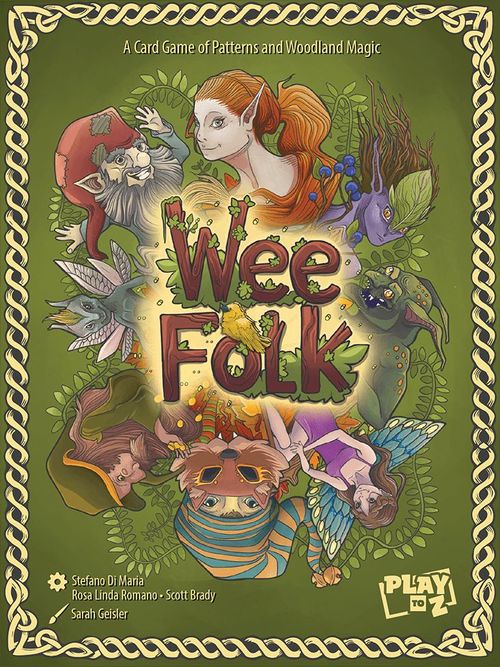
Wee Folk
Wee Folk Rulebook
Table of Contents
Components
- 70 Wee Folk cards
- 2 Reference cards
This is a wild card. It can be any Wee Folk. However, while they can be part of any pattern, they have no scoring value, and no action icons.
Setup
- Remove any one set of Wee Folk from the game and shuffle the rest, along with the wild cards, into a deck.
- Deal out 6 cards into the middle of the play area to form the common area known as the Forest. (A)
- Deal each player 6 cards to form their starting hand. Set the rest of the deck at the edge of the Forest.
- Give each player a Reference card on the +1 side.
Beginning with the tallest player, and alternating, each player will place one card from their hand directly into their Clearing. (B) The first card will be placed directly underneath a card in the Forest. The second card can be placed directly underneath another card in the Forest or under the previously placed card in their Clearing. The third card can be placed directly under a different card in the Forest or under any previously placed card in their Clearing. Once each player has placed 3 cards, the game begins with each player having only 3 cards left in their hand.
IMPORTANT: This is the only time that cards may be played directly into a Clearing.
Gameplay
Starting with the shortest player, on your turn play a card from your hand into the Forest. (C) It must replace a card that is already there. The Forest card that is being replaced gets pushed downwards one space into your Clearing. (D) Any cards underneath that card also move downwards.
Check to see if any completed patterns are present (see below). After any completed patterns have been resolved, end your turn by drawing ONE card from the deck into your hand. It is now the opponent's turn.
Note: Actions you may have previously played (see page 4), might have your hand contain more or less than three cards.
Patterns
Patterns are formed when the cards in the Forest and/or your Clearing match what is depicted on the Wee Folk cards as viewed by the player on either corner of the card. The pattern cannot be partially rotated or flipped – you must match exactly the pattern shown on the card as seen by your viewpoint.
- The pattern has to be made using only that type of Wee Folk or Wild Cards.
- The pattern can ONLY appear using the cards in the Forest and in YOUR Clearing. You may never use your opponent's cards in their Clearing.
- You may complete more than one pattern on the same turn. If two or more patterns are made at the same time, choose one to remove, shifting cards as required, before resolving additional patterns.
- Patterns may be collected at any time before or after your card is played, but only on your turn.
When a pattern is made, remove all the cards forming that pattern and place them into your score area. (E) Any of those that depict actions should be kept separate, (F) to allow you to see what you have available on that and future turns.
Once the cards are removed, (G) shift any cards underneath those cards upwards, including into the Forest. If an empty space in the Forest exists (i.e. no cards were underneath the card in the Forest), the opponent must fill the space if they have cards in that column. They would shift all cards in that column upwards, filling the Forest space.
If no one can fill the empty Forest space, draw a card from the deck and place it in the empty space.
Actions
Your reference card is worth 1 point at the end of the game unless you use it during the game. On your turn, you may flip the reference card for any one free action during the game.
Once per turn, a player can discard a collected scored pattern card from the game to activate its depicted action. This can be done anytime during their turn. A card that was just collected can be used immediately. Note that by discarding the card from the game, you will not score that card at the end of the game.
The actions are:
- Swap positions of any two cards in your Clearing.
- Swap positions of any two adjacent cards in the Forest.
- Immediately play a second card from your hand.
- Move a card in your Clearing to the bottom of any column in your Clearing.
- Draw a card from the deck into your hand.
- Discard a card from your Clearing to the bottom of the deck.
Game End
When the last card from the deck is drawn at the end of a player's turn, this signals the end of the game. Each player will take one more turn without drawing a card at the end of their turn. Then, proceed to scoring.
Scoring
Discard your hand: they will not score any points. Add up all the points on the cards you collected. This includes cards with actions that were not activated. Each point icon on a card equals a point.
(Example: Player One = 14 points; Player Two = 9 points.)
Then, find the highest valued column in your Forest and Clearing and subtract that total from your score. If you did not use your Reference card, add 1 point.
(Example: Player One minus 6 points; Player Two minus 4 points.)
The player with the highest total wins. If there is a tie, the player with the most collected cards remaining (do not count used action cards) is the winner. If still tied, the player with the fewest cards in their Clearing is the winner.
Wee Folk
Elves: Elves, in the lore of the Wee Folk, are the tall and shining kindred of the hidden world. Unlike their smaller cousins, they move with quiet grace through moonlit forests and hollow hills, appearing to mortals only when it suits their whim. Ageless and beautiful, their eyes are said to glimpse both the seen and unseen, and their touch may bring either blessing or mischief. To meet an Elf is to brush against mystery itself - never wholly friend nor foe, but always a reminder that the world holds wonders just beyond our sight.
Fairies: Fairies are the bright and delicate spirits who slip between the mortal world and their secret realms. They are glimpsed as flickering lights, a whisper of laughter, or a rustle of wings just out of reach. Small in form but mighty in magic, they weave delight and danger in equal measure, granting luck or leading astray at the turn of a mood. To cross paths with a Fairy is to find yourself caught in a dance of joy and trickery, a fleeting glimpse of the unseen that lingers long after they've gone.
Gnomes: Gnomes are the sturdy and clever guardians of earth and stone. Often found tending gardens, burrows, or hidden tunnels, they move quietly beneath roots and rocks, rarely seen by human eyes. Small but strong, their hands are skilled in craft and their minds quick with wit, capable of shaping both the land and the luck of those who respect them. To encounter a Gnome is to sense the steady pulse of the world beneath your feet - a reminder that even the smallest beings hold great power and quiet wisdom.
Pixies: Pixies are the mischievous sparks of the forest, lighter than air and quick as a whisper. They flit through flowers and ferns, their laughter ringing like wind chimes on a summer day. Playful and curious, Pixies delight in pranks that startle as much as they amuse, yet they may lend a small favor to those who earn their trust. To see a Pixie is to feel the forest's heartbeat and the twinkle of magic just beyond reach.
Leprechauns: Leprechauns, in the world of the Wee Folk, are the clever keepers of hidden treasure and secret paths. Small of stature but sharp of mind, they move with stealth through hills and meadows, always guarding what is theirs. Known for riddles and cunning bargains, they may grant fortune - or spin a fool's errand - to those who cross their way. To meet a Leprechaun is to glimpse the sly humor of the unseen world, where wealth and wit walk hand in hand.
Goblins: Goblins are the scrappy and restless dwellers of dark corners and forgotten ruins. They skulk where shadows gather, their sharp eyes and quick fingers always seeking gain or mischief. Though often feared, Goblins are clever survivors, capable of cunning and craft in equal measure. To encounter a Goblin is to feel the wild, unpredictable pulse of magic that lingers where order and chaos meet.
Sprites: Sprites are the pure and fleeting breath of nature, visible only in the shimmer of sun on water or the glint of dew on a leaf. Gentle and curious, they guide the growth of plants and the flow of streams, yet vanish when observed too closely. To glimpse a Sprite is to touch a moment of grace, a reminder that the smallest stirrings of the world are alive with secret life.
Tricksters: Tricksters, in the tales of the Wee Folk, are the unpredictable wanderers who thrive in laughter, riddles, and chaos. They appear in many forms - sometimes tiny, sometimes looming - always shifting, always testing. They delight in revealing folly and folly's folly, showing mortals the folly of their own pride. To discover a Trickster is to feel the dizzying thrill of uncertainty, a spark of magic that unsettles yet awakens the mind.