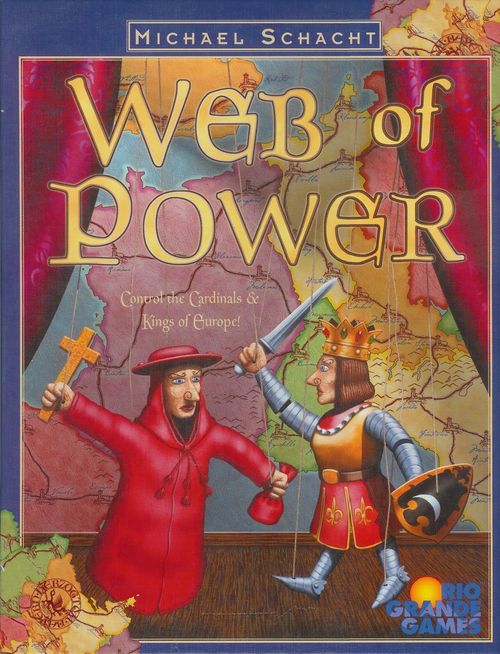
Web of Power
Web of Power Rulebook
Table of Contents
Table of Contents
Contents
- 55 cards (13 Franken/Aragon, 12 Bayern/Burgund, 11 Lothringen/Italien, 10 England/Schwaben, 9 Frankreich)
- 100 cloisters (20 each in 5 colors)
- 40 advisors (8 each in 5 colors)
- 5 scoring markers in 5 colors
- 1 black place marker
- 1 board
- 1 rule booklet
Preparation
-
Place the board in the middle of the table.
-
Each player selects a color and takes the cloisters and advisors in this color. They place their scoring markers on top of each other on space 0 of the scoring track on the board.
-
The players choose a starting player either randomly or by any other method they prefer. The starting player takes the black place marker.
-
He then places it on the table before himself, and keeps it until the final scoring.
-
With fewer than 5 players, remove some cards from the game.
With 4 players, remove one card of each color and place them in the box.
With 3 players, remove two cards of each color and place them in the box.
-
The starting player thoroughly shuffles the remaining cards and deals 3 cards face down to each player.
The players take these cards as their starting hands and may not show them to the other players. The starting player puts the remaining cards face down beside the board as a draw stack and draws the 2 topmost cards, placing them face up next to the draw stack. Leave space on one side of the draw stack for a face-up discard pile.
-
The starting player begins the game and play continues around the table in clockwise order.
The Board
The board is a map of central Europe divided into 9 countries. Eight of the 9 countries are paired with the same background color (e.g. Bayern and Burgund). These countries are always shown together on the cards.
Frankreich has its own color and is always alone on the cards.
Each country has several cloisters pictured along with their names. The cloisters are connected by roads.
The players place their cloisters on these pictures during the game.
The countries' coats of arms are pictured in circles on the map. The players place their advisors in these circles during the game.
The numbers (from 1 to 15) inside the squares on the map show the possible alliances between the advisors of the countries. They are scored in number order.
The possible alliances across water (1, 2, 3, 5, 6 and 15) are connected by lines. These lines represent sea routes not roads. Thus, they only exist to make the possible alliances clear.
The scoring track runs around the board, starting at 0 with dark squares every 5 spaces. If a player's score passes 99, he moves his marker past the 0 and all remember the extra 100 points.
Playing the Game
On a player's turn, he must do one of the following:
- Play 1, 2, or 3 cards from his hand and place cloisters or advisors in the appropriate countries. He then fills his hand to 3 cards.
- Discard one card and draw one card to fill his hand to 3 cards.
Whenever the draw stack is exhausted, the players score. The first time is the interim scoring: the players score only the cloisters. The second time is the final scoring: the players score the cloisters, the advisors, and the cloister chains. After the final scoring, the game is over.
Playing Cards
On his turn, a player may play up to three cards from his hand to place cloisters and advisors on the board.
The card played indicates where the player may place his piece. If two countries are shown on the card, the player may select either of the two countries.
After placing the piece, the player discards the card on the discard pile.
Placing Pieces
Players must use the following rules when placing pieces on the board:
- The player may only play pieces in one country on his turn.
- If the player is the first to play a piece in a country, he may only play one cloister in that country on this turn. If there is already one or more cloisters (of any colors) in a country, the player may play one or two pieces in that country on this turn.
- The player may play only one piece per card played.
- The player may play two cards of the same color together as a joker to play a piece in the country of his choice.
In any case, a player may place one or two pieces in one country on his turn, using one, two, or three (if the joker is used) cards.
Players are limited by the number of pieces they have. For example, after a player uses all eight advisors, he may play no more. If a player has used all of his pieces, he is limited on his turn to discarding a card and drawing a card to fill his hand.
example:
Anna has 1 Frankreich and 2 Franken/Aragon cards in her hand. She decides to put pieces in Franken and plays the Franken/Aragon card. As she is the first to play in Franken, she may only play one piece and it must be a cloister. She puts it on Chorin and ends her turn as she may not play in two countries in her turn.
Barbara has 1 Franken/Aragon card and 2 Bayern/Burgund cards. She also decides to put pieces in Franken and may put 2 pieces there as another piece (Anna's) is already there. She uses the Franken/Aragon card to put a cloister on Obra. She then uses the 2 Bayern/Burgund cards as a joker to place an advisor in the coat of arms circle in Franken.
Chris has 3 Frankreich cards in his hand. As there are already several cloisters in Frankreich, he may use 2 of the cards to play 2 pieces in Frankreich. If he does not want to play pieces in Frankreich, he may use 2 of the cards as a joker and play 1 piece in another country.
The rules for playing cloisters and advisors are different as described below:
- Cloisters are always placed on a named cloister space in the selected country. Only one cloister may be played on each cloister space. When all cloister spaces are filled, no further cloisters may be played.
- Advisors are always placed on the coat of arms circle in the selected country. Several advisors of differing or matching colors may occupy the same coat of arms circle, however there is a limit to how many total advisors may be present. This limit is the number of cloisters in the country held by the player with most cloisters in this country. For example, if there are 3 red, 2 yellow, and 2 blue cloisters in Frankreich, there may be at most 3 advisors. A player may place advisors in a country where he does not have cloisters, but advisors may not be placed in a country without cloisters.
example:
Anna wants to place 2 advisors in Frankreich. She has 1 Frankreich and 2 England/Schwaben cards. Barbara has 4 cloisters in Frankreich, more than anyone else. Thus, there can be at most 4 advisors in Frankreich at this time. Since there are only two advisors there now (Barbara and Chris each have 1), Anna places 2 advisors there using the Frankreich card for 1 and the other 2 cards as a joker for the other.
In Italien, Barbara and Dan have the only cloisters and tie for the most with 2 each. Since there are no advisors in Italien, 2 advisors can be placed there. Chris has 3 Lothringen/Italien cards and could choose to play 2 advisors, 2 cloisters, or 1 advisor and 1 cloister in Italien.
Drawing Cards
When a player has played the cards and placed the pieces he is allowed and wants, he fills his hand back to 3 cards. He may draw 0, 1 or 2 of the face-up cards next to the board, 0 to 3 topmost cards from the draw stack, or any combination of the two and in any order. He may, however, only draw enough cards to fill his hand to 3 cards.
example:
Anna plays two cards and now has a Frankreich card. The two face up cards are Bayern/Burgund and England/Schwaben. She wants to be able to play twice in Frankreich on her next turn and so draws the top card from the draw stack, a Bayern/Burgund card. For her second card she takes the Bayern/Burgund face-up card to give her a joker for her next turn.
Exchange a Card
If a player cannot or does not want to play pieces on his turn, he must exchange one card. The player discards one card from his hand to the discard pile and draws one of the two face-up cards or the top card from the draw stack.
Replace the Face-up Cards
When he has filled his hand to 3 cards, he draws cards from the draw stack to replace any face-up cards he took.
The Interim Scoring
When the draw stack is exhausted (there may still be 1 or 2 face-up cards) for the first time, the game is interrupted to score the cloisters that have been placed on the board. For this interim scoring, only the number of cloisters placed is considered. Advisors and cloister chains are not scored.
To be certain that all countries are scored and none are scored twice, first score all countries at the edge of board in clockwise order: England, Franken, Bayern, Italien and Aragon. Then, score the four internal countries: Frankreich, Lothringen, Schwaben and Burgund.
Players move their scoring markers around the scoring track to mark their points as they count them.
Cloister Scoring
- The player with most cloisters in a country scores one point for each cloister in the country, regardless of color.
- The player with the second most cloisters in a country scores one point for each cloister of the player with most cloisters.
- The player with the third most cloisters in a country scores one point for each cloister of the player with the second most cloisters.
- The player with the fourth most cloisters in a country scores one point for each cloister of the player with the third most cloisters.
- The player with the fifth most cloisters in a country scores one point for each cloister of the player with the fourth most cloisters.
If a player does not have a cloister in a country, he scores no points in that country. If one or more players tie with the same number of cloisters in a country, they all score the same number of points, depending on what scoring position they are in.
example:
In Franken, Anna (green) has 4 cloisters, Barbara (red) has 2, and Dan (blue) has 1. Anna has the most cloisters and scores 7 points (one for each of the cloisters in Franken). Barbara has the second most cloisters and scores 4 points (one for each of Anna's cloisters, as Anna has the most). Doris has the third most cloisters and scores 2 points (one for each of Barbara's cloisters, as Barbara has the second most).
example:
In Lothringen, Barbara (red) and Chris (lilac) each have 2 cloisters and Dan (blue) has 1. Barbara and Chris are tied with the most cloisters and score 5 points each (2+2+1). Dan has the second most cloisters and scores 2 points (the number of cloisters the players with the most each have).
After the cloisters have been scored for all 9 countries, the interim scoring is done. The players shuffle the discard pile and place it face down on the table as the new draw stack. The interrupted game now continues.
If a player was drawing cards from the draw stack and has still not filled his hand to 3 cards, he now draws cards from the draw stack or the face-up cards to fill his hand. After this, if either or both face-up cards are missing, cards are drawn from the draw stack to replace them.
With that player's turn done, the game continues with that player's left-hand neighbor.
Game End
When the draw stack is exhausted (there may still be 1 or 2 face-up cards) for the second time, the game ends, but not immediately. Players continue taking turns, but do not draw cards, until all players have taken turns in this round. As the black place marker indicates the starting player, the last player to play will be the starting player's right-hand neighbor.
The game also ends when no more pieces can be placed on the board. This means that all cloister spaces are filled and all possible advisors have been played or that all players have played all their pieces.
The Final Scoring
In the final scoring, cloisters, advisors, and cloister chains are scored.
Cloister Scoring
This scoring of cloisters is the same as described under interim scoring.
Advisor Scoring
The advisors are not scored by country, but by alliances between pairs of countries.
There are 15 alliances displayed on the board, numbered from 1 to 15. To ensure that all are scored, start with number 1 and score them in number order, using the black marker to indicate the alliance currently being scored.
Each alliance is scored and the players' scores recorded on the scoring track with their scoring markers.
Not all alliances will score points, but each alliance may score points for several players. An alliance scores points only if a player has the most advisors in each country connected by the alliance. If several players in a country are tied with the most advisors, they all tie for the most. A player does not have to have the most advisors in the two countries added together, but in each country considered separately.
If a player has the most advisors in a country, he may be able to score points in several alliances if he has the most advisors in the appropriate allied countries.
If a player has the most advisors in each country of the alliance, he scores one point for each advisor in the two countries, regardless of color. If several players have tie for the most advisors in each country of the alliance, they all score the same number of points: one point for each advisor in the two countries, regardless of color.
Players who do not have the most advisors in each country do not score points for alliances. There is no second place when it comes to scoring alliances.
example:
Move the black place marker to the 14 to score the Italien-Burgund alliance. There are 4 advisors in Italien: 2 for Dan (blue), 1 for Barbara (red), and 1 for Anna (yellow). There are two advisors in Burgund: 1 for Dan (blue) and 1 for Barbara (red). Thus, Dan (blue) has the most in Italien and Burgund and scores 6 points (4 advisors in Italien + 2 advisors in Burgund). Barbara and Anna do not score for this alliance.
Next the black place marker is moved to the 15 to score the Italien-Bayern alliance. There are 3 advisors in Bayern: 2 for Barbara (red) and 1 for Anna (yellow). As Dan (blue) has the most in Italien and Barbara (red) has the most in Bayern, no one scores for this alliance.
Cloister Chain Scoring
Finally, the cloister chains are scored.
A player scores a cloister chain if he has a chain of 4 or more cloisters in a continuous sequence along a road. Branches from the chain are not counted. The chains may, but need not cross country borders.
For each cloister in a chain, the player scores one point. Each cloister may only be scored in one chain.
example:
In the picture above, Chris (lilac) has a chain of 5 cloisters in Italien and Burgund. The cloister in Bayern is a branch from the chain and is not scored. Thus, Chris scores 5 points for this cloister chain. He may not count the 4 cloisters in Italien with the one in Bayern as a second chain as the rule forbids counting a cloister in more than one chain.
Winning the Game
The player who has the most points after the final scoring is the winner. If 2 or more players tie with the most points, the one among them who has the most pieces left in his supply (cloisters plus advisors) is the winner.
Variant
For a faster game with fewer restrictions on placing pieces, try the following:
- A player may place pieces in one or two countries on his turn if he has the cards that allow such placement.
- A player may place two cloisters in an empty country, but may not place one cloister and one advisor in an empty country.
- All other placement restrictions apply.
Rule Summary
- Play up to 3 cards (2 of the same color may be played as a joker).
- Place up to 2 pieces (cloisters and/or advisors).
- Only 1 cloister may be played in an empty country.
- A player may only play pieces in one country in his turn.
- The number of total advisors in a country is limited to the number of cloisters of the player who has the most cloisters in the country.
Instead of steps 1 and 2, a player discards one card and draws one card to replace it.
- Refill hand to 3 cards.
- Replace face-up cards if one or both were drawn.
Interim scoring (when the draw stack is exhausted for the first time)
- Cloister scoring
Final scoring (when the draw stack is exhausted for the second time)
- Cloister scoring
- Advisor scoring
- Cloister chain scoring