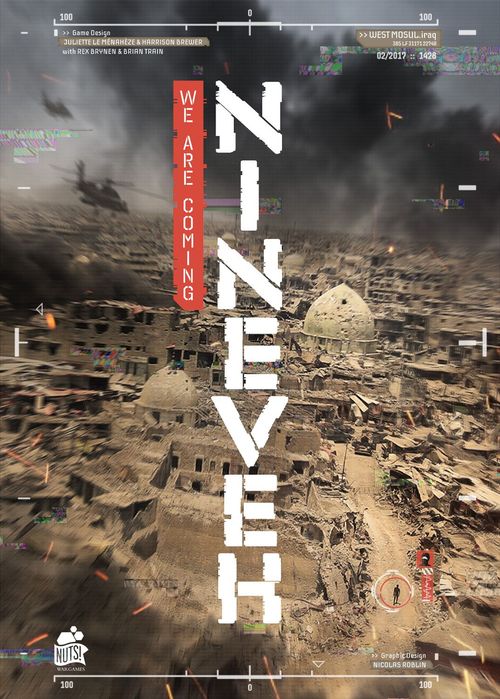
We Are Coming, Nineveh
We Are Coming, Nineveh Rulebook
Table of Contents
Table of Contents
2.0 Game Components and Concepts
The game includes the following: 93 blocks, other counters, two six-sided dice, a game map showing Western Mosul, five main sets of cards (Daesh and ISF priorities, Daesh units and capabilities, ISF units and capabilities, Events, and Military Council cards), and these rules. (For a full listing, see section 11.0.)
2.1 Units
Blocks are provided for the two sides in the game: the Iraqi security forces (ISF) on GREEN blocks and Daesh on BLACK blocks. Each block representing a unit has a number value on several sides of the block, representing both its attack strength and step count. The number value (for example, 4+) indicates the die roll needed in order to score a hit during combat. When a unit is hit, the block rotates counter-clockwise, increasing the die roll needed to successfully hit. This is called "taking a step loss" and represents casualties, morale losses, disruption, and loss of equipment during combat. A unit that must take a step loss beyond this point is removed.
The initial position of a block is marked by a black or white background.
Blocks are usually placed with their blank side towards the enemy, in order to maintain "the fog of war." It is extremely important to maintain the orientation of blocks when moving or revealing them, otherwise a player might accidentally suffer or recover step-losses.
2.11 Daesh Assets
Daesh assets are divided into four types:
- Combat units: includes the Leader, Veterans, Militia, and optional Ashbal (child soldiers), Technicals ("gun trucks"), Mortar, and Stay-Behind units. They can move.
- Production units: these optional units include IED Factories, Arms Caches, and the Media Centre. They cannot move.
- Improvised Explosive Devices (IEDs), including large IEDs and Vehicle-Borne IEDs (VBIEDs). They are not units. Only VBIEDs can move.
- Rumours. These are not units, but they can move, and reflect misinformation and the "fog of war."
If used, the optional Popular Mobilization Forces (PMF) units are not affiliated with any ISF headquarters.
In addition to unit blocks, We Are Coming, Nineveh! also includes special blocks marked 3-2-1-0 to indicate the number of special orders remaining to each headquarters unit.
2.12 Iraqi Security Forces
Iraqi security forces (ISF) are divided into three groups of combat units. Each group has a Headquarters (HQ) unit and a distinct coloured background on its counters:
- The Iraqi Army: consisting of the 9th Armoured division (9th AD) and the optional units from the 1st, 15th and 16th Infantry Divisions (1st, 15th, 16th ID), marked by a green background;
- The Ministry of the Interior: consisting of the Emergency Response Division (ERD), and Federal Police (FP) units, marked by a blue background;
- The Counter-Terrorism Service (CTS): consisting of Iraqi special operations forces, marked by a gold background.
2.2 Map
The map depicts West Mosul, which has been subdivided into areas for movement and combat purposes. These areas represent urban neighbourhoods and the major roads running between them. Consequently, game play reflects the ebb and flow of actual urban operations.
Each area has a terrain indicator represented by a dark brown (open terrain), light brown (urban terrain), or dark grey (Old City terrain) circle. The map also has important major road routes depicted that can enable faster travel (yellow lines), as well as key road junctions (marked with a yellow circle). The names of the suburbs or the buildings are purely cosmetic and have no effects in the game. The building inside the old city marks the location of the Grand Mosque of al-Nuri, where the leader of Daesh, Abu Bakr al-Baghdadi, declared the establishment of a Caliphate in June 2014.
Part of East Mosul is shown on the map, across the river from the Old City. It is out of play for all purposes.
In addition to the map, the game board also has three tracks to indicate Time (the current game turn), Collateral Damage, and ISF Casualties.
2.3 Decks
We Are Coming, Nineveh! comes with five card decks.
Daesh and the ISF both have priority cards, that will be played secretly before the first game turn (3.0).
Daesh and the ISF each have a units and capabilities deck, consisting of core units, optional additional units, and optional additional capabilities. These are reference cards that explain unit capability, combat values, and special effects. Additional units and capability cards are purchased (using capability points) before the first turn of play begins (3.2).
The event deck (6.5) consists of a number of special events that are triggered when either a 1 or a 6 (depending on the card) is rolled during the combat phase. These cards represent significant events and turning points in the Battle for Mosul that helped or hindered ISF efforts to liberate the city. These cards can include changes to the collateral damage track, unit effects, tactical decisions, or rewards for preparation and organisation. Some optional blank event cards (9.3) are also included, so that players can design their own events.
Context: The event cards seek to illustrate Clausewitz's concept of friction, as "countless minor incidents—the kind you never really foresee—combine to lower the general level of performance, so that one always falls far short of the intended goal". We hope that they create a sense of uncertainty that illustrates the "friction' of real-time combat decision-making.
The Military Council cards are only used when the game is played solitaire (10.0).
Card symbols. Capability and Military Council cards use small icons to show when an effect applies: Support (S, during the Support Phase), Movement (M, during the Movement Phase), Combat (C, during the Combat Phase), Any time (a lightning bolt), Fast movement (a double chevron), Enter Old City (a cloud/dome icon), and Die roll (a hexagon).
Example cards. A Military Council card shown in the rules ("151") carries three effects: Reposition — all Daesh units outside the Old City move towards the nearest road junction, unless already adjacent; do not enter an ISF area unless it contains fewer than 2 undisrupted units. Agile Foe — at the end of this game turn, reshuffle all the used and unused Military Council cards together to form a new deck. Media Centre — while the Media Centre is still in play, any Collateral Damage counts double next turn unless the ISF has the EW/SIGINT capability. A second Military Council card ("144") is shown partially overlapped in the printed rulebook; its legible fragments describe a Mortar-related effect that places a disruption marker on the two ISF units nearest the Grand Mosque of al-Nuri (inflicting a step loss on those units too if Daesh is in supply), and a Demolition effect: if Daesh is inside the Old City, ISF forces detonate explosives at the Grand Mosque, adding 1 to Collateral Damage (ignored if the Grand Mosque is not under Daesh control).
Sample Event cards shown in the rules include: Target of Opportunity — Iraqi soldiers spot a group of Daesh fighters operating in close proximity to civilians. If the ISF player chooses to open fire, roll a die: on a 1-2, increase Collateral Damage by one; on a 3-6, Daesh player suffers a step loss in an area adjacent to ISF unit(s) (ISF player's choice). Civilians in the Line of Fire! — ISF player must cease all further combat in this area this turn or suffer 1 Collateral Damage. The Beast — Famed Iraqi tank, nicknamed "The Beast," rampages against Daesh. The ISF player may immediately move one 9th AD unit into an eligible adjacent zone. It may attack during the present combat phase.
2.4 Rerolling
A number of card effects allow players to reroll a die. When doing so, ignore whatever effects the initial die might have had.
2.5 Control
An area is under Daesh or ISF "control" when it is solely occupied by one or more blocks belonging to that side. In the case of Daesh, these may be blocks of any kind, including Rumours or IEDs.
3.0 Starting the Game
The two players agree which side each will play. Each player should also select which of the three victory metrics (Time, Casualties, or Collateral Damage) is most important to them by secretly selecting the appropriate Priority card and placing it face down in the space marked on the map. The others should be set aside, also face-down. This metric will be revealed at the end of the game, and will count for double points (see 9.0). (If playing for the first time, we suggest Daesh select Time or Collateral Damage, and that ISF select Casualties or Collateral Damage.)
Remove the optional "player event" cards (9.3) from the Event deck if they are not being used. Shuffle all of the Event cards together into a single deck, and place them in the space marked on the map with the trigger number face up and the descriptive text face down.
Place the Time marker on the 1 space on the Time track to mark the first turn. Place the Collateral Damage and Casualties markers beside their tracks (since these start at zero). Place the supply marker with the "In Supply" side face up by the road junction adjacent to the Old City (marked with a black circle), or in another convenient location.
3.1 Core Units
ISF player. The ISF player receives the following core unit cards at no cost, as well as the associated units listed on the card:
- Headquarters
- 9th Armoured Division
- Counter-Terrorism Service (CTS)
- Emergency Response Division (ERD)
- Federal Police
Daesh player. The Daesh player receives the following core unit cards at no cost, as well as the associated units listed on the card:
- Leader
- Veterans
- Militia
- IEDs (improvised explosive device)
- Large IEDs
- VBIEDs (vehicle-borne IED)
- Rumours
3.2 Additional Units and Capabilities
Before the start of the game, each player is given 30 capability points, which are then used to purchase additional units and capabilities. This reflects campaign planning by the two sides, and the sorts of additional assets, training, and equipment each side could bring to the battlefield. These purchases are made in secret, and any capability cards purchased should be kept face down until they are first used (or revealed by a HUMINT card). The cost of cards reflects both their availability and their effectiveness during combat operations in West Mosul.
The cost of additional units and capabilities are noted on the associated cards. Units and capabilities may only be purchased once, unless two costs are shown on the card. In this case, the lower cost purchases a smaller number of units than the larger cost: in the case of Ashbal (child soldier) units, for example, the Daesh player may purchase 3 units at a cost of 2 capability points, or 6 units at a cost of 6 capability points.
If additional units are purchased, these will be usually deployed during set-up at the start of the game.
Other capabilities are used during a particular phase of the game, as noted on the card. Some capabilities can be used each turn. This can be indicated by "tapping" the card (turning it sidewards) to indicate the capability has been expended for this turn, and then resetting cards at the end of each game turn.
Other capabilities may be single use. In this case, the card is removed from play once used. The Hasty Attack card has special rules attached to it—see Section 9.2 for details.
References in the rules to "air support" only applies to the Coalition or ISF Air Support cards, and do not apply to UAVs unless specifically noted.
3.3 Deployment
Finally, players will set up their units. Blocks are placed standing up, with their current value at the top and with their blank side facing the opposing player. This maintains a "fog of war" during the game.
The ISF player has three starting areas on the south edge of the map. These areas are indicated by a star icon. The player must set up one group of forces (Army, Interior or Counter-Terrorism Service) in each starting area. There are no stacking limits in these areas.
- Army (green background): Army HQ, 6 x 9th Armoured Division. It is also possible to purchase 3x additional Army units (elements of the 1st, 15th, and 16th Infantry Divisions)
- Interior Ministry (blue background): Ministry of Interior HQ, 4 x ERD, 4x Federal Police
- Counter-Terrorism Service (gold background): CTS HQ, 8 x CTS
- Popular Mobilization Forces: if these optional units are purchased, all must start in one of the three starting areas.
The ISF player should also place the three special orders blocks (marked 3-2-1-0) on top of the headquarters card, with the "3" side up. This indicates how many special orders each headquarters unit has left.
When the ISF player is finished, the Daesh player can set up their units anywhere on the map (excluding the three Iraqi start areas).
- Leader HQ, 12 x Militia, 5 x Veteran, 2 x IED, 1 x Large IED, 1 x VBIED, 8 x Rumours
- Any additional units purchased: (Ashbal, Mortars, Technicals, Arms Cache, IED Factory, Media Centre, additional IEDs/ Large IEDs/ VBIEDs).
The Daesh player should also place a special order block on top of the leader card, with the "3" side up.
The campaign for West Mosul started on late February 2017 and concluded in early July 2017. Each Game-turn represents about ten days to two weeks of the campaign. In each Game-turn, there are two Player-turns (one for the ISF, followed by one for the Daesh). A Player-turn consists of a Support Phase, Movement Phase, and a Combat Phase. After both Player-turns are over, there is a Turn End Phase.
4.0 Sequence of Play
4.1 Player-Turn
4.11 Support Phase
- If Daesh is out of supply at the start of the Daesh support phase (7.1), an Ashbal or Militia unit suffers a step loss.
- Friendly HQs regain one special order (7.1).
- Rally special orders may be issued to remove disruption (7.1).
- The player uses any capability cards that are played during the Support Phase. Detailed effects are outlined on the card.
- If the Daesh player has purchased production units (Media Centre, IED Factory, Arms Cache), they may attempt to produce a unit or effect, as detailed on their capability card.
4.12 Movement Phase
All of the player's eligible units may move within the provisions of the rules governing movement (5.0).
4.13 Combat Phase
Combat between friendly and enemy units occupying the same area takes place, within the provisions of the rules governing combat (7.0). During the Combat Phase (only), players who roll a 1 or a 6 on a die may immediately trigger an event card (6.5).
During the Combat Phases of both player-turns, certain adjustments will be made to the collateral damage and the ISF casualty tracks according to event cards, capability cards, and any special effects that may come into play.
4.14 Turn End Phase
- Both players stand their units in the appropriate upright position if they have been revealed (placed face-up) during combat.
- Tapped cards are un-tapped (see 3.2).
- Any tunnel markers in ISF-controlled areas are removed.
- Lastly, the Time counter should be advanced one space on the Time track.
- The next game-turn then begins with the ISF player's Player-turn.
4.2 End of Game
The game ends when all Daesh combat units (see 2.1) in the Old City are eliminated, or at the end of Turn 12.
5.0 Movement
During the Movement Phase of their player-turn, a player may move all, some or none of their eligible units. All ISF units, all Daesh combat units, VBIEDs, and Rumours are eligible to move. Daesh IEDs, Large IEDs, and Daesh production units may not move once placed.
A unit may move from one area to an adjacent area. Generally each unit can only move one area, once per turn: exceptions are a Maneuver order (see 7.2) or Fast Movement.
Units must stop for the duration of the turn when they enter an area with an enemy unit in it.
Some capability cards may alter movement rules.
Example of fast movement: The ISF Army unit uses fast movement to travel along the major road (yellow line). When it reaches this point, however, it is stopped by the Rumour in the adjoining area. Place the armoured unit in this area. Units using fast movement always halt at the first zone containing enemy blocks. The Daesh units in Al-Thawra can either move and fight the ISF units of the north, or move to the other adjacent areas of Abi Tamam, Al-Abar, or Al-Uruba.
Example of overstacking: If the lone Daesh veteran unit was forced to retreat, it could retreat in any Old City area but, provoking overstacking, all units in that area would become disrupted.
5.1 Fast Movement
All ISF units, and Daesh VBIEDs and Technicals, may use major road networks for fast travel.
Major roads are indicated by two parallel bold yellow lines. As its move, an eligible unit may advance along an unlimited number of vacant or friendly-controlled areas that are adjacent to a road. Once the unit encounters an enemy-occupied area, however, it must stop in that area (or an earlier one).
5.2 Stacking
Stacking limits are dependent upon the terrain type of an area and the number of friendly units in that area:
- Open areas may stack up to 4 friendly units
- Urban areas may stack up to 3 friendly units
- Old City areas may stack up to 2 friendly units
- Stacking limits do not apply to ISF forces in the three ISF starting areas.
Enemy units do not count for stacking limits. IEDs (including Large and VBIEDs), Rumours, and Human Shields are not units but DO count towards Daesh stacking limits.
5.21 Overstacking
There is only one circumstance in which too many units may occupy a given area, thus violating the stacking limit. If a unit is forced to retreat in combat (6.4) and there are no friendly-occupied or vacant areas within the stacking limit, the retreating unit may overstack by moving into an adjacent area in excess of the normal stacking limit. If this occurs, the unit and all other friendly units in this area become Disrupted. See 6.3 for more information on Disruption.
5.3 Alleyways and Narrow Streets
ISF 9th Armored Division and all ISF HQ units may not enter Old City areas.
5.4 Major Road Junctions
The large circles denote junctions of major roads. An area touching a junction is assumed to be adjacent to all other areas that touch the same junction.
5.5 Tunnels
The Daesh players may move some units between tunnel markers as if they were adjacent areas, if this capability is in play. The rules for this are more fully described on the Small and Large Tunnel Network capability cards.
6.0 Combat Phase
6.1 Combat Procedure
During the Combat Phase of a player-turn, combat must take place in each area which contains opposing forces. The attacking (phasing) player determines in which order the areas will be resolved. In each area, combat takes place as follows:
- Both players reveal all of the blocks they have in the area. In doing this, be careful not to change the orientation of the blocks. Any Rumours are removed.
- The defending (non-phasing) player rolls to hit for each unit in the area. The score required to hit is noted on the top edge of a unit block (e.g. a Federal Police unit starts with a 5+. Therefore, a die roll of 5 or 6 indicates a successful hit). Some units may have die roll penalties or bonuses due to terrain, special capabilities, or disruption: see the unit card.
- The attacking (phasing) player then chooses how to distribute any hits taken among the attacking units. Some units—those from the 9th Armoured Division—are allowed a 5+ saving roll to cancel the effect of a hit. This is noted on their unit card. Hits are noted by rotating a block counterclockwise 90 degrees. Units are removed when they have no more rotations available, see 6.3.
- The surviving attacking units may now attack, using a similar procedure. The defending player chooses how to distribute any hits taken among their units.
- After one round of combat is resolved, the defending player may choose to have some or all of their remaining units retreat (see 6.4). If the attacking player is now in sole occupation of the area, the attacking player's units will remain in the area.
- If defending units choose to remain in the area, any attacking ISF CTS or Daesh Veteran units still present may choose not to retreat and instead fight a second round of combat in the area. In this case, all defending units may fire again first.
- Otherwise, all attacking units must retreat to eligible adjacent area(s) (see Section 6.4).
- If a second round of combat is fought, and defending units still remain in the area, all attacking units must retreat.
When all units in a given area have attacked, the attacking player now chooses another area to resolve combat. The combat procedure is repeated until all attacking player units in all areas where combat was possible have resolved their combat. Once all combat has been resolved, no area on the map should contain units from both sides.
Example of combat: The two CTS (gold) units attack Daesh units in the Old City. The defending Daesh player rolls first for the veteran unit and gets a 2. It is modified into 3 for one hit because the fight is taking place in the Old City. The Ashbal block rolls a 4 and doesn't hit. Now the ISF player decides to take his hit on his full strength veteran unit. Both attacking units having survived they both roll and get 3 and 4 for one hit. The Daesh player takes this hit on the Ashbal unit and decides to retreat (see example 6.4). The wounded Ashbal unit stays behind to cover the retreat. Because this is their special capability, the two CTS units decide to fight a second round.
Cards: Some Capability or Event cards have combat effects that are applied during the Combat Phase. The specific combat effect is written in the description of the card.
6.2 Combat Modifiers
Terrain: Depending on the area density, combat may be modified to account for terrain advantages, troop experience, and weapon ranges and effects. The modifier used is determined by the terrain where the combat takes place. (E.g. if a 9th AD unit attacks a Daesh militia unit in an Open area, terrain modifiers are applied according to Open area combat modifiers). Terrain modifiers are noted on the individual unit cards.
- Open terrain gives a +1 dice roll modifier in combat to 9th Armoured Division units.
- Old City terrain gives a +1 dice roll modifier in combat to Daesh veteran units.
Disruption: A disrupted unit suffers a -1 modifier to all combat die rolls.
6.3 Combat Results
Step Loss: When a unit is hit in combat, it takes a step loss, denoted by turning the unit block counterclockwise 90 degrees (usually this will increase the unit's to-hit number). Units are removed when they are rotated to a blank facing (with no hit number) or have been rotated full circle. A unit that has been removed due to step losses may not be returned to the game.
Note that 9th Armoured Divisions units have an opportunity to avoid a step loss when hit by rolling a 5+, as detailed on their card. This represents the benefits of heavier armour.
Each ISF unit removed raises the "ISF Casualties" total by two: advance the marker on the record track to keep score (this is important at the end of the game).
6.31 Disruption
If a unit has been disrupted due to overstacking, or a Capability or Event card, place a Disruption marker underneath the unit block. Until the Disruption marker is removed, the unit suffers -1 to all combat die rolls (however, if it rolls a 6 on the to-hit die in combat, the player still draws an Event Card). If another disruption is suffered for whatever reason, the unit does not add another Disruption marker; instead, it takes a step loss.
Disruption markers can only be removed by an HQ unit's special order. See 7.2.
Note: Disruption is a combat modifier that seeks to model morale effects, ammunition and equipment shortages, and disorganisation. Disruption can be caused by overstacking, or inflicted by capability cards such as the Mortar card, the Makeshift Drone card, and the Sniper card.
6.4 Area Control and Retreat
Once all combat in an area has been resolved, the attacking player's units must either remain in the area or retreat. If the attacking player has removed all opposing units from the enemy area, the attacking player's units will remain in the area.
If there are still defending Daesh units in the area, the Daesh units may choose to remain in the area, or some or all may retreat to adjacent permissible area(s).
If the attacking force includes ISF CTS or Daesh veterans, these units may opt for a second round of combat. If so, all defenders will once again fire first, and then the attacking CTS or veteran units may (if they have survived) return fire.
In any other case, or if the CTS or Veteran units choose to retreat, all attacking units must retreat to eligible adjacent area(s) (see below). If a second round of combat is fought, and defending units still remain in the area, all attacking units must retreat.
When a unit retreats from combat, they must retreat into a "secure area." A secure area must be adjacent, and either vacant or contain only friendly units. It must also meet the following conditions:
- The Daesh player must retreat to a secure area that is closer to the Northern map edge or to the Old City. Daesh units in the Old City may retreat to any Old City area.
- The ISF player must retreat to a secure area that is closer to the Southern map edge or to the unit's HQ.
- Any PMF units (if taken) may retreat towards to Southern or Western edge of the map as well.
- Iraqi Army units may also retreat to the west if the Flanking Maneuver capability has been taken. In this case, ISF forces may also retreat off the map to the west. Place any such retreating forces on the Flanking Attack card, which has no stacking limit. They must reenter the map at any area on the west edge on their next turn.
Example of retreat: The veteran unit wants to retreat. Its only choice is to go with the lone Militia unit to the North. The other areas are either enemy-controlled or would lead to an overstack. Overstacking during retreat is possible only if there is no other option.
An area must be closer, but it need not be the closest of several eligible areas. To determine whether an area is "closer" to the northern (or southern) board edge, measure from its northern (or southern) extremity. In other words, if any part of the area is "closer" (to the relevant edge or area), the area is considered closer. Units from a single area may retreat to different areas.
If a retreat leads to overstacking, all retreating units, plus all friendly units already in the area, are disrupted immediately.
If no secure area is available, the attacking player's units may retreat to any other adjacent area that is vacant or contains only friendly units, but each retreating unit must take a step loss as well (as well as possible disruption from overstacking).
If no retreat is possible at all, the retreating unit is destroyed.
6.5 Event Cards
If a player rolls an unmodified ("natural") ONE or a SIX during the combat phase on any of their to-hit rolls, immediately consult the top card on the event deck. If it displays the number just rolled, draw it and immediately execute the event before applying any combat effects. (Note that it may not be possible to fully execute what the card says; try to fulfil it as much as the current situation may allow.) Multiple events may be triggered during a single combat phase in this way. When an Event card refers to an area it means the area in which combat was taking place when the card was drawn (unless noted otherwise). Dice rolls during other phases do not trigger events.
7.0 Special Rules
7.1 Supply
ISF operations against Daesh are ongoing in other areas of Mosul and its environs, slowly closing the noose around the group. Daesh units might infiltrate behind Iraqi lines to cut off vital supply routes.
- Daesh is in supply if a continuous path via unimpeded road movement and/or Daesh-controlled areas can be traced from the road junction adjacent to the Old City (marked with a darker ring) to one of the areas adjacent to the northern map edge (also marked with darker rings). If Daesh is out of supply at the start of their Support Phase, the Daesh player loses one step loss from one Ashbal or Militia unit due to supply shortages, disrupted command and control, as well as desertions and escape from the battlefield. If no Ashbal or Militia units are available there is no effect.
- An ISF unit is in supply if a movement path can be traced from the unit to an Iraqi starting area through any number of contiguous, non-enemy occupied areas.
- ISF headquarters units and some Daesh production units are more effective if in supply.
Daesh's current supply status can be indicated by placing the supply marker beside the road junction (or any other convenient location) and flipping it to the appropriate side is supply status changes.
7.2 HQ Special Orders
We are Coming, Nineveh! has four different HQ units: three for the Iraqi Security Forces, and one for Daesh. Each HQ unit is a mobile single step-loss unit with a to-hit number of 5+. It can issue special orders during the support phase to one or more units that are within command range and are part of its formation.
The ISF player has one HQ unit for each major formation: the Counter-Terrorism Service (CTS—gold background), the Ministry of the Interior (ERD and Federal Police—blue background), and the Iraqi Army (9th Armoured Division, plus optional units from the 1st/15th/16th Infantry Divisions—green background). ISF HQ units may issue special orders only to units of their own formation that are within a command range of three areas. The Popular Mobilization Forces, if used, do not have a HQ.
The Daesh player has a Leader unit which acts as a HQ unit. It may issue a special order to any Daesh unit within command range of one adjacent area.
7.21 HQ Units
HQ units can issue three types of special orders:
- Rally: a disrupted marker is removed from a single unit. This order is issued during the player's Support Phase.
- Maneuver: a single unit may make an extra move. This order is issued during the player's Movement Phase.
- Leadership: a single unit may re-roll a combat die once. This order is issued during either player's Combat Phase. Any events take effect before the re-roll.
Each HQ starts the game with three special orders. The number of orders available is denoted by a special orders block marked 3-2-1-0, which is placed on top of the appropriate HQ card with the appropriate number on the upper edge. The number of special orders available is indicated using block rotations. Once a special order has been used, rotate the special orders block (NOT the HQ unit on the map) one step counter-clockwise 90 degrees to show it has one fewer order to issue. A HQ unit may issue more than one order in a turn, and a unit may receive more than one special order. A disrupted HQ or Leader units must undisrupt itself before issuing more special orders.
At the start of the ISF Support Phase, each ISF HQ that can trace a line of supply through non-Daesh areas to a starting area on the southern board edge is considered to be in supply and regains one special order (up to a maximum of three).
At the start of the Daesh Support Phase the Daesh HQ also regains a special order (up to a maximum of three) regardless of supply status.
7.3 Production Units
Daesh has a number of production units (Arms Caches, the Media Centre, and IED Factories) that can generate units or special effects. All production units are immobile single step-loss units with a to-hit number of 6+. During the Daesh Support Phase, each unit may select ONE operation from among those listed on its Additional Unit Card. Roll a die to see if the operation is successful, adding 1 if Daesh is in supply. You must roll equal to or higher than the number shown on the card to achieve the desired effect (for example, a 3 or higher would be required for an IED Factory to produce an IED).
7.4 Rumours
The Daesh player has a number of "Rumour" blocks to place at the beginning of the game. These reflect rumours, deception, and the "fog of war". These blocks are not units but do count against the stacking limit in an area. Whenever a Rumour is exposed for whatever reason, it is removed from the game immediately.
Certain ISF Capability Cards (artillery, air support) target an area rather than a specific block. Because of this, the identity of the affected block need not be revealed to the attacker, and a Rumour may be removed to satisfy a step loss. The Daesh player may also remove a Rumour from the map at any time.
Only 9 rumours can be in play at once.
7.5 Improvised Explosive Devices
Improvised Explosive Devices (IEDs, large IEDs, VBIEDs) are triggered immediately upon an ISF unit entering their area. Resolve the effect of the IED against the triggering unit, then remove the IED.
Only VBIEDs may move once placed. VBIEDs may take advantage of fast road movement but may not use tunnels. If a VBIED enters an area containing ISF units, it is triggered immediately, the effect is resolved, and the VBIED is removed. If there is more than one ISF unit in the area, the ISF player may choose which one is affected.
An IED of any type may be exposed and removed as a step loss when ISF Capability Cards (e.g. artillery, air support) inflict a step loss on the area it occupies.
An IED is not removed when revealed by a HUMINT, Improved ISR, or Coalition UAV capability card (although it is removed if a UAV then conducts a successful attack). Note that a single block is used to represent all three types of IED—simply orient the block so the correct type is at the top. The Daesh player is limited to a maximum of ten IED blocks in play at once (that is, the number provided in the game).
8.0 Victory and Defeat
Measuring "victory" in a complex counter-insurgency operation is challenging, given the various military and political dimensions of the conflict. We are Coming, Nineveh! tracks three such metrics:
- The TIME taken by the Iraqi Security Forces to clear Daesh combat units from West Mosul.
- The CASUALTIES taken by the ISF and their Coalition allies in doing so.
- The COLLATERAL DAMAGE—physical, economic, social, and political—inflicted on the city and its people during clearing operations.
These are each tracked using the displays on the left side of the map. The tracks indicate the historical outcomes of the battle, allowing players to measure their progress against the results achieved during the actual battle by Lt. Gen. Abdul Amir Rashid Yarallah and the ISF.
During the game, no track can go higher than 12. Regardless of how much a marker might have gone over 12, if it is reduced it goes down to 11, and so forth.
There are two ways of determining victory in We Are Coming, Nineveh! The "competing narratives" system may result in an ambiguous, even contested outcome—much like where the real thing, where the political consequences of the battle may not be known for years to come. Players may also use "victory points" system for a more definitive determination. The designers usually use both systems together to provide a suitable messy outcome.
8.1 End of Game Adjustments
Regardless of the system used, apply the following adjustments to the tracks at the end of the game. These adjustments can increase the total to more than 12 (unlike adjustments during the game, which can never bring the total higher than 12):
- For every ISF unit (except HQs) on their last step loss when the game ends, add 1 to Casualties.
- For every Daesh combat unit on the map when the game ends, roll a die. (Rumours, IEDs, and production units are not "combat units.") Subtract two if the unit is outside the Old City.
- 1-2: no effect
- 3: add 1 to Time
- 4: add 1 to Collateral Damage
- 5-6: add 1 to either Time or Collateral Damage (Daesh player's choice)
Both players now reveal the metric chosen as a priority.
8.2 Competing Narratives
Check the various tracks (Time, Casualties, and Collateral Damage) and then consult the narrative descriptions below before calculating victory:
8.21 Time
- 6 (or less): The Iraqi security forces have surprised everyone with the stunning speed of its advance, and as a consequence the reputation of Daesh has been dealt a serious blow. If the game ends this quickly the Iraqi player should consider it a major victory, regardless of what any other metrics indicate.
- 7-8: The ISF has fought an efficient campaign, despite Daesh resistance and the challenges of urban operations. The city has been cleared much faster than was the case in 2017.
- 9: While Daesh has put up stiff resistance, the ISF player has outperformed their historical counterparts.
- 10: The campaign has been gruelling and difficult, with Daesh bitterly contesting the Old City and other areas of West Mosul. This is the historical outcome: Iraqi Prime Minister Haider al-Abadi formally declared victory on July 10, although isolated clashes continued in a few areas for two weeks after this.
- 11: Daesh has fought tenaciously, slowing the ISF advance.
- 12(+): Daesh has proven a robust and adaptable foe, although its eventual defeat in Mosul remains inevitable. If Daesh still has a significant number of combat units left in the city at this point they may loudly proclaim a public relations victory, regardless of what any other metrics indicate.
8.22 Casualties
- 0: Iraqi casualties have been extraordinary light. If the ISF has made major progress in the campaign and collateral damage has been limited, the Iraqi player may claim a moral victory, regardless of what the other metrics indicate.
- 1-2: The Iraq security forces have lost a few hundred personnel, with a larger number wounded in action.
- 3-4: The Iraq security forces have lost several hundred personnel, with a much larger number wounded in action.
- 5-6: The Iraq security forces have lost over a thousand personnel, with thousands of others wounded in action.
- 7: The Iraq security forces have lost around 1,400 personnel, with many times this number wounded in action. Some units—notably the Counter Terrorism Service—have suffered up to 40% losses. This represents the historical outcome of the battle.
- 8-10: Iraqi casualties have been very high indeed, with up to two thousand killed in action.
- 10(+): The Iraqi Army, Interior Ministry, Counter Terrorism Services, and Popular Mobilization Forces have suffered well over two thousand dead, and more than ten thousand wounded. Regardless of military progress or collateral damage, the ISF will be forced to pause and rebuild before it can move on to liberate other areas of Iraq—providing Daesh with an opportunity to regroup and prepare its defences. The self-styled "Caliph" of Daesh, Abu Bakr al-Baghdadi, is very pleased with the performance of his battlefield commanders—regardless of what any other metrics might indicate.
8.23 Collateral Damage
- 0: The Iraqi security forces have taken extraordinary care during operations, limiting civilian casualties and damage to the city. The population is grateful, winning support from the Sunni inhabitants of Mosul for the Baghdad government. Provided substantial progress has been made in military operations against Daesh, the Iraqi side may claim a political victory, regardless of what other metrics might suggest.
- 1-3: Collateral damage to the city has been surprisingly low, winning praise for the professionalism of the Iraqi security forces from Mosul inhabitants, human rights groups, and coalition allies alike.
- 4-6: Difficult urban operations have inflicted serious damage on the city, forcing thousands to flee. Rebuilding will take considerable time.
- 7: Clearing Daesh out of Mosul has resulted in over 2,500 civilian deaths, many thousands more wounded, and half a million or so people forcibly displaced from the city. Much of the Old City and surrounding areas have been levelled, and improvised explosive devices and unexploded ordnance still litter the area. It will take many years to rebuild. This is the historical outcome.
- 8-9: Large areas of Mosul are now rubble. Several thousand people have been killed, and much of the local population has fled the city. This has generated a substantial political backlash, with many locals feeling that the Shi'ite dominated Baghdad government cares little for its Sunni citizens.
- 10-11: Civilian deaths are estimated to have exceeded five thousand during Iraqi government operations, earning widespread condemnation. Massive displacement of the civilian population has led to a growing humanitarian crisis across northern Iraq.
- 12(+): The massive civilian death-toll caused by ISF operations have sparked a major political crisis in Iraq. Local volunteers and humanitarian agencies are overwhelmed. Meanwhile, scenes of the apocalyptic destruction in Mosul figure prominently in Daesh propaganda videos. Regardless of any other metrics, the Daesh player may argue that the outcome is a political victory.
8.3 Victory Points
If players wish to have a more definitive account of who has won and lost, add all three metrics together. Count any metric chosen in secret by a player at the beginning of the game as a priority (see 2.5) for double value, or triple if both players have chosen it:
- Less than 35: major Iraqi victory
- 35-45: Iraqi victory
- 46-50: Daesh victory
- More than 50: major Daesh victory
If the result above seems to differ from the results suggested by the narrative outcomes, players are free to argue as to who has really won the battle. Military and political victory can be ambiguous and contested, and it is entirely possible for both sides to feel they have won (or lost).
9.0 Optional Rules
9.1 Historical Scenario
New players may feel overwhelmed by the large number of Capability Cards to choose from, or may wish to refight the campaign on its historical terms. In this case, players choose the following Capability Cards to start the game:
- ISF: Coalition UAV, Coalition Air Support, Iraqi Artillery Support, Coalition Forward Observer, Coalition Training Mission, Snipers, HUMINT, Operational Pause
- Daesh: Grand Mosque of Al-Nuri, Snipers, Makeshift Drone, Mouseholes, Mortar, Media Centre, Arms Cache, IED Factory, Ashbal, Additional IEDs
9.2 Hasty Attack Scenario
The ISF player may opt to attack quickly, before all preparations are ready, using the Hasty Attack capability card. This costs 25 capability points. The remaining 5 ISF capability points may only be spent on air support, UAV, helicopter, or artillery support.
The Hasty Attack card is played immediately before the start of the game. The Daesh player must randomly discard Capability Cards one at a time until 5 or more points of cards have been discarded. The card, and any associated units, are then removed from play.
Play then continues as usual. At the end of the game, subtract 2 from the Time track when determining victory.
9.3 More "Eventful" Play
Before the game starts, the players may agree to ignore the number on the top of an Event Card (as described in Section 6.5), and instead draw the card whenever a 1 OR 6 is rolled. This will allow you to experience more events, but at the cost of slowing play. If this optional rule is chosen, subtract 3 from the Collateral Damage score at the end of the game to offset the additional destruction it will cause.
The game also includes some optional "player event" cards. If these are used, prior to the start of play each player should secretly write down an event and effect triggered by the relevant card. Use your imagination, and apply your own understanding of the conflict! If the card is triggered, read the event and apply the effects. Effects should be relatively limited: a step loss, disruption, or similar.
10.0 Solitaire Play
We Are Coming, Nineveh! may be played solitaire. The ISF is controlled by the player, using the regular rules. Daesh actions are determined using Military Council (al-Majlis al-Askari) cards. To the extent possible, fog of war will be maintained by keeping the Daesh blocks hidden from the player unless revealed in combat.
The solitaire system cannot anticipate every possible situation, and at times Daesh may have more than one option available during set up or play. In such a case, the player should have Daesh act in the most sensible way, given the tactical situation. Indeed, we prefer to give the player some opportunities to use best judgment, rather than fully scripting every possible situation.
10.1 Preparation
The ISF player chooses an operational priority, purchases capabilities, and deploys first in the normal way. Some ISF capabilities work differently:
- EW/SIGNINT: Ignore the text on the card. The effect is determined by Military Council cards.
- Hasty Attack: Randomly remove two Daesh blocks from the Mosul group before they are placed. Subtract 2 from the Time track when determining victory.
- HUMINT: Only reveals blocks, since Daesh will not have Capability cards.
- Snipers: The Sniper card is not lost when rolling a 1.
The Daesh side does not purchase or use capabilities, nor do the Daesh leaders and various production units (Arms Cache, IED Factory, Media Centre) function in the usual way. Instead, the operation of these is controlled by the Military Council cards.
Shuffle the Military Council cards and place them face down. Shuffle the Daesh Priority cards and select one, sight unseen. This will be revealed at the end of the game.
Next, sort the Daesh blocks into the following two groups:
- Old City: Leader, Arms Cache, IED Factory, Media Centre, 4x Veterans, 2x Militia, 2x Large IED.
- Mosul: Mortars, 1x Veteran, 10x Militia, 4x Ashbal, 5x IED, 9x Rumours
Stand these up in the usual way with the current value at the top of the block and shuffle each pile so that the identity of each block faces away from the player. Set the unused blocks aside.
Place the unseen units on the map using the following sequence. Where multiple locations are eligible, place units in the eligible area that seems to best strengthen Daesh defences.
- Place one block from the Old City group in each Old City zone. This will fully deplete the Old City group.
- Roll for each urban area adjacent to the major road which encircles the Old City. On a 1-4 place one block there. On a 5-6 place two blocks there.
- Place one block in each empty area adjacent to the Tigris River.
- Roll for each empty urban area adjoining a road junction that is not an ISF starting area. On a 5+ place a block there.
- Roll for each remaining block that has not yet been placed, except the last:
- Place in the Old City.
- Place in any urban area adjacent to an ISF start area.
- Place in any occupied area adjacent to a road junction. If none are available, place in an unoccupied urban area adjacent to a road junction instead.
- Place in any urban area outside the Old City which only contains 1 block.
- Place in any empty urban area northwest of the Old City.
- Place in the empty area closest to the southern edge of Old City.
- Use your best judgment to place the final block in the area where Daesh defences look weakest.
10.2 Solitaire Game Play
In the solitaire game, Daesh plays first, followed by the ISF player turn.
During the Daesh turn, draw the top Military Council card. This will list two or three sets of actions that Daesh will undertake. In some cases, the effect of the card varies depending on whether the Leader or certain production cards are still in play, or if Daesh is still in supply. The card indicates during which phase(s) the effects will apply.
The actions of the Daesh Leader, Arms Cache, IED Factory, Media Centre, and Mortars are entirely determined by Military Council cards.
Daesh ignores step losses due to supply interruption (7.1) in the solitaire game. Instead, this effect is determined by certain Military Council cards.
Ignore any movement instructions that would cause Daesh units to overstack.
Daesh blocks are moved without being revealed to the player. They are only revealed when they suffer step losses, or when they must be revealed to conduct combat. Be careful to keep their orientations intact!
When the ISF initiates combat in an area, resolve all IED attacks in that area before combat commences. Where an IED or Large IED has "moved" to attack by the actions of a Military Council card, treat it as a VBIED instead. Roll for its effect immediately, before any regular combat is resolved.
At the end of the Daesh turn, all revealed Daesh blocks should be rendered hidden again to preserve the fog of war.
10.3 Common Issues & Common Sense
As noted earlier, the player should use common sense to resolve issues that are not fully addressed by a Military Council card or solitaire game rules.
The ISF player may not look at Daesh blocks, except where these are revealed through the action of Capability cards, Event cards, or in combat. When placing new units or IEDs, do not overstack.
If a Military Council card calls for an IED or combat unit to be placed on the map, but none is available, ignore the effect.
The following Event Card effects are modified in Solitaire play:
- Defector: If a 3+ is rolled, instead reveal 1 Daesh block.
- Workplace Accident: Place a disruption marker on a Daesh unit adjacent to the Grand Mosque of al-Nuri.
If an event card would cause overstacking in solitaire play, the card has no effect.
10.4 Adjusting the Difficulty of the Solitaire Game
If solitaire play is proving too easy, adjust the difficulty of the game with one or more of the following:
- Add one Technical, and the second Arms Cache and IED Factory, to the Mosul group.
- Draw a second Military Council card on game turns 1, 2, and 3.
- Set the starting level of Casualties and Collateral Damage to 1.
The additional Arms cache and IED Factory do not double any relevant effects listed on a Military Council card. However, they do make it more difficult for the ISF to completely eliminate this capability.
11.0 Game Component Summary
- 3 Daesh Priority cards
- 20 Daesh Military Council cards
- 7 Daesh Core Unit cards
- 8 Daesh Additional Unit cards
- 18 Daesh Capability cards
- 3 ISF Priority cards
- 5 ISF Core Unit cards
- 3 ISF Additional Unit cards
- 25 ISF Capability cards
- 71 Event cards
- 10x Disruption markers
- 1x Collateral Damage marker
- 1x "Call of Jihad" marker
- 1x Casualties marker
- 1x Time marker
- 1x Daesh Supply marker (front and back)
- 4x Tunnel markers (front and back)
- 35 Iraqi Security Forces blocks: 3x 1st/15th/16th Infantry Division, 6x 9th Armoured Division, 4x Federal Police, 4x Emergency Response Division, 8x Counter Terrorism Service, 4x Popular Mobilization Forces, 3x HQs, 3x HQ Orders
- 57 Daesh blocks: 2x Arms cache, 5x Veterans, 1x Daesh Leader, 1x Leader Order, 4x IED, 12x Militia, 1x Mortar, 2x Stay-Behind Forces, 6x IED (green = additional), 7x Ashbal, 1x Media Centre, 9x Rumours, 2x Human Shields, 2x IED Factory, 2x Technicals