Watten
Watten Rulebook
Table of Contents
Table of Contents
The Game
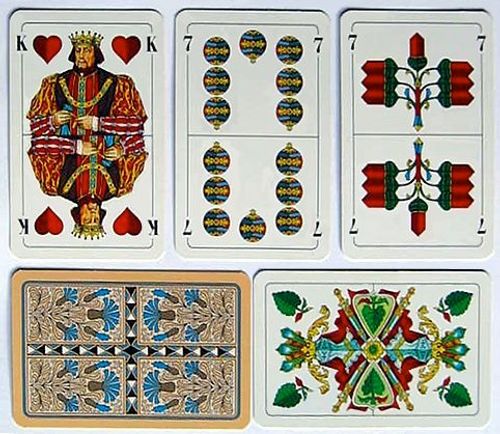
In Bavaria, Watten is played with 32 Schafkopf cards, with the four Sixes removed. The Bells-Seven (Schell-Siebener) takes the function of the Belli, which in original Wattn is the Bells-Six.
Usually Wattn is played by four, and the two people sitting opposite each other (crosswise) form a team. Either the players are used to one another and always play in the same team, or they "lift together" (zusammen heben): each player lifts a card from the deck and shows it. The players whose drawn cards are closest to each other form a team. Whoever also drew the highest card starts dealing.
After shuffling, the whole deck is presented to the player sitting to the right of the dealer, who may cut it. After that, the remaining pack plays no further role in this round.
Dealing
Cards are dealt clockwise, and of the 32 cards only 5 are dealt to each player. If one or two "Kritische" were taken from the cut pile by the cutter or the dealer, that person is dealt only the missing cards, until he has 5 cards in front of him.
Normally, in the first dealing round 3 cards are given to each player and in the second 2, until every player has 5 cards in front of him. Every player must leave the cards lying in front of him.
Announcing
The dealer and the player to the dealer's left (called the Vorderhand) may look at their cards first, in order to announce the game. The Vorderhand determines the Schlag (the "hit" rank), the dealer determines the Trumpf (trump suit), the cards that are valid in this round. Once the Haube is named, the remaining players may also pick up their cards. Now the point is to signal one's own cards to one's partner as quickly and inconspicuously as possible, while at the same time noticing what the opposing team is signalling to each other.
Play
The Vorderhand begins the game by playing the first card. If the Haube is led first, every player is obliged to follow with Trumpf, without the possibility of trumping. The Haube can only be trumped by one of the Kritische, which one may play in place of a Trumpf if one has one.
Otherwise, in every round the following order of tricks applies:
- The announced Trumpf beats all remaining cards;
- The announced Schlag beats the announced Trumpf and all lower cards;
- Haube beats Schlag and all lower cards;
- Spitz beats Haube and all lower cards;
- Belle beats Spitz and all cards below it;
- Max beats Belle and all cards below it.
Each round lasts until all 5 cards in the hand have been played. Once every player has played a card in the round, the one who played the highest card has won a trick. This player or his teammate then collects the trick. Whoever has won the most tricks (usually 3) has won the round. On request, the trick of the preceding round may be inspected again by all players until the next trick has been made.
Scoring
For each normally won round, the winning team may write down 2 points. If a round is "ausgeschafft", the winning team writes down 3 points.
The score is kept on a board (usually a slate). The board is divided vertically into two halves, and each team notes its score on its own side.
The team that first reaches 15 points has won the game. The team that first reaches 12 points, and is therefore close to winning, is "gespannt" (tense) and may no longer "ausschaffen", otherwise it is penalized. Fairly, it marks this by drawing a line lengthwise through the points written on its side of the board.
Each won game is recorded with short strokes at the edge of the board. The length of play is unlimited, until a player no longer feels like playing or the pub closes.
Variations
Watten is not a points or "eyes" game, but a trick-taking game. It is not strictly regulated, and announcements are customary. Because of the many variations of Watten, it is hard to set down general, binding rules. These can vary in small details from place to place and from inn to inn. If you are new to a group, you should ask about the rules before the first game.
Nevertheless, uniform basic rules apply to this game as well. A peculiarity is that in Watten it is allowed to tell one's partner the nature of one's hand by signs. In general one may speak almost without restriction. Whether it is true or untrue often becomes apparent only in the course of the game.
The document describes only the "Kritisches Watten" played by its author. Other Watten games it names are: Watten, Viererwatten, Watten zu dritt, Stichwatten, Blindes Watten, Ladinisch-Watten, Watten mit Ultimo, Bettler and Durchmarsch.
Tournament Rules
The following rules apply at the annual tournament:
- The teams playing against each other are determined by lot.
- The names, starting number and table number are to be entered on the list.
- The list must be written clearly, so that the lists can be checked exactly.
- Each pair keeps its own score. After the cut, nothing may be written any more.
- The tension line (Spannungsstrich) is to be drawn next to the numbers, so that the sum is easy to check.
- There are 3 rounds of 3 games each, played to 15 points. After every round the draw is made anew.
- Points are distributed as follows: a won game (whoever first has 15 points) counts 20 points. In one round a pair can therefore reach a maximum of 3x20 points. Whoever has the most points at the end is the winner.
- Partners always stay the same; only the opponent is drawn by lot.
- The first game is always dealt by the team with the higher starting number.
- Watten is played strictly. The partner may look at his cards only after the announcing.
- The deck may be cut only once.
- First 3, then 2 cards are dealt.
- After the deal, no further card may be looked at, and the top card (Deckblatt) must be laid face up.
- For a misdeal (Vergeben), the opponent gets 2 points. A wrong number of cards must be reported immediately.
- If a team overbids (überreizt sich), the opponent writes 2 points.
- Points are only written, not penalized.
- Being "gespannt" is at the same time being "ausgeschafft".
- "Kritische" may be used to announce Schlag and suit.
- If a "Kritischer" is played as the main Schlag (Hauptschlag), it cannot be trumped by a smaller "Kritischer".