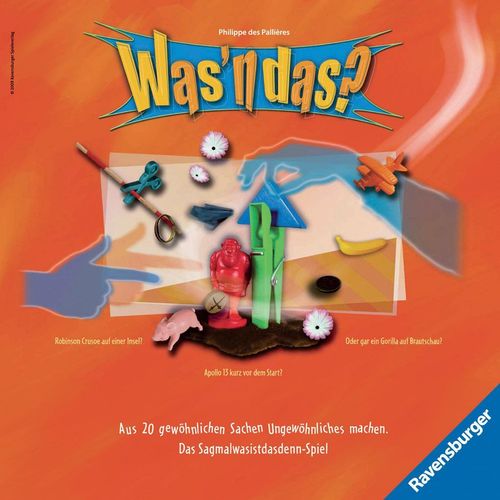
Was'n das?
Was'n das? Rulebook
Table of Contents
Table of Contents
- Principle of the Game
- Objective
- Game Material
- Game Setup
- Course of Play
- 1 — Selection and Reading of a Situation
- 2 — Mandatory, Secret Choice of One of the 6 Propositions
- 3 — Building the "Message" with the Objects
- 4 — Bets and Guesses from the Other Players
- 5 — Resolving the Bets, Tallying Points, and Moving the "Score" Pawns
- 6 — Preparing the Next Round
- Landing on One of the 3 "Special Spaces"
- End of Game
- List of "Special Space" Tiles
Principle of the Game
On their turn, each player must make the others understand a sentence, a word, or a concept, chosen from among 6 possibilities. To do this, they will have 13 objects at their disposal. It is the careful choice of these objects, and their position relative to one another, that gives meaning and allows communication between players.
Those whose role is to "guess" must react as quickly as possible by betting on one of the 6 possibilities on offer.
Players score points either because they won their bet, or because they were good "senders" and managed to make themselves understood by the greatest number of players.
Objective
Reach the finish space, after one full circuit of the board, or otherwise travel the greatest possible distance around the track, once the 18th and last card has been played.
Game Material
- A circular board of 40 spaces, used to mark the players' scores. 3 "special" spaces on the 14th, 23rd, and 33rd spaces.
- A deck of 55 "Vote" cards (9 packs of 6 cards in distinct colors, numbered 1 to 6, plus 1 "What do you think?" card, used to receive the bets).
- 200 "Situation" cards: stories, word choices, and so on, each offering 6 possibilities.
- 13 objects: a clothespin, a pair of doll's legs, a small board, a pebble, a feather, a figurine, an insect, a wooden pawn, a rubber band, a ball, a ring, a toothbrush, and a token.
- 9 "score" pawns, used to mark each player's progress on the board.
- 7 "special space" tiles.
Game Setup
- Unfold the board at the center of the playing table.
- Place all the objects at the center of the board.
- Separate the numbered cards and sort them by color. Each player receives one pack of 6 cards in the color of their choice. These cards are placed in front of each player, face down. The remaining cards are permanently removed from the game.
- Each player receives a "score" pawn in the same color as their cards and places it on the start space of the board.
- Draw 3 "special space" tiles at random and place them face down on the 3 special spaces on the board (one tile per space).
- The "What do you think?" card is placed on the inner edge of the board, in front of the first player (the sender) — see figure 2.
- Draw 18 "Situation" cards at random from among the 200 available. The game ends once the 18th card has been played (or once a player has managed to make a full circuit of the board).
- The players choose who will start the game in the role of sender.
- The objects must be set down. They may also be stacked, piled up, or wedged into one another — but in that case, they must stand on their own, without the sender having to hold them in place with their hands.
- It is forbidden to move, shift, or jiggle the objects, for instance to indicate a notion of speed or movement.
- It is forbidden for the sender to speak, sing, or give any other form of verbal or vocal clue.
- It is forbidden to attempt to represent letters of the alphabet or numerals.
Apart from these few restrictions, anything is possible!
- In particular, the other players may ask for the card and the 6 possibilities to be read again.
- They may also move this card, to read the text on it more conveniently.
- When the sender judges that they have finished, they announce this verbally to the other players.
Course of Play
A game of Objets trouvés is made up of 18 rounds.
A round always follows the same 6 steps:
- Selection and reading of a situation by the sender.
- Mandatory, secret choice of one of the 6 propositions.
- Building the "message" with the objects.
- Bets and guesses from the other players.
- Resolving the bets, tallying points, and moving the "score" pawns.
- Preparing the next round.
The role of sender passes from player to player, clockwise, in turn.
1 — Selection and Reading of a Situation
- The sender draws a "Situation" card.
- When all players are ready, the sender reads this situation aloud.
For example, the card "It's snack time":
- The hen pecks at grain,
- the cow grazes on grass,
- the frog gobbles up insects,
- the dog savors a bone,
- the cat brings back a mouse,
- the pig gorges itself on anything at all.
2 — Mandatory, Secret Choice of One of the 6 Propositions
One of the players takes the sender's 6 "Vote" cards, shuffles them carefully, and has the sender draw one of them.
The sender secretly looks at the number shown on the card they have drawn.
This number indicates which of the 6 propositions they will have to illustrate using the objects.
Example: their card shows the number 3. They will have to illustrate the proposition "The frog gobbles up insects." Once they have looked at the card, they place it face down, near the "What do you think?" card but outside the circle.
3 — Building the "Message" with the Objects
The sender chooses the objects with which they intend to make the others discover the sentence "The frog gobbles up insects."
- There is no limit to the number of objects they may use.
- There is also no time limit (though, as we will see below, time is a factor worth taking into account).
4 — Bets and Guesses from the Other Players
While the sender is arranging their objects, the other players may place their bets at any time.
It is important to place a bet as quickly as possible, and if possible before the others, because the value of the points earned decreases the longer one takes to commit to a guess.
How to place a bet
- Players hold in hand their 6 cards numbered 1 to 6. These numbers represent the 6 propositions announced by the sender.
- As soon as a player thinks they have understood which proposition the sender is trying to represent, they may set down the card whose number matches their supposed choice.
- The bet cards are placed, face down, on the "What do you think?" card.
- The following players place their "Vote" card on top of the one(s) already placed, and so on until the last player.
If a bet succeeds, the card closest to the "What do you think?" card — that is, the one placed first — wins the maximum number of points.
- A "Vote" card that has been placed can no longer be taken back.
- "Vote" cards must be placed face down.
Once the last player has placed their "Vote" card, the sender covers the pile with the card of their own color bearing the number of the proposition they illustrated. When this phase of the game ends, points are tallied.
5 — Resolving the Bets, Tallying Points, and Moving the "Score" Pawns
The sender turns over their own card, revealing the number of the choice they sought to represent.
Then, starting from the top of the pile, they turn over the "Vote" cards played by their opponents one by one.
Points earned by the players:
- The first card turned over is worth 1 point:
- if the player guessed wrong, they move their pawn back 1 space;
- if the player made the right choice, they move their pawn forward 1 space.
- The second card turned over is worth 2 points:
- if the player guessed wrong, they move their pawn back 2 spaces;
- if the player made the right choice, they move their pawn forward 2 spaces.
- The third card turned over is worth 3 points:
- if the player guessed wrong, they move their pawn back 3 spaces;
- if the player made the right choice, they move their pawn forward 3 spaces.
- And so on.
Careful: a pawn can never move back past the start space.
Points earned by the sender
The sender moves forward as many spaces as the number of players who won their bet.
Example: in a 9-player game, if 6 players won their bet, the sender moves their pawn forward 6 spaces.
6 — Preparing the Next Round
- The players collect their respective cards.
- The objects are gathered back up.
- The player seated to the left of the previous sender becomes the new sender.
- A new round may begin.
Landing on One of the 3 "Special Spaces"
There are 3 special spaces on the board, on which, at the start of the game, the players placed 3 tiles face down (one per space).
As soon as a player's pawn reaches or passes one of these spaces, they turn the tile over and apply the instruction shown on it, then discard the tile. From then on, the space that held the special tile is treated as a normal space.
End of Game
The game stops once the 18th card has been played. A winner may, however, be declared earlier: the first player to reach the finish space.
- Otherwise, the winner is the player in the lead after the 18th "Situation" card has been played.
- In case of a tie, the players may agree to play an additional round.
List of "Special Space" Tiles
- Remove 1 object from the game and replace it with 1 object found in the room where you are playing.
- Remove 2 objects from the game and replace them with 2 objects found in the room where you are playing.
- Remove 3 objects from the game and replace them with 3 objects found in the room where you are playing.
- Remove 3 objects from the game and replace them with 3 personal objects carried in your pockets, on your person, or in your bag.
- Remove up to 3 wooden objects (if any remain in the game) and replace them with as many objects found in the room where you are playing.
- Remove up to 3 red objects (if any remain in the game) and replace them with as many personal objects carried in your pockets, on your person, or in your bag.
- Remove the doll's legs, the insect, and the figurine (if they remain in the game) and replace them with as many objects found in the room where you are playing.