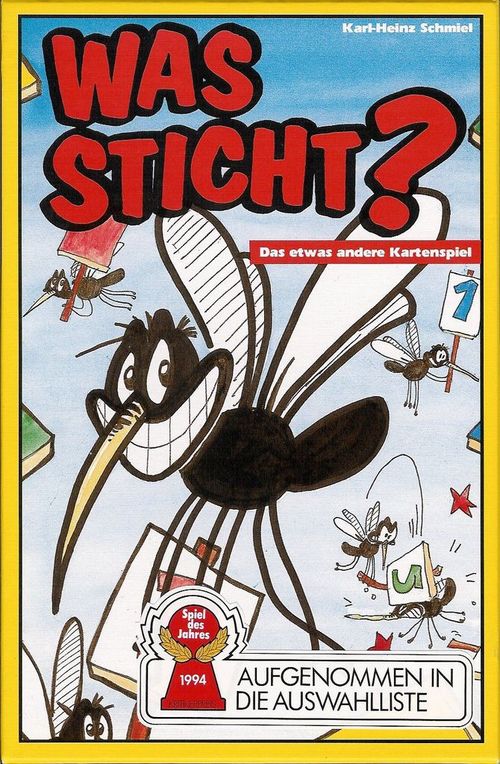
Was sticht?
Was sticht? Rulebook
Table of Contents
Table of Contents
Components
- 36 playing cards comprising cards from 1-9 in four colors.
- 5 trump suit cards: 4 cards showing the colors of the four suits plus one "No Trump" (keine Trumpffarbe) card.
- 10 trump number cards: 9 cards with the numbers from 1 to 9 plus one "No trump number" (keine Trumpfzahl) card.
- 24 task chips. These need to be separated before play.
- 1 wooden place marker.
- 1 set of rules.
There are also 4 blank cards, necessary as part of the manufacturing process; these are not used in the game.
Preparation
A dealer is chosen, using whatever method you prefer. The task chips are laid out face upwards on the table and the dealer chooses one. Players follow in a clockwise direction until each player has 5 chips. The remaining chips are replaced in the box. The task chips determine what task a player must carry out in that round. The exact meaning of each chip is given at the end of these rules. In the corner of each chip is a number. These give an idea of the relative difficulty of the various tasks. The higher the number, the harder the task is to complete. The numbers also act as a tie-splitting device should several players go out in the same round.
Play of the Game
The game consists of several separate rounds. The game continues until a player has completed all his tasks. Each round consists of the following phases.
Drawing Cards — The dealer lays out the cards face up and the players take turns to choose which cards they want.
Determining Tasks — Once the trump number and suit are determined, each player chooses one of their task chips.
The Trick Game — Now the cards can be trumped. The cards are played out in 9 tricks, and the players try to succeed in their tasks.
End of Round — Once all the cards have been played, the round ends. Successfully completed task chips are laid to one side and the next player in a clockwise direction becomes the dealer for the next round.
Choosing Cards
As we have already said, the players are allowed to choose their own cards. But watch out! Only the dealer knows what trumps are in this round. The other players must first deduce which suit and number are trumps.
The dealer takes the 36 playing cards, the 5 trump color cards, and the 10 trump number cards and shuffles the three decks separately. The dealer then looks secretly at the bottom card of the trump color and trump number decks. These two cards determine the trumps for the next round. The trump numbers rank higher than the trump suit. If the bottom card is "no trump suit" (keine Trumpffarbe) or "no trump number" (kein Trumpfnummer) then there is no trump suit and/or trump number in that round. (An example of the trump order is given in the Trick Game section below.)
Now the dealer lays out the cards in 4 rows of nine cards each.
The player to the dealer's left takes the wooden place marker. They then choose one card from the leftmost column of four cards. The other players in turn each choose a card from this column. Once the cards from the first column have been taken, the dealer gives a clue as to trumps. The four cards are treated as if they made up one trick, and the dealer must say which player would have won this "trick." Naturally he must take into consideration which cards, if any, in the trick are trumps. The other players must use these clues to discover as quickly as possible what the trumps are for the round. Then the wooden place marker is passed to the next player in clockwise order and they choose a card from the second column, followed by the other three players. Once again the dealer must say who would have won the trick. These actions are repeated until all the cards have been taken.
Example
The trump suit is Red and the trump number 2. Player A has the wooden marker, Player C is the dealer in this round and so knows what trumps are.
The cards are Red 3, Blue 7, Red 6, Yellow 2.
- Player A takes the Blue 7. He has no idea what trumps are, and so decides to take the highest numbered card.
- Player B takes the Red 6. He has already worked out the trump color, and so takes the highest card in that suit. He doesn't yet know what number is trumps.
- Player C takes the Yellow 2. Being dealer he knows both trump number and suit, and so realizes that the yellow 2 is a higher card than the two red cards. (Trump numbers rank higher than trump suits.)
- Player D must take the Red 3, because it is the only card left.
Player C now announces that Player A led and that he (Player C) would have taken the trick. He does not need to say anything more. In particular he should avoid comments like "I won because it was the trump number." The longer that the dealer can keep the other players in the dark about the trump suit and number, the better it is for him.
Once all the cards have been taken, the dealer turns over the trump suit and trump number decks, to show all players which suit and number cards are trumps.
Determining Tasks
Each player, with the exception of the dealer, now chooses one of their task chips: the one that they think they are most likely to manage in this round. They keep this secret until all three players have chosen. Then, all chips are turned face upwards. Chips may only be discarded if the tasks are correctly carried out.
The dealer doesn't choose a chip. Instead they must attempt to succeed in carrying out one of the three tasks chosen by the other players. If they manage this, then they may discard any of their own chips. However, they may only do this if the player whose task they have chosen fails to carry it out. If both the dealer and the player manage the task, then the player may discard the chip but the dealer may not.
The dealer therefore decides which of the three tasks available they will choose, but they need not declare this, and it may be that they will need to change their objective during the course of the round.
The Trick Game
Now you can get trumping. The rules are the same as most trick-taking games, for example Skat. The exact rules are as follows.
- The player to the dealer's left leads to the first trick.
- Each player plays a card in turn, in clockwise order.
- Players must follow the suit led where possible.
- The suit led is high; it can only be beaten by a higher card in the same suit or by a trump.
- If a trump is led, then other players must follow where possible. This is true both for the trump suit and for the trump number. If the trumps are red 3, for example, a lead of a red card means that the following players must, if possible, play either a red card or a 3. If a 3 is led in another suit, it still counts as a trump, and the following players must again, if they have one, play either a red card or a 3.
- Where a player cannot follow suit, they need not play a trump if they choose not to.
- The player who wins the trick leads to the next trick.
Trumps are cards of the trump suit and number trumps. Number trumps outrank suit trumps. The highest number trump is the number trump of the trump suit. This "supertrump" outranks all other cards. The other number trumps are all of equal value. If two or more are played in one trick, the first played wins the trick.
Example
The ranking of the trumps: trump suit Red, trump number 5.
- Red 5 (Supertrump)
- Blue/Green/Yellow 5 (first played in a suit wins)
- Red 9
- Red 8
- Red 7
- Red 6
- Red 4
- Red 3
- Red 2
- Red 1
If the trumps were Trump Number 5, No Trump Suit, then the 4 number 5 cards would be the only trumps. If the trumps were Trump Suit Red, No Trump Number, then the only trumps would be the red cards from 9 down to 1.
End of Round
At the end of each round, players who have correctly carried out their task discard their chip. The discarded chips should be put somewhere visible, so that the players can see how well each is doing. The dealer may only discard a chip if they have succeeded in carrying out a task that the player who played the chip has failed in (see Determining Tasks, above).
After each round the post of dealer passes one player to the left so that all the players can enjoy the power of knowing what trumps are in turn. All other positions change along with the dealer, i.e. the player to the left of the new dealer leads to the first trick.
Game End
The game ends as soon as one player has carried out all his tasks and so discards his last chip. This player wins. If two or more players discard their last chip in the same round, the winner is the player who has discarded chips of the highest value (the point values in the corner of each chip are added together for each player). In this case, positions are decided purely by the value of the discarded chips. The number of discarded chips is irrelevant to these positions.
Special Rules for 3-Player Games
The rules for 3-player games are largely the same as for 4 players. Only in Choosing Cards (above) do they differ slightly: in this case the "Table" plays as a dummy player.
The cards are laid out in 4 rows of 9 cards as usual. The 3 players each choose a card from the first column as usual. The fourth card is then laid to one side. This is repeated for each column until all cards have been taken. The 9 cards that the "Table" has taken are then put away, and play no further part in the round.
In the 3-player game, the given point values for the various tasks are not quite accurate. Some tasks are easier than in a 4-player game, some more difficult. Players should bear this in mind when choosing their tasks.
Meanings of the Task Chips
Keine Stich — The player may not win a single trick in this round.
Keine Roten Karten — The player may not take any red cards in this round. They may win tricks, but winning any trick containing a red card means failing to fulfil their task. The same applies for the other colored-card chips: Keine Grüne Karten (No Greens), Keine Gelbe Karten (No Yellows), Keine Blaue Karten (No Blues).
Genau 1 Stich — The player must take exactly 1 trick in this round. If they take more or less, then they have not managed their task. The same goes for Genau 2 Stich, etc.
Den letzten Stich — The player must take the last trick. All other tricks are irrelevant, and may be taken or not as wished.
Die meisten Stich — The player must make more tricks than any other player. If another player makes more or an equal number of tricks, then they have not succeeded.
Die wenigsten Stich — The player must make fewer tricks than any other player. If another player makes fewer tricks or an equal number, then this task has not been correctly carried out.