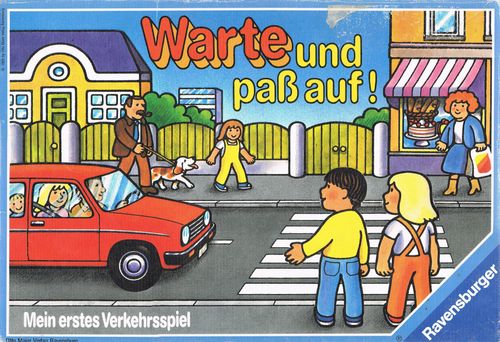
Warte und pass auf!
Warte und pass auf! Rulebook
Table of Contents
Table of Contents
Components
- 1 double-sided game board (one side without zebra crossings, one side with zebra crossings)
- 1 die
- 4 game figures
- 2 cars
- 1 rulebook
Game Play
Object of the Game
Players must get from home to a specific destination (for example the baker, the playground, or the kindergarten) on the other side of the street. Traffic rules for pedestrians must be observed along the way. The starting point (home) has the same color as the destination.
Setup
Each player chooses a figure and places it on the starting space of the same color (the front door of the home). The two cars are placed at the left and right edges of the board, facing in the direction of travel.
Figure 1: Starting position. The cars stand, facing their direction of travel, on the black arrows at the edge of the board.
Traffic Education Suggestions
- Tell me: when are you on the sidewalk?
- Do you have to cross the roadway?
- What do you have to watch out for?
- Distinguish between the roadway and the sidewalk! The sidewalk is for pedestrians. The roadway is for cars.
- The curb is the boundary.
- Show everything on the game board!
Rules for the Board Without Zebra Crossings
On the Sidewalk
Each player rolls the die once. The player with the most points begins. Players then roll in turn. The player moves their figure toward the destination by the number rolled. Other figures may be jumped over, and the space they occupy still counts.
If a player lands exactly on a space already occupied by another figure, they must stop their figure one space earlier. The surplus pip is forfeited.
Traffic education notes:
- Walk on the inside of the sidewalk. You are safe there. The roadway and the cars are farther away.
- If you meet other pedestrians, you must not bump into them.
Moving the Cars
If a car is rolled, the player must move both cars to the next black arrow. If the cars have already reached the end of the roadway, the player places them on the arrow on the other side of the street.
(The German text reads "schwarzen Reit" here, evidently a misprint for "schwarzen Pfeil" (black arrow), which is what the zebra-crossing section prints. It is translated as "black arrow".)
Figure 2: Placing the cars on the other side of the roadway.
Crossing the Roadway
First, players move their figure onto one of the two red waiting boxes on their own side of the sidewalk. The figures must stop there and wait until their next roll. The waiting boxes count when rolling, but a player does not need to land on them with an exact number. Surplus pips are forfeited. Two figures may stand in a waiting box at the same time.
Traffic education notes:
- Where do you usually cross the roadway? You can also chalk a waiting box on the curb there.
- You must always stop at the curb.
- Look left. Is a car coming? Look right. Is a car coming from that side?
- Wait and watch out!
- Only when the way is clear, walk briskly across the roadway. Do not run.
- Is a car standing at the edge of the roadway? Do you have to cross there? Is there not a clear spot nearby?
- If there is no other way, go forward until you can see the roadway (line of sight)*. Wait there and watch out! Look whether cars are coming. Only when the roadway is clear may you cross.
- Also pay attention to whether a driver is about to pull away. Can they see you? They could also be reversing.
- Stepping out between parked cars is very dangerous and should be forbidden for younger children. Because it does happen in real traffic, for example on completely parked-up streets, it must be discussed and practiced with older children with particular care. Stop at the line of sight! Children tend to dash out suddenly in exactly this situation.
- At a construction site you must be especially careful. You must not continue walking on the roadway.
- If pedestrians come toward you and there is not room for everyone on the sidewalk, wait.
When it is the player's turn to roll again, there are three options:
- The player rolls a number and may cross the roadway if no cars are coming (both cars are seen from behind).
- The player rolls a number and may not cross the roadway if cars are coming toward them (both cars are seen from the front). The pips are forfeited.
- The player rolls a car and may only move the two cars one arrow further.
Crossing the roadway counts as one pip. The remaining pips may be used to move toward the destination on the other sidewalk.
(The printed rulebook marks "line of sight" with an asterisk, but no footnote for it is printed.)
Rules for the Board With Zebra Crossings
On the Sidewalk
There is a construction site on each sidewalk. Only one figure can pass this construction site at a time. If two figures approach it from opposite directions, the figure that arrives later must wait in a waiting box until the way is clear.
Moving the Cars
If a car is rolled, the player must move both cars to the next black arrow. This does not apply if figures are standing in a waiting box at the zebra crossing. In that case the cars may only be driven up to the red line.
There the cars must wait until no figure is standing at the zebra crossing any more. A player who rolls a car while figures are still in a waiting box at the zebra crossing cannot move. The next player is up.
Crossing the Roadway
The roadway may only be crossed on the zebra crossing. Even at the zebra crossing, the player's figure must wait in a waiting box. When it is the player's turn to roll again, there are again three options:
- The player rolls a number and may cross the roadway if the cars at the zebra crossing are stopped at the red line, or if the cars have passed (they are seen from behind).
- The player rolls a number and may not cross the roadway if cars are approaching the zebra crossing and have not yet stopped at the red line.
- The player rolls a car and may only move the two cars.
Traffic education notes:
- You must also stop and wait at the zebra crossing. Some drivers do not stop.
- Look carefully.
- Does the driver see you? Do they stop their car? Do they even give you a sign?
- Does the driver on the other side also stop?
- Are the cars standing still? Only now may you walk.
- Look left and right again in the middle.
End of the Game
In this age group the main interest lies in reaching the destination. When all children have reached their destination, the game is over. The winner is the player who reaches their destination first.