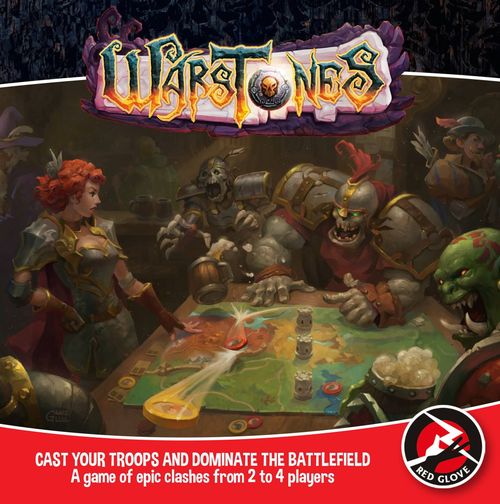
Warstones
Warstones Rulebook
Table of Contents
Table of Contents
Game Components
- 2 sets of 15 Units (chips) each
- 14 Unit cards (7 per faction)
- 12 City tokens (4 for the central Fortress, 8 for the peripheral ones)
- 2 action-counter tokens
- 1 Battle Scenario (90x90 cm)
- 3 Fortresses
- 1 "First player" marker
- 1 Battlefield cloth
- This rulebook
The battlefield comprises a play area divided into 9 "sectors", of which the 3 central, smaller sectors contain in their centre 3 "City spaces". The 3 Fortresses are fixed on these spaces.
Outside the play area (but still on the board) are six player "Bases" (two of them - the central ones - are used in 2-player games, while the other 4 - the side ones - are used in 4-player games) and two "Reserve" areas. Beside the Bases are four "action-counter" tracks.
Setup
Each player chooses a faction among those available in the base set. For each faction, units are available in the form of chips, accompanied by cards that describe the type of unit, its Army Points, its Recruitment cost and its Strength - the last two pieces of information are also printed on the chips themselves.
The players agree on which scenario to play and on the number of Army Points each will use to build their army. We suggest 200 points for a quick game, 300 for a standard game, 400 or more for an epic game. Each player then builds their army by enlisting units according to the following rules:
- it must include a Commander (and only one);
- at least half of the Army Points must be spent on Basic units (with a tolerance of 5 points).
The units chosen by each player are then placed in their own Reserve. The players also take the cards corresponding to the chosen units and lay them face up outside the game board; these cards, as already said, serve only as a reminder of abilities and costs. Finally, the players take 1 "action-counter" token and place it on space "5" of the track closest to them.
Who plays first is determined randomly; that player takes the First Player marker.
The City tokens are shuffled and then stacked face down, then 3 tokens are drawn at random and placed on top of the Fortresses. Alternatively, you can use the City tokens specific to the central Fortress (for it only) and those of the side Fortresses for the others (again after shuffling them randomly, in this case in two separate piles).
How to Play
The game is divided into Rounds in each of which the players, starting from the first and alternating, spend a total of 5 action points each, performing the moves they wish. The action-counter tokens are used to keep track of how many actions each player has already taken.
On their turn, the player can choose among the following moves:
- recruit (variable action cost);
- deploy (1 action point);
- attack (1 action point);
- besiege a city (1 action point);
- use a unit's ability (variable);
- move (3 action points).
It is also possible to choose to pass, giving up making a move. In that case all remaining action points are lost.
When both players have finished their action points, the Round ends and a new one begins. The First Player marker is passed to the player who did not have it (in a four-player game, to the next player in turn order).
Definition: "Flick". In this rulebook, "performing a Flick" means giving a small tap with the index finger to one of your own chips (units), so as to deploy or move the unit on the board.
Recruit (variable action cost)
The player chooses a unit from the Reserve and places it in their own Base. This action costs a number of action points equal to the unit's Recruitment cost (shown on the left in the illustration on the unit and on its associated card). The maximum number of units in your Base at the same time is 5; if it is reached, no more units can be recruited.
Note: if, because of a game effect, units are added to a player's Base in a quantity exceeding the limit of 5, some of them must return to that player's Reserve (their choice).
Deploy (1 action point; some units may have abilities able to change this value)
The player may freely move and reposition the selected unit inside their own Base, without ever crossing the edges of the half-moon drawn on the board; then, with a tap of the finger, they perform a Flick, that is, bring it into play, deploying it.
If, following a Flick, the unit ends its course outside the board, it is placed in the player's Reserve.
Likewise, if the unit hits and moves a unit belonging to its own faction, making it end outside the board, that unit is placed in the player's Reserve.
If instead the unit hits and moves an opposing unit, making the latter end outside the board, the ejected unit is placed in the opposing player's Base.
Units and Sectors
It may happen that a unit is "straddling" two or more sectors. The unit is considered to belong to the sector in which most of its chip rests. In case of doubt, it is considered to belong to the sector farthest from its starting Base.
Advanced Rule: Terrains
On the board there are some graphically delimited areas that represent special terrains. In the base set the following special terrains exist: Forest, Hill, Lake/River, Swamp. The remaining terrain is considered Plain and has no effect on the game.
- If a unit is in a Lake/River, its Strength is reduced by 1.
- If a unit is in a Swamp, the cost of performing a Move action on that unit is increased by 1 action point.
- If a unit is in a Forest, it can be attacked only by units within its same Sector.
- If a unit is on a Hill, the cost of performing a Move action on that unit is decreased by 1 action point.
A unit is considered to be on a type of terrain if more than half of its chip is inside that terrain. In case of doubt, it is considered to be outside the terrain.
Attack (1 action point)
An attack can take place in any sector in which the attacking player has at least one of their own units and at least one opposing unit is present.
The total Strength points of the attacking player's units are added up, and from this the sum of the total Strength points of the attacked player's units is subtracted; the difference is the damage that the attacker can inflict, as they choose, among the attacked player's units. Units that suffer damage equal to or greater than their own Strength are removed from the game.
Besiege a City (1 action point)
A siege can take place in any City sector in which the besieging player has at least one of their own units present.
The total Strength points of the besieging player's units are added up: if the total is equal to or greater than the City's Defence value (the 'Shield' symbol), the City is conquered. The player takes the City token, gaining its victory points.
At this point the opposing player assigns damage equal to the City's Counterattack value (the 'Sword' symbol) to the besieging player's units, distributing it as they prefer. In any case, at least one unit must always be destroyed* (even if the damage would not be enough to destroy any).
Any surviving units of the besieging player return to their Base.
For each opposing unit present in the sector where a siege took place, the player who controls it may choose whether to leave it where it is or bring it back to their own Base.
Finally, a new City token is drawn from the pile and replaces the previous one.
It is also possible to besiege when the total Strength points of the besieging player's units are lower than the City's Defence value. In that case the damage from the Counterattack is still assigned, but the City token will not be conquered by the player.
* If units that can besiege from one or more sectors away also take part in the siege, these can be destroyed only after destroying the unit or units located in the sector of the besieged City.
Use a Unit's Ability (variable)
Some units have abilities that are activated at the cost of a variable number of action points shown on the Faction card of that unit. Refer to the Faction cards for a description of these abilities.
Move (3 action points)
The player may perform a Flick on any of their own units already deployed on the board, at the cost of 3 action points. If chips leave the board, the normal rules described above apply.
Rounds, Moves and Action Points
The players alternate their moves as long as they have action points available. However, the strategy adopted and the variable use of action points often lead to asymmetries in the number of moves available; in that case the player who has used up their action points cannot make further moves during the current Round and must wait for the opponent to finish their own available action points in turn.
Example: Billy begins a new turn and chooses to deploy a Soldier (1 action point); Jimmy instead chooses to deploy his commander, a Vampire (4 action points); Billy deploys another Soldier (1 action point); Jimmy performs a Flick on the Vampire, deploying it on the board. At this point Jimmy has finished all his action points and Billy can make other moves consecutively until he has used up his remaining 3 action points.
Damage and Destruction of Units
Following an attack or a City's Counterattack, damage is always assigned all together and simultaneously.
A unit's Strength score determines at the same time its strength and its resistance. Consequently, to destroy a unit it is necessary to assign it damage equal to its Strength value. If the damage assigned is not enough to destroy it, it is lost.
Example: Jimmy besieges a City with two Returning Skeletons (Strength 2). The City has Defence 2 and Counterattack 3. Jimmy conquers the City and Billy inflicts 2 damage on one of the two Returning Skeletons, destroying it. The single remaining damage is lost, as it is insufficient to destroy the second Returning Skeleton.
End of the Game
As soon as a player possesses Cities for the total of victory points required, that player is immediately declared the winner of the game.
The number of victory points needed depends on the size of the armies employed, according to the following table:
| Army | Victory points needed |
|---|---|
| 150 points (demo) | 4 |
| 200 points (quick game) | 5 |
| 300 points (standard game) | 7 |
| 400+ points (epic game) | 9 |
In the circumstance (possible in particular in demo or quick games) in which both players find themselves with no units to recruit from the Reserve nor present in their Bases, the game ends and the winner is the one who has accumulated the most victory points. In case of a tie, the player who conquered the City with the highest single victory point score wins.
In case of a further tie, the player who lost fewer units during the game wins. If the tie continues... both players have shown a fighting spirit worthy of a fair draw!
3-Player Games
The rules do not differ from 2-player games except for the following points:
- a central Base and the two side Bases in front of it are used (those drawn with a dashed line);
- attacks are always made against the units of only one of the two opponents;
- players take their moves in clockwise order, with the First Player token passed clockwise.
4-Player Games
It is possible to play either free-for-all or in teams, 2 against 2. In both cases, the rules do not differ from 2-player games except for the following points:
- the central Bases are not used; instead the 4 side Bases (those drawn with a dashed line) are used;
- the order of play in taking actions is: player A, B, C, D (refer to the board diagram). The First Player token is passed following this order;
- in a 2-against-2 team game, allied players cannot attack each other, while they can use their ally's units for attack and siege actions (but not for recruiting, deploying or moving);
- the number of victory points needed by allied players to win equals that of the 2-player game plus 2 (for example, in a quick game in which each of the 4 players has a 200-point army, 7 points are needed to win).