Warp 6
Warp 6 Rulebook
Table of Contents
Table of Contents
Components
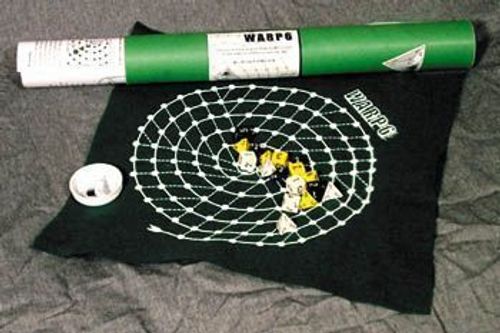
- Playing board with a hypermap of the surroundings of a black hole (cloth);
- 2 black eight-sided dice (d8);
- 3 black six-sided dice (d6);
- 4 black four-sided dice (d4);
- 2 white d8;
- 3 white d6;
- 4 white d4;
- 1 yellow d8;
- 2 yellow d6;
- 3 yellow d4;
- Rules.
Setup
Three players: each player chooses a color and takes 1 d8, 2 d6 and 3 d4. This gives each player 6 dice. The 3 black and 3 white dice left over are not used.
Two players: the players take all the black and white dice for themselves. Each of them thus has 9 dice of one color. The yellow dice are not used.
Starting the game: each player rolls all their dice. The player whose dice total the highest number starts on the hypermap; the other players follow clockwise in descending order of totals (to the left of that player). If two players roll the same total, they must keep rolling their dice until one of them wins.
Players then take turns placing their dice along the outer side of the spiral. These are your spaceships, which have arrived in the vicinity of the black hole. During the starting placement dice may not be turned over: they are placed on the board with exactly the face that came up when rolling for turn order.
Example of starting placement for three players
First the first player places any one of their dice at the start of the field (in the example, the black player), then the second (the white player), then the third (in the example, yellow). After that the first player places a die again, and so on.
Normal Engines
On your turn you move one of your dice along the solid line of the spiral counterclockwise. The number on the top face of the die is the number of moves the player may make along the spiral. In the example, a black d4 on the outer ring can make two moves, while the white d8 on the second ring has four moves available. When you use normal engines, the number on the die does not change.
Instead of moving a die, a player on their turn may change the number on any one of their dice by adding or subtracting one. For example, a "2" can be changed to a "1" or a "3". (A number cannot be changed beyond the range of the die, e.g. a d4 cannot be turned to a 5.)
Hyperjumps
When a die, having made its allotted moves, lands on an occupied space, it moves down (closer to the black hole) along the dotted line one step to the next inner circle. This is called a hyperjump. If that space is also occupied, the ship makes a hyperjump again, until it reaches a free space. The die that made the hyperjump is rolled when it reaches its final point of movement.
The number that comes up on it becomes the new number of moves available to that die.
In the example: the black d8 makes two moves, hyperjumps three moves down and is rolled again. The white d4, which stood one level lower, makes two moves, then hyperjumps one move down and is rolled again.
Victory
Any ship-die that reaches the center of the field, the black hole, is removed from the field. It does not matter how it got there: by making hyperjumps along the dotted lines or by moving along the spiral in the normal way. The number of moves remaining need not be exactly equal to what is needed to exit the game. For example, when 3 steps remain to the black hole, you may make 5 steps and fall into it.
When three players take part, the winner is the one who manages to remove 4 of their dice-ships from the field. In a game with two players, the winner is the one who first removes 6 of their ships from the field.
Example (white player): the white player can jump with the d8 into the black hole by using other dice as a chain for a hyperjump three levels toward the center. Or they can use the d4, which has enough moves to reach the goal.
On Strategy
The shortest path to the center is hyperjumps along the dotted lines. Any ship can go from the outer circle to the inner one by making one move if it uses a suitable chain of dice for the transition, so look for such an opportunity and do not let your opponent use a similar situation. Remember the number of dice you still need for the win, and plan your tactics so as to remove them from the field as quickly as possible.
Advanced Variant
If you want to make the game harder, place the dice not with a random value on the face (determined while rolling at the start of the game) but with the value you want. To do this, each player chooses the values on their dice themselves and does not show the others the result, until all players have done the same. After that the dice are revealed, and the result on them is used for the starting placement and for determining the first player in exactly the same way as if they had been rolled randomly.
Scoring
For a series of games, use a scoring system based on how far from the center the dice of the losing participant are.
In the example on the right, the black player became the winner of the game. The yellow player removed three ships from the game (one remains, which needs to reach the center), and the white player removed two (two more remain that need to reach the center).
To count points, count how many rings lie between the center of the black hole and the ships that still needed to be removed.
For example, in the picture below the yellow player has one ship left to remove, so we simply count the rings up to it. It is on the fourth ring of the spiral from the center, and therefore the player gets 4 points. The white player removed two ships and still has two to remove: count the number of spiral rings to the second ship from the center. The second ship is on the third ring, and the player gets 3 points.
In total the white player gets 3 points, and yellow gets 4 points. The black player gets 0 points. The player who has the fewest points over the series of games becomes the winner.