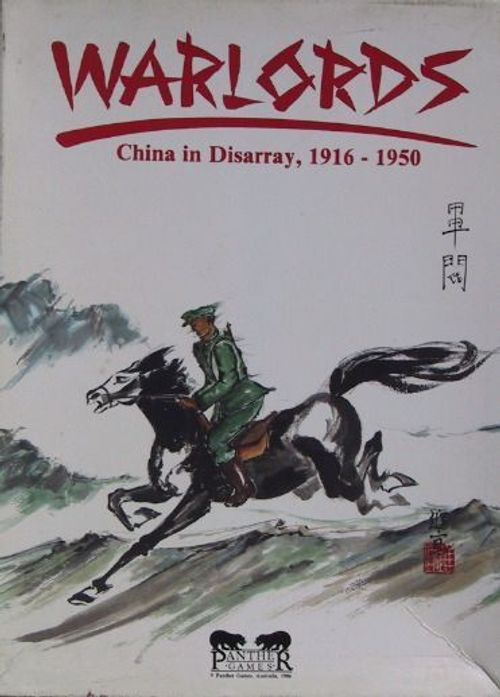
Warlords: China in Disarray, 1916-1950
Warlords: China in Disarray, 1916-1950 Rulebook
Table of Contents
Table of Contents
- 1. Introduction
- 2. Game Components
- 3. Armies
- 4. Sequence of Play
- 5. Political System
- 6. Famine
- 7. Revolts
- 8. Revenue and Production
- 9. Events
- 10. Initiative
- 11. Supply
- 12. Movement
- 13. Combat
- 14. Guerrillas
- 15. Minor Warlords
- 16. Victory
- 17. Special Rules
- 18. Scenario Instructions
- Historical Background
- Design Notes
1. Introduction
1.1 General Description
Warlords is a fun game of political diplomacy and military expansion. Players take control of the principal warlord factions which vied for supremacy in post-Manchu China. With the ultimate objective of re-unifying/controlling China, players must wheel and deal, bribe, coerce, plot and fight their way to political, military and economic victory.
Warlords can be played by 3 - 7 players. It has three short scenarios and a 1926-1950 campaign game. To start with we recommend you skim the rules (ignoring Sections 14 and 17) and play the 1916-1925 scenario, which deals with the basics. Follow the sequence of play and refer back to the rules as required. Then have a go at the 1937-1950 scenario, the 1926-35 scenario and finally the campaign game.
1.2 Scale
Each year comprises a Cycle Turn and three Operations (OP) Turns. The areas on the map represent historical provinces. Each unit represents an army, to which strength factors (about 5 000 men) are assigned.
1.3 Requirements
You will need a flat surfaced playing area about 1m² (10 sq ft); pencils, paper and erasers to record each player's army strengths and resources and; an opaque cup for the province chits.
1.4 Abbreviations
| Abbreviation | Meaning |
|---|---|
| CCP | Chinese Communist Party |
| CER | Combat effectiveness rating |
| CRT | Combat Results Table |
| GA | Guerrilla army |
| KMT | Kuomintang (Nationalists) |
| MA | Movement allowance |
| MP | Movement point |
| OP | Operations (Phase/Segment) |
| PP | Political point |
| RP | Resource point |
| TEC | Terrain Effects Chart |
| VP | Victory point |
1.5 Definitions
Warlords. The commanders of major regional political/military forces who struggled to dominate China. There are two types, namely the principal factions and the minor warlords.
Factions. These are the principal power groups, comprising the four traditional warlords (Chang, Feng, Sun and Wu), who actually represent an association of clans like a cartel; the two political entities (KMT and CCP); and the Japanese.
Minor Warlords. These are the less powerful groups usually tied to their local region.
Controlled province. A province is controlled when a minor warlord or faction occupies (garrisons) it with one or more regular armies. A guerrilla army can never control a province. While the armies of more than one province may occupy or transit a province, only one faction or minor warlord can control a province at any given time.
Uncontrolled province. An unoccupied province or one occupied only by guerrillas is uncontrolled - see Section 15.4 for effect on creating minor warlords.
Rounding down. Where fractions are rounded to the next lowest number - eg. 3.6 becomes 3.
Rounding up. Where fractions are rounded to the next highest number - eg. 3.4 becomes 4.
Rounding off. Where fractions are rounded to the nearest number - eg. 3.4 becomes 3 and 3.5 becomes 4.
2. Game Components
2.1 General
Each game should consists of:
- one box
- one map
- one rules book
- two counter sheets
- one dice
- three ready reference cards
- one track display
If any of these components are missing or damaged please write, enclosing damaged parts to:
Panther Games PO Box 8 Hughes. ACT. 2605 Australia
2.2 Counters
There are two types of counters - armies and markers. Armies represent the forces of each faction and bear their faction's symbol and their individual designation. Faction armies use a large counter. Minor warlord and guerrilla armies use a smaller counter. Markers are used to record information or represent such things as capitals.
2.3 Map
The map depicts China during the first half of this century. Depicted in each province are two numbers indicating its resource and forage values - see map key. There is also a factory symbol in Liaoning province, which has a special effect - see Section 17.6.
The terrain in all provinces is open unless indicated as rough. The borders between some provinces are depicted as mountainous. Refer to the Terrain Effects Chart (TEC) for details of their effect on movement and combat.
2.4 Track Display
This display contains the Game Turn Record, Political Status and Initiative tracks. Markers are provided to record details on the tracks.
2.5 Ready Reference Cards
One side of the ready reference cards has a miniature map for use in negotiations and planning. The other contains the various charts and tables used during play.
3. Armies
3.1 General
The forces of each faction/warlord are represented by its army counters, to which strength factors (of around 5000 men) are assigned.
The current strength of each army is recorded by the controlling player on an index card or piece of paper. Japanese armies have a maximum capacity of 20, KMT armies 15 and all others 10.
Factors may only be transferred between a faction's armies at the start of its Movement Segment, provided they are in the same province. Factors may not be exchanged between armies of different factions nor between, from or to guerrilla armies.
Armies and factors are produced in accordance with Section 8. The number of armies each faction can have in play at any time is limited to the counter mix.
3.2 Combat Effectiveness Rating
Each faction has a combat effectiveness rating (CER), which applies to all its armies and is used to modify the combat die roll - see Section 13.4. CERs only apply to regular combat, except for the special Japanese rating - see Section 13.4.
The respective faction CERs are:
| Faction | CER |
|---|---|
| Japan | +2/+1 (regular/guerrilla) |
| KMT | +1 |
| Feng | +1 |
| CCP (regular) | +1 |
| CCP (guerrilla) | 0 |
| Chang | 0 |
| Sun | 0 |
| Wu | 0 |
Minor warlords don't have a fixed CER, but rather determine their current CER just prior to combat. It can range from -1 to +1 - see Section 15.2.
3.3 Disbandment
When an army is disbanded its counter and any factors assigned to it are removed from play. An army is disbanded immediately (ie. before factors can be transferred to another army) if:
- a. it has no factors assigned to it
- b. it cannot be maintained
- c. it cannot be funded or forage
- d. it cannot retreat from combat.
4. Sequence of Play
4.1 General
Each year comprises a Cycle Turn and three identical Operations (OP) Turns. The turns are composed of phases which must be completed in sequence. Some phases are themselves divided into segments, which also must be completed in sequence.
The term 'phasing player' is used during OP Turns to refer to the player who currently has the initiative and is therefore conducting his/her OP Phase.
The sequence of play for a year is:
Cycle Turn
- Diplomacy Phase (5) a. Negotiations Segment b. Declarations Segment
- Famine Phase (6)
- Revolt Phase (7) a. Determination Segment b. Resolution Segment
- Production Phase (8) a. Foreign Aid Segment b. Taxation Segment c. Bribe Segment d. Maintenance Segment e. Force Production and Deployment Segment
First OP Turn
- Event Phase (9)
- Initiative Phase (10) a. Determination Segment b. Adjustment Segment
- First Faction OP Phase a. Supply Segment (11) b. Movement Segment (12) c. Combat Segment (13)
- Second Faction OP Phase (as per first faction)
- Third Faction OP Phase (as per first faction)
- Fourth Faction OP Phase (as per first faction)
- Fifth Faction OP Phase (as per first faction)
- Sixth Faction OP Phase (as per first faction)
- Seventh Faction OP Phase (as per first faction)
- Game Turn Interphase (adjust track markers)
Second OP Turn (as per first OP Turn)
Third OP Turn (as per first OP Turn)
5. Political System
5.1 Political Status
The political fortune of each faction is measured in terms of political points (PPs) and recorded on the Political Status Track. Political status is used to determine initiative and victory - see Sections 10 & 16.
Political Points (PPs). These are gained and lost in the course of play for declaring and breaking formal alliances, winning and losing battles, gaining and losing control of provinces and for moving one's capital. Consult the Political Points Schedule for details. Adjustments to the track for these events are made immediately.
In addition, each faction's political status is automatically adjusted at the end of the Initiative Phase of each OP Turn. It is increased one point if its status is currently negative; decreased one point if positive and not adjusted at all if at zero.
A faction's political status cannot be reduced above or below +/-15 PPs. Adjustments that would exceed these limits are ignored.
5.2 Diplomacy
During the Negotiations Segment of the Diplomacy Phase players are free to speak with whoever they wish; say whatever they like and, within reason, do whatever they like - though remember this is supposed to be a friendly game. About 10-15 minutes should be allocated for this purpose.
Once this segment is over players may not enter into further negotiations until the next Diplomacy Phase. Overt cajoling or hostile threats during the course of play are frowned upon (but expected).
5.3 Formal Alliances
A formal alliance is a declared pact between two factions. A maximum of two factions can enter a formal alliance and no faction may be party to more than one formal alliance at a time. Both parties must make a declaration during the Declarations Segment of the Diplomacy Phase. At this time both factions gain one PP. Thereafter the factions must operate together in the one combined OP Phase - see Sections 10.1 and 12.3.
Formal alliances may be broken by either party. This can be done either in the Declarations Segment or at any other time during the course of play. The party breaking the alliance will lose 2 PPs if it does so in the Declarations Segment or 3 PPs if broken at any other time. The party ratted-on does not lose any PPs, just an ally.
It is possible for a faction to break one alliance and form another in the same Declarations Segment. If broken at any other time the faction will have to wait until the next Declarations Segment to enter a new alliance.
5.4 Informal Agreements
These may take any desired form and be negotiated between any number of players. They might include mutual non-agression pacts, allocation of spheres of influence, exchange of RPs for certain concessions or actions (ie. bribes) etc.
Informal agreements need not be declared and have no binding force. They may be broken at any time with no loss of PPs (though the same can't be said for your credibility).However, once committed, the exchange of RPs must occur during the subsequent Bribe Segment as agreed.
6. Famine
6.1 Determination
During the Famine Phase one player rolls the dice. If the result is a 6 there is no famine, otherwise the result equals the number of provinces that have famine. Then a corresponding number of province chits are selected randomly and famine markers placed in the selected provinces.
6.2 Effect
Famine lasts for the entire year, the marker not being removed until the Game-Turn Interphase of the third OP Turn. The forage and resource values of famine affected provinces are halved, rounding down.
7. Revolts
7.1 General
Revolts represent local uprisings. One revolt occurs each year. Its location is determined during the Revolt Phase by randomly selecting a province chit. (Be sure the chits selected earlier for famine have been put back into the cup.). The revolt marker is then placed in the province selected.
7.2 Resolution
This occurs during the Resolution Segment of the Revolt Phase and depends on whether the province is garrisoned by regular forces. Guerrilla armies can never garrison or control a province and so have no effect.
If the province is not garrisoned, the revolt is automatically successful and the revolt marker replaced with a new minor warlord army of five factors.
If garrisoned, the revolting force or 'rebels' must attack the garrison. The rebels are the attackers and assumed to be a force of five factors with a CER of 0. Terrain modifiers are ignored. If the rebels fail to defeat the garrison their revolt is crushed and they are disbanded. If they win the battle place a new minor warlord army in the province. It will have five factors assigned, less its combat casualties. From thereon it is treated just like any other minor warlord.
8. Revenue and Production
8.1 General
How much revenue a faction receives determines its ability to maintain and produce new forces, to fund operations and to bribe other players.
Revenue is measured in terms of resource points (RPs). Players should keep a record on a piece of paper or index card of how many RPs they currently have. This should be amended as RPs are expended and received.
8.2 Revenue Sources
There are three sources of revenue - taxation of controlled provinces, foreign aid and bribes (or 'financial assistance packages' if you prefer). Revenue from all three is received during the respective segments of the Production Phase.
Taxation. In the Taxation Segment each faction receives RPs equal to the current resource value of its controlled provinces (ie. after taking into account the effects of famine and GAs). While at any given time only one faction can control a province, players may agree to share its resources.
Foreign Aid. All factions except the CCP and Japan are eligible to receive foreign aid. During the Foreign Aid Segment each eligible faction rolls a dice and consults the Foreign Aid Table. The column used varies according to the number of eligible factions still in play - see the Foreign Aid Table.
Bribes. During the Diplomacy Phase players may offer and agree to receive bribes for services rendered/actions not taken etc. Once the offer of a bribe has been agreed to, it cannot be rescinded and payment must be made during the Bribe Segment of the Production Phase. (Thus while players can take punitive actions if double-crossed, payments must be made in good faith.)
8.3 Force Production
During the Force Production and Deployment Segment new armies and factors can be produced and deployed onto the map. Each new regular army costs 2 RPs and each regular factor costs 1 RP. Each new GA costs 1 RP. Guerrilla factors are not produced but accrued - see Section 14.1. Japanese factors are not produced either, but taken on as reinforcements - see Section 17.4.
No more than one new army can be produced per controlled province and no more factors can be produced in a given province than its current resource value. The resource value of one province cannot be used to produce factors in another.
Exception. If available, the Feng faction can use the resource value of Mongolia (5) to produce factors in any of its controlled China provinces adjacent to Mongolia - see Section 17.3.
Forces must be deployed immediately they are produced in the province in which they were raised.
9. Events
9.1 General
There are five categories of events which affect play, namely:
- a. entry/elimination of a faction
- b. creation of a new minor warlord
- c. reinforcement/withdrawal of Japanese forces
- d. entry/withdrawal of Soviet forces
- e. end of game
In the Event Phase of each turn a check must be made to see if any of these occur. For details refer to Section 15.4 for creation of a minor warlord and Section 17.4 for reinforcement/withdrawal of Japanese forces. The others are covered below.
9.2 Entry of a Faction
Japan and the CCP factions do not commence the campaign game. The CCP enters automatically at the beginning of 1927 with a pool of 5 RPs but no forces. Section 17.2 details restrictions on where it can initially deploy its GAs.
Japan automatically enters at the beginning of the Cycle Turn of 1930 with 20 factors and a pool of 20 RPs with which to create its initial armies. Refer to Section 17.4 for details on restrictions applying to production and deployment of Japanese armies.
9.3 Elimination of a Faction
All factions other than the CCP and Japanese are eliminated if during an Event Phase they cannot find a home for their capital (ie. they do not control at least one province).
The CCP is eliminated if during an Event Phase after 1/1927 there are no CCP units (regular or guerrilla) in play.
Japan is eliminated either as a result of surrendering to the Allies or if it is left with no factors in play (either in China, Korea or the Japan box) - see Section 17.4.
9.4 Soviet Intervention (Optional)
After the defeat of Germany in May '45 the USSR turned its military might east and in a short blitz in Aug-Sep '45 defeated the Japanese Kwantung army in Manchuria. Events in Europe may have affected the timing and an early defeat of Japan would probably have precluded Soviet intervention.
Beginning with the Event Phase of 1/1945 a die is rolled. If the result is a 6 then the Soviets intervene, otherwise they are still preoccupied in Europe. If Japan surrenders or is eliminated before the Soviets intervene then no further attempts are made.
Effect. Immediately eliminate all Japanese forces in Suiyuan, Chahar, Jehol, Heilungkiang, Kirin and Liaoning. Thereafter Japanese forces cannot enter these provinces. Chinese factions who control any of these provinces may retain control and are unaffected. However, no Chinese forces may enter any of these provinces during the turn of Soviet intervention, but thereafter are free to grab what they can. Soviet intervention also modifies the die roll for Japanese surrender by +2 - see Section 17.4.
9.5 End of Game
Normally a game will end either at the time designated in the scenario instructions (Section 20), or during an Event Phase if one faction has achieved an automatic victory - see Section 16.2.
Alternatively, players can agree to end at a time, or upon an event, of their own choosing. The end could be randomly determined by the draw of a card or the roll of a die; fixed to a given amount of turns; or any formula you like.
10. Initiative
10.1 Determination
This occurs during the Initiative Phase by referring to the Political Status track and ranking each faction in descending order according to its current political point (PP) score.
Use the faction markers and the Initiative track to display the current order. Where more than one faction has the same score their respective order should be determined by rolling the dice.
For initiative allied factions must be ranked together using the lower PP score of the two factions. Example: Feng and Sun are allied and have 7 and 3 PPs respectively. Their initiative ranking would be based on a score of 3 PPs.
Special Option. Once the initial order has been determined, the highest ranking faction may elect to be placed in an alternate ranking. Allied factions, however, cannot exercise this option.
Example: it is 1928 and the political point scores are: KMT = 6, Chang = 4, Wu and Sun = 2, CCP = 0 and Feng = 1. After rolling a dice Wu is ranked ahead of Sun and the initial order is:
KMT, Chang, Wu, Sun, CCP, Feng
The KMT is not formally allied to any other faction and chooses to be ranked after the CCP and ahead of Feng. The final order would therefore be:
Chang, Wu, Sun, CCP, KMT, Feng
Japan. Although its political status is not recorded, Japan is always assumed to have the highest initiative and therefore can always exercise the special option.
10.2 Effect
Initiative determines the order in which factions conduct their OP phases - the faction ranked first operates first etc. Initiative also affects foreign aid - see Section 8 and the Foreign Aid Table.
11. Supply
11.1 General
There are two categories of supply, namely maintenance and operational supply.
Maintenance refers to annual payments for arms and equipment and occurs during the Maintenance Segment of the Production Phase. One resource point (RP) must be expended to maintain each regular army, regardless of how many factors assigned. Armies which are not maintained must disband.
New armies are produced after the Maintenance Segment and therefore need not be maintained in their first year. Guerrilla armies never need maintenance - see Section 14.
Operational supply refers to the ongoing provision of food and ammunition. For each faction it occurs during the Supply Segment of its OP Phase. Each army must be supplied by either foraging or funding, otherwise it must disband.
11.2 Foraging
Foraging represents troops living off the land. Armies that forage cannot move or attack but can defend.
The number of armies that can forage in a province is limited to its current forage value. This value may be reduced by famine or the presence of guerrilla armies - see Sections 6 & 14. Excess armies must be funded or disband.
11.3 Funding
Funding represents the expenditure of resources to allow armies to move and attack. Funding an army for one OP Phase costs one RP, regardless of the number of factors assigned. To force-march costs two RPs - see Section 12.
Minor warlord armies are always assumed to be funded. Armies in excess of forage values must be funded even if they don't move or attack. There is no limit to the number of armies that may be funded in a given province.
12. Movement
12.1 General
Except to retreat from combat (see Section 13) armies can only be moved during the Movement Segment of their faction's OP Phase and only if they are funded. Armies may be moved individually or in stacks. Each regular army has a movement allowance (MA) of two movement points (MPs), representing the number of MPs it can expend during its faction's OP Phase. Guerrilla armies (GAs) don't have an MA as such, but if funded may always move to any adjacent province.
To enter a province a regular army must expend one or more MPs in accordance with the TEC. Unexpended MPs may not be accumulated from one segment to the next.
Force-march. For the expenditure of an extra RP a regular army may force-march, thereby increasing its MA for the segment to 3 MPs. GAs may never force-march.
12.2 Restrictions
Armies of one faction must cease moving upon entering a province which contains armies of another faction, unless the other faction agrees to allow them to transit.
Armies may not enter a province unless they have sufficient MPs to do so. Note that armies must force-march to enter an adjacent province with rough terrain across a mountainous border.
12.3 Combined Operations
Normally each faction operates separately. However, factions which are formally allied to each other must combine operations and move and fight together. If a faction no longer wishes to operate in combination it must break the alliance - see Section 5.3.
13. Combat
13.1 General
There are two types of combat - regular and guerrilla. Guerrilla combat only occurs when one side consists solely of guerrilla armies (GAs): all other cases are regular combat.
Combat can only be initiated by the phasing faction during its Combat Segment. Its regular armies are automatically committed to regular combat when they enter or (as is the case with converting GAs) appear, without permission, in a province controlled by another faction or minor warlord.
Guerrilla combat is voluntary and can be initiated either by regular army garrisons or by GAs themselves. When initiating guerrilla combat, the phasing player does not have to commit all eligible armies to the attack.
Non-phasing regular armies are automatically committed to combat if attacked, regardless of the type of combat.
Regular armies of the phasing faction must conduct regular combat in preference to guerrilla combat.
If GAs elect to participate in regular combat they do so at half strength - see Section 14.
In a given Combat Segment, all combat is considered to be conducted simultaneously. For convenience, though, the phasing player may choose in which order individual combats (including those occuring within the same province) will be conducted.
Normally, phasing armies may only conduct one attack in their Combat Segment. However, where a province is defended by regular armies of more than one faction, separate attacks must be made against each non-allied faction. (Allied factions must attack and be attacked as one force.)
In a given Combat Segment, non-phasing armies may only be attacked once, though see Section 13.6 for details on retreating forces who are subsequently involved in combat.
13.2 Sequence
At the start of its Combat Segment the phasing faction must declare all its attacks, specifying which armies are participating and which are being attacked. It then conducts these one at a time in any order it desires.
Each combat uses the following sequence:
- Determine and declare combat strengths
- Each side rolls one dice
- Apply modifiers
- Determine and apply casualties
- Conduct retreats
- Adjust political status track
13.3 Combat Strength
As a general rule the combat strength of a force is the sum of its factors. However, CCP guerrilla armies participating in regular combat have their factors halved when determining combat strength.
13.4 Combat Modifiers
The combat die rolls may be modified according to the terrain in the province or the combat effectiveness rating (CER) of participating armies. Modifier effects are cumulative.
Terrain. In rough terrain the attacker's die roll is reduced by 1. There is no effect on the defender's die roll. This terrain modifier does not apply to revolts.
CER. Each faction has a CER (see Section 3.3), which modifies the combat die roll when its armies participate in regular combat. Where a force consists of armies with different CERs, use the highest CER. Only Japan has a special rating of +1, which is used for guerrilla combat
[Transcriber's note: the Section 3.2 table gives Japan's CER as +2/+1 (regular/guerrilla); the text above is reproduced as printed.]
Example A: a Japanese force is attacking a combined KMT/Sun force in Chekiang. The Japanese die roll would be adjusted first by +2 for its CER and then by -1 for the terrain, giving a final modifier of +1. The KMT/Sun die roll would be modified by just +1 for the KMT's CER.
13.5 Casualties
Determination. In step 4 of the combat sequence each side cross-references its modified die roll with the Combat Results Table (CRT) to obtain a % casualty figure. Use the first column of the CRT for regular combats and the second column for guerrilla combats. The % casualty figure obtained for the attacker indicates the % of the attacker's force (in terms of strength factors) inflicted on the defender as casualties and vice versa. Use the % Reckoner to work out the calculations. If doing the calculations yourself round-off all fractions.
Example: a Sun force of 30 factors attacks a Wu force of 10 factors. Wu rolls a 4 which results in a 25% casualty figure. 25% of Wu's 10 factors = 2.5, which rounds off to 3 Sun factors lost. Sun rolls a 5 which results in a 30% casualty figure. 30% of Sun's 30 factors = 9 Wu factors lost.
Application. Casualties must be applied immediately. They may be distributed amongst participating armies in any manner desired. If a force consists of armies from more than one faction, casualties should be disributed amongst the factions on a pro-rata basis. Where a force consists of both regular and guerrilla armies, all CCP losses must first come off CCP regular armies: only after all CCP regular armies have been eliminated may losses be distributed to participating guerrilla armies.
Remember that if all the factors of an army are eliminated the army must disband.
Example: A defending force of 2 Feng armies (the 4th with 10 factors and the 7th with 9) and 2 Chang armies (the 3rd with 7 factors and the 5th with 2) suffers a loss of 6 factors. As there is approximately a 2:1 ratio of factors the Feng faction would have to lose 4 and the Chang 2 factors. The Feng chooses to lose 2 factors off each of his armies while the Chang prefers to eliminating his 5th army altogether.
13.6 Retreats
After applying casualties only the victorious side may remain in the province. The losing side (ie. the side which lost the most factors or the attacker if both lost an equal number) must retreat into an adjacent province or else disband.
Retreats do not need funding and may be conducted into or across any non-prohibited terrain. Japan can use its sea transport capacity to retreat across the sea - see Section 17.4.
A force may not retreat into a province, controlled by another player, without permission. A force may be split up into different groups and retreated in different directions.
A force may retreat into a province that is yet to undergo combat, but may not participate in the forthcoming battle - ie. it cannot contribute its strength or CER and cannot be used to take casualties. If the defending forces are defeated it must retreat again.
Minor warlord armies can never retreat and must disband if defeated - see Section 15. Guerrilla armies cannot retreat, but are not disbanded if defeated in combat (they just slink back into the hills and countryside) - see Section 14.
14. Guerrillas
14.1 General
Only the CCP faction may form guerrilla armies (GAs). These represent irregular forces which have special operating characteristics and effects. The counter mix limits the total number that can be in play at any one time to 10. They are created either by being produced as new units or by being converted from regular CCP armies.
Production. GAs costs 1 RP each to produce. However, they are not produced during the Production Phase but rather at the beginning of any CCP OP Phase. In the CCP's first OP Phase (ie. 1/1927) they may be placed, up to two per province, in or within two provinces of Kiangsi. Thereafter, they may only be placed, one per province, in or adjacent to any province currently occupied by a CCP unit (regular or guerrilla). If after 1/1927 there are no CCP units on the map the CCP faction is eliminated and no more GAs can be placed. In addition to these limits a GA may not be placed in a province if it could not accrue factors - see below.
Conversion. Subject to the counter mix, a CCP regular army may freely convert to a GA at any time during the OP phases. The counter of the regular army is replaced with a GA counter and the factors previously assigned to the regular army are now assigned to the GA. Conversely, GAs may also convert to regular armies by the expenditure of 1 RP, but only during the CCP OP Phase. Again the counters are swapped and the factors assigned across. (In this manner CCP regulars can avoid combat, but they will have to expend RPs to convert back later.)
Accrual. Unlike regulars, GAs accrue factors without expending RPs. Subject to the current resource value of its province, each GA automatically accrues 2 factors when initially placed (ie. in a CCP OP Phase) and during each subsequent Production Phase. The number of GAs that can accrue factors in a province is limited to its current resource value. Excess GAs cannot accrue factors. Therefore, newly produced GAs may not be placed in a province where the number of GAs equals or exceeds the current resource value.
Example. Three GAs occupy Kiangsi, which normally has a resource value of 4. In the Production Phase each of the GAs would accrue 2 factors (total = 6). In a subsequent CCP OP Phase a new GA may be placed there, immediately accruing 2 factors. If Kiangsi had been in famine, only 2 of the initial 3 GAs could accrue factors in the Production Phase and no new GA could be placed there, while the province is occupied by more than one GA.
14.2 Supply
GAs don't have to be maintained but do require operational supply. Being 'closer' to the people and the land, they always forage before regular armies. GAs in excess of the current forage value must be funded or disband. As with regulars, GAs who forage may not move or attack but those funded may.
14.3 Movement
GAs don't have a MA but when funded may always move to any adjacent province. GAs may not force march.
14.4 Combat
Unlike regulars, phasing GAs don't have to initiate combat if they enter or remain, without permission, in a province controlled by another faction. They can, however, elect to initiate combat, either by themselves or in combination with friendly regular armies. In addition, non-phasing GAs don't have to participate in regular combat but may elect to do so.
Whenever GAs participate in regular combat their strength is halved, rounding down.
Modifiers. Except for the Japanese, CER modifiers are ignored when conducting guerrilla combat - see Section 19.4. [Transcriber's note: the printed cross-reference reads Section 19.4; the printed rules have no Section 19.] Terrain modifiers, however, still apply.
Casualties. Whenever GAs participate in regular combat CCP losses must be taken first from participating CCP regular armies. Only when these have been eliminated or where there were only non-CCP regulars participating, can CCP losses be taken from the GAs.
Retreats. Even if defeated, surviving GAs never retreat. They just remain in situ.
Political Point Adjustment. PPs are not awarded for guerrilla combat.
14.5 Resource & Forage Effects
The current resource and forage values of a province are both reduced by one for each GA present. This applies even when CCP regulars control a province.
15. Minor Warlords
15.1 General
Certain provinces begin the scenarios controlled by a minor warlord. One player should be responsible for maintaining their records and rolling the dice for them.
Minor warlords cannot attack (including guerrillas) nor can they move from their province. They do, however, defend it against invading regular armies and rebels. If regular forces enter a minor warlord's province they must attack its forces: transit agreements with minor warlords are not possible.
Guerrilla armies may occupy a minor warlord's province. They have the option to attack its forces and they reduce its production capacity.
If defeated in battle minor warlord armies cannot retreat and are disbanded.
15.2 CER
The CER of each minor warlord may vary throughout the course of the game. It is randomly determined prior to each combat in which it participates. Roll a dice and consults the following table:
| Die roll | CER |
|---|---|
| 1-2 | +1 |
| 3-4 | 0 |
| 5-6 | -1 |
15.3 Production
During the Production Phase, minor warlords accrue RPs equal to half (rounding up) their province's current resource value (ie. after modification for famine and guerrillas).This must be spent producing new factors which are added to its armies. If these have insufficient capacity new armies may be produced at no cost. However, a minor warlord may only have the minimum number of armies necessary to hold its factors.
Example: the minor warlord controlling Szechwan has 2 armies with 18 factors. It would normally receive 6 RPs, but famine has reduced this to 3 RPs, which must be used to produce 3 factors. Since its armies can only hold 2 more factors, it will receive another army free of charge to hold the remaining factor.
15.4 Creation
A new minor warlord is assumed to take control of any province that is not garrisoned (ie. occupied by at least one regular army) during an Event Phase. A new minor warlord army is placed in the province and a special production phase is conducted to determine how many factors are assigned to the army. This is conducted in the same manner as a normal Production Phase - see Section 8. If famine and GAs reduce the current resource value to nil then no army can be deployed.
15.5 Supply
Minor warlord armies never need to be maintained or funded.
16. Victory
16.1 General
Victory is determined at the end of a game by ranking each faction according to its military, resource and political power. A game will end either at a predetermined or variable finish date or whenever a faction achieves an automatic victory. Players are free to devise their own method for when to end the game and are not restricted to the scenario dates.
Measuring Victory. First each surviving faction calculates its own military, resource and political power. Military power is measured by how many factors a faction has. Resource power is measured by how many RPs are on hand plus the current resource value of its controlled provinces. Political power is a faction's current PP score.
Note that Japan is always assumed to be ranked first in terms of political status.
These indices of power are then compared and the factions ranked from strongest to weakest. For each index, victory points (VPs) are awarded to each faction according to its ranking. The lowest or weakest will receive 1 VP, the second lowest 2 VPs, third lowest 3 VPs and so on.
Each faction then totals the number of VPs awarded to it in all three indices. The factions are then ranked according to their VP totals, the highest achieving the greatest level of victory and so on.
16.2 Automatic Victory
An automatic victory is achieved if during any Event Phase a single Chinese faction has reunified China or the Japanese faction has subjugated China. China is deemed to be reunified whenever one faction controls 16 or more provinces, including Chihli. It is sudjugated when the Japanese control 16 or more provinces, including all coastal provinces.
Regardless of its subsequent VP total the faction achieving an automatic victory is automatically ranked highest for victory determination.
Players are free to set alternate, automatic victory conditions. For instance, the number of provinces required could be reduced. This would make for an even more volatile game.
17. Special Rules
17.1 KMT
The KMT is active from the beginning of the Cycle Turn of 1926.
17.2 CCP
The CCP is active from the beginning of 1927. It must commence by deploying GAs in or within two provinces of Kiangsi. CCP regular armies can avoid combat by converting back to GAs - see Section 14.The CCP is never eligible to receive foreign aid: it appears no-one wanted to help them unify China.
17.3 Feng
Provided Feng controls a province bordering on Mongolia, it can utilize the Mongolian resource value of 5. This value remains unaffected by famine or guerrillas. Factors produced using the Mongolian resource value may be deployed in any province adjacent to Mongolia which Feng controls.
Example. If Feng controlled Kansu and Tsinghai it could produce up to 2 factors in Kansu and 1 in Tsinghai plus another 5 factors using the Mongolian resource value. These could be deployed in either or both Kansu and Tsinghai.
17.4 Japan
Japan, being a fully fledged military power in its own right, is treated somewhat differently to the Chinese factions. It first appears on the scene at the beginning of 1930 and at best has until 1947 before it surrenders and must withdraw from China.
Initiative. As the pre-eminent power Japan is always ranked first for initiative - see Section 10.1.
Resources. Japan never receives RPs for control of provinces or from foreign aid. However, it automatically receives 15 RPs each Production Phase from 1930 - 1936 and 25 RPs thereafter.
Armies. Japanese armies may be produced, at a cost of 2 RPs each, during the Production Phase. Any number of new armies may be deployed in Korea or the Japan box. Alternatively, they may be deployed one per friendly controlled, non-isolated province (ie. one which can trace an uninterrupted line of communications back, via the sea if need be, to Korea or Japan).
Supply. Japanese armies never need to be maintained but must be operationally supplied as per Section 11.
Sea Transport Capacity. Japan has a capacity to transport by sea up to two armies (regardless of how many factors assigned). This capacity can be used during each Japanese Movement Segments and during any Combat Segment to evacuate retreating Japanese armies. An army being transported must embark, and end the segment disembarked, in either a coastal province, Korea or the Japan box. When being transported, Japanese armies have a ground MA of 0 and therefore must begin and end the Japanese Movement Segment in a coastal province, Korea or the Japan box.
Korea and the Japan Box. While technically speaking these areas are out of play, Japan can elect to retreat or hold its forces in Korea or the Japan box. Its forces can move by sea between Korea, the Japan box and any coastal province. Alternately, they can move by land directly from Korea into Liaoning or Kirin and vice-versa. No Chinese forces, even if allied to Japan, may ever enter Korea or the Japan box.
Reinforcements. Japanese factors are not produced but arrive automatically during the Production Phase. Japan receives 25 factors per year from 1930-1936; 100 in 1937; 50 per year from 1938-1941; and must roll on the Japanese Reinforcement/Withdrawal Table from 1942 onwards. Reinforcements may be immediately assigned to any non-isolated Japanese army or held in a pool and assigned in a subsequent Production Phase.
Withdrawals. Beginning with the Production Phase of 1942 Japan must roll a dice and consult the Japanese Reinforcement/Withdrawal Table to see if it receives reinforcements or has to withdraw forces from play to stem the advance of the Allies. Where factors have to be withdrawn, Japan must immediately reduce its pool of factors or take them from any of its non-isolated armies. If this would leave Japan with no deployed factors then Japan has been defeated (in China) and is out of the game.
Surrender. Beginning with the Event Phase of 3/1944 Japan must roll the dice and if a 6 results Japan must surrender to the Allies and withdraw from China (ie. leave the game). The die roll is modified by +2 if Soviet forces have invaded Manchuria; by +2 if 1946;and by +5 if 1947 (ie. it must automatically surrender in 1/1947). If Japan surrenders, its forces are immediately removed from the map and its on for 'young and old' fill the vacuum.
17.5 Capitals
Each faction other than Japan has a counter to represent the location of its capital (ie. the centre of its administration and its military and political HQ). The scenario instructions will advise in which province these commence - see Section 18. The CCP enters in 1927 without its capital being deployed. It must be placed immediately the CCP gains control of a province. For doing so the CCP is awarded 4 PPs.
While a capital can never be destroyed, it is displaced immediately its faction no longer controls the province in which it was located. In displacing it must be moved to the nearest province controlled by its faction. Where more than one is eligible the player can choose. A faction loses 1 PP if its capital is displaced to an adjacent province and 2 PPs if forced to displace to a non-adjacent province. These PP adjustments are in addition to those for losing control of the province. Players may not voluntarily displace their capital without also losing control of its province.
If a faction cannot find a home for its capital (ie. it controls no provinces) it is eliminated from the game. (Remember, that during the course of play, one faction can agree to hand over control of a province to another, provided the new owner can garrison it.)
17.6 Liaoning
Relative to other provinces Liaoning was heavily industrialized, with a large concentration of munitions factories. As such, it provides whoever controls the province an extra 5 RPs each year. For this purpose famine and GAs have no effect.
This factory bonus only applies to revenue. It does not increase the resource value for the purposes of force production. Therefore, assuming no famine or GAs, Liaoning would provide 10 RPs but still only a maximum of 5 factors could be produced there.
18. Scenario Instructions
18.1 General
There are three short scenarios and the campaign game. Players are recommended to begin with the 1916 -1925 scenario.
Start Sequence. First determine the scenario/campaign to be played; how many factions in play; and the desired duration or method for ending the game. Next determine which players control which factions. Each player then deploys its forces and the track displays are set up. Only then can players begin to negotiate.
First Year Rule. Although commencing with the Cycle Turn, there is no Production Phase (except for the Bribe Segment) in the first year of each scenario and campaign game - ie. there is no taxation, foreign aid or force production.
Deployments. Only the total number of factors and the provinces controlled are provided. Each faction is free to deploy, at no cost, as many of its armies as it likes, so long as each has at least one factor assigned. A faction's forces may deploy anywhere within its controlled provinces, provided each is garrisoned by at least one army.
Capitals. These are located in the provinces underlined.
18.2 1916-1925 Scenario
Introduction. This is a good introductory scenario, dealing only with the basics of the system -the KMT, CCP and Japs are not involved. As such it moves along very quickly and should prove a well balanced test of diplomatic and strategic skills.
Duration. Ten years.
Number of Players. Four. Playing with less is not recommended.
Initial Political Status. Wu - 4, Feng - 3, Sun - 2 and Chang - 1 PP.
Initial Deployments. (Capitals shown in bold, as underlined in the source.)
| Faction | Factors | RPs | Provinces |
|---|---|---|---|
| Wu | 28 | 10 | Chili, Honan, Hunan, Hupeh, Kiangsi, Kiangsu |
| Feng | 22 | 10 | Anwhei, Chahar, Chekiang, Fukien, Jehol, Shantung, Shensi, Suiyuan |
| Sun | 18 | 10 | Kwangsi, Kwangtung, Kweichow, Yunnan, Szechwan |
| Chang | 12 | 20 | Heilungkiang, Kirin, Liaoning |
| Minors | 4 | Kansu |
Note: in the source Feng's list underlines both Chekiang and Shensi; the capital is marked on both as printed.
Special Rules. All factions and minor warlords have a CER of 0 for the duration of the scenario. The Feng cannot utilize the Mongolian resource value (ie. Section 17.3 does not apply).
18.3 1926-1935 Scenario
Introduction. This scenario covers the rise of the KMT and CCP. Combining their special provisions with cut throat diplomacy, makes this the most challenging and enjoyable of the scenarios.
Duration. Ten years.
Number of Players. Five or six. - Japan is not represented. If playing with five delete the CCP.This scenario is not recommened for less than five players.
Initial Political Status. KMT - 6, Wu - 5, Chang - 4, Feng - 3, Sun - 2 PPs (CCP - 0).
Initial Deployments. (Capitals shown in bold, as underlined in the source.)
| Faction | Factors | RPs | Provinces |
|---|---|---|---|
| KMT | 32 | 10 | Kwangsi, Kwangtung |
| Wu | 40 | 10 | Chili, Honan, Hupeh |
| Chang | 60 | 10 | Heilungkiang, Kirin, Liaoning, Shantung |
| Feng | 25 | 60 | Chahar, Kansu, Jehol, Ningsia, Shensi, Suiyuan, Tsinghai |
| Sun | 40 | 20 | Chekiang, Fukien, Kinagsu |
Special Rules. CCP enters at the beginning of 1927 with 5 RPs - see Section 17.2.
Optional Rule. When measuring victory, the CCP rating for each index of power should be increased by one (eg. a third place would be changed to second).
18.4 1937-1950 Scenario
Introduction. This scenario covers the Sino-Japanese and subsequent Civil Wars. With only three players and drawn battle lines it's very much a straight club. As there is little scope for diplomacy, this is a good scenario to refine the mechanics of play, with the special provisions for the CCP, KMT and Japan.
Duration. Fourteen years.
Number of Players. Three. (Not recommended for other than 3 players.)
Initial Political Status. KMT - 3, CCP - 0.
Initial Deployments. (Capitals shown in bold, as underlined in the source.)
| Faction | Factors | RPs | Provinces |
|---|---|---|---|
| Japan | 170 | 40 | Chihli, Heilungkiang, Jehol, Kirin, Liaoning, Shantung |
| KMT | 200 | 20 | Anhwei, Chekiang, Fukien, Honan, Hunan, Hupeh, Kiangsi, Kiangsu, Kwangsi, Kwangtung, Kweichow, Szechwan |
| CCP (Regular) | 40 | 10 | Kansu, Shensi |
| CCP (Guerrilla) | 60 | See below | |
| Minors | 10 | Chahar | |
| Minors | 5 |
Special Rules. No formal alliance can be entered. GAs may deploy anywhere in China but only one per province.
18.5 1926-1950 Campaign Game
Introduction. We recommend you play each scenario before embarking on the campaign game. Unlike the scenarios emphasis is on long term solutions and players must be flexible.
Duration. Up to 25 years.
Number of Players. Six or seven. If only six, the Japanese should be controlled preferably by a player previously knocked out. If none, then by any player wishing to give up their current faction. If more than one player so wishes, roll the dice to choose. Alternately, Japan, or if you like the CCP, can be left out altogether.
Initial Political Status. As per the 1926-1935 scenario.
Initial Deployments. As per the 1926-1935 scenario. Japan enters at the beginning of 1930 - see Section 17.4.
Historical Background
Warlords is based on that turbulent period of China's modern history, from the fall of the Manchu Dynasty in 1911 to the final victory by the Chinese Communist Party (CCP) in 1949.
The warlords were the inheritors of the collapsed Manchu Dynasty, which had ruled China since 1644. The decline of Manchu central authority in the late 19th and early 20th century led to the rise of increasingly powerful provincial governors who buttressed their political/administrative authority with locally raised private armies. Following the final disintegration of the Manchu system in 1911 the local military governors became the only holders of real power.
Every province had its warlords - often competing fiercely for power. Gradually they formed increasingly powerful factions in order to protect and further their interests.
The period was one of tremendous turbulence. The disintegration of political authority produced social upheaval on an unprecedented scale and was marked by widespread conflict and famine.
The early 1920s also saw the birth of modern political forces, which brought China into the 20th century. In 1927 Chiang Kai-shek led his professional KMT (Nationalist) armies on 'the northern expedition'. Eventually the KMT defeated the powerful central warlords - Wu P'ei-fu and Sun Ch'uan-fang. Thereafter the armies of the northern warlords - Feng Yu-hsiang and Chang Tso-lin - offered little resistance.
In 1927 Chiang Kai-shek broke with the Communists, who then established major base areas in Kiangsi, Fukien and Hunan. After five unsuccessful campaigns the KMT, in late 1934, finally forced the CCP to abandon these bases and undertake the 'long march'. One year and 6,000 miles later the Red Army, reduced from 100,000 to 20,000 troops, ensconsed itself in the rugged north-western province of Shensi.
In 1937 fate, in the form of the invading Japanese army, intervened and diverted Chiang Kai-shek's attention away from the 'red menace'. These erstwhile enemies united (albeit unenthusiastically) to face the common foe.
The Sino-Japanese War which followed was fought on a massive and brutal scale. It provided the CCP with the opportunity to rebuild and expand into the countryside. Compared with the KMT's more modest efforts, the CCP's active resistance earned it widespread support which was to be the telling factor in the ensuing civil war.
Despite massive foreign aid the KMT could not hold onto power. After the CCP conquest of Nanking in 1949 the remnants of the KMT fled to Taiwan and the People's Republic of China was proclaimed.
Design Notes
Warlords comprises three major game elements - diplomacy, resources and operations. The three are inseparable. To win, one must expand, and this usually requires a combination of good diplomacy, plenty of resources and effective military operations. Players will need to consider carefully where their interests lie and by what strategies these can be best preserved and hopefully expanded.
Good diplomacy is essential and credibility is vital to good diplomacy. That magic ability to make friends and influence people should be nurtured by avoiding excessive greed, idle promises and idle threats. If you can't make friends you're going to need a lot of luck.
Resources are what you're after. But there's a Catch 22, because to get them you have to expend them. Just one hint: don't be a home-body. If gaining richer provinces means saying goodbye to your original ones, then leave and come back later if necessary.
To operate effectively you need big armies and lots of them, but you also need lots of RPs to fund them. Don't build so many new armies and factors that you become too poor to operate them effectively. The intensity of military operations required will depend on the situation. If you want to expand and hold new provinces you may have to move and fight in each turn (which can prove expensive). On the other hand, lying low can be very cheap.
Each game of Warlords contains many uncertainties as to how different players will approach their task. Game-testing has shown that the possibilities in each scenario are limited only by players' daring, cunning and inventiveness (not to mention their ability to threaten, bribe, cajole, lie, cheat and at times resort to unabashed grovelling).
Having designed Warlords to be quick and easy to play we hope you will take frequent advantage of these many possibilities.