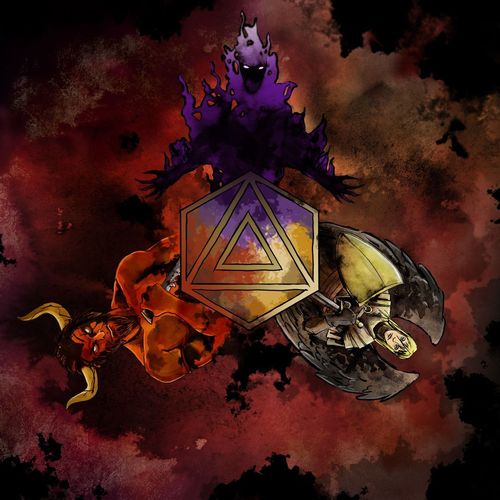
WARIGIN
WARIGIN Rulebook
Table of Contents
Table of Contents
The Game
If this is your first time playing WARIGIN, please don't open the two card stacks yet, or otherwise change the order of the cards. The cards are already pre-sorted for a two- or three-player starting scenario, so you can dive right in.
As an alternative to the starting scenarios, which let you play a quick game without first determining the challenger, the complete rules are found in Chapters 1-5. The instructions explain the game in chronological order and are structured so that you can, in theory, read the relevant chapter during play itself. If you do this, please plan for at least 30 minutes of extra playing time.
However, it is recommended that you read the rules once beforehand, and then use the overview on the last page to orient yourself during your first game.
WARIGIN is a highly conflict-driven board game for 2-3 players, offering asymmetrical, tactical battles in exciting 2-vs-1 faction wars. As a board game with additional card game elements, WARIGIN suits both a quick game in between other activities and long game nights: the combination of fast matches (15-30 minutes, once you know the cards), high replay value, and a match-spanning scoring system also guarantees long-term tension.
In WARIGIN's standard rules, individual battles are decided by rolling dice, so that matches play extremely fast and smoothly. For players who want a bit more tactics and bluffing in individual battles, there is also the optional Combat Card system: instead of a die roll, battles are decided by deliberately playing combat cards (see the Combat Card Variant section). For getting started, or for several quick games, the dice variant is recommended; for a single and/or more tactical game, the combat card rule is recommended instead (about 45-60 minutes).
In WARIGIN, one player leads their armies to war against the two other factions, who together form an Alliance against the challenger: the challenger wins the game as soon as they capture one of the two enemy fortresses. The Alliance wins the game as soon as the challenger's fortress is captured, or the challenger has no unit left on the battlefield.
WARIGIN is divided into 5 phases:
-
Setup: All three factions receive 9 face-down action cards; the remaining 9 action cards are laid face-up on the board.
-
Determining the Challenger: The challenger is determined through a short bidding sequence. The two other factions join together as the Alliance.
-
Deploying Units: The players place their units face-down in their respective home territories. Two-player variant: with two players, the Alliance player now takes control of the third faction.
-
The War: The war between the challenger and the Alliance is the core of WARIGIN. The game follows a clearly structured process:
- a) Reveal an event card.
- b) Challenger's turn (1 action card & 2 movements, OR 3 movements).
- b1. Action card (at most one action card per round, optional).
- b2. Movement (at most one movement per unit, one space).
- b3. Battle (if a space is shared with an enemy unit/fortress).
- c) Two-player variant: the Alliance player draws an action card, if available.
- d) Turn of the 1st Alliance faction (1 action card & 1 movement, OR 2 movements).
- e) Turn of the 2nd Alliance faction (1 action card & 1 movement, OR 2 movements).
The game ends as soon as one of the three fortresses is captured, or the challenger has no units left on the battlefield.
-
Scoring: WARIGIN offers a long-term, match-spanning scoring system. The rule is: the fewer cards the challenger claims at the start, the more victory points are awarded.
If this is your first time playing WARIGIN, a simplified entry via the starting scenarios is recommended, so you can get to know the game and the action cards (two players: see the Two-Player Starting Scenario; three players: see the Three-Player Starting Scenario).
If you have already played WARIGIN, or want to jump straight into the deep end including the bidding sequence to determine the challenger, continue on to the "Setup" chapter.
Two-Player Starting Scenario
In the regular game, you determine the challenger and their enemies through a short bidding sequence based on your individual starting hands. If this is your first time playing WARIGIN and you would rather get to know the various cards directly in play, this scenario offers a fast start for two players with pre-built card sets: please open the card stack with the "Partisans" card now, so you can dive right in (alternatively, you'll find the card order listed again below).
In this starting scenario, the randomly chosen dealer receives action cards 1-9 (1 = "Partisans"), and the other player receives action cards 10-18. Action cards 19-27 form the action card deck for the second player, while the sorted-out action cards 28-36 form the face-up action card discard pile. The 19 event cards form the face-down event card deck to the dealer's right.
Action card / Event card
The cards should now be distributed as follows:
Dealer's hand: Partisans, Avatar, Lightning Strike, Bog, Lightning Strike -Elite-, Scout -Elite-, Fiery Speech, Rebels -Elite-, Ceasefire
Second player's hand: Rebels, Bribery, Confusion, Plunder, Prophecy, Fiery Speech, Scout, Bog, Lightning Strike
Action card deck for the second player (face-down): Scout (bottom card), Rebels, Partisans, Confusion, Bribery, Ceasefire, Plunder, Prophecy, Avatar (top card)
Discard pile (face-up, to the dealer's left): Confusion -Elite-, Bribery -Elite-, Fiery Speech -Elite-, Partisans -Elite-, Prophecy -Elite-, Bog -Elite-, Plunder -Elite-, Ceasefire -Elite-, Avatar -Elite-
Event card deck (face-down, to the dealer's right): Void (top card), Plague, Necromancy, Burning City -right-, Crusade, Void, Poisoned Well, Veteran, Swords to Plowshares, Necromancy, Rebirth, Crusade, Veteran, Poisoned Well, Plague, Burning City -center-, Rebirth, Burning City -left-, Swords to Plowshares
Now please orient the board so that the yellow fortress is directly in front of the dealer. They take on the role of the challenger for the rest of the game: in this scenario, the dealer plays as the ruler of Heaven (yellow) against the second player, who controls the Alliance of Hell (red) and the Void (purple).
Please skip directly to Chapter 3 (see "Deploying Units") to place your units.
Three-Player Starting Scenario
In the regular game, you determine the challenger and their enemies through a short bidding sequence based on your individual starting hands. If this is your first time playing WARIGIN and you would rather get to know the various cards directly in play, this scenario offers a fast start for three players with pre-built card sets: please open the card stack with the "Partisans" card now, so you can dive right in (alternatively, you'll find the card order listed again below).
In this starting scenario, the randomly chosen dealer receives action cards 1-9 (1 = "Partisans"), the player to their left receives action cards 10-18, and the player to their right receives action cards 19-27. The sorted-out action cards 28-36 form the future face-up action card discard pile, and the remaining 19 event cards form the face-down event card deck to the dealer's right.
Action card / Event card
The cards should now be distributed as follows:
Dealer's hand: Partisans, Avatar, Lightning Strike, Bog, Lightning Strike -Elite-, Scout -Elite-, Fiery Speech, Rebels -Elite-, Ceasefire
Left player's hand: Rebels, Bribery, Confusion, Plunder, Prophecy, Fiery Speech, Scout, Bog, Lightning Strike
Right player's hand: Scout, Rebels, Partisans, Confusion, Bribery, Ceasefire, Plunder, Prophecy, Avatar
Discard pile (face-up, to the dealer's left): Confusion -Elite-, Bribery -Elite-, Fiery Speech -Elite-, Partisans -Elite-, Prophecy -Elite-, Bog -Elite-, Plunder -Elite-, Ceasefire -Elite-, Avatar -Elite-
Event card deck (face-down, to the dealer's right): Void (top card), Plague, Necromancy, Burning City -right-, Crusade, Void, Poisoned Well, Veteran, Swords to Plowshares, Necromancy, Rebirth, Crusade, Veteran, Poisoned Well, Plague, Burning City -center-, Rebirth, Burning City -left-, Swords to Plowshares
Now please orient the board so that the yellow fortress is in front of the dealer. They take on the role of the challenger for the rest of the game: as ruler of Heaven (yellow), the dealer faces off against the two other players, who each control one of the two Alliance factions (Hell (red) and the Void (purple)).
Please skip directly to Chapter 3 (see "Deploying Units") to place your units.
1. Setup
In the regular game, the players randomly choose one of the three different factions (Heaven = yellow, Hell = red, Void = purple), before the drawn dealer shuffles the 19 event cards and sets them aside as the face-down event card deck. They then shuffle the action cards and deal 9 face-down cards per faction (also with 2 players).
Action card / Event card
The remaining 9 action cards are now laid face-up on the board.
Notes:
- If there is no other agreement regarding faction choice and dealer, the oldest player acts as dealer in the first round and chooses their faction. The youngest player then rolls a die: on 1-4 they take the faction to the dealer's left, on 5-8 the faction to the dealer's right.
- Before the next game, the role of dealer moves clockwise. Ideally, by the end of a session, every player will have been dealer an equal number of times.
2. Determining the Challenger
In the next step, a short bidding sequence decides which player challenges the other two factions to seize supremacy. The challenger has various advantages for the rest of the game, but from then on fights alone against the two other, now allied, factions. Two-player variant: with two players, the challenger's opponent additionally gains control of the third faction after the bidding sequence.
The players now decide, based on the 9 action cards they received earlier — which they hold as hand cards, visible only to themselves — plus the 9 public cards on the board, whether they want to take on the role of challenger.
The following should be noted:
- All 36 action cards show their value in triangles, from 1 (weak) to 5 (very strong), in the upper left. There are 3 copies of each of the 12 action cards in the game in total, one of which is an Elite version. All 36 action cards together add up to a total value of 99.
- As a rule of thumb: a total value of 40+ (hand cards plus claimed public cards) is a good starting position for challenging the two other factions.
- The Elite versions of the action cards have a more powerful or additional effect compared to their respective base version. This Elite effect (explained in parentheses) is only activated in play when the action card is played by the challenger. For Alliance players, Elite cards have only the standard effect.
- Even though fighting against two armies may seem difficult, the reward for the challenger is high: besides the gameplay advantages (one extra action per turn, Elite effects, extra cards), the challenger also determines the final scoring through the number of extra action cards claimed (see the "Scoring" chapter).
Sequence of the Bidding
The player to the dealer's left decides first whether, based on their 9 hand cards, they want to challenge the two other factions without claiming any of the 9 public cards. If so, they become the challenger (then continue reading at d). If not, the other players decide, clockwise, whether they want to play as challenger without claiming an additional public card (then continue reading at d).
If no player wants to play alone without extra cards (which would also be the exception — it is not unusual for the challenger to claim 4+ of the public action cards), the player to the dealer's left then decides whether they want to become the challenger with ONE of the 9 cards (then continue reading at d). If not, the other players decide, clockwise, whether they want to play alone with one card (then continue reading at d).
Repeat the process with 2, 3, 4, 5, 6, 7, 8, and 9 cards, until one of the players decides to challenge the two other factions with the corresponding number of extra action cards (then continue reading at d). If no player wants to play alone even with 9 extra cards, please continue reading at "Special Case: No Player Wants to Play Alone."
The player who has decided to play alone against the two other factions becomes the challenger until the end of the current game. They now freely choose the agreed number of action cards from the middle and add them to their own action cards in hand. The cards not chosen are discarded and form the future action card discard pile.
Special Case: No Player Wants to Play Alone: If no player wants to play as challenger even with 9 extra action cards, the player with the most valuable hand (= the sum of the triangles on the 9 action cards in the player's hand) automatically becomes the challenger. However, they receive none of the public cards (they are all discarded), and likewise cannot use the Elite effect on action cards in this game. In the unlikely case that two players have an equally high value, the dealer reshuffles and deals the cards again.
Example: After each faction has received 9 action cards and a further 9 action cards lie face-up on the board, the player to the dealer's left quietly counts the value of their hand cards. With 30 triangles, they definitely do not want to challenge the two other players. They therefore pass on the question of whether they want to play alone without an additional card. The two other players likewise pass. Nobody wants to play alone with 1 or 2 additional cards from the board either. At 3 cards, however, the player decides to seize the chance: together with their hand cards (value: 30) and the three action cards of their choice (Lightning Strike -Elite-, Rebels, Local Leader), they now reach a value of 43, challenge the two other factions, and take the three claimed cards from the table in addition to their hand cards. That was bad luck for the dealer, who actually also wanted to play with 3 cards, but was only next in turn afterward. With that, the bidding sequence is complete, and play continues with deploying the units.
3. Deploying Units
In the next step, the players place their starting units in their home territory.
A distinction is made between soldiers (referred to from here on as Soldier units, no marking) and heroes (referred to from here on as Hero units, identifiable by the crossed swords on the underside).
For this, players receive units from their reserve, which consists of 6 Soldier units and 5 Hero units:
- Challenger: 5 Soldier units + 4 Hero units
- Alliance factions, each: 5 Soldier units + 3 Hero units
Two-player variant: if you are playing with two, the player who is not playing as challenger additionally gains control of the second (playerless) Alliance faction. They place the units of the 2nd Alliance faction in its home territory, but do NOT take onto their hand the action cards that were initially dealt to the playerless faction. This happens later, as the game progresses.
Now the players place their starting units face-down in the (color-coded) home territory of their respective faction. The units stand on the spaces, never on the intersections. The home territory consists of those 8 spaces that are one or two spaces away from the respective faction's fortress (please note that no unit may stand on the fortress itself).
The challenger additionally places one unit in the center of the board. This space counts as home territory for them (e.g. they are allowed to place a unit there via the "Partisans" card). They freely decide whether to place a Soldier or a Hero unit there.
Hidden Units: Each player should memorize the positions of their units well, since once units have been placed, it is not permitted to check the strength of one's own or others' units on the battlefield by revealing them, except when:
- a battle takes place.
- a unit is destroyed (or otherwise returns to the reserve).
- an action card explicitly allows units to be revealed.
Please note that the strength of revealed units is always shown to ALL players.
Optional Rule: To make the game simpler, you can change the rule on hidden units as follows: "It is not permitted to check the unit strength of enemy factions on the battlefield, except:..."
4. The War
Objective: The challenger wins the game as soon as they capture one of the two enemy fortresses. The Alliance wins as soon as the challenger's fortress is captured, or the challenger has no unit left on the battlefield.
The game ends immediately as soon as one of the victory conditions is met.
Until the objective is reached, the game proceeds according to steps a-f:
- Reveal an event card.
- Challenger's turn (3 actions).
- Play an action card (optional).
- Movement (and battle).
- Two-player variant: the Alliance player draws an action card.
- Turn of the 1st Alliance faction (2 actions).
- Turn of the 2nd Alliance faction (2 actions).
- The process begins again at a).
a) Reveal an Event Card
At the start of each round, the challenger reveals an event card, which is valid for all factions. This is either a one-time effect, or an event that remains valid until the next event card is revealed.
Examples: The event card "Plague" is revealed. The units of all factions are counted, and each faction with more than 6 units on the battlefield immediately removes two units of their own choice. The challenger's turn then begins. In the next round, the event card "Necromancy" is revealed, which applies during the turns of all three factions: as soon as a Hero unit is destroyed, it is reborn as a Soldier unit under the control of the active(!) faction. To make the best use of the event, the challenger destroys an enemy Hero unit of the 2nd Alliance faction with their action card "Lightning Strike" during their turn, and receives a Soldier unit of their own at its former position (note: reborn units may not move in the same round). During the turn of the 1st Alliance faction, a Hero unit then attacks and loses — this Hero unit is reborn as a Soldier unit of the 1st Alliance faction.
Notes:
- Previous event cards in the discard pile may not be examined.
- The challenger's units are always added or removed first, then those of the Alliance players, in clockwise order.
- If there is disagreement among the Alliance players regarding an event, the final decision rests with the player to the challenger's left.
- If the event card deck is empty, the cards from the corresponding discard pile are reshuffled and set up again as the new event card deck.
b) The Challenger's Turn
The challenger always has three actions in their turn. Playing an action card, as well as moving a unit, each cost one action.
They may move several units, but may not play more than one action card, and may not activate any unit more than once.
b1. Action Card Phase (optional): In this phase, the player has the option to play an action card from their hand. The effect takes effect immediately and is valid as long as the respective faction is taking its turn.
The following should be noted:
- A third of the action cards are Elite versions. However, the Elite effect (explained in parentheses in each case) is only activated in the game when the action card is played by the challenger. For all Alliance players, Elite cards have only the regular effect.
- The effect of all action cards ends with the faction's turn, i.e. you cannot strengthen units (e.g. via "Avatar") for a future battle.
- Explicit exceptions here are "Bog" and "Ceasefire," which are only discarded when their effect (which extends beyond one's own turn) ends. Until then, they lie in front of the affected faction's fortress as a reminder.
- It is not permitted to play an action card after movement/battle has occurred, or outside one's own turn.
- Played action cards are placed on a shared discard pile. It is not permitted to examine previously played cards again.
- Played cards are also discarded if their effect is invalid (e.g. if a player plays "Fiery Speech" on a Hero unit, or if there is no Soldier unit left in the reserve when "Rebels" is played).
- Card text always has priority over general rules, e.g. thanks to "Scout," units can move two spaces during the movement phase.
b2. Movement (and Battle): In this phase, the player moves their units. If they previously played an action card, the challenger moves two units (Alliance: one unit). If they did not play an action card, they move three units (Alliance: two units). It is not permitted to let movements lapse if units are able to move. If fewer units than available action points exist, the actions lapse.
A unit moves one space per action (see arrow) and can never enter a space occupied by a friendly or allied unit or fortress (see X icon). As soon as a unit moves onto a space with an enemy unit or fortress (see lightning icon), battle automatically occurs, at no additional action cost (see next section).
Rebirth vs. Placement: Please note that units which are reborn may NOT move in the same round (e.g. with "Necromancy," "Avatar"). This restriction does not apply to units being placed (e.g. "Rebels," "Veteran").
Battle is divided into five phases ("Optional: Combat Cards" — see the Combat Card Variant section):
i) Revealing the Units The attacking player reveals both units.
ii) Attacker and Defender Roll Based on unit strength, the combat value of both units is determined by rolling eight-sided dice: Soldier unit = 1 die, Hero unit = 2 dice (values added together), Fortress: 1 die.
iii) Applying Modifiers Next, the final combat results are calculated based on the active event card and any action card played.
iv) Removing a Unit The unit with the lower combat result loses and returns to the reserve. In case of a tie, the attacker always wins. As soon as an attacker wins a battle against a fortress, it is considered captured and the game ends immediately (please go to the "Scoring" chapter).
v) Hiding the Victorious Unit The victorious unit is turned face-down again.
Examples: The challenger plays "Fiery Speech" during their action card phase and moves the unit onto a space with an enemy. Both units are revealed: it is a Soldier attacker and a Hero defender. The challenger rolls a 6, the Alliance player rolls a 9 with their two dice (6 + 3). Since there is no modifier from event cards this round, only "Fiery Speech" is factored in (+4), so the final result is 10 (attacker) to 9 (defender). The defending Hero unit is removed. The Alliance is two spaces from the challenger's fortress with a unit, while the event "Crusade" (+4 for attacking Soldier units) is active. The Alliance player plays the card "Scout," and may now move two spaces and also gains +1 in battle. The unit moves onto the enemy fortress in two steps and battle begins: the attacker rolls a 2 with their Soldier unit, whereas the defender rolls a 7. Since the attacker also gains +4 ("Crusade") and +1 ("Scout"), the final result is 7 to 7. The Alliance player wins the tie as attacker, captures the fortress, and wins the game.
c) Two-Player Variant: Additional Action Card and General Notes
If you are playing with two, the Alliance player controls two factions. The following applies:
- At the start of the war, the Alliance player has only their 9 action cards from the beginning in hand, which they use for both Alliance factions as they choose.
- After each of the challenger's turns, the Alliance player draws one of the 9 action cards that were assigned to the uncontrolled faction during setup. Once that deck is used up, no further action card is drawn.
- Apart from the shared action cards, the actions for the 1st and 2nd Alliance factions are carried out independently of one another and in sequence.
Examples: The effect of "Fiery Speech," played by the player during the turn of the 1st Alliance faction, is NOT still active during the turn of the 2nd Alliance faction (i.e. it is not possible to strengthen a unit of the 2nd Alliance faction using the 1st Alliance faction). If the player plays a "Ceasefire" during the turn of the 2nd Alliance faction, they may not attack again with the 1st Alliance faction in the next round. The "Ceasefire" remains in effect until the next turn of the 2nd Alliance faction. The Alliance player may not place a "Partisans" in the home territory of the 2nd Alliance faction during the turn of the 1st Alliance faction, but may do so during the turn of the 2nd Alliance faction.
d) Turn of the 1st Alliance Faction
Next comes the turn of the 1st Alliance faction (clockwise, i.e. to the challenger's left). The procedure is identical to the challenger's turn (b), except each Alliance faction only has two actions: the player decides whether to play an action card and move one unit, OR move two units.
Please note that event cards — unless they have a one-time effect — are also active during the turns of the Alliance factions (e.g. "Crusade," which means +4 for attacking Soldier units)!
e) Turn of the 2nd Alliance Faction
Exactly like the turn of the 1st Alliance faction.
f) End of Round
Please begin again at a) "Reveal an Event Card" and follow the game sequence until a fortress has been defeated OR the challenger no longer has a unit on the battlefield.
Notes:
- No further action cards are drawn during the course of the game (apart from the two-player variant, see above). Once a player has played their last action card, they simply move their units.
- Alliance factions without units remain in the game. They may play action cards on their turn, and their fortress still defends normally.
5. Scoring
To determine the most successful commander in the eternal conflict between Heaven, Hell, and the Void, WARIGIN offers a match-spanning scoring system: the number of victory points is based on the number of action cards claimed during the initial bidding sequence ("Determining the Challenger"):
- Challenger plays only with their hand cards: +/- 14 victory points
- Challenger plays with 1-3 extra cards: +/- 12 victory points
- Challenger plays with 4-6 extra cards: +/- 10 victory points
- Challenger plays with 7-9 extra cards: +/- 8 victory points
- Special case: no player wanted to play alone: +/- 6 victory points
In scoring, the winner is credited with the respective points, while the losing side loses them accordingly (+/-), with the Alliance players splitting the respective point total in the 3-player variant. The sum of all awarded victory points is always zero at any time, to make recording and checking the math easier.
Examples:
| Outcome | Challenger | 2 players: Alliance player | 3 players: each Alliance player |
|---|---|---|---|
| Challenger wins; claimed no cards | +14 VP | -14 VP | -7 VP |
| Alliance wins; 2 extra cards | -12 VP | +12 VP | +6 VP |
| Alliance wins; 4 extra cards | -10 VP | +10 VP | +5 VP |
| Challenger wins; 9 extra cards | +8 VP | -8 VP | -4 VP |
Notes:
- If you use the scoring system, you should play at least 3/6/9 games with three players, or 2/4/6 games with two players, so that all players get equal chances at bidding.
- If you regularly play in the same group, why not run your very own personal "Eternal War" (30 scored games) and share your experiences with us (www.warigin.com).
Optional: Combat Card Variant
For a greater tactical challenge in individual battles, WARIGIN includes an additional deck of combat cards. In this optional game variant, these replace the dice.
Setup:
If you play with combat cards, the factions are determined before the first game by each player drawing one of the three faction cards.
Please note: the faction card is a special combat card. When the faction card is used in battle, the player always takes it back into their hand afterward!
Each player then receives the regular combat cards belonging to their faction card (16 in total; 2x each of 1-8). These are shuffled separately, and before the game begins, each player draws 5 additional combat cards on top of their action cards and faction card, before placing their face-down combat card deck in front of them for personal use.
Before determining the challenger, each player should now have the following cards: 9 action cards, 6 combat cards (1 of which is the faction card)
Combat Cards in Battle
Instead of a die roll, the chosen combat cards (together with the modifiers from event and action cards) now decide the outcome of a battle. Two-player variant: with two players, the Alliance player only uses the combat cards of their original faction.
This changes the battle sequence as follows:
i) Choosing Combat Cards Both players each choose two combat cards face-down. Note: for Soldier units or the fortress, the value of the lower combat card is always counted. This can be avoided if the player chooses their faction card (which has no printed value) as their second card alongside a regular combat card.
ii) Revealing Units and Combat Cards Both players reveal their units as well as their chosen combat cards.
iii) Calculating Combat Values Based on unit strength and the combat cards played, the combat value of both units is determined. There are two situations:
a) The player plays two regular combat cards:
- Hero unit: the values of both combat cards are added together.
- Soldier unit/fortress: the value of the lower combat card is counted.
OR
b) The player plays one regular combat card and the faction card:
- The value of the regular combat card is counted.
iv) Applying Modifiers Next, the final results are calculated based on the active event card and any action card played.
v) Removing a Unit Based on the combat result (combat cards and modifiers), the unit with the lower result is removed. In case of a tie, the attacker wins. If an attacker wins a battle against a fortress, it is considered captured and the game ends immediately (please skip to the "Scoring" chapter).
vi) Drawing New Combat Cards:
a) Two regular combat cards were played:
- Hero unit: both combat cards are discarded.
- Soldier unit/fortress: the higher combat card is discarded. The lower combat card returns to hand.
OR
b) A regular combat card and the faction card were played:
- The regular combat card is discarded. The faction card returns to hand.
Each player now draws replacements from their combat card deck for the discarded cards, so that they always hold 5 regular combat cards plus their faction card in hand. If the combat card deck is empty, the cards from the corresponding discard pile are reshuffled.
vii) Hiding the Victorious Unit The victorious unit is turned face-down again.
Examples: The challenger moves a unit onto an occupied enemy space. Both players choose two combat cards. Then the units and combat cards are revealed. The attacker has a Hero unit and combat cards with values 5 + 7. The defender is a Soldier unit with combat card 2 and the faction card. The defender is removed (12 to 2). All combat cards except the faction card are discarded; the attacker draws two, and the defender draws one new combat card from their personal deck. In the next battle, a different picture emerges: the attacker is a Soldier unit with combat card 4 and a faction card. The defender is a Soldier unit, but has chosen combat cards 2 and 8. The defender is removed, since only their lower card (2) counts. The attacker then discards combat card 4, the defender the (wasted) 8. This waste of a good combat card could have been prevented by playing the faction card. Each player draws one new combat card.
Optional Rule: To make the combat card game simpler, you can change the battle sequence: reveal the units before the combat cards are chosen.
Game Contents
- 51 combat cards, 36 action cards, 19 event cards, 4 info cards
- 33 wooden playing pieces (+3 spare pieces)
- 2 eight-sided dice
- 1 game board
- 1 rulebook
Age recommendation: WARIGIN is not suitable for players under 16 years of age.
Glossary
Soldier units and Hero units: Soldier units (no marking) are called soldiers. They fight with one die or one combat card. Hero units (marked with two crossed swords) are called heroes. They fight with two dice or two combat cards.
Action cards: Action cards can be played by a player at the start of their turn. There are 12 different action cards, each present 3 times (one of these as an Elite version, yellow design). The strength of an action card is shown by its value in the upper left (1-5 triangles).
Elite effect: The Elite effect (in parentheses) on Elite cards can only be used by the challenger — for Alliance players, the standard effect applies.
Event cards: Event cards are drawn before the challenger's turn. The effect is valid for one round, and therefore also affects the turns of both Alliance factions.
Fortress: The fortress is the space behind the three wall spaces. While friendly units cannot enter this space, an enemy unit entering the fortress space automatically starts a battle. The fortress defends with one die/one combat card, but cannot be the target of action cards and cannot itself attack. It is not possible to place friendly units on the fortress. The game ends as soon as a fortress loses a battle.
Faction card: see the Combat Card Variant section.
Home territory: see the "Deploying Units" chapter.
Combat cards: Combat cards are only needed with the "Combat Card Variant" optional rule. In that case, they replace the dice. Each player always holds 5 normal combat cards plus the faction card in hand, from which they choose during a battle.
Wall: The three spaces in front of the fortress are walls. It is not possible to place units on them via "Rebels" (though units may enter them during the movement phase in the same turn). The walls do NOT belong to the fortress.
Reserve: Units removed from the battlefield always return to the reserve for future use. If no matching unit is available in the reserve, any additional units from event and action cards are simply forfeited. Each player has a total of 6 Soldier units and 5 Hero units.
Rebirth: When a unit is reborn, it always occupies the space it was on at the start of the turn, and may NOT move in that round. That is:
- Rebirth of attacker -> the unit appears on the attacker's starting space.
- Rebirth of defender -> the attacker ends their turn on their own starting space; the unit appears at the defender's position.
Game Flow Overview
Victory conditions: The challenger wins the game as soon as they capture one of the two enemy fortresses. The Alliance wins as soon as the challenger's fortress is captured, or the challenger has no unit left on the battlefield.
Setup, Determining the Challenger, Deploying Units
- Each faction receives 9 action cards. 9 cards lie face-up on the board.
- The challenger is determined via the bidding sequence (1 -> 2 -> ... -> 9).
- Units are deployed within one's own home territory. Challenger: 5x Soldier, 4x Hero. Allied factions: 5x Soldier, 3x Hero each. Two-player variant: the Alliance player takes control of the third faction.
4. The War
a) Reveal an event card.
b) Challenger's turn (1 action card & 2 movements, OR 3 movements).
- b1. Action card (at most one action card per round, optional):
- An action card must always be played before movement.
- An action card may only be played on one's own turn.
- b2. Movement (at most one movement per unit per round):
- Units may move one space.
- Units cannot enter a space with a friendly unit/fortress.
- Battle begins when entering a space with an enemy unit/fortress.
Battle ("Optional: Combat Cards" — see the Combat Card Variant section)
- i) Reveal the units.
- ii) Attacker and defender roll according to their strength (Soldier: 1 die, Hero: 2 dice, Fortress: 1 die).
- iii) Event and action cards are factored in.
- iv) Remove the loser. In case of a tie, the attacker wins.
c) Two-player variant: the Alliance player draws an action card, if available. d) Turn of the 1st Alliance faction (1 action card & 1 movement, OR 2 movements). e) Turn of the 2nd Alliance faction (1 action card & 1 movement, OR 2 movements). f) End of round: begin again at a).
The game ends immediately as soon as a fortress is defeated, OR the challenger no longer has a unit on the battlefield.
5. Scoring
The challenger always receives the full point value; with 3 players, each Alliance player receives only 50%. 0 cards: +/- 14 VP, 1-3 cards: +/- 12 VP, 4-6 cards: +/- 10 VP, 7-9 cards: +/- 8 VP