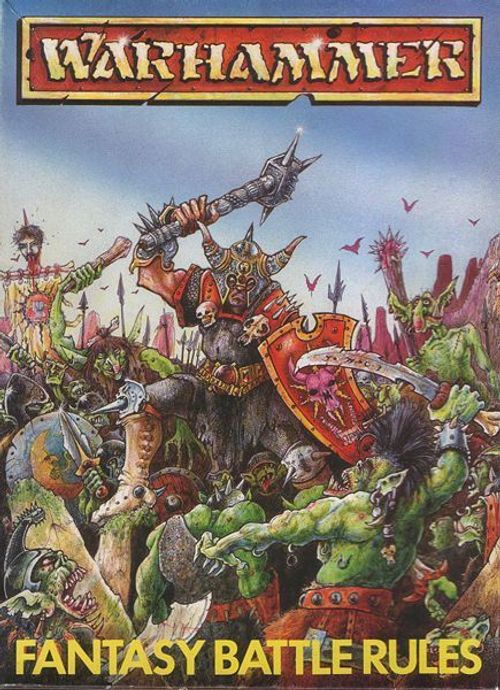
Warhammer Fantasy Battle Rules (Second Edition)
Warhammer Fantasy Battle Rules (Second Edition) Rulebook
Table of Contents
Table of Contents
- Basic Rules
- Fantasy Battle Games
- The Field of Battle
- Characteristics
- Models for Warhammer Games
- Organising Your Troops
- The Turn Sequence
- Movement
- Shooting
- Combat
- Who Can Fight
- Charges
- Firing at Charges
- Running Away
- Fighting: Attacks and Weapons
- Monsters' Attacks
- Throw to Hit
- Procedure
- Order of Attack
- Panicked, Prone, Routing and Flying Troops
- To Hit Modifiers
- Saving Throws in Combat
- High Strength Hits in Combat
- Removing Casualties in Combat
- Combat Results
- Push Backs
- Movement and Troops Engaged in Combat
- Rear Attacks
- Mounted Models in Combat
- Routs and Rallying
- Rallying
- Reserves
- Psychology
- Advanced Rules
- Weapons
- The Push
- Buildings
- Moving Within Buildings
- Fire
Basic Rules
Fantasy Battle Games
Game Equipment
Apart from the Warhammer rules and a selection of models and scenery, you will need dice, rulers, scrap paper and pencils. Normal six-sided dice, or D6s, are used during combat, and it is a good idea to have at least a dozen of these. A cup will make a useful shaker.
Players
Games are usually fought between two opposing sides, each side being represented by one or more players. For larger games it is convenient to have more than one player on each side, as this makes dice throwing and troop movement quicker and easier. The co-commanders can agree to divide their forces between them as they wish.
Games Master
If you are to fight a fantasy battle you will need an extra person called the Games Master, usually referred to simply as the GM. He will act as an umpire or referee, and it is his task to enforce the rules of the game, interpreting them where necessary. The GM should make sure the players have enough dice, pencils, paper and any other items needed during the game.
It is possible to fight a battle without a GM, so long as the players are willing to co-operate a little, adopt a reasonable attitude and are honest in their record keeping.
Dice
The Warhammer Games System uses a number of different and attractively shaped dice, as well as the normal six-sided dice with which we are all familiar. Players will find it useful to have at least one example of the 4-sided, 8-sided, 10-sided, 12-sided and 20-sided dice. You will need a number of 6-sided dice, preferably about a dozen.
Everybody knows how to throw a D6: the score is the number facing upwards when the dice has been rolled. The D8, D10, D12 and D20 are read in exactly the same way. The D4 is pyramid shaped, and so has no upper surface: the score is the number on the base edge of the pyramid.
Notation
The standard notation is to write 'D' for dice, followed by the number of sides. So a D4 is a 4-sided dice, a D6 is a 6-sided dice, and so on.
Sometimes you will need to roll more than one dice of a kind. This is indicated by a number preceding the D. For instance, 2D8 means you throw two D8s and add the scores together. You can throw one D8 twice if you are short of dice.
Sometimes you will need to add or subtract, or modify, the dice score. For example D6+1 means throw a D6 and add 1 to the result. 3D4+2 means throw 3 D4s, add the scores and then add 2 to the combined result.
| Dice rolled | Score | Procedure | Result |
|---|---|---|---|
| 3D4 | 1, 3, 2 | Add the scores | 6 |
| 2D6 | 2, 5 | Add the scores | 7 |
The Field of Battle
Before starting a Warhammer game you will need to set up the field of battle. You will require a fairly large table or area of floor to fight on; 6' by 4' is the ideal size for a modest game. Many gamers improvise quite satisfactorily using the dining room table. Having cleared an area, the GM or players may then place the model scenery, including woods, hills, rivers and buildings.
Scenery usually comprises the following items or types, although you are free to invent your own weird fantasy scenery should you wish. There is no limit to what you can do to provide an interesting and demanding setting for a game. The following scenery types have been given standard sizes, which are used to determine the amount of scenery on the table.
Hills are one of the most useful scenic items: troops stood on hills receive a combat advantage and can see over the heads of troops in front. Hills can be made from polystyrene ceiling tiles cut to shape, or even books piled on top of each other to get the right effect. Hills have to be made in steps so that models will stand on them. A single hill as an item of scenery should measure approximately 6" x 6", but two or more hills can be placed side by side to produce a long ridge.
Ditches, like walls, provide 'hard cover' for troops occupying them. It is assumed ditches are shallow enough to allow missiles to be fired normally from them. Troops attacking a ditch have the advantage of being on a higher level than their opponents. A section of ditch is 1" wide and 12" long and may be split up into smaller sections in the same way as hedges and walls. On the wargames table ditches are hard to represent, and perhaps the best method is to cut strips of card 2" wide and as long as your section. Then use plasticine to build up a slope on the front and rear of the ditch, leaving a 1" gap down the centre which forms the ditch itself.
Hedges provide 'soft' cover for troops behind them. Hedges can be bought from your local model shop, or home made using sponge cut into sections. A hedge is assumed to be 1" wide and 12" long, although the hedge can be split into up to 3 sections of 4" as required. Smaller sections wouldn't provide any real cover or barrier, as troops could too easily avoid or go round them. Two or more hedge sections can be placed together to make long hedges or field systems.
Walls are exactly like hedges but provide 'hard' cover. You can buy plastic walls from model shops, or make your own from card.
Woods are useful for blocking off areas, as they are difficult to move or fire through. Model trees can be bought from your hobby store either as plastic or metal kits. Alternatively you can make your own using pine-cones, or pipe cleaners and sponge. A wood as a scenic item should occupy an area of approximately 6" x 6", but two or more woods can be placed together to produce a larger wood or forest.
Debris and Ruins are small areas of broken ground, perhaps an old decayed building or spoil tip. A scenic area is assumed to cover approximately 6" x 6", although, as with woods and hills, two or more can be adjoined to give you a larger feature. The easiest way to represent debris on the wargames table is to scatter a few pieces of cork around the desired area. More ambitious modellers can build their own 'ruins' from card or plasti-card.
Buildings form vital strong points with commanding arcs of fire over the battlefield. They can be bought from model shops or home made from plasti-card. Many of the 'toy' construction kits can be quite useful too. A single building, no larger than 6" x 6", comprises one scenic item. Larger buildings represent correspondingly more items, whilst groups of buildings can be placed together to form a village.
Rivers provide useful linear obstacles. Model river sections are available from shops, but the best way to make rivers is to cut strips of card to shape and make banks out of plasticine. Rivers are 3" wide and 12" long per item, and to create a longer river you will need more sections. Rivers must begin and end at an edge of the board; they cannot simply stop. Once a river is in place the GM, or if he is not available the player who placed the river, must position a bridge or ford. This single bridge or ford does not count as a scenic item, and is compulsory. Apart from the single bridge or ford that has to be placed on a river, a player may select a number of further bridges or fords as scenic items, and position them anywhere he likes across the river. Bridges and fords are always 4" wide and span the river. Bridges can be bought, or homemade from plasticard or wood. Fords can be represented by a section of pale coloured card, to show where the river shallows.
Pools can provide obstacles, or even refuge for aquatic creatures. Pools can be made from card, approximately 6" x 6", and painted blue. Two or more pools can be combined to produce larger lakes.
Bogs are similar to pools, but can be crossed with a little difficulty. They can be made from card, approximately 6" x 6", and painted dark green. Mires and large bogs can be made by combining smaller ones.
Burial Grounds are useful to some evil undead creatures. Graveyards or urn fields can be represented by an area of card, or scattered scenic material approximately 6" x 6". A few suitable tombstone models will add to the effect. Obviously larger areas can be produced by placing two or more basic areas together.
Placing the Scenery
Scenery can be placed in a number of ways.
- The GM can place the scenery entirely at his own discretion.
- The GM can set up the scenery so that it is symmetrical; in this way no advantage is conferred to either player.
- The players can arrange to choose scenery using the following rules. Each player secretly nominates how many items of scenery he wants on his half of the table. The maximum number that can be nominated is 1 for every full 1' of table length. The GM then rolls a D6 for each side.
| D6 score | Result |
|---|---|
| 1, 2 | The player receives one less item than nominated |
| 3, 4 | The player receives the number of items nominated |
| 5, 6 | The player receives one more item than nominated |
Each player then chooses his own scenery. Players may position their scenery anywhere within their own half of the table. The player with the most items places one item first, then the other player places one item, and then the first player again, and so on. Once one player has run out of scenery the remaining player positions his remaining items. The table is now set for battle!
Using this method the players have a lot of say over the terrain they are fighting over. To offset this the GM may, if he wishes, reposition or remove one item of scenery from one or both sides.
- If the players have no GM then one player can set up the scenery, and the other may choose which table edge he wishes to start from. The player who set up the scenery then starts from the opposite edge.
Characteristics
Introduction
In the Warhammer game every creature type has characteristics particular to its race. Each characteristic represents one aspect of the creature, and is given a value of from one upwards. The characteristics are described below, but don't worry about remembering them all right now.
Fighting Characteristics
Movement Allowance - M. A creature's Movement Allowance, or just Move, determines how fast it may move around the tabletop in inches. So a creature with a Movement Allowance of 4 moves 4", a creature with a Movement Allowance of 6 moves 6". This distance will sometimes be reduced to take into account difficult terrain, obstacles and so on.
Weapon Skill - WS. The Weapon Skill illustrates the creature's ability to handle weapons, or to land a telling blow by biting or clawing. The lowest Weapon Skill is 1 and the highest is 10. The higher the WS the easier it is to strike a blow in combat, and the harder it is for your opponent to strike back.
Bow Skill - BS. Bow Skill dictates a creature's ability to use missile weapons, such as bows and arrows, slings or even thrown stones. Some creatures can spit poison, or acid, and their Bow Skill, or BS, determines how accurate they are. The lowest BS is 1 and the highest is 10. The higher the BS the easier it is to score a hit with your weapon. Sometimes a creature has been given a characteristic score of '0'. This indicates that the creature or individual concerned has no ability in that field whatsoever. This is most commonly applied to Bow Skill. So, for example, a creature with a BS of 0 may not use any missile weapons at all, even improvised weapons such as thrown rocks.
Strength - S. A creature's Strength shows how much damage it can cause. A creature with high Strength can cause a lot of damage, a creature with low Strength very little. The lowest Strength is 1 and the highest 10.
Toughness - T. Toughness determines a creature's natural resistance to damage. It is very hard to damage or wound a creature with high Toughness, and relatively easy to hurt a creature with low Toughness. The lowest value is 1 and the highest 10.
Wounds - W. Some creatures can take more damage than others, either because they have more stamina or because they have little regard for, or feeling of, pain. This is represented by the number of Wounds a creature can take before he, she or it is slain. The fewest wounds a creature can take, and the normal for most creatures, is 1. Theoretically there is no upper limit.
Initiative - I. Initiative determines a creature's speed of thought and action. A creature with a low Initiative will be slow and dull; a creature with a high Initiative will be fast. In combat creatures with high Initiatives will be able to strike before their enemies. The lowest Initiative is 1, the highest 10.
Attacks - A. The number of Attacks a creature can deliver at once will make it more or less deadly in combat. Most creatures have only 1 Attack, but other creatures bite, claw and lash with their tails all at once, giving them multiple Attacks.
Personal Characteristics
Personal characteristics are not vital to the Warhammer Battle Rules, although they are used to establish some saving throws against various types of attack and states of mind, such as magic and terror. They are developed and discussed in more detail in the companion Warhammer Role-Play Rules.
Leadership - Ld. A creature's Leadership indicates its ability to command others, to inspire confidence and loyalty. Values go from 1, the lowest, to 10, the highest. Units of troops have Leaders, and their Leadership value will affect the unit's fighting abilities to some extent.
Intelligence - Int. Intelligence determines a creature's ability to think and react. The lowest Intelligence is 1, and the highest 10. Creatures with a really low Intelligence suffer certain penalties and may have actual difficulty remembering whose side they are on.
Cool - Cl. Cool reflects a creature's temperament and ability to stay calm and under control. Values go from 1 to 10. Creatures with a very low Cool may lose control of their actions, and do unpredictable and hysterical things. Creatures with a high Cool are just the opposite: they can be unaffected by sights and experiences that would reduce more frail characters to jelly.
Will Power - WP. Will Power is a measure of mental and magical resistance; a creature with a high Will Power can often avoid or escape the effects of magic. On the other hand creatures with a low Will Power can find themselves affected more than normal. Values go from 1 to 10.
Creature Profiles
A creature or character's characteristics can be given all at once in what we call a Creature or Character Profile. For example, the Creature Profile for a Man is given as a table with the columns M, WS, BS, S, T, W, I, A, Ld, Int, Cl and WP.
[OCR note: the numeric values of the Man profile table are not legible in the text layer and have not been filled in. Consult the printed page 12 table.]
This is the Creature Profile for a standard Human. There are comparable Profiles for every creature, including Orcs, Elves, Dragons and so on. Creature Profiles only give the average values typical of that species, and this is the value we apply to creatures fighting in units. Obviously we accept that some members of a unit might be stronger or faster or tougher than others, but these things are assumed to average out.
Models representing Wizards, Heroes, Unit Leaders and other individuals can be given special Character Profiles, which reflect their individual weaknesses and strengths. See Advanced Rules, page 33. For now it is important only to bear in mind that Character Profiles can, and do, differ to some extent from the basic Creature Profile.
Models for Warhammer Games
Bases
Metal fantasy models suitable for playing Warhammer can be bought in most major model and hobby shops. Citadel Miniatures manufacture the largest and fastest growing selection of fantasy models in the world, so, whatever your choice of army or creature, you will easily be able to assemble your own unique Warhammer force.
Obviously, moving a large number of models around a battlefield poses a few problems. It is all too easy to knock over, lose or damage models in the heat of battle. Moving a lot of models can also take a long time.
To improve the stability of models and generally make them easier and safer to handle, it is a good idea to put them on bases. These can be made from thick card, or plasti-card. Glue each model onto a base 20mm x 20mm for infantry and 25mm x 40mm for cavalry. This represents the minimum space the model needs in which to fight and move.
It is convenient to mount some models on multiple bases; for example 3 infantry can be glued side by side on a base 60mm x 20mm. This makes them easier to move.
Large models and equipment can be based on any convenient sized area, so long as the model has sufficient space in which to fight and looks right. Large humanoids, such as Orcs, will have to be mounted on 25mm x 25mm bases. Base sizes are given in the Battle Bestiary.
Some people like to use round bases made from coins or washers. With these a movement tray is essential to enable models to be moved reasonably quickly. The big disadvantage of round bases is that they make it difficult to see exactly who is fighting who, which models can fight and which cannot. Assume models on round bases have a standard frontage of 20mm for infantry and 25mm for cavalry as normal. Changing formation can also get confusing with round bases, but on the whole gamers who prefer them usually muddle through combats and movement without much difficulty.
Movement Trays
A movement tray will enable you to move a whole unit of troops in just a few seconds, and is an invaluable playing aid, especially at the start of a battle. The tray is made from very thick card, plasticard or hardboard, and is of a size and shape so that an entire unit will fit onto it. During your turn, rather than move each model individually, the tray can be moved instead. As soon as the unit wishes to change formation the tray can be abandoned, and the models moved as normal.
Organising Your Troops
Troops are organised into fighting units called Regiments. A typical regiment is of between 5 and 30 models, although players are welcome to form regiments of any size they wish.
Models comprising a regiment should have the same Fighting Characteristics throughout, the same Movement Allowance, the same Weapon Skill, Strength and so on. Sometimes this is not possible, in which case a separate record will have to be kept of the characteristics of individual models.
Normally a regiment will have the same weaponry and armour throughout, although it is not strictly necessary to have identical models. For example, a unit of Goblins could have some in plate armour, some in mail and some with no armour at all, but on the battlefield they could all count as having mail. Similarly they could have assorted weapons, some with spears, other with swords or clubs, but on the battlefield they could all count as having swords. This is perfectly acceptable and makes each regiment look more threatening and interesting. Regiments of assorted models should be pointed out to your opponent, and their actual weaponry and armour made clear before the game.
All regiments start the game led by an officer called the Leader, who is represented by a special model. In the basic game the leader has identical Fighting Characteristics to the rest of the regiment.
Members of a unit must remain within base to base contact with at least one other member of the unit at all times.
It is not necessary to have individual heroes or large monsters organised into units. They may be formed into units if you wish, or can be moved independently. Individuals can attach themselves to fighting units to enhance their power where opportunity permits.
The Turn Sequence
The Turn
Games are fought between two opposing sides. Each side is represented by one or more players. In large games especially it is useful to have the extra players to move troops and throw dice.
Both sides take a turn in strict rotation. Flip a coin to see which side has the first turn. The side to go first (side A) takes a turn, then the second side (side B), then the first again (A) and so on.
During your turn you may move your troops and fire any missile weapons. Both sides may then fight hand-to-hand combat with enemy troops as explained in the combat rules.
Each turn sequence should follow the order laid out below.
| Phase | If it is your turn | If it is not your turn |
|---|---|---|
| 1. Movement | You may move your troops. | Your troops must remain stationary. |
| 2. Shooting | You may shoot with any weapons as appropriate. | - |
| 3. Hand-to-hand Combat | Both sides may fight with any troops engaged in hand-to-hand combat. | Both sides may fight with any troops engaged in hand-to-hand combat. |
| 4. Reserves | You may move uncommitted troops. This extra move represents the bringing up of reserves. | - |
| 5. Magic | You may attempt any magical operation, including casting any spells. | - |
| 6. Rallying | You may attempt to rally any of your routing troops. | - |
In small skirmishes, brawls and other more detailed role-play games all of the players are on the same side. The Gamesmaster, and any pieces he controls, are on the other side. See Warhammer Role-Play for a fuller explanation, and more detailed rules.
Movement
Introduction
This section deals with the movement of units and individual characters or monsters on the tabletop. We have tried to provide rules for all of the different types of terrain and different unit formations. However, it is inevitable that sooner or later a situation will occur which is not properly covered. In such a case it is up to the GM to invent his own rules, or apply an unbiased judgement within the spirit of the existing rules.
During your side's turn you may move your own models during the Movement part of the turn sequence. Some models suffer from restrictions, such as crossbowmen who cannot move and fire, but we shall ignore such exceptions for the moment.
The Movement Allowance
Some creatures are faster than others, whilst some are slow and cumbersome. In the Battle Bestiary we give the movement allowance for each type of creature. During movement each character, monster or unit may move up to its full movement allowance, subject to the special rules given for armour, terrain and obstacles. Models may be moved less than their allowance, or not at all, so long as they are not subject to any sort of compulsory movement rule (such as Routs, see page 27).
The movement allowance for most of the common, two-legged, average sized creatures is 4 inches. Should you wish to invent your own new monsters or creatures you can easily determine the movement allowance by comparison with a similar creature.
Armour
The basic movement allowance, minus any penalties for wearing armour, becomes the actual movement allowance for your troops. From now on, when we speak of the movement allowance, we mean this new, modified distance which takes armour into account.
| Armour Saving Throw | Penalty |
|---|---|
| 6 | None |
| 5 | 1/2" |
| 4 | 1" |
Example: a man with a shield and metal breastplate has a Saving Throw of 5. This gives him a 1/2" penalty on his basic movement allowance of 4", giving him an actual movement allowance of 3 1/2".
Armour and Encumbrance
The weight of armour, weapons and other equipment can seriously slow down your troops. In the Warhammer Battle Rules this is not dealt with in too much detail. If players are interested in such things we refer them to our Warhammer Role-Play game, which provides super-detailed rules for weight and encumbrance.
We shall, however, take into account the effect of the weight of armour and shield. The chart above gives the deduction from the basic movement allowance for wearing armour and carrying a shield. It is based upon the Armour Saving Throw, which is explained on page xx. The better the Saving Throw the more armour the model will be wearing.
Difficult Ground
The tabletop battlefield can include any amount of model scenery. The following terrain features count as Difficult Ground:
- Woods or dense foliage
- Steep or treacherous slopes
- Fords or shallow streams
- Soft sands or thick dust
- Brush, scrub or clinging vegetation
- Stairs, steps and ladders
- Building debris, wreckage, loose rocks or boulders
- Marsh, bogs, thick mud or sewerage
- Inside cluttered buildings or vehicles
Models crossing difficult ground move at half-pace. Count all distance as double, so every inch crossed counts as two inches. We find that there is little point in working out complicated fractions, so round up to the nearest half inch. The effect is cumulative: on a wooded steep slope models move at quarter-pace, each inch crossed counts as 4 inches.
Example: a man with shield and breastplate has a movement allowance of 3 1/2". If moving through a wood he can only travel 2" (1 3/4" rounded up to 2"). If he moves into a wood 2" away he moves the 2" as normal, and then 1" into the wood (half of the remaining 1 3/4" rounded up to an inch).
Crossing Obstacles
The following features count as obstacles:
- Hedges, fences and low walls (under 2 metres high)
- Doors and windows
- Ditches and narrow crevasses
- Getting on/off a vehicle or riding animal
Crossing an obstacle loses the model half of its total move distance. It is convenient to round any remaining fractions up to the nearest half inch. Models which do not have sufficient move allowance remaining to cross an obstacle must halt, and either cross next turn or use reserve movement to get across if possible (see page 28). They do not count as being half-way across.
Example: a man with shield and breastplate has a movement allowance of 3 1/2". Crossing a wall will take up 1 1/2", leaving 2" (rounding up to 2"). If the same man encountered a ditch whilst moving through a wood his move distance would be: movement allowance 3 1/2", half-pace in woods 2", crossing an obstacle minus 1" leaves 1" of movement. If the same character were moving in the open he would have an allowance of 3 1/2". If he moves 2" up to a wall he will have 1 1/2" left, not enough to get over the wall. He will have to halt and wait until next turn, or reserve move over the wall if possible.
Formations
To facilitate movement units can be grouped together into a convenient formation as the player wishes. The only provision is that models must remain in base-to-base contact at all times. Should models become separated for some reason beyond the player's control then the unit must reform into base-to-base contact as soon as possible.
Obviously, as a unit sustains casualties, gaps will appear. It is convenient to shuffle models forward, so that all casualties and odd models are contained within the back rank. No movement allowance penalty should be imposed for this, providing that the player is not attempting to exploit the rule to give him an unfair advantage.
Changing Formation
Changing formation, other than shuffling to allow for losses, is subject to certain restrictions and penalties.
Troops may change their frontage by up to 4 models during the Movement part of their turn. This may be done whilst moving normally and incurs no penalty. Stationary troops may change their frontage by up to 8 models.
Units of troops subject to Stupidity (such as Trolls) have difficulty maintaining formation, see Stupidity page 30. Where permitted to move at all, they may change frontage by 2 models; 4 if they remain stationary.
You can change frontage before moving the models, afterwards, or at some point during their move. It doesn't really matter, so long as only one change is made.
The easiest way to accomplish the manoeuvre is to remove or add models on the front rank from any rear rank. You can add or remove at either or both sides as you wish. Having re-arranged your front rank simply line up the models behind to create your new formation. Any models left over form a rear rank, which is placed centrally as in the illustration.
Interpenetration
In the basic game one unit of friendly troops may not move through another. Where this happens the GM must intervene to prevent it, even if this means the player being forced to remain stationary, or even move backwards against his wishes.
In the Advanced Game Rules interpenetration is allowed under certain circumstances (see page 32).
Manoeuvre
Moving large bodies of troops presents special problems, so we have rules to deal with them. The two main forms of manoeuvre are the wheel and the turn.
The Wheel. The model at one end of the unit remains in position, whilst the others march forward at half-rate, thus changing the direction of facing. The distance moved is considered to be that of the outside model.
The Turn. In the turn all of the models in a unit remain in the same place, but turn to face in a new direction. A turn is considered to take up half of the models' movement allowance. The illustration shows a unit turning to the side, and doing a complete about face.
Moving Backwards
Sometimes a whole unit will want to move backwards, but still remain facing the enemy. Troops can walk backwards. This is a tricky manoeuvre which must be performed at half-pace, counting each inch crossed as two inches.
Example: a unit of Men is moving backwards. Their normal movement allowance is 4", so they move 2". If they were also moving over difficult ground, such as a steep slope, their distance would be halved again, to 1".
The examples illustrated above represent what should happen in ideal circumstances. Of course, during a wargame things can get distinctly muddled, with units attempting to turn or wheel through bogs or woods, getting in each other's way and so on. The GM must use his discretion when overseeing complicated manoeuvres; sometimes it is better to allow a little 'shuffling' just to keep the positions neat and intelligible. The important thing is to be fair to both sides. If, during a manoeuvre, part of a unit is slowed down by difficult terrain or an obstacle, it is convenient to impose no penalty on the entire unit.
Shooting
Introduction to Shooting
During the Shooting part of your turn you may shoot once with any missile armed troops as appropriate. Models are limited by the maximum range given for their weapons, by their fire arc and possibly by interposing obstacles or scenery.
Obstacles
Firing troops must be able to draw a clear line of sight between themselves and their target. A missile man cannot fire at a target he could not theoretically see. Interposing hills, woods and buildings will normally block a shot, although it is up to the GM to determine whether firing is possible in specific circumstances.
Troops may normally fire only in one rank; models in a second or subsequent rank behind may not fire through their own unit.
Troops on hills may fire over the heads of troops below them, whether they are members of the same unit or not.
Troops riding Elephants, or on some other elevated platform, may fire over the heads of models below them.
Fire Arcs
The direction each model is facing in is the actual direction in which that individual is assumed to be facing. Obviously it is not possible to fire, say, a bow directly behind you. A model on foot may fire at a target within a 90 degree arc to its front.
Mounted troops may fire all round. Siege engines have the same fire arc as foot models. Troops riding a wagon, chariot or something similar have the same arc as foot models, but can be facing off to the side, or even directly away from the direction of movement.
Firing by Units
An entire unit of troops will usually fire any missile weapons they have at a single target, such as a unit of enemy troops. Sometimes, however, it will not be possible to fire an entire unit because they are prevented by fire arc or other limitations. In such a case, and only in such a case, it is acceptable to split fire, some models shooting at one target and some at another.
Sometimes you will find that some members of a firing unit are at short range, whilst others are at long range.
Weapons
The following table summarises the ranges and Strength values of each of the missile weapons.
Measuring Distances
Measure the distance between firer and target using a tape or ruler. Measure from the base of the model firing to the closest point on the base of the target model.
When shooting at an enemy unit measure from the base of each firer to the closest point on the base of the closest enemy.
To Hit
For each model shooting roll a D6. The basic score needed depends upon the Bow Skill of the shooters.
For example, a character has a BS of 4. He will need to score 3 or more on a D6 to hit his target. If he rolls the dice and it turns up 1 or 2 he has missed; if it turns up 3, 4, 5 or 6 he has hit.
Obviously a character with a BS of 6 or more is going to always hit if no modifiers are applied. Sometimes, however, the basic chance is changed depending on how difficult the particular shot is.
Modify your dice score as follows:
| Modifier | Condition | Notes |
|---|---|---|
| +1 | Firing at a large target | Generally anything over 10' high or long counts as a large target. |
| -1 | Firing at a small target | Generally anything under 1' high and long counts as a small target. |
| -1 | Firing from a moving mount | Such as a horse, wolf, elephant, wagon or chariot. |
| -1 | Firing at long range | As defined on the Weapons table. |
| -1 | If the firer is wounded | The firer has suffered any wounds at all, unless they have been healed or regenerated. |
| -1 | The target is behind soft cover | Soft cover comprises vegetation, woods or trees. |
| -1 | Throwing improvised missiles | Stones, bricks, pottery and other improvised missiles count as improvised. |
| -2 | The target is behind hard cover | Hard cover comprises stone or brickwork, walls and battlements. |
To Wound
For each hit scored on the enemy unit roll a D6. The score needed to cause a wound will depend upon the Toughness of the target and the Strength of the weapon.
| Weapon Strength | T1 | T2 | T3 | T4 | T5 | T6 | T7 | T8 | T9 | T10 |
|---|---|---|---|---|---|---|---|---|---|---|
| 1 | 4 | 5 | 6 | 6 | N | N | N | N | N | N |
| 2 | 3 | 4 | 5 | 6 | 6 | N | N | N | N | N |
| 3 | 2 | 3 | 4 | 5 | 6 | 6 | N | N | N | N |
| 4 | 2 | 2 | 3 | 4 | 5 | 6 | 6 | N | N | N |
| 5 | 2 | 2 | 2 | 3 | 4 | 5 | 6 | 6 | N | N |
| 6 | 2 | 2 | 2 | 2 | 3 | 4 | 5 | 6 | 6 | N |
| 7 | 2 | 2 | 2 | 2 | 2 | 3 | 4 | 5 | 6 | 6 |
| 8 | 2 | 2 | 2 | 2 | 2 | 2 | 3 | 4 | 5 | 6 |
| 9 | 2 | 2 | 2 | 2 | 2 | 2 | 2 | 3 | 4 | 5 |
| 10 | 2 | 2 | 2 | 2 | 2 | 2 | 2 | 2 | 3 | 4 |
[OCR note: the rows for Strength 8 to 10 are only partly legible in the text layer; they are read from the surviving fragments and should be checked against the printed page 20 chart. "N" means No Effect.]
Note that N on the chart means No Effect. A creature or target of combat, and can be referred to as killed. This does not mean that the Toughness indicated cannot be effected by a blow of that Strength level.
For example, a character with a bow, Strength 3, has hit a target with a Toughness of 4. He will need to score a 5 on a D6 to cause a wound. If he rolls the dice and it turns up 1, 2, 3 or 4 he fails to cause a wound and the hit has no effect; if the dice turns up 5 or 6 he has caused a wound, and one wound is deducted from the target's total.
Where it is in doubt whether a unit or individual is shot at from the front, side or rear, firers must shoot at the closest point on the target's base.
Units who are shot at from the rear derive no benefit from shields. Units shot at in either flank, or from the air, may still use their shields: it is assumed the troopers have sufficient mobility to turn slightly in the ranks. Routers cannot use their shields, they are far too disorganised.
High Strength Hits
It is harder to save against high Strength hits. Modify your saving roll as follows:
| Wound caused by a hit at Strength | Modifier |
|---|---|
| 4 | -1 |
| 5 | -2 |
| 6 | -3 |
| 7 | -4 |
| 8 | -5 |
| 9 | -6 |
| 10 | -7 |
Example: a man wearing a complete suit of plate armour is wounded by a crossbow bolt, Strength 4. He has a saving roll of 5, but suffers a -1 dice modifier, so he will need to score a 6 to save.
The Effect of Wounds
When a creature receives a wound reduce its wound total by 1. Once a creature has zero wounds it is considered to be out of combat, and can be referred to as 'killed'. This does not mean that the model is certainly dead, but to all intents and purposes it may be regarded as such, as it is no longer in a fit state to participate in combat.
Removing Casualties
Where a target unit has only one wound point per model, as is usually the case, one model is removed for each successful wound caused.
Where a target unit has more than one wound point per model, it may remove as many whole models as possible and record any amount left over. Future wounds on the unit may then cause further models to be removed as appropriate.
Example: a unit of Goblins receives 3 wounds. Goblins have only 1 wound point each, so remove 3 Goblins.
Example: a unit of Ogres receives 4 wounds. Ogres have 3 wound points each, so 1 Ogre is removed and the remaining 1 point is recorded. One of the surviving Ogres counts as having only one wound, and this may affect its fighting performance.
Example: a unit of Ogres already has 1 wound on it and receives another 2 wounds from further missile fire. This makes a total of 3 wounds, and so one Ogre is removed.
Saving Throws
A model that is armoured or which carries a shield may attempt to save against each wound suffered. This saving throw, or saving roll, is intended to represent the protective value of armour. It allows for shots that simply bounce off a model's armour or shield. Roll a D6.
| Type of Armour | Score required |
|---|---|
| Shield only, or Chainmail armour only, or A metal breastplate only | 6 |
| Shield plus chainmail armour, or Shield plus metal breastplate, or Complete plate armour only | 5 |
| Plate armour plus shield | 4 |
Cavalry may add 1 to their dice roll, and always have a saving throw of at least 6, even if the rider is totally unarmoured.
Cavalry whose mounts have armour or cloth barding may add a further 1, giving them a total of plus 2.
Troops employing weapons requiring the use of two hands do not gain any advantage from having shields, which must be dropped or slung across the back. For example, troops using two-handed axes.
Mounted Models
In the basic game any rider mounted on a horse, or horse sized beast, counts as cavalry. When shooting at cavalry work out hits and wounds as normal. Make any saving roll as appropriate, remembering that mounted models add 1 to the dice, and always have a saving roll of at least 6. Remove any models out of action as an integral model, i.e. 1 kill removes the rider and his mount.
When firing at beasts larger than horses the shooter may go for either the rider or his mount. Riders whose mounts are killed are removed from play in the basic game, unless they are individual characters, heroes, wizards etc, in which case they may continue to fight on foot. A mount whose rider is killed will react according to type. See the Battle Bestiary.
Firing from Horseback
Missile weapons can be fired from horseback, or any other riding creature, at short range only.
Weapon Types
Longbows cannot be fired from horseback or from any other mount.
Crossbows. Troops armed with crossbows may not move and fire during the same turn, as these weapons take a considerable time to reload.
Repeating Crossbow. A repeating crossbow fires small, light bolts from a magazine. These weapons have no long range; maximum range is 16". Unlike crossbows they can move and fire during the same turn. They have a high rate of fire, and so can shoot twice a turn instead of once like other missile weapons.
Elf Bow. The Elf bow can only be used by Elves. In the hands of any other race it counts as a short bow.
Shooting at Individual Models
The rules laid out above cover firing with units at other units. This section explains the restrictions on firing at individual characters.
Individual characters, wizards, heroes, army leaders, and the like, may not be engaged by any missile fire if they are in base to base contact with a unit of at least 5 troops.
Individual characters within 5" of a unit of at least 5 troops, or in base to base contact with a unit of less than 5 troops, may be engaged at short range only. They may be engaged from any range by another individual character. Individual characters not within 5" of a unit of at least 5 troops may be engaged normally.
Individual characters of great size or bulk, generally over 10 feet tall or long, can only count units of other creatures of equal or greater bulk as cover. So, for example, a Dragon cannot hide in a unit of Goblins, he's just too big a target. Even though they are not considered as being over 10' tall, a horse (or similar) mounted character cannot claim cover from a unit of infantry under 10' tall.
If a character is travelling with a unit, and the unit is wiped out by missile fire, then it is possible that the character may receive damage. Take the amount of surplus wounds caused. For example, if a unit of 10 men receive 14 wounds all 10 men are killed and there are 4 surplus wounds. Roll a D6; if the dice result is equal to or more than the number of surplus wounds then no damage is caused. If the result is less than the number of surplus wounds the character receives one wound.
If a group of individual characters is shot at, randomise any hits to see who is actually hit. Then take any 'to wound' and saving throws as appropriate.
Firing into Combat
Normally this is not allowed. Once two units have engaged in hand-to-hand combat then they are assumed to have become mixed up, so missiles would hit either side randomly. If you do wish to fire into a combat then dice randomly to see which unit is hit. For example, using a D6: 1, 2 or 3 and the enemy are hit; 4, 5 or 6 and the friendly unit is hit. If more units are involved you can adjust accordingly.
Throwing Dice
The missile and combat system used in Warhammer involves rolling a lot of D6's. There is little point in re-rolling the same dice for each model shooting. Take as many D6's as you have models in the firing unit. Roll the lot 'to hit'. Now pick out the dice which have scored hits and roll these all again 'to wound'. Now pick out the dice which have scored wounds and hand them to the other player to make any appropriate saving rolls. This method saves a lot of time.
Obviously if you are short of D6's you'll have to roll in batches, but this should present no real problem. D6's are cheap and widely available.
If some members of a regiment have different characteristics, then you can either roll their dice separately or use a different coloured dice to represent their attack.
Combat
Who Can Fight
During Combat any troops in frontal base-to-base contact with one or more enemy may fight. Combat is not restricted to just models belonging to the side whose turn it is; any models from either side may participate.
Charges
Any move intended to bring a unit or individual into hand-to-hand combat is called a charge. If a model or a unit wishes to charge it may double its movement allowance in order to do so.
Charges must be announced by the player before measuring distances. If the distance proves to be more than the charger's move then the unit will come to a halt before making contact, and must spend the rest of that turn, until the end of their next turn, confused. The failed chargers may not move at all, except to turn to face a charge, to follow up enemy in combat or as a result of being pushed back or routed. They may not fire missiles whilst confused. If confused troops become involved in combat they suffer a -1 'to hit' modifier.
Charges who fail to make combat because their enemy run away are treated in exactly the same manner as other units which fail to contact: they will be confused.
Troops who have been charged may turn any models not already engaged in hand-to-hand combat so that they face their chargers. Even stupid and confused troops may do this. This turn will actually take place in the opponent's turn, and is an exception to the normal turn sequence.
Firing at Charges
Missile armed troops who are charged may fire at their chargers. They may do this even though it is not their turn and they could not normally fire. Shooters who fire do so before the target unit starts to move, or at maximum range if out of range at the beginning of the charge. They are subject to a -1 dice modifier because they will be hurried and possibly flustered.
Missile armed troops who charge, and whose enemy successfully run away, may not fire their missile weapons for the rest of that turn.
Running Away
This is another rule that forms an exception to the normal turn sequence. If troops are charged they may opt to run away. They make an immediate charge speed move directly away from their attackers. Remember to deduct for any turns, terrain or obstacles.
If the chargers' move is sufficient to catch up with the evading unit, then the target is caught with their backs turned and automatically routed. A unit so caught may not fight back and may not use its shields. See Routs, page 27.
A unit may not stand and fire and then run away.
Fighting: Attacks and Weapons
Each creature may make as many attacks as are indicated on its creature or character profile. Generally speaking this will be one, although characters and some monsters can have more.
Troops carrying a weapon in each hand may strike their normal number of attacks with each weapon. So, a man with a sword in each hand may attack twice.
Some weapons require two hands to be used properly, including double handed axes, double handed swords and pole-axes. Troops equipped with these weapons must have two hands free to use them; they could not possibly carry a weapon in each hand.
Troops with a weapon in each hand, or using a weapon which requires both hands, may not use shields. If the unit is equipped with shields these are assumed to be slung on the back during fighting.
Monsters' Attacks
Normally, troops attack to the front only. Attacks by monsters can sometimes be exceptions to this rule.
Stomp. A stomp is a general term applied to many large model monsters. It is assumed to be a combination of treading on things, knocking them over, butting, flailing and kicking. Stomp attacks can be all round, either to the front, side or rear.
Bite. A bite is delivered by a creature's jaws. This is normally to the front only, but creatures with additional pairs of jaws growing from the creature's back or tail may bite all round with the extra attacks conferred.
Gore. Creatures with horns or tusks sometimes have a gore attack, although usually it is assumed goring takes place as part of a bite. Creatures can gore to the front only.
Claw. A claw is an attack from a creature's claws or talons. This is normally to the front or sides only, and only strangely mutated creatures with additional rearward pointing limbs could claim an additional rearward claw.
Tail. Tail lashing speaks for itself; it comprises lashing about with a heavy or strangling tail. Tail lashes can be to the rear or side, but not to the front.
Exceptions to any of these rules are specifically given for each monster in the Battle Bestiary.
Throw to Hit
The side whose troops have the first attack will roll a D6 for each fighting model, or for each attack if their troops have more than one attack each. The basic score needed to hit will depend upon the WS of the attackers and the WS of their enemies. The to-hit chart gives the minimum D6 score needed to cause a hit.
[OCR note: the body of the Throw to Hit chart (attacker's WS against defender's WS) is not reliably legible in the text layer and its values have not been filled in. Consult the printed page 23 chart.]
Procedure
Each combat proceeds as follows:
- Order of attack. Bodies of troops attack in strict order. Those with highest Initiatives strike first, followed by those with progressively lower Initiatives.
- Throw to hit. The troops who are attacking roll a D6 to see if their blows hit.
- Throw to wound. For each hit scored the attacker rolls a D6 to see if his hits have scored wounds.
- Saving throw. Troops who are wearing armour they may have may try to avoid the effects of wounds by making a saving throw.
- Combat results. After both sides have attacked in turn, troops may be forced back or routed.
Order of Attack
Bodies of troops attack in strict order, those with highest Initiatives strike first, followed by those of successively lower Initiatives.
If a creature has more than one attack then all of its attacks take place at the same time.
Any troops who are killed before they have a chance to strike, because they have lower Initiatives, may not fight back. If combatants have the same Initiatives, then treat their attacks as simultaneous. So any casualties incurred may strike back before the models are removed.
Panicked, Prone, Routing and Flying Troops
If you are fighting panicked troops, routing troops, models who are knocked to the ground, asleep, overcome by stupidity, or in any way unable to fight back, then their WS is counted as 1. Their own WS for any attacks they may be able to make remains unchanged.
If you are fighting troops attacking from the air then their WS is counted as 10 during your attack. Their own WS for any attacks they may make remains unchanged during their own attack.
See the appropriate rules sections for explanations of these states. Prone is used for role-playing games and is not strictly relevant to the Battle Rules.
To Hit Modifiers
In some circumstances it will be easier, or harder, to score a hit than in others. For example it would be easier to hit someone if you were stood above them, and harder if they were behind a wall.
To simulate this the following dice modifiers are used. The modifier is added to the D6 rolled 'to hit'. Modifiers are cumulative. So, for example, a +1, +2 and -1 modifier is an overall +2.
No modifier will take the score needed below 2. 2 represents the maximum effectiveness of troops.
Modify your dice score as follows:
| Modifier | Condition | Notes |
|---|---|---|
| +2 | Frenzied | If you are in a state of Frenzy. |
| +1 | Charging | If you charged into combat this turn. |
| +1 | Uphill | If your troops are on a higher slope, stair or rampart. |
| +1 | Following Up | If you pushed back your combat opponent in the previous turn. |
| -1 | Confused | If you failed to make contact in a charge in your last turn. |
| -1 | Crossing a Defended Obstacle | If your opponent is behind a hedge, wall, barricade or similar. |
| -1 | Using more than one weapon at once | Such as a sword in each hand. Apply this modifier to both attacks. |
| -1 | If you are using a weapon in your left hand wrong handed | If you are right handed. Apply this modifier to the wrong handed attack/s only. |
| -1 | Fear | Combat opponent. For blows struck against feared opponents whilst you are in a state of fear. |
| -1 | Terrified | If you are being terrorised by a creature within 15". |
| -2 | Unarmed | Except for creatures using normal, unarmed attacks such as claw, bite, etc. |
Frenzy, Terror and Fear are psychological effects described under Psychology (see page 29 onwards).
For example: a Man, Strength 3, has hit an Orc with a Toughness of 4. He will need to score a 5 on a D6 to cause a wound. If he rolls the dice and it should turn up 1, 2, 3 or 4 he fails to cause a wound and the hit has no effect; if the dice turns up 5 or 6 he has caused a wound, and one wound is deducted from the target's total.
Note that N on the To Wound chart means No Effect, as described under Shooting.
Saving Throws in Combat
A model that is armoured, or which carries a shield, may attempt to save against each wound suffered. This is done in exactly the same way as for missile fire. The saving throw, or saving roll, is intended to represent the protective value of armour. The roll allows for a blow that would simply bounce off a model's armour or shield. Roll a D6, using the Type of Armour table under Shooting.
Although casualties should theoretically be removed from the front rank of troops fighting, we assume that an individual stood behind would step into any gap created by the death of a front rank comrade. Accordingly, casualties can be removed from the rearmost rank as in the illustration. The rear rank can be neatened up so that all the models are in a line together.
Troops who have been attacked in the rear, and who cannot turn to face their enemies, derive no benefit from shields. Troops attacked in either flank, or from the air, may still use their shields: it is assumed the troopers have sufficient mobility to turn slightly in the ranks. Routing troops cannot use their shields, they are far too disorganised.
High Strength Hits in Combat
It is harder to save against high Strength hits. Modify your saving roll using the High Strength Hits table under Shooting.
Removing Casualties in Combat
Where a target unit has only one wound point per model, as is usually the case, one model is removed for each successful wound caused.
Where a target unit has more than one wound point per model, it may remove as many whole models as possible and record any amount left over. Future wounds on the unit may then cause further models to be removed as appropriate.
Example: a unit of Men receives 3 wounds. Men have only 1 wound point each, so remove 3 Men.
Example: a unit of Ogres receives 4 wounds. Ogres have 3 wound points each, so 1 Ogre is removed and the remaining 1 point is recorded. One of the surviving Ogres counts as having only one wound, and this may affect its fighting performance.
Example: a unit of Ogres already has 1 wound on it and receives another 2 wounds from combat. This makes a total of 3 wounds, and so one Ogre is removed.
Example: a model that has received 1 wound from missile fire and 2 wounds from combat is dead.
Combat Results
When a creature receives a wound reduce its wound total by 1. Once a creature has zero wounds it is considered to be out of combat, and can be referred to as 'killed'. This does not mean that the model is certainly dead, but to all intents and purposes it may be regarded as such.
Once all casualties have been removed from a particular combat you can work out who has won. Take each combat in turn. A combat is considered to be a group of fighting, hostile units who are interconnected by allied or enemy units. For example, in the diagram there are three separate combats. Count up the number of wounds each side has caused; the side that has caused the most is the winner.
Push Backs
The winning unit(s) will push back their enemies by 2". This happens immediately and does not count as extra movement; it simulates the defeated troops being gradually forced to give up ground to the onslaught of their enemies. Move the losing unit(s) 2" backwards, although they have moved backwards the troops are assumed to have remained facing their foes during the push back.
The winning units must follow their retreating enemies unless they are themselves behind some sort of defensive position or cover, such as behind a hedge or wall. If this is the case the unit doesn't have to follow their retreating enemies unless the player wishes them to.
A unit pushed back will have to take a Rout Test and may be routed. See Routs.
Movement and Troops Engaged in Combat
Troops engaged in combat may be pushed back, may follow up or rout, but other movement is not possible until the combat is over. A unit may decide it has had enough, and can rout voluntarily any time it likes.
Manoeuvring in push backs. A unit pushed back in combat may not make any manoeuvres and may not change formation. Casualties can be removed from rear ranks, and formations 'neatened', but that is all.
Manoeuvring in follow ups. Troops who are following up may expand or contract their frontage whilst doing so. The number of models that can expand or contract is 4 for non-stupid troops and 2 for stupid troops.
Lapping round. Troops who are following up after winning a round of combat may 'lap round' up to two spare models on each side of their formation, enabling them to get more men into combat. Their enemy can turn any unengaged models to fight. The Dwarfs lap round two models each side, while the Goblins turn any unengaged models to face them.
Troops being lapped round may turn any unengaged rear-rankers to meet the new threat. If there are no unengaged rear rankers then the unit has been attacked in the rear and must take a Panic test.
It is possible to charge into the rear of an already engaged unit. This also counts as a rear attack and the troops being charged must take a Panic test.
Rear Attacks
It is possible to lap round onto an enemy's rear, as in the drawing.
Mounted Models in Combat
In basic games any rider on a horse, or horse sized beast, counts as cavalry. When fighting cavalry work out hits and wounds as normal. Make any saving roll as appropriate; remember mounted models add 1 to the dice, and will have a save of at least 6. Remove a model slain as one integral model, i.e. 1 kill removes rider and mount.
Humanoids on foot, under 10' tall, fighting riding beasts larger than horses, may only attack the mount. Riders whose mounts are killed are removed from play in the basic game, unless they are characters, heroes or wizards, when they may fight on foot.
In combats between larger creatures and large riding beasts, or between two large riding beasts, beasts must attack each other. Riders may attack either rider or mount. A mount whose rider is killed will react according to type. See the Battle Bestiary.
Routs and Rallying
Routs
Even the bravest troops can only take so much; even the toughest monster or meanest hero can finally decide that he, she or it would much rather be somewhere else. Whatever the reason, a unit that routs is gripped by blind hysteria; frightened, completely witless and utterly disinterested in doing as their commander wishes.
A unit can be routed as the result of combat, excessive missile casualties or because of detrimental psychological factors.
Rout Tests
A unit must make a rout test in the following situations:
- The unit or character has been pushed back in combat. Test as soon as the push back occurs.
- The unit has just lost one or more of its original numerical strength to missile fire, magic missile attack, or a combination of both during a single turn.
- As instructed elsewhere in the rules.
The test is made on the unit's Leadership (the leader's Leadership if it is different).
- Roll 2D6.
- If the unit has just been pushed back it will have suffered more wounds than its enemy. Add the difference to the dice score.
- If the result is more than the Leadership the test is failed and the unit routs. If the result is equal to, or less than, the Leadership the unit is saved, and will continue to fight normally.
A unit which has no leader, if he has been killed for instance, may still try to save against a rout. Use the Leadership characteristic of the troops.
If a unit does not wish to pursue it can test on Leadership to Hold instead. Roll 2D6; if the result is equal to or less than the Leadership the unit does not have to pursue but may hold instead. A unit that is holding instantly becomes confused until the beginning of its next turn.
Characters in Routs
Once a unit is routed, all attached characters are considered to be part of that unit, and they will be forced to join in the rout. They have no choice but to go along with the pushing, hysterical mob.
Moving Routed Units
A routed unit which fails to make the leader save will rout immediately. The whole unit, including any attendant characters, is turned away from their enemy and immediately moved 4" away from the fight. This movement is done out of sequence, and is just to get the routers out of combat. If friendly units are blocking the routers' path away from combat the routers will move through them. A unit moved through in this way will not be able to reserve move that turn.
After the first move away from combat routers are moved in their own turn. A routing unit always moves at double normal rate. The unit must move away from the nearest enemy, or cause of their rout, and must head towards their own player's table edge where possible, taking the most direct route. If engaged in combat they are unable to fight back. If attacked in combat or shot at they do not count their shields towards any saving roll.
Once a routed model reaches the table edge it is removed from play and does not return; they are assumed to become scattered all over the countryside, hiding up trees, in ditches, pretending to be innocent peasants or travellers, and generally conducting themselves in a very unfitting and shabby manner.
Pursuers
If all of a unit's combat opponents rout, it must pursue. Pursuit represents the loss of control and unit co-ordination that occurs when enemy suddenly take flight. A unit will not pursue routers so long as they are still fighting other enemy.
As the routing unit is moved 4" from combat the pursuing unit is also immediately moved 4" so that it follows them and remains in contact. Troops whose normal charge move is less than 4" will not pursue. If the routing unit has moved through friends, the pursuers must immediately charge them; this is done out of the normal sequence; take psychological tests as normal.
Routers and Pursuers
Pursuers leaving the table during pursuit must spend one turn 'off-table', and may then return in any of their following turns on a D6 score of 4, 5 or 6. They will not be confused when they return.
Pursuers who are in contact with routing foes may strike blows during Combat as normal. Routers cannot fight back and count as Routed on the 'to hit' table.
During the routing unit's next turn they will move away from their pursuers. The pursuers instantly become Confused and will remain so until the end of their next turn. Confused troops may not move, except to turn to face a charge, to follow up enemy in combat or as a result of being pushed back or routed. They may not fire missiles; they may fight if charged, but suffer a -1 'to hit' modifier for being confused.
Pursuers who have to charge a second unit as described above take their charge bonus as normal. Work out combat and take psychological tests as normal. Next turn, the pursuers do receive the +1 'to hit' charge bonus.
Rallying
It is possible that a routing unit will manage to pull itself together and return to the fray. During the Rallying part of any turn after the first turn, a player may attempt to rally any of his routing troops that remain on the table and are not in combat.
To do this roll 2D6. If the dice score is more than the unit's Leadership they will continue to rout, and must try to rally again in their next turn so long as they remain on the table. If the score is equal to or less than the unit's Leadership they are rallied and are no longer routing. The unit must spend their entire next turn rallying. This is called The Rallying Turn. During the Rallying Turn troops may not move, except to turn to face a charge, or as a result of being pushed back or routed. They may not fire missiles or fight back if charged. If forced to take a rout test during the Rallying Turn they will automatically fail it, and rout.
A unit which has no specific leader model for some reason, if he is killed for instance, may still test to rally. The troops' personal characteristic Leadership is used for this.
Example: a unit of routing Goblins (Ld 5) has a Half-Orc character as its leader (Ld 7). The unit tests on the leader's characteristic, and so needs 7 or less to rally. If the Half-Orc is slain the unit may still try to rally, but now needs a 5 or less to succeed.
Reserves
Introduction
The Reserve part of the turn allows uncommitted models to be moved and repositioned. This represents the bringing up of fresh bodies of troops, and introduces the concept of keeping tactical reserves, as well as making the game smoother and more decisive.
Uncommitted Troops
Uncommitted troops are those which are more than 4" away from any enemy. These count as reserves and may move during the Reserve part of the turn; they may make this extra move even if they have already moved during the Movement section. This is called a reserve move. If any member of a unit is within 4" of any enemy, then the entire unit cannot reserve move and must remain stationary.
A unit reserve moving may not approach any closer than 4" to any enemy troops, and so may not charge, and cannot enter combat.
Routing troops may not reserve move. Their normal movement already takes into account their extra speed, and so they do not get this additional movement as well. Routing troops have a disturbing influence over units who see them. Because of this, any unit that is within 4" of routers, whether from their own or their opponent's side, may not reserve move.
The Reserve Move
A reserve move takes place exactly like ordinary movement. The move allowances and movement penalties all remain the same. A unit may reserve move up to its normal movement allowance, subject to the usual penalties. A unit may move less than its full allowance or not at all if the player wishes, unless it is subject to a compulsory reaction, such as Hatred (see page 30).
The following examples illustrate which units may reserve move and which may not:
Unit A is within 4" of unit 1 and so may not move. Unit B is 6" away from unit 1 and so may move. Unit C is 5" away from unit 1 and so may move.
Unit B moves to within 4" of unit 1, but cannot move any closer. Unit C moves away from unit 1.
Reserve Characters
Characters may reserve move in exactly the same way as large units. Enemy characters within 4", or routing friendly characters, all count as units for the purpose of reserve movement.
Reserve Move Psychology
Psychology tests made earlier in the turn hold good for the reserve move. So a unit subject to Hatred during normal movement will be subject to the same reaction during the reserve move.
If troops become exposed to a new psychological threat during the reserve move, test immediately.
Example: Unit 2 is subject to hatred against the hidden unit C. During its reserve movement, unit 2 rounds the corner, sees C and throws immediately for a hatred reaction.
Psychology
Introduction
When a commander is supervising a large body of soldiers he cannot always depend on them to do exactly what he wants them to. His troops' instincts of self preservation, their fears and dislikes, will all affect their actions.
This is simulated by the Stupidity, Frenzy, Panic, Terror, Fear and Hatred rules given in this section. The Battle Bestiary gives full details of which creatures suffer from which psychological factors, who hates who, which creatures cause fear or terror in which others, and so on.
We would suggest that novice players do not use any of these psychology rules until they are thoroughly familiar with the main body of the movement, shooting and combat rules.
Sequence for Testing
GM's should apply the psychology rules as an aid in developing the personalities and varying qualities of the different troop types. The results of some psychological tests will occasionally negate the effects of others. There is no need to follow the rules slavishly: the GM is free to interpret or modify the rules as he sees fit.
The following order is suggested for these tests. This sequence will make the tests easiest to use, and will best avoid conflicting results.
- Stupidity
- Frenzy
- Panic
- Terror
- Fear
- Hatred
Mounted troops, and animals under the direct supervision of a handler (base-to-base contact), make any tests using the rider's or handler's personal characteristics. Any resulting effect applies to the rider/mount or handler/animal combination.
Characters and Units
Characters are essentially independent models which can be moved individually, but which may be placed with units in order to enhance their combat potential or to derive protection. Characters who are travelling with a unit, in base-to-base contact, count as members of that unit for the purposes of psychological reactions.
Individual characters, heroes, wizards, adventurers etc, who are acting independently of units are tested separately.
Characters as Leaders
If a character is leading a unit of troops then the rest of the unit, including any additional characters, benefit (or occasionally suffer!) from the leader's characteristics. Because he is in charge, use the character's characteristics for all tests, not those of the troops or other attached characters even if those of the troops are higher. The result will hold good for both the leader and the unit. A character may only lead one unit in this way.
Leaders become subject to the psychological effects suffered by the mass of troops. Tests are still made on the leader's characteristics. All troops under the leader's command, including any ancillary characters, become subject to all of the psychological effects suffered by the leader. It is assumed leaders become caught up in the confusion of their troops, whilst the leader will spread panic and despondency should he crack up.
Example: a hero is leading a unit of Trolls. Trolls are subject to stupidity, the hero is not. Every turn the unit must roll for stupidity using the hero's Intelligence characteristic. If the test is passed the unit continues as normal. If the test is failed the whole unit, including the hero, becomes subject to the stupidity rules. The poor hero is not necessarily stupid himself, but he becomes so busy trying to stop his charges eating each other and sitting on him that he can be considered as such.
Testing
Test for each unit at a time, roll once for the whole unit. The result will then apply to the entire unit including any characters who are in base-to-base contact as part of the unit, whether on a permanent or temporary basis.
Characters who are not leading a unit, but who are travelling with a unit, may be subject to different psychological effects than the unit as a whole. In this case the character becomes subject to all the new psychological effects suffered by the troops as well as his own. This lasts for as long as he remains with the unit. The character still tests on his own characteristics for psychological effects that are unique to him. He does not use his own characteristics for the psychological effects inherited from the rest of the unit; he just goes along with the general reaction.
Stupidity
Creatures who are stupid suffer certain disadvantages. They have difficulty remembering just who they are fighting for, and are easily confused so that they sometimes become totally ineffectual for no apparent reason.
Test each unit of stupid troops at the beginning of their turn. Roll 2D6. If the result is less than or equal to the troops' Intelligence, then they are alright and behave normally. If the score is more than the troops' Intelligence they become badly confused and subject to the following rules until their next turn.
- If already in combat half of the unit will suddenly stop fighting, stare blankly around and wonder where they are. In a unit of an uneven number of troops (3, 5, 7 etc) the odd troops will fight on the D6 dice score of a 4, 5 or 6. Leaders and characters will always fight on the D6 dice score of a 4, 5 or 6. Throw for each character to determine whether they fight or not. Combat opponents strike blows against the entire unit, including characters, as if their WS was 1. The stupid troops' own WS remains as normal for their own attacks.
- If not in combat the unit will forget quite what they were doing and will move off as indicated by a D6: on a 1, 2 or 3 move directly forwards at half-pace. Anything in the way (friends, enemies, doors, trees etc) will be charged and attacked. On a 4, 5 or 6 the unit merely stands around in a confused and ineffective manner.
- Troops subject to a stupidity reaction will ignore all further psychological reactions until their next turn.
Stupid troops always change unit frontages slower than normal troops, even if they pass their stupidity test or are subject to other reactions.
Panic
Panic simulates the de-moralising influences of being attacked in the rear, or seeing friends run away. The test is made when:
- Whenever a friendly routing unit of at least equal numerical strength approaches to within 4", or if such a unit is already within 4" at the beginning of the player's turn.
- The test is also taken by a unit which has been charged in the rear whilst fighting somebody else to their front. The test is taken even if the unit has spare models to turn round to face their new attackers.
Roll 2D6. If the score is equal to or less than the troops' Cool then they are unaffected and may continue as normal. If the score is more than their Cool the unit may not move for the remainder of that turn, except that they may turn to face a charge, and they can be pushed back or routed as normal. They do not follow up pushed back enemy or pursue routed enemy. For the rest of the turn they may not fire missiles and count as panicked on the combat table.
Troops in a panic count as panicked on the combat table; see Combat.
Terror
Terror simulates a unit's reactions to being presented with huge and frightening monsters, or dangerous unexpected situations for the first time. The test is only taken by a unit once during a battle. Whether the unit passes or fails the test it will not have to test again. If the unit passes the test it will not have to worry about Terror again during the rest of the battle. If the unit fails the test it becomes subject to the rules given for the remainder of the battle.
Test when an enemy creature or hostile action which causes Terror first comes within 4".
Throw 2D6. If the score is less than or equal to the unit's Cool then the troops are unaffected; they bravely face whatever terror they are being presented with. If the score is more than their Cool the unit has failed the test, and becomes subject to the following rules for the remainder of the battle:
- If the unit is charged at any time by any creature/s which cause terror it will rout. The unit may attempt to save against the rout as normal.
- The unit suffers a -1 combat 'to hit' modifier whilst any creatures that cause terror are within 4" of the unit.
If a creature causes terror in a unit it will automatically cause fear too, and this applies whether the initial terror test is passed or not. Where both terror and fear tests are to be taken together the one dice throw stands for both tests. Terror and fear dice modifiers are cumulative, so troops in hand-to-hand combat against something that causes terror suffer -2 from combat 'to hit' dice modifiers.
Although a unit subject to terror will rout if charged by a creature that causes terror, such a unit may itself charge the terrorising creature. The unit will have to take a fear test first though. Troops about to charge can work up sufficient courage to attack a stationary creature, no matter how huge and threatening; but to have the same creature bearing down on you at speed is another matter entirely!
Frenzy
Certain troops are subject to Frenzy. This enables them to go into a kind of berserk battle rage, a blood-letting, flesh-tearing, raging fury that transforms each warrior into a whirlwind of destruction. Many of those who have this strange ability are religious zealots, often using hypnotic trances, strange chants or hallucinogenic herbal preparations to induce their battle frenzies.
Troops who are subject to frenzy must test whenever they approach within 15" of enemy, or at the beginning of their turn if enemy are already within 15".
Roll 2D6. If the score is equal to or less than the troops' Cool then they are not frenzied. If the score is more than the troops' Cool then they are frenzied until their next turn and subject to the following rules.
- The unit must move at charge speed towards the nearest enemy, and must charge any enemy within reach. Where the unit has a choice of targets it will always choose hated enemy where possible.
- Each member of the unit may double his number of attacks in combat.
- The unit must follow up any enemy pushed back in combat, even from behind fortifications.
- Troops in frenzy never rout, no matter how many times they are defeated in combat or by whom. They will fight to the death if necessary.
- Troops in frenzy ignore all further psychological effects.
A unit which enters a combat whilst in a state of frenzy stays in frenzy so long as at least one member of the unit remains in combat. There is no need for further tests.
Fear
The appearance, habits and reputation of some creatures can cause revulsion and apprehension in others. If a unit is charged or wishes to charge an enemy that it fears, it must test to see if the troops overcome their fear, or are themselves overcome by fear.
Roll 2D6. If the score is equal to or less than the unit's Cool, then the troops overcome their fear, and may continue as normal. If the score is more than the unit's Cool they have failed to control themselves, and become subject to the following rules.
- A unit wishing to charge may not do so. It must remain stationary for the rest of that turn.
- A unit that has been charged by an equal or lesser number of feared enemy troops will fight them, but suffers the -1 combat 'to hit' modifier on blows struck against the feared enemy. This applies for the duration of the combat, not just the first turn.
- A unit charged by a greater number of feared enemy troops will rout if they fail their test.
- A unit pushed back in the first round of combat by troops it fears may rout; units receive the normal rout save.
If the unit is charged or wishes to charge more than one feared enemy during the same turn make just the one test.
Sometimes a unit will wish to charge an enemy that does not itself cause fear, but which is travelling in company with a monster or another unit that does. For example, the unit will have to test for fear if the fear-causing creature is either leading the enemy unit, or is placed so that fighting the unit will inevitably result in fighting the fear-causing creature/s too.
Hatred
Feuds and vendettas stretching over the millennia, magical and religious antipathy, territorial dispute and racial contempt all lead to the irrational enmity covered by Hatred.
If hated enemy are within sight at the beginning of their turn, or come within sight during the turn, a unit must test to see if they lose control for that turn. Test only once during a turn, no matter how many enemy are in sight. Roll 2D6. If the score is equal to or less than the unit's Cool, then they are alright. If the result is more than the unit's Cool then they are overcome by a raging hatred and become subject to the following rules until their next turn.
- Troops must move as quickly as possible towards the closest hated enemy. Troops behind fortifications may alternatively remain stationary, but they may not retreat.
- Troops must charge any hated enemy within charge reach. Troops behind fortifications may alternatively remain stationary, but they may not retreat.
Fortifications include prepared fortifications, such as forts, towers and deliberately fortified low walls or barricades. Fortifications do not include woods, domestic hedges, fences, boundary walls or drainage ditches. The GM must use his discretion in permitting a player to count an enclosed area, such as a walled village or vineyard, as fortified or not.
Advanced Rules
Points Values
Points values (PVs) allow gamers to work out reasonably evenly matched sides by giving each model a fixed value. PVs pose something of a problem in a fantasy game; the root of this problem lies in the immense variety of creature types, and the very specific vulnerabilities of each. Many Warhammer players have suggested that an 'official formula' be adopted, allowing anyone to work out PVs using a creature's characteristics. Such a plan inevitably falls foul of the more extreme creatures. We believe we have to accept that any points system will fail some of the time, just because of circumstance. If we are to adopt a points system it must hold good generally, but the GM is allowed the option of giving one side more or less points to compensate for unusual circumstances.
The following system utilises a tried and tested formula which gives reasonable PVs in most situations. It is fairly easy to apply, and can be used to cost your own innovations.
The Formula
The following profile is average. It is the standard human profile, and the PV of the average creature is 5. This is the base level cost. Other costs are worked out from this.
To work out the cost of any other creature consider each of the characteristics in turn. For each unit of characteristic higher than the base level add the modifier shown. For each unit of characteristic lower than the base level subtract the modifier shown.
[OCR note: the modifier chart for each characteristic is not reliably legible in the text layer and its values have not been filled in. Consult the printed page 33 chart.]
Example: a Dwarf has a profile as follows, and has a PV modified as indicated. Total: 5 - 1 + 1 + 1 - 1 + 1 + 1 + 1 = 7 Points. [OCR note: the example total is partly illegible; the arithmetic is shown as printed.]
Creature example: a huge quivering mountain of flesh, perhaps some monstrosity created by the Gods of Chaos, has a profile which is as unusual as the beast itself. It is immensely powerful in combat, but has no long range ability. It has no missile skills, no magic and worse of all, it cannot move. Such a creature will slay an infinite amount of sword armed infantry, but can easily be destroyed by heavy artillery, siege machines or aerial bombardment (eventually!). So is the creature worth as much as the siege machine? Less? Or what?
Although this is an extreme case, the same argument holds good for more normal troops too. If a creature has a high BS but no missile weapon is it worth more than an identical creature with a low BS? If a creature has a high movement is this really going to benefit it in a siege type of game?
Minimum PV
The minimum PV is 1 point. There is no maximum.
PVs of More Than 10
The PV worked out from this system tends to under-value the bigger creatures. To compensate for this, creatures with a PV that works out as more than 10 modify their PV using the chart below. This is done before any extra points are added on for weapons, armour or riding mounts. First round up to the nearest 1, then apply the modifier.
| Basic PV | Modifier |
|---|---|
| 11-15 | multiply by 1 1/2 |
| 16-20 | multiply by 2 |
| 21-30 | multiply by 3 |
| 31-40 | multiply by 4 |
| 41-50 | multiply by 5 |
| per +10 | multiply by +1 |
[OCR note: the multipliers in this table are partly legible; the first row is read as printed as "multiply by 1 1/2" and should be checked against the printed page 34 chart.]
The result gives a basic points value for the creature. This does not include weapons, armour or riding mount.
Arms and Armour
The points cost of each creature includes one close combat weapon, usually a sword, knife or club. Other weapons, as well as armour, costs extra points.
Smaller creatures are going to be less able to use whatever weaponry they are given. To compensate for this, creatures with a basic PV of 4 or less may acquire additional weapons, armour or shields at half-cost. This does not apply to the bonus for poison weapons.
Larger and more exotic creatures may find it harder to find suitable armour, and become very effective when they do. Creatures with a basic PV of more than 10 must pay more for their armour and shields.
| Basic PV | Arms and Armour modifier |
|---|---|
| 4 or less | Half value |
| 11-20 | multiply by 2 |
| 21-30 | multiply by 3 |
| 31-40 | multiply by 4 |
| 41-50 | multiply by 5 |
| per +10 | multiply by +1 |
If your units include various differently armed and differently equipped models 'just for effect' then work out your points cost according to how the unit fights, not on the appearance of each model. For example a unit of Goblins could include some with no armour, others with shields, some with mail armour, and some with both. In combat the whole unit would be counted as having 1 point of armour, giving them a D6 save of 6; so work out the points cost accordingly.
Models carrying duplicates of weapons, or weapons they do not intend to use, do not have to pay the additional points. For example a character may have two swords, two knives or two bows. If a model does wish to use multiple weapons (a sword in each hand for example) extra points will be paid. Note that the points value for throwing knives, darts, axes, spears and javelins is for a supply of these weapons, generally speaking enough for a battle.
Horses and Other Mounts
Horses and other mounts should be paid for at the cost indicated in the Battle Bestiary, which has been worked out using the standard method. Mounts count as equipment, and so add on to the basic cost in the same way as arms and armour.
Many mounts work out cheap because they have low 'animal level' personal characteristics and usually no BS or A. In practice it makes no difference whether mounts have low or high characteristics, because all psychology tests are taken from the rider's personal characteristics.
To compensate for this, animals which are to be used as mounts always cost +5 extra points (giving them a minimum of 6 points). Animals which are to be used as mounts for champions and minor heroes cost +10 extra points. Animals which are to be used as mounts for other characters cost +20 extra points.
Example: a mounted warrior with a human and a horse. [OCR note: the weapon and armour cost table of this page is not reliably legible and its values have not been filled in. Consult the printed page 34 table.]
The cost of standards and musical instruments has been related to the type of troops. The cost of a standard equals the cost of a single trooper x 5. The cost of a musical instrument equals the cost of a trooper x 2. A unit of 20 models or more may have a musical instrument for free. A unit of 30 models or more may have a standard for free.
Powers
Many of the Warhammer creatures have additional powers as described under the Battle Bestiary section. Rather than suggest a scale of fixed bonuses and penalties we recommend that the GM awards extra points to any side which he feels is disadvantaged.
For example, if Humans were fighting Undead they would suffer to some extent from the psychological reactions of fear and terror. But the same Undead would have little success fighting Lizardmen, who are less vulnerable to such things.
Flying troops can be costed on their maximum flight speed instead of normal movement.
Basic Points for Common Creatures
The following chart lists the PVs for some of the common creatures, together with their usual profiles. PVs worked out using this system are given in the Battle Bestiary for all of the Warhammer creatures.
[OCR note: the profile values for the common-creature chart (Human, Goblin, Dark Elf, Halfling, Beastman, Skaven, Troll, Ogre, Wolf and others) are not reliably legible in the text layer and have not been filled in. Consult the printed page 35 chart. The one legible entry is HUMAN, PV 5, and the note that a wolf used as a mount costs +5 points: "+5 more points if used as a mount. E.g. Warhorse 7."]
Leaders
Regimental Leaders
Every unit of 5 models or more must have a Leader. One of the models in the regiment can be appointed as the leader, if you have a special leader model. In combat the leader model always fights in the front rank, but he is never removed as a casualty except as a result of a challenge to Personal Combat (see below).
The leader can also be attacked and removed once all of his unit has been slain, and he is the last model standing.
Characters as Leaders
Character models, heroes, wizards, etc, may take over the leadership of a unit by moving into base-to-base contact. A character may only assume command if the Leadership value of the unit's current leader is equal to or less than his own. He then becomes the unit's new leader until he decides to leave the unit.
A character may not assume command of a unit which already has a leader with a Leadership greater than his own. He may still travel and fight with the unit, but is not in command and has no authority over the unit.
No character may lead more than one unit at a time. No unit may have more than one leader at a time, even if it includes additional characters.
Psychology and Leaders
Psychology rolls are normally made using the personal characteristics of the troops. If a unit has a leader then he may use his own personal characteristics instead; he does not have to do so if he does not wish. In the case of normal leaders, characteristics will be the same as the rank and file troops.
Where a unit is led by a character whose psychological reactions are different to their own, the psychology is combined. For example, a unit of Trolls is subject to Stupidity, and a Dark Elf hero is subject to Hatred against other Elves. In a case such as this the psychology is combined, so that the Trolls and the Dark Elf become subject to Stupidity and Hatred against Elves. It is assumed the hero becomes entangled amongst the confusion, whilst he will take every opportunity to lead his unit against other Elves. Both tests can be taken using the Dark Elf's personal characteristics.
Personal Combat
If two units are engaged in combat either leader may challenge the other to personal combat. The two models are moved so as to be fighting each other, and their combat is worked out separately from the other models. In practice you can use a different coloured dice to denote a leader's hits where necessary. Damage caused on the leader must be recorded separately from damage on the rest of the unit. Any leader slain in personal combat is removed.
Any hero, champion, leader, wizard or other single character or monster model can challenge a leader or other character from a unit to personal combat.
Refusing Personal Combat
A leader or character can refuse personal combat by moving into a rear rank and taking no part in the combat. If there is no rear rank he cannot refuse the combat. A leader can force his unit to run away or rout in order to avoid combat. Refusing a combat will so totally destroy the leader's credibility in the eyes of his troops that his Leadership will drop to 1.
Standards and Musicians
Each unit of 5 models or more may include a regimental standard and/or a musician model. Both standards and musicians will improve the fighting abilities of your troops, creating a certain fighting spirit and sense of martial pride. However, the main reason for including standards and musicians in regiments is because they look good!
Standards
Standards can take the form of a banner or trophy of some kind, a head or other grisly bits on a pole for example. The model holding the standard fights exactly like any other rank and file trooper; he plants the standard in the ground or holds it in one hand whilst fighting.
The standard bearer model is never removed as a casualty whilst there are still some members of the regiment alive; it is assumed that the standard would be taken up by another trooper should its bearer be slain. A leader can take over a standard if all of his troopers are gone.
Standard Bonus
A unit with a standard may add +1 onto its Leadership, including that of the unit leader.
Should a standard be captured, however, the Leadership of the unit will drop minus 2 from its original unmodified level, as will that of the unit leader.
Capturing Standards
In combat any unit which pushes back another may attempt to capture their standard. After working out the combat and push back, the combat victor declares that he is going to attempt to seize the enemy standard. Proceed as follows:
- Fight another round of combat immediately.
- If the attacking side causes more casualties the standard is captured. The losing side is not pushed back by an attempt on the standard.
- If the attacking side does not capture the standard it has been successfully held. The successful defenders are bolstered by their success and discount the push back that they already have against them.
A standard may be recaptured in the same way.
Routed Units and Standards
Units which rout automatically lose their standard.
Musicians
Common musical instruments include drums and horns, although any suitably noisy device will do. Some creatures can make loud, offensive or distinctive noises, and these can be considered as musicians in their own right. As with standard bearers, the musician fights like any other ordinary trooper.
Musician models are never removed as casualties whilst there are still some ordinary members of the regiment alive; it is assumed that the instrument would be taken up by another trooper should the musician be slain. A standard bearer or leader can take over an instrument if all of the troopers are gone.
Musician Bonus
Musical instruments are used to co-ordinate a regiment's movements and manoeuvres. A unit with a musician may turn with only half the normal penalty.
Routed Units and Musicians
Units which rout automatically lose their musical instruments.
Champions and Heroes
Champion Profiles
A champion will have a normal profile as the rest of the regiment with the following modifications.
On the tabletop character models representing individuals take the form of heroes or wizards. Wizards are discussed in full detail in the separate Magic volume. Heroes are individual models representing heroic personalities, people of an altogether tougher, meaner and more powerful disposition than your average trooper.
Any role-playing character from any role-playing game can be used in a Warhammer battle, just so long as the GM works out the profiles and a fair points value where appropriate. Warhammer Role-Play characters can be used directly in any Warhammer battle, with no need to change any of the profiles except for taking new stats from the Wounds from the minor to the major scale.
The hero types that follow have been worked out to provide players with a wide selection of heroes, but not an exhaustive one. GMs should not feel under any compulsion to use the standard types, and can make any modification they wish in order to provide a wider selection, or to further limit those given.
Types of Hero
We give three grades for heroes: Champions, Minor Heroes and Major Heroes. To create either of these grades take the basic creature profile for the type and add on as described. Except for Wounds and Attacks, no modifier can take a characteristic above 10.
[OCR note: the Champion, Minor Hero and Major Hero profile modifier tables are not reliably legible and their values have not been filled in. Consult the printed page 38-39 tables.]
Champions. Every regiment of 10 models or more may include a Champion. Champions are always associated with units; they are treated as being ordinary members of their unit except that they are better fighters. Champions may not leave their units. No regiment may have more than one champion.
When working out combat always fight the champion separately, because of his improved profile. Champions of opposing regiments will always fight each other if opportunity permits. Champions can also be unit leaders if the player wishes. Leader/champions may be challenged to personal combat by enemy leaders and champions, in such a case they will have to fight one enemy model at a time (not both at once).
The points cost of a champion can be found by reworking out the new stats from the PV formula. This will normally be +2 points, unless the extra amount pushes the total to more than 10 points, in which case a standard PV modifier will be applied (see page 33).
Minor Heroes. The minor hero model may move around independently of units or other characters. He may decide to join a unit if he wishes, and may even take command of it (assuming he has enough Leadership). He is free to leave the unit any time so long as it is not routing or subject to some inhibiting psychological reaction.
The points cost of a minor hero can be found by reworking out the new stats from the PV formula. This will be +13 points, but as this will always push the total cost above 10 points there will be a further modifier (see page 33).
Major Heroes. The major hero model may move around independently of units or other characters in the same way as minor heroes. Major heroes are powerful models, and the GM might like to place a restriction on the number available. We normally allow 1 major hero as part of each full 1000 PV of the army.
The points cost of a major hero can be found by reworking out the new stats from the PV formula. This will be +23 points, but as this will always push the total cost above 10 points there will be a further modifier (see page 33).
Heroes and Magic
There is no reason why at least some heroes shouldn't have access to magical items, armour or weapons. On the whole it is best to leave this up to the GM. Remember that a game unbalanced by too many or too powerful magic artifacts will prove difficult to control and generally unsatisfactory. The GM, as the man on the spot, is the best person to make decisions about such things.
In our own games champions only very rarely utilise magical equipment (approx. 10%), minor heroes more likely to have magical equipment (50%), whilst major heroes have a reasonable chance (75%). Circumstance will, naturally, influence the probabilities where appropriate.
Unusual Heroes
GMs should feel free to create champions, minor heroes and major heroes for any creatures, no matter how unusual. For instance, Dragons, Undead creatures or animals. However, a good GM will always keep these 'mega-critters' for special occasions. After all, there is little point in having a whole game spoiled by a sudden incursion of Shrew major heroes.
Weapons
Different Weapons
In the basic game each creature type fights and causes damage equally, whether armed with a sword, double handed axe, spear or whatever. These rules allow you to introduce Weapon Differentiation: different weapons being harder or easier to use, and more or less damaging in their effect. Large heavy weapons, such as a double handed axe, are relatively clumsy and difficult to master, but a hit from such a weapon would cause horrendous damage.
Many gamers place great faith in choosing the 'right' weapon, and devoutly believe that small swords are faster and handier than long swords, and long swords are more nimble than spears, etc. The rules that follow reflect these generally held convictions. Weapons don't make as much difference in combat as is usually believed; weapon familiarity is much more important. GMs who favour a more 'weapon orientated' system may wish to amend, or add to, the weapons listed below and are free to do so.
Bonuses are cumulative.
Spears
Spears comprise a spearhead mounted on a shaft up to 12 feet long. The main historical advantage of the spear is that it is cheap to produce, and makes an effective barrier of spear points en masse, especially against mounted troops.
| Effect | Modifier | Condition |
|---|---|---|
| Initiative +1 | So long as the unit was not pushed back last turn. | |
| Initiative +1 | If striking against cavalry so long as the unit was not pushed back last turn. | |
| To Hit +1 | Against troops attacking from the air. |
Because a spear is quite long it is possible to fight in two ranks. A model may fight if he is stood directly behind another spear armed model belonging to the same unit. A model fighting from a rear rank suffers a -1 'to hit' and 'to wound' dice modifier.
Double Handed Weapons
This comprises heavy cutting or crushing weapons which are wielded in two hands: two-handed axes, clubs, maces, hammers, flails, picks and swords for example, as well as halberds and similar weapons. These weapons are cumbersome, and as they require two hands to use, shields may not be employed by troops fighting with them.
Hand Weapons
These include maces, axes, clubs, hammers, picks, flails and most swords. All of these weapons count as the same in combat, with victory depending on the individual rather than any comparatively insignificant advantage conferred by the weapon itself.
| Effect | Modifier | Condition |
|---|---|---|
| Initiative -1 | Against all troops | |
| To Wound +1 | Against all troops | |
| Armour -1 | From the saver's dice roll |
Improvised Weapons
This is a broad class for weapons acquired in the heat of the moment; bottles, rocks, chair legs and so on. It also includes agricultural and industrial tools, such as non-military hammers, shovels, pitchforks, hedge-hooks and the like. Most of these are badly balanced, and so are difficult to use and less effective than more conventional means of attack.
| Effect | Modifier | Condition |
|---|---|---|
| To Hit -1 | Against all troops | |
| Armour +1 | On the saver's dice roll (giving him a minimum save of 6) |
Knives
Knives and daggers are easy to use and readily concealed. However, they are too light weight to have much effect, especially on armoured troops.
| Effect | Modifier | Condition |
|---|---|---|
| Initiative +1 | Against all troops | |
| To Wound -1 | Against all troops | |
| Armour +1 | On the saver's dice roll (giving him a minimum save of 6) |
Nets
A net can be made of heavy cord or even chain mail. It will require one hand to hold, and may be used defensively as a shield or offensively as a weapon.
If used as a shield the net will confer the usual saving throw. If used as a weapon the net gives its user an extra attack. The net attack is always made just before the creature's normal attack(s), because the results of the net attack will modify the normal attack.
| Effect | Modifier | Condition |
|---|---|---|
| To Hit +1 | Against all troops |
Any models hit by the net are not damaged, so there is no 'to wound' roll. Instead, they are entangled for the remainder of that turn. Any model which is entangled cannot do anything at all; he may not make any further attacks, and cannot defend himself properly. The net user now makes his normal attack(s), using the following additional modifiers if the net attack has been successful.
| Effect | Modifier | Condition |
|---|---|---|
| To Hit +1 | Against all entangled troops | |
| To Wound +1 | Against all entangled troops | |
| Armour -1 | On the saver's dice roll |
At the end of the turn surviving entangled models are assumed to have escaped.
Large creatures are more difficult to net than small ones. To simulate this each single net hit entangles not one model but 1 Wound of one model. So, most normal creatures, which have only one Wound, will be entangled by one hit. A large creature such as a Troll, would need to be hit by three nets because it has three Wounds. Add up the number of hits scored against each unit of troops and divide by the number of Wounds they have. This will give the number of entangled models. Odd hits are ignored.
Example: 10 Lesser Goblins try to net the unit of Ogres they are fighting, scoring a total of 4 net hits. Ogres have 3 Wounds each, so 1 Ogre is entangled.
Ball and Chain
This is an unusual weapon, and not one employed by normal, sane, sensible troops. The only known users are the twisted, savage Goblin Fanatics: warriors driven to battle by mind-warping torture and unnatural intoxicants.
The weapon comprises a very large metal ball fixed on to a length of chain. Each ball-and-chain warrior is represented by two different models, one model carrying the ball-and-chain and another model swinging it around. The first model is mounted on a normal 20mm x 20mm base. The second model is mounted on a circular base radius 1" representing the effect area of the weapon. Only one model is placed on the table at a time.
Ball-and-chain warriors may be mixed into units of normal troops or can form small units. The unpredictable nature of the weapon makes it impractical to have a high number of them.
When a ball-and-chain warrior comes within 8" of an enemy he immediately starts to whirl his weapon around his head, moving towards the enemy as he does so. Remove the square based model and place on the circular based one. Movement and subsequent attacks are done out of the normal turn sequence, and can happen in either the warrior's own turn or that of his enemies; attacks start as soon as enemy come within 8" regardless of whose turn it is or the portion of the turn.
Each warrior is moved 2D6" in a biased random direction. The controlling player nominates the direction in which he wants the individual to move, and this is taken to be 12 o'clock on the chart. The player rolls a D20. The chart indicates the actual direction moved. Scores of 12-20 count as 12.
Each warrior moves the full distance indicated on 2D6", and can move straight through bodies of troops, possibly attacking two or more units during the same turn. Each unit contacted, whether friends or foes, receives 3 Strength 3 hits (except for the warrior's parent unit, as it is assumed he doesn't start whirling about in earnest until well clear).
After moving and working out any damage caused, the warrior must throw his ball-and-chain. The controlling player nominates the direction he would like the ball to go in, and this becomes 12 o'clock on the chart. The player now rolls a D20 to find the actual direction of the throw. A score of 1-12 gives the direction on the clock chart. A score of 13-20 indicates that the throw has gone horribly wrong, and the warrior has succeeded only in throttling himself, causing no damage, but killing him.
A successful throw will travel 12" and strike the first unit in its flight path. A unit struck receives 3 Strength 4 hits.
Once a warrior has made his throw he is overcome by exhaustion and is removed from play.
[OCR note: the chart values for the ball-and-chain direction and the 2D6 and 2D10 score ranges are partly legible; the direction chart and the "Scores of 12-20 count as 12" note for the net direction chart are not reproduced.]
Pikes
Pikes are similar to spears but longer, between 12 and 24 feet. Most pikes average between 16-18 feet. Pikemen rely on the mass effect of many pike points presenting a solid hedge of steel to their opponents. In practice the pike is a difficult weapon to use, especially over difficult terrain.
Because pikes are so long it is possible to fight in more than one rank. Models stood in a second rank may fight so long as they are directly behind another pike armed model belonging to the same unit, but suffer a -1 'to hit' and 'to wound' dice modifier. Models stood in a third rank, directly behind a fighting second ranker may fight, but suffer a -2 'to hit' and 'to wound' dice modifier. Models stood in a fourth rank, directly behind a fighting third ranker, may fight, but suffer a -3 'to hit' and 'to wound' dice modifier.
A pike unit pushed back will become tangled and confused, and so may only fight in a single rank, like other troops.
Pikemen cannot simply drop their weapons and draw swords whilst in combat; they must complete that combat using pikes. Otherwise, they can abandon their weapons any time they like, but cannot take them up again.
Pikemen cannot enter houses, cannot use their weapons in tunnels, small rooms or in similar cramped situations, and cannot throw their weapons - even as improvised missiles.
Mounted Troops and Weapons
Hand weapons can be used by mounted troops.
| Effect | Modifier | Condition |
|---|---|---|
| Initiative +3 | So long as the unit was not pushed back last turn. | |
| To Hit +1 | So long as the unit was not pushed back last turn. | |
| Initiative +3 | If striking against cavalry so long as the unit was not pushed back last turn. |
Improvised weapons encompass those used by foot troops. All Initiative bonuses are lost if the unit passes over any obstacles or difficult ground during movement. Following up is permitted without this penalty.
| Effect | Modifier | Condition |
|---|---|---|
| To Hit -1 | Against all troops. | |
| Armour +1 | On the saver's dice roll |
Knives can be used by riders, and confer the same bonuses as for foot troops.
| Effect | Modifier | Condition |
|---|---|---|
| Initiative +1 | Against all troops | |
| To Wound -1 | Against all troops | |
| Armour | On the saver's dice roll |
Spears. Spears comprise a spearhead mounted on a shaft up to 12 feet long. Used by mounted troops the spear is an ideal impact weapon, but can be used throughout combat unlike the unwieldy lance.
| Effect | Modifier | Condition |
|---|---|---|
| Initiative +1 | So long as the unit was not pushed back last turn. | |
| To Hit +1 | So long as the unit was not pushed back last turn. | |
| To Wound +1 | If the unit charged into combat this turn |
Diagram: first rank fights normally; second rank -1 to hit, -1 to wound; third rank -2 to hit, -2 to wound; fourth rank -3 to hit, -3 to wound.
Lances. A lance is a very long spear used underarm or 'couched'. The lance is only effective during the first turn of combat, when the rider charges in at maximum impetus. After the first turn troops armed with lances count as having hand arms, most of them dropping their longer weapons and drawing swords, the remainder using the butts of their lances like clubs or maces.
| Effect | Modifier | Condition |
|---|---|---|
| Initiative +2 | If the unit charged into combat that turn | |
| To Hit +1 | So long as the unit was not pushed back last turn. | |
| To Wound +2 | If the unit charged into combat that turn |
Skirmishers
Skirmishers are troops trained to fight in a loose or dispersed formation. Normally the individual members of a unit must remain in base to base contact with each other. Skirmishers, however, are an exception. A skirmish unit can adopt a loose formation in which the individual models are not in base to base contact. In a loose formation there may be a gap of up to 2" between bases. Each model must be within 2" of at least one other model belonging to the same unit (measuring base to base).
A skirmish unit may move through another friendly skirmish unit that is not engaged in hand-to-hand combat. They may do this even if both units are in base-to-base contact; it is assumed they spread out and then close in again to form a cohesive formation.
A skirmish unit may fire missiles all round, even if they are facing the wrong way. Their extra mobility allows them to make any necessary turns, enabling them to do this without penalty.
The Push
Formation Depth
(The Push rule is an Advanced Rule. It simulates the extra impetus of a deep formation in combat, allowing massed ranks of troops to punch their way through a more sparse enemy. The illustrations show a 4 deep unit attacking a single line of troops, where only the shaded models may actually fight.)
The Push Rule
During combat work out casualties as normal. The losing side will be pushed back in the normal way and must test for a rout.
If the unit which has won the round of combat is 2 ranks or more deeper than the losing unit, and at least 4 models wide, the losing unit must -1 from their Leadership score for each full rank advantage the winning unit has. This penalty is imposed only for the purposes of the rout test, and, if the test is passed, the Leadership returns to normal.
When applying the push rule only full ranks count, as shown in the examples below. Models which have overlapped are not considered to be part of the front rank, and so do not affect the depth of a unit.
Although the number of models that can fight is the same on both sides (6), the deeper formation will gain an advantage from having additional ranks.
Example: in the next combat round unit A pushes back unit 1, causing 2 casualties against 0. Because unit A is in 3 ranks, and unit 1 is in 1 rank, there is a depth advantage of 2. Unit 1 must make a rout test with a -2 modifier because unit A has a 2 rank advantage.
The Push Rule in Practice
In the illustration unit A and unit 1 are in combat. Unit A has a frontage of 6 models and a depth of 4. Unit 1 has a frontage of 6 models and a depth of 2.
During the first round of combat unit 1 pushes back unit A, causing 2 casualties against 1. Unit A tests for routing and passes. Unit 1 follows up and overlaps as shown.
Buildings
The following rules have been formulated over a great many games. They are designed to allow the GM to control a player's movement in, out and within buildings without going to the trouble of producing complicated maps and diagrams.
Sections
A free-standing wall section comprises a length of up to 4". All walls which are not actually structurally part of a building are free-standing, although they may butt onto a building, or form part of an open enclosure, such as a field boundary or cattle pen.
A building section is approximately 4" x 4". If a building has any dimension greater than 4" it may be considered to be two or more building sections of roughly equal size. Each section takes separate hits, and may be destroyed leaving the rest of the building intact. It is up to the GM to decide whether buildings comprise multiple or single sections, and he should make this clear to the players before the game begins. Preferably he should have the information written down.
Buildings and Damage
Buildings, fortifications and other solid constructions, such as walls, floors, ceilings etc, may be damaged by combat or missile hits of sufficient potency. In hand-to-hand combat all hits are automatic. Large creatures with sufficient Strength may try to tear down buildings, scoring automatic hits with the normal number of attacks.
Buildings and free-standing walls are divided into sections. Each section can survive a number of Wounds just like creatures. The results of hits must be recorded. The following types of building are examples:
| Type | Toughness | Wounds |
|---|---|---|
| Mud/Straw Huts, or Wooden Shacks | 7 | 2 per section |
| Timber/Stone/Concrete Building | 7 | 5 per section |
| Stone/Concrete Tower | 7 | 10 per section |
| Free-Standing Brick/Stone/Concrete Wall | 7 | 5 per 4" section |
| Wooden or Improvised Barricade | 6 | 5 per 4" section |
Saving throws: brick, stone and concrete structures have a D6 saving roll of 5, 6 against each Wound.
Collapse
A building/section which loses all of its Wounds will collapse. Troops inside or on top of a collapsing section will receive 1 Wound. They have a normal save for any armour they are wearing.
Moving Within Buildings
The ideal way to deal with such movement is to draw scale building maps, complete with stairs, doors etc. This method is a lot of work for the GM. During a tabletop battle it is easier to adopt a few simple rules:
Hacking Through Dividing Walls
If troops are appropriately equipped they can try to hack their way through interior walls, roofs, floors etc. Hits are automatic. Any single successful Wound onto the wall area creates a hole big enough to allow the passage of one human sized creature during movement. Passing through the hole takes up a model's entire movement allowance. Wounds on dividing walls do not count as Wounds onto the building.
Toughness of walls is as follows:
| Wall | Toughness |
|---|---|
| Solid Timber Wall | 7 |
| Light Wooden | 6 |
| Wattle and Daub or Thatch | 5 |
| Most Floors (wooden or clay) | 7 |
| Light Floors (reeds or matting over wooden frame) | 6 |
Movement Inside Buildings
Once a model has entered a building it may move from one building section to another using its entire movement allowance. If movement allowance is expended on doors (opening, closing etc) the model cannot move to another section that turn.
Models may not reserve move inside buildings.
A model may move up, or down, one level instead of moving horizontally. It is assumed stairs are used.
Open doors may be passed without penalty. Closed doors must be opened. Bolted or locked doors must be unlocked/unbolted before they can be opened. Alternatively doors can be broken down.
Members of a unit must remain within one section distance, and one floor level, of at least one other member of the unit.
Models may move freely within a building section so long as they are not trying to open/close, lock/unlock or bolt/unbolt doors.
These brief rules are all you really need to control movement within buildings in most games. The GM must be prepared to apply common sense in any situation not covered above.
Doors
Opening a door and passing through counts as crossing an obstacle. Closing a door behind you also counts as an obstacle. Unlocking, locking, bolting or unbolting a door each count as an obstacle. Moving through a doorway littered with the remains of a broken down door counts as crossing an obstacle.
Crossing an obstacle loses the model half of its total movement allowance. If you have any remaining movement left, round any fractions up to the nearest half inch.
Examples. A character can:
- Unlock a door, open it and pass through, taking up the complete movement allowance.
- Close a door and lock it, which would similarly take up the complete movement allowance.
- Unlock and unbolt a door, which would take up the complete movement allowance.
Only one model may occupy a standard doorway at one time. If a door is standing open this will present no problem, and the only limitation on the number of models that can pass through is their movement allowance. As an approximate guide 4 models moving 3 1/2" can pass through an open door during a single turn. If a door needs to be opened then only 2 models may pass through during the turn. If a door needs to be unlocked, or unbolted, and opened then only 1 model may pass during the turn.
If a door is locked, or bolted from the other side, it will have to be broken down.
| Door | Wounds | Toughness |
|---|---|---|
| Re-inforced Door (in public buildings) | 4 | 7 |
| Solid Timber Door | 3 | 6 |
| Light Wooden Door (as in domestic interiors) | 1 | 6 |
Firing From Buildings
Troops firing from buildings count as being behind cover. Troops firing from roof tops are behind cover to troops on the ground, but not flying troops or troops on a higher building level. The GM must use his discretion when allowing firing from windows. If your buildings have windows indicated, then one model may fire from one window. If your building models aren't quite so sophisticated allow one window per full 1", remembering to allow for door space where appropriate.
Buildings and Flying Troops
This chart shows the relationship between altitude levels for flying creatures and height levels for buildings. Obviously buildings could vary a great deal, and sometimes it may be necessary for the GM to specify the altitude level of a structure.
| Altitude | Building Level |
|---|---|
| High | From the roof of the 10th storey upwards. |
| Low | From the windows of the 2nd storey to the windows of the 10th storey. |
| Attack | The roof of the 1st storey. |
| Ground | First storey windows. |
A flying creature taking off from a Low or High altitude position need not climb to gain height, but can go straight into normal diving or level flight. A creature taking off from Attack altitude must still climb.
Example: a flyer taking off from the roof of a 1 storey building takes off from Attack altitude, and could climb 1 level to Low. A flyer taking off from the window of a second storey takes off from Low altitude and could climb 1 level to High.
Fire
Fire as a Weapon
Fire can be used as a weapon against both creatures and buildings. Some creatures even fear fire. Buildings can be damaged by fire, and can be destroyed by burning.
Fire weapons do normal damage for their type, so a flaming arrow will do normal arrow damage, for example. Flaming brands are treated as hand weapons as they are, in effect, clubs.
Flammable Targets
[OCR note: the first row of the fire-spread table is not legible in the text layer and has not been filled in. The rows that follow are reproduced as printed.]
| Fire points | Effect |
|---|---|
| (not legible) | (not legible) |
| 20-29 | The building is now a raging inferno. The roof collapses causing 1 automatic wound on any creature inside (saving throws as normal). Flammable targets also receive D3 fire damage points. Any surviving models are placed outside of the building. |
| 30 | Once a building section has acquired 30 points it is totally destroyed. |
The table row before 20-29 reads: troops inside a burning section receive 1 Strength 2 hit for every full turn they remain inside. Flammable models receive D3 fire damage points as well.
Spreading Fires
[Transcription stops here. The OCR text for "Spreading Fires" onward (Engines of War, Chariots, Flying Creatures and Airborne Attacks, Advanced Psychology, Poisons, Expert Rules) has not yet been transcribed in this draft.]