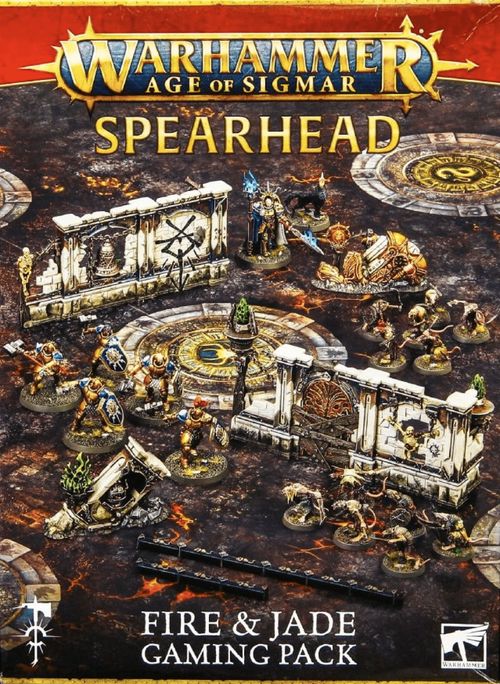
Warhammer Age of Sigmar: Spearhead – Fire & Jade Gaming Pack
Warhammer Age of Sigmar: Spearhead – Fire & Jade Gaming Pack Rulebook
Disclosure: the Fire & Jade Gaming Pack has no separate rules sheet. Its rules are the Spearhead Battlepack, Battleplan and Reference sections of Games Workshop's free Warhammer Age of Sigmar Core Rules PDF (Fourth Edition), reproduced below from the catalogued Core Rules transcription. The Core Rules are needed for the basics of play.
Spearhead Battlepack: Fire and Jade
To play a game using this battlepack, you'll need the Core Rules. The Core Rules explain the basics of Warhammer Age of Sigmar, such as how to move your models and how to use abilities. You don't need the Advanced Rules to use this battlepack.
1.0 Spearhead Armies
Each player in a Spearhead battle is the commander of a Spearhead army. A Spearhead army is a set of units that comes with its own rules and warscrolls. You can download the rules for 25 different Spearhead armies for free from warhammer-community.com.
1.1 Army Composition
On the first page of every Spearhead army's rules, you will find the army composition. This lists which units are included in the Spearhead army and who the general is. Unlike other Warhammer Age of Sigmar armies, the composition of a Spearhead army is fixed and cannot be changed.
1.2 Battle Traits
Every Spearhead army has one or more battle traits. These are powerful and thematic abilities that apply to some or all of the units in the army. For example, the 'Holy Orders' battle trait enables the Stormcast Eternals to use powerful once-per-battle abilities to smite their foes, while the 'Gnawhole Ambush' battle trait allows Skaven warriors to arrive on the battlefield behind enemy lines.
1.3 Regiment Abilities
Every Spearhead army has a choice of 2 regiment abilities, each of which provides the army with a different strength in battle.
1.4 Enhancements
Every Spearhead army has a set of 4 enhancements to pick from. These are upgrades for the army's general that make them more powerful in a variety of ways.
1.5 Spearhead Warscrolls
The warscrolls for the units in each Spearhead army are included with the other rules for the army. Although Spearhead warscrolls are similar to the warscrolls found in battletomes, they have been tailored to work specifically with Spearhead and cannot be used with other battlepacks.
Designer's Note – Wizards and Priests in Spearhead: Some units in Spearhead have the Wizard or Priest keyword. If you are familiar with other battlepacks, it is important to note the Magic module in the Advanced Rules is not used in Spearhead. As a result, there are no unbinding rolls and no chance of miscasts (among other things). Spells and prayers are resolved like any other ability.
(The book shows the Squig Hoppers warscroll as an example, including its 'Boing! Boing! Boing!' ability: Any Movement Phase – Declare: Pick an enemy unit that any models in this unit passed across this phase to be the target, then roll a dice for each model in this unit that did so. Effect: For each 4+, inflict 1 mortal damage on the target.)
2.0 Realm Battlefields
Spearhead battles are fought on realm battlefields. Once the players have picked their Spearhead armies, they must agree on a realm battlefield to use. Each realm battlefield comes with a matching Spearhead deck, along with a battleplan that explains how to fight a battle on that realm battlefield.
A realm battlefield is 30" x 22" and double-sided, with each side corresponding to a different Mortal Realm. The first realm battlefield is Fire and Jade, which has one side representing Aqshy, the Realm of Fire, and the reverse representing Ghyran, the Realm of Life.
3.0 Spearhead Decks
Spearhead decks are sets of cards that are used in Spearhead battles. Each realm battlefield has its own Spearhead deck. Each Spearhead deck consists of 2 twist decks (one for each side of the realm battlefield) and 2 battle tactic decks (one for each player).
3.1 Twist Cards
Each twist deck is made up of twist cards. A twist is a special rule that applies to the battle round being played. Each deck of twist cards corresponds to a specific side of the realm battlefield (the Aqshy Twist Deck and the Ghyran Twist Deck).
Source note: the printed rulebook shows only partly legible sample twist and battle tactic cards (e.g. an Aqshy twist and a Ghyran twist 'Grasping Vines', and the battle tactic 'Drive deep into enemy territory' with the command 'These warriors assume a defensive formation that blunts the blows of the enemy': Reaction: Opponent declared an Attack ability; a friendly unit targeted by that Attack ability ignores the Rend characteristic of attacks that target that unit this phase). The card decks themselves are not reproduced here.
3.2 Battle Tactic Cards
Each battle tactic deck is made up of battle tactic cards. The rules on each are split into 2 parts: a battle tactic and a command. You can either score the battle tactic at the end of your turn if you meet its conditions (to gain victory points) or you can use the command on the card for a more immediate benefit. You cannot do both, so choose wisely!
Each command will say when it can be used and what effect it has. After the effect has been resolved, the card is discarded. You can issue multiple commands to the same unit in the same phase.
4.0 Spearhead Battleplans
Each realm battlefield has a corresponding battleplan. The battleplan is a set of instructions on how to fight the battle and how to determine the winner. The battleplan for the Fire and Jade realm battlefield follows.
5.0 Terrain
In every Spearhead battle, the armies fight around 2 large terrain features and 2 small terrain features. Before the armies are deployed, each player will set up 1 large terrain feature and 1 small terrain feature wholly within their territory. Each terrain feature has certain passive abilities depending on its size:
- Large Terrain Feature: Cover, Obscuring, Unstable
- Small Terrain Feature: Cover, Unstable
Cover: Subtract 1 from hit rolls for attacks that target a unit that is behind or wholly on this terrain feature, unless that unit charged or has the Fly keyword.
Obscuring: A unit cannot be targeted by shooting attacks if it is behind or wholly on this terrain feature, unless it has the Fly keyword.
Unstable: Models can move across but cannot be set up on or end any type of move on any part of this terrain feature that is more than 1" tall.
(The examples shown are the Ruined Domicile, a large terrain feature, and the Ravaged Shrine, a small terrain feature.)
6.0 Objectives
In Spearhead battles, objectives are printed on the surface of each realm battlefield (the objective is the whole circle, not just the symbol in the centre).
6.1 Contesting Objectives
In Spearhead battles, while a model is on an objective (wholly or partially), it is contesting it.
Each objective is named after a mythical godbeast: Dracothion, Behemat, Ignax, Vulcatrix, Nagendra (and others as printed on the battlefield).
7.0 Reinforcements
Some units have the Reinforcements keyword (shown as an icon in the top-right corner of their warscrolls for ease of use). These units can be brought back to the battlefield after being destroyed as replacement units (Core Rules, 24.2). If any of your units have the Reinforcements keyword, you can use the following ability:
Once Per Turn, Your Movement Phase CALL FOR REINFORCEMENTS: A second wave of troops enters the fray, replacing those lost to the rigours of battle. Declare: Pick a friendly Reinforcements unit that has been destroyed. Effect: Set up an identical replacement unit on the battlefield, wholly within friendly territory, wholly within 6" of the battlefield edge and not in combat. Each Reinforcements unit can only be replaced once. Replacement units cannot themselves be replaced. Keywords: Core
A Spearhead Battle
The book shows a game of Spearhead underway upon the scorched plains of the Great Parch in Aqshy, with Stormcast Eternals clashing with a Skaven clawpack. Annotations: flying units, such as Prosecutors, can soar directly over other models and terrain, meaning they are very good at capturing objectives at the last moment; a destroyed unit of Clanrats can return to the battlefield because their warscroll has the Reinforcements keyword; a player's battle tactics are normally kept secret from their opponent; the large terrain features block visibility, so units can hide behind them – but not from units with Fly; a unit of Liberators is contesting the Dracothion objective in the centre of the battlefield; each Spearhead army has a general, a powerful unit that has access to enhancements; each player has a hand of battle tactic cards, which tell them what they should be trying to achieve and can instead be used as commands for a more immediate benefit; the twist deck is placed at the side of the battlefield in reach of both players – each battle round a twist card is drawn, which can lead to interesting opportunities or hazards for either player, and generally twists favour the underdog; a unit with a ranged weapon (such as a Warlock Engineer with a Warplock Musket) can hang back and shoot whilst also contesting an objective; six-sided dice and measuring sticks (or tape measures) are your essential tools, and the 3" measuring stick is perfect for measuring combat ranges.
Spearhead Battleplan: Fire and Jade
As the Hour of Ruin dawns, the fight to secure sacred sites and geomantic nexuses rages fiercer than ever. It is in Aqshy and Ghyran that the first battles of this new age are fought, each faction sending out vanguard forces to take and hold these places of power in the name of their deities – or even the godbeasts of myth. So unpredictable are these frontiers of war that the land itself can lend its blessing to the chosen or send wracking curses against those who incur its wrath.
Pre-Battle Sequence
- Roll off. The winner chooses who is the attacker and who is the defender.
- The attacker picks their regiment ability and their enhancement. Then the defender does the same.
- The defender chooses which side of the realm battlefield the players will fight on: Aqshy or Ghyran.
- The defender picks 1 of the deployment maps (horizontal: Territory A and Territory B as the two long halves of the battlefield; or diagonal: Territory A and Territory B divided by a diagonal line) and chooses which territory belongs to which player.
- The defender sets up their terrain features, followed by the attacker. Each terrain feature must be set up wholly within friendly territory, more than 6" from all other terrain features and more than 3" from both long battlefield edges and enemy territory. Terrain features cannot be set up on top of the objectives (either wholly or partially).
Deployment
Do not deploy armies as described in the Core Rules. Instead, the attacker sets up all the units in their army first, followed by the defender. Each unit must be set up wholly within friendly territory and more than 6" from enemy territory.
Battle Length
The battle lasts for 4 battle rounds.
Special Rules
Preparing the Spearhead Deck
This battle uses the Fire and Jade Spearhead deck. One player takes the twist deck that corresponds to the side of the battlefield the players are fighting on, shuffles it and places it face down next to the battlefield (the other twist deck is not used). Then, each player takes 1 battle tactic deck, shuffles it and places it face down where they can reach it during the battle.
Start of the Battle Round Sequence
The following sequence is resolved at the start of each battle round:
- If it is the first battle round, the attacker chooses who will take the first turn. In any other battle round, the players make a priority roll (Core Rules, 12.0).
- Determine the underdog (Core Rules, 12.0).
- The twist card is drawn.
- The players draw battle tactic cards (see below).
- Any abilities with the Start of Battle Round timing are used.
Twist Cards
One twist card is drawn at the start of each battle round. Follow the rules on it as soon as it is drawn.
Battle Tactic Cards
At the start of the first battle round, each player draws a hand of 3 battle tactic cards.
At the start of each subsequent battle round, each player draws battle tactic cards until they once more have a hand of 3 battle tactic cards. Before they do so, they can discard any number of battle tactic cards in their hand. Cards are discarded face-up.
Seizing the Initiative
If the player who went second in the previous battle round wins the priority roll and chooses to go first, it is called seizing the initiative. When a player seizes the initiative, they do not draw any battle tactic cards for that battle round unless they are the underdog and the difference in victory points between the two players is 5 or greater.
Victory Points
Each player scores victory points at the end of each of their turns as follows:
- Score 1 victory point if you control at least one objective.
- Score 1 victory point if you control two or more objectives.
- Score 1 victory point if you control more objectives than your opponent.
- Score 1 victory point for each battle tactic you completed this turn.
Glorious Victory
The player with the most victory points at the end of the battle is the winner. If the players are tied on victory points, the battle is a draw.
Thy life is a weapon – wield it well.
Spearhead Reference
The Spearhead Reference page repeats the pre-battle sequence, deployment, seizing the initiative, battle tactic card draws, start of battle round sequence, terrain, victory points and 'Call for Reinforcements' rules given above, with these clarifications: in step 4 of the pre-battle sequence the defender picks a deployment map (horizontal or diagonal); the defender sets up 1 large and 1 small terrain feature, then the attacker does the same; at the start of the second or later battle round you discard any battle tactic cards in your hand if you wish, then if you have fewer than 3 you keep drawing until you have 3.
Universal Core Abilities (Spearhead)
The Spearhead Reference lists the Universal Core Abilities in condensed form (Normal Move, Run, Retreat, Shoot, Charge, Fight), without flavour text, identical in effect to those in Core Rules 14.0 except that:
- Run: Declare: Pick a friendly unit that is not in combat to use this ability (the 'has not used a Run or Retreat ability this turn' restriction is not printed on this reference).
- Charge: the unit must end its move within 1/2" of an enemy unit (Core Rules 14.3 reads 'a visible enemy unit').
- Shoot and Fight declare text is as in the Core Rules, without the page cross-references.
Universal Weapon Abilities (Spearhead)
The Universal Weapon Abilities (Anti-X, Charge, Companion, Crit (2 Hits), Crit (Auto-wound), Crit (Mortal), Shoot in Combat) are repeated unchanged from Core Rules 20.0.