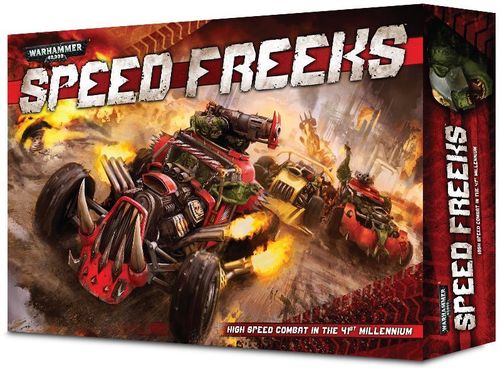
Warhammer 40,000: Speed Freeks
Warhammer 40,000: Speed Freeks Rulebook
Table of Contents
Table of Contents
- Game Overview
- Box Contents
- Datasheets
- General Rules
- The Game Turn
- Cunning Phase (Phase de Ruze)
- Vroom Phase (Phase de Vroum)
- Trails (Bidules)
- Collisions (Kollisions)
- Piloting Tests (Tests de Pilotage)
- Leaving the Battlefield
- Skidding (Dérapage)
- Shooting Phase (Phase de Tir)
- Fight Phase (Phase de Baston)
- Kastagn' (Scenarios)
- Kassez leur Matos! (Smash Their Rides!)
- La Grosse Baston (The Big Brawl)
- Kourse vers l'Orizon (Race to the Horizon)
- La Grande Arsouille (The Big Race)
- Additional Rules (Règles Additionnelles)
- Campaigns (Campagnes)
Game Overview
The burning engines roar, the power cells whistle, the saw blades start to turn, and the rides take on board the huge shells of experimental weapons. The Meks make their final adjustments. The Speedwaaagh! is on!
Speed Freeks is a game for at least two players. Each controls a stable (ékurie) of ork vehicles that comprises bikes and several rides that are as makeshift as they are dangerous.
The members of each stable are represented by Citadel miniatures, and the battlefield on which they clash is represented by specific game boards and obstacles. In turn, players select their miniatures to move them, make them shoot, and attack with their melee weapons in order to destroy their competitors and become the greatest stable in the galaxy!
If a group of players wishes, they can play a campaign, each leading a stable of ork vehicles over a series of linked games to decide who is the best racer.
Box Contents
Speed Freeks contains the elements needed for your games, described below.
- Datasheets: Each Speed Freeks miniature has its own datasheet, on which all the information needed to play it is found, as explained on page 4.
- Customisation cards: Customisation cards detail the upgrades that miniatures can acquire. Suggestions for using these cards are on page 21.
- Damage cards: Damage cards are used when a miniature suffers damage in combat. They are placed face down in a pile next to the battlefield. When necessary, draw the top card and apply the result.
- Game boards: Speed Freeks includes game boards that can be configured in various ways to create the battlefield, as indicated in each kastagn' (pages 15-18).
- Speed Freeks screens: Speed Freeks screens are used in the Cunning phase (Ruze, page 7) to allocate your dice in secret. The dashboards make it possible not to mix up your dice.
- Dice: Speed Freeks uses special six-sided dice, as well as an eight-sided die called the D8. It also includes a ruler for measuring the ranges of weapons and abilities.
- Initiative marker and damage tokens: Speed Freeks also includes an initiative marker to indicate who plays first, and damage tokens to indicate how many points of damage a miniature has suffered. There are also a few numbered tokens to use in the Big Race (La Grande Arsouille, page 18).
- Firing arc markers: The firing arc markers are used to determine whether a vehicle's guns can target an enemy (page 5), as well as the collision angle (page 10) or skids (page 11).
- Trails (bidules): There are four types of trails (page 10). Trails have single arrows, Spé trails have double arrows, and Klass trails have red triple arrows. There is even a reverse trail (bidule de reukul) to get yourself out of a bad spot!
Datasheets
The rules and characteristics of all Speed Freeks miniatures are presented on datasheets, which you will need to use the miniatures in combat. Each datasheet contains all sorts of information about its miniature, as shown on the example datasheet (Kustom Boosta-blasta).
- Vehicle Name: This section gives the name of the miniature, and a photograph to identify it.
- Vehicle Profile: This section contains the following statistics, which describe the strength of each miniature:
- Armour (Blindage): Indicates how hard the vehicle is to damage.
- Hits (Touches): Indicates how much damage the vehicle can take before being destroyed.
- Melee (Mêlée): This shows how dangerous the vehicle is in close combat.
- Driving (Conduite): Measures the driver's piloting skills and the degree of control he exerts over his machine.
- Guns (Kanons): Weapons are described using the following characteristics:
- Firing Arcs (Arcs de Tir): The directions in which the weapon fires, determined by the firing arc marker.
- Range (Portée): How far from its target a miniature must be to shoot.
- Shots (Tirs): The number of attack dice you roll for the weapon.
- Damage (Dégâts): The number of damage cards drawn for each successful attack die.
- Abilities (Aptitudes): Additional rules that apply when the weapon fires.
General Rules
The rules below set out everything you need to know to use your Speed Freeks miniatures in your races across the galaxy and against your competitors.
Measuring Distances
In Speed Freeks, distances are measured in inches ("), between the closest points of the bases of the miniatures for which you are measuring distances. You can measure distances whenever you like.
Dice
Speed Freeks uses special six-sided dice. The game also uses an eight-sided die, called the D8.
Bikes and Rides (Békanes et Kaisses)
Stables generally include bikes (békanes) and larger vehicles. In the rules, all miniatures that are not bikes are called rides (kaisses).
Terrain Features
You may want to add terrain pieces to your Speed Freeks boards, such as ruins or trees. These are called "terrain features".
Re-rolls
Some rules allow you to re-roll a dice roll, which means you roll one or more dice again. A die can never be re-rolled more than once.
In Turn Order (À tour de rôle)
If a rule asks players to go in turn order, start with the player who has the initiative token, then continue clockwise until all players have taken their action.
Obstacles
Speed Freeks includes six piles of debris called "obstacles". Details on using these obstacles are found on page 14.
Firing Arcs
You will see on each miniature's datasheet that guns and certain abilities have a firing arc. These are the directions in which a weapon can be pointed to hit opponents. When you attack with a weapon, you must identify the eligible targets. Place a firing arc marker against the base of the miniature, at the front or rear of it, as shown below, to see in which arc the enemy lies. If a miniature is in several firing arcs, it can be targeted by weapons of any arc it is in, regardless of which arc it is in.
In our example, miniature A made shooting attacks. Miniature B is an eligible target for any weapon with a front firing arc. Miniature C is an eligible target for any weapon with a front or right firing arc.
The Game Turn
A game of Speed Freeks is played over several turns, each divided into several phases, described below.
- Cunning phase (Phase de Ruze): During the Cunning phase, players allocate their dice and determine which player will act first in each subsequent phase of this turn.
- Vroom phase (Phase de Vroum): In the Vroom phase, players allocate their Vroom dice to each of their miniatures and move them.
- Shooting phase (Phase de Tir): In the Shooting phase, players choose in turn a vehicle and make the gun or guns it has fire at enemy miniatures.
- Fight phase (Phase de Baston): In this phase, miniatures can make melee attacks against nearby enemy miniatures. After the Fight phase, this turn ends and another begins with a new Cunning phase.
Cunning Phase (Phase de Ruze)
Even though Orks are not renowned for their intelligence or mental agility, the pilots of the Speedwaaagh! must react to developments in the race within a few hundredths of a second. Only the cleverest and the cruellest go further than the starting line.
Each player takes 10 Speed Freeks dice. Then, concealing their choice from their opponents with the Speed Freeks screen, players allocate the dice as they wish to the Cunning (Ruze), Vroom and Shooting (Tir) categories on their dashboard. Players must allocate at least 1 die to the Vroom category per miniature they control on the battlefield. Once allocated, the dice are called Cunning dice, Vroom dice and Shooting dice respectively, until the start of the next turn.
Players then remove their screens simultaneously to reveal their dice. Then they roll their Cunning dice. They score 2 points per lightning bolt result, 1 point per target (crosshair) or shield result, and 0 points per star (burst) result. The player with the highest score takes the initiative marker. In case of a tie, the players re-roll until one player gets the highest score. If no player allocated any Cunning dice, they roll the D8, re-rolling in case of a tie, and the player with the highest score takes the initiative marker.
Vroom Phase (Phase de Vroum)
The boosters are activated, and with a screech of tyres the vehicles swerve and zigzag across the battlefield. The pilots yell instructions at their crews as they try to take the lead in the race or get the best firing angle.
Starting with the player who has the initiative marker, players allocate their Vroom dice in turn to their miniatures. Players must allocate at least one Vroom die to each of their vehicles on the battlefield. A player cannot allocate more than 5 Vroom dice to a single vehicle. Dice that cannot be allocated cannot be used this turn.
That done, starting with the player who has the initiative marker, players choose in turn one of their miniatures to move and follow the sequence below.
- Roll the Vroom dice allocated to the miniature and add up Vroom points according to the symbols obtained:
- Add 2 points for each lightning bolt result.
- Add 1 point for each target (crosshair) or shield result.
- Add 0 points for each star (burst) result.
- Choose a number of trails equal to the number of Vroom points obtained. If you have 0 Vroom points or fewer, the vehicle has stalled and can no longer move this turn.
- Example of a roll of 4 Vroom dice: lightning bolt (2) + star (0) + target (1) + shield (1) = choose 4 trails.
- Draw an imaginary line through the centre of the miniature's base and align the first trail you want to use on this line, as shown. Place the rest of the trails you have chosen end to end in any order to obtain this miniature's trajectory. No trail can be used more than once when you create this miniature's trajectory. If there are no more trails available, the vehicle cannot go any further.
- Move the miniature along the trajectory, making sure that most of the imaginary line through the centre of the base follows the trail. When a miniature's base reaches the end of a trajectory, place the miniature in contact with the end of it, so that the imaginary line through the centre of the base is aligned with the mark at the end of the trail, as shown. If at any time the miniature comes into contact with another miniature, an obstacle or a terrain feature, the miniature enters into a collision and cannot move any further (see Collisions, p. 10).
Trails (Bidules)
Each player has several trails to move their miniatures. Each player can use each trail any number of times during a turn. Each player can use each of their Spé trails once per turn. Each player can use only a single Klass trail per battle for each of their miniatures. A Klass trail can only be used if the player obtains 1 or more lightning bolts on that miniature's Vroom dice.
Reverse Trail (Bidule de Reukul)
Each player also has a reverse trail, used differently to create a trajectory. The reverse trail is placed in contact with the rear of the miniature that is moving instead of the front, then the trajectory is created normally.
Collisions (Kollisions)
If at any point in its movement a miniature comes into contact with another miniature, an obstacle or a terrain feature, it makes a collision. Do not move that miniature any further, and resolve the following collision sequence.
- The point where the miniatures hit each other is the collision point. Consult the datasheets to see any abilities that apply.
- The player controlling the miniature that enters into the collision rolls 2 Speed Freeks dice for the obstacle or the miniature it hits, and their opponent rolls 1 Speed Freeks die for the miniature that is hit. Do not roll any dice for terrain features.
- For each lightning bolt or target (crosshair) result on these dice, draw 1 damage card for the miniature affected by the roll.
Head-on collision (Kollision frontale): If the collision point is in the front arc of both miniatures, roll 3 dice for each miniature instead.
Piloting Tests (Tests de Pilotage)
After moving a miniature using any number of Spé or Klass trails, you must make a piloting test, to check that the pilot has kept control of the vehicle. Roll a D8, and add 1 if you used one or more Spé trails, or 2 if you used a Klass trail. If the result is higher than the miniature's Driving characteristic, the vehicle is out of control.
Roll a D8 and make the miniature spin on itself by the most direct route in the direction shown in the diagram (a diagram of the base with directions numbered 1 to 8 around it). If any part of the miniature comes into contact with another miniature, obstacle or terrain feature, it stops turning, and counts as if it had been hit (collided).
Leaving the Battlefield
If any part of a miniature crosses the edge of the battlefield at any point in a movement, or following a spin-out (tête-à-queue), that miniature is immediately destroyed.
Skidding (Dérapage)
When you create a miniature's trajectory, instead of aligning the first trail on the centre of the miniature, you can declare that it will try a skid. In this case, use a firing arc marker to draw an imaginary line at a 45° angle instead of the centre of the miniature, as shown. If a miniature skids, add 1 to the result of any piloting test made for the miniature during the same turn.
Shooting Phase (Phase de Tir)
The clatter of weapons covers the noise of the engines when the gunners open fire, spraying hails of projectiles and energy beams at enemy vehicles, which barrel-roll before exploding, scattering multiple pieces of debris around.
Starting with the player who has the initiative marker, players allocate their Shooting dice to their miniatures. Shooting dice must be divided equally among all the player's miniatures on the battlefield that have an eligible target. An eligible target is an enemy miniature visible from any point of the miniature that fires (if in doubt, crouch down and look from behind the firing miniature to see if the miniature is visible), within range and within the firing arc of at least one gun of that miniature (if in doubt, check with a firing arc marker and a ruler).
In the example below, the Evil Sunz player has three miniatures on the battlefield, and the Bad Moons player has one. The Evil Sunz player has 4 Shooting dice, to be divided as equally as possible among the miniatures that have an eligible target. Ride A and bike B both have an eligible target, within the firing arc of one of their guns. Bike C has no eligible target, so the Evil Sunz player can allocate his 4 Shooting dice equally between ride A and bike B, as shown below.
That done, starting with the player who has the initiative marker, players select in turn one of their miniatures to which Shooting dice have been allocated and make shooting attacks for that miniature. To make a shooting attack, follow the sequence below. Each miniature can only be selected to make shooting attacks once per Shooting phase.
- Divide the Shooting dice allocated to the miniature as evenly as possible among all of that miniature's guns that have eligible targets.
- Choose one of the guns that has been allocated Shooting dice. Then choose an eligible target for that gun and roll a number of Speed Freeks dice equal to the gun's Shots characteristic. These are the Attack dice. You can re-roll 1 Attack die for each additional Shooting die allocated to the gun. Each target (crosshair) or lightning bolt result is a success; any other result is a failure.
- The player of the targeted miniature rolls a number of Speed Freeks dice equal to the miniature's Armour characteristic. These are the Defence dice. Each shield or lightning bolt result is a success; any other result is a failure. Each successful Defence die cancels one successful Attack die.
- If there are no successful Attack dice left, the attack fails. If one or more successful Attack dice remain, the player of the targeted miniature draws a number of damage cards equal to the Damage characteristic of the firing weapon for each remaining successful Attack die, and resolves their effects. Repeat steps 2 and 3 for the miniature's other guns that have Shooting dice.
Damage
A damage card indicates that a miniature suffers 1 or more points of damage. If this happens, you should place a damage token next to the miniature. If the number of damage tokens on a miniature is equal to or greater than its Hits characteristic, that miniature is destroyed. When a miniature is destroyed, immediately remove it from the battlefield. It takes no further part in the battle.
Fight Phase (Phase de Baston)
Saw blades screech as they bite into metal, crews strike their rivals with their tools and drivers crush their bodywork against that of their competitors, to seriously damage the nearest opponent.
Starting with the player who has the initiative marker, players choose in turn one of their miniatures that is within 2" or less of one or more enemy miniatures. To do so, follow the sequence below. Each miniature can only be chosen to make melee attacks once per Fight phase.
- The player of the attacking miniature chooses an enemy miniature within 2" or less of it and rolls a number of Speed Freeks dice equal to the attacking miniature's Melee characteristic. These are the Attack dice. Each target (crosshair) or lightning bolt result is a success; any other result is a failure.
- The player of the target miniature then rolls a number of Speed Freeks dice equal to the miniature's Armour characteristic. These are the Defence dice. Each shield or lightning bolt result is a success; any other result is a failure. Each successful Defence die cancels one successful Attack die.
- If there are no successful Attack dice left, the attack fails. If one or more successful Attack dice remain, draw a damage card for the target miniature for each remaining successful Attack die.
Kastagn' (Scenarios)
You will find in this section several scenarios to use in your games of Speed Freeks. From huge destructive battles to flat-out races in the desert, there is plenty to sink your teeth into.
When you play a game of Speed Freeks, you must choose a kastagn'. This rulebook includes four, but you can play one of your own creation if you wish. Some kastagn' are based on speed and manoeuvres, while others concentrate on the destructive power of weapons and on the vehicles themselves to defeat the enemy!
If you and your opponent cannot decide which kastagn' to play, roll a D8 and consult the table below.
| D8 | Kastagn' |
|---|---|
| 1-2 | Kassez leur Matos! (Smash Their Rides!) |
| 3-4 | La Grosse Baston (The Big Brawl) |
| 5-6 | Kourse vers l'Orizon (Race to the Horizon) |
| 7-8 | La Grande Arsouille (The Big Race) (if you do not have two boxes of Speed Freeks, play La Grosse Baston instead.) |
Obstacles
Barricades, piles of debris and other detritus abandoned by the orks litter the battlefield of every game of Speed Freeks. We call them collectively "obstacles". There are six obstacles of varying sizes in the box of this game.
In games of Speed Freeks, these obstacles can be destroyed in the same way as enemy miniatures. However, when you allocate Shooting dice to your miniatures each turn, each player can decide whether or not to treat obstacles as eligible targets for their stable (see Shooting phase, p. 12).
If a miniature wishes to shoot at an obstacle, follow the shooting sequence described on page 12. Obstacles have an Armour characteristic of 3, and a Hits characteristic of 2.
If a player must draw a damage card for an obstacle, it automatically suffers 1 point of damage instead.
Obstacles are of varied shapes and sizes and do not count as having firing arcs.
Kassez leur Matos! (Smash Their Rides!)
For an ork, smashing an opponent's ride is as important as collecting the parts to build a flashy vehicle, as long as their own machine does not end up added to the enemy's pile of debris!
The Stables (Les Ékuries)
Each player controls a stable comprising 1 ride and 3 bikes. One player plays the attacker, who assails the territory of their rival. The other player is the defender, and tries to repel or destroy the raiders. Players can discuss between themselves who will play the attacker and who will play the defender, or both roll their dice, and the player who obtains the most lightning bolts decides who is the attacker and who is the defender. In case of a tie, re-roll until one player gets more lightning bolts than the other.
The Battlefield
The defender creates the battlefield by placing up to 3 Speed Freeks boards as shown below, then places 4 obstacles anywhere on the battlefield. Obstacles must be placed more than 2" from any deployment zone and more than 8" from each other.
Placement
The defender places their stable entirely within the defender's 11" x 8" deployment zone. The attacker then places their stable entirely within the attacker's 11" x 8" deployment zone.
(Diagram: boards 1 to 3 in a row, with the Defender's deployment zone in a corner of board 1 and the Attacker's deployment zone on board 2. Board 4 is shown separately with edges marked 1-2, 3-4 and 5-6, and 7-8 "Defender's choice".)
First Turn
The attacker adds 1 to their total when rolling their Cunning dice in the first turn.
Shifting Dunes (Dunes Mouvantes)
The first time a miniature finishes its movement on the 3rd board, the defender rolls a D8 and places the 4th board in contact with the 3rd in the position corresponding to the result of the die roll, as shown (1-2, 3-4, 5-6 are the three sides marked on the diagram; 7-8 is the defender's choice). They then place the 2 remaining obstacles anywhere on this board, more than 8" from any other obstacle.
Duration of the Battle
If the 6 obstacles are destroyed, or if a player has no more miniatures on the battlefield, the battle ends. Otherwise, it lasts five turns.
Victory Conditions
If the 6 obstacles have been destroyed, or if there are no more of the defender's miniatures on the battlefield at the end of the battle, the attacker wins. If there is at least 1 obstacle on the battlefield at the end of the battle, or if there are no more of the attacker's miniatures on the battlefield, the defender wins.
La Grosse Baston (The Big Brawl)
When ork gangs meet in the desert, violence is inevitable. No one wants to back down before the end of the fighting, especially when the battlefield is littered with valuable spare parts.
The Stables
This is a battle for two to four players. Each player controls a stable comprising 1 ride and 3 bikes.
The Battlefield
Create the battlefield by placing four Speed Freeks boards as shown below (two by two). Each player then rolls a D8, re-rolling in case of a tie, and then, starting with the highest result, takes turns placing one obstacle on the battlefield, until all 6 are placed. Obstacles must be placed more than 2" from any deployment zone and more than 8" from each other.
Placement
Each player rolls all of their Speed Freeks dice and counts the number of lightning bolt results. The player with the lowest score chooses one of the 11" x 8" deployment zones shown below (one in each corner of the battlefield) and places their stable entirely in it. The player with the second lowest score then chooses one of the remaining 11" x 8" deployment zones shown below and places their stable entirely in it, and so on, until all players have placed their stable. Players who are tied re-roll their dice until the tie is broken.
Squig Nests (Nids de Squigs)
Roll a Speed Freeks die each time a miniature ends its movement within 2" or less of an obstacle. On a star (burst) result, draw a damage card for that miniature.
Duration of the Battle
The battle lasts five turns, or until only one player is left with miniatures on the battlefield.
Victory Conditions
Players score 1 point for each bike they destroy and 3 points for each ride they destroy. If a miniature is destroyed as a result of a damage card drawn because of the effects of a Ça Krame! damage card, the player who made the attack that inflicted the Ça Krame! card scores the points for that miniature. If a miniature has 2 or more Ça Krame! damage cards on it, the player who controls it can decide in which order they are resolved at the start of each turn. The player with the most points is declared the winner. In case of a tie, the tied players are declared winners.
Kourse vers l'Orizon (Race to the Horizon)
(The final words of the first line of the introduction are hidden by an overlay in the source image.) Even more than brawling, orks love to go fast. All Stables dream of being the fastest [...] and showing the other greenskins that they have the best machines and the best pilots.
The Stables
This is a battle for two to four players. Each player controls a stable comprising 1 ride and 3 bikes.
The Battlefield
Create the battlefield by placing 4 boards as shown below, from left to right. Players then each roll a D8, re-rolling in case of a tie, and then, starting with the highest result, take turns placing 1 obstacle on the battlefield until all 6 are placed. Obstacles must be placed more than 2" from any deployment zone and more than 8" from each other.
Placement
Each player rolls all of their Speed Freeks dice and counts the number of lightning bolt results. The player with the lowest score chooses one of the 12" x 5½" deployment zones shown below (four zones stacked along the tail edge) and places their stable entirely in it. The player with the second lowest score then chooses one of the remaining 12" x 5½" deployment zones shown below and places their stable entirely in it, and so on until all players have placed their stables. Players who are tied re-roll their dice until the tie is broken.
(Diagram: four boards in a row; the left edge is the "Tail edge" (Bord de Queue) with four deployment zones; the right edge is the "Head edge" (Bord de Tête).)
The Road Scrolls By (La Route Défile)
The first time a player moves a miniature onto the board closest to the head edge (see below), that player removes the board on the tail edge. Any obstacle or miniature in contact with that board is destroyed. That board is then placed in the same orientation, abutting the head edge of the battlefield. This creates new head and tail edges. The player who placed this board can also place on it the obstacles that were destroyed when the board was moved. Obstacles must be placed more than 8" from any other obstacle.
Duration of the Battle
The battle lasts until only one player is left with miniatures on the battlefield.
Victory Conditions
The player who has any number of miniatures left on the battlefield at the end of the battle is declared the winner. If the last two or more miniatures on the battlefield are destroyed simultaneously (for example because of Ça Krame! damage cards), the players who control those vehicles are declared winners.
La Grande Arsouille (The Big Race)
A particularly powerful Mek sometimes organises a race to entertain his Boyz, offering top-quality spare parts as a prize. Finish first or die trying!
The Stables
This is a battle for two to eight players. Each player controls 1 ride.
The Battlefield
This race requires two sets of Speed Freeks boards. Create the battlefield by placing the 8 Speed Freeks boards, 8 obstacles and 8 step markers to obtain a figure-of-eight circuit, as shown on the following page (a grid of 4 x 2 boards, with step markers 1 to 8 laid out around the circuit and obstacles placed along its centre).
Placement
Each player rolls all of their Speed Freeks dice and counts the number of lightning bolts. The player with the lowest score chooses one of the 6" x 4" deployment zones shown on the following page and places their stable entirely in it. The player with the second lowest score then chooses one of the remaining 6" x 4" deployment zones and places their stable entirely in it, and so on until all players have placed their stable. Tied players re-roll their dice until the tie is broken.
Circuit
Each player must try to pass each numbered step in order, starting with 1 and ending with 8. A miniature must pass within 4" or less of a step to pass it.
Step markers passed out of order do not count, and the sequence is not reset to zero if a miniature passes a step out of order. For example, if a miniature passes step 1 and then 3, step 3 does not count, and the miniature must go back and pass step 2 before it can pass 3. When a miniature has passed all the step markers in order, it earns 1 lap point. The sequence is then reset to zero for that miniature, which can begin a new "lap" by passing step 1.
Rowdy Crowd (Foule en Délire!)
If a miniature ends its movement within 3" or less of any edge of the battlefield, it risks being hit by a projectile thrown by the crowd. Roll a Speed Freeks die. On a star (burst) result, draw a damage card for that vehicle.
Duration of the Battle
The battle lasts until a player earns 3 lap points, or until only one player is left with miniatures on the battlefield.
Victory Conditions
The player who earns 3 lap points is declared the winner. Otherwise, the last player to have a miniature on the battlefield at the end of the battle is declared the winner. If the last two miniatures on the battlefield are destroyed simultaneously (for example as a result of Ça Krame! damage cards), the players who control those miniatures win.
Additional Rules (Règles Additionnelles)
This section contains additional rules that can be used with those described in the preceding pages to deepen your games of Speed Freeks.
Ork Clans
If you wish, you can affiliate your stable with one of the main ork clans. You can then use the corresponding clan rules for all the miniatures in your stable.
Evil Sunz
The Evil Sunz are known throughout ork society for their love of speed, and they constantly tinker with their engines to get the best out of them.
Les Pluss Vit' (The Fastest): Once per round, when you move an Evil Sunz miniature, you can reuse a Spé Trail already used by your stable that round.
Bad Moons
The Bad Moons always have the most luxurious rides, with squig-leather seats or rotating hood ornaments. These upgrades are not just aesthetic, because the Bad Moons often also have the best guns on the market.
Kanons d'Frimeurs (Show-Off Guns): You can re-roll any star (burst) results when you make shooting attacks with a Bad Moons miniature in the Shooting phase.
Deathskulls
The Deathskulls are very resourceful, able to salvage parts from smoking wrecks in the middle of a race to repair their own machines.
Pillards (Looters): Each time a vehicle is destroyed, you can choose one of your Deathskulls miniatures within 3" or less of it and remove 1 damage from it.
Goffs
The Goffs love a brawl, especially when they can look their opponent in the whites of the eyes while knocking their teeth out!
Les Pluss Costauds (The Toughest): You can re-roll 1 Attack die of a Goff miniature when it attacks in the Fight phase.
Snakebites
The Snakebites are traditionalists, who prefer kit that has proven itself to flashy gadgets. They do not have the prettiest rides, but they are often the most reliable.
Kom Avant (Like Before): You can re-roll the first star (burst) result when you roll the Vroom dice of one of your stable's Snakebites miniatures each turn.
Blood Axes
Often accused of not being true orks, the Blood Axes wield foreign concepts such as strategy and tactics. Once the race has started, this lets them seize the slightest opportunity to take the lead.
Tactiques Ruzées (Cunning Tactics): Once all Vroom dice are allocated, a Blood Axes player can re-allocate up to 3 of their Vroom dice. They must still allocate at least 1 to each of their miniatures.
Kustomisations (Customisations)
Kustomisations are vehicle upgrades that pilots can buy from a Mek. However, dealing with Mekboyz keen on experimentation carries risks, and an ork never knows what the disturbed mechanic will do to his ride. All he knows is that it will be loud and spectacular, which is enough to convince even the stingiest ork to part with his teeth and his dearly acquired scrap metal.
If you are playing a pick-up game, players can decide to use the customisation cards before the battle. If so, determine how many each miniature will have, then draw the appropriate number of cards for each miniature before placement.
In a campaign (p. 22), after each battle, each player can send one of their vehicles to be customised. Players who did not win can choose a vehicle and draw a customisation card. Those who won can choose a vehicle, draw two customisation cards and keep one. These miniatures keep these customisations for all the following games of the campaign. A miniature cannot have more than 3 customisations. If a miniature explodes, as indicated on its datasheet, all its customisations are lost as the vehicle must be replaced with a new machine.
Example card, "Patte de Squig" (Squig Foot): Roll a Speed Freeks die each time you must draw a damage card for this miniature. On a lightning bolt, do not draw it. You can only make one roll for each card to draw, whatever the number of similar abilities a miniature has.
Campaigns (Campagnes)
Playing games of Speed Freeks pick-up style is very stimulating, but the thrill of speed and destruction takes on a whole other dimension in a campaign.
If you wish, you can play a series of games of Speed Freeks with the same stables as part of a campaign. There are several ways to proceed, depending on the number of participants, the length of the campaign and the availability of your group of players.
Narrative Campaign
One or more players can write a story that will serve as a framework for their games. The players can then fight a series of battles that follow this story. This often allows players to develop amusing rivalries, scenarios of their own invention, and to add other narrative ideas such as weekly rewards for particularly formidable vehicles, special or unplayable objectives that rely on the story, to be fulfilled in addition to the normal objectives of a mission, or any other imaginable variant. Inspiration can come from anywhere, but the best scenarios are often those with a fun theme. The only limits are those of your imagination!
Ladder Campaign (Campagne à Échelons)
This type of campaign is simple. Players start in a randomly determined order, from the top to the bottom of the ladder. If a player beats an opponent placed higher than them on the ladder, they swap places. If a player beats an opponent placed lower, the winner swaps places with the player placed directly above them. This type of campaign is perfect for groups who have limited time to play, because you just need to name the winner when the allotted time is up or organise a final game between the top two players of the ranking to decide who will be champion.
Championship (Championnat)
Inspired by the various racing championships of the real world, this style of campaign uses a league system. Players must fight an equal number of games, against as many different opponents as possible. Players score a certain number of points for each victory, and at the end of the season, the one with the most points is crowned champion!
Linear Campaign (Campagne Linéaire)
This type of campaign is designed for two players, and the result of each kastagn' influences the events of the next. Below is an example of this type of campaign:
- The players begin with the Big Race (La Grande Arsouille). The winner will automatically be the attacker in the next kastagn', Kassez leur Matos.
- If the attacker wins Kassez leur Matos, they receive a free customisation before the players play Kourse vers l'Orizon.
- If the Defender wins Kassez leur Matos, their opponent can only allocate 8 Speed Freeks dice in the first round of Kourse vers l'Orizon.
- The loser of Kourse vers l'Orizon must draw a damage card for each of their miniatures before placing their miniatures for the final kastagn', the Big Brawl (La Grosse Baston).
- The winner of the Big Brawl (Grande Baston) wins the campaign and is crowned Speedboss!
Growing Your Stable (Agrandir votre Ékurie)
If you wish, you can allow players to grow their stable as the campaign progresses. This can be done in various ways. You could for example allow players to start the campaign with any number of miniatures in their stable. Then, after the players have agreed on the kastagn', they can choose which miniatures of their stable they will use to play that kastagn'. This allows players to choose the miniatures best suited to a particular kastagn', but it also means that the customisations acquired at the end of the games will be spread among a greater number of vehicles.