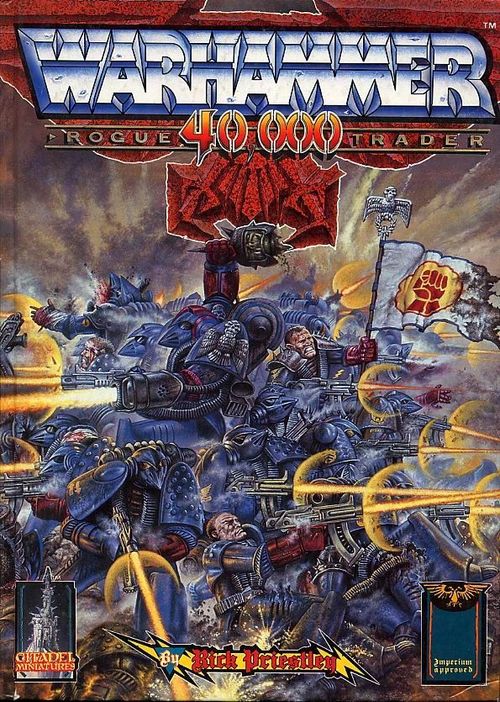
Warhammer 40,000: Rogue Trader
Warhammer 40,000: Rogue Trader Rulebook
Table of Contents
Table of Contents
- About This Book
- Scales
- Game Equipment
- Combat
- Movement
- Shooting
- Hand-to-Hand Combat
- Rout and Pursuit
- Reserves
- Psychology
- Buildings
- Vehicles
- Dreadnought Suits
- Robots
- Aerial Movement and Combat
- Personalities
- Psionics
- Mutants
- Points Values
- The Battle at the Farm
- Equipment
- Basic Weapons
- Close Combat Weapons
- Heavy Weapons
- Very Heavy Weapons
- Grenades and Missiles
- Mines
- Support Weapons
- Weapon Summary
- Vehicle Profiles
- Armour Profiles
- Robot Profiles
- Bionics
- Miscellaneous Equipment
- The Age of the Imperium
- Humans
- The Adeptus Terra
- Habit Colours
- Weapon Generation
- Chart 1 - Low Level Adeptus Mechanicus and Administratum
- Chart 2 - Low Level Adeptus Custodes
- Chart 3 - Low Level Adeptus Arbites (See Also Chart 6)
- Chart 4 - Ordinary Members of the Adeptus Mechanicus and Adeptus Astronomica
- Chart 5 - High Level Members of the Adeptus Terra
- Chart 6 - Adeptus Arbites Combat Equipment
- Inquisition
- Psykers
- The Adeptus Astra Telepathica
- Navigators
- The Legiones Astartes
- Warriors of the Army
- The Rogue Trader
- The Assassins
- Abhumans
- The Eldar Race and the Craft-Worlds
- Orkoid Space and the Ork Domains
- The Ancient Slann and Their Inheritance
- Tyranids and the Hive Fleets
- Warp Creatures
- Alien Creatures
- Alien Plants
- Death World
- Creature Charts
- The Advanced Gamer
- Planetary Landings
- Extended Battles and Campaigns
- Plot Generator
- Summary
- Playsheet
- Radius Effect Templates
- Orks - Gamesmaster's Information
- Space Marines - Gamesmaster's Information
- Marines Brief
- Ork Players Brief
- Counters
- Unit Record Sheet
About This Book
The Warhammer 40,000 book is divided into five main sections containing rules, background information and other details to aid play.
Combat gives rules, suggestions and useful hints for staging your own tabletop battles using miniatures and dice. Movement, shooting, close combat, rout and pursuit, reserves and psychology are all covered, and an extended set of rules is provided for vehicles, dreadnoughts, aerial movement, personalities and psionics.
Equipment provides you with a wide variety of fascinating futuristic weapons, armour types, vehicles, robots and many other features for inclusion in the game.
The Age of the Imperium explains how the Warhammer 40,000 universe works, how the different races act and fight, and how the different sorts of troops are organised and equipped.
The Advanced Gamer provides extra rules for players, including advice on campaigns, game plots and multiplayer games. Also covered are collecting and painting models, and we provide modelling details so that you can make your own buildings as well as offering some examples of how scenery can be constructed.
Summary lists all of the major charts together, and provides you with a selection of combat templates, building plans, record sheets, and paper counters.
Scales
Warhammer 40,000 has been designed around a ground scale of 1 tabletop inch = 2 metres of real distance. Tabletop distances are expressed in inches and imperial units within the rules. 'Real' distances are expressed in metric measurements: so a target 10 inches distant on the tabletop is 20 metres away in 'real' terms. There is no reason why you shouldn't modify this scale to suit your own collection of models and the size of your playing area.
Each model represents a single man, alien, vehicle, building or whatever. Large groups of very small creatures, such as thousands of locusts, can be represented by a smaller number of models. In cases such as this, one model can be regarded as representing 100 creatures if they are approximately rat sized, or 1000 creatures if they are tiny insects. So, 2 model rats = 200 individual rats; 2 model locusts = 2000 individual locusts.
The ranges and effectiveness of weapons have been calculated from the basis of individual weapons firing a single shot or blast at a single target. Most of the rules used for historical wargames assume massed ranks of firers blasting away at a massed target. For this reason, the ranges and effectiveness of Warhammer 40,000 weapons may seem comparatively low, but we believe that this is reasonably accurate, and it does give a better game.
Game Equipment
Apart from these rules and a selection of models and scenery, you will need dice, rulers, scrap paper and pencils. Dice are used during combat, and it is a good idea to have several of these. A cup will make a useful shaker. As an alternative to models we have provided a selection of counters for you to copy and use. Though they are in no way as attractive or as substantial as metal models, these will allow you to fight out your first few battles for no additional cost or effort.
Players
You also need players! Games are usually fought between two opposing sides, each side represented by one or more players. For larger games it is convenient to have more than one player on each side, as this makes dice throwing and troop movement quicker and easier. The co-commanders can agree to divide their forces between them as they wish.
Gamesmaster
To fight a Warhammer 40,000 game you will need an extra person called the gamesmaster, usually referred to simply as the GM. He will act as the umpire or referee, and it is his task to enforce the rules of the game; interpreting them where necessary. The GM should make sure that the players have sufficient dice, pencils, paper and any other items needed during play.
It is possible to fight a game without a GM, so long as the players are willing to cooperate a little, adopt a reasonable attitude and are honest in their record keeping. It is also possible to fight games in which all of the players are on the same side, against a side controlled directly by the GM. Of course, this does rely on the GM to make the game as fair as possible. One-sided games against the GM should be conducted with the aim of finding how well the players perform, rather than by aiming to defeat them.
Dice
The game uses a number of different shaped dice, as well as the normal six sided dice with which we are all familiar. Players will find it useful to have at least one each of the 4 sided, 8 sided, 10 sided, 12 sided and 20 sided dice. You will need a number of 6 sided dice, preferably about a dozen.
The standard notation is to write 'D' for dice, followed by the number of sides. So, when you see 'D4' in the text you know we are referring to a 4 sided dice — similarly, a D6 is a normal six sided dice, and so on. Sometimes you will need to roll more than one dice of a kind. This is indicated by a number preceding the D. For instance, 2D8 means you throw two D8s and add the scores together — throw a D8 twice if you are short of dice. The following examples illustrate the method.
| Dice | Rolled | Score | Procedure | Result |
|---|---|---|---|---|
| 3D4 | 3 D4s | 1, 3, 2 | Add scores | 6 |
| 2D6 | 2 D6s | 2, 5 | Add scores | 7 |
Sometimes you will need to modify the dice score. For example D6+1, this means throw a D6 and add 1 to the result. 3D4+2 means throw 3 D4s, add the scores, and then add 2 to the combined result. D6x10 means roll a D6 and multiply the score by 10.
Everybody knows how to throw a D6 — the score is the number facing upwards once the dice has been rolled. The D8, D10, D12 and D20 are read in exactly the same way. The D4 is pyramid shaped, and so has no upper surface. The score is the number on the base edge of the pyramid — this number is the same on all three faces of the base edge.
Combat
The Field of Battle
In the Warhammer 40,000 universe, battle and adventure can take place on any one of over a million worlds, and who is to say what form the environment might take on any one of them? Whatever the basic terrain, you will need to set up the field of battle, for which you will need a fairly large games table or area of floor. Six feet by four feet is a fair size; larger tables are difficult to reach across properly. Once your area is clear, it is up to the gamesmaster or players to place model scenery.
Scenery
It is easy to provide rules for 'normal' scenery, such as hills, rivers and woods. These features may take on strange or twisted forms to those we know on our own world, but they will still be comparable for our purposes. In addition the Warhammer 40 000 game includes many types of special scenery. For the moment we'll just concern ourselves with the following basic features. The Advanced Gamesmaster section contains rules for special scenery.
Hills are common and useful scenic items. Models stood on hills receive a combat advantage and can see over the heads of troops below them.
Woods are useful for blocking off areas, as they are difficult to move or fire through.
Hedges provide 'soft' cover for troops behind them. A section of hedge should be about 1" wide and at least 4" long. Smaller sections wouldn't provide any real cover or barrier, as troops could too easily avoid or go round them. Two or more hedge sections can be placed together to make long hedges or field systems.
Walls are exactly like hedges but provide 'hard' cover.
Ditches, like walls, provide 'hard cover' for occupying troops. It is assumed ditches are shallow enough to allow weapons to be fired from them without any penalty. Troops attacking a ditch have the advantage of being on a higher level than their opponents.
Debris and ruins are small areas of broken ground, perhaps an old decaying building, a crashed vehicle or a spoil tip.
Buildings form vital strong points with commanding arcs of fire over the battlefield.
Rivers. The best size is about 12" long and between 3" and 5" wide. Rivers must run from one table edge to another, they cannot simply stop. Remember, rivers don't have to be water - boiling lava, molten sulphur, even liquid nitrogen could all flow like liquid under certain conditions, making for a colourful spectacle.
Bridges and fords can be of any width, but 3"-4" is recommended: narrower bridges tend to be too cramped.
Pools can provide obstacles on the table, and even refuges for aquatic creatures.
Bogs are similar to ponds, but can be crossed with a little difficulty.
Stalagmites are tall pointed formations rising from the ground. Whether they are true stalagmites formed by precipitation, or merely unusual rock formations doesn't matter for our purposes.
Rocks are rocks.
Setting Up the Scenery
Scenery can be placed on the table in a number of different ways as described below.
-
The GM places the scenery entirely at his own discretion. This is the usual method, and, so long as the GM is fair, the best way of designing your battlefield.
-
The GM can set up the scenery so it is symmetrical, in this way no advantage is conferred to either player. This is a good method for a strictly competitive game.
-
The players can arrange to choose scenery using the following rules. Each player secretly nominates how many items of scenery he wants on his half of the table. The maximum number that can be nominated by each player is 1 for every full 1' of table length. The GM then rolls a D6 for each side.
| D6 | Result |
|---|---|
| 1-2 | The player receives one less item than nominated. |
| 3-4 | The player receives the number of items nominated. |
| 5-6 | The player receives one more item than nominated. |
Each player then chooses his own scenery. A single item should be no larger than 6"x6" in the case of woods, buildings, bogs, etc. No linear item should be longer than 12", although hedges or walls chosen as items may be split into smaller sections. A number of scenic items of the same type can be positioned together to make an extra large, or extra long, feature, such as a large wood, a long hedge or a river. Players may position their scenery anywhere within their own half of the table. The player with the most items places one item first, then the other player places one item, then the first player again, and so on. Once one player has run out of scenery, the other positions his remaining items. The table is now set for battle!
Using this method the players have a lot of say over the terrain they are fighting over. To offset this the GM may, if he wishes, reposition or remove one item of scenery from each or both sides.
- If the players have no GM then one player can set up the scenery, and the other may choose which table edge he wishes to start from. The player who sets up the scenery then starts from the opposite edge.
Troop Characteristics
This section describes the characteristics that are common to the Warhammer Games System: Warhammer Battle Rules, Warhammer Fantasy Roleplay and Warhammer 40,000. If you are already familiar with the system there is no need to read this section; although you may like to note the change in name of what is bow skill in Warhammer to ballistic skill in Warhammer 40,000. The common abbreviation is BS in both cases.
In the Warhammer 40,000 game every type of creature has characteristics particular to its race. Each characteristic represents one aspect of the creature, and is given a value of one or more. The characteristics are described below, but don't worry about remembering them all right now.
Fighting Characteristics
Movement allowance (M), often just referred to as move. This characteristic determines how far a creature may move across the tabletop in inches. For example, a model with a M of 4 moves 4" a turn, whilst a model with a M of 6 moves 6". This distance will sometimes be reduced to take into account difficult terrain, obstacles and other factors.
Weapon skill (WS). This indicates a creature's ability to handle close combat weapons, or its chances of landing a telling blow by biting or clawing. The lowest WS is 1 and the highest is 10. The higher the WS the easier it is to strike a blow in combat, and the harder it is for your opponent to strike back.
Ballistic skill (BS). This indicates a creature's ability to use long range weapons, such as guns, launchers, rifles or even thrown stones. Some creatures can spit poison, or acid, and their BS determines how accurate they are. The lowest BS is 1 and the highest is 10. The higher the BS the easier it is to score a hit with your weapon.
Strength (S). This characteristic shows how easily a creature can cause damage in hand-to-hand combat, a creature with a high S causes damage relatively easily, a creature with a low S would be less likely to damage an opponent. The lowest S is 1 and the highest 10.
Toughness (T). This characteristic measures a creature's natural resistance to damage. It is very hard to damage a creature with a high T, and relatively easy to hurt a creature with a low T.
Wounds (W). Some creatures can take more damage than others, either because they have more stamina, or because they have little regard for, or sense of, pain. This is represented by the number of wounds a creature can take before he, she or it is removed from the game. Every creature can take at least 1 wound, but some exceptional creatures can take more. Theoretically, there is no upper limit.
Initiative (I). This characteristic determines a creature's speed of thought and action. A creature with a low I will be slow and dullwitted, a creature with a high I will be fast. In hand-to-hand combat, creatures with high I will be able to strike before their enemies. The lowest I is 1, the highest 10.
Attacks (A). This characteristic shows the number of hand-to-hand combat attacks that a creature can deliver at once. Most creatures have only 1, but some can bite, claw and lash with their tails all at once, giving them multiple attacks. This characteristic never applies to missile attacks.
Personal Characteristics
Leadership (Ld). This characteristic indicates a creature's ability to command, and to react to commands. It reflects innate sense of discipline and obedience. Values go from 1, the lowest, to 10, the highest. Units of troops have leaders whose Ld characteristic score will affect the whole unit's fighting abilities to some extent.
Intelligence (Int). This shows a creature's ability to think and use technical equipment. The lowest Int is 1, and the highest 10. Creatures with a really low Int are unable to use certain pieces of equipment.
Cool (Cl). This characteristic reflects a creature's temperament, and its ability to stay calm and under control. Values go from 1 to 10. Creatures with a very low Cl may lose control of their actions, and do unpredictable or hysterical things. Creatures with a high Cl are just the opposite; they can be unaffected by sights and experiences that reduce frail characters to jelly.
Will power (WP). This is a measure of mental resistance, a creature with a high WP can often avoid or escape the effects of psychic attack. Values go from 1 to 10.
0 Level Characteristics
Sometimes a creature has been given a characteristic score of '0'. This indicates that the creature or individual concerned has no ability in that field whatsoever. This is most commonly applied to BS. For example, a creature with a BS of 0 may not use any long range weapons at all, even improvised weapons such as thrown rocks.
Profile
A creature or character's characteristics can be given all at once in what we call a creature or character profile.
The Fighting Characteristics are M, WS, BS, S, T, W, I and A; the Personal Characteristics are Ld, Int, Cl and WP.
For example the creature profile for a Human is:
| M | WS | BS | S | T | W | I | A | Ld | Int | Cl | WP |
|---|---|---|---|---|---|---|---|---|---|---|---|
| 4 | 3 | 3 | 3 | 3 | 1 | 3 | 1 | 7 | 7 | 7 | 7 |
There are comparable profiles for every creature, including Orks, Squats, Enslavers, Gretchins and other alien races. Creature profiles only give the average values typical of that species, and this is the value applied to creatures fighting in units. Some members of a unit might be stronger, faster or tougher than others, but these things are assumed to average out.
Models representing heroes, unit leaders and other individuals can be given special character profiles, which reflect their individual strengths and weaknesses. For now it is only important to bear in mind that character profiles can, and do, differ to some extent from the basic creature profile.
Organising Troops
Models are organised into fighting units. A unit can be any number of models from 5 upwards, but you will find it most convenient to have units of either 5 or 10 models. Standard unit organisations are given in the Background section, where unit organisation, command structure and uniforms are discussed in some detail.
A unit fights and operates as a single body of troops. For instance, 9 Space Marines and a Sergeant make up a 10 man Squad of Marines. Units always have a leader; usually an officer or NCO, or a tribal chieftain amongst primitive creatures. Because a unit acts as a single body, under the command of one of the unit, individual members are not supposed to just wander off on their own. No member of a unit may move more than 2" away from at least one other member of the same unit.
For example, a squad of Space Marines are moving across clear ground in fairly 'open' formation. No model is more than 2" away from at least one other. (The accompanying diagram shows an officer, marked O, and four troopers, marked T, spaced so that each is within 2" of another member of the squad.)
Sometimes a unit will become dispersed for reasons beyond the player's control. For example, one of the models may be eaten unexpectedly by a hungry Venus Man trap or a hidden Carnivorous Sand Clam. In such a case the player must arrange his unit back into an acceptable formation as soon as possible, preferably during the following turn.
Members of a unit will usually be equipped and armed in the same way, and have identical profiles. It is not necessary to have identical models, and minor discrepancies in a model's equipment can be overlooked and make no difference to the unit as a whole. Some units incorporate individuals who carry a different weapon, often a heavy support weapon. A separate note must be made of this and any other oddities.
Bases
The purpose of a base is to establish which models can fight in hand-to-hand combat. Equally important, a base will stop models from falling over. As most combat takes place at a distance, and hand-to-hand combat is of only secondary significance, the actual dimensions of the base are not critical. A base should allow a model enough room to move and fight, without being so large that it looks ridiculous. The actual shape of the base itself is not important.
The Turn Sequence
The turn sequence is standard for Warhammer Battle Rules and Warhammer 40,000.
Games are fought between two opposing sides. Each side is represented by one or more players. In large games it is useful to have the extra players to move troops and throw dice.
Each side takes a turn in strict rotation. Flip a coin to see which side has the first turn. The side to go first (side A) takes a turn, then the second side (side B), then the first again (A) and so on.
During your turn you may move your troops and fire any permitted weapons (though some weapons cannot be moved and fired in the same turn as explained later). Both sides may then fight hand-to-hand combat with enemy troops as explained in the hand-to-hand combat rules.
Each turn sequence should follow the order laid out below.
| # | Phase | |
|---|---|---|
| 1 | Movement | If it is your turn you may move your troops. If it is not your turn your troops must remain stationary. |
| 2 | Shooting | If it is your turn you may shoot with any weapons as appropriate. |
| 3 | Hand-to-hand Combat | Both sides may fight with any troops engaged in hand-to-hand combat. |
| 4 | Reserves | If it is your turn you may move uncommitted troops. This extra move represents the bringing up of reserves. |
| 5 | Psionics | If it is your turn you may use any psionic powers as appropriate. |
| 6 | Rallying | If it is your turn you may attempt to rally any of your routing troops. |
This sequence may sometimes be changed to accomodate specific happenings. Such instances are dealt with in the main body of the rules; for example, see the section on mines p97. The GM must always be prepared to use common sense in all situations, and be prepared to make exceptions to the standard sequence where necessary.
Movement
During your side's turn you may move your own models during the movement part of the turn sequence. Everything that can move has a movement allowance characteristic. This represents the maximum distance, in inches, that the model can be moved. A creature with an M of 4 can move up to 4". Models may be moved less than their full move, or not at all if the player wishes, so long as they are not subject to some compulsory movement rule (such as routs - see later). Although the rules given here cover most eventualities, sooner or later you will encounter a new situation. In such a case it is up to the GM to invent his own rules, or apply an unbiased judgement within the spirit of the existing rules.
Encumbrance
In certain circumstances a model's move is reduced to take into account the weight of armour and equipment. This is called encumbrance, and can seriously slow down the speed of your troops. Armour and other equipment that reduces a model's move is called heavy (H-type) equipment. See the Equipment section for details of the actual penalties for specific items.
For example - a human wearing a suit of mesh armour suffers a penalty of -½". Standard human M is 4, so the adjusted move distance will be 3½".
Difficult Ground
Difficult ground is an area of scenery that is especially difficult to traverse. This might be for any number of reasons, such as clinging vegetation, soft sand, uneven rocks, unstable lava crusts, etc. The GM must decide before the game which areas or features constitute difficult ground and would normally indicate these to the players. Models crossing difficult ground do so at half-rate. So, a model which normally has a move of 4 will travel only 2" over difficult ground. It is convenient and acceptable to round all fractions of an inch up to the nearest ½" to prevent unnecessary complication. If a model crosses normal and difficult ground during the movement part of the turn, then remember that it will move at half rate only over the difficult ground.
For example - a model with an M of 4 would be able to move 1" through difficult terrain and 2" through normal terrain on its move.
These are examples of difficult ground.
- Woods and other dense foliage
- Steep or treacherous slopes
- Fords and shallow streams
- Soft sand or thick dust
- Brush, scrub or other clinging vegetation
- Stairs, steps and ladders
- Building debris, wreckage, loose rocks or boulders
- Marsh, bog and thick mud
- Inside cluttered buildings and cramped vehicles
Very Difficult Ground
Some terrain is even more difficult to get through than difficult ground. Moving through scenery of this type is at quarter-rate. So, a model with an M of 4 may move 1" through very difficult ground. Two kinds of difficult terrain can be combined to form very difficult ground. For example:
- Woods on treacherous slopes
- Bog and dense foliage
- Clinging vegetation and wreckage
Impassable Terrain
Impassable terrain is just that! It cannot be passed under normal circumstances. Troops or creatures may fly over or tunnel under impassable terrain if suitably equipped or naturally able to do so.
Splitting Units
If a player wishes, part of a unit may be split off into one or more smaller units: this is an exception to the normal rules on organising units. These units may be of any number of models, even one. Each division takes the unit an entire turn spent without moving, firing or doing anything at all. During this time the unit's leader will be explaining what he wants done, who is to go where, and so on. The unit leader remains with the parent body. The new unit has no leader, and cannot be split further.
Each new unit must be given a brief written instruction - such as 'hold the ravine and give cover' or 'scout to the ridge and report enemy activity'. The instruction can be agreed verbally with the GM if the player wishes. The new unit must now obey its instructions - as interpreted by the GM.
A unit can, at any time, stop obeying its instruction and return to, and merge with, its parent body. If forced to abandon its ordered task it will always attempt to return to the parent body if possible.
Direction of Facing
Models are assumed to be facing in the direction as indicated by the position of the figure. This can be important, as most weapons have only a limited fire arc.
Turning
Any model can be turned once up to 90° either before, after or at some point during movement. This incurs no penalty. Each additional turn of up to 90° incurs a penalty of -½" from the total move distance.
Example. A Space Marine is being pursued by his foes. He is facing them, and must make a 180° turn to face in the opposite direction (a -½" penalty - the first 90° is free). The player moves the model a further 2½" and turns 180° to face his enemies once more (a 1" penalty). Total ½+2½+1 = a move of 4.
Obstacles
An obstacle is a crossable linear feature, such as a hedge, wall, ditch, etc. Some other activities, such as climbing through a window and getting into a vehicle, are also treated as if bypassing obstacles. Crossing an obstacle costs a model half of its total move distance. Again, as with difficult ground, it is convenient and acceptable to round remaining fractions up to the nearest ½". Models which approach an obstacle and then have less than half their move remaining cannot cross. They must halt. They do not count as 'half-way across'. They may be able to use Reserve Movement to get across (See Reserve Movement).
Examples of obstacles:
- A door or window
- A hedge, fence or low wall
- A ditch or narrow crevasse
- Getting on/off a vehicle or riding animal
Unit Coherence
Models operating as a unit must stay reasonably close together. No model may stray further than 2" from at least one other member of the unit. The diagram illustrates a unit moving in a loose formation, with troopers (T) and an officer (O) spaced no more than 2" apart.
Shooting
During the shooting part of his turn a player may shoot once with any appropriately armed model. Alternatively, a model may be assumed to throw a hand-held projectile, such as a grenade. There are some exceptions, and some special cases, as discussed later.
Fire Arcs
The direction in which the model is facing is assumed to be the actual direction faced by the individual. Common sense will tell you that it is not possible to fire a weapon directly behind you. A weapon may be fired at a target within a 90° arc to the front of the model. The diagram below illustrates the 90° arc. Occasionally, players may dispute whether a target lies within the accepted fire-arc. Where doubt exists, the GM must decide and the players must abide by his decision.
The fire-arc diagram shows the 90° arc marked out to the front of models on hexagonal, square and round bases, with an arrow marking the direction faced by the model.
Line of Sight
The firer must be able to draw a clear line of sight to the intended target; a firer cannot shoot at a target that he could not theoretically see. This is the basic rule - and you must use your common sense when you interpret it.
Hills, large boulders and buildings will normally block the line of sight totally. Assume the ridge or high point of a hill runs down its exact middle. Where there is doubt the GM must decide. Often it is necessary to get down low over the table for a model's eye view!
Linear obstacles, such as hedges and walls, block a firer's line of sight on level ground. However, it is possible to draw a line of sight to a model in cover behind a wall or hedge (so long as it is not hiding - see later). Similarly, if the firer is in cover behind a hedge or wall he can draw a line of sight over it. Especially high walls or hedges may block a line of sight totally; this is at the GM's discretion. It is best to point out any especially high walls/hedges before the game begins. Especially large vehicles or creatures may be visible over a linear obstacle, and may even be able to see and fire over it; again, this is at the GM's discretion.
Woods will block a line of sight if the firer and target lie on either side of the wood. If the target lies inside the wood, the line of sight is blocked if there is more than 2" of woodland between firer and target. If the target is within 2" of the edge of the wood he can be seen and fired at from outside as normal (unless he is hiding).
Interposing models, like interposing terrain, block the line of sight. It is not possible to fire through another model at a target beyond.
The line of sight diagram illustrates these cases with firers (F) and targets (T), and is labelled:
Interposing hill blocks line of sight. No shooting.
Interposing wood blocks line of sight. No firing.
Here the target may be fired at by Firer 1 because it is within 2" of the wood's edge. Firer 2 may also fire as the range is less than 2". Firer 3 is more than 2" from the target and may not fire.
Interposing linear obstacle blocks line of sight. No firing.
Target within cover behind obstacle MAY be fired at.
Firer in cover behind obstacle MAY fire over it.
Here Firer 1 cannot fire at the target as the line of sight is blocked by Firer 2.
Hiding
In appropriate circumstances a model can use a piece of cover to hide behind. This can be thought of as ducking behind a wall or the corner of a building. This makes the model impossible to see or target upon, but does not restrict its own vision at all. It is assumed that the hiding trooper can just steal a glance from his cover.
The player must declare that the model is hiding during his turn - it cannot then be targetted upon during the enemy's following turn.
The hiding diagram shows examples labelled:
Target 1 may hide behind the hedge - Target 2 may not.
The Target hides inside a wood.
The Target hides inside a crater.
Here the Target hides at a window.
By firing a model reveals its position and may not then hide in the following turn.
If surrounded by enemy models, it is possible to be hidden from some but not others. The GM must give a ruling where necessary.
The following rules apply to hiding.
- A model is only hidden behind a vehicle, wall (or other linear obstacle) if within 1" of it. The model is only hidden from troops on the other side of course! The hidden trooper can see normally by peeking over the edge of his cover.
- A model may be hidden inside a wood (or comparable cover). If within 2" of the edge it is able to see outside perfectly normally.
- A model may be hidden in a crater, trench, pit, bog (or other hole in the ground) and still see out normally.
- A model in a building may be hidden at a window or entrance (or comparable opening) and see out normally.
- A model cannot fire a weapon and go into, or remain in, hiding during the same turn. A model which fires a weapon always gives away its position, and can be targetted by enemy in their following turn.
- A model cannot go into hiding during or after a reserve move. Reserve moves represent a dash or hurried movement of a kind that would easily give away a model's position. A model in hiding may not make a reserve move for the same reasons.
Shooting from Elevated Positions
Troops on hills, the upper storeys of buildings, aerial vehicles or in any elevated position, can draw a line of sight over lower terrain features, linear obstacles or models. This means that they may be able to fire at targets which would otherwise be hidden, or obscured by interposing models.
Firers on high ground may shoot at targets normally obscured by lower terrain features.
Similarly, it is possible to draw a line of sight to these over lower terrain features.
Here the Firer can fire over the hedge at the Target standing on higher ground.
Cover
There are two kinds of cover - hard cover and soft cover. Hard cover comprises walls, ditches, trenches, vehicles, rocks and other features which not only block a firer's vision to some extent, but which also offer some form of real physical protection. Soft cover comprises features which block a firer's vision to a degree, but which offer, at best, only flimsy protection. Often the GM will have to give a ruling as to whether a particular feature counts as soft or hard cover.
- To claim protection from linear cover (hedges, walls, etc), that cover must lie between the target and firer, and the target must be within 1" of the cover. If the firer and target are both within 1" of the cover it is effectively cancelled out and is ignored.
- The corner of a building, vehicle or large rock (or similar) can be counted as cover. The model is placed at the edge, so that it is partly but not wholly obscured.
- Woods (and other similar features) offer automatic protection to troops inside them.
- Trenches and pits offer automatic cover from outside fire.
- Troops at windows and doors (and other comparable features) count as behind cover from outside fire.
- Any trooper may take cover by simply throwing himself to the ground. A suitable marker may be placed next to the model to indicate this, or the model can be carefully laid down. This counts as soft cover. It takes a model half a turn to get down, and half a turn to get up again. This counts as movement and may restrict firing with some weapons. Once a target is within 4" range of the firer it cannot claim cover in this way.
The cover diagrams are labelled:
Target is within 1" of the hedge and is therefore behind cover.
Firer and Target within 1" - cover is cancelled out.
Here the Target claims cover from the corner of a building.
All Targets in woods count as in cover irrespective of distance.
Here the trench offers cover from Firer 1 but not from Firer 2.
Shooting from In-Cover
Troops who are behind cover are not restricted in what they can see or fire at. However, if they are hiding, they will give away their positions by firing, and can then be targetted in the enemy's following turn.
Shooting from within Woods
In woods, and wood-like vegetation or dense crystal forests, visibility and all firing ranges are reduced to 2" maximum. The only exceptions are models firing from within 2" of the edge, who may see and fire outside normally.
Troops who are inside a wood and are more than 2" from an edge cannot be seen or shot at from outside the wood at all.
Discovering Hidden Troops
If troops can get close enough to enemy who are hiding, they will see them, and be able to fire on them even although they haven't given away their position in any other way. Creatures will automatically spot enemy creatures who are hiding within their initiative characteristic number of inches. So, for example, humans (I3) will spot hiding enemy within 3".
Some technical equipment also enables creatures to detect hidden enemies from a greater distance - such as a bio-scanner. See the Equipment section for details.
Here the Target is hiding at the edge of a wood. The Firer (I3) may still fire, as the Target lies within his 3" spotting distance.
Range
All weapons have a maximum range, and targets must be within this range. In addition, it is usually easier to hit a target at short range than it is at long range. The actual range bands are different for different weapons. Details of each weapon's maximum, short and long ranges are given in the Equipment section. Here are a few examples, to give you the idea.
| Weapon | Short Range | Long Range | Maximum Range |
|---|---|---|---|
| Bolt pistol | 0-8" | 8-16" | 16" |
| Plasma pistol | 0-6" | 6-18" | 18" |
| Lasgun | 0-12" | 12-24" | 24" |
Before firing, measure the range. Decide whether the target is in range, and, if so, whether it is at short or long range.
To Score a Hit
To see whether a shot hits its target roll a D6. The dice roll needed depends on how good a shot the firer is - ie his ballistic skill characteristic, or BS. The chart shows the minimum D6 roll needed to score a hit.
| BS | 1 | 2 | 3 | 4 | 5 | 6 | 7 | 8 | 9 | 10 |
|---|---|---|---|---|---|---|---|---|---|---|
| Score | 6 | 5 | 4 | 3 | 2 | 1 | 0 | -1 | -2 | -3 |
So, for example, if a character has a BS of 3, the player must roll a 4 or more on a D6 to score a hit. An easy way of remembering this chart is to think of a character with a BS3 as having a '3 in 6' chance of a hit (ie - hits on a 4, 5 or 6). Similarly, a character with a BS1 has a 1 in 6 chance of a hit (ie - hits on a 6).
Basic Modifiers
The firer's dice roll is modified to reflect how easy or difficult the shot is.
| Modifier | Situation | Notes |
|---|---|---|
| +1 | Firing at a large target | Generally anything over 3 metres high or long counts as a large target. |
| -1 | Firing at a small target | Normally anything under 30cm high and long counts as a small target. |
| -1 | Firing from a moving surface | Such as a vehicle, from horse-back, etc. |
| -1 | Firing at a fast moving target | If the target is in motion. This modifier is applied for every full 10" moved during its previous turn. |
| -1 | If the firer is wounded | The firer has suffered any wounds at all, unless healed or regenerated. |
| -1 | The target is behind soft cover | Soft cover comprises vegetation, woods or trees for a figure lying down. |
| -1 | Throwing improvised weapons | Stones, bricks, pottery and other impromtu missiles count as improvised. |
Weapon Modifiers
Some weapons are more simple to use than others, making it easier or more difficult to score hits. In some cases a weapon's design might make it relatively effective at short range, but less so at long range. To allow for this, every weapon has its own set of 'to hit' modifiers. For example:
| Weapon | Short Range | Long Range |
|---|---|---|
| Laspistol | +2 | -1 |
| Bolt pistol | +2 | |
| Bolt gun | +1 |
Most 'pistol' type weapons are relatively more effective at short range, because they are handy, easy to use and fairly mobile. On the other hand they are virtually useless at long range.
Minimum to Hit
The minimum score required to hit is 2. There is no such thing as an automatic hit. No modifier may take the score needed to below 2.
Maximum to Hit
Sometimes a score of 7 or more is needed to hit. In such cases it is up to the GM to permit the shot or not. Generally, speaking, it is best to ignore such shots from normal troopers in large games, but to allow them in small games, or from special character models. Obviously, it is not possible to roll 7 or more on a D6. So, to see if a hit is scored first roll a D6. If the result is a 6, then there is a chance that the shot might have hit, and a further D6 roll is made. The chart below gives the score required.
| Score needed to hit 7 | 8 | 9 | |
|---|---|---|---|
| D6 score needed 6+ | 4 | 5 | 6 |
Thus a hit on an 8 requires a roll of 6 followed by a 5 or 6. Hits cannot be scored if 10 or more is needed.
Damage
Once you have established that a hit has been scored you must decide whether the shot causes damage or not. Not all hits cause damage, some might just graze the target, or maybe strike a piece of equipment and glance off harmlessly. To decide whether a hit causes damage you must compare the strength of the weapon with the toughness of the target.
Consult the chart below. Cross reference the weapon's strength with the target's toughness (T). The number indicated is the minimum score on a D6 needed to cause wound damage. Wound damage from most weapons or creatures is 1 point (or 1 wound). Some weapons, however, are more powerful, and cause D4, D6, D10 or even more wounds.
A target can only take so many wounds. Usually this is 1, the actual amount is indicated on the creature profile (W). Once the target has received this many wounds it is out of combat. The creature is assumed to be dead, unconscious, or otherwise incapacitated, and can be removed as a casualty.
Note that N on the chart means no effect. A creature or target of the toughness indicated cannot be affected by a hit of that strength level.
Target's Toughness T:
| Weapon Strength | 1 | 2 | 3 | 4 | 5 | 6 | 7 | 8 | 9 | 10 |
|---|---|---|---|---|---|---|---|---|---|---|
| 1 | 4 | 5 | 6 | 6 | N | N | N | N | N | N |
| 2 | 3 | 4 | 5 | 6 | 6 | N | N | N | N |
Saving Throws
Most warriors of the future wear some sort of protective armour. To simulate the effects of this armour a 'save' is allowed against damage received. If a save is successful the shot bounces off or is absorbed by the armour. Only one save is attempted for any one shot, no matter how many actual wounds the shot might cause. If the save is successful no damage is taken.
Different sorts of armour give different saving rolls, and some sorts of armour can be used together to give better protection. Saving rolls are always on a D6. To save successfully the result of a D6 roll must be the same or higher than the number given for the armour type. All the types of protection available are described in the Equipment section - the following are examples.
| Armour | Minimum score required to save |
|---|---|
| Flak armour | 6 |
| Mesh armour | 5 |
| Carapace armour | 4 |
Example: A character receives 1 wound and is considered to be a casualty. However, he is wearing mesh armour (a flexible if rather heavy material of considerable toughness). The player rolls the dice, needing a 5 or 6 to save. The dice is a 5 - a save.
Save Modifiers
Some of the weapons of the far future are very powerful and just cannot be stopped by some types of armour. Adjust the saving throw dice score by the modifier indicated for the weapon being fired. Often this will make the save impossible.
The following are examples. Note that the needler has a positive modifier - this weapon is easily stopped by armour, even a character with no armour has a save of 6 against this weapon.
| Weapon | Modifier | Basic Save with mesh | Modified Save |
|---|---|---|---|
| Bolt gun | -1 | 5 | 6 |
| Las-cannon | -6 | 5 | no save |
| Needler | +1 | 5 | 4 |
Area Effect Weapons
Some weapons, notably grenades, explode causing damage over a fairly large area. Other weapons scatter shot over a wide area with a similar effect.
Area Effect Marker
Area effect is represented by a card circle with a radius of 1/2" or more. These are called area effect markers. Take the marker appropriate for the weapon and place it with centre over your target point. The target point must be theoretically visible to the firer, but a target need not be an actual model or vehicle - it could be a spot of ground or visible terrain feature such as the edge of a wood.
Area Effect Deviation
Area effect weapons may sometimes miss the target point, and posssibly hit another target. This is called deviation.
The chances of a weapon deviating from its target are related to the size of the marker - weapons with smaller markers are more accurate. Weapons with larger markers are more difficult to place precisely - but it is less necessary to do so. In the case of thrown grenades those with larger markers are heavier or may be less suitable for throwing, in either case they are more prone to deviate.
| Marker Radius | Deviates on the D6 score of |
|---|---|
| ½ | 6 |
| 1 | 5 or 6 |
| 1½ | 4, 5 or 6 |
| 2 | 3, 4, 5 or 6 |
| 2½+ | 2, 3, 4, 5 or 6 |
To discover the direction of deviation, nominate one direction as 12 o'clock and roll a D12. This will give a standard direction relative to a clock face.
To discover the distance deviated roll a D6. The score is the deviation distance in inches. Extreme deviation may effectively increase a weapon's range. No weapon may deviate by more than half the measured range: an 8" grenade toss may never deviate by more than 4".
The deviation diagram is labelled:
Place marker over Target. This is a 1" radius marker.
Shots deviate D6" according to a D12 roll.
This marker deviates by 5" at 2 O'Clock. No marker deviates by more than half the original range.
Rolling to Hit with Area Weapons
Once the position of the marker has been established you can see which models are targets. Any model which lies wholly or even partially within the area marker is a target. Roll to hit each target in turn. It is not always clear how many models are encompassed by a marker, and the GM must be prepared to give a ruling. In clear fifty-fifty cases throw a dice to decide. Alternatively, allow partially covered models to count as targets, but at -1 to hit. This is left to the GM's discretion to decide, and is largely a matter of personal taste.
Targetting at Hidden Troops with Area Weapons
Models which are hiding may not be targetted by a shooter. However, a shooter with an area weapon can always aim at an area of cover, or an adjacent visible target. In this way it is possible to hit a target which, theoretically, cannot be seen. The deviation rules prevent players from taking advantage of this too much. However, if the GM considers a player to be using this rule unfairly - blasting away at areas of cover with no real visible targets - then he can impose a further +1 on the deviation dice. This is left to the GM's discretion.
Area weapons thrown or fired into a closed room or vehicle, will hit all occupants automatically so long as the area is equivalent to a single building section (approx 4x4" or less). See Buildings.
Open Topped Vehicles, Bikes, Horses, Etc
At short range a firer may choose whether he wants to shoot at a crew member of a vehicle, or at the vehicle itself. The same applies to riders and horses (and other riding beasts).
At long range a shot may hit either crew/riders or vehicle/mount. Dice randomly as follows. Roll a D6.
| D6 | Result |
|---|---|
| 1, 2 or 3 | A crew member/rider |
| 4, 5 or 6 | The vehicle/mount |
If a vehicle has a crew of several creatures, then dice randomly amongst them to see which is hit. The GM can always use his common sense to adjust the chances of hitting vehicle or crew; depending on the vehicle or mount design and size for example.
Vehicles and mounts which are destroyed will usually crash or fall, posibly causing damage on the crew. See Vehicles.
Firing into Hand-to-Hand Combat
Normally this is not allowed; models engaged in hand-to-hand combat are not eligible as targets. This is because it would be very easy to hit the wrong person! However, some entities are sadly lacking in moral judgement on such matters and may wish to fire, even though they run the risk of hitting their own friends. In cases such as this decide which models are hit by dicing randomly among the possible targets. A roll of 1-3 hitting the enemy, and 4-6 hitting the firer's friends.
Firing from Hand-to-Hand Combat
Troops who have entered hand-to-hand combat may not fire during the shooting part of the turn. Some shooting is allowed as part of hand-to-hand combat, but this is resolved later.
Firing from a Moving Platform
It is especially difficult to fire if you cannot remain still long enough to draw a bead on your target. Models firing from a moving vehicle or riding animal may do so at short range only. This does not apply to weapons mounted on or in vehicles as part of their armament, but only to fire from troops in or on the vehicle. Properly mounted weapons have stabilising systems to compensate for vehicle movement.
Slow Weapons
Slow weapons (S-type) are generally slow to load, or slow to operate. Weapons of the kind are indicated in the Equipment section. It is not possible for an individual to move and fire a S-type weapon during the same turn, either during movement or reserves. Even turning the weapon around counts as moving, and so makes shooting impossible.
Slow weapons can be fired from moving vehicles, so long as the crew remain stationary on the vehicle.
Following Fire Weapons
Some weapons are capable of following fire, these are called following-fire weapons (F-type). Following fire is a lengthy, continuous burst, which can be used to sweep an area, or cut a swathe of destruction.
When using an F-type weapon select the target, roll to hit and cause damage as normal. If wound damage is caused (even if this is saved) then the weapon may be fired again, either at the same target, or at a new target within 4" of the original. If wound damage is caused once more the process continues, each new target must be within 4" of the previous one. You may keep rolling to hit until either a target is missed, or a shot fails to score a wound (saving throws do not count for this).
Hand-to-Hand Combat
Entering Hand-to-Hand Combat
A model can enter hand-to-hand combat by a move called a charge. During the movement part of the turn, a model may charge an enemy model within reach. For the purposes of a charge the maximum distance a model can move is doubled. A model with a normal move of 4" may make a charge of up to 8" - even if the distance covered is only 2 or 3" the move is still a charge. Terrain and other modifers apply as usual. No model may simply wander into close combat - it must charge, and the player must say that it is charging, even if the distance involved is only a fraction of an inch.
Once models are in actual physical base-to-base contact they are in hand-to-hand combat. All models in hand-to-hand combat may fight, no matter whose turn it is, no matter whose side they are on.
If, for some reason, a charger fails to make contact with his enemy then he may do nothing at all for the rest of that turn. He cannot shoot, perform psionics, rallying, etc. This applies only to that model - not the whole unit.
Being Charged
Models which are charged may always turn to face their attacker/s. this is an exception to the normal turn sequence. This does not affect the model's next move, or its ability to stand and fire as described below.
A model being charged may stand and fire at its charger/s. This is permitted even though it isn't the model's turn. This is an exception to the normal turn sequence. Models may not fire if they are carrying slow weapons. Work out all firing before the chargers start to move (or at maximum range). The firers are subject to a minus 1 modifer on their 'to hit' dice to represent the fact that they will be hurried and possibly flustered.
A model being charged may opt to run away. It will make an immediate double rate move directly away from the charger, modifying for terrain and turns as usual. Models which opt to run away and who have insufficient move distance to escape their chargers are automatically routed. A model may not 'stand and fire' and 'run away'.
Unit Coherency During Charges
A unit of troops does not have to charge in its entirety. Some models might charge, while the remainder just plod along behind; possibly giving covering fire. Remember - members of a unit must remain within 2" of at least one other member of the unit. This applies equally well to charging troops as to others.
On occasion, some members of a unit being charged may wish to run away leaving the rest of the unit to fight. In this case the charger may always change targets, going for another enemy model that lies within its charge distance. This target too may elect to run away, so it is possible for a single attacker to force several models to run away during a single charge.
A diagram shows an attacker with its charge radius marked as an arc: the first target runs away, the second target runs away, and the charge is finally made against a third target within the same charge radius.
Close Combat Weapons
Close combat is a desperate, messy affair, and many commonly carried weapons are too bulky to aim or fire in this situation. Only close combat (C-type) weapons can be used in hand-to-hand combat, these are marked in the Equipment section and on the summary charts. These weapons are primarily pistols or weapons which are specifically designed for fighting at close quarters, such as power swords, chainswords, power axes, etc. If the model has no suitable weapon then it will use a rifle butt, fists, feet, etc - this is called an improvised attack.
During close combat each model may make as many attacks as indicated on its profile. Usually this is 1.
Multiple Weapons
Troops may carry a weapon in both hands - two pistols for example. In this case the model may make its normal number of attacks with each weapon. So, a character with 1 attack will in fact make 2.
Most weapons require two hands to use. A model cannot be carrying technical equipment (or anything else) in a hand and have that hand free for a weapon.
Attack Arc
In a similar way as with shooting, it is not possible to strike a blow in one direction whilst facing in another. A model may only attack another model if it is within a 90° attack arc to its front. Diagrams in the book illustrate the arc with different shaped bases; a triangular marker indicates the base front, and the normal close combat arc is 90°.
An assailant in a position outside the arc cannot be struck. Remember, models can usually turn to face an attack.
Special Attack Arcs
Normally, attacks are made to the front only. Attacks by some creatures can sometimes be exceptions to this rule:-
Stomp. A stomp is a general term applied to many large creatures. It is assumed to be a combination of treading on things, knocking them over, flailing and kicking. Stomp attacks can be made in any direction - front, sides or rear.
Bite. A bite is delivered by a creature's jaws. This is normally to the front only.
Gore. Creatures with horns or tusks sometimes have a gore attack, although usually it is assumed goring takes place as part of a bite. Creatures can gore to the front only.
Claw. A claw is an attack from a creature's claws or talons. This is normally to the front or sides only.
Tail. Tail lashing speaks for itself, it comprises lashing about with a heavy or strangling tail. Tail attacks can be to the rear or sides, but not to the front.
Tentacle. A tentacle attack is so flexible that it can be all round.
Example: the Catachan Devil
A good example of a creature with different attacks is the Catachan Devil. Depending on the size of the creature, the legs confer a number of basic stomp attacks. The rear section is modified into a long tail which curves over the creature's back in the manner of a scorpion. Also like a scorpion, the tail has a poisoned barb, successful hits cause D6 points of damage against living targets (1 point otherwise). On older male Catachan Devils, the front pair of legs becomes grossly enlarged, taking on the appearance of crab claws. Often one claw will be much larger than the other, and the locals refer to these creatures as 'fiddlers'. Each claw gives one attack causing D4 points of damage: fiddlers cause D6 points of damage with their large claw. Surrounding the creature's mouth are rings of short tentacles; because of their small size the tentacle mass has only 1 attack, but causes D4 damage on successful hits.
| M | WS | BS | S | T | W | I | A | Ld | Int | Cl | WP | |
|---|---|---|---|---|---|---|---|---|---|---|---|---|
| Small | 4 | 3 | 0 | 5 | 5 | 4 | 8 | *a | 10 | 2 | 10 | 7 |
| Medium | 5 | 3 | 0 | 6 | 6 |
*a 2 stomps, 1 tail, 1 tentacle, 1 bite - total 5 *b 4 stomps, 1 tail, 1 tentacle, 1 bite - total 7 *c 6 stomps, 1 tail, 1 tentacle, 1 bite - total 9
There is a 50% chance of a large Devil being an adult male with 2 additional claw attacks. There is a 10% chance of a male being a fiddler with a more powerful claw.
Stomps and bites cause 1 points of damage each. Tail attacks cause D6 points of damage against living targets. Claw attacks cause D4 points of damage (D6 for fiddlers). Tentacle attacks cause D4 points of damage.
The Catachan devil is a relatively complicated creature, it has several attack types, and does variable damage with each type. Most creatures are far simpler with only 1 or 2 attack types. The Background section gives details for more creatures and, of course, you are free to invent your own.
Procedure for Hand-to-Hand Combat
Each combat proceeds as follows.
| Step | ||
|---|---|---|
| 1 | Order of attack | Models attack in strict order. Those with highest initiatives strike first, followed by those with progressively lower initiatives. |
| 2 | Throw to hit | Roll D6 to see if the blow hits. |
| 3 | Throw to damage | For each hit scored the attacker rolls a D6 to see if hits have scored wound damage. |
| 4 | Saving throw | Models which are wearing armour may try to avoid the effects of wound damage by making a saving throw. |
| Combat results | After both sides have attacked, models may be forced back or routed. |
Order of Attack
Models attack in strict order, those with the highest initiatives striking first, followed by those of successively lower initiatives.
If a creature has more than one attack, all of its attacks take place at the same time.
Any troops killed before they have a chance to strike because of having a lower initiative than their opponents may not fight back.
If combatants have the same initiatives, then treat their attacks as simultaneous. So, any casualties incurred may strike back before the models are removed. Alternatively, each side rolls a dice and the highest score goes first. If combatants have identical initiatives, but one side has charged, the chargers should be permitted to attack first.
Throw to Hit
Roll a D6 for the attacking model. The minimum dice score needed to cause a hit will depend upon the WS of the two combatants. WS is used for all hand-to-hand combat, even if the combatants are using C-type pistols or other firearms. The close scuffle of hand-to-hand combat places great emphasis on reactions, brute force and nerve, so WS is used - not BS.
Cross reference the WS of the attacker with the WS of the defender. The chart gives the minimum score needed on a D6 to score a hit.
| Attacker's Weapon Skill | Defender's WS 1 | 2 | 3 | 4 | 5 | 6 | 7 | 8 | 9 | 10 |
|---|---|---|---|---|---|---|---|---|---|---|
| 1 | 5 | 5 | 6 | 6 | 7 | 7 | 8 | 8 | 9 | 9 |
| 2 | 4 | 5 | 5 | 6 | 6 | 7 | 7 | 8 | 8 |
Disadvantaged Opponents
Sometimes a model will be disadvantaged in some way, and unable to fight back. It might be unconscious, asleep, or routing. An opponent who is unable to fight back has its WS automatically rated at 1.
To Hit Modifiers
In some circumstances it will be easier, or harder, to score a hit than in others. For example, it would be easier to hit someone from above, and harder if they were behind a wall.
To simulate this the following dice modifiers are used. The modifier is added to the D6 dice made 'to hit'. All modifiers are cumulative. For example, a +1, +2 and -1 modifier result in an overall +2.
Modify your score as follows.
| Modifier | Situation | Notes |
|---|---|---|
| +2 | Frenzied* | In a state of Frenzy. |
| +1 | Charging | If the model charged into combat this turn. |
| +1 | Uphill | If the model is on a higher slope, stair or rampart. |
| +1 | Following up | If the model pushed back its combat opponent in the previous turn (explained later). |
| -1 | Crossing a defended obstacle | If the enemy is behind a hedge, wall, barricade or other linear obstacle. |
| -1 | Using more than one weapon at once | Such as a sword or pistol in each hand. Apply this modifier to both (all) attacks. |
| -1 | If using a weapon wrong handed | In the left hand if right handed, or vice-versa. Apply this modifier to wrong handed attack/s only. This also applies in addition to using more than one weapon. |
* Frenzy is a psychological effect described under Psychology.
Note that some pistol weapons have shooting modifiers when used for normal shooting. These do not apply during hand-to-hand combat but only when the weapon is being used at range.
Minimum to Hit
There is no such thing as an automatic hit - each attack requires a minimum score of 2 to hit. No modifier will take the score needed to below 2.
Maximum to Hit
Sometimes a score of 7 or more is needed to hit. Obviously, it is not possible to roll a 7 or more on a D6. So, to see if a hit has been scored first roll a D6. If the result is a 6, the blow might have hit, and a further D6 dice roll is made. The chart below gives the scores required.
| Score necessary to hit 7 | 8 | 9 | |
|---|---|---|---|
| D6 score needed 6+ | 4 | 5 | 6 |
To Damage
For each hit caused roll a D6. The dice score required to cause wound damage will depend upon the toughness (T) of the target and the strength (S) of the attacker. This is exactly the same as for shooting and the same chart is used.
Some close combat (C-type) weapons have their own S. If the attacker is using a C-type weapon, and that weapon has a higher S than the creature itself, use the higher weapon value. For example, the S of a power sword is 5, which is higher than the standard S of most humans (which is 3).
If a creature's own S is higher than that of the C-type weapon carried use the creature's S, not that of the weapon. Obviously, a weapon can only do so much damage no matter who uses it - however, the bigger, stronger creatures can often force a blow or shot that is more telling.
Saving Throw
Saving throws may be made for models against combat wounds in exactly the same way with wound damage from shooting.
Close Combat Results
At the end of each turn's close combat, units which have caused more wounds than they have received have won that round. A unit which receives more wounds than it causes has lost that round. Each turn's close combat is referred to as a round, irrespective of which side's turn it is.
Push-Backs
If a unit loses a round of close combat models still in contact with their enemies are forced to retreat - they are said to have been pushed back. The losing models must retreat 2", moving away from their opponents. This simulates a gradual retreat made during the fight, and it is assumed models remain facing the same direction. No deduction is made for this 2" move - it is additional to normal movement. Modify for terrain as appropriate. Pushed back models may not move through doors, windows or into buildings. Instead the unit halts with its back to the building, but is still counted as being pushed-back.
Diagrams show a push-back sequence: Unit A and B are in hand-to-hand combat; B2 is killed so Unit A has won the combat; Unit B is pushed back 2". In the following turn Unit A has pushed back Unit B, and A1, A3, A4 follow-up their oponents while A2 must remain stationary.
Follow-Ups
If a unit wins a round of close combat its opponent will be pushed back. Unless defending a linear obstacle or prepared defensive position, troops must follow-up retreating foes. Move the models back into close combat in the new position. Models whose opponents have been slain will not follow-up other enemy models, but remain stationary for the rest of that turn.
A unit not wishing to follow-up may try to remain stationary instead. To find out if they do so, or whether they are taken up by the battle and compelled to advance, roll 2D6. If the score is equal to or less than the unit's leadership (Ld) characteristic then the unit will remain stationary for the rest of that turn. If the score is greater than the unit's Ld then models still facing opponents must follow-up.
Messy Combats
Sometimes units will become mixed up. In this situation it is possible that opponents might both win, or both lose, the combat round. This might happen because of a unit is fighting more than one enemy unit at once. It may push back one unit, but be itself pushed back by another. When this happens, that particular round is a draw, and the models from the unit remain in place.
A diagram shows casualties for a messy combat between units 1, 2 and A:
| Unit | Casualties lost | Casualties caused | Result |
|---|---|---|---|
| 1 | 3 | 0 | Loses |
| 2 | 1 | 2 | Wins |
| A | 2 | 4 | Wins |
Unit Coherency in Push-Backs
During a push-back, or a follow-up, try to ensure that models remain within the statutory 2" of at least one other member of the unit. Sometimes this will not be possible. In these circumstances it is permissible for a model to be separated from the rest of the unit by more than 2".
This is another situation in the which the GM's common sense is important. It is preferable to enforce the 2" rule. If a unit becomes scattered as a result of close combat the GM must give a ruling. The following options cover most situations, they are arranged in order of preference.
- If a model is more than 2" from the rest of the unit, but is able to move to within 2" of the present position of another member of the unit in the player's next turn, ignore the discrepancy. The stray model must move towards its unit in the following turn. If necessary the main body must slow down or halt to allow it to catch up.
- If a model is more than 2" from the rest of the unit, and is in hand-to-hand combat, ignore the discrepancy until the combat has been resolved and the model is free to move. Then see 1 above.
- If a model is more than 2" from the rest of the unit, and is unable to move to within 2" of the present position of another member of the unit next turn, and is not in hand-to-hand combat, that model is considered 'split' from its unit. It may rejoin the unit exactly as an intentionally split trooper. A small group of models may be split in this way, forming two or more units. Unintentionally split troopers have no orders and will try to rejoin their main body wherever possible. If they cannot see or communicate with their unit, they will act according to the GM's instruction. Split troopers will usually adopt a defensive position and sit tight.
- In all situations the leader is considered to be the focus of the unit. If the leader strays beyond 2" range it is the rest of the unit that is split not him. If a unit is truly leaderless then the largest faction can be considered as the main body.
Breaking Off from Hand-to-Hand Combat
If a model begins a turn in close combat with an enemy, it may not simply be moved away. The usual thing to do is to resolve the round and abide by the results as normal.
However, a unit wishing to leave close combat during the movement part of the turn may do so. This is called breaking off. The player must declare his intention to break off and take a rout test. If this is failed the retreat turns into a rout, and the rout and pursue rules apply (see the following section). If the test is passed the unit may retreat at double-pace away from hand-to-hand combat. The unit may not charge new opponents, shoot or do anything else for the rest of that turn.
Models whose opponents break from hand-to-hand combat must remain stationary for the rest of that turn. Because their foes have their backs turned, they may strike a blow as they turn. This is like a close combat blow, but is taken immediately. Only one blow is struck by each model - no matter how many attacks the model actually has. Work out hits and wounds as normal except that, as opponents have their backs turned, their WS counts as 1.
Rout and Pursuit
A rout represents a total breakdown in discipline. Even the bravest troops can only take so much, and can be forced to rout in the face of superior numbers or unexpected horrors. Routing troops stop fighting, and run away from the battle with all haste.
The Rout Test
A unit must make a rout test in the following situation.
- The unit has just lost a round of hand-to-hand combat.
- The unit suffers casualties of 1/3 or more of its current numerical strength to shooting and/or psychic attack during a single turn.
- As indicated elsewhere in the rules. For example, while breaking away from hand-to-hand combat.
- Anytime at the GM's discretion.
The test is made on the unit's leadership (Ld) characteristic. If the unit's leader has a different Ld value then the rest of the unit test on this instead - even if it is lower. Test as follows.
- Roll 2D6.
- If the result is more than the Ld the test is failed and the unit will rout. If the result is equal to or less than the Ld the test is passed, and the unit will continue to fight normally.
A unit which has no leader - because it has been killed, for example - must still take a rout test, in which case use the Ld value of the troops themselves.
Moving Routed Troops
The whole unit is turned away from their enemy and immediately moved 4" away from the fight or nearest threat. This movement is made out of sequence, and is intended to represent the initial panic and flight of the routers. If friendly units are blocking the routers' path, the routers will move through them. A unit moved through in this way will not be able to reserve move that turn.
After the initial 4" move, routers are moved in the movement part of their own turn as normal. A routing unit always moves at double normal rate. The unit must move away from the nearest enemy, or cause of their rout, and must head towards the nearest table edge where possible, taking the most direct route. If engaged in hand-to-hand combat they are unable to fight back.
Routers Leaving the Table
Once a model reaches the table edge it is removed from play and does not return - routers are assumed to become scattered beyond any hope of recovery.
Rallying
It is possible that a routing unit will manage to pull itself together and return to the fray. During the rallying part of his turn after the turn in which the rout occured, a player may attempt to rally routers remaining on the table, so long as they are not still in base-to-base contact with enemy models.
To do this roll 2D6. If the dice score is equal to or less than than the unit leader's Ld they are rallied and are no longer routing. The unit must spend its entire following turn stationary, re-organising and re-grouping. This is called the rallying turn. Troops can turn to face any direction the player wishes during the rallying turn, and may adopt any formation. They may fire weapons normally, except that they may not use S-type weapons.
A unit which has no specific leader model for some reason, if he is killed for instance, may still test to rally. The troops own Ld is used instead.
If a unit has been unintentionally split, any portion not containing a leader suffers a -1 Ld penalty for the purposes of rallying. Any single model, either a solitary survivor or a model more than 2" from another in its unit, suffers a -2 Ld penalty for purposes of rallying.
Pursuers
If a unit wins a round of hand-to-hand combat and all of its opponents rout, that unit must normally pursue. Pursuit represents the sudden loss of control and unit co-ordination that occurs as an enemy takes flight. It is a mixture of impulse, enthusiasm and sheer battle-fury. A unit will not pursue routers whilst it is still fighting other unrouted enemy.
Moving Pursuers
As the routing unit routs 4" out of hand-to-hand combat the pursuing unit will follow. Even models from the unit not taking part in the close combat round will become caught up in the pursuit. Pursuers are immediately moved 4". Troops whose charge move is less than 4" never pursue, they will remain stationary for the remainder of the turn instead.
Pursuers who are still in contact with routers during the next, or subsequent, turns, will strike blows during the hand-to-hand combat part of the turn as normal. Routers cannot fight back, and their WS counts as 1.
During their next turn routers will move away at double their normal movement rate. If the pursuers' own double-rate move is sufficient to stay in contact they may continue the pursuit. See Not Wishing to Pursue below. Even though it is the routers' turn, the pursuers must follow them, remaining in physical contact at all times.
Moving Through Another Unit
If the routers pass through other units from the same side, the pursuers will charge them. This is out of the normal sequence.
Not Wishing to Pursue
If a player does not wish a unit to pursue a routing enemy, he may immediately make a test on their Ld. Roll 2D6 - if the score is more than the unit's Ld they have failed to control themselves and must pursue. If the result is equal to or less than their Ld the test is passed, the troops snap to order and hold steady. A unit which does not pursue must spend the remainder of that turn and its entire following turn stationary - except that models may turn to face any direction the player chooses, and stragglers beyond the 2" distance can be regrouped. However, the unit may fire normally.
Stopping a Pursuit
In the pursuers' own turn the pursuing unit is still in hand-to-hand combat and may not move at all (except to face a fresh charge). If a player wishes to stop a pursuit, he must make a test against his unit's Ld. This is made as the pursuers move away during their turn. Test as described for Not Wishing to Pursue.
If successfully halted, the unit must spend its following turn stationary - except that models can turn to face any direction and stragglers beyond the 2" distance can be regrouped
Leaving the Table
Pursuers who pursue a routing unit off the table may come back at the same place in any of their subsequent turns providing the controlling player rolls a 4, 5 or 6 on a D6.
Reserves
The reserve part of the turn allows uncommitted models to be moved and repositioned. This represents the bringing up of fresh bodies of troops, and introduces the concept of keeping tactical reserves. A reserve move can be thought of as a dash or headlong advance. It is additional movement that may be made if the coast is clear.
Although included here in the main body of the rules, the GM may wish to dispense with the reserve rules in some situations. You may wish to do this to begin with in any case, only introducing the reserve move once players and GM are familiar with the rules for movement, shooting and hand-to-hand combat. In small games there is little to be gained from using the reserve movement rules, and they may be ignored.
Uncommitted Troops
Uncommitted troops are those to which all of the following apply:
- The model belongs to a unit with no members within 4" of any enemy.
- The model did not shoot in the shooting part of the turn.
- The model is not already in/behind cover.
- The model is not hiding.
These count as reserves and may move during the reserve part of their turn, they may make this extra move even if they have already moved during movement. This is called a reserve move.
Models already in cover may not reserve move, but models may move into cover, including into woods, during their reserve move. They may not claim to be hiding, however, as their sudden turn of speed does not leave them enough time to get their heads down.
A unit reserve moving may not approach any closer than 4" to any enemy troops, may not charge, and cannot enter hand-to-hand combat.
The following examples illustrate which units may reserve move and which may not. In the diagram, unit A is 8" from unit I and 6" from unit D, and unit I is 5" from unit C; in the second panel unit A is stationary, unit B moves to within 4", and unit C moves away.
Routing Troops
Routing troops may not reserve move. Their normal movement already takes into account their extra speed, and so they do not get this additional movement as well.
Routing troops have a disturbing influence over units who see them. Because of this, any unit that is within 4" of routers, whether from their own or their opponent's side, may not reserve move.
The Reserve Move
A reserve move takes place exactly like ordinary movement. The move allowances and movement penalties all remain the same. Models may reserve move up to the normal movement allowance, subject to the usual penalties. A unit may move less than its full allowance or not at all if the player wishes, unless it is subject to a compulsory reaction, such as hatred.
Reserve Move Psychology
Psychology tests made earlier in the turn hold good for the reserve move. So a unit subject to hatred during normal movement will be subject to the same reaction during the reserve move.
If troops become exposed to a new psychological threat during the reserve move, test immediately.
Unit 2 is subject to hatred against unit C which it cannot yet see. During the reserve move unit 2 rounds the corner, sees C and throws immediately for a hatred reaction.
Psychology
It is not always possible to rely on troops to do exactly what is desired of them. Fear, hatred, racial motivation or just the instinct for self-preservation will sometimes dictate their actions. At other times they will suffer from psychological attacks which make them do things which are totally out of character.
This is simulated by the confusion, fear, frenzy and hatred rules. Some races suffer more than others from these effects, as discussed in the racial descriptions of the major races.
Although included here in the main body of the rules, the GM may wish to dispense with the psychology rules in some situations. You may wish to do this during your initial games and then introduce psychology once players and GM are familiar with the rules for movement, shooting and hand-to-hand combat.
Sequence for Testing
Sometimes several of the psychological rules might potentially apply at once. In this case test in the following sequence.
- Confusion
- Frenzy
- Fear
- Hatred
Test on Cool
Tests are based on the cool (Cl) characteristic of the troops. It is usual to test for all of the potentially-affected models in a unit at once. Roll one set of dice. The result applies to all potentially-affected models.
If the unit has a leader, test on the Cl of the leader (an individual hero character can always act as a leader of a unit he is with). If the unit has no leader (ie - the normal leader is dead, or it is a split unit) then test on the Cl of the troops. If the models have different Cl values test on the lowest.
Mounted models and creatures under the direct supervision of a handler are tested on the rider or handler's characteristic. The results apply to the rider/mount or handler/animal combination.
Making the Test
- Roll 2D6.
- If the score is equal to or less than the troops' Cl, the test is passed and no effects are suffered.
If the score is more than the troops' Cl the test is failed and the unit is affected as described below.
Confusion represents muddle-headedness, mild delusion or intoxication, physical feebleness and general incompetence. Some gases cause confusion; some creatures have hypnotic powers which cause confusion.
Make the test when models are fired on by a weapon or creature with a confusion attack. A creature which is confused in one turn must automatically test for confusion at the beginning of its next turn. So, it is possible for a model to be confused for many turns from a single attack.
The following effects last until those affected can make a successful test:
a. -1 to hit with all shooting. b. -1 to hit in hand-to-hand combat. c. May use no psychic powers. d. Movement allowance is halved. e. The unit may not be split. f. The unit ignores all further psychology tests whilst confused.
Frenzy. Some races are unusually violent, hot-tempered and uncontrollable. They are capable of going into a frenzy, a whirling dance of death and destruction that is almost unstoppable. Even humans are capable of this - although special drugs or training are necessary to achieve it.
Models which are affected by frenzy must test whenever enemy approach to within 15", or at the beginning of their turn if enemy are already within 15". Frenzy lasts until the beginning of the player's next turn unless troops are in hand-to-hand combat (see f below). So long as enemy remain within 15", the unit will have to continue testing each turn.
As soon as troops become frenzied they obey the following rules:
a. +2 to hit in hand-to-hand combat. b. The unit must move at double pace towards the nearest enemy, and charge any enemy within reach. c. The unit must always follow-up in hand-to-hand combat (even if defending a prepared position). d. The unit ignores all rout tests. Troops cannot be routed whilst frenzied. e. Troops in frenzy ignore all further psychology tests. f. Once in combat the unit remains frenzied automatically, so long as at least one model is in base-to-base contact with an enemy.
Fear. The appearance and reputations of some creatures can seriously unnerve other races. Some weapons have a similar effect. Some races fear only other specific races, or weapons, as discussed in detail in the appropriate sections.
A fear test is usually made for whole units at a time. Test when a unit wishes to charge something that it fears, or when it is charged or attacked by anything that it fears.
A unit failing a fear test is subject to these rules:
a. If attempting to charge, the unit may not do so but must halt instead. b. If charged by something that it fears, the unit is routed automatically. There is no need to take a rout test. c. If attacked by weapons that it fears, the unit must take an immediate rout test and honour the result.
Hatred covers all forms of inter-racial animosity, traditional rivalry and innate aggression. Some creatures just hate everything, while many races bear long-standing grudges against others. Races subject to hatred are detailed in the racial descriptions.
Test whenever hated enemy appear in sight, or at the beginning of your turn if already in sight. As with fear, the test is usually made for the whole unit at once.
Units which fail their test must abide by the following rules:
a. The unit must move at full normal rate towards their hated enemies. Troops behind fortifications or prepared defences may instead remain halted, but they may not retreat. b. Troops must charge any hated enemy within charge reach. Troops behind fortifications or prepared defences may instead remain halted, but they may not retreat. c. So long as the unit is subject to a hatred reaction it cannot be routed by hated enemy. No rout test is made so long as the unit is in hand-to-hand combat against a hated enemy.
Fortifications include all forms of prepared defences, such as barricades, trenches and bunkers. It also includes any linear obstacle, building or vehicle which gives cover.
Buildings
Buildings and other constructions are an important part of the game for several reasons. Not least of these is that they provide cover for troops, inviting many variations of ambush, assault and in-depth defence. Equally important is their appearance. Buildings help to make the game look interesting, challenging and ultimately more enjoyable for the GM and players.
Constructions need not be simply houses, or even industrial complexes such as oil refineries and mines. Constructions might be bunkers, built for defence; ancient tombs, the remnants of a dead civilisation; or vehicles so vast that an individual can move around inside as if it were a building.
There are two different ways of dealing with buildings in the game. These are by mapping and by section.
Mapping
This is the most time consuming and complex of the two methods, but it is both more realistic and more rewarding. Before the game, the GM draws detailed maps of the building/s, including features such as doors, stairs, windows and all internal fittings.
As models enter buildings, the GM describes where they are inside, what they can see and other details he thinks relevant. The GM then plots the position of the models as they move through the building. The players do not see the map at any time, but can make rough plans from the GM's description.
If close combat or shooting occurs within the building, it is best to move the action onto a side table. The interior of the building can be improvised or imagined, while the relative positions of the antagonists are indicated by the models themselves.
Section
This method is quicker and easier than mapping and is more appropriate for larger games, in which buildings are not the main focus of the action.
Each building on the table is divided into one or more sections. A section corresponds to a single level, approximately 4x4" in area. Most small buildings can be considered to be 1 section per level. A building with more than 2 sections on the ground floor would be comparatively rare. Before the game, the GM must decide and note down how many sections each construction has.
During their turn, models may be moved from any section to another adjoining it. If their way is blocked by interposing locked doors, or other barriers, these must be dealt with first. Usually this will cause a delay of 1 turn.
A unit occupying a building must remain coherent. Models may be placed in adjacent building sections, but the occupied sections must form a coherent link. There must be no unoccupied sections separating the unit; if this happens the player must rectify the situation in his following turn, or else the unit is considered split.
Hand-to-Hand Combat within Buildings
These rules deal with hand-to-hand combat and special situations when using the section method described above. This is the normal approach to buildings in all but the smallest 'skirmish' type of games.
Models may charge into a house in order to attack enemy within: they may do this even if they are not sure enemy are inside. The defenders count as being behind hard cover, as they have the advantage of protection offered by windows, doors, furniture, etc. All enemies within the same section are assumed to be in close combat.
If the defenders win the first round of hand-to-hand combat the attackers are pushed out of the house. The defenders may follow-up, but do not have to. If the attackers win the first round of hand-to-hand combat they have forced their way inside the building, and the defenders lose the advantage of cover in subsequent rounds of hand-to-hand combat.
Normal hand-to-hand combat rules apply. Shooting from section to section is not normally allowed, it being assumed doors and walls block the line of sight. Grenades, however, can be thrown from one section to an adjacent one.
Area Weapons within Buildings
Any area weapon fired into a building section automatically causes a hit on all models, equipment, etc, within the section. This is due to the effects of an explosion in a confined space. When firing or throwing from outside through a small opening, such as a door or window, the firer should roll for deviation as appropriate, and then roll once to hit, to determine whether the shot/throw actually goes through the gap. If successful 1 automatic hit is scored on every occupant of the section. If a model is throwing a grenade through a window, but is so close that it obviously wouldn't miss, then there is no need to roll for deviation or to hit - success is assumed. This applies to troops outside a building but within 2" of their target, and to troops within buildings throwing grenades from one section to an adjoining one.
Buildings and Damage
Buildings take on many different forms, but the types described below are common throughout the universe. All buildings have a toughness rating and a damage rating. The damage rating is similar to the wounds characteristic of creatures, it represents how many points of damage a single section of that building can take before it collapses.
Mud/straw huts, light wooden and tin shacks. Primitive but inexpensive. Toughness 7. Damage 2 per section.
Plexi-shelter. A one-man, self-supporting habitation unit, made of tough plastic. Used by the military and exploration teams world-wide. Toughness 8. Damage 3 per section.
Timber/stone/concrete building. Cosy and old fashioned. Toughness 8. Damage 5 per section.
Stone/concrete tower or emplacement. A building constructed to stand up to the ravages of time, weather and invading aliens. Toughness 8. Damage 10 or more per section.
Free-standing brick/stone/concrete wall. Each 4" length of such a wall has Toughness 8 and Damage 5.
Wooden or improvised barricade. As favoured by the citizens of Paris (Paris 477 otherwise known as Barricade Planet.) Each 4" length of such a barricade has Toughness 6 and Damage 5.
Saving Throws
Brick, stone, concrete and comparable synthetic structures have a basic D6 saving roll of a 5 or 6 against damage suffered.
Wall Sections
Each 4" length of free-standing wall is a separate section. All walls which are not structurally part of a building are free-standing, although they may butt onto a building, or form part of an open enclosure - such as a field boundary or cattle pen.
Collapse of Buildings
A building/section which loses all of its damage will collapse. Models inside or on top of a collapsing section may attempt a normal save for any armour they are wearing, but if this fails they are killed, no matter how many points they have. Vehicles inside buildings receive a D10 strength hit - causing D6 wound damage if successful. Vehicles will be trapped in debris on a D6 roll of a 6.
Hacking Through Walls
If troops are appropriately equipped they can force their way through interior walls, spacecraft bulkheads, roofs, floors, etc. Hits are automatic. Any single successful damaging blow on a wall area creates a hole big enough to allow the passage of one human sized creature per turn. This does not count as damage to the building itself.
Toughness of walls is as follows:
| Surface type | Toughness | |
|---|---|---|
| Solid timber wall | 8 | |
| Plexi-glass | 8 | Used in plexi-shelters |
| Light wooden | 6 | |
| Sheet steel | 7 | |
| Corrugated iron | 7 | |
| Most flooring | 7 | Wooden, sheet steel or synthetic |
| Light flooring | 6 | Reeds or matting over wooden frame |
| Wattle and daub | 6 | |
| Thatch |
Doors
Bolting, locking, opening or closing a door, or any combination of two of these, reduces a model's move distance by half. Any combination of three or four of these reduces movement to zero. More is not possible.
Only so many models can pass through a door during a turn. As a rough guide, allow 4 models to pass through a normal sized door per turn if their move is 3½" or more. Models moving 2½-3½" allow 3, 1½-2½ allow 2, any slower allow 1. If a door is locked, or bolted from the other side, it will have to be broken down.
All doors have a toughness of 6, and a variable number of damage points depending on their size and construction. The GM is at liberty to invent doors which are tougher or which have more damage.
| Door | Damage | |
|---|---|---|
| Solid timber door | 4 | |
| Plastic | 2 | |
| Toughened glass | 2 | |
| Light wooden door | 1 | Used in domestic interiors |
| Light steel | 3 | Used in industrial interiors, vehicle hatches and spacecraft |
| Heavy steel | 5 | Main doors to banks, spacecraft air-locks and public buildings |
| Toughened steel | 10 | Vaults, military shelters |
Firing from Buildings
Troops firing from buildings count as being behind cover. Troops firing from rooftops are behind cover to troops on the ground, but not to flying troops or models on a higher building level. The GM must use his discretion when allowing firing from windows.
Vehicles
Vehicle Profiles
Every kind of vehicle has a vehicle profile. This determines how it moves, how many crew it has, and what equipment it carries.
| Land Max speed | Land Acc/dec | Air Max speed | Air Min speed | Air Acc/dec | TRR | Cp | T | D | Sv | Eq | W |
|---|
Land Max Speed. This represents the fastest move possible to the vehicle without running the risk of losing control. A vehicle may be driven at speeds of twice the maximum indicated, but to do so would be dangerous.
Land Acc/dec. This indicates the amount by which a vehicle can accelerate each turn. A vehicle can decelerate at twice this rate. So, for example, a vehicle which has an acc/dec of 6 can increase its speed by 6" or slow down by 12".
Air Max Speed. This represents a vehicle's maximum flight speed. As with land movement the vehicle may be driven up to twice as fast - but this is risky.
Air Minimum Speed. Some flying vehicles are capable of hovering mid-air, but most are not. The speed indicated is the slowest a vehicle can travel without falling out of the sky.
Air Acc/dec. This is the same as for land movement.
Turn Radius Ratio (TRR). A non-hovering vehicle turns by wheeling rather than by making precise angular turns. The radius of the wheel always equals the forward speed of the vehicle in inches multiplied by the turn radius ratio. The distance travelled by the vehicle is measured along the inside of the curve.
The accompanying diagram shows a vehicle wheeling from its original direction of travel into a new direction of travel, and is labelled: Distance travelled = speed; Radius = Speed x Turn Radius Ratio.
Capacity (Cp). This is the maximum number of human sized models that can be carried by the vehicle, including driver and any other crew.
Toughness (T). As with creatures and buildings, vehicles have a toughness used to determine whether they suffer damage.
Damage (D). Also as with creatures and buildings, vehicles can only take a finite amount of damage before they are destroyed.
Save (Sv). Most vehicles are made from a fairly resilient material; many are armoured. To reflect this, most vehicles have a saving throw against damage.
Equipment (Eq). This column indicates the capacity of the vehicle to carry equipment. It is given as a number, which is the maximum number of points of equipment which can be carried. Most items of equipment generally count as 1 point - but large and bulky items are worth more. Examples of these can be found in the Equipment section.
Weapons (W). This indicates the capacity of the vehicle to mount weapons. It is given as a number: this is the number of basic type weapons that can be installed. One heavy weapon can be installed for every 2 points, and a single very heavy weapon can be installed for 6 points. For example, a vehicle with 3 weapon points might have a lasgun (basic weapon) and a las-cannon (heavy weapon). The actual combination of weapons can and does vary tremendously. A random generation chart in the Equipment section provides you with a way of establishing the armament for vehicles.
Moving
Vehicles may be moved only during the movement part of the turn. Vehicles are never moved during the reserve part of the turn. This is to reflect their lack of precise mobility compared to the average foot-trooper.
Boarding and Leaving Vehicles
Models may be embarked or removed from a vehicle at any point during its move. This does not reduce the vehicle's move, but it does reduce the troopers' move by a half.
If a vehicle is moving faster than 10" during a turn, then it is dangerous to leave or enter. Models attempting to do so suffer an automatic hit (no saving throw) with a strength equivalent to the speed of the vehicle minus 10.
The number of models which can leave/enter a vehicle during the turn depends on doors and hatches which are treated in the same way as doors on buildings. The chart below summarises this.
| Move of troops | Number that can leave/exit |
|---|---|
| 3½ or more | 4 |
| 2½ or more | 3 |
| 1½ or more | 2 |
| Less than 1½ | 1 |
This chart assumes a normal door, which one man-sized creature can comfortably move through at a time. The GM can adjust for larger or smaller doors at his discretion.
Open-topped vehicles do not restrict the number of troops who can leave/exit.
Drivers
Vehicles must be driven, and a driver requires to use at least one hand to control a vehicle. This leaves one hand free for a pistol shot, or to throw a grenade. A character who is driving and shooting in this way counts as using both hands and suffers the -1 to hit penalty.
Built-In Weapons
Forward firing built-in weapons can be fired by the driver. Both of his hands will then be occupied throughout the turn (one to drive and one to fire weapons); otherwise, there is no penalty. Any built-in weapons can instead be fired by an additional crew member.
Firing from Vehicles
Troops can fire from open-topped vehicles or through weapon ports or hatches on closed vehicles. All firing from a moving vehicle is restricted to short range only, including the throwing of grenades. However, the firing can be assumed to take place at any time, and from any point during the vehicle's move.
Hits on Vehicles
Vehicles can be shot at in the same way as other targets. Note the 'to hit' modifiers for size and speed. Exposed crew members of open-topped vehicles can be targetted and shot at within short range if the firer prefers. At long range, shots will randomly hit either the vehicle or exposed crew members. Shots at enclosed vehicles always hit the vehicle itself - never the crew inside.
As with creatures, vehicles which are hit will suffer damage depending on their toughness and any saving rolls. As vehicles have lots of damage points they can usually take several hits before their damage is used up. A vehicle with no damage left is destroyed and all weaponry and other equipment will cease to function. Crew members are automatically killed unless they can make their basic saving throw on a D6. Some vehicles have ejector seats - and this entitles crew to an ejector seat saving roll (see Equipment).
If a vehicle sustains damage during the turn, there is a chance that some special damage effect might occur. Roll a D6 - a score of 6 indicates a problem of some kind has occurred. To find out what has happened roll a D10 and consult the special damage effects chart. If the vehicle receives more than one damage point during the turn, just make one D6 roll to see if special damage has occured, and one D10 roll to determine what that damage is. However, for each damage point above 1 add +1 to both the D6 and D10 rolls. So, a vehicle which suffers 4 damage points adds +3 to both dice, and would therefore suffer special damage on the D6 roll of a 3 or more. It follows that a vehicle suffering 6 or more damage points at one time automatically suffers special damage. This rule can easily be recalled if you remember that the number of damage points represents the chance on a D6 of suffering special damage - ie, 3 damage is 3 in 6, 1 is 1 in 6.
Note that although a vehicle may have a vast number of damage points, it is possible to destroy a vehicle by special damage effects. Also, because of the D6 and D10 modifiers for high damage, any vehicle taking 6 points of damage in a turn will always suffer a special effect, and any vehicle taking 12 damage points in a turn will always be destroyed.
Special Damage Effects
| Dice roll | Effect | |
|---|---|---|
| 1-2 | Auxiliary Power | If the vehicle has turrets of any kind one has jammed solid and cannot be used. If the vehicle has no turrets see 3-4 below. |
| 3-4 | Temporary Loss of Control | The vehicle goes out of control for the next turn only. |
| 5-6 | Power Loss | Halve move allowance and acc/dec rates. This can have cumulative effects. |
| 7 | Mechanical Jam | Whatever action was made last turn (moving, firing or whatever) it will keep on happening from now on. Weapons firing on automatic continue to fire in the same direction. If the vehicle is moving it continues in the same direction at the same speed. |
| 8 | Weapons Loss | 1 built-in weapon system is destroyed - roll randomly. |
| 9 | Systems Failure | Everything stops! Automatic systems lock, the vehicle moves D6" directly forward and grinds to a halt. |
| 10 |
Moving Out of Control
For each vehicle moving out of control, roll at the beginning of the turn to determine speed and direction changes during movement. The player has no control whatsoever over the path or speed. Roll to determine speed using two D10s, one standing for acceleration, the other for deceleration. The combined result gives the overall increase or decrease in the vehicle's speed compared to the previous turn. For example, if the speed last turn was 14", and the acceleration dice scores 3 and the deceleration dice scores 8, then the vehicle slows down to 14-5 = 9" this turn. An 'out of control' vehicle which decelerates to a halt remains halted so long as it remains out of control.
Direction is determined using a D6. Vehicles either go straight ahead or turn with a radius equal to their speed in inches.
| D6 | Direction |
|---|---|
| 1-2 | Turn to the left. |
| 3-4 | Turn to the right. |
| 5-6 | Go straight ahead. |
Vehicles moving out of control should be moved before other models, and damage from collisions worked out immediately.
A vehicle colliding with another vehicle or a solid object will go out of control for the duration of its following turn (unless destroyed/immobilised by resulting damage).
Travelling Over Maximum Speed
A vehicle attempting to travel over its maximum speed will go out of control for the duration of its following turn on the D6 score of a 6. If turning, this is increased to a 5 or 6, if out of control in the previous turn it is increased to 4, 5 or 6.
Collision
If two vehicles collide, the damage suffered by each equals D4 points per 5" (or part) of the combined speed, plus the opposing vehicle's toughness minus its own toughness.
A vehicle hitting a scenic feature, such as a wall, hedge, building or boulder, receives D4 damage points for each 5" (or part) that it moved plus the object's toughness minus the vehicle's toughness. The feature receives D4 damage for each 5" (or part) moved by the vehicle plus the vehicle's toughness, minus the object's toughness. Rocks and similar solid objects can be assumed to have a toughness of 10.
If a vehicle hits a creature it receives D4 damage points for each 5" (or part) that it moved plus the creature's toughness minus the vehicle's toughness. The creature receives D4 damage for each 5" (or part) moved by the vehicle plus the vehicle's toughness, minus the creature's toughness.
Auto-Systems
Most vehicles incorporate robotic systems that are capable of performing one or more tasks normally accomplished by driver or crew. The effect of these is simply to remove the need for an associated crewman. The following systems are available.
Auto-drive. The vehicle will drive itself according to a verbal instruction. Auto-drives are sophisticated, intelligent computers, and will avoid danger, take evasive action and otherwise behave in a manner comparable to a living driver.
Auto-aim. An auto-aim unit can fire and contol one mounted weapon. It is activated verbally, and will select appropriate targets as instructed.
Auto-fac. This unit provides automatic facilities such as opening doors, hatches and operating other equipment.
All auto-units can relay information via telescreens or verbally, and are sufficiently discriminating to ask for information, or alert the crew in the event of a malfunction or possible danger. They can be thought of as small robotic devices with a degree of sentience, but limited spheres of interest. Auto-units can speak to crew members and each other, and may even possess a built in 'friendly' personality.
The standard abbreviations for each type are Ad, Aa and Af respectively.
Dreadnought Suits
Many of the types of armour described in the Equipment section offer almost complete immunity - at least from the common weapons. However, there is one kind of armour which is even more powerful than any of these - the dreadnought suit (also known as battle suits, battle armour, mech suits and mech armour). These suits are quite literally one-man tanks; and it would, perhaps, be better to think of them as small, mobile vehicles rather than as normal armour. A man (or other creature) wearing a dreadnought suit is a force to be reckoned with; quite capable of taking on twenty times his own number of ordinary troops.
Dreadnought suits usually stand between 3 and 4 metres tall. It is possible to manufacture even larger suits, but it is doubtful whether the gain in physical aura compensates for the inevitable loss in mobility. The wearer, or pilot, sits in an enclosed cockpit - usually contained in the mid-section of the suit. His arms and legs do not fit into the robotic limbs themselves. Instead, the pilot crouches in a foetal position, suspended in a protective amniotic jelly. Information from the suit's sensors (vision, sound, touch, etc) is fed directly into his consciouness by means of a spinal link. Impulses from the pilot are translated instantly into bio-mechanical instructions that move the suit's limbs, fire the weapons, etc. To the pilot, the suit feels and behaves just as if it were his own body, even though his real body remains inactive and senseless. The suit and pilot exist in a complete symbiosis that cannot easily be broken - once accustomed to the suit's functions and senses it is very hard for a pilot to readapt to normal life. Trying to do so often causes severe mental damage, represented by a reduction of D4-1 points from one randomly determined personal characteristic every time the suit is removed.
Profiles for Dreadnought Suits
Because of the unique nature of these suits, they have their own profile - the only change is that wounds are replaced by damage points as we are dealing with a machine rather than a creature. Profiles vary a great deal, as there are many different types of suit, and even examples of the same type may differ in many respects. One of the reasons for this is that systems are extremely complex and never absolutely reliable. Suits often contain salvaged parts from other suits, improvised repairs or field modifications. The Equipment section gives a random generation system so you can design your own dreadnoughts. A typical dreadnought suit is Imperial Battle Armour.
| M | WS | BS | S | T | W | I | A | Ld | Int | Cl | WP |
|---|---|---|---|---|---|---|---|---|---|---|---|
| 6 | 6 | 6 | 6 | 6 | 6 | 6 | 3 | As pilot | As pilot | As pilot | As pilot |
| Saving throw | 3, 4, 5 or 6 |
| Technical level | 8 |
| Weapons | 4 points |
| Equipment | 4 points |
The number of weapons carried and the types of equipment are described in the same way as for vehicles. The suit described above can carry 4 basic weapons, 2 heavy weapons or 1 heavy and 2 basic.
The Effect of Damage on Dreadnought Suits
Once all of the suit's damage points are gone it is considered destroyed. The pilot is dead unless he can make his ejector seat saving roll, assuming he has one (see Equipment for details).
As with vehicles, a dreadnought suit may suffer special damage effects. In any turn that the suit suffers one or more damage points roll a D6. A score of 6 indicates that something has malfunctioned. Roll a D10 and consult the chart to determine what has gone wrong. As with vehicles, if the suit suffers more than 1 damage point during the turn add +1 to the D6 and D10 dice for each additional point.
| Dice roll | Effects | |
|---|---|---|
| 1-2 | Right/Left arm | The power for 1 entire arm fails, losing any in-built weaponry and the ability to use that arm (determine which arm is affected randomly). |
| 3-4 | Loss of coordination | Subtract 1 from all to hit dice. From now on, the move rate is randomised, roll a D6 to determine the number of inches the model must be moved. |
| 5-6 | Power loss | Halve the model's move allowance. Subtract 1 for all to hit dice. Subtract D4 from the suit initiative as the suit slows down. |
| 7 | Mechanical Jam | Whatever action took place this turn, moving, firing, etc, must continue from now on. Weapons continue to fire in the same target, movement continues in the same direction at the same speed, etc. |
| 8 | Weapons Lost | 1 (random) in-built weapon system is destroyed. The pilot becomes confused (see Psychology - no need to roll, the effect happens automatically). |
| 9 | Systems Failure |
Robots
Robots are a part of everyday life in human and alien society. Vehicles and any comparable machines can be effectively turned into robots by the installation of appropriate auto-systems (auto-drive, auto-aim and auto-fac). These auto-systems provide the equivalent of a human operator, and are fully capable of discriminating, making decisions and taking appropriate action. So, for example, a las-cannon with auto-aim can be fired just as if it had a crewman.
Profiles
Robots have profiles like living creatures, except the wounds characteristic is replaced with damage points as this is more appropriate for machines. All robots have a saving thow of at least 6. Warrior robots will often carry a certain amount of integral equipment and/or weapons. Examples are given in the Equipment section, as well as rules for randomly creating robots of small, medium and large size. The following example is of an Imperial Battle Robot.
| M | WS | BS | S | T | D | I | A | Ld | Int | Cl | WP |
|---|---|---|---|---|---|---|---|---|---|---|---|
| 6 | 5 | 5 | 5 | 5 | 5 | 5 | 3 | 10 | 8 | 10 | 10 |
| Saving throw | 2, 3, 4, 5 or 6 |
| Technical level | 8 |
| Weapons | Left arm: bolter and missile launcher. Right arm: bolter and ball-and-chain |
Special Rules
- Robots can fire all of their weapons during their turn, but may use no more than one weapon from any one arm or limb. So, in the case of the Imperial Battle Robot, two weapons may be used - two bolters for example, or a bolter and the missile launcher. The usual rules about moving and firing apply. Large robots mounting weapons in turrets are treated as vehicles in this respect, and may move and fire without penalty. A robot's intelligence is irrelevant to its use of in-built weapons and equipment.
- In-built weaponry does not affect the robot's movement rate, even if such weapons are heavy weapons.
- Robots never rout. Their leadership has been given a nominal value of 10, but rout tests are never taken.
- All robots have communicators and auto-senses. They are immune to blinding weapons.
- Robots and sentient creatures cannot be mixed in the same unit, although a creature is permitted to lead a unit of robots. Robots are not governed by the normal 2" unit coherance restriction, and a unit can be divided as the player wishes.
- Although possessing a near perfect memory and computing ability, robots lack the intuitive insight which makes good warriors. They may be slow when speed is of the essence, they are often brash and clumsy when what is really needed is stealth and patience. The speed with which a robot can act and make decisions is governed by its intelligence, and with the limited capacity of the robot brain smaller robots tend to be more intelligent than large ones. This is simulated in the rules by advanced orders. A player controlling robots must write down the direction in which each robot is to move at the end of his previous turn. (This can be expressed as 1, 2 o'clock, etc relative to a direction nominated as 12 o'clock). Robots of intelligence 7 or less are even slower and their player must write down his intended move direction two turns in advance. Robots with intelligence of 5 or less are really slow and cumbersome, and their player is obliged to write down move orders three turns in advance. Once move direction has been written down it cannot be changed, although a player may instead elect not to move at all if he wishes. Robots always end their movement facing in the direction of movement (they may not then turn). Robots which are stationary must be turned to face the direction in which they were ordered to move. Only if ordered to remain stationary they can be turned in any direction. If large robots have turrets their direction of fire must be noted with movement, and their targetting arc is 90 centred on the nominated direction.
Special Damage on Robots
As with vehicles, a robot is destroyed once all of its damage points are gone. A robot may also suffer special damage in the same way as vehicles and dreadnought suits. If damage is taken during the turn roll a D6 - a score of 6 indicates that a malfunction of some kind has occurred. Roll a D10 and consult the chart to find out what has gone wrong. If the robot receives more than 1 damage point during the turn do not roll for each one, but add +1 to the D6 and D10 dice for every additional damage point suffered.
| Dice roll | Effects | |
|---|---|---|
| 1-2 | Right/Left arm | The power for 1 entire arm fails, losing any in-built weaponry and the ability to use that arm. Randomly determine which arm is affected. |
| 3-4 | Loss of co-ordination | Subtract 1 from all to hit dice. From now on, the move rate is randomised, roll a D6 to determine the number of inches the robot must be moved. |
| 5-6 | Power Loss | Halve the model's move allowance. Subtract 1 from all to hit dice. Subtract D4 from the initiative characteristic. |
| 7 | Mechanical Jam | Whatever action took place this turn, moving, firing, etc, continue from now on. Weapons continue to fire on the same target, movement continues in the same direction at the same speed. |
| 8 | Weapons Lost | 1 (random) in-built weapon system is destroyed. The robot's circuits are scrambled as a result of the hit, and it becomes confused (see Psychology - no need to roll, the effect happens automatically). |
| 9 | Systems Failure | Everything stops! Auto-systems all lock and the robot grinds to an ineffectual halt. |
Robotic Malfunction
A robot might be 100% reliable, but it is more interesting if rules are introduced for malfunction. The GM may decide to use these rules or not - but should decide before the battle so that the players are aware of the capabilities of their troops.
Robots suffer continuous battering during their existence and are consequently prone to malfunction, especially under battlefield conditions where the stresses are that much greater. The GM should allot a chance of each robot suffering a malfunction every turn - this can be as low as 1 in 20 or as high as 1 in 4. 1 in 6 would seem a good average for an interesting game. Once it has been established that a malfunction occurs roll a D10 and consult the special damage effects chart as if normal damage had been caused. Malfunctions last only for that turn, they do not last for the rest of the game as do the effects of normal damage.
Making Templates for Robot Fire
If you are going to use robots a lot it is worth making a series of templates to regulate their fire. Templates should consist of triangular wedges of 22½°, 45° and 90° to allow for the different intelligence ratings. Ideally each template should be of sufficient length to allow you to fire the common weapons - 24" should be adequate. To allow for long range fire the template can always be extended using rulers.
Aerial Movement and Combat
Some creatures are winged and can fly in suitable atmospheres. Some types of vehicles can also fly, whilst jet-packs provide individual aerial mobility.
Movement in the Air
Flyers are moved during the standard movement part of the turn. They may not move during the reserve part of the turn. It is assumed that aerial movement takes place continuously throughout the player's turn and that of the opposing side. However, for game purposes this is represented by a single move.
Movement Rates
Aerial movement is limited by the maximum flight speed of the creature/equipment. This is given in inches on the appropriate profile.
Flyers are also limited by a minimum flight speed. Models attempting to fly below this rate will fall from the sky and crash.
As with vehicle movement, all aerial movement is controlled by the acc/dec and the turning radius ratio.
Acc/Dec
The acc/dec rate of the creature or equipment is represented by a number. This is the number of inches by which the flyer can increase speed from turn to turn. A flyer can decrease speed at twice the acc/dec rate.
Turning
The turning radius ratio indicates how sharply a flyer can turn. All aerial turns are made using a turning radius in the same way as ground vehicle movement. The diagram below illustrates how this is done. A ruler is placed at a right-angle to the flyer, and a tape measure or ruler is then used to measure the distance moved.
The diagram shows a flyer turning from its Direction of Travel to a New Direction of Travel, and is labelled: Distance Travelled = Speed; Radius = Speed x Turn Radius Ratio.
The radius always equals the flyer's speed times the turning radius ratio. For most flyers the ratio is 1 - so a flyer moving 8" has a turning radius of 8".
Height Levels
The air is divided into levels. These are attack level - corresponding to the first few metres or so of vertical distance, level +10 - corresponding to a maximum height of 20 metres, level +20, +30, +40, etc corresponding to successively greater vertical distances in 20 metre bands. In theory you can add as many bands as you wish (+50, +60, etc) but +40 is the greatest altitude normally required. Although as described the bands correspond to fixed heights, in fact they serve only as range modifers - adding +10", +20", etc to the range from the ground. Anyone with a rudimentary knowledge of geometry will immediately realise that this doesn't reflect the literal distances between the firer and flying target at various ranges. For example, a flyer at level +10 would be exactly 10" away from a firer immediately underneath, but only 15" (rounding up to nearest inch) away from a firer 10" away - not 20" as the rules would indicate. Think of this discrepancy as an additional penalty imposed due to the difficulty of targeting at distant flying targets - the further away the target the proportionately more difficult it is to hit.
During their movement, flyers may choose to climb, dive or fly level. Flyers can move up one level for each 20" of forward movement (or part thereof). Flyers can dive by one level for each 10" of forward movement (or part thereof). Flyers attempting to dive at faster rates will crash. Flyers capable of hovering may move up or down by a single level per turn with no need to move horizontally.
Take Off
Models capable of flight can take-off instead of making a ground move. They may never move on the ground and in the air during the take-off turn. During the take off turn they will fly no faster than their acc/dec rate.
Landing
Flyers can land safely only if travelling within their normal deceleration rate (acc/dec x2). To land, a model must end its aerial movement at attack level, the player declares that the model is 'landed and on the ground'. Once landed the model is treated like any other for purposes of ground movement, and may make a reserve move that turn as appropriate. Vehicles never make a reserve move, they may move from the following turn and their ground speed is assumed to be the same as their final air speed modified by the acc/dec for ground movement as normal.
Flyers as Targets
Flyers at attack level are always shot at as if they were normal ground targets - there is no modifer for the additional vertical distance which is no more than a few metres in any case.
Flyers at level +10 can be shot at from the ground and count as being 10" further away than the horizontal distance.
Flyers at level +20 can be shot at from the ground and count as being 20" further away than the horizontal distance.
Flyers at level +30 can be shot at from the ground and count as being 30" further away than the horizontal distance.
Flyers at level +40 can be shot at from the ground and count as being 40" further away than the horizontal distance.
Flyers as Shooters
Flying creatures can throw or fire weapons at the ground from any height. If at attack level, level +10 or level +20 they count the range as the horizontal distance between the shooter and target. If at level +30 they count the horizontal distance plus 10". If at higher levels they count the horizontal distance plus an additional 10" per level. If the modified distance outranges their weapon there is no chance of hitting.
Aerial Shooting
Flying shooters can fire at other aerial targets. When firing at aerial targets up to two levels lower, measure the horizontal range only (eg level +30 to level +10). When firing at higher levels add 10" to the horizontal distance for each height level difference (eg level +10 to level +30 = +20"). When firing at lower levels more than two levels distant (eg level +40 to level +10) add 10" for each level difference in excess of two (+40 to +10 = +10"). Targets and firers at attack level are considered as if they were normal ground targets (eg attack level to level +20 is 2 levels difference).
Combat Against Ground Targets
Most flyers cannot hover over an enemy to strike a blow, but instead will simply sweep over their target, delivering a blow as they pass. To simulate this, a flying model is allowed to fight in combat against any enemy that it overflies during its turn. Ground models attacked by an overflying enemy may strike back just as in normal combat.
A flyer overflies all models touched by the model's base as it passes and may attack any target (or several if it has two or more attacks to distribute amongst different targets). The flyer must be at attack level.
Flying models, other than those capable of hovering, cannot sustain a combat for more than one turn. If flying models just happen to be positioned on top of enemies at the end of their movement, it is best to move the flyers to just behind - so that it is clear they may not fight in the following (other player's) turn.
Flyers with a minimum move of 0 may hover above their enemy, prolonging an engagement over several turns if they wish.
The accompanying diagram shows three aerial attackers (A1, A2, A3) flying straight across the table: A1 overflies targets T1 and T4, A2 overflies target T2, and A3 overflies targets T3 and T5.
Defending Yourself Against Aerial Attack
A unit attacked by aerial troops has the usual options, including stand and fire and run away. Often, a unit will be attacked from the air whilst already engaged against ground troops. When this happens, models may fight against either the flyers or their ground opponents.
Procedure for Ground/Air Combat
The procedure for working out combat is the same as for normal combat with the following exceptions and special rules. Flyers may be fired at prior to close combat under the normal stand and fire rules.
Order of attack. Troops attacking from the air always strike first.
Throw to hit. Modifiers apply as normal except that flying troops receive no bonus for charging or following up.
Combat results. If aerial troops lose a combat the entire unit is pushed back one height level - this will automatically end the combat. Ground troops cannot follow up; even if they can fly themselves they have insufficient time in which to get airborne.
If ground troops lose a combat they must make an immediate rout test as normal. They are not actually pushed back physically, and remain in position unless routed. If routed, the unit will move away from their enemy, in a direction decided by the GM where this is not obvious. Aerial troops will pursue routers as normal if physically possible, often, however, this is not the case, and the flyers may simply continue their movement.
Aerial Combat
Flyers at the same level and in base-to-base contact during combat will fight in the same way as normal ground troops. Flyers cannot 'overfly' other flyers and strike blows, they must be in base-to-base contact to fight.
Work out combat as normal. Take strikes in order of initiative, as you would during ground combat. The charge and follow up modifiers do not apply. Work out combat results as normal, including follow-ups and push-backs. Make any rout tests, and work out subsequent routs and pursuits in the same way as against ground opponents.
Breaking Off from Combat
During their movement, aerial troops can break off from a combat against ground or other aerial troops. They do not have to test for routing, and they do not suffer 'blows as they turn'. Aerial troops are often obliged to break off a combat to comply with their minimum move distance.
Dropping Things
If a flyer moves over a unit, suitable missiles may be dropped. This can be done from attack level, level +10 or level +20 but not if the flyers are in hand-to-hand combat.
Dropping an object takes place during shooting instead of normal weapons fire. A flyer cannot shoot a weapon and drop an object during the same turn. Dropped objects include, stones, bricks and other improvised items as well as grenades.
A unit of flying troops may land to collect suitable items to drop. This may mean going to some theoretical off-table position, landing, collecting and returning with a full load. A unit leaving the table to do this must wait for one full turn. At the beginning of each subsequent turn roll a D6. A score of 6 indicates that the unit returns with replenished supplies of rocks, bricks, etc. Place the unit at any point along their own table edge and move as normal. A unit may give up looking for missiles, and return to it's own player's table edge at the beginning of their next turn.
Hits from Dropped Items
Follow this procedure for each attacker.
- Nominate a target point for each attacker.
- Roll a D6.
- Deduct 1 at level +20, 2 at level +10, 3 at attack level.
The result is the distance in inches the object lands away from its target. A score of zero or less is a direct hit. Damage from rocks, bricks, etc causing hits is resolved by taking the strength of the creature dropping the missile, plus 1 for ever level above attack (eg 1 at +10, 2 at +20, etc). In the case of grenades the burst circle is placed with the centre over the point where the object strikes the ground, it does not deviate from that point. A normal 'to hit' roll is then required for each target, followed by 'to wound' rolls as appropriate.
Dropped objects which do not land directly on target land in a random position at the distance from their target indicated by the initial dice throw. If a dropped object strikes a target accidentally work out damage as before.
Missiles dropped from higher altitudes (+30 upwards) are unlikely to hit their target. Proceed as before but instead of a D6 roll a D20 and deduct 1 - this indicates the distance in inches from the target.
Crashing
A flying vehicle crashing to the ground, or any aerial debris, causes D4 wounds/damage to itself and anything it lands on for each height band of original altitude. The chart below summarises the damage caused from various heights.
| Height | Damage |
|---|---|
| Attack | D4 |
| +10 | 2D4 |
| +20 | 3D4 |
| +30 | 4D4 |
| +40 | 5D4 |
To determine where a plummetting object falls, move it D12" in a random direction. If it should land on another vehicle, model, building, etc, modify the damage/wounds caused on the ground target (but not the falling object). The damage/wounds equals D4 per height band plus the falling object's toughness minus the target's toughness. A falling human would be unlikely to harm a tank, - whereas a falling tank would make a rather unpleasant mess of any human it might land on.
Buildings and Flying Troops
This chart shows the relationship between altitude levels for flying creatures or vehicles, and height levels for buildings. Obviously, buildings can vary a great deal, and sometimes it may be necessary for the GM to specify the altitude level of a structure.
| Height Level | Building Level |
|---|---|
| Ground | First storey windows |
| Attack | The roof of the first storey. |
| +10 | From the windows of the second storey to the roof of the 5th storey. |
| +20 | From the windows of the 6th storey to the roof of the 10th storey. |
| +30 | From the windows of the 11th storey to the roof of the 15th storey. |
| +40 | From the windows of the 16th storey to the roof of the 20th storey. |
A flyer can take off from an elevated platform and is then at the equivalent height level.
Personalities
As described in the rules so far, troops fight in units, and are not free to move about or make decisions independently of others in their unit. Personality models are different: they represent individual characters. Personality models move, fight and shoot independently of units, and are often more powerful than ordinary troopers of their race. A personality model may be thought of as representing the player himself, or at least a major part of the player's persona. Each side may have several personality models, but, to some extent, each one is a part of the controlling player. A side may win a battle - but if a player's best personality is killed it is a hollow victory indeed.
Personalities as Unit Leaders
A unit's leader may be a personality model, representing a tough, battle-hardened sergeant or a brave, young commander. Such a leader is still a member of his unit, and may not leave it. Apart from having superior fighting abilities he is treated like any other leader model.
Personalities Taking Over Units
A personality model may assume command over any friendly unit, so long as his own leadership is not less than that of the unit's current leader. To assume command the personality model must be moved so that it is in base-to-base contact with the leader for 1 turn. If a unit has no living leader any personality model may assume command automatically. Once a personality model has taken over the command of a unit he remains with it as its leader. He is considered to be part of the unit for all purposes, including routs and psychology.
Often a personality model and a unit will be subject to different psychological effects - especially if they are of different races. In such a case the whole unit, including the personality model, becomes subject to the combined effects. It is assumed that a leader will become carried away and entangled in the reactions of his troops, whilst he will take every opportunity to avoid or indulge his own psychological traits. In all cases the psychology tests are made on the leader's cool characteristic.
While adversely affected by a psychology test, a personality model may not relinquish command of a unit. Otherwise, a personality model may choose to relinquish command at the beginning of any turn.
Standard Personalities
A personality model can be created in a number of ways using the basic creature profile for its race. From the GM's point of view, the easiest way of doing this is to select one of the standard personality types given below: the champion, the minor hero and the major hero. Each one of these has standard characteristics for its race, plus the modifiers indicated. No modifier may take any characteristic above 10, apart from attacks and wounds.
| M | WS | BS | S | T | W | I | A | Ld | Int | Cl | WP | |
|---|---|---|---|---|---|---|---|---|---|---|---|---|
| Champion | +1 | +1 | +1 | +1 | ||||||||
| Minor hero | +2 | +2 | +1 | +1 |
These standard personality types are only a rough and ready classification of variations in characteristics typical of a personality model. However, it is a convenient system, especially where the GM has only a little time in which to set up a battle.
Maximum Characteristic Scores
No characteristic, apart from wounds and attacks, can ever be increased to more than 10. No creature can ever have a fighting characteristic score greater than that indicated for a major hero of its race. A creature can have any or all of its personal characteristics increased to the maximum of 10, but must have psychic powers if they are to be increased beyond the levels indicated for a major hero of that race.
The chart below summarises the maximum possible scores attainable by a human and a human with psychic powers.
| M | WS | BS | S | T | W | I | A | Ld | Int | Cl | WP | |
|---|---|---|---|---|---|---|---|---|---|---|---|---|
| Standard Human | 4 | 3 | 3 | 3 | 3 | 1 | 3 | 1 | 7 | 7 | 7 | 7 |
| Maximum Human | 4 | 6 | 6 | 4 | 4 |
Variable Heroes
This is an alternative system that allows players to create their own heroes. It takes quite a long time to prepare a personality model in this way, but it is more interesting and will create a unique hero.
The GM decides before the game how many heroes each side is to have. He also decides how many points of advance each hero is to have. For example - each side might be allowed two heroes with 10 points each and 1 with 15. Each point of advance can be used to increase any of the permitted characteristics by 1 point, up to the normal maximum amount. Points of advance cannot be used to increase a model's characteristics to more than its theoretical maximum.
This chart illustrates how the different standard personality types correspond to a random number of points of advance. This is for reference only - obviously there is no reason why you cannot create characters with in-between values.
| Type | Points | Random Points |
|---|---|---|
| Champion | 4 | D6 |
| Minor Hero | 14 | 4D6 |
| Major Hero | 23 | 7D6 |
An alternative system is to give each player a fixed number of points of advance, and allow him to create as many personality models as he likes, or as many as the GM permits. Normal maximum levels apply, but the player is free to create either one extremely good personality, two fairly good ones, three average characters, or whatever. It is a good idea for the GM to stipulate the maximum number of personalities allowed - otherwise the player may feel tempted to create a mass of weak, but rather annoying, personalities. We would suggest 10%, or 1 in 10, of normal forces should be the maximum number of personalities for a large game.
Instead of the GM deciding the numbers of points available, this can be randomly determined by dice if he prefers. Each side can be given 2D6, 3D6, or whatever number of points as the GM sees fit. We would suggest 1D6 points for every 20 models on that side - but this can be varied by the GM at his discretion.
Random Heroes
Rather than allowing players to distribute the points of advance amongst their heroes' characteristics, it is possible to randomly allot each point. This is a better system for creating personalities controlled by the GM, and can be used by the GM to create characters for the players before the game.
Roll a D20 for each point of advance and allot it to the characteristic indicated. Once a characteristic has reached its maximum value re-roll any duplicates.
| M | WS | BS | S | T | W | I | A | Ld | Int | Cl | WP |
|---|---|---|---|---|---|---|---|---|---|---|---|
| - | 1-3 | 4-6 | 7 | 8 | 9-10 | 11-13 | 14-15 | 16-17 | 18 | 19 | 20 |
Generating Characters for Campaigns
Although Warhammer 40,000 is primarily concerned with mass combat, battle and large scale carnage, provision is made for generating single characters which represent the players as idealistic, young, inexperienced adventurers. This is a useful way of creating characters for small-scale skirmishes, or adventures in which all of the players are on the same side - fighting opponents controlled by the GM.
Each player starts off by controlling a single model which represents the character he has chosen. He may also control ordinary troops under his command, followers, employees, etc, but only the personality model is really important. To begin with the character profile is generated from the basic creature profile, with D6-2 points of advance distributed randomly. Players rolling a 1 or 2 receive only a basic profile.
Improving a Character's Profile in a Campaign
In a campaign a player's own personality, his player character, may increase one of his characteristics after each game. At the end of each game the character receives 1 point of advance which is placed by the player. No characteristic may be increased beyond the maximum permitted level, which is that of a major hero of that race. A character who is wounded during the game, or who the GM judges to be unworthy of the advance, does not receive it.
This is a simple way of allowing heroes to gain power and importance. It should not be compared to the far more complex and involved methods utilised in role-playing games such as Warhammer Fantasy Role Play. However, GMs are at liberty to develop the system further as suits their needs.
Psychic Powers
For most races, personality characters have been given a percentage chance of having psychic powers. Details of generating these abilities are discussed in the Psionics section on pages 48 and following.
Psionics
The use of psychic powers is encompassed by the term psionics. Individual creatures capable of employing such powers are described as psychic or as psykers. There are, of course, countless other names applied to these creatures (some rather derisory). Within human society they might be called witches, warlocks, telepaths or any one of countless other names.
Psychic Mastery
Some psykers are more powerful than others, this is reflected in their psychic mastery or mastery for short. There are four grades, each corresponding to a progressively more powerful individual. So, for example, a first mastery psyker is the least powerful, whilst a fourth mastery psyker is the most powerful.
It would be possible to imagine psykers of even greater powers than those encompassed by the fourth grade of mastery - the Emperor of the Imperium is an individual of that rank, and many psykers believe the voids of warp-space to be populated by comparable entities. However, for our purposes the four grades will suffice.
Psionic Level
As psychic powers are used the psyker will tire. If he continues to use his powers he will literally run out of energy and will have to rest before he can use his abilities again. This psychic energy is measured for game purposes in psychic points, or just psi-points. The maximum number of psi-points a character may hold at one time is called his psionic level, or psi-level.
This chart summarises the typical amount of energy available to an average psyker of each of the mastery grades. The random column shows how you can generate a random psi-level for a psyker of a given mastery.
| Mastery | Psi-level | Random Psi-level |
|---|---|---|
| Mastery 1 | 10 | 3D6 |
| Mastery 2 | 20 | 6D6 |
| Mastery 3 | 30 | 9D6 |
| Mastery 4 | 40 | 12D6 |
As a psyker uses his abilities, psi-points are deducted from his total until he has none left.
Psyker Abilities
There are 40 distinct psychic powers or abilities described in this section. Not all psychics can use all of the powers described, very few psychics have more than 10 distinct abilities. The number of abilities is limited by the creature's intelligence characteristic, the normal maximum being 10.
A psyker can only employ abilities of a level equal to or less than his own mastery. So for example, a character with a mastery of 2 may employ only level 1 and level 2 psychic abilities.
Generating Psychic Abilities
The number of abilities can be taken from the chart below. This gives typical values and a randomly generated number to be used if you prefer.
| Mastery | Typical number | Random number |
|---|---|---|
| Mastery 1 | 3 | 1D6 |
| Mastery 2 | 6 | 2D6 (max 10) |
| Mastery 3 | 9 | 3D6 (max 10) |
| Mastery 4 | 10 | 4D6 (max 10) |
There are several ways of determining abilities for a psychic creature. When he works out the scenario, the GM can decide for himself what abilities psykers should have. Alternatively, the player can be allowed to select his own abilities, up to the number indicated. The third way is to generate the abilities randomly.
To determine which abilities are possessed by a psyker roll on the random charts, noting down the abilities on a piece of scrap paper. If an ability is rolled twice the result may be ignored. No creature may have more abilities than its intelligence characteristic. If the intelligence characteristic is lowered, for some reason, then random abilities will be lost to bring the total in line.
Random Ability Charts
Random psychic abilities can be generated from each level using a D10. Random levels can be determined using a D4. Random determination between three or two levels can be made using any appropriate dice (such as a D6).
Level 1
| D10 | Ability |
|---|---|
| 1 | Aura of Resistance |
| 2 | Cure Injury |
| 3 | Hammerhand |
| 4 | Immunity from Poison |
| 5 | Mental Blow |
| 6 | Steal Mind |
| 7 | Telekinesis 1 |
| 8 | Telepathy 1 |
| 9 | Teleport 1 |
| 10 | Wind Blast |
Level 2
| D10 | Ability |
|---|---|
| 1 | Aura of Protection |
| 2 | Ectoplasmic Mist |
| 3 | Jinx |
| 4 | Mental Bolt |
| 5 | Rally |
| 6 | Sense Presence |
| 7 | Smash |
| 8 | Telekinesis 2 |
| 9 | Telepathy 2 |
| 10 | Teleport 2 |
Level 3
| D10 | Ability |
|---|---|
| 1 | Aura of Recalcitrance |
| 2 | Animate Weapon |
| 3 | Cause Confusion |
| 4 | Cause Fear |
| 5 | Destroy Aura |
| 6 | Mental Blitz |
| 7 | Rout |
| 8 | Telekinesis 3 |
| 9 | Telepathy 3 |
| 10 | Transfer Aura |
Level 4
| D10 | Ability |
|---|---|
| 1 | Aura of Invulnerability |
| 2 | Change Allegiance |
| 3 | Cure Wounds |
| 4 | Limbo |
| 5 | Mental Blast |
| 6 | Stasis |
| 7 | Strength of Mind |
| 8 | Telekinesis 4 |
| 9 | Telepathy 4 |
| 10 | Temporal Distort |
Innate Psychic Abilities
All psykers are sensitive to psychic vibrations and auras, and have certain abilities because of this. These are additional to the normal 'level' abilities, and do not count towards the individual's maximum number of psychic abilities. A psyker can employ one of these abilities during his turn, he may not use another ability at the same time. Innate abilities work automatically and do not require the expenditure of psi-points - there is no need to test for success.
Psychic Sense. If a psyker touches an object which has psychic powers, or which has been affected by psychic powers, this will be apparent. The psyker will not be aware of the function or purpose of the power, only that it is present. A psyker will be able to sense that another creature is psychic by touching, such as by shaking hands.
Psychic Awareness. A psyker who remains totally inactive for an entire turn, neither moving, fighting or using other psychic powers, will be aware of the presence and rough direction of any other psykers within 48".
Abilities
Each ability includes the following information.
| Level | Abilities are divided into 4 levels of complexity equivalent to the 4 grades of mastery. Level 1 abilities are easiest and require least expenditure of psi-points, level 4 abilities are the hardest and require the greatest expenditure of psi-points. |
| Psi-points | When a psyker attempts to employ his powers he uses energy in the form of psi-points, the amount used varies from ability to ability. The psi-points are deducted from the psyker's remaining psi-points total. |
| Description | Each ability is different in its effects, range, etc. |
Using an Ability
A psyker may attempt to employ any of his abilities during the psionics part of his turn. If the psyker has 12 or more psi-points remaining he can use his powers without testing for success - they will always work. If the psyker has less than 12 points remaining then he must test to see if his powers work or not.
Test for success by rolling 2D6. If the result is equal to or less than the psyker's remaining psi-points the ability can be used. A score of more than the psyker's remaining psi-points indicates that the ability has failed.
After attempting to use psychic powers, and whether the psyker succeeds or fails, deduct the psi-points required for the ability from the remaining total.
The Psychic Save
Any individual suffering from psychic attack may attempt to make a saving throw. The player rolls 2D6 for each model affected. If the score is equal to or less than the model's will power the ability has no effect. If the score is more than the will power the save has failed and the ability has full effect.
Augmented Saves
A psyker under psychic attack may use psi-points to augment his own psychic saving throw. Before making his saving throw the player must declare how many psi-points he is going to use to augment his save. Each psi-point used adds one to the psyker's will power for the purposes of that save. After the save has been resolved the will power returns to normal, and the psi-points used to augment it are deducted.
Enhanced Attack
A psyker making a psychic attack may use psi-points to lower his target's will power. The psyker declares how many psi-points he is using, and the target's will power is temporarily reduced by one for each psi-point. Once the save has been determined the target's will power reverts to normal.
Where an enhanced attack and an augmented save are to be made at the same time it is best to have each player secretly write down the number of psi-points used in each case.
A character's will power temporarily lowered or increased during psionic attack is altered only for the purposes of the psychic save.
Resting and Regaining Psi-Points
A psyker who rests from the beginning of his turn until the beginning of his next turn regains 1 psi-point. Resting psykers must be totally inactive, they cannot move, fight or even speak.
Intelligence and Abilities
Psykers are limited in the number of abilities they can have by their intelligence. No psyker may have more than he has intelligence. Innate abilities do not count towards the total.
Psychic Engineering
A psyker draws power from within himself. Psychic power is inherent in many living organisms and can be channelled or retained within specially constructed objects. Weapons designed to channel or enhance psychic powers are usually called force weapons after the force - a common term for psychic energy and its use. A typical weapon of this kind is the force sword.
Level 1 Abilities
Aura of Resistance
Level 1 · Psi-points 2
Auras are powerful emanations that protect the psyker from harm. The aura provides a physical barrier - a sort of force-field - that gives the psyker a basic saving throw of a 6 on a D6. This can be combined with existing armour as a +1 save. Auras may be destroyed by some psychically attuned weapons, and so are not a guarantee of invulnerability. A character may only bear one aura at a time, and can remove his own aura whenever he wishes. Bearing an aura does not prevent a psyker from using other abilities.
Cure Injury
Level 1 · Psi-points 3
This ability can be used by the psyker to heal either himself or one character by touch. 1 wound is instantly restored on the character. This ability will not work on a character who is suffering from more than 1 wound - it will not even heal a single wound.
A psyker who attempts to use this ability and fails will cause 1 wound rather than heal: there is no psychic or other saving throw. This ability will not work on a creature that is already slain.
Hammerhand - combat attack 1
Level 1 · Psi-points 2
This ability allows the psyker to channel raw psychic energy through his body - turning him into a powerful fighter. He may fight in hand-to-hand combat with twice as many attacks as normal, and blows struck will be at +2 strength. The ability takes effect immediately and lasts until the psyker is wounded, when it is destroyed.
Immunity from Poison
Level 1 · Psi-points 2
This ability gives the psyker the power to transmute poisons and other harmful chemicals into harmless ones. This power may be given to the psyker himself or any other single creature within 3". It takes effect immediately and gives the bearer complete immunity from poisons, animal venoms, choke, hallucinogen, scare, stumm, toxin and virus grenades, web toxins, needler chemicals, frenzon and stimulant for the remainder of the day.
Mental Blow - mental attack 1
Level 1 · Psi-points 1
This ability enables the character to directly attack the mind of his target with a bolt of mental energy - a sort of psychic punch! Target restrictions apply in the same way as for normal missile fire. A mental blow has a maximum range of 24". There is no need to roll to hit, the blow automatically hits its target, causing a hit with a strength of 3. A damaging strike causes D3 wounds. A psychic save can be attempted, but no armour saving throws are allowed.
Steal Mind
Level 1 · Psi-points 4
This ability enables a psyker to reach into the mind of an enemy and to temporarily disconnect all higher functions. The victim appears to be a slavering idiot, remaining aware of what is happening, although unable to do anything about it. The target must be within 12". The victim can do little other than sit on the ground, gibber, dribble and eat grass. The effect is only temporary, lasting for D6 of the affected model's turns. The dice can be rolled by the GM in secret, and the result not revealed until the effect wears off.
A mindless creature cannot defend itself and has a defensive WS of 1. It will move randomly at half-pace.
Telekinesis - telekinesis 1
Level 1 · Psi-points 1
Telekinesis is the power to move objects by pure will. A psyker with this ability may move any one unsecured object within 12", weighing a kilo or less, up to a distance of 6". Alternatively, the object may be made to hover, or suspend itself mid-air. Most hand-held equipment, including grenades, weigh less than a kilo, and lever pulling and button pressing can be achieved by means of this ability.
Telepathy - telepathy 1
Level 1 · Psi-points 1
This ability enables the psyker to establish momentary one-way contact between himself and another individual within 24". A brief message may be given - the equivalent of about 10 words.
Teleport - teleport 1
Level 1 · Psi-points 3
A psyker with this ability can use it to teleport a distance of up to 24". This happens immediately, the model disappearing and rematerialising all within the psionic portion of the turn. Characters cannot teleport through walls, solid objects, etc.
Wind Blast
Level 1 · Psi-points 2
The psyker generates a sudden and powerful disturbance of the atmosphere by releasing a burst of psychic energy. The wind blast is treated like an area weapon with a radius of 2" - but does not deviate. Maximum range is 24".
Troops hit will be knocked to the ground and may not move or fire. The effect lasts for as long as the psyker wants, so long as the character does not use other abilities, move or is engaged in hand-to-hand combat. Troops behind hedges, walls, in buildings or cover of any kind are not affected. If the blast is directed into units which are engaged in hand-to-hand combat both sides will be affected: the total number of combat hits caused by each side during the next round of combat will be halved (rounding down).
Level 2 Abilities
Aura of Protection (+2 aura)
Level 2 · Psi-points 3
This is an improved version of the aura of resistance (level 1). The aura of protection operates identically, except that the psyker receives a basic saving throw of 5 or 6 on a D6. This can be combined with existing armour as a +2 save.
Ectoplasmic Mist
Level 2 · Psi-points 4
The psyker draws energy from himself and fuses it into a grey, cold and cloudy fog called an ectoplasmic mist. It is placed by the player as a 6" diameter circle anywhere on the gaming table. Troops caught in the mist cannot see out of it or through it, and troops outside cannot see into it or past it. Troops inside move at half-rate. The mist will last for 2D6 turns, and disperses at the end of the last turn. The GM should keep a record of how long the mist will last, this can be determined secretly if desired.
Jinx
Level 2 · Psi-points 4
This is a very general ability, allowing the character to interfere with mechanical, electric, hydraulic and similar mechanisms. It can be used to fudge a door so that it won't open, a weapon so that it cannot be fired, or a vehicle so that it goes out of control. Conversely, it can be used to open a locked door or repair a broken system. Once used, the target remains 'fudged' unless a psyker uses the same ability to reverse the process. The ability can only be used on one item at a time, and has a range of 24".
Mental Bolt - mental attack 2
Level 2 · Psi-points 4
This is a powerful version of the mental blow. A mental bolt enables the character to attack the mind of his target with a bolt of mental energy. Target restrictions apply in the same way as for normal missile fire. The maximum range of a mental bolt is 24". There is no need to roll to hit, the bolt automatically hits its target, causing a hit with a strength of 4. A damaging strike causes D4 wounds. A psychic save can be attempted, but no armour saving throws are allowed.
Rally
Level 2 · Psi-points 4
This ability enables the psyker to form a brief telepathic link with the minds of his colleagues, banishing fear and panic from the minds of routing troops. Only one unit may be affected. At the end of the turn, when the unit would otherwise test to rally, the unit is rallied automatically, without recourse to a dice throw. No psychic saving throw is made.
Sense Presence
Level 2 · Psi-points 3
This ability enables the psyker to sense the presence and location of living creatures within 12" of himself. This ability can be used to locate a hidden target prior to shooting at it - in which case the character takes his 'psionic' part of the turn out of sequence (before he shoots).
Smash
Level 2 · Psi-points 3
This ability utilises raw psychic energy to destroy material objects, such as a door or wall. It will not work on a living creature. The psyker must touch the surface to be affected. The ability causes a strength 10 hit on the target, causing D4 wounds/damage if successful.
Telekinesis - telekinesis 2
Level 2 · Psi-points 3
Using this improved version of the telekinesis ability a psyker may move any one or more unsecured objects weighing less than 10 kilos in total up to a distance of 6". The ability has a range of 12". Alternatively, the object may be made to hover, or suspend itself mid-air. An assortment of loose objects can be employed as a missile attack causing a strength 3 hit, and D4 wounds/damage if successful.
Teleport - teleport 2
Level 2 · Psi-points 6
This is a longer-ranged, more powerful version of the first level teleport ability. It allows a psyker to teleport a distance of up to a mile in any direction. This is achieved immediately, the model disappearing and rematerialising all within the psionic part of the turn. He is able to teleport through walls, solid objects, etc, so long as the thickness of interposing matter is no more than a metre.
Level 3 Abilities
Animate Weapon
Level 3 · Psi-points 6 + 2 per turn to maintain
This ability allows a psyker to pass on a little of his power into an inanimate object - such as a weapon. The weapon, or other single piece of equipment, can now act independently of either the psyker or other operator. Where appropriate the weapon can be considered as having a profile of M6, WS6, BS6, S4, T6, I6 and A1. The weapon can not only fire of its own accord but may move about, floating in the air if it has no obvious means of propulsion. The effect lasts until the beginning of the psionic part of the psyker's following turn. After the first turn the psyker must expend a further 2 psi-points to maintain the effect until the psionic part of his following turn. This does not prevent him from using other psychic powers at the same time.
Aura of Recalcitrance (+3 aura)
Level 3 · Psi-points 3
This is a greatly improved version of the aura of resistance. It operates in the same way, except that it allows the psyker a basic saving throw of 4, 5 or 6 on a D6. This can be combined with existing armour as a +3 save.
Cause Confusion
Level 3 · Psi-points 5
This ability opens up the target unit's mind to a barrage of confusing, conflicting and thought-destroying data. The unit becomes instantly confused, as if it has just failed a confusion test. A subsequent test is made during each succeeding turn until the unit makes a successful save.
Cause Fear
Level 3 · Psi-points 5
The psyker induces fear into a unit of troops within 24". The unit becomes subject to fear against all potential hand-to-hand combat opponents, and must make the appropriate psychological test whenever they charge or are charged.
The unit receives an initial psychic saving throw to see whether the ability takes hold or not.
Destroy Aura
Level 3 · Psi-points 4
This ability enables the psyker to make a direct attack against another character bearing an aura of levels 1 or 2. The maximum range is 24". The character does not receive a psychic saving throw, the aura is instantly dispelled. Note that this ability does not affect auras of a higher level.
Mental Blitz - mental attack 3
Level 3 · Psi-points 6
This is a powerful version of the mental bolt. A mental blitz enables the character to directly attack the mind of a target using a bolt of mental energy. Target restrictions apply in the same way as for normal shooting. The maximum range of a mental blitz is 24". There is no need to roll to hit, the bolt automatically hits its target, causing a hit with a strength of 6. A damaging strike causes D6 wounds. A psychic save can be attempted, but no armour saving throws are allowed.
Rout
Level 3 · Psi-points 6
This ability is the inverse of the rally ability. The psyker forms a brief telepathic link with the target unit, instilling a sense of unreasoning fear and panic. This ability is used against a whole unit. Maximum range is 24". The unit will rout automatically if it fails a psychic saving throw, as if it had just been routed during hand-to-hand combat. This does not affect any other units in any way, not even units in combat with the one being routed.
Transfer Aura
Level 3 · Psi-points 5
Auras can only be created by and around the psyker himself. However, an existing aura can be transferred onto any other character within 2".
Telekinesis - telekinesis 3
Level 3 · Psi-points 6
Using this much-improved version of the telekinesis ability, a psyker may move any one or more unsecured objects with a total weight approximately equivalent to that of a small vehicle. The ability has a range of 24" and the distance moved can be up to 12". If used against a moving small vehicle it must test to go out of control. Alternatively, the object may be made to hover, or suspend itself mid-air. An assortment of loose objects used as a missile attack causes a strength 5 hit, and D6 wounds if damage is scored.
Telepathy - telepathy 3
Level 3 · Psi-points 6
This ability enables the psyker to establish two way contact between himself and another individual within 24". The individuals remain in contact for as long as both parties wish, and the link is severed if either suffers wound damage.
Level 4 Abilities
Aura of Invulnerability (+4 aura)
Level 4 · Psi-points 8
This is the most powerful version of the aura of resistance. It operates in the same way as the level 1 aura except that it gives the psyker a basic saving throw of a 3, 4, 5 or 6 on a D6. This can be combined with existing armour as a +4 save.
Change Allegiance
Level 4 · Psi-points 8
This ability allows the psyker to tamper with the fundamental personality of the target unit or character, changing motivations and loyalties. The ability has a range of 24". The target has a normal psionic saving throw. If affected, the target changes sides for the rest of that day, and can now be controlled by the player as if it was one of his own units/characters.
Cure Wounds
Level 4 · Psi-points 10 per wound
This ability can be used by the psyker to heal either himself or one character by touch. 1 wound is instantly restored for each 10 psi-points used.
This ability will not work on a slain creature.
Limbo
Level 4 · Psi-points 8
This ability enables the psyker to disassemble the physical part of himself, turning into a phantasm. As such he is absorbed into the psychic universe, unable to act upon or even realise what is happening in the 'real' universe. The psyker remains in this incorporeal state for D6 days, after which he may rematerialise anywhere within the universe. Alternatively, he may remain as a phantasm, adrift upon the psychic winds for as long as he chooses. The use of this ability has a weakening effect upon the psyker. Everytime it is used D6 points are lost from the psi-level total.
Mental Blast - mental attack 4
Level 4 · Psi-points 10
This is the most powerful of all the mental attacks enabling the character to directly attack the mind of his target with a bolt of mental energy - a sort of psychic punch. Target restrictions apply in the same way as for normal shooting. The maximum range of a mental blast is 24". There is no need to roll to hit, the blow automatically hits its target, causing a hit with a strength of 8. A damaging strike causes D6 wounds. A psychic save can be attempted, but no armour saving throws are allowed.
Stasis
Level 4 · Psi-points 12
This ability allows the psyker to alter the laws of time and space, temporarily creating a stasis comparable to that caused by a stasis grenade. The range is 24", and an area is affected with a radius of 2". Models failing their saving throw within the affected area will remain in stasis for a period of approximately 24 hours, and may not do anything at all during this time. Other models may not fire or move through the stasis during this time.
Strength of Mind
Level 4 · Psi-points 6
This ability channels psychic energy into the mind of the psyker, allowing him to increase one of his persona. characteristics (Ld, Int, Cl and WP) by 1. This can take levels to above the theoretical maximum of 10. The effect lasts for the rest of the day and will have worn off by the next morning. This ability cannot be used repeatedly, so long as one characteristic remains enhanced the ability will not work again.
Telekinesis - telekinesis 4
Level 4 · Psi-points 9
The most powerful form of the telekinesis ability. This allows the psyker to move any one or more unsecured objects with a total weight approximately equivalent to that of a large vehicle (two medium, or three small vehicles). The range of the ability is 24" and the distance moved can be up to 12". If used against moving vehicles they must test to go out of control. Alternatively, the object may be made to hover, or suspend itself mid-air. An assortment of loose objects used as a missile attack causes a strength 7 hit, and D10 wounds if damage is scored.
Telepathy - telepathy 4
Level 4 · Psi-points 8
This ability enables the psyker to establish two-way contact between himself and any or all individuals within 24". The individuals remain in contact for as long as all parties wish, but the link will be severed if any suffers wound damage.
Temporal Distort
Level 4 · Psi-points 12
The psyker can utilise his powers to create a disturbance in the fabric of space, causing repetitions and negations of the time stream. A skilful individual can manipulate this to his advantage.
Once this ability has been used, the psyker player can alter the game sequence in any one of the following ways. At the end of that turn all the models on that side may repeat any one part of the turn sequence - moving, shooting, hand-to-hand combat or psionics. If repeating hand-to-hand combat only models on the same side as the psyker strike blows. Alternatively, during the enemy's next turn, the psyker can cause all of the models on that side to miss a part of the sequence. If hand-to-hand combat is missed the enemy may not strike blows, but the psyker's own side still fights as normal.
Mutants
Since the Twentieth Century mankind has suffered constant mutation as a result of exposure to various types of genetically damaging radioactive and chemical pollution. Nuclear wars ravaged many worlds during the Dark Age of Technology and the ensuing Age of Strife. As a result, the human gene-stock is far less stable than it was during the pre-atomic age and mutation is common. Families with no record of mutation might reasonably expect to run a 5% risk of mutated offspring. Amongst mutant parents the chances are over 90%. These same factors also affect aliens, although they may be more or less susceptible to mutation than humans.
The position of mutants within the Imperium varies from world to world. On the majority of primitive and medieval worlds they are slain as soon as they are born. On the majority of technically advanced worlds they are permitted to live, but rarely enjoy the boon of full citizenship. On many worlds they are segregated from the normal population, outlawed, or forbidden to live in certain areas. Generally speaking, they form a huge downtrodden portion of the population of the Imperium. Their dissatisfaction occasionally erupts as rebellion. Such revolts occasionally allow the mutants to take control of planets or even groups of planets for a short period. Usually, however, retaliation is swift and effective.
Mutation is widely regarded as a mark of deviance that should be supressed. However, some mutations are not apparent immediately, and in such cases a mutant may rise to a position of social or military prominance. When this happens individuals may be powerful enough to maintain their position despite a generally known or widely rumoured mutation.
Creating Mutants
You can create mutants by taking any basic creature and adding a number of the mutations described below. An average number of mutations can be determined by rolling a D3. Mutants occasionally act in cohesive groups - perhaps as space pirates, rebels or bandits. Long isolated planets may develop populations which are almost entirely mutant. A group of these creatures may take a while to generate in detail, but the result will provide an interesting and unusual game.
Roll a D100 for each mutation. Note the results as you go along. Many mutations involve some sort of characteristic modifications or special rules. These must be noted down by the player concerned.
Random Chart
| D100 | Mutation | D100 | Mutation |
|---|---|---|---|
| 01 | Acid excretion | 51-52 | Limb transference |
| 02 | Albino | 53 | Long legs |
| 03 | Arms elongate at will | 54 | Long neck |
| 04 | Atrophied limbs | 55 | Long nose |
| 05 | Beaked | 56 | Long spines |
| 06-07 | Bestial face | 57 | Mace tail |
| 08 |
Acid excretion. The creature's skin exudes a repulsive and extremely potent acid. The creature itself is not affected by this vile substance, however, anyone or anything else will be horribly burned. If the creature can land a successful combat blow then the strength of the blow is increased by +4 and the damage caused is increased from 1 to D6 wounds (or by +D6 if more than 1 already). If faced with steel, or other solid barriers, the creature can melt through given time - typically taking 1 turn to penetrate 10cm of hardened steel or its equivalent.
Albino. The creature is a perfect albino with eerie white skin and glowing red eyes. Such creatures generally suffer from poor eyesight, especially in dim light. Albinos never have infra-vision, even if their race normally has this attribute, and cannot use infra-vision equipment. In addition their eyes are especially sensitive to light, and photochromatic eye protection is less effective than normal. Saving rolls are always counted as 1 'pip' less to allow for this, ie a normal save might be 5 or 6 and an albino saves on a 6.
Arms elongate at will. The creature has a complex system of ligaments and muscle instead of normal arm bones. This peculiar arrangement permits the individual to elongate the arms a distance of 1+D6" in order to make a single close combat attack. The victim may not fight back. Having made the attack, the arms immediately withdraw and the target is free to move, shoot, etc as normal.
Atrophied limbs. This mutation affects the limbs and/or head resulting in imperfectly formed and often useless body parts. Roll a D6 to see how many parts are deformed.
| D6 | Parts | D6 | Parts | D6 | Parts |
|---|---|---|---|---|---|
| 1-3 | 1 | 3-5 | 2 | 6 | 3 |
Roll a D6 to determine which parts are affected.
| D6 | Part | Effect |
|---|---|---|
| 1 | Head | The creature is a moronic pinhead (see moronic.) |
| 2-4 | Arm | One arm is useless |
| 5-6 | Leg | One leg is useless. A creature with 1 leg may move at half-rate. A creature with no legs is immobile. |
Atrophication of limbs results in general loss of coordination and balance. For each limb lost reduce the creature's initiative by 1. Limb loss is also indicative of a broader deficiency. To represent this reduce the creature's toughness by 1 for every 2 limbs lost.
Beaked. The creature has a horny beak similar to that of a bird. In close combat the creature gains a single bite at normal strength. This does not count as an improvised attack.
Bestial face. This mutation changes the facial structure so that it resembles that of a beast. It is extremely common amongst mutated humans and has spawned the sub-race of Beastmen. Apart from leaving its victim in a state of sickening ugliness this mutation is neither harmful nor beneficial.
Beweaponed extremities. The creature's arms or normal manipulative limbs are formed into the shape of clubs, often with spikey nodules or exposed bone. Although useless for holding weapons, these do make excellent hand-weapons in their own right, so that the creature need never worry about counting as improvised in combat.
Big ears. This mutation affects the tissue of the ears, which become so swollen and prominant as to resemble those of an elephant. This is rather inconvenient to put it mildly, making it almost impossible to wear a helmet for instance! However, the creature's hearing becomes quite acute, so that the slightest sound can be detected easily. This allows the creature to function as if equipped with a bio-scanner sensitive to any animal source.
Birds feet. The creature suffers from a mutation that leaves the feet clawed and scaled like those of a bird. This confers no advantage or disadvantage but is unattractive.
Black skinned. This is an abnormal mutation affecting the skin structure. All light reaching the skin is completely absorbed, without reflecting even the tiniest amount. The creature is seen only as a black shape, with no actual detail or structure apart from a pitch-black outline. This does not affect the creature in any way, other than making it totally invisible in darkness.
Breathes fire. This terrible mutation permits the creature to breathe flame. Fire breath can be used in close combat or at a distance with a maximum range of 8". The strength of all attacks is the same as the mutant. Successful attacks cause 1 wound.
Brightly patterned skin. The creature has a brightly patterned skin, striped, spotted, parti-coloured, etc. Such mutations are odd looking, even occasionally attractive, but are only superficial. They have no associated advantages or disadvantages.
Bulging eyes. This mutant has huge, goggling, frog-like eyes. Aside from looking rather strange this mutation confers the advantage of infra-vision upon creatures that would not otherwise have it.
Burning body. The creature's body chemistry is distorted in a very strange and unnatural way, the skin burning constantly. A creature with a mutation of this kind is invulnerable to normal fire and takes only half damage from all heat based weapons (laser, plasma, melta-guns). Odd half-wounds can be resolved by rolling a D6, a score of 1-3 indicating no damage, a score of 4-6 is 1 wound. In close combat the creature's immense body heat causes discomfort and panic in opponents, who must deduct 2 from their 'to hit' dice. Any wounding hits inflicted by the mutant automatically cause +1 wound above normal.
Cloud of flies. This mutation is especially unpleasant, affecting the skin in such a way that the flesh becomes loose and putrescent. The creature is permanently surrounded by a great swirling mass of flies which live off its disgusting hide. The flies not only feed from the semi-liquid mess, but lay their eggs upon it and maggots can be seen wriggling beneath the skin. The flies do give one advantage, however; any hand-to-hand combat opponent will be so disoriented that he suffers a -1 'to hit' penalty as flies gather around his mouth, crawl around his eyes and fly up his nose.
Cloven feet. This is another common Beastman mutation. The creature has feet cloven like those of a goat. In addition legs are often hairy and sometimes the whole lower torso may be goat-like.
Cowardice. The creature is genetically chicken! It will never willingly enter close combat and if charged will run away if possible.
Crest. This mutant has a huge crest like that of a bird. Mutations of this kind mimic many of the popular hair-styles of the hive-worlds, and are not always looked upon with disfavour.
Crystalline body. The creature's body appears to be made from a form of living glass. It is tough but inflexible. The creature's toughness is increased by +1. At the same time its wounds are reduced to a maximum of 1. All saving rolls made by this creature are at a -1 modifier, i.e. a normal save of a 5 or 6 becomes a modified save of a 6.
Emits clouds of poisonous gas. The creature emits noxious gases from one or more of its bodily orifices. Each cloud is represented by a 2" radius burst marker. The creature can emit a single cloud during any turn on the D6 roll of a 5 or 6. Up to D6 such clouds can be released in a game. (The size and frequency of gas clouds can be varied at the GM's whim - if the creature is especially large for example). Clouds move D6" per turn in a random direction, or follow the course of any wind where appropriate. There are 6 different types of gas. Roll for each cloud as it is emitted.
| D6 | Gas |
|---|---|
| 1-2 | Poisonous. Automatically kills by inhalation. All models suffering a hit are slain. Assume WS3 for this and all subsequent gas attacks. |
| 3 | Paralysis. Automatically paralyses by inhalation. All models suffering a hit are paralysed and can do nothing. A recovery can be made on the D6 roll of a 6 made at the beginning of the victim's turn. |
| 4 | Noxious. This causes sickness and dizziness. All models suffering a hit must subtract -1 from all dice rolls made for the rest of the game. |
| 5 | Oily black gas. This cannot be seen or targetted through by any troops - even those with infra-vision. |
| 6 | Hallucinogen. Roll for effects as you would for hallucinogen gas. |
Enormous involuntary noise. This is a singularly embarrassing mutation that affects the digestive system. Periodically the creature produces an unexpected, involuntary and very loud noise. This happens on any turn on the D6 roll of a 6. If the creature is a member of a fighting unit its fellows will have grown accustomed to its peculiarities and are not affected by the odd belchings, burblings, rumblings, etc. Other creatures within 6" will be startled by the sudden noise and must subtract -1 from all dice rolls made that turn.
Enormous leonine mane of hair. The creature sports an enormous leonine mane like that of a lion. This may extend to the head generally, which may be lionish with a great deal of facial hair.
Enormously fat. This mutation affects the creature's metabolism so that it becomes enormously fat and bloated. This mutation affects Ogres to a certain extent, but in its more extreme form there are associated disadvantages. Individuals occupy twice as much space as normal (i.e. counts as 2 vehicle crew). Fatties attempting to go through a normal sized door, hatch, etc, will get stuck on the D6 roll of a 4, 5 or 6 and can only free themselves on the subsequent roll of a 6.
Evil eye. This weird mutation enables the creature to make a single gaze attack instead of normal shooting. The gaze has a range of 4" - the creature must roll 'to hit' as normal. If hit by the evil eye, a character's karma will be severly disturbed, suffering a -1 dice modifier on all rolls made during the rest of the game.
Extra joints. This mutation endows the limbs of the creature with extra joints in its arms and/or legs. Despite making the individual appear rather odd, this confers no real advantage/disadvantage.
Extremely thin. The creature is unnaturally thin and emaciated, bones protrude through skin, ribs stick out like keys on a piano, eyes bulge comically. Such creatures have their strength reduced by 1 (to a minimum of 1) and find it impossible to buy clothes in chain stores.
Eyestalks. This mutation deprives the creature of normal eyes, replacing them with stalk eyes like those of a crab. Such creatures cannot use the normal range of infra-vision or photochromatic gear.
Feathered hide. This is a mutation which affects the creature's skin. The creature is covered with feathers, often of a garish pattern, and may have vestigial wing membranes between arm and body.
Featureless face. This rather sad mutation leaves the creature with no facial features at all. Such creatures are blind. They are forced to eat and breathe via an additional orifice, often situated upon some hidden or embarrassing part of the body.
Furry. The creature's body is covered in long, dense fur. If naturally furry, then a mutated creature is even more so, its features and even general shape are completely obscured.
Great fangs. The creature has huge fangs. These are so large that the creature can use them in close combat without having to count as improvised weapons.
Great horns. This mutation is fairly common amongst beastmen. Huge pointed horns grow menacingly from the creature's skull. This confers the same advantages as great fangs.
Growth. Unnatural growth affects the creature's body so that it becomes D3+1 times larger than normal. Characteristics are increased as follows.
| Growth | M | WS | S | T | W | I |
|---|---|---|---|---|---|---|
| x2 | x1½ | +2 | +1 | x1½ | -1 | |
| x3 | x2 | -1 | +3 | +2 | x2 | -3 |
| x4 | x2½ | -2 | +4 | +3 | x2½ | -5 |
Headless. The creature has no visible head, all of its normal cranial organs and functions are accomodated within the torso.
Hideous appearance. This mutation leaves the creature in such a disgustingly sickening condition that it causes fear in all intelligent creatures (Int 5 or more).
Hopper. The creature has but a single huge foot, moving along by hopping. This does not affect movement other than making it impossible to scale ladders.
Horrible stench. The creature's metabolism is savagely distorted, producing a variety of fetid and unpleasant odours. Roll a D6 to establish the range of the stench in inches. All models within this range are subject to a disadvantageous -1 modifier on all dice rolls; members of the creature's own unit are immune, having become accustomed to the horrible smell.
Huge head. The creature has a vast, balloon-like head that wobbles ridiculously on top of its narrow deformed shoulders. Intelligence is increased by +1.
Hunchback. This mutant has a terrible, conspicuous and ugly hump right in the middle of its back. Although gross and a great inconvenience to its tailor, this mutation in no way affects the creature's fighting prowess.
Hypnotic gaze. This is a very special power which enables a creature to transfix an enemy model once per turn. Maximum range is 12". The victim must make a saving roll against its will power, needing to score equal to or less than WP on 2D6. If this is failed the model is transfixed and may do nothing until released by the mutant. Release is automatic once the mutant either moves to more than 12" away or attempts to transfix a further enemy.
Illusion of normality. This mutant has at least 1 other mutation, but appears perfectly normal. The appearance is kept up right until the creature is touched, when its true form will become apparent.
Invisibility. By some freak of cell structure this mutant appears invisible. The GM must carefully record the creature's position at all times. Only by using equipment, carrying things, etc will the creature give itself away.
Iron hard skin. The creature has hard, chitinous, often warty or scaly skin. This confers a basic D6 saving throw of 5 or 6, or adds 2 'pips' to the creature's normal saving throw.
Irrational fear. This mutant suffers from a severe mental disorder that renders it subject to fear against one of the following.
| D6 | Subject of fear |
|---|---|
| 1 | Any creature larger than itself |
| 2 | Any alien creature |
| 3 | Any creature of its own race |
| 4 | Creatures making loud noises or firing guns |
| 5 | Plants |
| 6 | Other mutants |
Irrational hatred. The creature has a mental disorder similar to irrational fear but this time manifested as hatred. Use the chart for irrational fear to establish what the creature hates.
Levitation. The creature may levitate by up to 1m from the floor and also move horizontally at normal move rates.
Limb loss. The creature loses 1 or more limbs determined as follows.
| D6 | Loss | D6 | Loss |
|---|---|---|---|
| 1 | Both arms | 2 | Both legs |
| 3-4 | One arm |
Limb transference. This is a common mutation. Creatures have their limbs swopped around. Not only limbs but also facial features can be affected. Determine how many parts are affected with a D6.
| D6 | Parts | D6 | Parts | D6 | Parts |
|---|---|---|---|---|---|
| 1-4 | 1 part | 5 | 2 parts | 6 | D3+1 parts |
Determine which parts are affected with a D10:
| D10 | Part | D10 | Part |
|---|---|---|---|
| 1-2 | Head | 5-7 | Arm |
| 3 | Eyes | 8-0 | Leg |
| 4 | Mouth |
Determine the location the part is moved to as follows:
| D10 | Location | D10 | Location |
|---|---|---|---|
| 1 | Head | 6 | Groin |
| 2 | Chest | 7 | Elbow |
| 3 | Back | 8 | Knee |
| 4 | Stomach | 9 | Hand |
| 5 | Hip | 10 | Foot |
Long legs. The creature has enormously long legs. This is quite advantageous in some situations, allowing the creature to traverse difficult and very difficult ground with only half the normal penalty.
Long neck. The creature has a long giraffe-like neck.
Long nose. This mutation endows the creature with a large, bulbous, extremely long nose or snout.
Long spines. The creature's body is covered with long spines or spikes. Any close combat opponent will find it difficult to get near the creature and must subtract -1 from 'to hit' rolls.
Mace tail. The creature has a tail, often with a knobbly or spiked end rather like some dinosaurs. This can be used in close combat, giving an additional attack at the creature's basic strength.
Massive intellect. This mutation boosts the creature's intelligence to 10. This is irrespective of normal maximum levels. The mutant may well suffer from preceptible bulging of the cranial region.
Metal body. The creature's skin is formed from some sort of naturally deposited metal, making him very tough indeed! The creature has a +1 toughness on normal.
Mindless. This mutant is totally without a brain. It will obey the commands of anyone within 4" - usually the nearest but if two are equally close determine randomly. The creature is too thick to respond to psychological threats. Intelligence is 0.
Moronic. The creature is congenitally dense. The intelligence score remains as normal, but everytime the creature uses a piece of equipment it must test to see if the task is accomplished correctly. This applies no matter how simple the item - eg door handle, sword, button. The creature is completely unable under any circumstances to open cartons of milk or yoghurt.
Multiple arms. This creature is blessed with extra arms. These enable additional close combat weapons to be carried and hense give additional attacks. Only one weapon may be used during shooting however.
| D6 | Arms |
|---|---|
| 1-4 | 2 extra arms |
| 5-6 | 4 extra arms |
Multiplication. This bizarre mutation enables the creature to split into two or more entities for a limited time. This can be done only in moments of stress - if the creature is fired upon for example. At such times roll a D6, a score of 6 indicates that the creature has split into D6 additional parts, each identical to the original. All personal equipment, clothing and weapons are also duplicated. At the end of D6 turns the creatures reunite into a single entity at a point equidistant between all of the parts. As long as one part survives the mutant is restored to full health. This can happen only once during a battle.
One eye. This mutation gives the creature a single large eye like a cyclops. Eyesight is unimpaired, except that all shooting becomes more difficult and shots at over short range are subject to a further -1 'to hit' modifier.
Overgrown body part. Throw a D10 to determine the part affected.
| Roll | Part | Growth D6 | Bonus (if any) | |
|---|---|---|---|---|
| 1 | Arm | 1-2 | x2 | none |
| 3-4 | x3 | +1 strength | ||
| 5-6 | x4 | +2 strength -1 initiative | ||
| 2 | Arms | 1-2 | x2 | +1 strength |
| 3-4 | x3 | +1 strength +1 |
Pin head. The creature has a tiny head barely big enough to support its shrunken little face. Intelligence is reduced by -1.
Pointed head. The creature's head is pointed in such a way that makes it difficult to obtain a decent helmet. This affects intelligence, reducing the creature's normal score by -1.
Powerful legs. The creature has immense kangaroo legs and can leap a clear distance equivalent to its normal movement allowance, either vertically or horizontally. Normal movement (by hopping) is unaffected.
Prehensile tail. The creature has a mobile tail, easily able to wield an additional close combat weapon.
Quadrupedal/bipedal. If normally bipedal the creature becomes quadrupedal, losing the use of its arms. If normally quadrupedal the creature becomes bipedal, gaining the use of arms.
Rapid regeneration. This is a very useful mutation that affects the creature's metabolic functions and ability to heal itself. It can only be used by creatures with more than 1 wound on their profile. A creature which has taken wound damage will automatically recover 1 wound per turn until it reaches its normal total. This ability is no use once all of the creature's wounds are gone - in which case the individual is dead and cannot regenerate.
Razor sharp claws. The creature has steely claws that can be used in close combat instead of another weapon. The mutant need never count as using improvised weapons in close combat.
Rearranged face. The creature's features are all jumbled up - the eyes may be below the mouth, the nose on the forehead, the mouth positioned vertically, etc.
Regeneration. This is a similar mutation to rapid regeneration, although not quite as effective. It affects only creatures with multiple wounds in the same way as rapid regeneration. It the mutant suffers wound damage, but still has at least 1 wound left, it can try to regenerate 1 wound at the beginning of its turn. Roll a D6 - if the score is 5 or 6 one wound is recovered, otherwise there is no change but the creature may try again next turn. This power cannot be used by a creature with zero wounds - such a creature is dead and beyond regeneration.
Rotting flesh. This mutation causes the flesh to rot visibly upon the creature's body. This is a sickening sight and the creature smells pretty awful as well. Digits may be missing from hands and feet, the face is barely recognisable and internal organs may be seen poking through ruptures in the weakened flesh. The mutant suffers -1 initiative, -1 strength and -1 toughness.
Scaly skin. The creature's skin is scaly like that of a reptile. On the D6 roll of a 4, 5 or 6 this will be hard and horny enough to increase its toughness by +1.
Scorpion tail. The creature has a tail like that of a scorpion, equipped with a barbed sting. This is used in combat giving an extra attack at a strength of 1 point higher than the creature's normal strength.
Short legs. The creature's legs are amazingly and improbably short. All difficult and very difficult ground counts as twice as difficult for this mutant.
Shrink. The creature is shrunken and generally small and shrivelled. To determine the extent of shrinkage roll a D3+1, the amount shown is the fraction of the creature's normal size - i.e. 2 = ½, 3 = 1/3, 4 = ¼. Consult the chart for effect. No characteristic may fall to below 1.
| Size | Move | Strength | Toughness | Wounds | Initiative |
|---|---|---|---|---|---|
| ½ | -½ | -1 | +1 | ||
| 1/3 | -1 | -1 | -1 | -1 | +2 |
| ¼ | -1½ | -2 | -1 | -2 | +3 |
Silly voice. The mutant speaks with a squeeky, stuttering, trumpeting, honking or other unusual noise.
Silly walk. An extreme mannerism in the creature's perambulatory technique endows it with a ridiculous gait.
Skull face. The creature has a head in the form of a skull.
Snake tail. This mutant has a tail terminating in the head of a snake. With such a tail the creature may make an additional close combat attack at the creature's normal strength.
Spits acid. This unusual mutation allows the creature to spit corrosive acid. This can be used in close combat as an additional attack at +2 strength to the creature's normal, and with a saving throw modifier of -2.
Subject to fits. This creature is subject to fits brought about by stress. When it is charged the creature must make a test against its cool. Roll 2D6 - if the score is equal to or less than the cool the test is passed and all is well. If the score is greater than the cool the test is failed and the creature is thrown into a convulsive fit rendering it completely useless. This lasts until a 6 can be rolled on a D6 at the beginning of a subsequent round.
Suckers. The creature's limbs and body are entirely covered with powerful suckers. The mutant can use these suckers in close combat to attach itself to its opponent which it does automatically when scoring a hit (whether the hit causes damage or not is immaterial). Once the creature is attached it doubles its number of attacks whilst the opponent may make no attacks at all. A 'suckered' opponent may try to escape by rolling the equivalent of a normal combat 'to hit' and is then considered to be free from the beginning of the following round.
Tail. This mutant has a long tail.
Tentacles. Instead of arms this creature has long curling tentacles. These function in the same way as normal manipulative organs.
Three eyes. This common mutation endows the mutant with three eyes. This makes it very hard to buy spectacles, but makes no difference to the creature otherwise.
Timeline slip. This unusual mutation gives the creature the ability to literally jump out of time for a brief period. At the beginning of any of its turns the mutant may disappear from the table - the individual has jumped ahead of time and will reappear in the same position D6 turns later. The mutant has a degree of control over the time jumped, and so may add or subtract 1 from the dice roll - this roll should be kept secret from the opposition for obvious reasons.
Transparent skin. This is a fairly nauseating mutation rendering the creature's skin and much of its organic tissue completely transparent. Deeper organs can clearly be seen pulsating and throbbing away - quite disconcerting in fact!
Very agile. The creature is astoundingly fast and agile. It has +2 attacks and may add +1 to any saving throw to account for its additional mobility.
Very fast. This creature can perform actions at incredible speeds - drawing guns, moving, tying shoe laces, etc. To an observer the creature appears as a blur moving far too fast for the eye to follow. The creature moves four times as fast as normal (movement x4), and may strike in combat with four times as many blows (attacks x4). Otherwise all actions can be done approximately four times as fast as normal. A slow-loading weapon can move and fire with a -¼ rate movement penalty. Psionics and thought processes are not speeded up.
Very strong. The creature is fabulously strong for its racial type. Add +D4 points onto its strength characteristic. Such creatures are usually large and well muscled, with bulging torsos and huge crushing hands. Creatures with a +3 or more automatically add 1 to toughness as well.
Very warty skin. This mutation affects the creature's skin which becomes covered in large, ugly warts.
Vividly coloured skin. This affects skin pigmentation. Not only can skin be coloured in any one of a number of vivid and unusual colours, but it might also be striped, spotted or patterned in some entertaining fashion.
Walking head. This mutation turns the creature into a simple walking head with arms and legs directly attached to its oversized skull.
Wings. The creature acquires a pair of wings which can be used to fly. These may be feathered, bat-like or reptilian in form. Creatures with wings can hover and so have no minimum flight speed. Their maximum flight speed can be determined as 4x2D4". Acc/dec is always ¼ of the maximum flight speed. Turn radius ratio is always 1.
Points Values
Many gamers find it difficult if they don't have a third person to act as their GM, and are forced to resort to doing without, relying instead upon their own honesty and knowledge of the rules. Whilst it is a simple matter for two opponents to deal with the mechanics of fighting a battle, designing a scenario for the game is always tricky. In a normal game it is largely up to the GM to determine the sides, because only the GM is fully aware of the capabilities and objectives of the opponents, or of any special obstacles, problems and other situations in the scenario. Without a GM how can the players ensure that their sides are fair? The obvious answer is to use a points system. Each creature, weapon and piece of equipment is given a points value. When two opponents meet it is possible for each side to consist of an evenly balanced value of troops.
The Points System
Points for creatures are worked out from the profile. Points values are given for all of the creatures listed in the Background section. The human profile as given below is considered to be average and has been given a base value of 5 points. The values of other creatures are worked out relative to this.
| M | WS | BS | S | T | W | I | A | Ld | Int | Cl | WP |
|---|---|---|---|---|---|---|---|---|---|---|---|
| 4 | 3 | 3 | 3 | 3 | 1 | 3 | 1 | 7 | 7 | 7 | 7 |
To work out the cost of other creatures consider each characteristic in turn. For each unit of characteristic which is higher than the base level add the modifier shown. For each unit of characteristic below the base level subtract the modifier shown.
| M | WS | BS | S | T | W | I | A | Ld | Int | Cl | WP |
|---|---|---|---|---|---|---|---|---|---|---|---|
| ¼ | ½ | ¼ | 1 | 1 | 4 | ¼ | 4 | ¼ | ¼ | ¼ | ¼ |
For example - a Squat has a profile as given below and has a points value modified as indicated.
| M | WS | BS | S | T | W | I | A | Ld | Int | Cl | WP | |
|---|---|---|---|---|---|---|---|---|---|---|---|---|
| Profile | 3 | 4 | 3 | 3 | 4 | 1 | 2 | 1 | 9 | 7 | 9 | 9 |
| Modifier | -¼ | +½ | +1 |
Total 5-¼+½+1-¼+½+½+½ = 7½ points
Minimum points value. The minimum points value for creatures is 1.
Maximum points value. There is no maximum points value.
Points Value Modifiers
Values worked out from the formula given above tend to undervalue the larger creatures. To compensate for this a modifer is applied to any creature whose points value works out greater than 10. This is done before adding weapons, equipment or other factors. Firstly, round the value up to the nearest whole number. Then apply the following multiplier.
| Score as formula | Multiply by | Score as formula | Multiply by |
|---|---|---|---|
| 11-15 | 1½ | 61-70 | 7 |
| 16-20 | 2 | 71-80 | 8 |
| 21-30 | 3 | 81-90 | 9 |
| 31-40 | 4 | 91-100 | 10 |
| 41-50 | 5 | per +1 | +1 |
| 51-60 | 6 |
The result gives the actual points value of the creature, it does not include weapons, equipment, armour, vehicles or mounts.
Flying creatures are subject to an extra cost of +5 of the total (or +10% of the total including modifiers - whichever is the greater). Round fractions from the flying bonus down to give a whole number.
Burrowing creatures such as Crawlers are subject to the same modifer as flying creatures.
Creatures with saves similar to armour saves but given to take into account horny skin, etc, cost an additional +½ point per 'pip' before the modifers are applied. So a 5 or 6 save is +1, for example.
Riding/draught creatures such as horses have a minimum value of 5 pts.
Weapons
The basic points cost is assumed to include a single non-ranged close-combat weapon. This will usually be a sword, combat-knife, club, a combat-attachment or other comparable weapon. It may not be a pistol or any weapon which has a range effect. Other weapons, including small close-combat weapons, cost additional points. The points values are summarised below.
| Class | Weapon | Points Value |
|---|---|---|
| Basic | Auto-gun | 1½ |
| Basic | Bolt gun | 2 |
| Basic | Bow | ½ |
| Basic | Crossbow | 1 |
| Basic | Flamer | 2 |
| Basic | Graviton gun | 2 |
| Basic | Handbow | ½ |
| Basic | Lasgun | 1½ |
| Basic | Melta-gun |
*Except for grenades and shells marked with a number the points cost buys sufficient quantity so that there is no need to record expenditure during a normal game. These grenades and shells are tiny compared to their modern equivalents, and a trooper might easily carry 20 or 30 with no more effort than a single 20th century grenade or shell. If necessary roll 5D10 or assume 25. Those shells/grenades marked with a number are more expensive, larger or available only in limited quantities, the amount shown is the quantity carried for the points indicated. Expenditure is normally recorded for such items.
Equipment
Equipment also has to be added to the basic cost. The cost of equipment is as follows.
| Item | Points value |
|---|---|
| Auto-sense | ½ |
| Auto-system | 10 each |
| Bio-scanner | 5 |
| Bombot | 5 |
| Breathing apparatus - Artificial gill | 1 |
| Breathing apparatus - Filters | ½ |
| Breathing apparatus - Gills | 5 |
| Breathing apparatus - Mask | ½ |
| Breathing apparatus - Respirator | ½ |
| Cameleoline | ½ |
| Communicator | ½ |
| Ejector seats (vehicles) | 5 |
Armour
| Armour | Points value | Armour | Points value |
|---|---|---|---|
| Carapace | 1½ | Plate | 1 |
| Conversion field | 3 | Powered armour | 6 |
| Chainmail | ½ | Refractor field | 1½ |
| Displacer field | 2 | Shield | ½ |
| Flak | ½ | Stasis field | 25 |
| Mesh | 1 |
Bionics
| Bionic | Points value | Bionic | Points value |
|---|---|---|---|
| Arm (each) | 30 | if bio-scanner | +10 |
| Ears | 30 | if energy-scanner | +10 |
| Eyes | 30 | Legs | 30 |
| if targeter | +10 | Lungs | 50 |
Dreadnoughts and Vehicles
Points for dreadnoughts and vehicles are worked out from the basic profile with equipment and weaponry added. The points for dreadnoughts are worked out in the same way as for creatures, with the additional modifier given.
| Dreadnought | +25 |
The points for vehicles are worked out as follows.
| Maximum land speed | ¼ per 1" |
| Acc/dec rate | ½ per 1" |
| Maximum air speed | 1 per 1" |
| Minimum air speed | -1 per 1" |
| Acc/dec air speed | ½ per 1" |
| Turn radius ratio ½ | +10 |
| Turn radius ratio 1 | +5 |
| Turn radius ratio 2 | +2 |
| Capacity | x2 |
| Toughness | x3 |
| Damage | x5 |
| Save | 10 per 'pip' (i.e. 5 or 6 = 20) |
Example. The Vincent Black Shadow bike without rider, weapons or equipment works out as follows.
| LAND Max speed | LAND Acc/dec | AIR Max speed | AIR Min speed | AIR Acc/dec | TRR | Cp | T | D | Sv | Eq | W | |
|---|---|---|---|---|---|---|---|---|---|---|---|---|
| Profile | 32 | 16 | ½ | 1 | 5 | 1 | 5 | 2 | 2 | |||
| Points | +8 | +8 |
Total 8+8+10+2+15+5+20 = 68 + equipment/weapons
Robots
Points for robots are based on their individual profile and any weaponry as if they were normal living creatures. Most robots have their own built in save costed at +½ per saving roll 'pip' before modifiers are applied (i.e. 6 is +½).
Psionics
The points for psychic creatures are worked out in the same way as other troops and then modified by psychic mastery, psi-level and the number of abilities they have.
| Each level of psychic mastery | 10 |
| Each point of psi-level | 1 |
| Each level 1 ability | 5 |
| Each level 2 ability | 10 |
| Each level 3 ability | 20 |
| Each level 4 ability | 40 |
Example. A basic psyker with a normal human profile and a psychic mastery of 1, with psi-level of 12 and 3 abilities works out as follows.
| Basic human | 5 |
| Psychic mastery of 1 | 10 |
| Psi-level of 12 | 12 |
| 3 level 1 abilities | 15 |
| Total | 42 |
A creature which has psychic abilities not expressed in terms of levels and points (such as the Psychneuien) is given a bonus of +5 points or 10% of the total cost (whichever is greater). Round fractions from this bonus down to give a whole number.
Using Points Values
Points values have been included as an alternative to experience and intelligent consideration on the part of the GM. If you don't have a GM then a points system does at least provide a basis for what should be a fair game. Similarly, if the GM is new to Warhammer 40,000 the points values will help towards his selection of sides. However, the points values do not (and indeed cannot) guarantee to give a fair game in all situations. There are so many special effects and special vulnerabilities that it is impossible for any points system to cope. The best method of setting up a game is for the GM to design his scenario and then carefully think about the forces involved. This is easy to do once you have played Warhammer 40,000 a few times, and should enable the GM to produce a fairer, more evenly balanced and more satisfying result than any points based system.
Basic Points for Common Creatures
This chart summarises the points values of creatures described in the rules. Additional points must be added for equipment, etc.
| Creature | Basic | Champion | Minor Hero | Major Hero |
|---|---|---|---|---|
| Human | 5 | 7 | 36 | 84 |
| Human Marine | 8 | 9 | 69 | 124 |
| Beastman | 6 | 8 | 38 | 87 |
| Halfling | 2¾ | 4¾ | 18 | 78 |
| Ogryn | 21 | 32 | 124 | 210 |
| Creature | Points |
|---|---|
| Astral Hound | 24½ |
| Enslaver | 69 |
| Psychneuein (adult) | 83 |
| Psychneuein (grub) | 3 |
| Vampire | 124 + points for psychic powers |
| Ambull | 78 |
| Bouncer | 8¼ |
| Carnivorous sandclam | 1 |
| Catachan Devil (small) | 144 |
| Catachan Devil (medium) | 348 |
| Catachan Devil (large) | 600 - male 747 |
| Catachan Face-eater | 1 |
The Battle at the Farm
Scenario - the Battle at the Farm
The battle at the farm represents a typical encounter between a group of Orks and a force of Space Marines. The battle has been designed to introduce players and gamesmaster to Warhammer 40,000 and can be easily resolved during a single evening. You will need one person to act as the GM and two players, one to represent Orks and the other Space Marines. Apart from a tabletop you will need a few scenic features and models. Scenery can be improvised using books if you wish, whilst you can use the counters provided instead of models. The counters have been printed into the book, and rather than cut your copy of Warhammer 40,000 we would suggest photocopying the page and gluing the sheet onto a piece of card. You can make as many counters as you like, and can always make some more if the originals get tatty.
Like all battles, this one has a story to it. Similarly, every game should have a storyline or plot - the outcome of which will depend on the result of the battle itself. The story and all game details are referred to simply as the scenario.
The Players' Brief
Before every game the gamesmaster should prepare a written brief for each player and one for himself too. Each player's brief contains all the information the player would know if he were the commander on the spot - so all the GM needs do is present players with their own brief and allow them to read it. A brief contains a description of the background to the scenario, a run down of the situation represented by the battle, profiles for the player's own troops, details of weapons, equipment, and objectives for the game. Having a written brief allows the player to keep an accurate check of his forces, and makes it unnecessary for the GM to keep on explaining important details. The brief also makes it easy for each player to keep his own details and objectives confidential, for this reason it is important that players see only their own brief. Sometimes the GM will need to discuss a detail with a player, or the player may wish clarification on some point, in which case the GM and player can leave the room to avoid giving anything away to the opposition. Another useful feature of the written brief is that it can be used to record details during the game, and notes about the battle afterwards. If players or GM keep old briefs, an interesting record of each battle can be maintained for future reference.
Gamesmaster's Brief
The GM's brief simply records all the details of the game not given in the players' briefs. The brief for The Battle at the Farm is quite detailed. When you invent your own scenarios you will find you can remember most of the information, and all you will need are a few notes to 'jog' your memory. Whereas the player's briefs describe the situation from the point of view of the individual commander, the GM's brief describes the situation as it really is. There is no reason why a player's brief can't contain deliberately misleading or wrong information - but the GM's brief must be accurate! When playing a scenario written by someone else (as in the battle that follows) the GM's brief must be extremely thorough.
What the GM Must Do
Read through the entire scenario at least once. As the GM you must be familiar with the basic details of the game and the troops involved. It is your responsibility to arrange the time and place of the game with the players and to prepare the tabletop for action. This scenario has been designed so that you need only a little scenery. If necessary, you can always improvise by using books to represent hills, card to represent walls or ruins, and plasticine to represent anything else you want! Set up the table before the players arrive, and make sure you have all the paperwork to hand. There are three 'brief sheets'; one for you as the GM, and one for each player. Each brief sheet contains all the information the GM or player requires in order to play the game.
A map of the battlefield shows the following features: an Orchard in the upper left; Bultha's Rise, a contoured hill in the upper right, with the Ruin of Generator on its lower slope; the Main Building of the farm in the centre; a Ruin of Outhouse to the left of the main building and a second Ruin of Outhouse below and to the right of it; and two Cattle pens in the lower centre-left of the table.
The player's brief sheets are printed in the perforated section at the back of the book. These may be removed from the volume without damaging the binding, and given to the players at the start of the game. Alternatively, should you not wish to tear out these sections you may copy or photocopy them. You will also need to prepare one area effect radius marker - a card circle 1½" radius. At the back of the book you will find a page of cut-out templates which you may use if you wish.
Don't forget, you will need dice, rulers, tape measures, pencils/pens and scrap paper. If your game is going to go on into the evening, make sure you have access to some sort of refreshments - you can ask your players to contribute by bringing something along.
When the players arrive, present them with their briefs. Players must be allowed ten minutes or so to read through them and thoroughly digest their contents. It is important that players remain unaware of the details of their opponent's brief. If players have any questions the GM can answer them now, before the game starts. It may be necessary to take a player aside to answer any confidential questions.
Beginning the Game
The Marine player begins with his troops effectively out of sight in the buildings, or otherwise hidden. Models do not, therefore, have to be placed on the table from the start. Before play begins the player may record the positions of his troops on a copy of the map - however he is still obliged to place his troops as indicated on the dispositions map. Once a model has fired, or moved within sight of an enemy, it is placed on the table; otherwise models can be moved secretly and their positions recorded. Because the game is fairly open you won't have to do too much recording.
The game starts with the Ork player moving his troops onto the battlefield. They can appear anywhere along the eastern table edge and do not have to all come on at once. Units may be kept in reserve and moved onto the table during a later turn if the player wishes. Only whole units may be kept back in this way. All troops measure their first move from the table's edge.
Ending the Game
The game will probably end with the total defeat of one side - with all the Orks or Marines dead or routed. Troops routing from the table take no further part in the game. However, any Orks that escape the battle could conceivably fetch reinforcements and prevent the Marines from reaching New Rynn City. This could be pointed out to the Marine player as an incentive to prevent Orks from escaping, but so long as no Ork personalities escape you can assume routers desert, get lost or are unable to remember exactly where they were when the battle took place.
The GM's Brief
The situation. Commander Pedro Cantor and the survivors of the disaster at the marine base are trying to get to New Rynn city - the last city still in human hands. For a description of the Space Marine forces see the Player's Brief. They are only 5 kilometres away from the city walls: finding Ork patrols numerous and alert they hid overnight in an abandoned farm. Meanwhile Ork Leader Thrugg Bullneck leads his weary patrol directly for the farm - the rest of the patrol believing this to be a regular assignment. In fact, Thrugg has been here before, when the farm was originally attacked and its homesteaders slaughtered. During the massacre Thrugg found and hid what he believes to be a great treasure of precious stones. Only one of his patrol knows of this (Sergeant Hruk) and the plan is to recover the treasure and split it between them. The two forces clash totally unexpectedly, and a fierce battle ensues in which the objective is survival (although Thrugg and Hruk probably have other things in mind!).
The battleground. See the map for details. The farm lies in ruins following the initial assault some days earlier. The main building has survived only as a shell of broken walls about 1½ metres high, it is built of stone. Outhouses and cattlepens exist only as low stone walls. The small Jadeberry Orchard is largely intact, providing what little cover exists in the basically open battlefield. A low hill (Bultha's Rise) protects the farm buildings from prevailing winds, upon its top are the remains of the farm's wind powered electricity generator.
Main building - a rectangular series of walls counting as obstacles to cross and as hard cover to troops behind them
Walls - obstacles and hard cover
Orchard - counts as a wood and consequently difficult ground
Wreckage of generator - counts as an obstacle and hard cover
Dispositions. The Space Marines start the game within the main building where they have been sleeping. Make a copy of the dispositions map and present it to the Marine player with his brief. The 3 sentries (split 1 man units, 1 from each of the main units) are positioned as indicated on the dispositions map. It is the east sentry that first sees the Orks and communicates the alarm to the remaining troops. The Orks enter play on the eastern table edge. At this point the player does not know the farm is occupied, and Thrugg's uppermost thought must be entering the main building and recovering his booty. However, the player must be rightly suspicious and will probably want to advance cautiously to see if the farm hides enemy troops.
Victory conditions. The Space Marines must slay all of their opponents to prevent them informing other Orks of their presence. Thrugg and Hruk are only interested in their treasure. To recover this they must spend 1 entire game turn alone in the main building - stuffing the jewels into their pockets and packs. Alternatively, one Ork can recover the loot in 2 turns. To win the game the Ork player must recover the jewels and either Hruk or Thrugg must survive. If the Ork player elects to communicate the Marines' whereabouts and succeeds he will be ordered to stand back and await reinforcements. Once he has done this the Marines have 4+D6 turns in which to leave the table by the eastern edge. Any troops failing to do this are caught by an overwhelmingly superior force of Orks and slain automatically. Once this time limit is up Thrugg has blown his last chance of recovering the jewels - the Ork in charge of the relief force decides to build a parking lot on the site!
Many players prefer to gauge how well they have done in terms of 'victory points'. These must be worked out by the GM before the game and are an optional system. They make no difference to the game. One advantage of using this system is that you can get a result if you agree to play for a set number of periods, or length of time, without necessarily having to finish the game. The victory points for the players in this game are as follows.
| Side | Condition | Points |
|---|---|---|
| Marine | Each surviving Marine trooper | 1 |
| Marine | Commander Cantor survives | 5 |
| Marine | All Orks slain | 5 |
| Marine | All Orks either slain or routed | 3 |
| Orks | Each surviving Ork trooper | ½ |
| Orks | Hruk survives | 2 |
| Orks | Thrugg survives | 3 |
| Orks | Treasure recovered | 5 |
| Orks |
Equipment
This section lists weapons, vehicles, armour and other equipment available to the armies and adventurers of the far future. Rules are included for each item, as well as a thorough description, many pictoral examples, and other details necessary to incorporate them into the game.
Technical Level
Where appropriate, items have been allotted a technical level of between 1 and 10. This tech level represents how easy or difficult the item is to use. It does not reflect in any way how difficult the item is to manufacture, install or maintain. Many artifacts of unfathomable construction are actually quite easy to use, whereas some easily made items require considerable practice or skill. In some instances, a separate tech level has been given for installation, special use, etc.
No creature may use a device with a tech level greater than its own intelligence characteristic. Most animals have an intelligence rated at 1-4. The base level for using very simple artifacts (such as clubs, maces and axes) is 4. Obviously, mere intelligence is not always enough to guarantee that a creature can use a given artifact - the creature must be physically able to employ the weapon or item.
Unfamiliar Equipment
The GM has two options regarding the use of unfamiliar equipment. The first is to assume that a player can use all equipment of a technical level no higher than the user's intelligence. This may not be realistic, but in large battles it is practical. If an excuse needs to be found, then the GM may wish to cite previous military training, standardisation of systems, or just plain luck. More realistically, the GM can allow a user to employ unfamiliar equipment only after a period of familiarisation followed by a successful dice roll. As before, the character cannot employ items with a tech level greater than the intelligence characteristic. Familiarisation takes 1 full, stationary, inactive turn per tech level of the item. After this period make a test against the user's intelligence using 2D6. To successfully understand the device, the dice roll must score equal to or less than intelligence; so, if I is 7, a score of between 2 and 7 indicates success. If the test is failed a character may continue to study the item, and the player may roll again every turn until a successful roll is made or he gives up. During this time a character can do nothing other than study the device. He may study only one device at a time, and time spent in study must be continuous. If concentration is broken (by moving, firing, etc) the character must start again from scratch. Once familiar with an item, the character can use all items of that design, and can show another character how it functions (cutting study time to 1 turn and modifying the I characteristic by +1 for purposes of the test).
Weapon Profiles
The amazing variety and complexity of the weapons of these future times require that each should be described in some detail. Special rules have been included in the text where necessary. A summary of these rules appears at the end of the section and can be photocopied for easy reference. The weapon profiles have been divided into seven categories.
| Category | Description |
|---|---|
| BASIC WEAPONS | Which are fired at a distance using two hands - like a modern rifle. |
| CLOSE COMBAT WEAPONS | Which includes purely hand-to-hand combat weapons, such as swords, as well as weapons which can be used at a distance and in hand-to-hand combat: pistols, for example. |
| HEAVY WEAPONS | Heavy versions of basic weapons - powerful, but cumbersome, giving a movement penalty of ½" or more. |
| VERY HEAVY WEAPONS | Very heavy versions of the basic weapon types, suitable only for use on large vehicles, or as emplaced defences. |
| GRENADES & SHELLS | Grenades suitable for throwing or use in launchers, and shells suitable for use in missile launchers. |
| MINES | Mines and mine laying. |
| SUPPORT | Planetary defences, anti-spacecraft weapons and rear area battlefield support weapons. |
Each weapon has been given a profile chart like the one below. The information presented on the chart summarises the weapon's effects and special features.
The profile chart is labelled as follows:
- Short range - the short range of the weapon, assuming it has one. 'C' indicates a purely close combat weapon.
- Long range - the long range of the weapon, assuming it has one.
- Shooting to hit: Short - the to hit modifier at short range.
- Shooting to hit: Long - the to hit modifier at long range.
- Strength - the strength of a hit from the weapon.
- Damage - wound/damage caused.
- Save modifier - the saving throw modifier applied to the target.
- Type - which can be:
- c Close combat - can be used in hand-to-hand combat
- h Heavy - the number represents the movement penalty in inches
- s Slow - the weapon cannot be moved and fired
- f Following fire - the weapon can fire repeatedly on successful wounds
- Area - the area effect radius of the weapon.
The Use of Larger Weapons
Warhammer 40,000 is a skirmish game, it is intended to represent clashes of relatively small bodies of troops. Within this context the largest weapons seem pretty awesome, especially the support weapons, some of which are capable of levelling whole cities. These have been included out of a sense of completeness, but players and GMs shouldn't feel that they have to use such weapons in their games. A more appropriate use for a really heavy weapon is for it to represent a target for a raid, much like a medieval siege engine might become the target for a midnight sally by the defenders of a castle.
A Note on Effects and Ranges
We've already mentioned in the introduction that ranges and effects have been deliberately kept low to make the game playable. Some people find this very hard to accept. Try to remember that the universe of the future is very different than that of today, brute force and fear are the most potent of all weapons.
The hand-to-hand fighting reputation of a unit may be in itself sufficient to put down a rebellion! Technology and sophisticated weapon systems have no place in this universe, equipment must work and, where possible, it must be easy to manufacture on worlds where the only building materials are wood, stone and metal ores. Try to remember to that a weapon's combat effectiveness is measured in terms of durability and ease of production as much as its theoretical performance - hence the relatively low powered laser is the most common weapon. It is true that twentieth century weapon systems may outrange or even outperform some of the weapons described in the following pages (in theory), but then some of the latest generation of combat rifles and vehicles may be outranged and (in practice) out-performed by older models. For example, the old 303 rifle was designed to operate at far greater ranges than the modern 'Bullpup', its sighting mechanism and general construction were also much sturdier - not factors included in the performance statistics but vitally important under battlefield conditions.
In the Warhammer 40,000 universe a battle is often decided at close quarters, and the ranges given for the weapons reflect this. Even so, most weapons would be capable of longer range fire than allowed under the rules. The usual explanation for this is that although weapons could be fired at ranges perhaps ten times as far, the chances of scoring a hit at such ranges are negligible. However, if players wish to take longer ranges into consideration this is possible using the following rules modifications.
- Ranged weapons have a further range band up to ten times the normal maximum range for bolters, auto-guns, missile-launchers and all weapons which fire a physical projectile. Bows, crossbows, slings and energy weapons have a range five times as long as their stated maximum. Note that beamers and grenades have no extended range - the maximum remains as given.
- At this range a D6 roll of a 6 is required before the normal 'to hit' roll is made. All strengths of hits are reduced by 1 beyond their normal maximum range.
Index to Weapons and Random Generation
The index lists each weapon within its general group. A column for randomly generating weapons is also included. This isn't a true random chart because it has been deliberately biased to reflect the popularity and availability of the different weapons. A true random weapon can be obtained by using the index number and any appropriate dice. Some of the weapons would be so unlikely to be used by technologically advanced warriors that they have not been given a % chance. Such weapons can only be introduced at the GM's discretion.
Basic Weapons
| No | D100 | Weapon |
|---|---|---|
| 1 | 01-25 | Auto-gun |
| 2 | 26-35 | Bolt gun |
| 3 | GM decides | Bow |
| 4 | GM decides | Crossbow |
| 5 | 36-40 | Flamer |
| 6 | 41-45 | Graviton gun |
| 7 | 46-47 | Handbow |
| 8 | 48-65 | Lasgun |
| 9 | 66-70 |
Close Combat Weapons
| No | D100 | Weapon |
|---|---|---|
| 1 | GM decides | Antique pistol |
| 2 | 01-10 | Auto-pistol |
| 3 | 11-20 | Bolt pistol |
| 4 | 21-25 | Chainsword |
| 5 | 26-40 | Combat accessory |
| 6 | GM decides | Force rod |
| 7 | GM decides | Force sword |
| 8 | GM decides | Hafted weapon |
| 9 |
Heavy Weapons
| No | D100 | Weapon |
|---|---|---|
| 1 | 01-15 | Auto-cannon |
| 2 | 16-20 | Conversion beam projector |
| 3 | 21-25 | Distortion cannon |
| 4 | 26-35 | Grenade launcher |
| 5 | 36-45 | Heavy bolter |
| 6 | 46-50 | Heavy plasma gun |
| 7 | 51-55 | Heavy stub |
| 8 | 56-57 | Heavy webber |
| 9 |
Very Heavy Weapons
| No | D100 | Weapon |
|---|---|---|
| 1 | 01-34 | Defence laser |
| 2 | 35-67 | Macro-cannon |
| 3 | 68-00 | Plasma cannon |
Grenades
| No | D100 | Weapon |
|---|---|---|
| 1 | 01-02 | Anti-plant |
| 2 | 03-05 | Blind |
| 3 | 06-10 | Choke gas |
| 4 | 11-20 | Crack |
| 5 | 21-30 | Frag |
| 6 | 31-35 | Hallucinogen gas |
| 7 | 36-40 | Haywire |
| 8 | 41-45 | Knock-out gas |
| 9 | 46-55 |
Support
| No | D100 | Weapon |
|---|---|---|
| 1 | 01-10 | Barrage bomb |
| 2 | 11-20 | Bio-wire bomb |
| 3 | 21-30 | Disruptor beacon |
| 4 | 31-40 | Holographs |
| 5 | 41-50 | Homing beacon |
| 6 | 51-60 | Mine missile |
| 7 | 61-70 | Missile |
| 8 | 71-80 | Nightlight |
| 9 | 81-90 |
Basic Weapons
The vast majority of weapons carried by the military and civilians are hand-held, carbine-sized guns designed to be fired from the shoulder or hip. These are not practical to use one-handed. In combat they count as improvised weapons unless they have some form of combat accessory (see Close Combat Weapons).
Auto-Gun
An auto-gun is comparable to a twentieth century automatic rifle in appearance and operation - although it uses caseless, small calibre ammunition and has a rate of fire far outweighing that ancient weapon. Its main advantage is that it has a long effective range. These weapons often find their way into the hands of human militia, and are the standard arm in some less advanced cultures.
| Short range | Long range | To hit short | To hit long | Strength | Damage | Save modifier | Type | Area |
|---|---|---|---|---|---|---|---|---|
| 0-12" | 12-32" | +1 | - | 3 | 1 | -1 | - | - |
Bolt Gun
The bolt gun, also known as the bolter or blaster, fires small bolts or shells having explosive or armour piercing tips. Bolt guns are popular with pirates and criminals because they make a loud, violent and suitably satisfying noise. For the same reason they are popular with Orks - and represent the most common weapon used by those loathsome creatures.
| Short range | Long range | To hit short | To hit long | Strength | Damage | Save modifier | Type | Area |
|---|---|---|---|---|---|---|---|---|
| 0-12" | 12-24" | +1 | - | 4 | 1 | -1 | - | - |
Bow
The bow is an easily made and practical weapon common on feral and primitive worlds.
| Short range | Long range | To hit short | To hit long | Strength | Damage | Save modifier | Type | Area |
|---|---|---|---|---|---|---|---|---|
| 0-12" | 12-24" | - | -1 | 3 | 1 | - | - | - |
Explosive tipped arrows can be employed instead of the standard steel, etc. These cause strength 4 hits with a -1 save modifier.
Crossbow
Crossbows are reasonably effective and easy to make. Accordingly, they are quite common on feral and primitive planets. Crossbows are mostly used by humans, but other races are capable of manufacturing comparable weapons.
| Short range | Long range | To hit short | To hit long | Strength | Damage | Save modifier | Type | Area |
|---|---|---|---|---|---|---|---|---|
| 0-16" | 16-32" | - | -1 | 4 | 1 | - | s | - |
The normal missile is a short bolt with a steel, plastic or ceramic tip. In addition it is possible to fix a tip which explodes on impact. Explosive tips cause strength 4 hits with a -1 save modifier.
Flamer
The flamer fires a burst of super-heated chemical which sticks to the target and burns it up. A target hit by a flamer receives an additional automatic hit during every hand-to-hand combat part of each turn while the chemical burns. This means a target will receive 2 hits during the first turn, one from shooting and one from hand-to-hand combat. Players roll a D6 at the start of their turn to determine whether burning models continue to burn.
| D6 | Result |
|---|---|
| 1-5 | The chemical still burns |
| 6 | It goes out |
| Short range | Long range | To hit short | To hit long | Strength | Damage | Save modifier | Type | Area |
|---|---|---|---|---|---|---|---|---|
| 0-6" | 6-12" | +2 | -1 | 4 | 1 | -2 | - | 1½" |
A creature which is burning cannot do anything. Friends in contact can help to beat out the flames (+1 on the dice per beater). Creatures in frenzy ignore the fact that they are dying horribly and just keep on fighting until they die or the flames go out of their own accord.
Graviton Gun
The graviton gun is a curious weapon, it was originally developed for peaceful purposes in low gravity environments. Any target hit by the gun acquires added mass - becoming much heavier almost instantly. This does not physically change or harm the target but it does make movement difficult. The target receives a movement penalty of D6" for the rest of the game. If this reduces movement to zero the model is helplessly pinned to the ground and can take no physical action. A flying target struck by a graviton gun crashes to the ground causing D6x normal damage on itself and anything it lands on. A hit on a vehicle does not reduce movement, but halves the acc/dec rate and doubles the turning radius due to the increased mass. A hit from a graviton gun always takes effect - there is no saving throw.
| Short range | Long range | To hit short | To hit long | Strength | Damage | Save modifier | Type | Area |
|---|---|---|---|---|---|---|---|---|
| 0-8" | 8-16" | +1 | - | special | - | - | - | 1½" |
Handbow
The handbow is a pistol weapon, but because of its construction can only be used at range; it cannot be used in hand-to-hand combat. The weapon resembles a small crossbow, and fires a bolt similar to that of a crossbow. However, it is held in one hand and fired like a pistol. Only the use of advanced fibre tension arms and a servo-assisted mechanism allows the weapon to function - the tension would break a weapon built from inferior materials. After every shot the weapon needs to be re-tensioned, which makes it slow to use.
| Short range | Long range | To hit short | To hit long | Strength | Damage | Save modifier | Type | Area |
|---|---|---|---|---|---|---|---|---|
| 0-8" | 8-16" | - | -1 | 4 | 1 | - | s | - |
Lasgun
A useful application of the laser principal with good availability and reliability. Lasguns are fairly low-powered weapons, but are popular with all military forces because they are easy to maintain and cheap to manufacture.
| Short range | Long range | To hit short | To hit long | Strength | Damage | Save modifier | Type | Area |
|---|---|---|---|---|---|---|---|---|
| 0-12" | 12-24" | +1 | - | 3 | 1 | -1 | - | - |
Melta-Gun
The melta-gun, melter, or fusion-gun, is designed to melt its target away with a blast of near-unstoppable super heat. The weapon needs to be accurately pre-set, and so cannot be moved and fired in the same turn. It has a short range, but its high strength and damage make it a useful weapon to carry.
| Short range | Long range | To hit short | To hit long | Strength | Damage | Save modifier | Type | Area |
|---|---|---|---|---|---|---|---|---|
| 0-6" | 6-12" | +1 | - | 8 | D6 | -4 | s | 1" |
Musket
A primitive weapon, still used on some feral and backward planets, of which Birmingham is the most well known.
| Short range | Long range | To hit short | To hit long | Strength | Damage | Save modifier | Type | Area |
|---|---|---|---|---|---|---|---|---|
| 0-6" | 6-24" | - | -1 | 3 | 1 | -1 | s | - |
Needle Gun
Needlers propel small slivers of poisoned chemical. These dissolve almost instantly on contact, slaying or paralysing the target. The propulsion unit is a small laser. Needlers are favoured by hunters, sportsmen and others who need carcasses or live animals in good condition. An individual using a needler can employ a paralysing instead of a lethal chemical - in which case victims are removed from play, but can be considered alive. Needlers are silent and flashless, and may be fired by hidden troops without giving away their positions. Note the positive saving throw modifier - needlers are easily stopped by armour, and even unarmoured troops have a save of a 6 on a D6.
| Short range | Long range | To hit short | To hit long | Strength | Damage | Save modifier | Type | Area |
|---|---|---|---|---|---|---|---|---|
| 0-16" | 16-32" | +1 | - | 3 | 1 | +1 | s | - |
Plasma Gun
The plasma gun fires a hail of plasma bolts; small packets of super-heated energy. The weapon uses a vast amount of power, and for this reason needs to be energised for two whole turns before firing. The weapon cannot be used at all during this two turn power build up.
| Short range | Long range | To hit short | To hit long | Strength | Damage | Save modifier | Type | Area |
|---|---|---|---|---|---|---|---|---|
| 0-8" | 8-24" | +1 | - | 7 | 1 | -2 | f | - |
Shotgun
The shotgun is a smooth-bore, low velocity weapon capable of firing a variety of different ammunition. This versatility makes them useful tools for farmers or settlers. They are relatively easy to manufacture and maintain, ammunition can be produced by almost any planet or outpost, no matter how poorly equipped or badly supplied. Designs vary, although performances are comparable. Some shotguns are magazine fed, others are pump action whilst a few are single shot weapons. On many civilised worlds they are carried by police or militia. They are equally popular with outlaws, bandits and, on hive-worlds, with the scum of the city-bottom. Three types of ammo are described here, others are in use but rarer.
Gas shells release a deadly gas that disperses by the end of the turn. There is no save for armour. Creatures with breathing apparatus or wearing sealed suits or other atmosphere proof clothing or armour are immune.
| Ammo | Short range | Long range | To hit short | To hit long | Strength | Damage | Save modifier | Type | Area |
|---|---|---|---|---|---|---|---|---|---|
| (weapon) | 0-4" | 4-18" | - | -1 | - | - | - | s | ½" |
| Scatter | 3 | 1 | - | ||||||
| Solid |
Shuriken Catapult
The shuriken catapult utilises the same technical systems that enable some vehicles to hover or move within a planet's gravity field. This principle of gravitic reaction can also be used to fire a small metal projectile. In the case of the shuriken catapult the projectile is a circular or star shaped disc which has a mono-molecular cutting edge. Every burst of weapon fire catapults a hail of these missiles; each fully capable of cutting through steel, and able to slice through flesh and bone quite effortlessly. The weapon is easily recognisable by the two polar fins near its muzzle, it is these fins which create the powerful magnetic vortex which draws and accelerates ammunition from the magazine. The magazine itself is flat, circular and sits on top of the weapon. Some variants of the shuriken catapult have fins or magazine positioned in the vertical plane, although this is less common.
| Short range | Long range | To hit short | To hit long | Strength | Damage | Save modifier | Type | Area |
|---|---|---|---|---|---|---|---|---|
| 0-12" | 12-24" | +1 | - | 4 | 1 | -2 | f | - |
Sling
The sling is a time honoured and versatile weapon and one easily improvised from any strip of material or leather. Although only in common usage on primitive or feral planets, slings are sometimes seen in action during citizen riots and other scenes of civil disturbance. A grenade may be thrown by a sling functioning as an impromptu missile launcher. The profile given is for a normal slingshot or stone.
| Short range | Long range | To hit short | To hit long | Strength | Damage | Save modifier | Type | Area |
|---|---|---|---|---|---|---|---|---|
| 0-12" | 12-18" | - | -1 | 3 | 1 | - | s | - |
Close Combat Weapons
Close combat weapons are fundamentally of two kinds, pistols and hand-held impact weapons such as swords, clubs, bottles, etc.
Antique Pistol
Although not common, this sort of primitive ball and powder weapon is still made and used on some backward planets.
| Short range | Long range | To hit short | To hit long | Strength | Damage | Save modifier | Type | Area |
|---|---|---|---|---|---|---|---|---|
| 0-6" | 6-12" | -1 | -2 | 3 | 1 | -1 | c | - |
Auto-Pistol
Auto-pistols are rapid-firing automatic pistols similar to twentieth century sub-machine guns, but more compact. Still occasionally built on human frontier worlds, and carried by less sophisticated aliens, these are deadly weapons at short range.
| Short range | Long range | To hit short | To hit long | Strength | Damage | Save modifier | Type | Area |
|---|---|---|---|---|---|---|---|---|
| 0-8" | 8-16" | +2 | - | 3 | 1 | -1 | c | - |
Bolt Pistol
These are smaller and more compact versions of the basic bolt gun and find favour amongst the same sort of creatures - i.e. those who prefer ugly, cumbersome weapons which make a lot of noise and cause a great deal of obvious damage. A character carrying one of these things means business!
| Short range | Long range | To hit short | To hit long | Strength | Damage | Save modifier | Type | Area |
|---|---|---|---|---|---|---|---|---|
| 0-8" | 8-16" | +2 | - | 4 | 1 | -1 | c | - |
Chainsword
This is a popular weapon with pirates, in effect a high-powered chainsaw that can easily rip through flesh or metal.
| Short range | Long range | To hit short | To hit long | Strength | Damage | Save modifier | Type | Area |
|---|---|---|---|---|---|---|---|---|
| C | - | - | - | 4 | 1 | -1 | c | - |
Combat Accessory
Many weapons have built in blades, spikes or clubs. Often these are very large and heavy, and are used with a chopping motion rather like axes. Many examples are illustrated throughout these lists. Weapons with these attachments do not count as improvised in hand-to-hand combat. This means a weapon which is not a C-type weapon can be effectively converted into a club, axe, etc, by the addition of a combat accessory.
| Short range | Long range | To hit short | To hit long | Strength | Damage | Save modifier | Type | Area |
|---|---|---|---|---|---|---|---|---|
| C | - | - | - | As user | 1 | - | c | - |
Force Rod
This is an unusual weapon of alien origin. It is made from a black substance which is physically indestructable and impenetrable by X-rays or probes of any kind. Rods are nearly always about 15" long and weigh about a pound. Occasionally, rods turn up in other forms; daggers, weird figurines and round circlets like a wrist bangle.
| Short range | Long range | To hit short | To hit long | Strength | Damage | Save modifier | Type | Area |
|---|---|---|---|---|---|---|---|---|
| C | - | - | - | see above | - | - | c | - |
Force rods are useless to normal creatures; only individuals with psychic powers can utilise them. They function as storage batteries for psychic energy. A psyker may store psi-points in the rod for future use, his own points are used up as if he had employed psychic powers, but may be regained by resting as normal. The psyker may store up to 10 points for each mastery grade of psychic power he has. The power may be used as follows.
- A psyker can draw points back from the rod, taking one of his own turns. He may never increase his psi-points over his normal psi level limit.
- A psyker may instantly use any points to augment/enhance psychic attacks.
- A psyker may use the rod in combat, points used in the attack indicate the strength of successful hits. Unsuccessful hits use no points.
All force weapons, including rods, are psychically attuned and - whether wielded by a psyker or non-psyker - will destroy a protective psychic aura on contact (such as a hand-to-hand combat hit).
Force Sword
A force sword can only be used by a psyker - in the hands of a non-psyker it counts as a normal sword. A force sword resembles a normal carbon-steel, plastic or ceramic blade - in fact it is very different. Inside the structure is interwoven a powerful psi-convector, a special material formed into a precise serpentine shape which concentrates and directs psychic energy. This sometimes appears as a pattern on the blade. A psyker scoring a successful hit with the weapon can use psi points to add to the basic strength of the hit (i.e. that of the user). In addition each point of psi power used reduces the target's saving throw by 1. So a psyker with a S of 3 can use 2 psi-points to give him a strength 5 attack with a -2 save.
All force weapons, including swords, are psychically attuned and, whether wielded by a psyker or non-psyker, will destroy a protective psychic aura on contact (such as a combat hit).
| Short range | Long range | To hit short | To hit long | Strength | Damage | Save modifier | Type | Area |
|---|---|---|---|---|---|---|---|---|
| C | - | - | - | As user | 1 | vary | c | - |
Hafted Weapon
This includes all primitive weapons held and used in both hands. Most of these weapons comprise a blade and a wooden, metal or synthetic shaft; such as a spear, halberd or double-handed axe. Double-handed swords are comparable in effect. These are cumbersome weapons, but none the less deadly for all that, and a good blow can easily split armour and skull alike.
| Short range | Long range | To hit short | To hit long | Strength | Damage | Save modifier | Type | Area |
|---|---|---|---|---|---|---|---|---|
| C | - | - | - | As user | 1 | -1 | c | - |
Hand Flamer
This is a smaller and more compact version of the basic flamer. The same rules about burning and additional damage apply.
| Short range | Long range | To hit short | To hit long | Strength | Damage | Save modifier | Type | Area |
|---|---|---|---|---|---|---|---|---|
| 0-4" | 4-8" | +2 | - | 4 | 1 | -2 | c | - |
Hand Weapon
Many parts of the universe are primitive and barbaric, where warfare is still a matter of battling it out with axes, clubs and other simple weapons. A hand weapon is considered to be any weapon used in one hand to strike an enemy. It includes axes, clubs, crude swords, hammers and flails. These weapons may often be found in the hands of degenerates, primitive aliens, and all manner of creatures who prefer simple, uncomplicated answers to the problems of the universe.
| Short range | Long range | To hit short | To hit long | Strength | Damage | Save modifier | Type | Area |
|---|---|---|---|---|---|---|---|---|
| C | - | - | - | As user | 1 | - | c | - |
Improvised Weapon
If a model has no weapon suitable for hand-to-hand combat it will do its best with fists, feet, gunbutts, stones and anything else to hand (or foot). These count as improvised weapons and suffer a -1 to hit modifier. Many creatures have special attacks and do not need weapons in order to fight, they never count as improvised.
| Short range | Long range | To hit short | To hit long | Strength | Damage | Save modifier | Type | Area |
|---|---|---|---|---|---|---|---|---|
| C | - | - | - | As user | 1 | - | c | - |
Jokaero Digital Weapons
The Jokaero are a strange race who manufacture equally strange artifacts. Amongst these are the various digital weapons. A digital weapon fits either onto a finger or on the knuckle. Weapons are activated by fingers, and can be fired either one at a time, several at a time or all at once. Because they are so tiny they can be employed in addition to a normal weapon in hand-to-hand combat - irrespective of what a character has in his hands already. Each weapon used, therefore, gives +1 attack.
The Jokaero make digital versions of the needle pistol, laspistol and hand flamer. Each has exactly the same effects as its larger counterpart. Jokaero weapons are very rare - most people would never see one and they are almost impossible to buy. When offered for sale they command just about any price the owner cares to name. These weapons would never find their way into general service, but personality models might be equipped with them - if they are lucky!
Laspistol
Laser pistols, known also as laspistols, blazers and bloogers, are cheap and easy to obtain. They are carried openly on many planets, and most citizens know how to use one. All sophisticated aliens are familiar with laser technology, and produce weapons of a comparable kind. The examples turned out by the Eldar craftsmen are generally regarded as the most reliable, as well as being beautiful works of art.
| Short range | Long range | To hit short | To hit long | Strength | Damage | Save modifier | Type | Area |
|---|---|---|---|---|---|---|---|---|
| 0-8" | 8-16" | +2 | -1 | 3 | 1 | - | c | - |
Needle Pistol
The needle pistol is a small and elegant version of the basic needler weapon. As it is silent and flashless it is used in all kinds of underhand and secretive work - assassination, 'doping' and kidnapping are missions for which the weapon is ideal. Creatures carrying these weapons are often regarded with suspicion.
| Short range | Long range | To hit short | To hit long | Strength | Damage | Save modifier | Type | Area |
|---|---|---|---|---|---|---|---|---|
| 0-8" | 8-16" | +2 | -1 | 2 | 1 | +1 | c | - |
Neuro-Disruptor
This is another weapon which is, or was, manufactured by unknown aliens. Examples occasionally turn up for trade, and are much sought after. The disruptor is made from a transparent crystalline material, a bit like glass. Disruptors have no obvious power source or internal workings, although occasionally lights and misty shapes appear within the crystal body. A neuro-disruptor works by intent, victims hit by the weapon become confused - as if they had failed a confusion test. No dice roll is made.
| Short range | Long range | To hit short | To hit long | Strength | Damage | Save modifier | Type | Area |
|---|---|---|---|---|---|---|---|---|
| 0-6" | 6-12" | +2 | - | See text | - | - | c | - |
Plasma Pistol
This is a pistol version of the basic plasma gun. Like its larger counterpart the weapon uses vast amounts of energy, and needs to be recharged for one turn after use. Once fired, the weapon cannot be used until the firer's turn after next.
| Short range | Long range | To hit short | To hit long | Strength | Damage | Save modifier | Type | Area |
|---|---|---|---|---|---|---|---|---|
| 0-6" | 6-18" | +2 | -1 | 6 | 1 | -1 | c, f | - |
Power Axe
This weapon resembles a large axe or halberd, but is powered from a backpack. The cutting edge of the weapon vibrates at a high frequency, enabling the power axe to cut straight through any surface, even steel. These weapons are much prized by pirates, and are extremely useful in assaults and siegework amongst buildings and spacecraft.
| Short range | Long range | To hit short | To hit long | Strength | Damage | Save modifier | Type | Area |
|---|---|---|---|---|---|---|---|---|
| C | - | - | - | 6 | 1 | -3 | c | - |
Power Sword
A power sword consists of a powerful energy field surrounding a thin, taut wire. Power swords - and the shorter power knives - are activated when drawn from their protective sheaths, which are often disguised to resemble ordinary sword scabbards.
| Short range | Long range | To hit short | To hit long | Strength | Damage | Save modifier | Type | Area |
|---|---|---|---|---|---|---|---|---|
| C | - | - | - | 5 | 1 | -1 | c | - |
Power Glove
Power gloves consist of a metal gauntlet surrounded by a powerful energy field. Power gloves can tear and punch through thick metal, bulkheads and even the toughest sorts of armour. They may be turned on or off at will at any time during the turn. It is not possible to employ an activated power glove and use the hand for anything else.
| Short range | Long range | To hit short | To hit long | Strength | Damage | Save modifier | Type | Area |
|---|---|---|---|---|---|---|---|---|
| C | - | - | - | 8 | 1 | -5 | c | - |
Sawn-Off Shotgun
The sawn-off shotgun is a useful weapon. It is slow to load, but can fire several different types of shot (see the shotgun for details). Shotguns are common on agricultural and primitive worlds.
| Short range | Long range | To hit short | To hit long | Strength | Damage | Save modifier | Type | Area |
|---|---|---|---|---|---|---|---|---|
| 0-4" | 4-8" | - | -1 | Varies | 1 | Varies | c, s | ½" |
Stub Gun
This weapon, also known as a slug gun or hand gun, is similar to a twentieth century automatic. Stubs are adaptable, easily repaired, and ammo is relatively easy to make. Consequently these guns are still used on many colonial, agricultural worlds where off-world supplies are rare.
| Short range | Long range | To hit short | To hit long | Strength | Damage | Save modifier | Type | Area |
|---|---|---|---|---|---|---|---|---|
| 0-8" | 8-16" | - | -1 | 3 | 1 | - | c | - |
Sword
A good old-fashioned carbon steel or plastic blade! Regarded as the mark of a gentleman on many worlds. The carrying of swords is generally accepted in a hostile universe.
| Short range | Long range | To hit short | To hit long | Strength | Damage | Save modifier | Type | Area |
|---|---|---|---|---|---|---|---|---|
| C | - | - | - | As user | 1 | - | c | - |
Web Gun
The webber fires a chemical which rapidly expands into a mass of entangling sticky fibres. As these strike home, the web tightens, and the more the victim struggles the tighter the web gets. Once hit, a target cannot get free unless the web is sprayed with a special web-solvent which destroys it. Victims with an intelligence of 1-4 will always struggle to the extent where the web tightens so much they are crushed to death. Other victims can be considered to be alive, but physically helpless. There is no need to roll to cause wound/damage, and there is no saving roll. Webbing does not prevent psykers from employing their powers. Some webbers can fire an aneasthetised web, which knocks the victim unconscious. This means creatures with low intelligence are not crushed, consequently it is better suited for hunting.
| Short range | Long range | To hit short | To hit long | Strength | Damage | Save modifier | Type | Area |
|---|---|---|---|---|---|---|---|---|
| 0-4" | 4-8" | +1 | - | see above | - | - | c | - |
Heavy Weapons
Heavy weapons are designed to give battlefield support where needed, especially against fortified positions and vehicles. Many are simply heavy versions of basic weapons. All are large and require careful positioning if they are to have maximum effect.
Auto-Cannon
Auto-cannon are similar in concept to twentieth century tank guns. They are rapid firing and use mass-reactive explosive ammunition. They are mostly vehicle mounted because of their great weight.
| Short range | Long range | To hit short | To hit long | Strength | Damage | Save modifier | Type | Area |
|---|---|---|---|---|---|---|---|---|
| 0-20" | 20-72" | - | - | 8 | D6 | -3 | h 2", s | 1" |
Conversion Beam Projector
These are also known as beamers. They can only be fired if the operator is stationary - the weapon will not work on board a moving vehicle. In order to ensure stability, troops using beamers are often equipped with special stabilising boots and ground claws.
The weapon functions by converting matter into energy, creating an energy field to its front. The energy field increases in intensity as the beam extends further. Initially, the field builds up very slowly - so that troops in the path of the beam can avoid it fairly easily. At its maximum extent the matter/energy conversion becomes so powerful so as to cause a violent explosion. Normally this will be at a range of 80 metres (40 inches). However, any solid object which is in the path of the beam will feed the energy field causing a premature explosion - and a good deal of damage!
| Short range | Long range | To hit short | To hit long | Strength | Damage | Save modifier | Type | Area |
|---|---|---|---|---|---|---|---|---|
| 0-20" | 20-40" | -1 | - | varies | D6 | varies | h 1½", s | varies |
The strength of the weapon varies according to the mass of the target. To represent this, the strength of the attack always equals the toughness of the target plus 1. This means beamers cause wounds/damage on the D6 roll of a 3, 4, 5 or 6.
The save modifier varies according to the range. Because of the slow initial build-up, alert, agile targets can avoid its effects. The saving roll, therefore depends on the distance the model can move, and not its armour. The chart summarises the various saves. For example, a model that can move 3" has a 5 or 6 saving throw at short range.
D6 save based on movement
| Range | 0-2" | 2-4" | 4"+ |
|---|---|---|---|
| Short | 6 | 5,6 | 4,5 or 6 |
| Long | - | 6 | 5 or 6 |
The area effect of a beamer varies according to range. At short range it is only 1½", but at long range the area is extended to 3".
A beamer cannot miss a target and not explode somewhere. If deviation causes it to miss altogether, simply extend the line of fire until a target presents itself, or the maximum range is reached.
Remember, a beamer will destroy not only troopers and vehicles, but also buildings and scenic features. A beamer pointed down into the ground will create a crater 1-4" in diameter at short range and 1-8" in diameter at long range.
Distortion Cannon
The distortion cannon, also known as the displacer cannon, displacer, D-cannon, warp cannon or warper, uses the same principle as a spacecraft's warpspace drives. The target is 'warped' slightly into hyperspace, and then back again. This occurs in an uncontrolled fashion, exposing the target either to the deadly cold of interstellar vacuum or the inferno of the heart of a sun. This automatically kills or destroys the target once a hit is scored.
The only hope of avoiding the full effect of the weapon is to dive out of the main area before the distort field reaches full intensity. To represent this, targets which are hit have a saving throw based on how quick and agile they are. Targets with a move allowance of 0-2" save on the D6 roll of a 6, move of 2-4" save on a 5 or 6, faster troops save on a 4, 5 or 6. Vehicles cannot save if stationary, and save on a 6 otherwise. Troops making a saving roll are still caught up in the field, but are not killed. Instead they are moved spatially D6" in a random direction. Vehicles moved spatially automatically go out of control in their following turn.
| Short range | Long range | To hit short | To hit long | Strength | Damage | Save modifier | Type | Area |
|---|---|---|---|---|---|---|---|---|
| 0-16" | 16-32" | - | -1 | see text | - | - | h 2", s | 2" |
Grenade Launcher
A light tubular launcher that is capable of firing any grenades. There are many designs, but the principle shape is universal. Many of these launchers are designed to fire from a modified automatically-fed backpack. Grenade launchers perform a similar role to mortars in twentieth century warfare in that they can fire indirectly, and don't need a visible target to fire (see The Advanced Gamer).
| Short range | Long range | To hit short | To hit long | Strength | Damage | Save modifier | Type | Area |
|---|---|---|---|---|---|---|---|---|
| 0-20" | 20-60" | - | - | As ammo | - | - | h ½", s | - |
Heavy Bolter
The heavy bolter, or heavy blaster, is a heavy version of the basic bolter, and fires a burst of explosive bolts. Although heavy and rather slow to use, the weapon is very effective at laying down a curtain of fire.
| Short range | Long range | To hit short | To hit long | Strength | Damage | Save modifier | Type | Area |
|---|---|---|---|---|---|---|---|---|
| 0-20" | 20-40" | - | - | 5 | D4 | -2 | h 1", s, f | - |
Heavy Plasma Gun
Like other plasma weapons, this fires a hail of super-heated plasma energy packets. It is heavier and more lethal than the standard plasma gun. Most of its bulk is taken up by the power packs needed to feed it. These are large; far larger that the basic energy packs. Because of this, the heavy plasma gun can fire either of two different kinds of shot: sustained fire and maximal fire. Sustained fire uses only a small amount of the available energy, so there is no need for the weapon to build up power. Maximal fire is an all out burst, releasing all of the stored energy in a single cataclysmic shot. If used like this the weapon cannot be fired for a further 3 turns, whilst the power-packs generate more energy. Sustained fire causes D4 wounds/damage, maximal fire D10.
The weapons has two sets of stats. The first for sustained fire, the second for maximal fire.
| Fire | Short range | Long range | To hit short | To hit long | Strength | Damage | Save modifier | Type | Area |
|---|---|---|---|---|---|---|---|---|---|
| Sustained | 0-20" | 20-40" | - | - | 7 | D4 | -2 | h 2", s, f | 1" |
| Maximal | 0-20" | 20-72" | - | - | 10 | D10 | -6 | h 2", s | 1" |
Heavy Stub
Heavy stubs are clumsy just like the twentieth century heavy machine guns they resemble. Their use is mostly confined to yokel militia units.
| Short range | Long range | To hit short | To hit long | Strength | Damage | Save modifier | Type | Area |
|---|---|---|---|---|---|---|---|---|
| 0-20" | 20-40" | - | - | 4 | 1 | -1 | h 1", s, f | - |
Heavy Webber
This is a large version of the standard web gun. This weapon fires a considerable quantity of web material, covering an area several metres in diameter. Once hit a model cannot get free except by use of the special web solvent generally carried by all webber crews. The rules regarding intelligence, saving throws, etc, apply as for ordinary web guns.
| Short range | Long range | To hit short | To hit long | Strength | Damage | Save modifier | Type | Area |
|---|---|---|---|---|---|---|---|---|
| 0-12" | 12-24" | - | - | special | - | - | h 2", s | 2" |
Missile Launcher
This weapon is similar in appearance to the grenade launcher but is larger, and is fired direct - usually off the shoulder. They fire any of the missile shots listed under Grenades and Missiles.
| Short range | Long range | To hit short | To hit long | Strength | Damage | Save modifier | Type | Area |
|---|---|---|---|---|---|---|---|---|
| 0-20" | 20-72" | - | - | as ammo | - | - | h 1", s | - |
Las-cannon
The las-cannon, laser cannon or blazooga, is a weighty, tubular weapon usually fired off the shoulder, or from a mount of some kind. It is frequently mounted on vehicles as their main armament.
| Short range | Long range | To hit short | To hit long | Strength | Damage | Save modifier | Type | Area |
|---|---|---|---|---|---|---|---|---|
| 0-20" | 20-60" | – | – | 9 | 2D6 | -6 | h 2", s | – |
Multi-laser
The multi-laser is a rapid-firing combination laser chamber designed to slice its way through compact bodies of troops. In operation this makes it comparable to a twentieth century quadrupedally mounted bofors gun - delivering a hail of fire against its target. It is a weighty device and usually vehicle mounted.
| Short range | Long range | To hit short | To hit long | Strength | Damage | Save modifier | Type | Area |
|---|---|---|---|---|---|---|---|---|
| 0-20" | 20-60" | +1 | – | 6 | D4 | -1 | h 2", s, f | – |
Multi-melta
Like the multi-laser, this is a combination weapon that has a number of melta-barrels. It is a vicious and effective weapon, if rather short ranged. Targets are just melted away - turning creatures into pools of steaming protoplasm, and vehicles into so much twisted goo.
| Short range | Long range | To hit short | To hit long | Strength | Damage | Save modifier | Type | Area |
|---|---|---|---|---|---|---|---|---|
| 0-12" | 12-24" | +1 | – | 8 | 4D6 | -4 | h 2", s | 2" |
Very Heavy Weapons
Defence Laser
Defence lasers are very large weapons indeed, with a laser chamber over 15 metres long, and an overall weight of many tons. They are usually set inside permanent and immovable concrete silos. The power drain of these weapons is enormous, and special generators are integral to their design. They can be built into vehicles, assuming you can find one big enough, but this is not usual. Their main purpose is to fire off-planet, into the upper-atmosphere against incoming missiles and spacecraft. Positioned on top of high buildings they can be used against ground targets, and are ideal for siege warfare. Their range is limited only by the curvature of the planet. This factor limits their usefulness against ground targets - giving a practical range of under a mile at ground height.
Very heavy weapons usually take up 6 weapon points on a vehicle. Defence lasers, however, are so large that they take up 10 points. This is greater than most of the standard vehicle profiles will permit.
| Short range | Long range | To hit short | To hit long | Strength | Damage | Save modifier | Type | Area |
|---|---|---|---|---|---|---|---|---|
| 0-20" | See text | – | – | 10 | 10+D10 | -6 | s | 4" |
Macro-Cannon
Macro-cannon are the largest and heaviest versions of the auto-cannon. They fire explosive shells of considerable size and potency. A macro-cannon can be mounted on a large vehicle (taking up 6 weapon points) but they are more commonly used in emplacements and for static defence. They can be used for indirect fire (see The Advanced Gamer). Maximum range is about 40 kilometres, but is regarded as unlimited for purposes of the game.
| Short range | Long range | To hit short | To hit long | Strength | Damage | Save modifier | Type | Area |
|---|---|---|---|---|---|---|---|---|
| 0-20" | See text | – | – | 10 | 2D10 | -6 | s | 2" |
Plasma Cannon
This weapon employs a shell that energises into boiling plasma as it is fired. As with other plasma weapons, a massive energy drain is involved. Power reserves are enormous, but even so a plasma cannon cannot be fired for two turns in succession.
| Short range | Long range | To hit short | To hit long | Strength | Damage | Save modifier | Type | Area |
|---|---|---|---|---|---|---|---|---|
| 0-20" | 20-72" | – | – | 8 | 10+D10 | -6 | – | 2" |
Grenades and Missiles
A grenade can be thrown by hand, sling or fired by a grenade launcher. The profiles given are for hand-thrown ranges. For the ranges and modifiers of weapon-launched grenades see the relevant weapon entry. All of the weapons available in grenade form are also available as missiles - which must be fired from a missile launcher.
These weapons take three basic forms. These are - blast, gas and field-effect.
Blast grenades and missiles have an actual physical effect - they explode! Models caught within the effect area may be hit, and will suffer damage worked out in the normal way.
Gas weapons affect the target's tissue or nervous system - killing or disabling. Gas does not necessarily need to be inhaled to work, any exposure to unprotected skin will usually suffice. Only troops wearing sealed suits or armour, or inside sealed buildings or vehicles will be unaffected. Roll to hit all targets as usual. Once hit a target is automatically affected, the effects and saving throws vary depending on the type of gas used.
Field-effect weapons produce a short-lived energy field on detonation. The effects of the field vary according to the weapon. Roll to hit all targets in the normal manner. Once hit the target is automatically affected, the effects and saves varying according to the weapon type.
Gas and field-effect weapons can be designed so that they have a very brief active life (a single turn). Others may hang around as dense clouds, persistent energy fields or lingering areas of deadly danger. When dealing with longer-lasting effect areas, leave the burst marker in position. Cotton wool can be fixed to a card circle to produce a useful gas marker. At the beginning of each turn (no matter which side's turn it is) roll a D6.
| D6 | Result |
|---|---|
| 1 | Disperses - remove the marker |
| 2-5 | Remains as it is |
| 6 | Drifts off D6" in the direction of the wind as determined by the GM |
A persistent gas weapon released into a sealed room or vehicle cannot disperse. If a gas or field-effect area lasts for more than one turn, targets will often be within it at the start of their own turn. Work out additional damage or effect during shooting or combat, so a model which moves out of a gas area during its movement is not affected. This is a general rule - and the GM is free to change it if he judges the situation appropriate. For example, a model couldn't move right through a gas cloud during the movement part of the turn and then claim to be unaffected.
Anti-Plant
Anti-plant grenades release a gas that instantly destroys all foliage, depriving concealed troops of cover, and killing harmful vegetation types. Anti-plant will even destroy bio-wire. The GM should remove appropriate scenery from within the affected area - there is no need to roll dice to hit/damage etc. Trees and other hardy vegetation will be left as blackened stumps, possibly providing individual cover.
| Short range | Long range | To hit short | To hit long | Strength | Damage | Save modifier | Type | Area |
|---|---|---|---|---|---|---|---|---|
| 0-4" | 4-8" | always hits | always hits | – | – | – | h | 1½" |
Blind
Blind is a sophisticated kind of smoke grenade, releasing dense smoke and broad spectrum electro-magnetic interference. Characters cannot see or target through blind, and psykers cannot use their powers to penetrate it. Troops in hand-to-hand combat may strike blows only on the D6 score of a 6. Blind affects all troops within its effect area - there is no need to roll to hit/damage etc.
| Short range | Long range | To hit short | To hit long | Strength | Damage | Save modifier | Type | Area |
|---|---|---|---|---|---|---|---|---|
| 0-4" | 4-8" | always hits | always hits | – | – | – | s | 1½" |
Choke Gas
Choke is a lethal gas that must be inhaled to have any effect. Models wearing respirators are unaffected. The gas is dense and green, and exposure causes damage in the same way as normal weapons. Roll to hit and wound/damage. There is no save.
| Short range | Long range | To hit short | To hit long | Strength | Damage | Save modifier | Type | Area |
|---|---|---|---|---|---|---|---|---|
| 0-4" | 4-8" | – | -1 | 3 | 1 | – | s | 1½" |
Crack
These shells and grenades are designed for 'cracking' open armour - accordingly they need to be placed more carefully than most grenades and their throwing range is half normal. As well as the normal crack shell, there is also a special crack missile which is more powerful - this is only available in missile form and must be fired from a missile launcher.
| Version | Short range | Long range | To hit short | To hit long | Strength | Damage | Save modifier | Type | Area |
|---|---|---|---|---|---|---|---|---|---|
| Crack grenade/shell | 0-2" | 2-4" | – | -1 | 6 | D6 | -3 | s | ½" |
| Crack missile | As missile launcher | – | – | – | 8 | D10 | -6 | – | ½" |
Frag
These are standard anti-personnel grenades - they explode scattering fragments of casing over an area.
| Short range | Long range | To hit short | To hit long | Strength | Damage | Save modifier | Type | Area |
|---|---|---|---|---|---|---|---|---|
| 0-4" | 4-8" | – | -1 | – | 1 | – | s | 1½" |
Hallucinogen Gas
Hallucinogen gas is used as a psychological weapon, it causes delusion, hallucination and, sometimes, madness. The effects are difficult to predict, but are usually short-lived. Roll to hit targets as normal. The GM rolls a D10 to establish the effect for each target, describing the result in the following graphic detail.
| D10 | Effect |
|---|---|
| 1-4 | Your hands are slimy tentacles, your fingers twisted worms! This is an hallucination - snap out of it! Roll for confusion. |
| 5 | You're sure you felt something drop onto your head! What is that tickling your neck? ... It feels like a spider ... spiders ... hundreds of 'em! Tear off all your clothing, discard all equipment and scratch. The model is totally immobilised and inactive until the next turn, and must then be rolled for again if it remains within the gas. |
| 6 | That tree/building/other suitable object moved .... why can't the others see it? You'll have to save the day .... blast hell out of it! The effect lasts until next turn, then roll again if the model remains within the gas. |
| 7 | Now's your chance! You've been waiting for a moment like this for months .... just run off behind those buildings and leave these mugs. You'll be home within a week and never see them again. The model breaks away from its unit and takes to the hills. The effect can only be overcome by a successful rally. |
| 8 | The sky's so big and wide! It would be great to just jump up into it and fly around like a ptera-squirrel. The character stands on the spot and leaps into the air as high as he can. Why are your comrades looking at you like that? You smile and ask them if they want to fly too. The model is incapacitated until next turn, then roll for it again if remaining within the gas cloud. |
| 9 | The enemy! They're all around you. Fire, throw grenades, shout warnings to your friends. Randomise firing and other weapons use, determine hits on friends as appropriate. The effects last until the model's next turn, then roll again if it remains within the gas. |
Troops already suffering the effects of hallucinogen gas will re-roll if exposed during a second or subsequent turn. They count scores of 1-4 as the same as their original score - making it 50% likely that they will continue their current lunacy.
The creative GM will invent effects of his own to substitute for some or all of those described.
| Short range | Long range | To hit short | To hit long | Strength | Damage | Save modifier | Type | Area |
|---|---|---|---|---|---|---|---|---|
| 0-4" | 4-8" | -1 | – | – | – | – | s | 1½" |
Haywire
When haywire shells/grenades detonate they release a massive burst of electro-magnetic energy. This is sufficient to cause damage to living tissue, but is really aimed at electrically operated machinery. Position the area marker as usual and roll to hit and cause wounds/damage against living creatures as with a normal weapon. There is no saving throw. In addition roll a D10 - the score represents the effectiveness of the shell, a low number corresponds to a high effect, a high number a relatively low effect. All technical equipment in the area (including weapons and equipment) with a tech level higher than the number rolled is immediately rendered inoperative. Even bio-units are affected - the energy surge scrambles their neuro-fibres just as it burns out electrical cables and fuses small components.
Equipment inside vehicles derives a certain amount of protection from the armour and vehicle-shell - giving each item of equipment inside a saving throw equivalent to the basic armour of the vehicle. A vehicle's engines, power-supply, etc, can be affected. Make a normal armour saving throw, if this is failed roll an unmodified D10 on the special damage effects chart.
It is not always obvious which items are affected by haywire - especially low-tech items which may or may not have electrically driven components. Obviously, clubs, swords and similar weapons have no moving parts or electrical components and couldn't be affected. Antique firearms and stub-guns are purely mechanical and cannot be harmed. Generally speaking, assume something is affected unless it obviously shouldn't be. Ultimately, it is up to the GM to give a ruling on specific items.
| Short range | Long range | To hit short | To hit long | Strength | Damage | Save modifier | Type | Area |
|---|---|---|---|---|---|---|---|---|
| 0-4" | 4-8" | – | -1 | 2 | 1 | none | s | 1½" |
Knock-Out Gas
Knock-out is a gas weapon. It must be breathed in to have any effect, and models wearing respirators or the equivalent are not affected. Other targets are affected if hit. Targets are simply rendered unconscious. They remain unconscious whilst within the gas area, but recover at the beginning of any of their turns on the D6 roll of a 5 or 6 once the gas has gone.
| Short range | Long range | To hit short | To hit long | Strength | Damage | Save modifier | Type | Area |
|---|---|---|---|---|---|---|---|---|
| 0-4" | 4-8" | – | -1 | – | – | – | s | 1½" |
Melta-Bomb
This grenade/missile explodes with a blast of super-heat - the intense thermal energy melting away the target. This is a very deadly device indeed, and is especially useful for attacking vehicles and buildings.
| Short range | Long range | To hit short | To hit long | Strength | Damage | Save modifier | Type | Area |
|---|---|---|---|---|---|---|---|---|
| 0-4" | 4-8" | – | -1 | 8 | D6 | -4 | s | 1" |
Photon
A photon shell releases a burst of light energy sufficient to seriously damage visual organs. This causes blindness in any creatures within the effect area, and destroys light-sensitive equipment (including infra-equipment and targeters). There is no need to roll to hit - all troops within the area are automatically hit and affected. Troopers wearing protective visors may be unaffected (depending on the saving throw of the visor - see Miscellaneous Equipment). Creatures inside buildings or vehicles, or behind hard cover, have a D6 save of a 4, 5 or 6. Blinded creatures may recover their sight within D6 days 50% of the time. In any case, troops are blinded for the duration of the game, and can be considered to be unconscious due to the effects of shock. Models may be removed from play at the GM's discretion - they take no further part in the game.
| Short range | Long range | To hit short | To hit long | Strength | Damage | Save modifier | Type | Area |
|---|---|---|---|---|---|---|---|---|
| 0-4" | 4-8" | always hits | always hits | – | – | – | s | 1½" |
Plasma
A plasma shell releases a cloud of flesh-boiling plasma over its effect area. The effect area remains until it disperses, but shrinks by ½" radius each turn after the first. So, a plasma shell never lasts longer than 3 turns (including enemy turns). Plasma can be represented by an area marker covered in flame effect cotton wool - three sizes will be needed of course.
| Short range | Long range | To hit short | To hit long | Strength | Damage | Save modifier | Type | Area |
|---|---|---|---|---|---|---|---|---|
| 0-4" | 4-8" | – | -1 | 5 | 1 | -2 | s | 1½" |
Psyk-Out
When Psyk-out shells detonate they release fine dust particles which are heavily impregnated with negative psychic energy. This form of psychic energy is extremely rare - in the whole of human space it can be obtained only as a by-product of the Emperor's unique metabolism. Using this material to make anti-psychic weapons is considered by many to be a great waste, and their issue and use is strictly controlled. Any psyker within the effect area of this shell loses D6 psi-points immediately, and 1 point of psi-level permanently. In addition any psychic powers being employed from the area, through the area or into the area are instantly negated - including any protective psychic zones or auras. The energy is dispersed at the end of the turn.
| Short range | Long range | To hit short | To hit long | Strength | Damage | Save modifier | Type | Area |
|---|---|---|---|---|---|---|---|---|
| 0-4" | 4-8" | always hits | always hits | – | see text | – | s | 1½" |
Rad
Radiation shells release dangerous radioactivity from their landing point. Nominate your target point and roll for deviation assuming a radius of 2" (deviates on a 3 or more). Having established the landing point, roll a D6+D4. This is the radiation level of the 'radiation hotspot'. The area effect radius of a rad shell is equivalent to half its rad level, rounding up to the nearest half inch. Represent the hotspot with a coloured marker - it will remain in place indefinitely (most of these charges lose 1 level per 24 hours).
Creatures passing through a radiation hotspot receive one automatic hit, with a strength equal to the radiation level.
The GM can opt to secretly record the position and strengths of hotspots. Players are then free to blunder into danger without realising it - very inconvenient for the players, but extremely amusing for the GM.
| Short range | Long range | To hit short | To hit long | Strength | Damage | Save modifier | Type | Area |
|---|---|---|---|---|---|---|---|---|
| 0-4" | 4-8" | – | – | varies | – | – | s | varies |
Scare Gas
This causes a state of panic if absorbed by the skin or breathed. Models who are within a cloud, or who pass through a cloud during the turn, are hit automatically and must test for fear.
Smoke
The area is covered in dense smoke and will remain so until it disperses. Models may not see or target through smoke (unless they have infra-vision). Models in hand-to-hand combat may only strike a blow on the D6 score of a 6.
| Short range | Long range | To hit short | To hit long | Strength | Damage | Save modifier | Type | Area |
|---|---|---|---|---|---|---|---|---|
| 0-4" | 4-8" | always hits | always hits | – | – | – | s | 1½" |
Stasis
A stasis shell detonates creating a stasis field within which time is distorted and virtually ceases to exist. A field is unaffected by all events around it, it cannot be fired into or through. Models inside a field are instantly frozen and may do nothing, but are not destroyed and will resume their activity once the field passes. Flying objects are frozen in mid-air. The effect lasts until the field disperses.
| Short range | Long range | To hit short | To hit long | Strength | Damage | Save modifier | Type | Area |
|---|---|---|---|---|---|---|---|---|
| 0-4" | 4-8" | – | -1 | – | – | – | s | 1" |
Stumm Gas
Used widely by police - this detonates to disperse a debilitating gas over an area. Models within the area, or passing through the area during the turn are automatically hit and must test for confusion. The gas cloud remains until it disperses.
| Short range | Long range | To hit short | To hit long | Strength | Damage | Save modifier | Type | Area |
|---|---|---|---|---|---|---|---|---|
| 0-4" | 4-8" | always hits | always hits | – | – | – | s | 1½" |
Tanglefoot
Tanglefoot shells detonate producing a minor distortion effect in the fabric of space. This causes gravitic disturbance, spacial displacement and a certain amount of time distortion. Models caught in the field move at half-rate. Models firing into or out from the field suffer a -1 to hit penalty. Effects last until the field disperses. Troops within the field are automatically hit - there is no need to dice.
| Short range | Long range | To hit short | To hit long | Strength | Damage | Save modifier | Type | Area |
|---|---|---|---|---|---|---|---|---|
| 0-4" | 4-8" | always hits | always hits | – | – | – | s | 2" |
Toxin Gas
Toxin is a gas that can be absorbed through the skin or breathed in. Only troops in sealed clothing are safe. Other targets are instantly slain if hit; their body tissues erupting into a putrescent mass of green and bubbling corruption. Roll to hit as normal, there is no saving throw. The gas remains until it disperses.
| Short range | Long range | To hit short | To hit long | Strength | Damage | Save modifier | Type | Area |
|---|---|---|---|---|---|---|---|---|
| 0-4" | 4-8" | – | -1 | – | – | – | s | 1½" |
Virus
Virus shells are germ warfare weapons, perfected to a reasonably safe and controlled degree. The types of virus used can, and do, vary a great deal, and it would be theoretically possible to manufacture species discriminating types. However, the rate of mutation is such that it would be impossible to guarantee this, so the weapons are rarely used for strategic decimation.
Place the marker as normal and roll to hit all targets. Only troops in protective clothing or in a sealed building/vehicle are immune, respirators are no protection. Targets which are hit are killed - with no saving throw. As a model is killed the virus will mutate and may spread to unaffected troops. Roll a D6, this is the radius centred on the dead body over which the virus will now spread. Immediately roll to hit new targets within this area - this may include troops who were lucky enough to avoid being hit by the initial blast. Continue rolling new effect radii and new casualties until no hits are scored or no potential targets remain.
The virus is genetically programmed to mutate into a harmless form once the killing spree has stopped. Note - although considered instantaneous, a virus would normally spread no faster than half a mile from the detonation point during a single game turn. Also, although the effects of virus are assumed to last only one turn, in fact in 1% of all uses it will break out again at a random moment within the next 10 years.
| Short range | Long range | To hit short | To hit long | Strength | Damage | Save modifier | Type | Area |
|---|---|---|---|---|---|---|---|---|
| 0-4" | 4-8" | – | -1 | – | – | – | s | 1½" |
Vortex
A vortex shell creates a small disruption in the space/time fabric, a spinning whirlpool of destruction like a tiny black-hole. The disruption is called a vortex field. You cannot see or fire through a vortex field. All buildings, scenery and models caught in the area are destroyed automatically - a vortex destroys all matter and all energy. There is no need to roll to hit, and normally no saving throw. A character may be allowed a discretionary saving throw to represent his chances of leaping aside at the last minute (usually a D6 roll of a 6).
Vortex fields are actually spherical in shape and leave a crater where they have been, a moving field cuts a trench. The problem with these weapons is that they are unpredictable (they are also very rare and extortionately expensive).
When initially thrown/fired the vortex shell deviates on the D6 roll of a 2 or more. Vortex fields remain in play, vanish or move as indicated on the chart below. At the beginning of each turn (irrespective of which side's turn it is) roll a D10 and consult the chart below.
| D10 | Result |
|---|---|
| 1-3 | The vortex field vanishes |
| 4-7 | The field remains unchanged |
| 8 | The vortex field moves off D6" in a random direction |
| 9 | The vortex splits into two fields of equal size - dice again for each |
| 10 | The vortex instantly expands to radius 3" and disappears, leaving a giant crater |
A vortex clipping a building or vehicle will cause D4 damage for each full ½" the vortex penetrates. So a vortex of 1½" radius (3" diameter) going straight through a building will cause 6D4 damage. If more than 50% of the ground area is destroyed the building will collapse anyway. If more than 1" of a vehicle is affected it is assumed destroyed unless it is a juggernaut. There is no saving throw.
On the games table a vortex field is represented by a card marker painted black to look suitably threatening. A black hemisphere would be visually more accurate (half of a ball), but finding a ball of the right size would be tricky.
| Short range | Long range | To hit short | To hit long | Strength | Damage | Save modifier | Type | Area |
|---|---|---|---|---|---|---|---|---|
| 0-4" | 4-8" | always hits | always hits | – | – | – | s | 1½" |
Mines
Mines are comparable in effect to grenades and shells. In fact, all of the grenade type weapons can be adapted to mine form by the use of a simple pressure, temperature or proximity fuse or a similar device. It isn't really practical to lay mines during a game except by using the special mine missile described in the next section. If the GM wants to include mined areas in the game, a map must be drawn showing their extent and type. Most mines are coin-sized 'micro-mines', usually laid in clusters or scattered groups. Finding them is almost impossible - except by accident of course. Consequently, a mined area remains dangerous, even once some of the mines have gone off. If the GM wishes, he can assume that only a single mine has been planted, in which case it will detonate and is then removed from the map. Crack, melta-bombs and other hard-hitting mines are the most likely to be laid singly, or in small numbers, often across a road to catch vehicles.
Any model wandering into a mined area, or travelling over a mined area of road, is a target. Players may choose to set up mines so that they will only be activated by weight - in which case anything of small vehicle weight or more will be a target. Roll once to hit, using a BS of 3 - this usually means hits are scored on the roll of a 4, 5 or 6 on a D6. Work out damage as if the model had been hit by the equivalent grenade/shell type. It is assumed that mines are slightly less powerful than the equivalent grenade types, and do not have effect areas. For the same reason the effects never last longer than 1 turn, gas and field-effect weapons dispersing immediately.
Mines can be detected by using an energy scanner (described under Miscellaneous Equipment). Any model using an energy scanner reduces its chances of being hit to a 6 on a D6. Alternatively, any area effect explosive type grenade or shell can be used to clear an area equivalent to its own effect area marker. This does not guarantee destroying all mines, but reduces the chances of being hit to a 6 on a D6.
Support Weapons
All off-table support weapons are large. They may be fired from silos many miles away, or from orbiting spacecraft or overflying aircraft. Some of the larger missiles can be launched from the edge of a solar system towards planets many millions of miles away. The availability of such support weapons must be decided by the GM before the game, and may depend upon the wider game context or scenario. It is not recommended that these huge and powerful weapons are used too frequently, and when they do appear in games they are better employed as the target of some raid or the focus of capture or destruction. They are included in the rules out of completeness. Any potential hits from support weapons can be worked out with a BS of 3.
Barrage Bomb
A barrage bomb is a long range tactical missile designed to be used primarily against cities or emplacements. Range is practically unlimited. A barrage bomb can be fitted with drives, enabling it to be launched from the edge of a solar system at a target on a distant planet. Before striking its target the missile divides into 6 fragments.
When using this weapon nominate your target point and determine where the first fragment lands. Place a 2" area effect marker and roll for deviation - bombs deviate on the D6 score of a 2 or more. Deviation distance is D20". The remaining 5 fragments deviate automatically from the position of the first one - so roll a D12 for direction and D20 for distance in inches from the centre of the original marker. Once all markers are in position, work out damage. If markers overlap it is usual to work out damage only once - but the GM can allow damage to be worked out for each overlapping fragment if he judges the situation appropriate. Note that the weapon has no range bands as such.
| Short range | Long range | To hit short | To hit long | Strength | Damage | Save modifier | Type | Area |
|---|---|---|---|---|---|---|---|---|
| – | see text | – | – | 5 | D10 | -5 | – | 2" |
Bio-Wire Bomb
Missiles are used to despatch this strange weapon. Each bomb contains special seeds, growth medium and nutrients: the plant that grows from this material is called bio-wire. Bio-wire grows almost instantly, it is extremely tough, regenerates very quickly, and its sharp thorns will penetrate most armour or lacerate exposed flesh. Rapid speed of growth allows the thick tendrils to move with animal precision, entangling and strangling living creatures. Once caught, acidic secretions will reduce a man-sized creature to bones inside a minute.
Nominate the landing point of the missile. The missile deviates in a random direction by D20" on a roll of 2 or more on a D6. Once you have established where the missile comes down, mark out a 2" radius area with lichen, or other suitable scenic material. This is very difficult terrain, reducing movement to a quarter. In addition, any model moving through the bio-wire receives an automatic hit at strength 5 causing D6 wounds. Even vehicles will be affected - suffering D6 points of damage if hit.
Bio-wire is even more deadly because it can grow. The GM rolls at the beginning of each side's turn. Growth will occur on the D6 dice roll of a 6 - the radius of the clump increasing by a further ½".
Bio-wire cannot be affected by most weapons. A chainsword, power axe or power sword will cut a path, enabling movement at half-rate - but this does not stop the bio-wire attacking. Fire based weapons and plasma will clear an area equivalent to the effect area, as will anti-plant grenades or missiles.
Disruptor Beacon
These are missile launched devices. They serve a tactical role on the battlefield, making communication difficult. A disruptor beacon emits a constant signal that dampens all other radio signals emanating from within 100". All communication becomes impossible whilst the beacon is intact. Nominate the landing point - on the D6 roll of a 5 or 6 beacons will deviate D20" in a random direction. Beacons can be destroyed by causing 1 point of damage. They have a toughness of 8.
Holographs
Holographic lasers, or sky-writers, project words or pictures onto cloud cover, and can be seen by anyone on the table. As such they have no burst marker or physical effect. A projected image lasts for D6 turns, and during that time any psychological tests taken by the enemy are subject to a minus 1 dice modifier. Sky-writers are designed to have a morale effect, reminding the enemy of past defeats, taunting individual soldiers, or promising comfort and safety as a P.O.W.
Homing Beacon
A homing beacon emits a constant signal that can be subsequently tracked using a communicator or other receiver. Additional off-table support weapons can be fired onto the position of a beacon and will home-in to the signal - negating any chance of deviation. Whether the homing beacon lands on target or not is another matter! Beacons will deviate on the D6 roll of a 5 or 6 by D20" in a random direction. A beacon will be destroyed by any damage received, it has a toughness of 8.
Mine Missile
This is a large parent missile which shatters above its target, scattering an area 12" radius with thousands of tiny, coin-sized, micro-mines. Nominate the target point and roll for deviation. Mine missiles deviate by D20" in a random direction on the D6 roll of a 2 or more. Potential targets are hit with a BS equivalent of 3, which usually gives a hit on the score of 4, 5 or 6. Mines remain active until they are cleared by explosive area fire.
Missiles
In theory there is no reason why any of the grenade and missile types shouldn't be available in larger support versions. It would be possible to manufacture a missile of any size: from a weapon little larger than a normal launcher shell, to one capable of wiping out a city, province or continent. All large missiles deviate on a D6 score of 2 or more, deviating in a random direction by D20". Area markers are multiples of the grenade type - x2, x3, x4, etc. It is convenient to refer to such large missiles as 'x5 scare missile', or 'x3 toxin missile', etc. Effects are the same as the grenade equivalent.
Nightlight
These are relatively small missiles, usually around 2-3 metres long. They are fired into the sky where they fully illuminate the area of the game for 2D3 turns. In daylight they are ineffective except as pre-arranged signals.
Plasma Bomb
A plasma bomb is a large missile typically used by or against spacecraft. They are also used for planetary sieges. The missile energises at launch, converting into a mass of seething plasma - each missile becomes a ball of boiling energy sufficient to melt a city-block. As it converts to plasma, the missile divides into 6 fragments. This enables the plasma to spread out and saturate its target. A target under plasma attack becomes a blazing inferno which only the very fortunate survive.
Range is practically unlimited. A plasma bomb can be fitted with drives enabling it to be launched from the edges of a solar system against a target on a distant planet - a powerful missile of this kind is sometimes known as a plasma torpedo, or plasma lance.
When using this weapon nominate your target point anywhere on the table, and determine the position of the first fragment. Place a 2" radius effect area and roll for deviation. Plasma bombs deviate on the D6 score of a 2 or more. Deviation distance is D20" in a random direction. The remaining fragments will automatically deviate from the landing position of the first one - so for each of the other 5 fragments roll a D12 for direction and D20 for distance in inches. Once all the markers are in position work out damage. If the markers overlap it is usual to work out damage only once - but the GM can allow damage to be worked out for each overlapping fragment if he judges the situation appropriate. Note that the weapon has no range bands and that all to hit dice are modified by +2.
| Short range | Long range | To hit short | To hit long | Strength | Damage | Save modifier | Type | Area |
|---|---|---|---|---|---|---|---|---|
| – | see text | +2 | – | 10 | 10+D10 | -10 | – | 2" |
Scatter Missile
This missile breaks up before impact, scattering 6 standard type grenades. Nominate the target point and roll for deviation. Deviation is D6" on a D6 score of a 5 or 6. All grenades (including the first) automatically deviate D6" from this point. Scatter missiles can contain any standard grenade type or types.
Weapon Summary
Basic Weapons
| Weapon | Short Range | Long Range | To Hit S | To Hit L | Strength | Damage | Save Mod. | Type | Area | Tech |
|---|---|---|---|---|---|---|---|---|---|---|
| Auto-gun | 0-12" | 12-32" | +1 | – | 3 | 1 | -1 | – | – | 6 |
| Bolter | 0-12" | 12-24" | +1 | – | 4 | 1 | -1 | – |
Heavy Weapons
| Weapon | Short Range | Long Range | To Hit S | To Hit L | Strength | Damage | Save Mod. | Type | Area | Tech |
|---|---|---|---|---|---|---|---|---|---|---|
| Auto-cannon | 0-20" | 20-72" | – | – | 8 | D6 | -3 | h 2", s | 1" | 6 |
| Beamer | 0-20" | 20-40" | -1 | – | varies | D6 | varies | h 1½", s |
Close Combat Weapons
| Weapon | Short Range | Long Range | To Hit S | To Hit L | Strength | Damage | Save Mod. | Type | Area | Tech |
|---|---|---|---|---|---|---|---|---|---|---|
| Antique Pistol | 0-8" | 8-12" | -1 | -2 | 3 | 1 | -1 | c | – | 6 |
| Autopistol | 0-8" | 8-16" | +2 | – | 3 | 1 | -1 | c |
Grenades and Missiles
| Weapon | Short Range | Long Range | To Hit S | To Hit L | Strength | Damage | Save Mod. | Type | Area | Tech |
|---|---|---|---|---|---|---|---|---|---|---|
| Anti-plant | 0-4" | 4-8" | – | – | – | – | – | s | 1½" | 4 |
| Blind | 0-4" | 4-8" | – | – | – | – | – | s | 1½" |
Vehicle Profiles
This section has been designed around the concept of 'generic types'. Each generic type corresponds to a vehicle's propulsion or general form, and each of these is sub-divided into three categories of 'small', 'medium' and 'large'. You should be able to fit any kit currently available, or any conversions of your own, into one of these categories. Specific details of armament and additional equipment are left as variables in the descriptions, and can be randomly generated if you wish.
A vehicle profile is presented as two linked tables. The first covers movement:
| LAND Max speed | LAND Acc/dec | AIR Max speed | AIR Min speed | AIR Acc/dec | TRR |
|---|
- Land Max speed — this is the fastest risk free move possible to the vehicle.
- Land Acc/dec — the amount the vehicle can accelerate, X2 to give the deceleration rate.
- Air Max speed — the vehicle's maximum safe flight speed.
- Air Min speed — the slowest possible flight speed.
- Air Acc/dec — the amount the vehicle can accelerate in flight, X2 to give the deceleration rate.
- TRR — the ratio of turning circle radius to current speed.
The second covers the vehicle itself:
| Cp | T | D | Sv | Eq | W |
|---|
- Cp — the maximum number of human sized crew that can be carried.
- T — used to calculate damage.
- D — used to record damage.
- Sv — basic D6 saving throw against damage.
- Eq — the amount of equipment 'points' the vehicle can carry.
- W — the amount of weapons 'points' the vehicle can carry.
Generating Weaponry for Vehicles
A vehicle's armament can either be decided by the GM before the game, chosen by the player, or generated randomly using the generation charts for weapons. It is recommended that where a GM has designed a scenario he actually decides all details of vehicles including armament prior to the game. In this way the GM can be sure his scenario will work, and that there will be no unbalancing element introduced by the players or a random dice throw. However, for those who like to generate details randomly, the chart below gives details of how a vehicle's weapon points are divided up between very heavy, heavy and basic weapons. Basic weapons are worth 1 point, heavy weapons 2 points and very heavy weapons 6 points (except for defence lasers which are 10 points).
Roll randomly on the weapons charts to determine the weapon/s carried. When rolling for vehicles capable of mounting a defence laser, it is best to roll for the very heavy weapon first, as the installation of this weapon will reduce the number of other weapons that may be carried. If a roll indicates the presence of a defence laser on any other vehicle ignore the result and roll again.
Weapon points
| D6 | 1 | 2 | 3 | 4 | 5 | 6 | 7 | 8 | 9 | 10 | 11 | 12 |
|---|---|---|---|---|---|---|---|---|---|---|---|---|
| 1 | 1b | 2b | 3b | 4b | 5b | 6b | 7b | 8b | 9b | 10b | 11b | 12b |
| 2 | 1b | 2b | 1b1h | 2b1h | 3b1h |
b = basic, h = heavy, v = very heavy, * = only vehicles of this size are permitted to mount a 10 point defence laser, in which case the remaining points are made up in basic weapons.
Fire Arcs on Vehicles
Generally speaking, fire arcs should make sense relative to the model itself — so, a vehicle with a weapon mounted to its front may fire to its front, a vehicle with a turret can fire all round, and so on. A fire arc from a fixed weapon should be 90° calculated from the exact centre of the vehicle and facing straight forward, backwards or directly to either side.
The accompanying diagram shows a fixed weapon fire arc calculated forward from the centre of the vehicle, and a turret with a 360° arc.
Generating Equipment for Vehicles
As with armament, additional equipment may be selected by the GM or randomly generated from the equipment tables. Much of the equipment has little or no significance when applied to vehicles, in which case the vehicle either has an empty equipment space, or the equipment indicated is carried in stowage and may be used by the crew if they wish.
Alternatively, this shortened chart can be used to determine a vehicle's equipment. The list includes only items which would most likely be carried by a vehicle, plus a cover-all category for more exotic equipment. Rolls which indicate other equipment can be re-rolled on the random equipment charts. If the same equipment is rolled more than once it may be taken or re-rolled as the player wishes.
| D100 | Equipment |
|---|---|
| 01-10 | Auto-aim |
| 11-30 | Auto-drive |
| 31-40 | Auto-facilities |
| 41-45 | Bio-scanner |
| 46-65 | Communicator |
| 66-70 | Ejector seats |
| 71-75 | Las-cutter (3 points) |
| 76-80 | Phase field generator (2 points) |
| 81-85 | Power canopy (2 points) |
| 86-95 | Targeter |
| 96-00 | Other equipment (random) |
Index and Random Generation of Vehicle Types
| No. | D100 | Type |
|---|---|---|
| 1 | 01-10 | Bike |
| 2 | 11-20 | Crawler |
| 3 | 21-25 | Flyer |
| 4 | 26-40 | Hoverer |
| 5 | 41-45 | Juggernaut |
| 6 | 46-60 | Landing-pod |
| 7 | 61-65 | Road-wheeler |
| 8 | 66-85 | Track/wide-wheeler |
| 9 | 86-00 |
Bikes
Bikes are small vehicles designed to carry a single passenger and a small amount of equipment, they may be wheeled, hoverers or one of the other main vehicle types, and may be capable of flight. Most bikes, however, are either wheeled or hoverers. Special rules apply as for their main type as well as the following.
- Bikes are open targets in the same way as open-topped vehicles. At short range the bike or rider may be targeted, at long range shots are randomised between the rider and bike.
- Although bikes are not intended to carry passengers, it is possible to carry a single pillion passenger. Such a passenger may not do anything whilst on the bike, but may leap off in the same way as an individual exitting from a vehicle. Whilst carrying a passenger a bike's turn radius ratio is increased to 1.
- A stationary bike may be turned on the spot so that it faces any direction.
Typical Bike
| LAND Max speed | LAND Acc/dec | AIR Max speed | AIR Min speed | AIR Acc/dec | TRR |
|---|---|---|---|---|---|
| 32 | 16 | — | — | — | ½ |
| Cp | T | D | Sv | Eq | W |
|---|---|---|---|---|---|
| 1 | 4 | 1 | — | 1 | 1 |
Random Bike
| LAND Max speed | LAND Acc/dec | AIR | TRR |
|---|---|---|---|
| 2D6+20 | 2D6+4 | 25% chance of flight | ½ |
| Cp | T | D | Sv | Eq | W |
|---|---|---|---|---|---|
| 1 | D3+2 | 1 | D6+4 | D3-1 | D3-1 |
Saving throws of 7 or more indicate no save.
The Vincent Black Shadow
| LAND Max speed | LAND Acc/dec | AIR Max speed | AIR Min speed | AIR Acc/dec | TRR |
|---|---|---|---|---|---|
| 32 | 16 | — | — | — | ½ |
| Cp | T | D | Sv | Eq | W |
|---|---|---|---|---|---|
| 1 | 5 | 1 | 5-6 | 2 | 2 |
Weaponry varies a great deal, but typically comprises either two bolters or a single heavy-bolter. Standard equipment is one auto-drive unit and one communicator.
Crawlers
Crawlers are designed to operate on the surface or underground by means of burrowing. On the surface they are comparatively slow and cumbersome. However, they can travel underground through most types of soil and loose rock, or over sea bottoms and river beds.
- Crawlers cannot move overland through woods or equivalent terrain. Other difficult ground is ignored.
- Crawlers can move through linear obstacles, demolishing or flattening them in the process. They can move through or up or underneath buildings, taking only half normal collision damage.
- Crawlers can tunnel underground at full rate through loose soil, sand, gravel, marsh and comparable material. They can tunnel through compacted soil and earth at half-rate. Solid rock, concrete and comparable materials are impassable.
Crawlers usually begin a game underground, tunnel into position, and emerge during the game. The best way to represent this is for the GM to ask the player where and when each crawler is going to break surface. So, for example, the player might declare that one of his crawlers is going to emerge 'directly in front of the launching pad in turn 4', or '12" due north of the compound in turn 3'. Whilst crawling underground it is unlikely that crawlers will be able to communicate or manoeuvre totally effectively, so the GM should introduce a chance of delay or of going off course. Allow each crawler a 1 in 6 chance of not appearing during its nominated turn and each subsequent turn. The chances of going off course should be greater, so allow only a 1 in 6 chance of the vehicle not going off course. Course deviation is worked out in the same way as area fire deviation, with the vehicle being positioned D6" from its intended point in a random direction. Once placed on the table a crawler may be moved underground again, further movement can be worked out by map. Roll for delay and deviation when the crawler attempts to emerge once more. Deviation can never exceed half the total distance travelled. During the turn in which it emerges, a crawler may fire its weapons as normal. It may also disgorge crew, but only at half-rate.
Typical Crawler
| Size | LAND Max speed | LAND Acc/dec | AIR Max speed | AIR Min speed | AIR Acc/dec | TRR |
|---|---|---|---|---|---|---|
| S | 16 | 4 | — | — | — | 2 |
| M | 12 | 4 | — | — | — | 2 |
| L | 8 | 4 | — | — | — | 2 |
| Size | Cp | T | D | Sv | Eq | W |
|---|---|---|---|---|---|---|
| S | 2 | 9 | 20 | 5-6 | 2 | 2 |
| M | 6 | 9 | 40 | 4-6 | 3 | 5 |
| L | 12 | 9 | 60 | 3-6 | 6 | 8 |
Random Crawler
| LAND Max speed | LAND Acc/dec | AIR | TRR |
|---|---|---|---|
| 2D6 | D4+2 | 1% chance | 2 |
| Cp | T | D | Sv | Eq | W |
|---|---|---|---|---|---|
| 2D6 | D4+6 | 10x D6 | D4+2 | D6 | D10 |
The Sand Crawler
| LAND Max speed | LAND Acc/dec | AIR Max speed | AIR Min speed | AIR Acc/dec | TRR |
|---|---|---|---|---|---|
| 16 | 4 | — | — | — | 2 |
| Cp | T | D | Sv | Eq | W |
|---|---|---|---|---|---|
| 2 | 9 | 20 | 5-6 | 2 | 2 |
Standard armament comprises 2 auto-guns. Standard equipment is 1 communicator and auto-aim for one of the auto-guns.
Flyers
Flyers are vehicles which are capable of full flight, like aeroplanes and helicopters. They may also be walkers, hoverers, tracked or wheeled as well. Even some crawlers can fly (although this is rare). Flight is achieved by hover-thrust jets, sometimes with anti-gravity lifters or gravitic reaction motors. Vehicles which fly can usually hover, although some may be incapable of any mode other than full flight (such as the aeroplane).
In flight, all terrain is overflown and therefore ignored. The examples below are pure aircraft, with no ground movement. The maximum and minimum speeds, acc/dec rates and turn ratios can be transferred onto any small, medium or large vehicle of any type to turn it into a vehicle capable of both ground and aerial movement. The remaining statistics then come from the ground movement type (capacity, toughness, damage, etc).
Due to their high speed, it is possible for a flyer to literally enter and leave the table in a single turn — completing a single fly-past. During such a turn weapons can be fired or dropped from any position along the flight path. Similarly, troops on the ground may fire at the flyer at any position it occupied during its turn.
Typical Flyers
| Size | LAND Max speed | LAND Acc/dec | AIR Max speed | AIR Min speed | AIR Acc/dec | TRR |
|---|---|---|---|---|---|---|
| S | — | — | 300 | 0 | 12 | 2 |
| M | — | — | 300 | 12 | 24 | 3 |
| L | — | — | 300 | 36 | 36 | 4 |
| Size | Cp | T | D | Sv | Eq | W |
|---|---|---|---|---|---|---|
| S | 2 | 6 | 15 | — | 3 | 3 |
| M | 8 | 6 | 20 | — | 5 | 5 |
| L | 20 | 6 | 30 | — | 8 | 8 |
Random Flyers
| LAND Max speed | LAND Acc/dec | AIR Max speed | AIR Min speed | AIR Acc/dec | TRR |
|---|---|---|---|---|---|
| — | — | 10x 6D6 | * | 6D6 | D4+1 |
| Cp | T | D | Sv | Eq | W |
|---|---|---|---|---|---|
| ** | D4+3 | 4D6+20 | — | D4+2 | D4+2 |
* 10% chance of 0. Otherwise 6D6. ** 50% chance of 2. Otherwise 2D10.
The Orgus Flyer
| LAND Max speed | LAND Acc/dec | AIR Max speed | AIR Min speed | AIR Acc/dec | TRR |
|---|---|---|---|---|---|
| — | — | 240 | 24 | 24 | 2 |
| Cp | T | D | Sv | Eq | W |
|---|---|---|---|---|---|
| 2 | 4 | 30 | — | 4 | 4 |
Standard weaponry is a las-cannon and a missile launcher. Standard equipment includes auto-drive, a targeter for the las-cannon, a communicator and ejector seats for the crew.
Hoverers
Hoverers are vehicles which hover just above ground level. They may be powered by hover-thrust jets, or by a combination of jets and anti-gravity fields. In either case the effect is the same, giving a maximum ground clearance of up to 1 metre.
- Hoverers can cross linear obstacles such as hedges or low walls without risk at speeds of up to ½ maximum. At greater speeds vehicles will go out of control during the following turn.
- Hoverers are not able to operate inside woods, or amongst areas of large, irregular mineral formations (such as crystal forests and closely packed stalagmites).
- Bogs, water and other marshy or loose ground incur no penalty.
Typical Hoverers
| Size | LAND Max speed | LAND Acc/dec | AIR Max speed | AIR Min speed | AIR Acc/dec | TRR |
|---|---|---|---|---|---|---|
| S | 24 | 8 | — | — | — | 1 |
| M | 20 | 6 | — | — | — | 1 |
| L | 16 | 4 | — | — | — | 1 |
| Size | Cp | T | D | Sv | Eq | W |
|---|---|---|---|---|---|---|
| S | 2 | 7 | 15 | — | 2 | 2 |
| M | 8 | 7 | 20 | 6 | 4 | 4 |
| L | 12 | 7 | 30 | 5-6 | 5 | 5 |
Random Hoverer
| LAND Max speed | LAND Acc/dec | AIR | TRR |
|---|---|---|---|
| 2D6+12 | D6+2 | 20% chance of flight | 1 |
| Cp | T | D | Sv | Eq | W |
|---|---|---|---|---|---|
| 2D6 | D4+4 | 4D6+10 | D3+4 | D6 | D6 |
A save is generated using a D3 (half the score of a D6 rounding up) plus 4. A score of 7 equals no save.
The Land Speeder
The land speeder is a patrol, recce and light battle vehicle. It is fast, manoeuvrable and has a crew of two.
Equipment carried as standard is 1 communicator unit, 1 targeter for the main armament, 1 auto-drive and 1 auto-aim for the main armament. Weapons carried as standard are 1 melta-gun and 1 multi-melta each with 360° traverse.
| LAND Max speed | LAND Acc/dec | AIR Max speed | AIR Min speed | AIR Acc/dec | TRR |
|---|---|---|---|---|---|
| 24 | 8 | — | — | — | 1 |
| Cp | T | D | Sv | Eq | W |
|---|---|---|---|---|---|
| 2 | 7 | 15 | 6 | 4 | 3 |
Juggernaut Vehicles
Vehicles can be constructed that are far larger than anything described so far. Factory vehicles, mining vehicles, and vehicles designed as huge fighting machines are built by all major races. Such vehicles are so large they are not really viable for military use — nor would such a vast machine fit easily onto the wargames table! A game might be fought inside a juggernaut in the same way as games can be fought inside buildings or spacecraft. Vehicles of this size are usually wheeled, tracked or of crawler type — but the profiles for them can all be generated from the charts below.
Even a small juggernaut would be quite large on the tabletop. A model in the region of 24" long would be necessary. Although a game involving a juggernaut is possible, such a game would be an oddity. Games involving the largest juggernauts would be impractical as they are larger than table sized. However — for those who want to try — the profiles are provided.
- All difficult ground may be traversed normally, including sea beds, bedrock, under marshes, etc.
- Juggernauts can move through woods, other scenic features and linear obstacles, demolishing or flattening them in the process. They may attempt to move through or over buildings, taking only half normal damage.
- Juggernauts are so large that they can act as garages for other vehicles. This is in addition to equipment space given and routine cargo space. A small juggernaut can house up to 3 small/2 medium or 1 large vehicles. A medium juggernaut can house twice this many, a large juggernaut three times as many.
- Juggernauts are so large that they can survive almost any amount of damage without taking special damage effects. Do not roll for special damage effects. Instead, consider each turret, track, etc to be a separate target which can take damage equivalent to 10% of the vehicle total. Shots against specific bits of the vehicle do damage only against those bits — not against the vehicle itself. Doors, hatches, etc can be blown out if hit with sufficient power. The vehicle's armour can be cut through in the same way as a building wall.
- The larger juggernauts are best represented by the tabletop itself, with features, turrets, and so on placed directly onto the table. The vehicle interior can be drawn up as a map, and the whole game conducted in a similar way as an attack on a large building.
Typical Juggernaut
| Size | LAND Max speed | LAND Acc/dec | AIR Max speed | AIR Min speed | AIR Acc/dec | TRR |
|---|---|---|---|---|---|---|
| S | 12 | 4 | — | — | — | 3 |
| M | 12 | 4 | — | — | — | 4 |
| L | 12 | 4 | — | — | — | 5 |
| Size | Cp | T | D | Sv | Eq | W |
|---|---|---|---|---|---|---|
| S | 100 | 10 | 100 | 3-6 | 30 | 20 |
| M | 200 | 10 | 200 | 3-6 | 40 | 30 |
| L | 300 | 10 | 300 | 3-6 | 50 | 40 |
Random Juggernaut
| LAND Max speed | LAND Acc/dec | AIR | TRR |
|---|---|---|---|
| 12 | 4 | 1% chance | D4+2 |
| Cp | T | D | Sv | Eq | W |
|---|---|---|---|---|---|
| 2x D100 | 10 | 3x D100 | 3-6 | 10D6+10 | 10D4+10 |
A Juggernaut
A typical juggernaut is the great city-crushing siege juggernaut of the Imperium. It is extremely large, bristles with weaponry, and has enough space inside for 3 other large vehicles. The vehicle is far too large to be represented on the table, although its upper surface could well make a good battlefield, with crewmen emerging from hatches as assault teams try to blow their way inside.
| LAND Max speed | LAND Acc/dec | AIR Max speed | AIR Min speed | AIR Acc/dec | TRR |
|---|---|---|---|---|---|
| 12 | — | — | — | — | 7 |
| Cp | T | D | Sv | Eq | W |
|---|---|---|---|---|---|
| 100 | 10 | 140 | 3-6 | 48 | 32 |
Landing Pods
Landing pods are futuristic landing-craft used to transport men and materials onto a planet's surface. Once landed they are immobile. Larger landing pods often incorporate weapons, and are designed to form strongpoints for their crews. Most however, are just delivery vehicles, and once they have landed can merely await future reclamation when the battle is over. These vehicles are used by all races, including humans, and especially by the marines. Teleportation is more common, but is not always practical, especially if spacecraft cannot get close enough to the target planet — as is often the case in the face of hostile defenders and powerful ground bases. Landing pods can be launched towards their target from almost any distance, even from the very edge of a solar system. They have fuel enough to manoeuvre, but are poorly armed and armoured. An assault of landing pods relies on numbers to get through, their small size making them difficult targets for ground based attack.
A landing pod assault is represented as follows. Roll for each pod at the beginning of your turn. A score of 5 or 6 indicates that it has landed somewhere on the table. A score of 1 indicates that it has landed off-table. Scores of 2-4 indicate that it has not landed yet, and should be re-rolled in the following turn. Pods landing on the table hit the ground at a randomly determined point (this can be done anyway you like — one method is to divide the x and y axis of the table up and roll randomly along each). They will be travelling in a randomly determined direction and will plough through D6" of ground before coming to a dead halt. Work out damage from collisions immediately (pods cannot go out of control — once stopped they remain stationary). Surviving pods will immediately burst open, and the crew can disembark to any position within half a normal move of the pod. Pods landing off-table are assumed to survive intact, and the troops will enter at a random point on a random table edge in the player's following turn.
The smallest pod carries only a single man, but most pods are large enough to carry 5 troops including 1 with a heavy weapon. Medium sized and larger pods burst open to form protective ramps, which count as hard cover. These may incorporate a small weapons bunker with a toughness the same as the pod, and 5 points of damage. Large pods may carry a single small vehicle (or the equivalent amount of equipment) including crew.
Typical Landing Pods
| Size | Cp | T | D | Sv | Eq | W |
|---|---|---|---|---|---|---|
| S | 1 | 8 | 5 | 5-6 | — | — |
| M | 5 | 8 | 10 | 4-6 | — | 2 |
| L | 10 | 8 | 15 | 3-6 | — | 4 |
Random Landing Pods
| Cp | T | D | Sv | Eq | W |
|---|---|---|---|---|---|
| D10 | D4+5 | 2D6+3 | D4+2 | — | D4 |
Road-Wheelers
Road-wheelers are wheeled vehicles designed for use on roads, or over good, solid ground. Most civilian vehicles are of this type. On many frontier worlds, civilian vehicles are frequently modified to incorporate weaponry and other military hardware. The number and placement of wheels can vary, but has little effect on performance.
- Road-wheelers cannot cross linear obstacles of any kind. Attempting to do so counts as a collision, and brings the vehicle to a halt.
- Vehicles cannot enter woods or comparable terrain features. Those doing so are considered to have hit a solid barrier, the vehicle is halted and damage worked out as for a collision.
- All difficult ground and very difficult ground is impassable at speeds greater than 4". In addition roll a D6 every turn, a 6 indicating that the vehicle has become stuck and cannot move of its own accord.
Typical Road-Wheelers
| Size | LAND Max speed | LAND Acc/dec | AIR Max speed | AIR Min speed | AIR Acc/dec | TRR |
|---|---|---|---|---|---|---|
| S | 32 | 12 | — | — | — | 1 |
| M | 28 | 8 | — | — | — | 1 |
| L | 24 | 6 | — | — | — | 1 |
| Size | Cp | T | D | Sv | Eq | W |
|---|---|---|---|---|---|---|
| S | 2 | 7 | 15 | — | 1 | — |
| M | 6 | 7 | 20 | 6 | 1 | — |
| L | 12 | 7 | 30 | 5-6 | 3 | — |
Random Road-Wheeler
| LAND Max speed | LAND Acc/dec | AIR | TRR |
|---|---|---|---|
| 2D6+20 | 2D4+4 | 10% chance of flight | 1 |
| Cp | T | D | Sv | Eq | W |
|---|---|---|---|---|---|
| 2D6 | D4+4 | 4D6+10 | D3+4 | D4 | D6-3 |
A save is generated using a D3 (half the score of a D6 rounding up) plus 4. A score of 7 equals no save.
The City Car
| LAND Max speed | LAND Acc/dec | AIR Max speed | AIR Min speed | AIR Acc/dec | TRR |
|---|---|---|---|---|---|
| 25 | 11 | — | — | — | 1 |
| Cp | T | D | Sv | Eq | W |
|---|---|---|---|---|---|
| 10 | 5 | 25 | — | 3 | — |
The city car has no weapons and carries standard equipment of communicator, auto-drive and auto-facilities.
Tracks and Wide-Wheelers
Tracked vehicles are designed to be able to cope with difficult ground. They are generally mobile, but fairly slow compared to hoverers or road-wheelers. Wide-wheelers are vehicles which employ wheels, but are designed to travel over difficult ground, and are comparable to tracked vehicles in performance. Usually wheels will be very large, or there will be a great number of them, giving extra-ordinary traction. Sometimes wheels and tracks may be combined on the same vehicle.
- Tracked vehicles can move over most difficult ground without penalty or risk.
- Woodland or equivalent terrain is impassable. A vehicle moving through bogs or very loose ground will become stuck on a D6 roll of a 6, and cannot then move unaided.
- Linear obstacles can be moved over without penalty, except for stone walls and the equivalent. These can be crossed without risk at speeds of up to half maximum. At greater speeds the vehicle goes out of control for the duration of the following turn.
- Streams and rivers can be crossed without penalty.
Typical Tracks
| Size | LAND Max speed | LAND Acc/dec | AIR Max speed | AIR Min speed | AIR Acc/dec | TRR |
|---|---|---|---|---|---|---|
| S | 24 | 6 | — | — | — | ½ |
| M | 20 | 4 | — | — | — | 1 |
| L | 16 | 3 | — | — | — | 1 |
| Size | Cp | T | D | Sv | Eq | W |
|---|---|---|---|---|---|---|
| S | 2 | 8 | 15 | 6 | 2 | 2 |
| M | 6 | 8 | 25 | 5-6 | 3 | 6 |
| L | 12 | 8 | 40 | 4-6 | 5 | 10 |
Random Tracks
| LAND Max speed | LAND Acc/dec | AIR | TRR |
|---|---|---|---|
| 2D6+12 | D4+2 | 10% chance of flight | 1* |
| Cp | T | D | Sv | Eq | W |
|---|---|---|---|---|---|
| 2D6 | D4+5 | 6D6+10 | D3+3 | D6 | D12 |
* There is a 1 in 6 chance of this being ½. Otherwise as given.
A save is generated using a D3 (half the score of a D6 rounding up) plus 3.
The Land Raider
The land raider is a multi-role combat vehicle designed to cope with most situations that the galaxy can throw at it. Its wide tracks can move easily over loose or dangerous ground, while its plasteen encased body can hold up to 10 crew in relative comfort.
| LAND Max speed | LAND Acc/dec | AIR Max speed | AIR Min speed | AIR Acc/dec | TRR |
|---|---|---|---|---|---|
| 20 | 7 | — | — | — | 1 |
| Cp | T | D | Sv | Eq | W |
|---|---|---|---|---|---|
| 10 | 8 | 30 | 5-6 | 3 | 5 |
Weapons carried as standard are 2 las-cannons and 1 bolter. The las-cannons are mounted in ball turrets on either side of the vehicle. Each las-cannon is able to fire within an 180° arc measured from the centre-line. The bolter is forward firing. Equipment carried as standard includes targeters for the las-cannons, and auto-drive.
Walkers
Walkers are vehicles which have legs. These can be represented on the gaming table by many of the robot type kits. When selecting kits you will have to be discriminating — many of those available are far too humanoid to be credible. Walkers have two or more legs. They are mobile and can penetrate most forms of terrain.
- Walkers ignore all types of terrain except for woods and deep water.
- Walkers cannot walk on water, but they can walk along the bottom of sea-beds at half-rate. Streams and shallow rivers incur no penalty.
- Woods, and equivalent terrain types, are passable at half-rate or less.
Typical Walkers
| Size | LAND Max speed | LAND Acc/dec | AIR Max speed | AIR Min speed | AIR Acc/dec | TRR |
|---|---|---|---|---|---|---|
| S | 20 | 10 | — | — | — | ½ |
| M | 16 | 8 | — | — | — | ½ |
| L | 12 | 6 | — | — | — | ½ |
| Size | Cp | T | D | Sv | Eq | W |
|---|---|---|---|---|---|---|
| S | 2 | 7 | 15 | 6 | 2 | 2 |
| M | 6 | 8 | 25 | 5-6 | 3 | 3 |
| L | 12 | 8 | 40 | 4-6 | 6 | 6 |
Random Walker
| LAND Max speed | LAND Acc/dec | AIR | TRR |
|---|---|---|---|
| 2D6+8 | 2D4+2 | 10% chance of flight | ½ |
| Cp | T | D | Sv | Eq | W |
|---|---|---|---|---|---|
| 2D6 | D4+5 | 6D6+10 | D3+3 | D6 | D6 |
The Stegatank
Standard weapons are 2 forward firing las-cannon — firing together under a single auto-aim system. Standard equipment is 1 communicator, 1 auto-aim and 1 targeter for the las-cannons. The las-cannons must be fired together at the same target.
| LAND Max speed | LAND Acc/dec | AIR Max speed | AIR Min speed | AIR Acc/dec | TRR |
|---|---|---|---|---|---|
| 17 | 7 | — | — | — | ½ |
| Cp | T | D | Sv | Eq | W |
|---|---|---|---|---|---|
| 6 | 7 | 32 | 5 | 4 | 8 |
Armour Profiles
The purpose of body armour is to protect the wearer from harm. Most armour takes the form of a physical barrier that absorbs or dissipates the energy of a blow or weapon hit. Other sorts of armour are more advanced, and operate on different principles. The most technically advanced types of armour are the various kinds of protective energy fields.
Energy fields can be combined with physical armour, but two or more energy fields cannot be used together at the same time. Nor can armour-energy fields be combined with other sorts of energy field generated by other equipment; models attempting to use both at the same time will destroy both items.
When the various types of armour are combined it is best to take saving throws separately in most cases. Where convenient the GM may combine the saving throws into a single saving throw equivalent.
Index of Armour and Random Generation
| No. | D100 | Armour |
|---|---|---|
| 1 | 01-15 | Carapace |
| 2 | 16-20 | Chainmail |
| 3 | 21-25 | Conversion field |
| 4 | 26-30 | Displacer field |
| 5 | 31-50 | Flak |
| 6 | 51-70 | Mesh |
| 7 | 71-75 | Plate |
| 8 | 76-85 | Powered |
| 9 | 86-90 |
Fields
| No. | D100 | Field |
|---|---|---|
| 1 | 01-25 | Conversion |
| 2 | 26-50 | Displacer |
| 3 | 51-75 | Refractor |
| 4 | 76-00 | Stasis |
Primitive
| No. | D100 | Armour |
|---|---|---|
| 1 | 01-33 | Chainmail |
| 2 | 34-66 | Plate |
| 3 | 67-00 | Shield |
Modern
| No. | D100 | Armour |
|---|---|---|
| 1 | 01-20 | Carapace |
| 2 | 21-45 | Flak |
| 3 | 46-70 | Mesh |
| 4 | 71-90 | Powered |
| (5) | 91-00 | Shield plus pistol (optional) |
Carapace body armour. Carapace armour comprises especially thick plates of flexible plastic reinforced by synthetic fibre or ceramic. Each plate is moulded to fit a part of the body. It gives very good protection, but is cumbersome. It offers a basic saving throw of 4, 5 or 6 on a D6.
Carapace armour counts as heavy equipment with a movement penalty of 1". It is not practical to combine carapace with other sorts of physical armour due to its bulk. The main advantage of this form of protection is that it is air-sealed, offering protection from gas weapons when worn with a respirator. Technical level 5.
Chainmail. Chainmail is a primitive type of armour consisting of inter-linked metal chains formed into a suit and worn over a thick padded jerkin. Against the weapons of the Warhammer 40,000 universe these offer only minimal protection, and suffer from being heavy with a -½" movement penalty. A suit of chainmail gives a basic saving throw of a 6. Technical level 5.
Conversion field. This is an energy field, and except when actually taking effect it is invisible. The field converts all energy to light, including combat and shooting damage. A successful save causes a flash that illuminates a circular area with a radius equal to the strength of the attacker/weapon in inches. Within this area troops will be blinded on the D6 throw of a 4, 5 or 6 unless wearing some kind of eye protection. A conversion field will protect the wearer's eyes, so that no ill effects are suffered from his own light blast. This counts as a photo-chromatic visor to other blinding lights. Conversion fields are fairly reliable, giving a basic save (followed by a flash) on a 4, 5 or 6.
Blinded models remain blinded until the beginning of their next turn. While blind they cannot shoot, take part in hand-to-hand combat, etc, and count their WS as 1 for their own defence in hand-to-hand combat. Technical level 6.
Displacer field. This is an all-enclosing energy field, but is quite invisible until it takes effect. The field responds to any combat or shooting damage by activating a tiny warp-drive mechanism contained in a belt pouch. On a successful save the model is instantly transported D6 inches in a totally random direction. A safety mechanism prevents the model transporting into a wall or other solid object. This is accompanied by a flash of light which although not harmful will expose hidden troops in the same way as shooting. The field is not totally effective — giving a basic saving throw of a 4, 5 or 6. Saving throws for displacer armour should be taken separately from normal armour saves, and should be taken first. Technical level 6.
Flak. This is a common type of body armour, it is often worn by civilians with dangerous manual jobs. It has an outer layer of ablative material. If struck by energy weapons this will burn away thus dissipating most of the damaging heat. The middle layer comprises a honeycomb of interconnected air bubbles which absorb the energy of a physical blow. The inner lining is a special, thick plastic. Under normal conditions this is fairly pliable, somewhat like canvas, but it responds to physical pressure by becoming hard and tough. It is very effective at stopping shots already slowed down by the outer layers. Flak worn on its own gives a basic saving throw of a 6 on a D6. Its main advantage is that it does not restrict movement at all. Technical level 5.
Mesh. Mesh armour is made from the same plastic material used in the lining of flak armour. This material is formed into very small shapes, usually hexagons or octagons about 2mm across. These are fastened together, or meshed, with further material to produce a flexible fabric. This gives the appearance of reptile scales, or old-fashioned mail armour. Mesh is very tough, and is quite heavy, counting as heavy equipment with a movement penalty of ½". Models wearing mesh have a basic saving throw of a 5 or 6 on a D6. Mesh can be worn in conjunction with flak to give a combined saving throw of 4, 5 or 6, but the added bulk increases the movement penalty to a total of 1". Technical level 5.
Plate armour. Plate armour is another primitive type of defence, comparable to a suit of medieval armour. Such suits are usually worn over a thick padded undergarment, and sometimes chainmail as well. The saving throw already takes this into account. It is extremely heavy, with a movement penalty of -1". It offers quite good protection from light weapons, with a basic saving throw of 5 or 6 on a D6. Technical level 5.
Powered armour. Powered armour consists of an all-enclosing protective suit, life-support system, and many technically advanced features. The natural weight and cumbersomeness of the armour is overcome by a system of electrically motivated fibre-bundles which replicate in every way the muscular movements of the wearer. So, although heavy, the wearer is free to move without penalty. Auto-senses and communicator are included, together with respirators which enable the suit to be used in any atmosphere or hard vacuum. Controls are minimal, most of the suit functions are automatic. Control messages and hazard warnings can be given by the suit either audibly or visually, and the suit's built-in computer will respond to vocal commands.
The armour gives a saving throw of 4, 5 or 6 on a D6. It does not count as heavy equipment and confers no movement penalty. Like carapace armour it is air-sealed. Powered armour can be combined with flak (but not mesh) giving a save of 3, 4, 5 or 6 and a ½" movement penalty. Technical level 6.
Refractor field. This is an all-enclosing energy field powered from a small pack. When it is turned on, the wearer is surrounded by a hazy band of light. This gives away hidden troops in the same way as weapon fire. Weapon and hand-to-hand combat damage is partially refracted around the field, dampening its effects. The field offers a basic saving throw of a 5 or 6 on a D6. Technical level 5.
Shield. A simple shield will offer a degree of protection against attacks made from the model's front. It is no use at all against any area type of attack or against an attack made from the side or rear. A model carrying a shield has a basic save of a 6. This can be combined with any other form of physical armour, increasing the basic save by 1. Note that a model carrying a shield cannot use that arm for anything else, and can only use pistol type weapons accordingly.
Not all shields originate from primitive cultures. Advanced forms of the principle may even include a built-in pistol weapon (which can then be used as normal in hand-to-hand combat only). A shield can be slung on the back to free both hands, but then counts as a ½" move penalty. Shields must either be on the arm or slung for the whole turn - they cannot be slung or taken up halfway through a turn. Technical level 4.
Stasis field. This is an all-enclosing energy field. It works on a similar principle to warp-drives as used on spacecraft. The field can be turned on at the beginning of the player's turn and remains active until the beginning of his next turn - approximately 10 seconds of real time. The effect is to generate a complete stasis around the wearer. The user becomes ethereal, and cannot be harmed in any way at all: he appears transparent and hazy. Whilst the effect lasts, the model can do absolutely nothing. As far as the wearer is concerned, time simply does not exist for that 10 second period. The armour cannot be used two turns in a row - if a character attempts to do so he is instantly transported into interstellar space and destroyed (most units have a safety feature which prevents this). Technical level 6.
Robot Profiles
Robot design varies every bit as much as vehicle design, so a similar system has been used to describe the various types. Humanity and robots have a long history, but the current trend towards superstition and scientific denial has led mankind to distrust robots and neglect their full potential. Human life is cheap, whereas the ancient sciences are practiced only by a few, principally by the members of the Adeptus Mechanicus - the so-called Tech-priests whose skills are mostly directed in other directions.
Robots have been classified into four basic types depending on their means of locomotion, each is sub-divided into three basic sizes - small, medium and large. Small robots are man-sized or smaller, medium ones between 2 and 4 metres tall, and large robots are taller than 4 metres. The descriptions include random charts for each type, typical profiles for each type, and an example of the class. GMs should have no difficulty fitting any of the available plastic model kits into the rules.
Equipment for Robots
All robots have auto-senses, infra-vision and completely effective photo-chromatic protection. This is assumed, and does not occupy equipment points. Equipment points may be filled with other suitable equipment generated from the chart below.
| D100 | Equipment |
|---|---|
| 01-10 | Bio-scanner |
| 11-40 | Communicator |
| 41-50 | Field armour (random type) |
| 51-55 | Flight pack |
| 56-65 | Jump pack |
| 66-70 | Lascutter (3 points) |
| 71-75 | Phase field generator (2 points) |
| 76-80 | Rad-counter |
| 81-00 | Targeter |
Index to Robots and Random Generation
| # | D100 | Type |
|---|---|---|
| 1 | 01-25 | Hover robots |
| 2 | 26-50 | Tracked robots |
| 3 | 51-75 | Walker robots |
| 4 | 76-00 | Wheeled robots |
Hover Robots
These robots hover just above ground level propelled by hover-thrust jets, or by a combination of jets and anti-gravity fields. Maximum ground clearance is about 1 metre. Like hovering vehicles, robots can cross bogs, water and other marshy or loose ground with no penalty. Unlike vehicles, normal rules apply for movement within woods and over linear obstacles.
Random Weaponry for Robots
Like vehicles, each robot has a number of weapon points which can be filled with appropriate weapons. Basic and close combat weapons are 1 point each, heavy weapons 2 and most very heavy weapons 6. In hand-to-hand combat robots never count as making an improvised attack, it is assumed that they have some sort of built in close combat impact weapon in addition to other weapons and taking up no points. Generate weaponry for robots using the weapon points table from the vehicle section, and the random weapons tables from the weapons section. You will find all useful charts summarised at the end of the book. Large robots (those with 6 or more wounds/damage) may mount their weapons in turrets, affording a wider arc of fire.
Typical Hover Robot
| Size | M | WS | BS | S | T | W | I | A | Ld | Int | Cl | WP | Save | Weapon | Equipment |
|---|---|---|---|---|---|---|---|---|---|---|---|---|---|---|---|
| Small | 4 | 5 | 5 | 5 | 5 | 1 | 5 | 1 | 10 | 10 | 10 | 10 | 5-6 | 2 | 1 |
Random Hover Robot
| M | WS | BS | S | T | W | I | A | Ld | Int | Cl | WP | Save | Weapon | Equipment |
|---|---|---|---|---|---|---|---|---|---|---|---|---|---|---|
| 2D4 | 2D4 | 2D4 | 2D4 | 2D4 | D10 | 2D4 | D4 | - | 3D6-W* | - | - | D4+2 | D6 | D3 |
* (max 10)
Wheeled Robots
Wheeled robots are mostly confined to civilian usage, but rules have been included for those interested. Robots with multiple wheels, or especially large wheels, are considered in the same category as tracked robots.
Wheeled robots cannot cross linear obstacles at all, and cannot climb stairs. Attempting to do so counts as a collision, worked out in the same way as a vehicle collision. Nor can these robots enter woods or comparable terrain features. Those doing so are considered to have hit a solid barrier, are halted, and damage is worked out as for a vehicle collision.
All difficult ground and very difficult ground is impassable at speeds greater than 4". In addition roll a D6 every turn, a 6 indicating that the robot has become stuck and cannot move of its own accord.
Typical Wheeled Robot
| Size | M | WS | BS | S | T | W | I | A | Ld | Int | Cl | WP | Save | Weapon | Equipment |
|---|---|---|---|---|---|---|---|---|---|---|---|---|---|---|---|
| Small | 6 | 5 | 5 | 5 | 5 | 1 | 5 | 1 | 10 | 10 | 10 | 10 | 6 | 2 | 1 |
Random Wheeled Robot
| M | WS | BS | S | T | W | I | A | Ld | Int | Cl | WP | Save | Weapon | Equipment |
|---|---|---|---|---|---|---|---|---|---|---|---|---|---|---|
| 2D4 | 2D4 | 2D4 | 2D4 | 2D4 | D10 | 2D4 | D4 | - | 3D6-W* | - | - | D4+2 | D6 | D3 |
* (max 10)
Tracked Robots
This category also includes robots with special all-terrain wheels, multiple wheels, and very large wheels; all of which are designed to have a similar performance to tracks. A mixture of wheels and tracks can be combined on the same robot.
Movement through woods and equivalent terrain is not possible except by use of roads and trackways. A robot moving over a bog, or other very loose ground, will become stuck on the D6 roll of a 6 and cannot then move unaided.
Most other vegetation can be moved over without penalty, including loose scrub and hedges. Similarly, rivers and streams can be moved through (or under) with no movement reduction. Linear obstacles, other than stone or concrete walls, can be moved over without penalty. Walls can be moved over without causing damage at half-rate or less. At higher speeds work out damage as for a vehicle collision.
Typical Tracked Robots
| Size | M | WS | BS | S | T | W | I | A | Ld | Int | Cl | WP | Save | Weapon | Equipment |
|---|---|---|---|---|---|---|---|---|---|---|---|---|---|---|---|
| Small | 6 | 5 | 5 | 5 | 6 | 1 | 5 | 1 | 10 | 10 | 10 | 10 | 5-6 | 2 | 1 |
Random Tracked Robot
| M | WS | BS | S | T | W | I | A | Ld | Int | Cl | WP | Save | Weapon | Equipment |
|---|---|---|---|---|---|---|---|---|---|---|---|---|---|---|
| 2D6 | 2D4 | 2D4 | 2D4 | 2D4+1 | D10 | 2D4 | D4 | - | 3D6-W* | - | - | D4+2 | D6 | D3 |
* (max 10)
Walker Robots
Walker robots have legs - androids and other humanoid robots are of this type. Walkers are very mobile, and can move rapidly over most forms of terrain. Walking robots ignore all terrain penalties except for woods and deep water. They cannot walk on water, but can walk along the bottom of a sea-bed, or other deep water, at half-rate. Streams and shallow rivers incur no penalty. Woods and the equivalent terrain are passable at half-rate or less.
Typical Walkers
| Size | M | WS | BS | S | T | W | I | A | Ld | Int | Cl | WP | Save | Weapon | Equipment |
|---|---|---|---|---|---|---|---|---|---|---|---|---|---|---|---|
| Small | 4 | 5 | 5 | 5 | 5 | 1 | 5 | 1 | 10 | 10 | 10 | 10 | 5-6 | 2 | 1 |
Random Walker Robot
| M | WS | BS | S | T | W | I | A | Ld | Int | Cl | WP | Save | Weapon | Equipment |
|---|---|---|---|---|---|---|---|---|---|---|---|---|---|---|
| 2D4 | 2D4 | 2D4 | 2D4 | 2D4 | D10 | 2D4 | D4 | - | 3D6-W* | - | - | D4+2 | D6 | D3 |
* (max 10)
Dreadnoughts
Dreadnought suits are used by many races, although their size and general appearance is similar regardless of origin. Most intelligent creatures are man-sized, hence most dreadnought suits are between 3 and 4 metres high. Suits are complex, and rarely reliable. Constant battlefield repairs and improvision of spare parts means that few suits are alike. Although generically known as dreadnought suits in the Imperium, they are also called battle suits/battle armour, mech suits/mech armour or mechs. Other special rules relating to these suits can be found in the main Hand-to-hand Combat section.
- Dreadnought suits have full auto-senses as standard, occupying no equipment points.
- Dreadnought suits are completely sealed, life-supporting units, and are impervious to gas attacks and other atmospheric effects.
- Pilots have very little space inside the suits and so may carry no personal equipment other than a single pistol weapon.
- Dreadnoughts suffer no movement penalty for carrying heavy weapons or equipment.
- A dreadnought may fire all of its weapons during the turn. Slow loading weapons may not fire and move.
Typical Dreadnought Suit
Imperial battle armour is fairly common amongst the ranks of the imperial forces - marine chapters occasionally having several suits, armies having a pool of up to a half-dozen suits in various states of repair.
| M | WS | BS | S | T | W | I | A | Ld | Int | Cl | WP |
|---|---|---|---|---|---|---|---|---|---|---|---|
| 6 | 6 | 6 | 6 | 6 | 6 | 6 | 3 | As pilot | As pilot | As pilot | As pilot |
(M to A are fighting characteristics; Ld, Int, Cl and WP are personal characteristics.)
| Saving throw | 3-6 |
| Technical level | 8 |
| Weapons | 4 points |
| Equipment | 4 points |
The numbers of weapons carried and the types of equipment are described in the same way as for vehicles. So, the imperial battle armour can carry 4 basic weapons, 2 heavy weapons or 1 heavy and 2 basic. Roll up armour and equipment as for a vehicle.
Random Dreadnought Suits
| M | WS | BS | S | T | W | I | A | Ld | Int | Cl | WP |
|---|---|---|---|---|---|---|---|---|---|---|---|
| 2D6 | 2D6 | 2D6 | 2D6 | 2D6 | D4+1 | 2D6 | D4 | As pilot | As pilot | As pilot | As pilot |
| Saving throw | D4+2 |
| Technical level | 6+D4 |
| Weapons | D4+2 |
| Equipment | D4+2 |
| Chance of flight | 10% |
Dreadnought suits capable of flight have characteristics in the same way as flying vehicles - use the flying vehicles chart to generate them.
Bionics
Although superficially similar to robotics, bionics are in fact quite different. True - both involve similar technology, but whereas robots are self-supportive, thinking machines, bionic implants are merely mechanical substitutes for biological organs or limbs. So, a human might have a bionic hand, arm, eye, etc, but still be essentially human, no matter what he looks like! Most technological races are capable of producing bionic parts, which may or may not be cosmetically designed to match original organs. Generally speaking, bionics are a rather special acquisition, and would not be available normally to the poor or even moderately well off. Personality models might conceivably have bionic parts, the higher ranking (and thus more experienced) a personality, the more likely he would be to have a bionic replacement. This can be done at the GM's discretion, allotting parts to characters when working out the scenario or, alternatively, the following chart can be used.
Number of Bionic Parts
| Personality | 0 | 1 | 2 | 3 | 4 | 4+D4 |
|---|---|---|---|---|---|---|
| Champion | 01-90 | 91-95 | 96-98 | 99 | 00 | |
| Minor Hero | 01-80 | 81-90 | 91-95 | 96-98 | 99 | 00 |
| Major Hero | 01-70 | 71-85 | 86-90 | 91-95 | 96-99 | 00 |
Index and Random Generation of Bionic Parts
| # | D100 | Part |
|---|---|---|
| 1 | 01-10 | Single arm |
| 2 | 11-25 | Both arms |
| 3 | 26-35 | Ear/s |
| 4 | 36-60 | Eye/s |
| 5 | 61-85 | Legs |
| 6 | 86-00 | Lungs |
Arm. Each bionic arm allows the character to make a single hand-to-hand combat attack with a strength of +1 (not counting as an improvised weapon). Successful damage causes D6 wounds/damage with all saving throws at -1. The arm cannot be used to wield further close combat weapons, except for digital weapons. There is a 10% chance of a bionic arm having 1 inbuilt or close combat weapon with a 1% chance of D4 digital weapons in addition.
Ears. Bionic hearing is only useful when not wearing a full helmet, and allows a character to hear living creatures breathing, hearts beating, and so on. This functions as a bio-scanner. Excessive background noise may serve to block out this ability - this is left to the GM to decide at the time.
Eyes. Bionic eyes are immune to the effects of blinding flashes and have automatic infra-vision. There is a 50% chance of a bionic eye being able to function as a targeter - giving +1 to hit with all weapons. There is a 10% chance of an eye being able to function as a bio-scanner, allowing detection of hidden troops, and equal chance of an eye being able to act as an energy-scanner, allowing detection of functional devices, mines, etc.
Legs. Bionic legs allow extra speed, doubling a character's normal move rate. Characters with bionic legs may also deliver a single strength +3 hand-to-hand combat 'kick' in addition to their normal attacks. D6 wounds/damage are caused with a saving throw of -2. Characters may also leap fissures and other horizontal gaps of up to D4+2" width, and the equivalent of 1 storey in height. Leaping takes the equivalent of a whole movement turn.
Lungs. Bionic lungs enable a character to avoid the effects of all poisonous or harmful gases, and will act as a complete respirator for 12 hours, permitting survival underwater or in severely de-oxygenated atmospheres.
Miscellaneous Equipment
This section gives details and rules for equipment not covered in the other sections. It incorporates as many useful items as possible - far more in fact than any single game could comfortably accommodate. Even so, there is nothing to stop the GM inventing further equipment. This is often a good idea, especially if your game has a technical setting in which certain items would be of value. For example, imagine that a game is being fought in a secret missile installation between a force of raiders and an assortment of scientists, civilian workers and other defenders. Wouldn't the raiders need special gadgets to force code-sequence locked doors, destroy or confuse missile control equipment, cut through bulkheads, etc? If the GM feels it is necessary, any extra equipment can be invented before the game and any special rules worked out.
Index and Random Generation of Miscellaneous Equipment
This chart lists each item of equipment by index number. A random generation column has been provided, enabling players or GM to randomly select equipment.
| # | D100 | Equipment | Sub-roll | Sub-item |
|---|---|---|---|---|
| 1 | 01-03 | Auto-sense | ||
| 2 | 04-06 | Auto-systems | 01-33 | Auto-aim |
| 34-66 | Auto-drive | |||
| 67-00 | Auto-facilities | |||
| 3 | 07-09 | Bio-scanner |
Auto-sense. These are a combination of different artificial sensory organs that relay information directly into the brain, bypassing the creature's own natural sensory organs altogether. Characters wearing dreadnought suits receive information in this way. Auto-sense can be fitted into helmets, vehicles or almost any item of equipment, and have safety mechanisms that prevent extremes of sensory stimulation. This means that weapons designed to blind (such as a photon grenade) will have no effect. Auto-senses are not normally capable of infra-vision, but can be modified with suitable visors (see infra vision). Technical level 7.
Auto-systems. Auto-systems are simply robotic systems that negate the need for a human operator. They can be fitted to vehicles in the guise of auto-drive (replacing the need for a driver), auto-aim (taking the place of weapon crewmen) and auto-fac (which operates all other facilities - radios, doors, etc). Auto-systems can be fitted to any equipment, no matter how small or large. Automatic robotic defence guns featuring auto-aim are commonly used to defend all sorts of installations as well as public buildings, jails, etc. Auto-systems have no technical level because they are independently functioning machines, they require no operator as such.
Bio-scanner. A bio-scanner detects living matter of any kind within 4" of a nominated point not more than 10" away from the user. Readings will indicate abnormal concentrations of tissue, such as large creatures or close groups. The scanner can differentiate between animals and vegetation, and can read through rock or metal up to 5 metres thick. Technical level 7.
Bombot. A bombot is a simple robot. It is designed to move towards a target and explode. Bombots has a move of 4", subject to the usual modifiers, and are moved just like ordinary troops. During his own turn a player can elect to explode his bombot at any convenient (or inconvenient) moment. Bombots explode with the effect of any of the grenade types. Technical level 7.
| M | WS | BS | S | T | W | I | A | Ld | Int | Cl | WP |
|---|---|---|---|---|---|---|---|---|---|---|---|
| 4 | 0 | 0 | 3 | 3 | 1 | 3 | 0 | 10 | 10 | 10 | 10 |
Breathing apparatus. There are several types of breathing apparatus allowing individuals to breath alien atmospheres or harmful gases. Most of the gases used as weapons are absorbed through the skin, and equipment of the type described here is not effective on its own. The exceptions are choke, knock-out and scare (modified save).
- Artificial gill. An artificial gill extracts oxygen from oxygenated water or gas, enabling a character to breathe underwater or in any polluted or poorly oxygenated environment - such as a fire. It is worn as a backpack and counts as heavy equipment with a 2" move penalty. Technical level 6.
- Filters. Filters are inserted into the nostrils. They filter out harmful gases but do not enable a character to breathe underwater or in a vacuum. Technical level 5.
- Gills. Gills are an internal, bio-engineered implant that enable a character to breathe oxygenated water. The implantation has to be done in surgery. Technical level (implant) 10.
- Masks. Masks are worn over the whole face and are conspicuous. They function in the same way as filters. Technical level 5.
- Respirators. Respirators have a supply of oxygen contained in a canister. A character can breathe normally from one canister for up to 12 hours. Additional cylinders count as a ½" move penalty. Technical level 6.
Cameleoline. Cameleoline is a substance that can be woven into the structure of most fabrics. It is unusual in that it offers chameleon-like protection - appearing to merge into the background. The material is fashioned into cloaks, coverings, ponchos and canopies of all kinds. A stationary model wearing cameleoline presents a difficult target, giving a -1 to hit modifier. The spotting distance for detecting hidden troops is modified by -1" for targets wearing cameleoline.
Communicator. A communicator is a multi-purpose radio transmitter and receiver. Most communication is achieved using pre-set channels, and communication is instantaneous. Channels can also be 'closed' so that the signal can only be received on another communicator programmed with a pre-arranged descrambling code. Otherwise, a channel can be established between two communicators on the D6 roll of a 6. Maximum range is about 50 miles. High-powered versions have a longer range, but are larger and are carried as backpacks - these count as heavy equipment with a ½" move penalty for every additional 50 miles of range. Vehicle mounted units take up the equivalent of 1 equipment point and have planet-wide broadcast and reception capabilities, with a total range of about ten million miles - local conditions will usually moderate this maximum. Technical level 5.
Ejector seats. These can be fitted to any vehicle, taking up 1 equipment space for an entire system (sufficient to eject all crew and passengers). An ejector seat can be used as a saving throw on models caught inside destroyed vehicles. Roll a D6 for each individual, scores of 4, 5 or 6 indicate a successful eject to a random position within D6" of the vehicle.
Energy-scanner. An energy-scanner detects energy emissions within 4" of a nominated point not more than 10" away from the user. This will indicate the position of functioning equipment, vehicles, robots, weapons, etc. It will not detect ordinary life functions, but psychic activity will show up as an extremely high reading. Radiation sources will not show up as distinct from other emissions. Technical level 7.
Eye-protectors. There are several different types of visor, chemical and device that offer protection for the eyes against photon weapons and such like.
- Photochromatic visors fit onto all forms of headgear or can be worn as goggles. They darken almost instantly, offering a 4, 5 or 6 saving throw against blindness. Technical level 5.
- Photochromatic contacts are simple contact lenses that darken to protect the eyes against sudden light. They are invisible under normal conditions, and offer a 3, 4, 5 or 6 saving throw against blindness. A creature requires a technical level of 5 to wear contacts.
- Photochromatic drops are a chemical that is dropped into the eyes and which is normally transparent. The chemical remains good for about 24 hours. Under a sudden light stimulus the chemical darkens dramatically, giving the user a save of a 5 or 6. Technical level 5 to apply the chemical.
- Photochromatic injections are made into the eyes using a light sensitive chemical. This cannot be detected in any way and remains effective for about 28 days. It affords the user a saving throw of 3, 4, 5 or 6 against blindness. Technical level 7 to make the injection.
If any of these protective measures are combined, take each save in turn.
Flight pack. A flight pack is worn on the back. It can be controlled either by a manual control (which requires a free hand) or by direct mind-impulse link. The pack enables the wearer to fly, using a small thrust jet combined with suspensors. Minimum speed is 0 - so the wearer can hover at a dead standstill if desired. Maximum speed varies but is typically only in the region of 30" with an acc/dec rate of 6". Alternatively, this can be generated using 8D6 and 2D4 respectively. Turn radius ratio is 1. A flight pack will lift one man and a reasonable amount of equipment including one heavy weapon. If excessively loaded the GM should impose a suitable modifier on performance (two loads halve all details, three loads divide by three, and so on). Also, heavy loading is risky and should involve a chance of crashing every turn (two loads a 6 on a D6, three loads 5 or 6 and so on). Technical level 5.
Frenzon. Frenzon is the generic name given to a number of psychological control drugs that are available to high level officers of the Imperium. Comparable drugs may be available to other advanced races too. A single dose of one of the specific types can be used to induce a state of frenzy, confusion, fear or hatred. Effects are automatic and no test is made. A single dose of the antidote negates the psychological state. Frenzon drugs are favoured by some fighting units of the priesthood. They are administered by means of a device that resembles a wristwatch, but which actually contains a supply of frenzon drugs which are injected directly into the skin. The wearer can control his own mental state by use of these drugs. Repeated use, however, has a detrimental effect - every time the device is used after the first time a test is made. On the D6 roll of a 6 the character's metabolism gives out under the constant pressure of repeated doses, and the individual collapses, taking D4-1 wounds. Characters who are still alive remain unconscious for D4 turns.
Frenzon is used extensively amongst the penal legions; army units consisting entirely of convicted criminals, debtors, liberals and other social transgressors. In their case, however, the wrist despensers are permanently fastened to their bodies and controlled by an officer via a closed-channel communicator. Technical level 5.
Gravity chute. A gravity chute is a pack-sized suspensor that allows a character to float safely to the ground from any height. Such devices can be used to drop troops onto a battlefield, either from a low flying aircraft or from the upper atmosphere. Models dropped in this way land at a random position on the table. Models dropped from stationary flying vehicles land within D6" of a point immediately underneath them. Technical level 4.
Immune. Immune is a broad spectrum immunisation that offers some protection against virus attacks, as well as from general disease and ill health. A single dose remains effective for about 100 days, offering a saving throw of 4, 5 or 6 on a D6 against disease and, specifically, from a virus grenade/shell/missile or mine. Technical level 4.
Infra-vision. This is a form of enhanced vision - it enables creatures to see heat, and to see through most forms of soft cover as if it weren't there. This means that an enemy can often be targeted even if it is otherwise hiding. Infra-vision enables a creature to see in the dark as if it were normal daylight. Engine exhausts, fires and other heat sources will all be blatantly visible, and the GM can intrepret this ability further if he wishes. Infra-vision can be gained in one of the following three ways (note - there is no infra-vision equivalent to the photochromatic chemical).
- Infra-vision surgery is used to graft artificially cultured heat-sensitive tissue on or in the recipient's eyes. As the ability becomes a physical part of the creature there is no technical level, although the surgery would require a level of 10 to accomplish.
- Infra-vision visors can be fitted to all forms of headgear (including those with auto-senses), or worn as goggles, giving full infra-vision to wearers. Technical level 5.
- Infra-vision contact lenses are colourless and cannot normally be seen. They are not totally effective, giving only a restricted range of vision, this being 20". A creature requires a technical level of 5 to wear contacts.
Jump pack. A jump pack permits its wearer to make a long, powered jump instead of a normal move. Unlike a flight pack, a model using a jump pack does not remain airborne but takes off, jumps and then lands all as part of its movement. A trooper can jump into hand-to-hand combat if desired. This counts as charging, he is not considered to be an aerial combatant. A model may shoot from a position at any point during its jump. Grenades can be dropped at any point directly under the jump (even though they are slow weapons and moving and firing is not normally allowed). Reserve moves are not permitted.
A jump can be made up to a distance of 18", reaching a maximum height sufficient to clear linear obstacles, vehicles and human-sized troops. Woods and single storey buildings can be cleared, but the horizontal distance jumped is reduced to 12" to account for the greater vertical height. Higher buildings can be jumped over at the GM's discretion, typically reducing horizontal movement to 6".
Before a model is 'jumped' the player must indicate the intended landing point and then roll for deviation as for area effect weapons. Jumpers deviate on the D6 roll of a 4, 5 or 6. Non-deviators are moved as indicated. Deviators are moved in a random direction from their target point within D6". It is not possible to deviate by more than half the total distance jumped. Technical level 5.
Las-cutter. A las-cutter is an industrial tool that is used to cut through solid metal, rock, etc. It has a range of only 3", but within this distance will automatically cut a hole into a building or spacecraft (or pretty much anything else!) sufficiently large to allow the passage of one human-sized creature per turn. Hits are automatic. The weapon could feasibly be used against vehicles or creatures (although this is not the intention). When used in this way the cutter automatically hits with a non-detonating area effect of ½" radius, each target receives D10 automatic wounds/damage with a -6 save modifier. Las-cutters are large, counting as heavy equipment with a move penalty of 3" or as 3 points of vehicle equipment. Technical level 6.
Medi-pack. A medi-pack is an advanced automatic medic-machine capable of ministering to a wounded or disabled character. It is contained in a case about the size of a portable typewriter. Allow a full stationary turn for a character to use a medi-pack either on himself or another model. It can achieve the following.
- Negate or cause any of the psychological states (e.g. confusion).
- Regenerate 1 wound on any living character (models with only 1 wound to start with are beyond help!).
- Instantly negate any temporary disability (primarily blindness, but also the effects of some gases, such as hallucinogen, and paralysing poisons from needle guns).
Permanent disabilities cannot be helped. Wounded models may only regenerate 1 wound from a medi-pack, never more no matter how many times it is used. Medi-packs are heavy equipment and there is a 1" movement penalty. A vehicle-based unit occupies 1 equipment point and can be used to treat up to 4 characters simultaneously within the vehicle - if the vehicle also has auto-facilities the machine will function without an operator. Technical level 7.
Needler chemicals. The needle pistol and needle gun fire small slivers of chemical - a tiny toxic crystal that penetrates skin to kill or paralyse. Both effects are described along with the weapons themselves in the Weapon Profiles. Although a variety of toxins are available, and variable chemicals can always be developed, there are basically two types; the killers and the paralysers. Paralysing chemicals effectively take a model out of the game, but do not kill. The effects of the chemical will wear off naturally within 24 hours, or can be neutralised at any time by applying an antidote. Needler chemical antidote is generally effective against all formulations of the basic paralysing agent, and will work on any score of a 2 or more made on a D6. It takes a whole turn to administer by hand, or can be fired from a needle weapon. Technical level 7.
Parawings. Parawings are sophisticated versions of parachutes, with many of the handling characteristics of hang-gliders. They are used to drop from low flying aircraft, enabling their pilots to glide into battle. It is possible to control a parawing in flight, and landing can be accomplished with great accuracy. Pilots are free to fire their weapons from the air, and are only restricted in that they are unable to use weapons during their landing turn. Once landed the parawings are removed, and the troopers can fight on foot. A parawing has a maximum airspeed of 12", a minimum speed of 6" and an acc/dec of 3". Turn radius ratio is ½. Parawings are not capable of carrying heavy weapons or equipment. Technical level 4.
Phase field generator. This useful tool was originally developed for use in the mining industry, being another technical spin-off from the warp drives employed on spacecraft. The machine projects a small area into warp space, and holds it there for a short period - possibly several minutes. Living creatures caught in the affected area will be killed. Solid objects literally disappear, opening up a gap or hole through which troops can move. Once the machine has stabilised the field, creatures or objects can move into the affected area without being affected themselves. The only problem with the device is that material can only be held in warp space for a limited amount of time. The unpredictability of the machine is a major drawback - individuals caught in the area during a sudden and unexpected re-materialisation of the warped material are killed instantly.
The phase field generator has a range of 6". Within this range it can open up a hole in any solid material sufficient to allow entry by two human-sized models, or a single small or medium vehicle, per turn. This can be thought of as a 1" radius area effect marker. The weapon takes a complete stationary turn to set-up and prepare for firing at a pre-selected area. It can then be activated during any of its following turns. During the activation turn, all material within the affected area is warped away, including models that move into the area during the turn. In following turns the area is safe, and models may be moved through the resultant gap. The generator must remain stationary at all times. If moved or turned off, the warp material will instantly reappear. At the beginning of each of his turns, the player using the generator must roll a D6 to establish that all is well. A score of 6 indicates that the field has broken down, and the warped material returns immediately. Models caught in the field are killed horribly as their primal atoms are crushed and blended with the returning material, producing a horrible, mutated conglomerate of the two.
A phase field generator is a heavy piece of equipment, counting as a 2" move penalty for ordinary troops and as 2 points of equipment on a vehicle. Technical level 7.
Polymorphine drug. Polymorphine is a shape altering chemical that breaks down a creature's natural muscle structure for a few minutes, allowing new features to be moulded either by hand, or by use of a former of some kind. It can only be used by individuals who have undergone sub-muscular surgery to loosen their muscle structure. Even so, special training is required, and no ordinary creature could benefit from the drug. Only the Assassins of Earth can really make use of it. Any other creature attempting to use polymorphine would suffer tortuous agony whilst their facial and other muscles writhe out of control, settling into a disgusting and horrifying distortion of their original features. Technical level 7.
Porta-rack. The porta-rack is an essential tool of the Inquisitor - it is used for extracting the truth from recalcitrant subjects. It resembles a small black box, from which protrude many hundreds of fine wires. Placed against the skin these extend, delving deep within the subject's central nervous system, enabling the Inquisitor to control the individual's emotions and state of mind. With a little fine tuning, uncooperative individuals soon become compliant.
The device takes a turn to operate, and the victim must then save against his will power every turn (rolling equal to or less than WP on 2D6). Once failed, the victim will automatically tell all. Technical level 8.
Power-board. A power-board is fundamentally a toy. It is used in the dangerous, but highly popular, sport of sky-surfing, in which athletes fly across the skies balanced on flying boards, controlling their flight with body weight and a pressure foot throttle. The boards also have a military use, although only amongst unbalanced, maladjusted and battle-crazed troops. A flight pack is a better, saner, alternative. Minimum speed is 0, so the board can hover at a dead standstill. Maximum speed varies .... but is always fast! A typical board has a top speed of about 60", with an acc/dec rate of 12". Alternatively, this can be generated using 10D10 and 5D4. Turn radius ratio is ¼. A board can carry one man and a reasonable amount of equipment, but no heavy items. If excessively loaded the GM should impose a suitable modifier on performance (two loads halve all details, three loads divide by three, and so on - a single heavy item counts as a full load). Also, over-loading is risky and involves a chance of crashing every turn (two loads will crash on a D6 roll of 6, three loads a 5 or 6, and so on). Technical level 5.
Power canopy. A power canopy is a field generated screen that can be used to seal off a vehicle from the atmosphere - especially open-topped vehicles. It is a heavy piece of equipment, taking up 2 equipment points when installed. It can be turned on or off once during the player's turn. Once activated the vehicle is totally sealed off, and it is not possible for the crew to fire weapons out. The screen offers no protection for the vehicle from normal damage. Technical level 5.
Power field generator. This is a device which creates a barrier of pure energy around itself. The resultant field can be any size, depending on the amount of power fed into it. It is invisible, and takes the form of a spherical bubble centered on the generator. Any object encountering the field will feel a slight shock; this is usually sufficient to discourage animals. Any object or creature trying to force a way through the shield will be stopped, whether originating from within or without the enclosed area. It is impossible to destroy a barrier except by overloading its power source. Power sources are graded according to the radius of bubble they can maintain. For the sake of the game this is expressed in inches (6", 12", etc). However a bubble may be many miles in radius and encompass a considerable area. To cause an overload it is necessary to cause wound/damage. For each point of damage caused the field radius shrinks by D6" during that next turn only. A field which shrinks to 0 or less is destroyed permanently. A field reduced in size will automatically recover to full size during the following turn. Power fields have a toughness of 10. Power field generators are heavy items and occupy 1 equipment space for every 3" (or part) of field radius. Radius can be randomly generated as D6" for vehicle mounted units, a 4D6" for average units (usually emplaced). Larger fields are possible. Technical level 7.
Rad-counter. A rad-counter is a hand-held meter that allows a character to detect areas of harmful radiation. The range of the device is 18", and it will measure the rad level at any point within the range. The user indicates the point where he wants a reading and the GM can reveal any radiation hotspots present. Technical level 5.
Rad-suit. A rad-suit is an all-enclosing sealed suit which will protect the wearer against all damage from radiation. It is very loose-fitting, and can be worn over armour or other clothing. Technical level 5.
Sealed suit. Sealed suits are simply self-sustaining life support suits. They are usually flimsy and transparent, and always include respirators. Such a suit isolates the wearer from all gases and harmful atmospheres. A sealed suit is very loose fitting and can be worn over armour or other clothing. Technical level 5.
Stimulant. A general purpose stimulant is a chemical that can be injected, ingested or inhaled. It takes a whole turn to administer and will awaken an individual who is unconscious. It can be used to counter the effects of web anaesthetic or knock-out gas, and will dispel confusion. Once it has taken effect, the individual can be knocked-out, webbed or confused again from that time on. Technical level 5.
Stumm antidote. Stumm antidote protects the nervous system against the confusing effects of stumm gas. It takes a turn to administer, but will remain effective for about 24 hours, during which time the character cannot be harmed by stumm gas. Technical level 5.
Syn-skin. Syn-skin is a spray-on second skin. It is airtight, watertight and proof against all gases. Syn-skin can be used to seal a character's natural skin, covering mouth, ears, eyes, etc, and will provide protection against hard vacuum or gas weapons. Syn-skin feeds the body with oxygen for up to 12 hours, after which the user will collapse and die if the material is not removed. If the character is to survive for move than 12 hours, some provision must be made for him to breathe. Internally worn oxygen/carbon dioxide exchangers can be inserted into the throat, and will keep a living creature alive for a further 12 hours. Speech and hearing is afforded by a small communicator inserted into the throat and at the base of the ear. Syn-skin takes 10 turns to spray on, including fitting the throat and ear insertions. It takes 1 turn to remove sufficient to prevent suffocation, 5 turns to remove the lot - syn-skin solvent is required for this.
As well as protecting the body against the atmosphere, the syn-skin layer also feeds in a booster chemical that heightens the wearer's senses, speeds his reactions and invigorates all of his physical functions. This has the effect of increasing WS, S, T and I by +1. Syn-skin also protects the eyes completely against all damage by blinding lights. Syn-skin can be any colour or transparent - it is usually black. Technical level 9.
Suspensors. Suspensors are small anti-gravity generators, similar to those used in hover vehicles, flight packs, power-boards, etc. They are quite small, usually no more than 10cm across, and are usually round and flat like a yo-yo. A single suspensor attached to a piece of heavy equipment will reduce the associated movement penalty. Each suspensor will 'lighten' the load by the equivalent of a ½" penalty, so an item with a normal 2" penalty will be reduced to 1½" by a single suspensor or to nothing by four. A model cannot be made to move in excess of its normal move allowance by means of a suspensor. In theory, with the use of sufficient suspensors, any weight can be lifted. Each suspensor cancels out the equivalent to 10 kilos. An item under suspension will float freely, and will move around if pulled or pushed. Technical level 5.
Targeters. A targeting device enables a more accurate shot to be made, giving a +1 to hit score. These devices combine various optical and electronic sights, together with a guidance system in the case of missiles. Targeters are heavy items with a ½" movement penalty. As vehicle mounted equipment they occupy 1 equipment space. Targeters are specific to weapons - a vehicle mounting a las-cannon and a plasma gun can have a targeter for either or both, but they are not interchangeable. A single targeter can be used if two or more of the same weapon are mounted to fire in unison. Technical level 7.
Teleporters. A teleporter is a large piece of equipment and must be built into a spacecraft or building. It comprises a set of central controls and a teleport chamber. Objects more than twice man-height can never be teleported, and any attempt to do so will always cause a malfunction. Teleporters will transport cargoes from ship to ship, ship to planet or vice versa. They cannot be used to move objects from one part of a planet to another. Teleport beams can penetrate only a limited amount of solid matter (about 5 metres) but always travel in straight lines. This is why planet to planet transport is not possible - the curvature of the planet imposes a significant blocking thickness.
Up to 6 man-sized objects or creatures can be teleported from the teleport chamber at once. A teleporter will rarely place its cargo 100% accurately, although safety features do prevent materialisation inside another object. The player must nominate his landing point on the games table and roll a D6. A score of 2 or more indicates that the landing position has deviated from the nominated spot by D6" in a random direction. At the GM's discretion, large numbers of groups being teleported at once can be teleported onto the games table randomly - dividing the table into segments as appropriate. This is a useful method for staging large invasions, where the teleporters wouldn't be overly bothered about exact location anyway.
Teleporting back into the chamber is similar. The teleporter must be locked on with a homing signal (a communicator will provide a source). All creatures and associated objects within 3" of the signal source will be teleported at once. To properly locate a signal, the signal source must remain stationary for at least 1 whole turn. At the end of such a turn, a D6 is rolled a score of 5 or 6 indicating that the teleporter has successfully locked on and teleported its targets. A score of 2, 3 or 4 indicates that nothing has happened - the player may try again next turn. A score of 1 indicates a problem - the targets are not teleported but may try again next turn. Once a problem has been indicated the chance of a successful teleport from that signal source is reduced to a 6. However, if a further 1 is rolled on a subsequent attempt, this indicates a transporter accident. Roll a D6.
- The subject/s are reduced to primal atoms and their substance scattered forever to the cosmic wind.
- The subject/s are reduced to their primal atoms, and reconstituted as a single heaving mass of tangled flesh and other material. On arrival the protoplasmic mess expires more or less immediately.
- Living creatures and material remain separate, but are twisted - limbs are misshapen and tissues scarred so that they form sickening parodies of faces and expressions. The individual does not die, but all characteristics are reduced by 1 (to a minimum of 1).
- Living creatures remain generally intact, but suffer extreme localised damage to a single random limb, necessitating amputation.
- Living creatures are fundamentally unaffected, but skin tissue is scarred so that flesh appears red and twisted as if badly burned.
- A single creature is mutated into a bag of heaving protoplasm, but will not die or lose any characteristics other than A, WS and BS which drop to 0. Psionic powers remain as before, and the individual is still sentient and mentally unchanged. Senses will probably remain in some form, albeit badly mangled and damaged.
Multiple creatures are combined into a single, living organism with multiple limbs, heads and other organs but only a single (faintly disturbed) personality. Combine the highest characteristics from all the original creatures. The new creature always has at least 1 functioning manipulative limb from each component creature.
The maximum range of a teleporter is 100 kilometres (about 50,000 tabletop inches!). Teleportation is the standard method of moving fighting men onto a planet's surface quickly and with the least danger. Technical level (console use) is 8.
Note: - all teleporters are built so that a harmful weapon or creature teleported into the chamber can be safely dealt with, usually stunned by a chemical dart or picked off by an auto-aim controlled laser. Grenades and other explosives (apart from vortex grenades) are surpressed by an automatic power field and will not harm the teleporter - although they will affect creatures in the same cargo.
Teleport homer. A teleport homer is a trackable transmitter that remains in contact with its teleporter, giving a constant strong signal. The user can activate the teleporter using the homer. The source must remain stationary for 1 turn as usual, but the teleport is always successful and no dice is rolled. The user can choose to teleport either the whole 3" radius like a normal teleport, or just himself and his equipment. Technical level 7.
Tendril sensors. Tendril sensors are a special type of implant, similar to a bionic implant, but functioning in a radically different way to normal human senses. Each sensor is formed from a metallic trunk about half a metre long, 6cm thick, and terminating in a bulb of metal. These sensors are permanent implants, and are usually positioned around a creature's head in groups of 6 or more. All normal senses are destroyed, but the tendril senses allow the character to be aware of everything within 12" no matter whether hidden or obscured by solid objects, and everything within 60" as if normally sighted. Radiation, heat and all communication beams/waves can be perceived up to 60" as if visible. A psyker, or psychic force, can be detected by touch. Noises can be perceived if emanating within 12". Technical level 3.
Web anaesthetic. The web material used in the web gun can be augmented by an anaesthetic material that knocks out a target as it binds it. This chemical is absorbed through the skin, and will not take effect if the target is wearing a sealed-suit, syn-skin or airtight armour. The anaesthetic can be countered by a general stimulant. Technical level 7.
Web solvent. Web material can only be dissolved by a special solvent. This comes in canisters and sprays onto the web, loosening it and turning it to liquid. A single can contains enough solvent to free 10 individuals. Technical level 7.
The Age of the Imperium
The Age of the Imperium is the background book of Warhammer 40,000. Only its game content — troop and creature profiles, points values, random equipment-generation charts and special rules — is reproduced below; the background narrative is not.
Humans
Profile. The standard creature profile for a human is given below.
| M | WS | BS | S | T | W | I | A | Ld | Int | Cl | WP |
|---|---|---|---|---|---|---|---|---|---|---|---|
| 4 | 3 | 3 | 3 | 3 | 1 | 3 | 1 | 7 | 7 | 7 | 7 |
Standard personality types have the following profiles.
| Type | M | WS | BS | S | T | W | I | A | Ld | Int | Cl | WP |
|---|---|---|---|---|---|---|---|---|---|---|---|---|
| Champion | 4 | 4 | 4 | 4 | 3 | 1 | 4 | 1 | 7 | 7 | 7 | 7 |
| Minor Hero | 4 | 5 | 5 | 4 | 4 |
Human personalities can be created using any of the methods discussed in the Personalities section of the combat rules. Personalities have a basic 5% chance of having psychic abilities. This applies generally to all human personalities, with a few exceptions as noted in the descriptions of each human type.
The Adeptus Terra
Personalities can be generated from the standard profile for humans - note that the Adeptes Custodes and Arbites have minimum profiles as minor hero and champion, but personalities are still generated from basic human profiles.
Profile. Obviously the priesthood is such a large organisation that its members encompass the full spectrum of human profiles, from basic to major hero. The following stats are the minimum for divisions described.
| Division | M | WS | BS | S | T | W | I | A | Ld | Int | Cl | WP |
|---|---|---|---|---|---|---|---|---|---|---|---|---|
| Ad. Custodes | 4 | 5 | 5 | 4 | 4 | 2 | 5 | 2 | 8 | 8 | 8 | 8 |
| Ad. Mechanicus | 4 | 3 | 3 | 3 | 3 |
Equipment. With the exception of the Judges and the Guard, the members of the Adeptus Terra are not warriors. It is true that the most important amongst its ranks habitually carry weapons for their own protection (it is a hostile universe after all), but such weapons would generally be small, easily concealed pistols or hand arms. The only weapon carried by all members is the knife - and this is a utilitarian tool as much as a weapon. High ranking members of the Adeptus Terra would be at liberty to carry what weapons, armour and other equipment they liked.
Habit Colours
| Department | Habit colour |
|---|---|
| Adeptus Custodes | Black |
| Adeptus Mechanicus | White |
| Adeptus Arbites | Black |
| Adeptus Astronomica | Blue |
| Adeptus Astra Telepathica | Green |
| Administratum | Black/grey/white |
| High Lords of Terra | Red |
Weapon Generation
This section contains charts which you can use to randomly arm and equip members of the various divisions.
Chart 1 - Low Level Adeptus Mechanicus and Administratum
Knife/sword — Always
Plus 50% chance of 1 of the following
| Item | Roll |
|---|---|
| Laspistol | 01-60 |
| Needle pistol | 61-85 |
| Hand flamer | 86-95 |
| Webber | 96-00 |
Chart 2 - Low Level Adeptus Custodes
Knife/sword — Always
Plus 1 of the following Plus a 50% chance of a second of the following
| Item | Roll |
|---|---|
| Lasgun | 01-75 |
| Laspistol | 76-85 |
| Bolt gun | 86-90 |
| Bolt pistol | 91-95 |
| Hand flamer | 96-97 |
| Plasma pistol | 98-99 |
| Webber | 00 |
Chart 3 - Low Level Adeptus Arbites (See Also Chart 6)
Knife/sword — Always
Plus 1 of the following
| Item | Roll |
|---|---|
| Bolt pistol | 01-75 |
| Bolt gun | 76-85 |
| Laspistol | 86-90 |
| Lasgun | 91-95 |
| Webber | 96-00 |
Plus a 50% chance of 1 of the following
| Item | Roll |
|---|---|
| Hand flamer | 01-20 |
| Plasma pistol | 21-40 |
| Flamer | 41-60 |
| Plasma gun | 61-80 |
| Power axe | 81-00 |
Plus 1 item of armour
| Item | Roll |
|---|---|
| Mesh armour | 01-90 |
| Carapace armour | 91-95 |
| Powered armour | 96-00 |
Plus a 50% chance of refractor field armour
Chart 4 - Ordinary Members of the Adeptus Mechanicus and Adeptus Astronomica
Knife/sword — Always
Plus a 10% chance of one of the following
| Item | Roll |
|---|---|
| Laspistol | 01-75 |
| Needle pistol | 76-95 |
| Bolt pistol | 96-00 |
Individual high-level members of the priesthood have access to the full armouries of their division and could have almost any equipment. The chart below will enable you to generate such a character - but other weapon combinations and equipment variations are equally possible.
Chart 5 - High Level Members of the Adeptus Terra
Knife/sword — Always
Plus 1 of the following
| Item | Roll |
|---|---|
| Sword | 01-50 |
| Chainsword | 51-60 |
| Neuro-disruptor | 61-62 |
| Power axe | 63-65 |
| Power glove | 66-70 |
| Power sword | 71-00 |
Plus 2 of the following
| Item | Roll |
|---|---|
| Laspistol | 01-50 |
| Needle pistol | 51-60 |
| Hand flamer | 61-80 |
| Plasma pistol | 81-90 |
| Webber | 91-00 |
Plus 1 of the following types of armour
| Item | Roll |
|---|---|
| Mesh armour | 01-25 |
| Carapace armour | 26-50 |
| Powered armour | 51-00 |
Plus the following as indicated
| Item | Chance |
|---|---|
| Refractor armour | Always |
| Conversion armour | 10% chance |
| Displacer armour | 10% chance |
| Stasis armour | 10% chance |
Members of the Adeptus Arbites engaged on active service would carry a certain amount of military hardware in addition to the equipment indicated on chart 3. This can be generated for each individual as follows.
Chart 6 - Adeptus Arbites Combat Equipment
1 item from the following
| Item | Roll |
|---|---|
| Bionic part (random) | 01-10 |
| Chainmail armour | 11-20 |
| Crossbow | 21-30 |
| Frenzon | 31-40 |
| Hafted weapon | 41-50 |
| Jump pack | 51-60 |
| Plate armour | 61-70 |
| Power board | 71-80 |
| Shield | 81-90 |
| Shotgun | 91-00 |
Inquisition
Profile. Inquisitors often come from the ranks of the priesthood. They have human profiles, but only an extraordinary human could take on the responsibilities of the Inquisitor. Therefore, profiles correspond at least to minor heroes.
| M | WS | BS | S | T | W | I | A | Ld | Int | Cl | WP |
|---|---|---|---|---|---|---|---|---|---|---|---|
| 4 | 5 | 5 | 4 | 4 | 2 | 5 | 2 | 8 | 8 | 8 | 8 |
This represents a fairly average Inquisitor. Because Inquisitors are individuals they are best represented by personality models and it is better to generate their profiles randomly. Use the chart below to determine the number of advance points available - remember the maximum is still 23 points (the most for any human).
| D10 | Advance points (max 23) |
|---|---|
| 1-4 | 4D6 |
| 5-7 | 5D6 |
| 8-9 | 6D6 |
| 0 | 7D6 |
Allocate points randomly as described in the Personalities chapter of the Combat rules.
Inquisitors are often drawn from the ranks of psychic members of the priesthood - so any Inquisitor has a 50% chance of having psychic powers. Psychic Inquisitors are also individuals who have been judged by the Adeptus Astra Telepathica as mentally strong enough not to require ritual soul-bonding with the Emperor (see the Adeptus Astra Telepathica for a full description of this process).
Equipment. There is no item of equipment which is unavailable to the Inquisition. Their very duty places them in constant contact with exotic, often alien, technology. Equipment carried by each agent is a matter of individual choice, and might be varied depending on circumstances. Most Inquisitors wear powered armour, often discreetly hidden under a tabard and worn without a helmet. An armour energy-field of some kind would feature on the equipment list of almost all agents. Weapons carried at all times would include at least one pistol (usually a bolter) and a sword (often a chain sword or power sword). Older, richer or luckier agents might even boast Jokaero digital weapons, even as many as ten, although 1-4 (D4) would be more usual.
Weapon Generation
Suitable personal equipment can be generated from the following chart.
Chart 1 - Pistols
D4 pistols from the following
| Item | Roll |
|---|---|
| Auto-pistol | 01-10 |
| Bolt pistol | 11-50 |
| Hand flamer | 51-60 |
| Laspistol | 61-70 |
| Needler | 71-75 + chemicals |
| Neuro-disruptor | 76-80 |
| Plasma pistol | 81-90 |
| Webber | 91-00 + chemicals |
Chart 2 - Jokaero Digital Weapons
D4 digital weapons with a 10% chance of a further D6
| Item | Roll |
|---|---|
| Needler | 01-33 |
| Laser | 34-66 |
| Flamer | 67-00 |
Chart 3 - Close Combat Weapons
D4 from the following
| Item | Roll |
|---|---|
| Chain sword | 01-15 |
| Power axe | 16-20 |
| Power glove | 21-40 |
| Power sword | 41-80 |
| Sword | 81-00 |
Chart 4 - Grenades
2D6 randomly selected grenades (see equipment lists)
Chart 5 - Armour
1 of the following
| Item | Roll |
|---|---|
| Flak | 01-10 |
| Mesh | 11-20 |
| Carapace | 21-30 |
| Powered | 31-00 |
Chart 6 - Armour Energy-Fields
D4 of the following
| Item | Roll |
|---|---|
| Conversion | 01-25 |
| Displacer | 26-40 |
| Stasis | 41-60 |
| Distort | 61-00 |
Chart 7 - Additional Equipment
The following chart states the chance of an Inquisitor possessing each item
| Item | Chance |
|---|---|
| Bio-scanner | 90% chance |
| Breathing Apparatus | 90% chance — 01-50 filters, 51-75 gills, 76-80 mask, 81-00 respirator (implant) |
| Cameleoline | 10% chance cloak/tabard |
| Communicator | Always |
| Energy-scanner | 90% chance |
| Eye-protection | 90% chance — 01-10 visor, 11-45 contacts, 46-75 drops, 76-00 injection |
| Flight pack | 10% - unlikely to be worn as a matter of course |
| Immune | 75% - D6 doses |
| Infra-vision | 75% chance — 01-50 surgery, 51-75 visor, 76-00 contacts |
| Porta-rack | 95% chance |
| Power board | 1% chance |
Psykers
Psykers. The following profiles are for humans as psykers, including members of the Adeptus Astronomica but not Astropaths (who are described fully in their own section). Profiles can be as given, or randomly generated as normal. If randomly generated, remember that a psyker may have personal characteristics of up to 10 (the limit for non-psychic humans being 9).
| M | WS | BS | S | T | W | I | A | Ld | Int | Cl | WP |
|---|---|---|---|---|---|---|---|---|---|---|---|
| 4 | 3 | 3 | 3 | 3 | 1 | 3 | 1 | 7 | 7 | 7 | 7 |
Standard personality types have profiles as follows.
| Type | M | WS | BS | S | T | W | I | A | Ld | Int | Cl | WP |
|---|---|---|---|---|---|---|---|---|---|---|---|---|
| Champion | 4 | 4 | 4 | 4 | 3 | 1 | 4 | 1 | 7 | 7 | 7 | 7 |
| Minor Hero | 4 | 5 | 5 | 4 | 4 |
Weapon generation. Psykers will have weapons and equipment typical of their position - ie as Space Marines, Inquisitors, Navigators, etc. A psychic character operating independently, or as an individual agent of the Imperium can be allotted equipment from the following charts.
Chart 1 - Pistols
Always 1 with a 25% chance of a second
| Item | Roll |
|---|---|
| Auto-pistol | 01-10 |
| Bolt pistol | 11-30 |
| Hand Flamer | 31-40 |
| Laspistol | 41-70 |
| Needler | 71-75 + chemicals |
| Neuro-disruptor | 76-80 |
| Plasma pistol | 81-90 |
| Webber | 91-00 |
Chart 2 - Close Combat Weapons
75% chance of 1 of the following with a 25% chance of 1 additional
| Item | Roll |
|---|---|
| Chainsword | 01-10 |
| Force sword | 11-15 |
| Force rod | 16-20 |
| Power axe | 21-25 |
| Powerglove | 26-40 |
| Power sword | 41-80 |
| Sword | 81-00 |
Chart 3 - Grenades
10% chance of D4 grenades determined from the following
| Item | Roll |
|---|---|
| Frag | 01-50 |
| Crack | 51-75 |
| Blind | 76-90 |
| Random | 91-00 |
Chart 4 - Armour
25% chance of 1 of the following
| Item | Roll |
|---|---|
| Flak | 01-50 |
| Mesh | 51-00 |
Chart 5 - Armour Energy-Fields
25% chance of 1 of the following
| Item | Roll |
|---|---|
| Conversion | 01-25 |
| Displacer | 26-40 |
| Stasis | 41-60 |
| Distort | 61-00 |
Chart 6 - Additional Equipment
| Item | Chance |
|---|---|
| Bio-scanner | 50% chance |
| Breathing apparatus | 50% chance — 01-50 filters, 51-75 gills, 76-80 mask, 81-00 respirator (implant) |
| Cameleoline | 10% chance cloak/tabard |
| Communicator | 90% chance |
| Energy-scanner | 90% chance |
| Eye protection | 50% chance — 01-10 visor, 11-35 contacts, 36-75 drops, 76-00 injection |
| Flight pack | 10% - unlikely to be worn as a matter of course |
| Immune | 75% - D6 doses |
| Infra-vision | 50% chance — 01-50 surgery, 51-75 visor, 76-00 contacts |
| Rad counter | 50% chance |
| Rad suit | 10% - usually packed away |
The Adeptus Astra Telepathica
Profile. Astropaths have the same basic profile as other humans.
| M | WS | BS | S | T | W | I | A | Ld | Int | Cl | WP |
|---|---|---|---|---|---|---|---|---|---|---|---|
| 4 | 3 | 3 | 3 | 3 | 1 | 3 | 1 | 7 | 7 | 7 | 7 |
Personality types can be any of the standard profiles, or randomly generated. Randomly generated characters differ from normal non-psychic humans only in that the upper limit for an Astropath's personal characteristics is 10 and not 9 as normal.
Special Rules
- An Astropath is psychically strengthened to withstand the attentions of warp creatures. This doesn't affect the rules of play, except in that most of the psychically parasitic creatures can only warp into normal space through a non-protected psyker. This is indicated in the creature's description. Astropaths are psychically protected and thus cannot be utilised by creatures in warp space. They can, however, still be harmed by psychic attacks made from normal space.
- Astropaths are blind but have a form of near-sense which allows them to sense normally visible objects within 20 metres (10 tabletop inches). Up to this distance they may shoot, fight etc normally.
Equipment. Astropaths carry no equipment as a rule - their ability to use most types of equipment is hindered by the fact that they are blind, but they do carry a long white stick or staff. One of the abilities gained during the soul-binding is near sense - an awareness that allows the Astropath to detect nearby objects, to sense (if not exactly see) the world about him. Some Astropaths have mechanical eyes connected directly into their brains, but this is not common - few Astropaths have the money or influence to restore their sight.
Astropath Abilities
Astropaths have psychic abilities in exactly the same way as other psykers. In addition they have between 1 and 5 other abilities conferred during the soul-binding. Astropaths always have the Astrotelepathy ability with a 50% chance of having D4 other abilities generated on the following chart. Note that many of these abilities relate to spacecraft and warp travel, and so have little direct relevance to the tabletop game. They are given here to illustrate the sort of powers available to these powerful psykers.
| Roll | Ability |
|---|---|
| 01-25 | Locate Warp Gate/Portal |
| 26-50 | Psychic Beacon |
| 51-75 | Resist Warp Creature |
| 76-00 | Warp Space Trail |
Astrotelepathy
- Level: Special
- Psi-points: 4
- Description: This is an extremely long-range telepathy that permits Astropaths to receive and transmit messages over distances up to 50 thousand light years. The message must be brief, taking a single turn to transmit and receive, and being no longer than 10 words. The use of this ability is successful only 50% of the time. Messages are often distorted or lost.
Locate Warp Gate/Portal
- Level: Special
- Psi-points: 4
- Description: This ability allows the Astropath to locate the position of any warp gate/portal within 10 light years. Within warp space this ability can be used to locate warp portals through to real space 10% of the time. Otherwise the ability is always successful, assuming a gate/portal is present.
Psychic Beacon
- Level: Special
- Psi-points: 4
- Description: An Astropath with this ability is able to broadcast a psychic beacon similar to the Astronomican but far less powerful. The range of the signal is a 10 light year radius around the position of the Astropath. Within this sphere of space a Navigator can guide a ship even without access to the Astronomican, beyond the galaxy for example. The ability cannot be used from inside warp space, so an Astropath on board a spacecraft is unable to provide a signal (although if two ships were making alternate jumps it would be possible for each to derive coordinates from the other).
Resist Psychic Attack
- Level: Special
- Psi-points: 4
- Description: This ability can be used at any time, during either your own or the enemy's turn. Astropaths using this ability may discount damage from any psychic attack that turn, whatever form it takes, whether from a normal ability or a special attack from a warp creature. Examples include: catatonia caused by Astral Hounds, possession by an Astral Spectre, life-force drain from a Soul-stealer or Vampire, enslavement by an Enslaver and influence by a Warp Demon.
Warp Space Trail
- Level: Special
- Psi-points: 4
- Description: This ability allows an Astropath to place a psychic homer into the mind of a member of a spacecraft crew. It doesn't matter which crewman is affected, the victim wouldn't even be aware of his predicament. The homer can only be placed from a short distance away (up to 1000 kilometres in clear space, but as little as 10 kilometres in a busy spaceport). Once placed the homer lasts for D6+4 days and its signal can be detected within 1000 kilometres by the Astropath. If during this time the ship makes a warp jump the Astropath will be able to sense its destination. Of course, to successfully trail a ship through warp space the trailing craft must remain within 1000 kilometres in real space, otherwise the signal will be too weak to follow.
Navigators
Profile. Navigators have profiles identical to other humans and may be any of the personality types described for ordinary humans.
| M | WS | BS | S | T | W | I | A | Ld | Int | Cl | WP |
|---|---|---|---|---|---|---|---|---|---|---|---|
| 4 | 3 | 3 | 3 | 3 | 1 | 3 | 1 | 7 | 7 | 7 | 7 |
As well as the standard personality types, navigators may also be Space Marines in which case they have appropriate profiles. The chart below summarises the basic human personalities.
| Type | M | WS | BS | S | T | W | I | A | Ld | Int | Cl | WP |
|---|---|---|---|---|---|---|---|---|---|---|---|---|
| Champion | 4 | 4 | 4 | 4 | 3 | 1 | 4 | 1 | 7 | 7 | 7 | 7 |
| Minor Hero | 4 | 5 | 5 | 4 | 4 |
As with Inquisitors, navigators are very much individuals, and it may be more appropriate to generate personalities randomly. You can determine the number of points of advance available on the chart below. 50% of navigators have normal unmodified profiles - otherwise roll a D10.
| D10 | Points of advance |
|---|---|
| 1-3 | D6 |
| 4-5 | 2D6 |
| 6 | 3D6 |
| 7 | 4D6 |
| 8 | 5D6 |
| 9 | 6D6 |
| 10 | 7D6 |
Allocate the points randomly as described under Personalities in the Combat section. Navigators never have psychic powers.
Random generation. Profiles can be generated as described above. Personal equipment can be generated as follows.
Chart 1 - Pistols
Always 1 with a 50% chance of a second
| Item | Roll |
|---|---|
| Auto-pistol | 01-10 |
| Bolt pistol | 11-20 |
| Hand flamer | 21-30 |
| Laspistol | 31-70 |
| Needler | 71-75 + chemicals |
| Neuro-disruptor | 76-80 |
| Plasma pistol | 81-90 |
| Webber | 91-00 |
Chart 2 - Jokaero Digital Weapons
25% chance of 1 from the follow chart
| Item | Roll |
|---|---|
| Needler | 01-33 |
| Laser | 34-66 |
| Flamer | 67-00 |
Chart 3 - Close Combat Weapons
75% chance of 1 from the following chart Plus a 25% chance of a second
| Item | Roll |
|---|---|
| Chainsword | 01-15 |
| Power axe | 16-20 |
| Power glove | 21-40 |
| Power sword | 41-80 |
| Sword | 81-00 |
Chart 4 - Armour
25% chance of 1 of the following
| Item | Roll |
|---|---|
| Flak | 01-20 |
| Mesh | 21-40 |
| Carapace | 41-60 |
| Powered | 61-00 |
Chart 5 - Armour Energy Fields
25% chance of 1 of the following
| Item | Roll |
|---|---|
| Conversion | 01-25 |
| Displacer | 26-40 |
| Stasis | 41-60 |
| Distort | 61-00 |
Chart 6 - Additional Equipment
The following % chance as indicated
| Item | Chance |
|---|---|
| Bio-scanner | 50% chance |
| Breathing apparatus | 50% chance — 01-50 filters, 51-75 gills, 76-80 mask, 81-00 respirator (implant) |
| Cameleoline | 10% chance cloak/tabard |
| Communicator | Always |
| Energy-scanner | 50% chance |
| Eye protection | 50% chance — 01-10 visor, 11-45 contacts, 46-75 drops, 76-00 injection |
| Flight pack | 10% - unlikely to be worn as a matter of course |
| Immune | 75% chance - D6 doses |
| Infra-vision | 50% chance — 01-50 surgery, 51-75 visor, 76-00 contacts |
| Rad counter | 90% chance |
| Rad suit | 90% - usually packed away |
The Legiones Astartes
| M | WS | BS | S | T | W | I | A | Ld | Int | Cl | WP |
|---|---|---|---|---|---|---|---|---|---|---|---|
| 4 | 4 | 4 | 4 | 3 | 1 | 4 | 1 | 8 | 8 | 8 | 8 |
This is the basic creature profile for Marines. Personalities can be generated from this in the same way as for other humans. Normal human maximum values apply (so S never goes above 4, for example).
| Type | M | WS | BS | S | T | W | I | A | Ld | Int | Cl | WP |
|---|---|---|---|---|---|---|---|---|---|---|---|---|
| Marine | 4 | 4 | 4 | 4 | 3 | 1 | 4 | 1 | 8 | 8 | 8 | 8 |
| Champion | 4 | 5 | 5 | 4 | 3 |
Organisation. Marines belonging to the same Chapter are called battle-brothers or battle-kin. Each Chapter comprises administrative staff, maintenance teams, transport teams and about a thousand Space Marines. Each Chapter is led by a veteran Marine with the rank of Imperial Commander. The warriors themselves are divided into fighting squads of 10 troopers, each led by a Sergeant. 10 such squads make up a Company led by a Captain. Non-combatant staff perform all the support roles and are organised accordingly into mechanics, spacecraft crew, etc. Each Chapter has its own associated Astropaths and Navigators. Medical and Communications officers are organised at Chapter level, but operate as individuals on the battlefield (corresponding to minor heroes. Each Chapter would have between 4 and 8 medical officers and communications officers.
The Chapter organisation chart runs: Emperor, then Chapter Leader and Imperial Commander. Under the Chapter Leader are Medical and Communications, 4-8 of each. Under the Imperial Commander are Ten Companies, each with an Astropath, Scribe, Physician and Technician; each Company has Ten Squads, each of a Sergeant and 9 Marines.
Equipment. The Marines' favoured weapon is the bolt gun, preferably with some sort of close combat fighting accessory - such as an axe blade. In addition, all Marines carry a long knife or short sword, and most employ a bolt pistol as well.
Heavy weapons and other specialist equipment are evenly spread throughout each company. Occasionally, a Chapter Leader may wish to instigate the formation of heavy-weapons companies, but this is rare. Such a company would be formed from the weapon teams normally distributed throughout the ten companies of a Chapter.
The Space Marines wear a standard form of armour, which, although varying in appearance a great deal, is basically the same for each Chapter. This corresponds to powered armour as described in the Armour profiles. The suit helmet includes auto-senses, communicator and respirators. The suit is totally insulated from the atmosphere and functions as a space suit as well as battle armour.
Typical Squad. A typical Marine squad comprises a Sergeant, two special weapons Marines and 7 others (total 10). The Sergeant and ordinary Marines are equipped with a knife, a bolt pistol and a bolt gun. The two special weapons marines have no bolt gun but instead substitute a flamer (or graviton gun) for one, and missile launcher (or beamer or heavy bolter) for the other. All are equipped with powered armour, including built-in communicator and auto-senses.
Specialist staff. Specialist combat staff are essentially medical and communications officers. These are equipped in the same way as standard Marines, but carry additional equipment appropriate for their job. Medics carry a bio-scanner, immune, medi-pack, rad-counter, stimulant, and web solvents. Two suspensors are usually carried to negate the move penalty associated with the medi-pack. Communications personnel carry the same equipment as the ordinary Marines plus energy-scanner, bio-scanner, infra-vision visor (which operates through the normal helmet auto-senses) and a high powered communicator with a range of 320 kilometres and associated move penalty of 1½". This is offset by three suspensors.
Chapter Colours and Badges
The chart below summarises the main colour, banner and badge for eleven Space Marine Chapters. As there are 1000 such Chapters in the Imperium it would be futile trying to list them all, so gamers should feel free to invent their own.
| Chapter | Colour |
|---|---|
| Blood Angels | Red |
| Blooddrinkers | Red-brown |
| Crimson Fists | Blue and red |
| Dark Angels | Black |
| Flesheaters | Red |
| Fleshtearers | Black |
| Iron Hands | Black |
| Rainbow Warriors | Multi-coloured |
| Silver Skulls | Steel |
| Spacewolves | Grey |
| Ultramarines | Blue |
| Whitescars | White |
Weapon Generation
To randomly generate a Marine squad of 10 men first roll to determine how many special weapons it contains. Roll a D6.
| D6 | Number of special weapons |
|---|---|
| 1 | 1 |
| 2-5 | 2 |
| 6 | 3 |
The squad contains 1 Sergeant, the number of special weapon Marines indicated and ordinary Marines making a total of 10.
Generate the weaponry for each ordinary Marine as follows. Alternatively, assume all are identically armed (as would usually be the case). It is assumed each trooper has sufficient grenades of the type generated to last him the entire battle - these grenades are very small and dozens can be carried quite effortlessly.
Chart 1 - Ordinary Marines
| Item | Chance |
|---|---|
| Knife | Always |
| Bolt pistol | 90% chance |
Plus 1 of the following
| Item | Roll |
|---|---|
| Bolt gun | 01-95 |
| Lasgun | 96-98 |
| Auto-gun | 99-00 |
Plus a 25% chance of 1 of the following grenades types
| Item | Roll |
|---|---|
| Blind | 01-15 |
| Crack | 16-40 |
| Frag | 41-90 |
| Random | 91-00 not psyk-out or vortex |
Chart 2 - Sergeants
| Item | Chance |
|---|---|
| Knife | Always |
| Bolt pistol | Always |
Plus 1 of the following
| Item | Roll |
|---|---|
| Bolt gun | 01-50 |
| Bolt pistol | 51-90 |
| Hand flamer | 91-00 |
Plus the % chance of each of the following
| Item | Chance |
|---|---|
| Chainsword | 25% chance |
| Power axe | 5% chance |
| Power glove | 5% chance |
Plus a 25% chance of 1 of the following grenade types
| Item | Roll |
|---|---|
| Blind | 01-15 |
| Crack | 16-40 |
| Frag | 41-90 |
| Random | 91-00 not psyk-out or vortex |
Chart 3 - Special Weapon Marines
| Item | Chance |
|---|---|
| Knife | Always |
| Bolt pistol | Always |
Special weapons can be either basic or heavy. Roll for each in turn using a D6.
| D6 | Type |
|---|---|
| 1-3 | Basic |
| 4-6 | Heavy |
| Basic | Roll |
|---|---|
| Flamer | 01-25 |
| Graviton gun | 26-40 |
| Needler | 41-50 |
| Melta-gun | 51-60 |
| Plasma gun | 61-80 |
| Shuriken catapult | 81-00 |
| Heavy | Roll |
|---|---|
| Beamer | 01-10 |
| D-cannon | 11-20 |
| Grenade launcher | 21-30 |
| Heavy plasma gun | 31-40 |
| Heavy Bolter | 41-50 |
| Las-cannon | 51-60 |
| Missile launcher | 61-80 |
| Multi-laser | 81-90 |
| Multi-melta | 91-00 |
A Marine squad would not normally carry additional close combat weapons other than as given above. However, that is not to say that the Marines are not trained in their use, or able to call upon such weapons as necessary. A Marine unit equipped for close combat will substitute its normal main armament for a weapon generated from the table below. A squad would normally be equipped in the same way throughout (75% chance), otherwise roll for each individual in turn. As 90% of Marines carry bolt pistols anyway, this will mean a typical armament of two such weapons.
Chart 4 - Additional Close Combat Weapons
1 of the following
| Item | Roll |
|---|---|
| Bolt pistol | 01-50 |
| Chainsword | 51-60 |
| Hand flamer | 61-65 |
| Laspistol | 66-70 |
| Needle pistol | 71-72 |
| Plasma pistol | 73-75 |
| Power axe | 76-85 |
| Power glove | 86-87 |
| Power sword | 88-91 |
| Sword | 92-98 |
| Webber | 99-00 |
Chart 5 - Additional Equipment
The following % chance of each of the following
| Item | Chance |
|---|---|
| Powered armour | Always |
| Bio-scanner | 50% chance of 1 per squad |
| Cameleoline | 10% chance - all troops or none |
| Energy-scanner | 50% chance of 1 per squad |
| Flight pack | Specialist missions only - all troops or none |
| Infra-vision | 25% chance of a squad's leader having suitable visor attachment operating through the helmet auto-senses. |
| Phase field generator | Specialist missions only - all troops or none |
| Rad counter | 50% chance of 1 per squad |
| Rad suit | Specialist missions only - all troops or none |
| Suspensors | 10% chance of D4 per squad |
| Targeters |
Auto-senses and communicator are built into the standard armour and helmet, and the complete suit includes respirators and is proof against poisonous atmospheres and gas weapons. Specialist mission weapons are subject to the GM's interpretation and may be allowed or not depending on circumstance. Other equipment can be distributed amongst the troops, but small hand-held devices, such as bio-scanners, are typically retained by the Sergeant.
Transport. Every Chapter has its own transport pool (as well as its own spacecraft), and several types of vehicle are generally available. However, there are obviously limits on resources, and Marines favour a general purpose, medium-sized vehicle for troop transport. This is typically driven by one of the Marines. Each Chapter also has one medium or small vehicle for medical and communication staff use. Generate type as follows.
| Roll | Type |
|---|---|
| 01-25 | Hoverer |
| 26-75 | Tracked/wide-wheeler |
| 76-00 | Walker |
Road-wheelers are not used. Crawlers are reserved for special missions when approximately 10 (or 3D6) are available per Chapter. Large vehicles are also not generally used - although each Chapter will typically keep a pool of D4 of each of the three types; hoverer, tracked and walker. Small vehicles are used extensively, one of the three main types being attached to each company as standard, and often used by the Captain. In addition, each Chapter could call upon 35 (10D6) such vehicles at one time. Medical vehicles always include a vehicle sized medi-kit as part of their equipment, communications vehicles always include a large communicator with planet-wide broadcast and reception capability.
Tactics. The tactics adopted will vary according to the situation faced. If the situation demands a headlong rush the Marines are always willing, for they desire nothing more than to lay down their lives for the Gods of Battle. The basic 10 man squad is the main element in any battle, but can prove unwieldy in small skirmishes. In these situations it is usual for the unit to split into two groups of 5 - often before the actual fighting starts. Each 5 man group can be regarded as a separate unit, and each can be further split if desired.
Warriors of the Army
Profile. Warriors have standard human profiles as follows:
| M | WS | BS | S | T | W | I | A | Ld | Int | Cl | WP |
|---|---|---|---|---|---|---|---|---|---|---|---|
| 4 | 3 | 3 | 3 | 3 | 1 | 3 | 1 | 7 | 7 | 7 | 7 |
Standard personality types have the following profiles.
| Type | M | WS | BS | S | T | W | I | A | Ld | Int | Cl | WP |
|---|---|---|---|---|---|---|---|---|---|---|---|---|
| Champion | 4 | 4 | 4 | 4 | 3 | 1 | 4 | 1 | 7 | 7 | 7 | 7 |
| Minor Hero | 4 | 5 | 5 | 4 | 4 |
Human personalities can be created using any of the methods discussed in the Personalities section of Combat.
Organisation. Warriors are organised into squads of 10 men including a special weapon trooper and Sergeant. 10 such squads comprise a company led by a Captain. Any number of companies can be combined to make an army, approximately 100 being about average (10,000 troops). Ancillary non-combatant staff are integral to each company, and each army has its complement of coordinating non-combatant staff. Additional officers forming intermediate levels of command are included as required. The army leader would be an Imperial Commander and he and his personal staff would usually be appointed from the ranks of the priesthood. The disposition, supply and command of the imperial armies lies totally within the hands of the Administratum, forming a further tool of the all-powerful priesthood. Non-combatant staff include a number of Astropaths, maintenance crews, and such like, but no spacecraft crews. Armies never have their own inter-stellar spaceships (unlike Marines) and rely totally on the fleet for transport. This is a deliberate policy of the priesthood, aimed at curbing the individual power of army commanders and discouraging potential rebels.
Although armies are the basic unit of organisation, smaller task forces of 1 or more companies may be detached to fight independently under a senior Captain.
Equipment. Lasguns are favoured by the army because they are simple to maintain, operate and produce. Imperial Commanders can, and do, keep varied stocks of weapons for special use as the occasion demands. Ordinarily, however, a trooper will carry a lasgun and a short-sword or knife. Laspistols are considered to be officers' weapons, and are employed by Sergeants and Captains.
Special Equipment is distributed evenly throughout the squads. Each squad usually employing a single special weapon - either a basic or heavy weapon. On occasions special weapons squads can be improvised, or even special weapon companies, although these instances would be rare.
Flak armour is standard. A helmet may be worn, or a hood, although often head protection is altogether absent. Eye protection and breathing devices are not carried as standard. Communicators are carried by Sergeants and high ranking officers, but not by the rank and file.
Typical squad. A typical squad of imperial warriors comprises a Sergeant, a special weapon trooper and 8 others. The sergeant and ordinary warriors are all equipped with a knife, lasgun and flak armour. The Sergeant also carries a laspistol. The special weapon equipped warrior substitutes his lasgun for a flamer or missile launcher. Other special weapons are less common.
Weapon Generation
A squad comprises a Sergeant, a special weapon warrior and 8 ordinary warriors and may be generated randomly. Generate the weaponry for each trooper as follows. Alternatively, assume each is identically armed (as would usually be the case). Where grenades are carried it is assumed each trooper has sufficient of the type indicated to last the entire battle - grenades are quite small and dozens could be carried effortlessly.
Chart 1 - Weaponry for All Troopers
Knife — Always
Plus 1 of the following
| Item | Roll |
|---|---|
| Auto-gun | 01-05 |
| Bolt gun | 06-10 |
| Lasgun | 11-00 |
Plus a 15% chance of 1 of the following grenade types
| Roll | Item |
|---|---|
| 01-15 | Blind |
| 16-40 | Crack |
| 41-90 | Frag |
| 91-00 | Random not psyk-out or vortex |
Chart 2 - Additional Weaponry for Sergeants
1 of the following
| Item | Roll |
|---|---|
| Bolt pistol | 01-10 |
| Hand flamer | 11-20 |
| Laspistol | 21-95 |
| Plasma pistol | 96-99 |
| Webber | 00 |
Plus a 25% of 1 of the following
| Item | Roll |
|---|---|
| Chainsword | 01-75 |
| Power axe | 76-80 |
| Power glove | 81-85 |
| Power sword | 86-90 |
| Hafted weapon | 91-95 |
| Hand weapon | 96-00 |
Chart 3 - Special Weapons
Warriors with special weapons substitute their basic weapon or either a basic or heavy weapon generated from the following charts. Roll a D6 to determine which.
| D6 | Type |
|---|---|
| 1-3 | Basic weapon |
| 4-6 | Heavy weapon |
| Basic | Roll |
|---|---|
| Flamer | 01-25 |
| Graviton gun | 26-40 |
| Needler | 41-50 |
| Melta-gun | 51-60 |
| Plasma gun | 61-80 |
| Shuriken | 81-00 |
| Heavy | Roll |
|---|---|
| Beamer | 01-10 |
| D-cannon | 11-20 |
| Grenade launcher | 21-30 |
| Heavy plasma gun | 31-40 |
| Heavy bolter | 41-50 |
| Las-cannon | 51-60 |
| Missile launcher | 61-80 |
| Multi-laser | 81-90 |
| Multi-melta | 91-00 |
Chart 4 - Additional Close Combat Weapons
A squad would not normally carry additional close combat weapons other than as already given. However, a unit may be equipped for close combat by substituting the normal main armament for a weapon generated from the table below. A squad would normally be equipped in the same way throughout (75% chance), otherwise roll for each individual in turn.
1 of the following
| Item | Roll |
|---|---|
| Laspistol | 01-50 |
| Chainsword | 51-60 |
| Hand flamer | 61-65 |
| Bolt pistol | 66-70 |
| Needle pistol | 71-72 |
| Plasma pistol | 73-75 |
| Power axe | 76-85 |
| Power glove | 86-87 |
| Power sword | 88-91 |
| Sword | 92-98 |
| Webber | 99-00 |
Chart 5 - Additional Equipment
The given % chance of each of the following.
| Item | Chance |
|---|---|
| Flak armour | Always |
| Mesh armour | 10% chance - worn in addition to flak |
| Bio-scanner | 50% chance of 1 per squad |
| Cameleoline | 10% chance - all troops or none |
| Communicator | Always - 1 per squad |
| Energy-scanner | 50% chance of 1 per squad |
| Eye-protectors | 25% chance of photochromatic visors - all troops or none |
| Flight pack | Specialist missions only - all troops or none |
| Phase field generator | Specialist missions only - D4 per army |
| Rad counter | 50% chance of 1 per squad |
| Rad suits | Specialist missions only - all troops or none |
Equipment can be distributed amongst the troops, but small hand-held devices, such as bio-scanners, are typically retained by the Sergeant.
Transport. Transport is held in an army pool, and several types are available. However, with limited resources, and supply often erratic, the army prefers to maintain a number of multi-purpose, medium sized vehicles for troops transport. Generate type as follows.
| Roll | Type |
|---|---|
| 01-25 | Hoverer |
| 26-75 | Tracked/road-wheeler |
| 76-00 | Walker |
Road-wheelers are not used. Crawlers are reserved for special missions where approximately 10 (or 3D6) are available per army. Large vehicles are also not generally used - although each army will usually keep a pool of D4 of each three types; hoverer, tracked and walker. Small vehicles are used extensively, one of the three main types being attached to each company as standard, and often used by the Captain. In addition each army could call upon up to 35 (10D6) such vehicles at one time.
Penal legions. In some legions the warriors are deliberately controlled by use of frenzon injectors fastened around their wrists. Officers carry control equipment, and can induce various psychological states in their troops. A penal unit has a 25% chance of being so controlled.
Tactics. The army is ready to modify its approach depending on the calibre of opposition, the environment and the nature of the equipment they have at their disposal. On the whole they prefer a more cautious approach than the elite Marines, being less ready to lay down their lives for a cause they probably don't understand and would care little about if they did. Aliens are a different matter. With typical human bigotry and xenophobic blood-lust, the army can be relied upon to vigorously attack and destroy alien life forms.
The 10 man squad is the basic fighting unit - with special weapons often detached early during a battle to hold important positions or give covering fire. A cautious advance into close range is preferred, but hand-to-hand combat is generally avoided.
The Rogue Trader
Profile. Rogue Traders are individuals who have reached a position of power within the imperial hierarchy. A Rogue Trader's profile reflects his status as an experienced individual. The profile given may be regarded as typical of the level of advancement.
| M | WS | BS | S | T | W | I | A | Ld | Int | Cl | WP |
|---|---|---|---|---|---|---|---|---|---|---|---|
| 4 | 5 | 5 | 4 | 4 | 2 | 5 | 2 | 8 | 8 | 8 | 8 |
A better way of representing a Rogue Trader is to generate his profile randomly. The minimum number of advance points available is 4D6 ranging up to the full 7D6 (or 23 points) for the most highly advanced characters. To create a Rogue Trader decide the number of points using a D4.
| D4 | Advance points |
|---|---|
| 1 | 4D6 |
| 2 | 5D6 |
| 3 | 6D6 |
| 4 | 7D6 |
Then allocate the points randomly as described under Personalities in the Combat section. Rogue Traders are frequently possessed of psychic powers, 30% are psykers compared to 5% of normal human characters. Non-psychic Rogue Traders may be Navigators, there being a 5% chance of this.
Equipment. Equipment can be of any type, often alien or otherwise unavailable within the Imperium. In battle a Rogue Trader would typically appear in powered armour and some sort of armour energy field. Weaponry carried at all times would be at least one pistol weapon, usually a bolter, and a power sword or chainsword. Digital weapons are regarded with high favour too.
Weapon Generation
A Rogue Trader's personal equipment is likely to be extensive and can be generated as follows.
Chart 1 - Pistols
D4 of the following
| Item | Roll |
|---|---|
| Auto-pistol | 01-10 |
| Bolt pistol | 11-50 |
| Hand flamer | 51-60 |
| Laspistol | 61-70 |
| Needler | 71-75 + chemicals |
| Neuro disruptor | 76-80 |
| Plasma pistol | 81-90 |
| Webber | 91-00 + chemicals |
Chart 2 - Jokaero Digital Weapons
D4 of the following with a 10% chance of a further D6
| Item | Roll |
|---|---|
| Flamer | 01-33 |
| Laser | 34-66 |
| Needler | 67-00 |
Chart 3 - Close Combat Weapons
D3 of the following
| Item | Roll |
|---|---|
| Chainsword | 01-15 |
| Power axe | 16-20 |
| Power glove | 21-40 |
| Power sword | 41-80 |
| Sword | 81-00 |
Chart 4 - Armour
1 of the following
| Item | Roll |
|---|---|
| Flak | 01-10 |
| Mesh | 11-20 |
| Carapace | 21-30 |
| Powered | 31-00 |
Chart 5 - Armour Energy Fields
D4 of the following
| Item | Roll |
|---|---|
| Conversion | 01-25 |
| Displacer | 26-40 |
| Stasis | 41-60 |
| Distort | 61-00 |
Chart 6 - Additional Equipment
The stated % chance of each of the following
| Item | Chance |
|---|---|
| Bio-scanner | 90% chance |
| Breathing apparatus | 90% chance — 01-50 filters, 51-75 gills, 76-80 mask, 81-00 respirator (implant) |
| Cameleoline | 50% chance cloak/tabard |
| Communicator | Always |
| Energy-scanner | 90% chance |
| Eye protection | 90% chance — 01-10 visor, 11-45 contacts, 46-75 drops, 76-00 injection |
| Flight pack | Unlikely to be worn as a matter of course - but always available |
| Immune | 75% chance - D6 doses |
| Infra-vision | 75% chance — 01-50 surgery, 51-75 visor, 76-00 contacts |
| Rad-counter | 75% chance |
| Rad suit | 10% chance - usually packed away |
This is personal equipment. The equipment carried aboard ship would include at least one example of every item of equipment, including vehicles.
Retinue. Rogue Traders do not take to the empty voids of space alone - each commands a small fleet, a contingent of warriors, settlers, and all manner of support personnel. With them go supplies to last for several years, vehicles, prefabricated research stations, housing, transport, weaponry, etc. A typical retinue would be an entire company of Space Marines (100 warriors) plus two companies of ordinary imperial troops all with standard vehicles and auxiliary equipment. These can be generated in the normal manner should you wish.
The Assassins
Profile. Once he has emerged from training, an Assassin will have characteristics equivalent to at least a minor hero.
| M | WS | BS | S | T | W | I | A | Ld | Int | Cl | WP |
|---|---|---|---|---|---|---|---|---|---|---|---|
| 4 | 5 | 5 | 4 | 4 | 2 | 5 | 2 | 8 | 8 | 8 | 8 |
A basic level Assassin can also be randomly generated with 4D6 advance points. Most Assassins would be more powerful than this, however, and can be randomly generated. Roll a D4 to determine advance points.
| D4 | Advance points |
|---|---|
| 1 | 4D6 |
| 2 | 5D6 |
| 3 | 6D6 |
| 4 | 7D6 |
Then allocate the points randomly as described under Personalities in the Combat section.
An Assassin has a 25% chance of having psychic powers (always considered to be protected from psychic aliens). Navigators are sometimes recruited into the Assassins and there is a 5% chance of an Assassin being a Navigator.
Equipment. Assassins have access to all equipment. Jokaero digital weapons are much favoured, polymorphine and syn-skin are almost mandatory. Armour is not usually worn because it is inappropriate to most of the situations in which an Assassin operates. Where needed, armour is available.
Weapon Generation
An Assassin's armament can be randomly generated from the charts below. This will provide a variety of weapons, some of which can be discarded at the player's discretion.
Chart 1 - Pistol
D4 of the following
| Item | Roll |
|---|---|
| Auto-pistol | 01-10 |
| Bolt pistol | 11-50 |
| Hand flamer | 51-60 |
| Laspistol | 61-70 |
| Needler | 71-75 + chemicals |
| Neuro disruptor | 76-80 |
| Plasma pistol | 81-90 |
| Webber | 91-00 + chemicals |
Chart 2 - Jokaero Digital Weapons
D4 of the following plus a 10% chance of a further D6
| Item | Roll |
|---|---|
| Flamer | 01-33 |
| Laser | 34-66 |
| Needler | 67-00 |
Chart 3 - Close Combat Weapons
D4 of the following
| Item | Roll |
|---|---|
| Chainsword | 01-15 |
| Power axe | 16-20 |
| Power glove | 21-40 |
| Power sword | 41-80 |
| Sword | 81-00 |
Chart 4 - Grenades
2D6 randomly generated grenades (use chart in Profiles section).
Chart 5 - Armour
25% chance of 1 of the following
| Item | Roll |
|---|---|
| Flak | 01-25 |
| Mesh | 26-40 |
| Carapace | 41-60 |
| Powered | 61-00 |
Chart 6 - Armour Energy Fields
D4 of the following units
| Item | Roll |
|---|---|
| Conversion | 01-25 |
| Displacer | 26-40 |
| Stasis | 41-60 |
| Distort | 61-00 |
Chart 7 - Additional Equipment
The following % chance of each item
| Item | Chance |
|---|---|
| Bio-scanner | 90% chance |
| Breathing apparatus | 90% chance — 01-50 filters, 51-75 gills, 76-80 mask, 81-00 respirator (implant) |
| Cameleoline | 90% chance - cloak |
| Communicator | Always |
| Energy-scanner | 90% chance |
| Eye-protection | 90% chance — 01-50 surgery, 51-75 visor, 76-00 contacts |
| Polymorphine drug | 90% chance - D6 uses |
| Rad counter | 75% chance |
| Rad suit | 10% chance - usually packed away |
| Stimulant | 95% chance - 5D6 doses |
| Stumm antidote | 50% chance - D6 uses |
Abhumans
Abhumans are creatures evolved from human stock, but changed or mutated to a greater or lesser degree. They differ from ordinary mutants in that they conform to a recognisable physical standard, breed true, and are no more prone than normal humans to further mutation. There are many millions of these creatures living within the Imperium, and they are tolerated or exploited by the authorities very much like the rest of the population. It is rare for abhumans to reach positions of great power within the imperial hierarchy, and many forms are subject to popular derision, fear or prejudice. They are recruited into the armies, fleets and other imperial services (although not the Marines). In the army they are often placed in companies, or squads, along with other abhumans, and segregated from human warriors.
Abhumans have their own distinct profiles. However, their equipment, dress and other details will tend to follow the standard for the organisation to which they belong, be it the army, the priesthood, Inquisition, etc.
Beastmen - Homo Sapiens Variatus
| M | WS | BS | S | T | W | I | A | Ld | Int | Cl | WP |
|---|---|---|---|---|---|---|---|---|---|---|---|
| 4 | 4 | 3 | 3 | 4 | 1 | 3 | 1 | 7 | 6 | 7 | 6 |
This represents an average Beastman. Personalities can be generated from this in the same way as for other humans and aliens. The standard profiles for Beastman personality types is given below.
| Type | M | WS | BS | S | T | W | I | A | Ld | Int | Cl | WP |
|---|---|---|---|---|---|---|---|---|---|---|---|---|
| Champion | 4 | 5 | 4 | 4 | 4 | 1 | 4 | 1 | 7 | 6 | 7 | 6 |
| Minor hero | 4 | 6 | 5 | 4 | 5 |
Beastmen personalities can be created using any of the methods discussed in the Personalities section of Combat. The maximum values for non-psychics is that of the major hero. Beastmen personalities have a 3% chance of having psychic abilities.
Halflings - Homo Sapiens Minimus
| M | WS | BS | S | T | W | I | A | Ld | Int | Cl | WP |
|---|---|---|---|---|---|---|---|---|---|---|---|
| 3 | 2 | 4 | 2 | 2 | 1 | 5 | 1 | 6 | 7 | 6 | 8 |
This is the profile for an average Halfling. Personalities can be generated from this in the same way as for other humans and aliens. The standard profiles for Halfling personalities are given below.
| Type | M | WS | BS | S | T | W | I | A | Ld | Int | Cl | WP |
|---|---|---|---|---|---|---|---|---|---|---|---|---|
| Champion | 3 | 3 | 5 | 3 | 2 | 1 | 6 | 1 | 6 | 7 | 6 | 8 |
| Minor hero | 3 | 4 | 6 | 3 | 3 |
Halfling personalities can be created using any of the methods discussed in the Personalities section of Combat. The maximum characteristic values are those of the major hero.
It is rare, though not unknown, for Halflings to develop psychic powers. A Halfling personality has a 1% chance of having psychic powers.
Ogryns - Homo Sapiens Gigantus
| M | WS | BS | S | T | W | I | A | Ld | Int | Cl | WP |
|---|---|---|---|---|---|---|---|---|---|---|---|
| 6 | 3 | 2 | 4 | 5 | 3 | 3 | 2 | 5 | 4 | 5 | 7 |
This is the profile for an average Ogryn. Personalities can be generated from this in the same way for other humans and aliens. The standard profiles for Ogryn personalities are given below.
| Type | M | WS | BS | S | T | W | I | A | Ld | Int | Cl | WP |
|---|---|---|---|---|---|---|---|---|---|---|---|---|
| Champion | 6 | 4 | 3 | 5 | 5 | 3 | 4 | 2 | 5 | 4 | 5 | 7 |
| Minor hero | 6 | 5 | 4 | 5 | 6 |
Ogryn personalities can be created using any of the methods discussed in the personalities section of Combat - the maximum characteristic values are those of the major hero.
Ogryns are notoriously prosaic creatures and do not, as a rule, develop psychic powers.
Squats - Homo Sapiens Rotundus
| M | WS | BS | S | T | W | I | A | Ld | Int | Cl | WP |
|---|---|---|---|---|---|---|---|---|---|---|---|
| 3 | 4 | 3 | 3 | 4 | 1 | 2 | 1 | 9 | 7 | 9 | 9 |
This is the profile of an average Squat. Because Squats are small, but extremely tough and resilient, they are able to carry a considerable weight without it affecting them. So, a Squat can carry up to 2" movement penalty's worth of heavy equipment without penalty. A Squat carrying equipment with a normal penalty of 2½", for example, will only suffer a penalty of ½", giving an actual move of 3 - ½" = 2½".
Over the years Squats have developed a distinct racial dislike for Orks and Gretchins - feelings generated as a result of numberless wars and atrocities by the races concerned. Their natural aggression and lack of patience has caused them to become involved in many long and arduous conflicts, especially against the Orks. Squats are subject to psychological hatred of Orks and Gretchins. Selected units can be subject to hatred against other alien types too. This is left for the GM to decide before the game, or can be regarded as a 10% chance of hating the enemy to be fought.
Personalities can be generated from the basic profile in the same way as for other humans and aliens. The standard profiles for Squat personalities are given below.
| Type | M | WS | BS | S | T | W | I | A | Ld | Int | Cl | WP |
|---|---|---|---|---|---|---|---|---|---|---|---|---|
| Champion | 3 | 5 | 4 | 4 | 4 | 1 | 3 | 1 | 9 | 7 | 9 | 9 |
| Minor hero | 3 | 6 | 5 | 4 | 5 |
Squat personalities can be created using any of the methods discussed in the Personalities section of Combat - the maximum characteristic values are those given for the major hero.
Squat personalities have a 3% chance of having psychic powers, but they have a marked tendency to be less powerful than other human psykers. This is reflected in their psi-level, which is only half that of a standard human.
| Mastery | Psi-level | Random Psi-level |
|---|---|---|
| Mastery 1 | 5 | D6+1 |
| Mastery 2 | 10 | 3D6 |
| Mastery 3 | 15 | 4D6 |
| Mastery 4 | 20 | 6D6 |
The Eldar Race and the Craft-Worlds
| M | WS | BS | S | T | W | I | A | Ld | Int | Cl | WP |
|---|---|---|---|---|---|---|---|---|---|---|---|
| 4 | 4 | 4 | 3 | 3 | 1 | 6 | 1 | 8 | 9 | 9 | 8 |
This is the basic profile for Eldar. Personalities can be generated from this in the same way as for humans and other aliens. The chart below summarises the standard personality profiles. These can be used instead of randomly generating characters if you wish.
| Type | M | WS | BS | S | T | W | I | A | Ld | Int | Cl | WP |
|---|---|---|---|---|---|---|---|---|---|---|---|---|
| Champion | 4 | 5 | 5 | 4 | 3 | 1 | 7 | 1 | 8 | 9 | 9 | 8 |
| Minor hero | 4 | 6 | 6 | 4 | 4 |
Eldar are a psychically sensitive race, and a fair proportion of them develop psychic powers as they mature. The chance of an Eldar personality having psychic powers is 75%.
All Eldar share a racial trait called infra-vision. This functions in exactly the same way as an infra-vision visor, allowing an Eldar to perceive radiation from a wider spectrum than other creatures. This enables them to see in the dark as if it were normal daylight.
Organisation. Few craft-worlds have armies as such, and the most common organisation amongst mercenary bands is based around squads of 5 warriors, ten squads making a company led by a Captain. The size of a company can vary a great deal, however, including more or less squads. Company leaders are the highest recognised rank. The natural aristocratic ranking provides leaders of various levels.
Equipment. The Eldar have access to every manner of equipment, including much of the rarer and more expensive gear generally unavailable to most aliens. Eldar tend to be self-equipped or equipped by a patron in the case of mercenary units. For defence they favour a combination of mesh armour and refractor fields, sometimes a shield is carried in addition. Helmets are frequently very ornate, and include a built-in communicator, breathing mask and photochromatic visor. Weaponry usually includes at least one long knife and one other weapon, often a shuriken catapult. Other favoured main armament includes lasguns, melta-guns and needlers. Some Eldar are especially fond of flamers and plasma guns.
Typical squad - mercenary Eldar. A typical squad of mercenary Eldar comprises five warriors including a squad leader. All are equipped in finely decorated mesh armour and carry a refractor field device. Their helmets include photochromatic visors, communicators and breathing masks.
The squad leader carries a shield with built-in laspistol, an additional laspistol at his belt and a shuriken catapult. Of the remaining troops, three carry shuriken catapults while the fourth carries a special weapon, typically a las-cannon or a melta-gun. All have long knives and carry laspistols.
Typical squad - Eldar pirates. Eldar who turn to piracy often include the worst elements of the race; misfits, lunatics, sadists and the seriously disturbed. A typical squad of pirates numbers 5 warriors equipped with mesh armour and carrying a refractor field defence device. The helmet includes a communicator, photochromatic visor and breathing mask.
Weaponry includes long knives throughout. The squad leader may carry a brace of laspistols, or hand flamers, in addition to his main armament of a plasma gun or flamer. Three warriors have shuriken catapults, and the remaining warrior carries a special weapon. Favoured special weapons are the flamer, melta-gun, heavy plasma gun and multi-melta.
Weapon Generation - Eldar Adventurer
An Eldar adventurer wouldn't launch himself upon a hostile universe without taking along a few precautionary measures. As individuals, their equipment can include anything - but the charts presented here will give a typical range of weapons and gear.
Chart 1 - Pistols
2 of the following
| Item | Roll |
|---|---|
| Auto-pistol | 01-10 |
| Bolt pistol | 11-50 |
| Hand flamer | 51-60 |
| Laspistol | 61-70 |
| Needler | 71-75 + chemicals |
| Neuro disruptor | 76-80 |
| Plasma pistol | 81-90 |
| Webber | 91-00 |
Chart 2 - Jokaero Digital Weapons
1 of the following
| Item | Roll |
|---|---|
| Flamer | 01-33 |
| Laser | 34-66 |
| Needler | 67-00 |
Chart 3 - Close Combat Weapons
1 of the following
| Item | Roll |
|---|---|
| Chainsword | 01-15 |
| Power axe | 16-20 |
| Power glove | 21-40 |
| Power sword | 41-80 |
| Sword | 81-00 |
Chart 4 - Grenades
D6 randomly generated grenades from the following list
| Item | Roll |
|---|---|
| Anti-plant | 01-02 |
| Blind | 03-05 |
| Choke | 06-10 |
| Crack | 11-20 |
| Frag | 21-30 |
| Hallucinogen | 31-35 |
| Haywire | 36-40 |
| Knock-out | 41-45 |
| Melta-bomb | 46-55 |
| Photon | 56-60 |
| Plasma | 61-63 |
| Psyk-out | 64-65 |
Chart 5 - Armour
1 of the following
| Item | Roll |
|---|---|
| Flak | 01-10 |
| Mesh | 11-70 |
| Carapace | 71-90 |
| Powered | 91-00 |
Chart 6 - Armour Energy Fields
1 of the following
| Item | Roll |
|---|---|
| Conversion | 01-20 |
| Displacer | 21-30 |
| Refractor | 31-80 |
| Stasis | 81-00 |
Chart 7 - Additional Equipment
The given % chance of each of the following
| Item | Chance |
|---|---|
| Bio-scanner | 90% chance |
| Breathing apparatus | 90% chance — 01-50 filters, 51-75 gills, 76-80 mask, 81-00 respirator (implant) |
| Cameleoline | 50% chance cloak/tabard |
| Communicator | Always |
| Energy-scanner | 90% chance |
| Eye-protection | 90% chance — 01-10 visor, 11-45 contacts, 46-75 drops, 76-00 injection |
| Flight pack | 50% - unlikely to be worn as a matter of course |
| Immune | 75% - D6 doses |
| Power board | 5% chance |
| Rad counter | 75% chance |
| Rad suit | 50% chance - usually packed away |
Weapon Generation - Eldar Warriors
A squad contains a leader, the number of special weapon warriors indicated and additional warriors making a total of 5. Roll a D6 to determine the number of special weapon warriors.
| D6 | Number of special weapons |
|---|---|
| 1-2 | 0 |
| 3-4 | 1 |
| 6 | 2 |
Generate the weaponry for each ordinary trooper from the following charts. Alternatively, assume all are identically armed. Each warrior is presumed to have sufficient grenades of the type/s generated to last the entire battle - these grenades are very small and dozens can be carried quite effortlessly.
Chart 1 - Basic Weapons
| Weapon | Mercenaries | Pirates |
|---|---|---|
| Sword/knife | Always | Always |
| Laspistol | 50% chance | 50% chance |
Plus 1 of the following
| Weapon | Mercenaries | Pirates |
|---|---|---|
| Auto-gun | 01-20 | 01-20 |
| Bolt gun | 21-30 | 21-30 |
| Lasgun | 31-40 | 31-40 |
| Shuriken catapult | 41-00 | 41-00 |
Chart 2 - Grenades
25% chance of 1 randomly generated grenade type, but excluding psyk-out. If vortex grenades are indicated only a single grenade is carried by any warrior.
Eldar leaders carry the same equipment as their men, with the addition of 1 extra close combat weapon and 1 extra pistol weapon. The latter is combined into a shield 50% of the time. Pirate leaders substitute their main armament for one of the weapons indicated plus 2 pistol weapons and 1 additional close combat weapon.
Chart 3 - Leader's Weapons
| Weapon | Mercenaries | Pirates |
|---|---|---|
| Plasma gun | — | 01-75 |
| Flamer | — | 76-00 |
| Auto-pistol | 01-20 | 01-15 |
| Bolt pistol | 21-30 | 16-20 |
| Hand flamer | 31-40 | 21-40 |
| Laspistol | 41-60 | 41-60 |
| Needle pistol | 61-70 | 61-65 |
| Neuro disruptor | 71-80 | 66-75 |
| Plasma pistol |
Special weapon troopers have either basic or heavy weapons instead of the usual main armament. Roll for each in turn using a D6.
| D6 | Type |
|---|---|
| 1-3 | Basic weapon |
| 4-6 | Heavy weapon |
Chart 4 - Basic Special Weapons
| Weapon | Mercenaries | Pirates |
|---|---|---|
| Flamer | 01-33 | 01-40 |
| Graviton gun | 34-40 | 41-45 |
| Melta-gun | 41-70 | 46-75 |
| Needler gun | 71-75 | 76-80 |
| Plasma gun | 76-00 | 81-00 |
Chart 5 - Heavy Special Weapons
| Weapon | Mercenaries | Pirates |
|---|---|---|
| Auto-cannon | 01-10 | 01-10 |
| Beamer | 11-15 | 11-15 |
| Displacer cannon | 16-20 | 16-20 |
| Grenade launcher | 21-30 | 21-25 |
| Heavy bolter | 31-40 | 26-30 |
| Heavy plasma | 41-45 | 31-60 |
| Las-cannon | 46-75 | 61-70 |
| Missile launcher | 76-90 | 71-85 |
| Multi-laser |
Other equipment is generated from the following charts.
Chart 6 - Armour
1 of the following
| Item | Roll |
|---|---|
| Flak | 01-10 |
| Mesh | 11-70 |
| Carapace | 71-90 |
| Powered | 91-00 |
Chart 7 - Armour Energy Fields
| Item | Chance |
|---|---|
| Refractor | 90% chance |
Chart 8 - Additional Equipment
The given % chance of each item
| Item | Chance |
|---|---|
| Bio-scanner | 90% chance of 1 per squad |
| Cameleoline | 20% chance - all or none |
| Energy-scanner | 90% chance of 1 per squad |
| Flight pack | 10% chance - unlikely to be worn as a matter of course |
| Power board | 5% chance in Pirate squads only - all or none |
| Rad counter | 75% chance of 1 per squad |
| Targeters | 90% chance per heavy weapon |
| Teleport homer | 1 per squad if teleported down |
Helmets automatically include photochromatic visor, communicator and breathing equipment.
Transport. Eldar use hoverers almost exclusively, other types being a distinct minority. Eldar vehicles are elegant and waspish, but they are no less powerful or deadly for all that. Craft-worlds have the ability to fabricate vehicles from raw materials gathered automatically by robot scavenging and recycling systems. Using a design and construction computer requirements are duplicated within seconds using patterns preserved in the craft-world's memory.
| Roll | Type |
|---|---|
| 01-75 | Hoverer |
| 76-80 | Road-wheeler |
| 81-85 | Tracked/wide-wheeler |
| 86-00 | Walker |
Tactics. Eldar are cunning tacticians and very clever at enticing their foes into complex and deadly traps. When pressed, however, they are by no means afraid of plunging into hand-to-hand combat, shrieking their blood-chilling battle cries and laying into their enemy with great ferocity and courage.
Orkoid Space and the Ork Domains
| M | WS | BS | S | T | W | I | A | Ld | Int | Cl | WP |
|---|---|---|---|---|---|---|---|---|---|---|---|
| 4 | 3 | 3 | 3 | 4 | 1 | 2 | 1 | 7 | 6 | 7 | 7 |
This is the basic creature profile for Orks. Personalities can be generated from this in the same way as for humans and other aliens. The chart below summarises the profiles for the standard personality types. These can be used instead of randomly generating characters if you wish.
| Type | M | WS | BS | S | T | W | I | A | Ld | Int | Cl | WP |
|---|---|---|---|---|---|---|---|---|---|---|---|---|
| Champion | 4 | 4 | 4 | 4 | 4 | 1 | 3 | 1 | 7 | 6 | 7 | 7 |
| Minor hero | 4 | 5 | 5 | 4 | 5 |
Orks are so quick tempered and hot blooded that they are considered to hate all enemy on the games table. This can be waived at the GM's discretion, but Orks always hate Squats no matter what. Squats and Orks have a long history of rivalry and animosity.
Orks can develop psychic powers, although this is relatively rare compared with humans. An Ork personality has a 2% chance of having psychic powers.
Organisation. Each Ork realm is controlled by its own Warlord and is effectively independent. Occasionally two Warlords will combine forces against a common foe. The Warlord's most trusted servants are his Captains. These powerful individuals form a lesser nobility whose influence depends on their personal following and courage. Warlords and Captains maintain their own independent fleets and armies, and most Warlords rely on the support of allied Captains or factions to stay in power. Needless to say, Captains are always rebelling and toppling Warlords. Most Ork worlds remain in a state of perpetual civil war. Every Captain has his own warrior officers or commanders, each responsible for a force of warriors and non-combatant functionaries. The size of each force may vary - few captains would trust their underlings with too big a force! Individual forces are divided up into squads led by squad leaders. Squads are usually 10 strong, but in practice any size between 4 and 10 is possible.
The Ork command chart runs: Warlord, Captains, Commanders, then Non-combatants and Squad Leaders, with Warriors beneath the Squad Leaders.
Equipment. Ork warriors prefer to wear mesh or flak armour, their favourite weapons are bolt gun types. Other weapons are used too, including missile and grenade launchers. Their equipment is very similar to that used by humans, and they are quite prepared to cannibalise or copy equipment manufactured by other races.
Typical squad. A typical Ork squad consists of 10 Orks, including a squad leader and at least 1 special weapon trooper (usually a missile launcher or heavy blaster). They are all equipped in mesh armour, formed in bizarre and barbaric shapes, and often including patches of pure metal. As well as their main armament they have a short sword or knife and, usually, a bolt pistol.
Weapon Generation
To randomly generate an Ork squad of 10 troops first roll to determine how many special weapon troopers its contains. Roll a D6.
| D6 | Number of special weapon warriors |
|---|---|
| 1 | 1 |
| 2-5 | 2 |
| 6 | 3 |
The squad contains 1 leader, the number of special weapon warriors indicated and troopers to make a total of 10.
Generate the weaponry for each ordinary trooper using the charts below. Alternatively assume all are identically armed and equipped.
Each Ork trooper is presumed to have sufficient grenades of the type generated to last the entire battle - these grenades are quite small and dozens could be carried without causing encumbrance.
Chart 1 - Warriors
The stated % chance of each of the following items
| Item | Chance |
|---|---|
| Sword/knife | Always |
| Bolt pistol | 50% chance |
Plus 1 weapon generated from the following list
| Weapon | Roll |
|---|---|
| Bolt gun | 01-95 |
| Auto-gun | 96-00 |
Plus a 25% chance of 1 of the following grenade types
| Grenade | Roll |
|---|---|
| Crack | 01-25 |
| Frag | 26-75 |
| Melta-bomb | 76-80 |
| Random | 81-00 but not vortex or psyk-out |
Chart 2 - Leaders
The stated % chance of each of the following items
| Item | Chance |
|---|---|
| Sword | Always |
| Bolt pistol | Always |
| Chainsword | 50% chance |
| Power axe | 25% chance |
| Power glove | 5% chance |
Plus 1 weapon generated from the following list
| Weapon | Roll |
|---|---|
| Auto-pistol | 01-40 |
| Bolt gun | 41-60 |
| Hand flamer | 61-80 |
| Plasma pistol | 81-00 |
Plus a 25% chance of 1 of the following grenade types
| Grenade | Roll |
|---|---|
| Crack | 01-25 |
| Frag | 26-75 |
| Melta-bomb | 76-80 |
| Random | 81-00 not vortex or psyk-out |
Chart 3 - Special Weapons Troopers
Special weapons troopers can have either basic or heavy weapons. Roll a D6 to determine which.
| D6 | Type |
|---|---|
| 1-3 | Basic |
| 4-6 | Heavy |
The stated % chance of each of the following weapons
| Item | Chance |
|---|---|
| Knife | Always |
| Bolt pistol | Always |
Plus 1 of the following special weapons
| Basic | Roll | Heavy | Roll |
|---|---|---|---|
| Flamer | 01-40 | Auto-cannon | 01-10 |
| Graviton gun | 41-60 | Grenade launcher | 11-25 |
| Melta-gun | 61-80 | Heavy bolter | 26-40 |
| Plasma gun | 81-00 | Heavy plasma | 41-50 |
| Las-cannon | 51-60 | ||
| Missile launcher | 61-80 | ||
Chart 4 - Close Combat Alternatives
Many Orks prefer close combat to shooting. 25% of all troops will substitute their main armament for a close combat weapon. This frequency may be increased during street fighting or spacecraft boarding actions.
1 of the following
| Weapon | Roll |
|---|---|
| Auto-pistol | 01-10 |
| Bolt pistol | 11-30 |
| Chainsword | 31-40 |
| Hafted weapon | 41-45 |
| Hand flamer | 46-50 |
| Hand weapon | 51-65 |
| Laspistol | 66-75 |
| Plasma pistol | 76-80 |
| Power axe | 81-83 |
| Power glove | 84-85 |
| Power sword | 86-88 |
| Stub gun | 89-94 |
Other equipment can be generated from the charts below.
Chart 5 - Armour
1 of the following
| Armour | Roll |
|---|---|
| Mesh | 01-60 |
| Flak | 61-80 |
| Carapace | 81-90 |
| Powered | 91-95 |
| None | 96-00 |
Chart 6 - Additional Equipment
| Item | Chance |
|---|---|
| Bio-scanner | 25% chance of 1 per squad |
| Cameleoline | 5% chance - all troops or none |
| Communicator | 1 per squad |
| Energy-scanner | 50% chance of 1 per squad |
| Flight pack | Specialist missions only - all troops or none |
| Jump pack | 25% chance - all troops or none |
| Phase field generator | Specialist missions only - 1 per Empire |
| Rad counter | 25% chance of 1 per squad |
| Rad suit | Specialist missions only - all troops or none |
| Suspensors | 5% chance D4 per squad |
| Teleport homer | 1 if teleported down |
Powered armour includes communicator, life-support, etc. Specialist missions are subject to the GM's discretion. Other equipment can be distributed amongst the squad, but small hand-held devices such as bio-scanners are typically retained by the leader. As Orks have typically low Intelligence some items may have to be restricted to personalities.
Transport. Orks favour rugged, tracked vehicles. Often these are captured rather than manufactured by the Orks, but they do make their own crude and ugly vehicles.
| Roll | Vehicle |
|---|---|
| 01-15 | Hoverer |
| 16-75 | Tracked/wide-wheeler |
| 76-00 | Walker |
Road wheelers are not used. Crawlers are reserved for special missions when approximately 10 (3D6) are available within each empire. Large vehicles are used quite commonly, and 25% of all vehicles will be of this type. Small vehicles are also used to some extent, with approximately one available for every 3 squads. They are intended as scouts, pursuit and hunting vehicles.
• Gretchins
| M | WS | BS | S | T | W | I | A | Ld | Int | Cl | WP |
|---|---|---|---|---|---|---|---|---|---|---|---|
| 4 | 2 | 3 | 3 | 3 | 1 | 2 | 1 | 5 | 5 | 5 | 5 |
This is the basic creature profile for Gretchins. Personalities can be generated from this in the same way as for humans and other aliens. The chart below summarises the profiles for standard personality types, these can be used instead of random generation if you wish.
| Type | M | WS | BS | S | T | W | I | A | Ld | Int | Cl | WP |
|---|---|---|---|---|---|---|---|---|---|---|---|---|
| Champion | 4 | 3 | 4 | 4 | 3 | 1 | 3 | 1 | 5 | 5 | 5 | 5 |
| Minor hero | 4 | 4 | 5 | 4 | 4 |
Gretchins rarely develop psychic powers. The chance of a Gretchin personality having psychic powers is 1%.
Organisation. Gretchins follow the standard Orkish administrative pattern. Every warlord has his own court of followers and sub-ordinate captains controlling a variable number of warrior squads. Squads are made up of 10 warriors, including a squad leader and, usually, 1 special weapon trooper. Gretchins serving under Ork masters will have Ork rather than Gretchin leaders, and these can be generated in the standard way for Ork leaders.
Equipment. Equipment also follows the Orkish mould. Gretchins prefer to wear mesh or flak armour. Because of their low intelligence they prefer to use shotguns, bows, crossbows and simple close combat weapons rather than bolt guns. More exotic weaponry is usually carried only by personalities (as they are the only ones capable of understanding it). Their favoured weaponry includes missile and grenade launchers.
Typical squad. A typical squad consists of 10 warriors including 1 squad leader who may be an Ork. Some squads have either 1 or 2 special weapon troopers who are usually armed with a missile launcher or heavy blaster and must have at least minor hero status. All troops are equipped with crude mesh armour. Their main armament is supplemented by a short knife and antique pistols.
Weapon generation. To randomly generate a squad of 10 Gretchins first roll to determine how many special weapon warriors it contains. Roll a D6.
| D6 | Number of special weapon warriors |
|---|---|
| 1-3 | 0 |
| 4-5 | 1 |
| 6 | 2 |
The squad contains 1 leader, the number of special weapons warriors indicated and troopers making a total of 10. Special weapons warriors must have at least minor hero status.
Generate the weaponry for each ordinary trooper using the following charts. Alternatively, assume all are identically armed. Each trooper is assumed to have sufficient grenades of the type generated to last the entire battle - grenades are small and easily carried and concealed.
Chart 1 - Warriors
The given % chance of the following
| Item | Chance |
|---|---|
| Sword/knife | Always |
| Antique pistol | 01-50% |
1 of the following
| Weapon | Roll |
|---|---|
| Bow | 01-10% |
| Crossbow | 11-30% |
| Handbow | 31-35% |
| Musket | 36-50% |
| Shotgun | 51-00% |
Plus a 25% chance of 1 of the following grenade types
| Grenade | Roll |
|---|---|
| Crack | 01-25% |
| Frag | 26-75% |
| Melta-bomb | 76-80% |
| Random | 81-00% not including vortex or psyk-out |
Chart 2 - Leaders of Hero Status
The given % chance of the following
| Item | Chance |
|---|---|
| Sword | Always |
| Bolt pistol | Always |
| Chainsword | 50% chance |
| Power axe | 50% chance |
| Power glove | 5% chance |
1 of the following
| Weapon | Roll |
|---|---|
| Auto-pistol | 01-40% |
| Bolt gun | 41-60% |
| Hand flamer | 61-80% |
| Plasma pistol | 81-00% |
Plus a 25% chance of 1 of the following grenade types
| Grenade | Roll |
|---|---|
| Crack | 01-25% |
| Frag | 26-75% |
| Melta-bomb | 76-80% |
| Random | 81-00% not vortex or pysk-out |
Special weapon troopers have either basic or heavy weapons. Roll for each in turn using a D6.
| D6 | Type |
|---|---|
| 1-3 | Basic |
| 4-6 | Heavy |
Chart 3 - Special Weapon Warriors
The given % chance of the following
| Item | Chance |
|---|---|
| Knife | Always |
| Bolt pistol | 25% chance |
1 of the following
| Basic | Roll | Heavy | Roll |
|---|---|---|---|
| Flamer | 01-40% | Auto-cannon | 01-10% |
| Graviton gun | 41-60% | Grenade launcher | 11-25% |
| Melta-gun | 61-80% | Heavy bolter | 26-40% |
| Plasma gun | 81-00% | Heavy plasma | 41-50% |
| Las-cannon | 51-60% | ||
| Missile launcher | 61-80% | ||
Like Orks, Gretchins prefer close combat to shooting, and will often substitute their main armament for a close combat weapon (25% chance), especially during close street fighting or spacecraft boarding actions (when the percentage chance can be increased at the GM's discretion).
Chart 4 - Close Combat Alternatives
1 of the following
| Weapon | Roll |
|---|---|
| Hafted weapon | 01-50% |
| Hand weapon | 51-75% |
| Power axe | 76-78% |
| Power sword | 79-80% |
| Sword | 81-00% |
Chart 5 - Armour
1 of the following
| Armour | Roll |
|---|---|
| Carapace | 01-10% |
| Flak | 11-30% |
| Mesh | 31-90% |
| Powered | 91-95% |
| None | 96-00% |
Chart 6 - Additional Equipment
The given % chance of each of the following items
| Item | Chance |
|---|---|
| Bio-scanner | 25% chance of 1 per squad |
| Cameleoline | 5% chance - all troops or none |
| Communicator | 1 per squad |
| Energy-scanner | 25% chance of 1 per squad |
| Flight pack | Specialist missions only - all troops or none |
| Jump pack | 25% chance - all troops or none |
| Phase field generator | Specialist missions only - 1 per empire |
| Rad counter | 25% chance of 1 per squad |
| Rad suit | Specialist missions only - all troops or none |
| Suspensors | 5% chance of D3 per squad |
| Teleport homer | 1 if teleported down |
Powered armour includes communicator, life-support, etc. Specialist mission weapons should only be included at the GM's discretion. Other equipment can be distributed amongst the troops, but small hand-held weapons, such as communicators, are typically retained by the squad leader. As with Orks, some equipment must be carried by personalities whose intelligence is sufficient to use it.
Transport. Vehicles are crude copies of Orkish ones (themselves often crude copies of human or other vehicles). 'Crude' is a adjective that describes most aspects of Gretchin accomplishment (and social behaviour).
| Roll | Vehicle |
|---|---|
| 01-15 | Hoverer |
| 16-75 | Tracked/wide-wheeler |
| 76-00 | Walker |
Road-wheelers are not used. Crawlers are reserved for special missions when approximately 10 (or 3D6) are available per empire. Large vehicles are used, approximately 20% of the vehicle stock being of this type. Small vehicles are also used to some extent, with 1 per 3 squads. As with Orks, these vehicles are used for scouting, hunting and pursuit.
The Ancient Slann and Their Inheritance
| M | WS | BS | S | T | W | I | A | Ld | Int | Cl | WP |
|---|---|---|---|---|---|---|---|---|---|---|---|
| 4 | 3 | 2 | 3 | 4 | 1 | 3 | 1 | 8 | 7 | 9 | 9 |
This is the basic profile for Slann, personalities can be generated from this in the same way as for humans and other aliens. The chart below summarises the profiles of the standard personality types for Slann. These can be used instead of randomly generating characters if you wish.
| Type | M | WS | BS | S | T | W | I | A | Ld | Int | Cl | WP |
|---|---|---|---|---|---|---|---|---|---|---|---|---|
| Champion | 4 | 4 | 3 | 4 | 4 | 1 | 4 | 1 | 8 | 7 | 9 | 9 |
| Minor hero | 4 | 5 | 4 | 4 | 5 |
Slann personalities have a 90% chance of having psychic powers.
Organisation. Slann warriors are called braves, and a number of braves plus a leader makes up a warband. The number of warriors in a band varies, but is usually between 6 and 8, although it can vary between 2 and 12. This can be randomly determined using 2D6. A senior officer called a warleader commands a group of warbands. Where armies are large it will have many warleaders, all of whom will meet before a battle to make plans and exchange ideas with experienced warleaders, chiefs and mages. The warleader in overall charge is the warchief - selected from and by the other warleaders. The greatest and most respected individuals in Slann society are the Great Mages. Their aid would be sought in battle, for their knowledge of magic, philosophy and the arcane sciences is formidable. The Great Mages remain aloof from society, although their advice is constantly sought by the social leaders. Slann society is tribal, and the leader of each tribe is known as the Mage Chief. Except amongst primitive Slann, tribes never fight each other and tribal relations are peaceful.
The Slann social hierarchy runs: Great Mages; Mage Chiefs and other social leaders; Warchiefs; Warleaders; Warband (a Leader and Braves).
Equipment. Every tribe maintains a huge stock of weapons and equipment - tribes often exchange items as gifts, and many pieces are of incalculable age. Some equipment kept in this way derives from ancient alien cultures now dead or forgotten. However, very little of this equipment ever filters through to the braves, most of whom use weapons similar to those employed by humans and other races. A typical warband will be equipped with lasguns, and may include up to three individuals with special weapons. Favoured special weapons are beamers, D-cannon and graviton guns, although heavy lasers and other weapons are used too. Slann braves all carry some sort of close combat weapon, often a simple hand weapon such as a mace or club. Leaders have neuro-disruptors and may have a power axe or glove. The Slann prefer to rely on energy field armour rather than physical protection. Armour is worn, but has mostly a mystic rather than practical function. This takes the form of a padded chestplate, similar to flak armour and giving the same protection (a D6 save of a 6). Displacer field armour is standard amongst Slann braves. In addition all Slann carry communicators, and warriors are given photo-chromatic injections.
A typical warband. A typical warband comprises 7 warriors including leader, 2 special weapon braves and 4 others. The leader is equipped with lasgun, neuro-disruptor and power glove, and wears displacer field on top of flak armour. The braves have lasguns, displacer field and flak armour. The special weapon braves replace their lasguns with a beamer and a graviton gun. All carry a hand weapon, such as an axe or club, and all carry crack and frag grenades. Communicators and eye protection are standard throughout.
Weapon generation. A warband comprises 2D6 warriors. Each warband contains a leader, the number of special weapon braves indicated and additional braves making up the total already established. Roll a D6 to determine the number of special weapon braves.
| D6 | Number of special weapon braves |
|---|---|
| 1-2 | 1 |
| 3-5 | 2 |
| 6 | 3 |
Generate the weaponry for each brave using these charts. Alternatively, assume all are identically armed. Each warrior is presumed to have sufficient grenades of the type/s generated to last the entire battle except vortex and psyk-out. Where generated a warrior only has 1 of these grenade types.
Chart 1 - Leaders and Braves
All braves carry a hand weapon plus 1 of the following
| Weapon | Roll |
|---|---|
| Auto-gun | 01-10 |
| Bolt gun | 11-15 |
| Lasgun | 16-90 |
| Shuriken catapult | 91-00 |
Plus the following grenades
| Roll | Grenades |
|---|---|
| 01-50 | 1 random type excluding pysk-out |
| 51-90 | 2 random types excluding pysk-out |
| 91-00 | D6 random types |
Chart 2 - Additional Weapons for Leaders
D3 weapons generated from the following
| Weapon | Roll |
|---|---|
| Hand flamer | 01-25 |
| Laspistol | 26-35 |
| Neuro disruptor | 36-60 |
| Plasma pistol | 61-70 |
| Power axe | 71-80 |
| Power glove | 81-85 |
| Power sword | 86-95 |
| Webber | 96-00 |
Slann with psychic powers always carry a forcesword, and may carry a forcerod (10% chance per mastery).
Special weapon braves have either basic or heavy weapons instead of the usual main armament. Roll for each in turn using a D6.
| D6 | Type |
|---|---|
| 1-3 | Basic weapon |
| 4-6 | Heavy weapon |
Chart 3 - Special Weapons
1 of the following
| Basic | Roll | Heavy | Roll |
|---|---|---|---|
| Crossbow | 01-15* | Auto-cannon | 01-10 |
| Flamer | 16-30 | Beamer | 11-35 |
| Graviton gun | 31-55 | D-cannon | 36-65 |
| Melta-gun | 56-75 | Grenade launcher | 66-75 |
| Needler | 76-80 | Heavy plasma gun | 76-85 |
| Plasma gun | 81-00 | Heavy webber | 86-90 |
* with explosive bolts
Chart 4 - Armour
1 of the following
| Armour | Roll |
|---|---|
| Carapace | 01-05 |
| Flak | 06-80 |
| Mesh | 81-95 |
| Powered | 96-00 |
Chart 5 - Armour Energy Field
1 of the following
| Field | Roll |
|---|---|
| Conversion | 01-25 |
| Displacer | 26-75 |
| Refractor | 76-90 |
| Stasis | 91-00 |
Chart 6 - Additional Equipment
The given % chance of each of the following items
| Item | Chance |
|---|---|
| Bio-scanner | Always - 1 per warband |
| Breathing apparatus | Masks or filters are always available. Artificial gills are available 10% of the time, respirators 10% of the time |
| Cameleoline | 25% chance cloak - all or none |
| Energy-scanner | 90% chance of 1 per warband |
| Flight pack | 10% chance - unlikely to be worn as a matter of course |
| Eye protection | Always - injection (D6 save of 3) |
| Jump pack | 25% chance - all troops or none |
| Las-cutter | Specialist missions only - usually 1 in any game |
| Phase field generator | Specialist missions only - usually 1 in any game |
| Rad counter | Always - 1 per warband |
| Rad suits |
Transport. Slann use vehicles entirely of their own design, most of which are walkers or combined hoverer/flyers. As with weapons, the Slann maintain a vast reserve of vehicles which are available to those forming warbands. The type of vehicle a warband might be permitted to requisition depends upon the leader's standing in society, various aspects of his life so far, and, most importantly, upon mystic divination. Determine the vehicle type as follows.
| Roll | Vehicle |
|---|---|
| 01-50 | Hoverer/flyer |
| 51-60 | Tracked or wide-wheeler/flyer |
| 61-85 | Walker |
| 86-00 | Walker/flyer |
Crawlers are reserved for special missions but are not regarded as appropriate for normal warband use. The size of the vehicle must accommodate the warband, and so will usually be medium or occasionally large (take the crew capacity as equal to the warband size). Individual personalities may have their own vehicles (50% chance) - which will always be small. All Slann vehicles have auto-drive, auto-aim and complete auto-facilities, making them independently operating members of the warband.
• Jokaero
| M | WS | BS | S | T | W | I | A | Ld | Int | Cl | WP |
|---|---|---|---|---|---|---|---|---|---|---|---|
| 4 | 1 | 3 | 2 | 3 | 1 | 3 | 1 | 9 | ? | 7 | 7 |
This is the basic profile for Jokaero. Note that the characteristic score for Intelligence has not been given. Any necessary rolls made against intelligence may assume a score of 10. Jokaero are communal creatures, and personalities take the form of patriarchal or matriarchal leaders, elders, and especially strong or forceful individuals. Personalities can be generated from the basic profile in the same way as for other creatures. The chart below gives the standard values for personalities. Jokaero never develop psychic powers.
| Type | M | WS | BS | S | T | W | I | A | Ld | Int | Cl | WP |
|---|---|---|---|---|---|---|---|---|---|---|---|---|
| Champion | 4 | 2 | 4 | 3 | 3 | 1 | 4 | 1 | 9 | ? | 7 | 7 |
| Minor hero | 4 | 3 | 5 | 3 | 4 |
The Jokaero ability to build complex devices is represented by allowing them to rebuild weapons and equipment during the game. To do this there must be a personality model present to act as coordinator and designer, whilst the other Jokaero concentrate on the work itself. The Jokaero may attempt to build any weapon, any vehicle, any item of equipment, etc - they can try to build a spacecraft if they wish! They are limited only by the resources at hand and the time available - on a games table both are likely to be in short supply.
Weapons may be rebuilt as follows. Any basic weapon can be rebuilt into any other basic weapon. Pistol type combat weapons can be rebuilt into other pistol weapons. Heavy weapons can be built into other heavy weapons. Very heavy weapons can be rebuilt into other very heavy weapons. It is possible to break weapons down into smaller weapons. It is also possible to combine some weapons to make larger or more powerful versions. The chart below shows the ratios of the various categories. When building heavier weaponry, component weapons cannot be more than one level lighter. So, for example, combat pistols can only be used to build basic weapons, not heavy or very heavy weapons.
| Combat | Basic | Heavy | Very Heavy | Defence laser |
|---|---|---|---|---|
| ½ | 1 | 2 | 6 | 10 |
Note that the defence laser is especially large, it requires more than the ordinary amount of components. Defence lasers can only be built from other very heavy weapons and/or las-cannon.
Vehicles can be rebuilt in a similar way to weapons. 1 heavy vehicle equals 2 medium vehicles equals 4 light vehicles equals 16 bikes. Vehicles of a given size category can be rebuilt into other vehicles of the same size. This may involve a change in traction, weaponry, equipment, etc. This can be represented by allowing the Jokaero player to either leave a vehicle characteristic unchanged or generate it anew using the vehicle profiles. So, for example, a player might elect to leave a vehicle's equipment and weapons unchanged, but to randomly determine its new toughness, speed, etc. Large vehicles can be built from smaller vehicles so long as the component vehicles are not more than 1 level smaller.
Equipment can be rebuilt into any other equipment, but always requires at least 2 items to make 1 new item. If the new item is especially large, the GM may rule that more components are necessary. The GM may also rule that specific components are needed, which may or may not be available.
Rebuilding is worked out as follows. In addition to the personality, at least 2 other Jokaero are needed. At the end of each turn spent stationary and working, roll a D6. For each additional Jokaero working on the project add 1 to the dice, up to a minimum requirement of a 2 on the dice. Rebuilding items larger or more complex than a heavy vehicle is possible, but would take longer than the average game. GMs are at liberty to improvise additional rules for exotic or especially large rebuilds.
Organisation. Jokaero live in family groups averaging about a dozen individuals. Related families often travel and work together, and band together where there is fighting to be done. Each family is headed by a patriarch or matriarch. In combat, families form the basic units. It is usual for each family to have its own vehicle as well as a stock of equipment.
Equipment. Equipment is no real problem to the Jokaero .... If they need it they build it. If specific parts are required they search them out, scavenge or steal them. Equipment is, therefore, completely random - Jokaero are not known to favour any one type of weapon or vehicle.
Generation. A Jokaero family group can be generated as follows. A group comprises D4-1 personalities (minimum 1) and 3D6 other Jokaero. Personalities can be determined as follows using a D6.
| D6 | Personality |
|---|---|
| 1-3 | Champion |
| 4-5 | Minor hero |
| 6 | Major hero |
Weapons carried tend to be random. Generate the weapons for each individual in turn. It is possible for a Jokaero to be unarmed. Weapons for personalities are generated in the same way as for other Jokaero. Each is presumed to have sufficient grenades of the type generated to last the entire battle, as these are very small and easily carried. Where Vortex or psyk-out are generated only D3 are carried.
Chart 1 - Jokaero Weapons and Armour
- 75% chance of 1 random pistol weapon
- 75% chance of 1 random basic weapon
- 25% chance of 1 random grenade type
- 25% chance of 1 random armour type
Jokaero without basic weapons have a 75% chance of 1 random heavy weapon
Chart 2 - Jokaero Personal Equipment
Equipment carried is generated for each individual as follows
| Item | Chance |
|---|---|
| Bio-scanner | 25% chance |
| Breathing apparatus | 25% chance: 01-50 filters; 51-75 gills; 76-80 mask; 81-00 respirator (implant) |
| Cameleoline | 10% chance cloak |
| Dreadnought armour | 5% chance |
| Energy-scanner | 25% chance |
| Eye protection | 25% chance |
| (Eye protection type) | 01-50 visor; 51-75 contacts; 76-90 drops; 91-00 injection |
| Flight pack | 25% chance |
| Power board | 5% chance |
| Rad counter | 25% chance |
| Rad suit | 5% chance |
In addition the family has D6 random items of equipment which may be distributed as the player sees fit.
Transport. Vehicles can be generated randomly for their type. Roll a D10.
| D10 | Vehicles |
|---|---|
| 1 | No vehicles |
| 2 | D6 bikes |
| 3 | 1 small vehicle |
| 4 | 2 small vehicles |
| 5-8 | 1 medium vehicle |
| 9 | 1 medium and 1 small vehicle |
| 10 | 1 large vehicle |
The type of vehicle can be randomly determined as follows. Roll a D10.
| D10 | Type |
|---|---|
| 1-2 | Crawler |
| 3-4 | Hoverer |
| 5-6 | Road-wheeler |
| 7-8 | Track/wide wheeler |
| 9-0 | Walker |
Tyranids and the Hive Fleets
| M | WS | BS | S | T | W | I | A | Ld | Int | Cl | WP |
|---|---|---|---|---|---|---|---|---|---|---|---|
| 5 | 4 | 4 | 3 | 3 | 2 | 4 | 2 | 7 | 10 | 8 | 8 |
This is the basic creature profile for Tyranids. Personalities can be generated from this in the same way as for humans and other aliens. The chart below summarises the profiles of the standard personality types, these can be used instead of randomly generating characters if you wish.
| Type | M | WS | BS | S | T | W | I | A | Ld | Int | Cl | WP |
|---|---|---|---|---|---|---|---|---|---|---|---|---|
| Champion | 5 | 5 | 5 | 4 | 3 | 2 | 5 | 2 | 7 | 10 | 8 | 8 |
| Minor hero | 5 | 6 | 6 | 4 | 4 |
Tyranids are moderately psychic and personalities have a 5% chance of having psychic powers.
Organisation. Hive fleets are like huge mobile worlds, comprising hundreds, sometimes thousands of ships of all shapes and sizes. The hive is ruled over by a Hive-tyrant. Tyranid society is similar to that of social insects (such as ants and termites) and the Hive-tyrant represents the hive in more than name, for all the Tyranids of a hive are the children of the Hive-tyrant. Hive Tyrants are hermaphrodites, other Tyranids are sterile. The death of a Hive-tyrant means the dispersion of the hive itself, and the propengation of new Hive-tyrants from infant Tyranids. Hive-tyrants are always psychic with a mastery of 4. Hugely bloated with eggs, the Hive-tyrant is largely immobile, the day-to-day affairs of the hive are conducted via a sub-strata of Hive-lords.
Hive Lords function as army and unit leaders in times of war, as ship commanders, sectional administrators, etc. Warrior units are based on fours, with a squad of three warriors and a leader.
Tyranid armies always include a fair number of slave races, the most common of whom are the genetically engineered Zoats. Any Tyranid force must have at least half its numbers made up by Zoats.
Equipment. Tyranid equipment is manufactured from biological components - however, it functions in the same way as mechanical equipment, and is easily as effective. Functions performed by electrical or mechanical devices are replicated by their biological equivalents; talking orifices for communicators, muscles for levers, etc. The equipment tends not to have hard edges or precise angles, but is not totally dissimilar in appearance to normal equipment, and simpler devices may look superficially the same. Armour of all types is worn, including powered armour and the various field devices. Favoured weapons are blasters - these having the unique ability to grow their own ammunition! Combat weapons are frequently carried in shreaths attached to a straps along the creature's side.
Typical squad. A typical squad comprises four individuals including 1 leader and, usually, 1 special weapon warrior. Clothing takes the form of a harness providing holter positions for various weapons. The basic weapon carried is a bolter, the special weapon in a heavy bolter. The officer also has a bolt pistol.
Weapon generation. To randomly generate a squad of 4 Tyranids first roll to determine how many special weapons it contains. Roll a D6.
| D6 | Number of special weapons |
|---|---|
| 1-2 | 0 |
| 2-6 | 1 |
The squad contains 1 leader, the number of special weapon troopers indicated and warriors to a total of 4.
Generate the weaponry for each ordinary warrior as follows. Alternatively, assume all are identically armed (as would usually be the case). Each warrior is presumed to have sufficient grenades of the type generated to last the entire battle - these grenades are very small and dozens could be carried without penalty.
Chart 1 - Tyranid Warriors
The given % chance of the following
| Item | Chance |
|---|---|
| Sword | 10% |
| Bolt-pistol | 30% |
Plus 1 of the following
| Weapon | Roll |
|---|---|
| Auto-gun | 01-25 |
| Bolt gun | 26-75 |
| Shuriken catapult | 76-00 |
Plus a 25% chance of 1 of the following grenade types
| Grenade | Roll |
|---|---|
| Crack | 01-25 |
| Frag | 26-75 |
| Melta-bomb | 76-80 |
| Random | 81-00 not pysk-out or vortex |
Chart 2 - Tyranid Leaders
The following
| Item | Chance |
|---|---|
| Sword | 10% |
| Bolt pistol | Always |
Plus 1 of the following
| Weapon | Roll |
|---|---|
| Auto-pistol | 01-10 |
| Bolt pistol | 11-50 |
| Hand flamer | 51-60 |
| Laspistol | 61-65 |
| Needle pistol | 66-70 |
| Neuro disruptor | 71-80 |
| Plasma pistol | 81-90 |
| Webber | 91-00 |
Plus the given % chance of each of the following
| Weapon | Chance |
|---|---|
| Chainsword | 50% chance |
| Hafted weapon | 10% chance |
| Power axe | 25% chance |
| Power glove | 5% chance |
| Power sword | 10% chance |
Plus a 25% chance of 1 of the following grenade types
| Grenade | Roll |
|---|---|
| Crack | 01-25 |
| Frag | 26-75 |
| Melta-bomb | 76-80 |
| Random | 81-00 not psyk-out or vortex |
Special weapons troops have either basic or heavy weapons instead of the normal main armament. Roll for each in turn using a D6.
| D6 | Type |
|---|---|
| 1-3 | Basic |
| 4-6 | Heavy |
Chart 3 - Special Weapons
| Basic | Roll | Heavy | Roll |
|---|---|---|---|
| Flamer | 01-25 | Auto-cannon | 01-10 |
| Graviton gun | 26-35 | Beamer | 11-15 |
| Melta-gun | 36-50 | D-Cannon | 16-20 |
| Needler | 51-60 | Grenade launcher | 21-30 |
| Plasma gun | 61-00 | Heavy bolter | 31-50 |
| Heavy plasma gun | 51-60 | ||
Chart 4 - Armour
An 80% chance of 1 of the following
| Armour | Roll |
|---|---|
| Carapace | 01-25 |
| Flak | 26-60 |
| Mesh | 61-90 |
| Powered | 91-00 |
Chart 5 - Additional Equipment
The given % chance of each of the following
| Item | Chance |
|---|---|
| Bio-scanner | 25% chance of 1 per squad |
| Cameleoline | 5% chance - all or none |
| Communicator | 1 per squad |
| Energy-scanner | 25% chance of 1 per squad |
| Flight pack | Specialist missions only |
| Jump pack | 10% chance - all or none |
| Phase field generator | Specialist missions only - D6 per hive |
| Rad counter | 25% chance of 1 per squad |
| Rad suit | Specialist missions only - all or none |
| Suspensors | 5% chance D4 |
| Targeters | 25% chance per heavy weapon |
Powered armour includes communicator, life-support, etc. Specialist missions weapons are subject to the GM. Other equipment can be distributed amongst the troops, but small hand-held devices, such as bio-scanners, are typically retained by the squad leader.
Transport. Tyranid vehicles are usually of the hover type or walkers, and have the typically Tyranid biological appearance. Determine type randomly
| Roll | Vehicle |
|---|---|
| 01-75 | Hoverer |
| 76-80 | Tracked/wide-wheeler |
| 81-00 | Walker |
Crawler type vehicles are reserved for specialist missions and are readily available. Vehicles of all sizes are employed and can be generated as follows using a D6.
| D6 | Size |
|---|---|
| 1 | Small |
| 2-5 | Medium |
| 6 | Large |
Tactics. Tyranids prefer to use shock tactics to quickly subdue their enemy, ensuring as high a surrender rate as possible. Wars are fought for prisoners whho will go to form the raw material for the fleets and further equipment.
• Zoats
| M | WS | BS | S | T | W | I | A | Ld | Int | C | WP | |
|---|---|---|---|---|---|---|---|---|---|---|---|---|
| Zoat | 7 | 5 | 3 | 4 | 5 | 3 | 5 | 2 | 10 | 9 | 9 | 9 |
This is the basic creature profile for Zoats. Personalities can be generated from this in the same way as for humans and other aliens. The chart below summarises the profiles of the standard personality types, these can be used instead of randomly generating characters if you wish.
| Type | M | WS | BS | S | T | W | I | A | Ld | Int | Cl | WP |
|---|---|---|---|---|---|---|---|---|---|---|---|---|
| Champion | 7 | 6 | 4 | 5 | 5 | 3 | 6 | 2 | 10 | 9 | 9 | 9 |
| Minor Hero | 7 | 7 | 5 | 5 | 6 |
Zoats of the Hive Fleets are never psychic. Independent Zoats are too diverse to include here in any detail, but a typical population might result in personalities having a 50% chance of psychic powers. Some populations are more psychic than others.
Organisation. Zoats fight in military units of four. Their unit leaders are Zoats, although the higher ranks and more technical positions are likely to be filled by Tyranids. Any Tyranid force must have at least half its numbers made up by Zoats.
Equipment. Zoats use standard Tyrand equipment. Zoat units and leaders can be equipped using the same charts as for Tyranids.
Typical squad. A typical squad comprises four individuals including 1 leader and, usually, 1 special weapon warrior. Clothing takes the form of a harness providing holter positions for various weapons. The basic weapon carried is a bolter, the special weapon in a heavy bolter. The officer also has a bolt pistol. This is exactly as for Tyranids.
Uniforms. Zoats wear the same harness as Tyranids.
Weapon generation. Generate weapons and equipment using the Tyranid charts.
Transport. Generate vehicles using the Tyranid charts.
Warp Creatures
This section is concerned with the many different creatures existing wholly or partially within the medium of warp space, or which have special abilities, powers or interests derived from there. These creatures may be of an altogether different order to those of the material universe, or they may be essentially normal creatures with limited warp space access. The number and variety of warp creatures can only be guessed at, and those presented here represent only a useful core of beings for inclusion in the game. Others may be invented by imaginative GMs as desired. Because warp creatures present players with special problems, it is a good idea to occasionally invent new ones, or to modify the powers of existing types. In this way players will remain unsure of exactly what they are facing, and that's an important part of the game!
Many of the creatures described in the following section prey upon or exploit psychic creatures in some way. In particular many are described as being able to use an unprotected human psyker in certain ways. Unprotected psykers are human psykers whose uncontrolled psychic emanations act like a beacon in warp space. Some human psykers are strong enough to control their powers, and these do not count as unprotected, such psykers are often recruited into the imperial services in some form. Only about 10% of all psykers are this strong. The remainder count as unprotected unless they undergo the soul-binding ritual with the Emperor and become Astropaths. As a rule, psychic characters controlled by the players will not be unprotected.
• Astral Hound
| M | WS | BS | S | T | W | I | A | Ld | Int | Cl | WP | |
|---|---|---|---|---|---|---|---|---|---|---|---|---|
| Astral Hound | 6 | 4 | 0 | 4 | 4 | 1 | 5 | 2 | 9 | 3 | 9 | 9 |
Astral Hounds hunt in packs of 1-6 animals. For a pack to manifest itself within the material universe, the GM or controlling player rolls 2D6 and compares the score to the pysker's WP characteristic. If the score is more than the WP the Hounds materialise. If not, the psyker resists their intrusion, and the Hounds will try again in the following turn. Once in the material universe, the Hounds appear within D6+4" of their prey and attack in a pack (equivalent to a unit). In combat, any hits from an Astral Hound cause paralysis unless the standard armour saving roll is made. Once disabled the victim can be removed to warp space along with its attacking Hound. If there are then no psykers (unprotected or otherwise) within 100 metres, the entire pack returns to warp space to share in the feast. Psykers within 100 metres will be attacked as before, the hunt continuing anew!
Astral Hounds have the ability to shift themselves momentarily via warp space. The controlling player nominates his aiming point anywhere within 12" of the Hound's current position. The Hound will land within D6-2" of this position - Hounds not landing bang on target are positioned randomly at the specified distance from it.
• Astral Spectre
The term Spectre covers a variety of entities which have no physical bodies, but which exist primarily within the medium of warp space. They are able to impinge upon the material world only through the activities of psychics, following the psychic trail either deliberately, or being drawn to it unintentionally. Unprotected human psykers cannot help but attract these creatures, giving rise to poltergeist activity, apparent insanity, etc. Spectres have intelligence, but of an order very different from humans, and in many ways incomprehensible. They have no respect for living creatures, utilising psykers only to survive. Once divorced from warp space a Spectre needs a constant supply of psychic energy or else it is destroyed. They only way a spectre can obtain this energy is to occupy the body of an intelligent living creature (Int 5 or more). Every day that the Spectre occupies a body D6 points of the victim's WP are drained, until the body is completely drained and then useless. Abandoned bodies do not die, but become mindless shells. The body of a psyker is more useful to the Spectre because psi-points can be drained as well as WP. The host cannot replenish psi-points lost to the Spectre, and will eventually be drained and abandoned as with other creatures.
To manifest within the body of an unprotected psyker a Spectre must score more than the psyker's WP on 2D6. A spectre failing to take over a psyker in this way would normally seek a new victim, and may make one such roll a turn until a suitable host is found. Once installed in a material body, the Spectre may transfer to a new victim by physical contact, new victims need not be unprotected psykers but can be ordinary psykers or even non-psykers. A further 2D6 test is made against the new victim's WP for success. A combat hit will suffice for transfer to take place. A Spectre acquires a certain amount of knowledge from its host, enabling it to speak the same language and accomplish the same daily routine. Only close friends and relatives would easily spot the change in character. A Spectre cannot survive in the material universe without a body, and a bodiless Spectre will be destroyed on the D6 roll of a 6 made every turn. A Spectre without a body cannot be harmed in any way.
| M | WS | BS | S | T | W | I | A | Ld | Int | Cl | WP | |
|---|---|---|---|---|---|---|---|---|---|---|---|---|
| Astral Spectre | - | +2 | +2 | +1 | +1 | +1 | +1 | +1 | 10 | 10 | 10 | 10 |
The Spectre's fighting characteristics are derived from its host with the modifiers as indicated.
Every day a Spectre will draw D6 points of WP/Psi-points from its host. If the host has insufficient resources left for the Spectre a new host must be found. Disembodied Spectres are destroyed on the D6 roll of a 6 made every turn. If a host body is slain the Spectre is automatically slain too.
• Enslavers
Enslavers can take over and control the minds of up to 10 other creatures. Victims retain all of their knowledge, abilities and physical attributes, but are directed by the will of their Enslaver. This mind control ability has a range of up to 50 metres.
Enslavers travel through warp space by utilising the psychic vibrations of other creatures. As usual, the strongest and most easily tracked psychic emanations come from unprotected human psykers. Enslavers can detect such vibration from tens of light years distance, and can home in to and exploit unprotected psykers in a particularly gruesome way. Once they have traced a victim, three Enslavers band together to form a mental bond. After a period of 50-75 hours the victim is transformed into a special form of warp gate, a physical link through warp space between the pysker's world and that of the Enslavers. Because the gate has been formed by three specific Enslavers, only they may use it, although they are unrestricted and may enter and exit as they wish.
Once on a world Enslavers can create more warp gates from any psyker that they enslave - even protected psykers such as Astropaths. These new warp gates are identical in appearance to the orignal one, and will permit the passage of three more Enslavers. As before, the new portal will permit only the passage of a specific three Enslavers. The three Enslavers permitted to use a warp gate may include creatures already on the planet's surface, such as its creator. Clearly, once it has begun, an infiltration of these creatures is very difficult to halt.
Enslavers are incapable of using weapons or tools, but they have a natural weapon in the form of a psychic shock. This has a range of 50 metres. Normally, however, Enslavers remain hidden and let their slaves do their fighting.
| M | WS | BS | S | T | W | I | A | Ld | Int | Cl | WP |
|---|---|---|---|---|---|---|---|---|---|---|---|
| 6 | 3 | 3 | 5 | 5 | 3 | 4 | 1 | 10 | 10 | 10 | 10 |
Enslavers are a remarkably uniform race, and it is doubtful whether individuals ever attain any significant advance on their characteristics. Therefore, profiles remain as given, and personality Enslavers have basic characteristic scores.
Psychic shock. This has a range of 24 tabletop inches, it is an area weapon with a radius of 1" but never deviates from the aiming point. In close combat the area template may be placed over the Enslaver, so that all models in contact are potential targets. The psychic shock attacks with a S of 5 and ignores all armour. Psychic characters, but no others, receive a saving roll based on their WP, needing equal to or more than their WP on 2D6 for success.
Enslaving. It is possible to enslave enemy within 12". Each Enslaver may enslave up to 10 creatures at one time. If the Enslaver has less that 10 thrall creatures, it may attempt to enslave the difference - i.e. if it controls 8 creatures it may attempt to enslave 2 more, if only 3 it may attempt to enslave a further 7. The Enslaver may not attempt to take over any one victim more than once in any turn. To take over a creature (whether psychic or otherwise) the Enslaver player must roll more than the victim's WP on 2D6 - roll separately for each attempt. Once taken over, a slave must remain within 24" of its master otherwise the psychic link is broken and the victim returns to normal. Enslavers may release slaves at any time they wish. A slave released from control for whatever reason may do nothing for 1 whole turn.
Note for GMs. The movement of slaves is not easy to control and requires good, adaptive gamesmastering on your part. Once an individual has been enslaved the Enslaver player may declare that the model is now 'on his side'. From that moment the slave is moved and controlled by the Enslaver player. Slaves may continue to act in the other player's turn for so long as this is convenient, but should be switched over to the Enslaver player's turn at an opportune moment. They do not miss a turn to compensate, so the Enslaver player has the opportunity to exploit a brief period of hyper-activity. As Enslavers often remain safely hidden, it may be necessary to make enslaving dice rolls in secret (so as not to give away positions). Because of this the Enslaver player may find it a good idea to secretly take over models, allowing them to remain under the control of his opponent until needed. In this way, the opposition remain unsure whether their troops have been taken over or not, and are unable to work out exactly where the Enslavers are hiding.
Gate creation. This can be effected using any enslaved psyker. The controlling Enslaver must have no other slaves at the time, and must remain within 12" of the psyker until the gate is formed. The psyker will instantly be transmuted into a gate on the D6 roll of a 6, the roll may be repeated each turn until successful. A gate created in ths way allows the passage of three more Enslavers during a following turn on the D6 roll of a 4 or more.
These gates are fleshy repositories of psychic force, directing and drawing the Enslavers through the medium of warp space. They cannot be used to transport anyone or anything else. Gates can be destroyed but are very tough.
Gate characteristics
| M | WS | BS | S | T | W | I | A | Ld | Int | Cl | WP |
|---|---|---|---|---|---|---|---|---|---|---|---|
| 0 | 0 | 0 | 0 | 10 | 10 | 0 | 0 | 0 | 0 | 0 | 0 |
Enslavers in games are tricky creatures to use, it is not always easy to regulate movement, combat, and firing once models have been taken over. It is recommended that GMs steer clear of these creatures until used to the game mechanics. Then introduce them in a small, easily controlled and short scenario. Enslavers played properly will remain hidden, usually inside buildings. This means that the GM may have to record hudden movement, and will have to oversee the various enslavement rolls and record their results. All this poses problems for the GM and players, but, properly controlled, makes for a very interesting game that really challenges both sides.
• Psychneuein
The Psychneuein resembles a huge, spindly wasp; it is not intelligent, and is a voracious hunter and killer. It is also possessed of unique, sickening, reproductive habits. Like many other warp creatures, the Psychneuein is sensitive to psychic emanations. Although capable of responding to any such emanations, the most attractive and powerful come from the unprotected human psyker. Female Psychneuein use these emanations to materialise a clutch of eggs directly into the mind of their victims. The normal range of this ability is only a 100 metres, but is increased to ten light years in the case of unprotected human psykers. Each egg is tiny, and no initial discomfort is felt by the psyker, but, as the eggs grow into larva, they begin to feed upon the psyker's brain. So rapid is their growth from that point, the victim may suffer no more than a mild headache in the morning, yet by evening he would be dead. Within hours the grubs will have picked the carcass clean, and will seek a safe, dark refuge in which to pupate. By the following day they are ready to emerge as adult Psychneuein - carnivorous winged predators. Once in adult form they are relatively easy to destroy, having no compulsion to hide. However, they are still dangerous because they are capable of breeding more of their kind within the minds of nearby unprotected psykers. Over short distances (of up to 100 metres or 50 tabletop inches) all pyskers are vulnerable whether protected or not, and any psyker exposed during a game will be infected on the D6 roll of a 6.
The adult Psychneuein is vividly coloured in yellow and black, its wings are transparent. Grubs are white and generally maggot-like in appearance. The adult is 2½ metres long, grubs reach a maximum size of ½ a metre before they pupate.
| M | WS | BS | S | T | W | I | A | Ld | Int | Cl | WP | |
|---|---|---|---|---|---|---|---|---|---|---|---|---|
| Adult | 4 | 6 | 0 | 5 | 6 | 2 | 6 | 3 | 10 | 3 | 10 | 10 |
| Grub | 2 | 3 | 0 | 2 | 2 |
The Psychneuein is a creature that can easily be played by the GM as part of a scenario, although it has potential to be run by a player, perhaps with a group of the creatures being attacked in a cavernous nest site.
A typical clutch will raise D6 creatures split 50/50 male and female. Adult Psychneuein take D6 days to reach sexual maturity and mate, the chances of finding a receptive unprotected psyker for egg-laying will depend upon the general population of the planet. On human planets there will generally be sufficient unprotected psykers about for this to be no real problem. Victims will usually be close by.
• Vampires
Vampires are polymorphic entities able to change their metabolism in order to resemble the creatures amongst whom they live. Their natural shape (if such it can be called) is bat-like, although approximately human sized.
Vampires live amongst their chosen race after the manner of that race, and cannot easily be singled out. They have psychic powers of a level comparable to humans. Vampires maintain their lives by absorbing the life-force of other creatures, achieved by prolonged physical contact (a simple combat blow will not suffice). Life-force is drained in the form of WP and, if the victim is a psyker, psi-points. Victims drained of all WP will die. Psi-points may be recovered as normal, but WP may only be recovered if the host is permitted D10 days complete rest, after which 1 point is recovered for each subsequent day's rest. Fortunately, Vampires can derive some sustenance by normal eating and drinking, and so only require a little stolen vitality to survive.
If a victim is completely drained of WP it can be revived as a Zombie - a will-less servant completely under the Vampire's control. Zombies are corpses, and will slowly rot and decay until their usefulness becomes somewhat limited. Creating a Zombie is not something casually undertaken.
| M | WS | BS | S | T | W | I | A | Ld | Int | Cl | WP |
|---|---|---|---|---|---|---|---|---|---|---|---|
| 4 | 6 | 6 | 5 | 5 | 3 | 6 | 3 | 10 | 10 | 10 | 10 |
The Vampire must drain at least 1 point of WP or psi-points from a living host every day. If this is not done Vampires will lapse into a catatonic state and can only be revived by the sacrifice of a member of the host race conducted over their sleeping form. To drain its victim a Vampire must establish close physical contact with the host over a period of at least a minute. The Vampire must them roll greater than his victim's WP to drain up to D6 points of WP or psi-points. Points cannot be stored from day to day, at least 1 point must be drawn every day. A Vampire drawing more than 1 point may add the surfeit to his own psi-points, which may increase the total to over the normal psi-level.
Vampires have psychic powers. Determine mastery, psi-level and details of powers in the same way as for humans and other psychic races. Vampires may recover psi-points in the normal way, as well as by draining energy from their victims.
Shape changing is a natural ability of Vampires, they are able to assume the shape of any familiar human sized creature. The transformation takes D6 turns to complete. Once transformed the Vampire gains physical abilities associated with the creature, such as being able to fly, swim, hover, etc. The Vampire does not gain any of the creature's psychic powers or special attacks. The Vampire's characteristics remain unchanged.
• Warp Entities
Many entities exist within the medium of warp space, creatures of an altogether different order from those of the real world. Spectres represent one such group of creatures, and are described elsewhere. Only a powerful psychic link enables a warp entity to enter the real universe, and even then few warp entities come willingly. Such a link may be provided intentionally by the combined efforts of sick-minded psykers combined with the sacrifice of living souls. More often, the link is provided unintentionally by unprotected human psykers. To survive in the real universe, the warp entity needs to assume a phsyical shape, which is achieved via the mind of the linking agent. Once it has been manifested in this universe, the warp entity is effectively marooned, stranded in an unfamiliar body in an unfamiliar reality, amongst strange and barbaric creatures.
The only chance a warp entity has of returning to warp space is to amass psychic energy from the creatures around it. Such energy is released only as a psychic creature dies. Warp entities will manipulate the creatures around them, playing upon their superstitions and fears and forcing them to help gather victims. Amongst primitives cooperation is usually absolute, in more sophisticated societies the entity may have to resort to using influential psychic powers. Warp entities will often be drawn into the real universe in groups, the largest and most powerful becoming their leaders. Entities will often cooperate if they can derive mutual advantage.
Profile. A Warp Entity's profile reflects general size and power. It is most convenient to generate these randomly, although GMs may invent suitable characteristics if they wish.
| M | WS | BS | S | T | W | I | A | Ld | Int | Cl | WP |
|---|---|---|---|---|---|---|---|---|---|---|---|
| D6+4 | D6+4 | D6+4 | D6+4 | D6+4 | D6+4 | D6+4 | D6+4 | 10 | 10 | 10 | 10 |
This will give a fairly powerful creature. A smaller, servile entity can be generated as follows.
| M | WS | BS | S | T | W | I | A | Ld | Int | Cl | WP |
|---|---|---|---|---|---|---|---|---|---|---|---|
| D6+4 | D4+2 | D4+2 | D4+2 | D4+2 | D4+2 | D4+2 | D4+2 | 10 | 10 | 10 | 10 |
Warp Entities have a 50% chance of being winged, with a maximum flight speed of 24", acc/dec of 8" and turning radius ratio of 1.
All Warp Entities have psychic powers. Servile entities are equivalent to mastery 1 psykers with psi-level and abilities generated randomly. Larger creatures are of random mastery (1-4). Psi-points can be regained in the normal manner up to the maximum levels.
Influence. Warp Entities can exert influence over creatures. They will remain loyal to the Entity at all times irrespective of distance or circumstance. Only the death or return of the Entity to warp space will break the link. To establish influence, the victim needs to be within 6", and the player must roll higher than his victim's WP on 2D6. Only one attempt may be made per turn. Creatures acting under influence retain all their knowledge and personal identity, but perceive their interests as lying with their master.
Energy draining is automatically achieved upon the death of a psyker within 6". The psyker's psi-points pass directly into the Warp Entity. This may take the Entity's store of psi-points over the normal psi-level.
Return to warp space can be achieved by any Warp Entity who has a surfeit of 100 psi-points over and above his normal maximum psi-level. Entities may delay returning in order to help other stranded Entities, but would be unwilling to do so for very long.
Warp Entities may choose to cause fear or terror in any intelligent living creature should they so wish.
• Zombies
A Zombie is essentially a mindless corpse of any race or creature, animated by the psychic power of a controlling entity, such as a Vampire. Zombies continue to decay, their bodies gradually disintegrating over a period of time. Having no will of their own, Zombies need to be controlled at all times. The range over which they can be controlled is just under 50 metres (24 tabletop inches), at greater distances the Zombie is destroyed forever.
Profile. Zombies have profiles as for their creature type. Zombies lose any psychic or special powers they had when alive, and are unable to speak (except perhaps for a strained rattle or two). Zombies are automatons, and never make rout or psychological tests. It is not necessary to retain unit formation with Zombies, and they may be split and regrouped at any time.
Alien Creatures
The galaxy is a big place - it includes over a million known habitable planets with developed ecological systems. Each is unique and populated by countless creatures of all shapes and sizes. For the GM running a Warhammer 40,000 game or campaign, there is no reason to limit the scope only to creatures described here. However, you'll find plenty in the following pages to provide you with many novel and challenging games. And, if necessary, you can invent new creatures or change existing ones as you go along. A cunning variant of an old monster will be just as unexpected and worrying for the players as a brand new creature, perhaps more so, as they may be tempted to underestimate its true powers.
• Ambull
Ambulls originate from the dangerously hot polar rock-deserts of Luther McIntyre IX. They can survive extremely hot temperatures for long periods, a factor which has led to attempts at domestication on several desert planets. As a consequence, Ambulls can be found on many planets throughout human space. Ambulls have huge barrel-chested bodies and an ape-like stance. Two arms reach almost to the ground whilst two legs are crooked and short. Both arms and legs end in iron-hard claws used for tunnelling through the soft stone that covers their native land. Ambulls will excavate tunnels in which to live, spending much of their time underground, sheltering from the direct heat of the sun. This subterranean lifestyle is shared with many of Luther McIntyre's inhabitants, including the Ambull's favourite food, the Crawler. Ambulls will pursue Crawlers and other prey through the soft rock by tunnelling at considerable speed. The Ambull's huge expandable jaws are then used to grab and yank the food from the loose rubble. The Ambull's eyes are adapted to sense heat, giving infra-vision at all ranges. The creatures live in family groups, often occupying the same tunnel system for years on end, slowly excavating a vast underground network many miles long. While specially evolved to live below the surface, they adapt well to most environments and will eat all manner of living creatures.
| M | WS | BS | S | T | W | I | A | Ld | Int | Cl | WP | |
|---|---|---|---|---|---|---|---|---|---|---|---|---|
| Ambull | 6 | 5 | 0 | 5 | 5 | 3 | 5 | 3 | 8 | 4 | 8 | 8 |
Ambulls have 2 claw attacks and 1 bite. They can be employed by the GM as random monsters if desired. In a similar way to Crawlers, they can be positioned randomly on the table, tunnelling up through underground passages to attack models on the surface. See the section on Crawlers for suggestions on possible ways of accomplishing this.
Ambulls in games can be used as standard Death World monsters. A more interesting idea is to exploit their underground tunnels to form the basis for a scenario. For example, bandits are hiding out in a series of Ambull tunnels. The authorities must go in and flush them out. A map of the area can be retained by the GM, and defenders moved around in secret, enacting out individual fights as they occur. The Ambulls are still around of course, and may well be attracted by the noise of battle!
• Bouncers
Bouncers are an unusual life-form from the planet Chbal. They are spherical, 1-2 metres in diameter, red with yellow viens, and have no organs or limbs apart from their normally invisible claw-like feet. A bouncer's body is light, its skeleton being formed from inflated sections of tissue. In the windy atmosphere of Chbal, Bouncers travel vast distances, following the wind patterns, floating across oceans and bouncing their way from continent to continent. They are lively and inquisitive creatures with playful natures and alert minds. They have an intelligence somewhat lower than any truly sentient race, but can mimic speech and take great interest in the activities of other creatures. Bouncers are not hostile unless provoked, when they will attack by bouncing onto their victim and delivering an attack with their long, taloned claws. These creatures are quite fragile and any rupture in their skin will usually deflate and kill them.
| M | WS | BS | S | T | W | I | A | Ld | Int | Cl | WP | |
|---|---|---|---|---|---|---|---|---|---|---|---|---|
| Bouncer | 12 | 3 | 0 | 3 | 1 | 1 | 6 | 1 | 7 | 4 | 7 | 7 |
Bouncers have a single stomp attack. They move and attack rather differently to most creatures. Bouncers literally bounce about, each bounce being up to 12" long and sufficiently high to reach a second storey window. In appropriate wind conditions this bounce can be extended considerably. When attacking, the Bouncer simply bounces onto its victim and straight off again, fighting a single round of combat.
Bouncers in games. Bouncers make a good random creature, suddenly appearing on the battlefield, bouncing about and disappearing. For a more involved game two sides could be battling it out. one side defending a cliff-side cave site. Unknown to either side. this is a Bouncer nesting site, and the creatures (naturally) choose just that moment to return.
• Carnivorous Sand Clam
This creature evolved on the mostly aquatic world of Salutation, where it lives on the wide coastal margins, preying on the many forms of semi-aquatic animals that inhabit them. The clam is about 2 metres across, with two large serrated valves. It spends most of its life submerged in the sticky mud... waiting. If a small aminal strays within its grasp, the clam feels the vibrations of movement above and rapidly opens, drawing sand and victim into its shell. Although too large to be fully drawn inside, man-sized creatures can easily be trapped, and can then only escape by destroying the creature. A sand clam is a powerful animal, and its jaws can crush a leg or sever an arm.
| M | WS | BS | S | T | W | I | A | Ld | Int | Cl | WP | |
|---|---|---|---|---|---|---|---|---|---|---|---|---|
| Sand Clam | 0 | 6 | 0 | 4 | 4 | 1 | 3 | 1 | 0 | 0 | 0 | 0 |
Sand clams are immune to all psychological effects and, because they are immobile, cannot be routed or otherwise driven away. They attack automatically should anything pass over them, trapping a victim if they score a hit. Should victims be hit but not killed, they will remain trapped until the clam is destroyed. Although in theory the clam and victim are in close combat, any available weapon can be used against the clam. The use of area weapons, however, is not recommended, lest the victim suffer further damage. Once it has a victim trapped, the clam attacks once per turn until the prey is dead, when it will re-submerge beneath the sand.
Sand Clams in games can be positioned along any sandy stretch just like mines - the GM can either plot their position or simply make a note of the area in which they lurk. Any models wandering over the area are attacked on the D6 roll of a 5 or 6. The problem becomes even more interesting as two sides clash over possession of a valuable object lying smack in the middle of clam community - a spacecraft wreck for example. Even better - your teleport homer was attached to your commander - your commander has been eaten by a sand clam - but which one?
• Catachan Devil
These ferocious animals are large, territorial carnivores. They originate from the Catachan system, but have been introduced onto several worlds. Catachan Devils are superbly adapted to life in the hot, damp jungles of their home planet. Their bodies are segmented, the mid-sections each having a pair of legs, and the number of sections, legs, and the creature's overall size varies according to the creature's age. Large individuals can have twenty sections, twenty pairs of legs, and reach over thirty metres long. The rear section is modified into a long tail and poisoned barb which curves over the creature's back in the manner of a scorpion. On older, male Catachan Devils, the front pair of legs becomes grossly enlarged, taking on the appearance of crab claws. Often one claw will be much larger than the other, and locals refer to such creatures as fiddlers. The Catachan Devil's head is small and pointed, with luminous green eyes. In front of the eyes, and surrounding the creature's mouth is a ring of short tentacles. Ecah tentacle is studded with stinging cells which subdue the prey. The mouth itself is extendable, comprising two rasping mandibles. Although the creature has no teeth as such, bony hooks lining the mouth serve the same purpose.
| M | WS | BS | S | T | W | I | A | Ld | Int | Cl | WP | |
|---|---|---|---|---|---|---|---|---|---|---|---|---|
| Small | 4 | 3 | 0 | 5 | 5 | 4 | 8 | a* | 10 | 2 | 10 | 7 |
| Medium | 5 | 3 | 0 | 6 | 6 |
- a* 2 stomps, 1 tail attack, 1 tentacle attack, 1 bite - total 5
- b* 4 stomps, 1 tail attack, 1 tentacle attack, 1 bite - total 7
- c* 6 stomps, 1 tail attack, 1 tentacle attack, 1 bite - total 9
There is a 50% chance of a large Catachan Devil being an adult male with 2 additional claw attacks. There is a 10% chance of a male being a fiddler with a more powerful claw. Stomps and bites cause 1 point of damage each. Tail attacks cause D6 points of damage against living targets, 1 point otherwise. Claw attacks cause D4 points of damage (D6 for fiddlers). Tentacle attacks cause D4 points of damage.
Catachan Devils in games are rather powerful creatures. They make excellent Death World creatures and can be guaranteed to give the players a hard time.
• Catachan Face-Eater
This is a creature native to the Death World of Catachan, but has colonised several other worlds, though whether by accident or design is unknown. The Face-eater is one of the most unpleasant species on this generally rather dangerous world. In its natural environment the creature hangs from trees, or lies in wait by trackways and watering holes. When a likely looking victim approaches, the face-eater pounces, a powerful muscle spasm propelling the animal several metres towards the head of its victim. Powerful digestive enzymes combine with the creature's rasping body surface, enabling the Face-eater to feed whilst suffocating its victim. Once dead, the victim becomes the repository for a clutch of several hundred eggs which hatch within a matter of hours. The emerging offspring pass through a maggot-like larval stage during which they feed upon the body of their host. Face-eaters have been known to turn up even on civilised worlds, and their rapid life-cycle can lead to an outbreak which takes weeks to bring under control. They naturally seek warm, damp conditions, hence their propensity to turn up in bathrooms where their resemblance to a face-flannel has led to several unpleasant and well publicised accidents.
| M | WS | BS | S | T | W | I | A | Ld | Int | Cl | WP | |
|---|---|---|---|---|---|---|---|---|---|---|---|---|
| Face-eater | 4 | 3 | 0 | 3 | 1 | 1 | 5 | 1 | 10 | 2 | 0 | 0 |
Face-eaters attach themselves in close combat on a successful hit, and then cause an automatic hit every turn unless removed. Once attached they can only be hit by an improvised attack and can only be removed once killed. Weapons, whilst effective, will always cause damage to the victim as well as the Face-eater. The creature can move 4" per turn but may not reserve move. They can leap 8" into close combat and the target may not run-away. No creature is too big for a Catachan Face-eater, but its low S will prevent it harming especially large creatures. Once a Face-eater has positioned itself the victim can do nothing other than attempt to remove it, though large, non-intelligent creatures (such as dinosaurs) may panic and move about randomly, possibly causing damage accidentally. Creatures wearing fully enclosed helmets are immune.
Face-eaters in games can be positioned by the GM, or a general area can be noted as being infested with the creatures. Any models moved to within attack range of the Face-eater will be attacked on the D6 roll of a 4 or more. A blob of plasticine can be used to represent the Face-eater. Once on the table, Face-eaters can be moved by the GM, always moving towards and attacking victims within 8" or otherwise moving randomly.
• Crawlers
Crawlers are subterranean burrowing creatures that live in soft dry sand and other loose soil. They evolved in the extensive polar deserts of Luther McIntyre IX, but were subsequently transported to many other desert worlds in an attempt at domestication. Crawlers feed on sub-soil micro-plankton, but will also attack and eat larger animals, including humans and similarly sized creatures. Farming these strange animals proved fairly easy, however, the effect on the ecology of their host worlds was often disastrous, and all experiments ceased after a few decades. Unfortunately, many Crawlers ran wild, and have since developed thriving colonies on several hundred worlds. They resemble squids or cuttlefish, whose rear body section has been formed into a single driving screw. This propels the Crawler underground, or along the surface of loose soil. Crawlers feed by grasping their prey with their tentacles and drawing their victims into their gaping, beak-like, maw. They can detect vibrations on the surface from a considerable distance, and will home on to unusual or excessive vibration.
| M | WS | BS | S | T | W | I | A | Ld | Int | Cl | WP | |
|---|---|---|---|---|---|---|---|---|---|---|---|---|
| Crawler | 4 | 3 | 0 | 3 | 3 | 1 | 3 | 1 | 4 | 1 | 4 | - |
Crawlers are most often employed by the GM. One way of introducing them into the game is to position a specified number every turn (D4, D6, D8, etc) and randomise the position at which they enter play. Obviously, as Crawlers can move underground, they can enter the table at any point. Alternatively, decide which of all potential targets the crawlers might attack and position them randomly within D6-1" of this point, a score of 1 indicating that they emerge directly underneath their target and attack immediately. Crawlers forced to retreat in combat will immediately tunnel underground and remain inactive for 1 turn. Crawlers have a single bite attack.
Crawlers in games are a standard Death World creature, providing the GM with a fine, and rather unusual, monster. Their ability to tunnel up through the soil is particularly disconcerting, and can provide the basis for a special scenario in which players are never quite sure whether they are safe. One side coud be defending an installation in the middle of a desert (an oil refinery perhaps). They know about the Crawlers and so live entirely in buildings raised above the ground. The attackers arrive in landing pods, only to discover that they must face enemies from below as well as above.
• Crotalid
The Crotalid is a semi-aquatic carnivore that lives in large tropical and sub-tropical rivers. In appearance and general habits it is very much like a crocodile, except that it is considerably larger. Crotalids live in large numbers along river banks and mud-flats, feeding on fish, other aquatic animals and creatures drinking from the river. Crotalids are prolific and will quickly come to dominate any area they inhabit. Once populations reach saturation point they become subject to a lemming-like migration, a subconscious instinct to move on. Crotalid migrations are unique in that they move through the medium of warp space, drawn by the instinctive need for food and room. A migrating group seems able to excercise a collective ability to transcend warp space, making a jump of up to 10 light years from world to world. What controls this ability, and what mechanisms enable it to occur, are completely unknown. However it is apparent that the power is not consciously manipulated, and the creatures frequently end up on worlds not entirely suitable for them. A typical migrating group is about 100 individuals. Migrations occur only once every few decades, and once a group has migrated it will not do so again for several generations. The ability seems to be generated by population pressure alone. Crotalids occupy many planets in a compact cluster, which would seem to indicate an origin somewhere in the region of the Lost Hope Death World.
| M | WS | BS | S | T | W | I | A | Ld | Int | Cl | WP | |
|---|---|---|---|---|---|---|---|---|---|---|---|---|
| Crotalid | 4 | 3 | 0 | 4 | 5 | 3 | 2 | 2 | 8 | 2 | 10 | 10 |
Crotalids have 2 bite attacks. The creatures are fierce predators, but are unlikely to stray far from their river homes. In games based around rivers, water travel or similar circumstances, they provide a useful hazard to both the combatants.
Crotalids in games are useful antagonists providing yet another variant on the encountered monster theme. Their migratatory instincts also present the possibilities of a short, enjoyable scenario in which a group suddenly migrate onto an occupied planet.
• Cthellean Cudbear
The Cudbear is a vicious carnivore originating from the Cthelle Death World. Its natural habitat is cool woodland and mountain, and its shaggy coat is ideal for keeping out the cold and wet. The same coat also gives the creature the appearance of a large, purple, excessively furry bear with gaping tooth-filled mouth and long rending talons. Cudbears are highly territoral and ruthless killers, and think nothing of attacking even large numbers of well armed troops.
| M | WS | BS | S | T | W | I | A | Ld | Int | Cl | WP | |
|---|---|---|---|---|---|---|---|---|---|---|---|---|
| Cudbear | 6 | 6 | 0 | 7 | 7 | 3 | 5 | 3 | 10 | 3 | 10 | 10 |
The Cthellean Cudbear is a useful example of a typical Death World carnivore. Any number of similar creatures can be represented with the same profile and habits. It can be controlled by the GM, moving towards and attacking the nearest models at all times.
The Cudbear in games is a powerful creature, strong and difficult to kill. Its most appropriate use is simply as a Death World nasty. An interesting scenario could involve a Cudbear sneaking aboard a spacecraft prior to take off and falling asleep in a remote corner. Unnoticed by the crew, the Cudbear wakes in deep space and instantly starts looking for food, finding and eating the navigator before rampaging through the ship!
• Dinosaurs
Giant reptiles are a common life-form throughout the galaxy, especially on Death Worlds where they are often the main predator type. The similarity of these creatures to various kinds of ancient Earth reptiles has prompted the generic title of Dinosaurs to be used to describe them. This is, however, a mere convenience, and no biological relationship is implied. Dinosaurs vary in size from animals no larger than a cat to monsters well over 30 metres long. Profiles are given for small, medium and large Dinosaurs, corresponding to beasts up to 5 metres, up to 10 metres, or more. Whatever their exact dimensions, Dinosaurs tend to be dim and unpredictable. To reflect this they move at a random rate, but never receive a reserve move, nor any bonus for charging. In combat they are allotted a random initiative score, and so may strike prior to, or after, their opponents. They also have a random number of attacks, making them potentially very dangerous indeed.
Before moving a Dinosaur - roll the dice indicated to give your move rate. This is the maximum distance that will be moved (since the Dinosaur may move less if its progress is halted by close combat, impassable terrain, etc). Once in close combat, the player (or GM) controlling the Dinosaur will determine its initiative and the number of attacks for that round. This is repeated for every round of combat.
| M | WS | BS | S | T | W | I | A | Ld | Int | Cl | WP | |
|---|---|---|---|---|---|---|---|---|---|---|---|---|
| Small | 2D4 | 6 | 0 | 5 | 5 | 2 | D6 | D3 | 9 | 1 | 9 | 9 |
| Medium | 2D6 | 6 | - | 6 | 6 |
Dinosaurs fight with stomp attacks, which means they can fight all round. They have a basic saving throw of a 5 or 6 on a D6 to account for their tough, scaly skin.
Dinosaurs in games are always something of an unknown factor, their random habits posing a real problem to all sides. Apart from using them as a standard heavy monster for Death Worlds, they can also be introduced into scenarios in the guise of 'farm animals'. Dinosaur meat is a valuable commodity, making farming practical, if rather dangerous.
• Ferro-Beast
The Ferro-beast originates from the world of Yimbo-bim, a planet generally poor in minerals of all kinds and ferric minerals in particular. So acute is this deficiency that one form of native animal has evolved specific feeding mechanisms to enable it to digest ferric metals directly from mineral ores. The Ferro-beast is about 2 metres long, quadrupedal and armadillo-like with a tough knobbly shell. Its mouth is surrounded by short tentacles covered in suckers, these secrete acidic juices and allow the creature to turn metal ores into digestible 'soup'. The Ferro-beast has evolved complex sensory organs that enable it to smell metal ores over a distance of many miles.
The presence of pure refined metals, such as are commonly used on spacecraft and as component parts on vehicles and equipment, will attract Ferro-beasts from many miles around. Crazed by the nearness of refined metal, the normally placid Ferro-beast becomes insanely heedless of danger, fighting its way through almost any obstacle to feed. At such times the creatures are aggressive and dangerous.
| M | WS | BS | S | T | W | I | A | Ld | Int | Cl | WP | |
|---|---|---|---|---|---|---|---|---|---|---|---|---|
| Ferro-beast | 6 | 3 | 0 | 4 | 6 | 2 | 3 | 2 | 9 | 3 | 9 | 6 |
The GM should consider all creatures carrying any equipment, all vehicles, and all artificial structures to contain at least some ferric metal. Ferro-beasts are best controlled by the GM, moving towards and feeding upon the nearest source of ferric metal at all times. Ferro-beasts will always try to eat the most exposed metallic parts from buildings, vehicles and other structures - often such parts will be doors, weapons, or other convenient items. A Ferro-beast will automatically damage any ferric metallic object it is in contact with - a D6 is rolled every turn and a score of 4 or more indicates the item is useless. The Ferro-beast can eat a hole big enough to allow passage of a human-sized creature by making three successful eat-damage rolls. Damage from eating metal is additional to any normal close combat attacks - the Ferro-beast defends itself by stomping opponents.
Ferro-beasts in games are a definite nuisance monster, although their unique habits lend them to interesting situations. A Ferro-beast can easily render a spacecraft unspaceworthy, or destroy an important weapon or installation. Imagine the havoc caused at a spaceport should a group of Ferro-beasts be purposely let loose by some irresponsible individual!
• Genestealer
This enigmatic monster originates from one of the moons of Ymgarl, but has spread throughout space and is threatening to become a real menace. In its native state it is blue, has two pairs of clawed arms, a long muscular tail and a tough leech-like body. Its head is a simple tube full of slobbering tendrils and sharp inward-pointing teeth. What makes the Genestealer truly unique is its deadly and extremely rapid reproductive cycle. Genestealers are of a single gender, and are incapable of reproducing amongst themselves. To reproduce they require another creature, any creature will suffice, of any gender. For all the Genestealer requires is the basic genetic material which is contained in every living cell of the mate. A Genestealer implants its own genetic material in the form of an egg capsule, which is forced into the body of the host by an extendible ovipository normally secreted inside the head. The implantation does not kill the mate immediately, but the implanted egg quickly grows until ready to burst out as an immature Genestealer. Needless to say, this kills the parent/host. Interestingly enough, newly born creatures, although fundamentally Genestealers, will have characteristics inherited from the host parent. Thus a Genestealer/human may have a vaguely humanoid head, or only two arms instead of the usual four, and perhaps its tail will be shortened or missing. A Genestealer of four or more generations consistent human parentage would pass for a human on cursory inspection, although a closer look would reveal a bluish skin, sharp pointed teeth and rather disturbing stare. On their home world, Genestealers exploit a large leech-like creature called a Csith which is the usual mate. Matings with a Csith always produce natural Genestealers, no matter what its parentage otherwise.
| M | WS | BS | S | T | W | I | A | Ld | Int | Cl | WP | |
|---|---|---|---|---|---|---|---|---|---|---|---|---|
| Genestealer | 6 | 6 | 0 | 5 | 4 | 2 | 5 | 2 | 10 | 3 | 10 | 8 |
The profile given is that of a pure Ymgarl Genestealer. A Genestealer of human or other parentage will have characteristics which are a cross between the pure form and the alien parent. This means that Genestealers may even acquire a degree of intelligence. Depending on the type of Genestealer, the GM should run the creature as either a random monster, or as an intelligent, weapon-using creature. Genestealers can be represented by a third player, and are an interesting creature to play as part of a campaign, or series of games, because they change all the time.
A Genestealer landing a blow in combat can implant an egg capsule instead of doing damage. The egg will hatch in any subsequent turn on the D6 roll of a 6. Immature Genestealers are incapable of breeding, but otherwise act like their parents. A Genestealer matures only once it has killed and eaten three human-sized creatures (taking 1 full turn to eat each).
Genestealers in games lend themselves to all sorts of interesting situations. Their vampirish habits can be exploited to enact games with vampiric plots, in which, for example, a human/genestealer lordling is being attacked in his castle by outraged peasants supported by an Inquisitor and imperial troops. The Genestealer has a few of his offspring to help him defend his home, perhaps including a few curious cross-breeds such as Wolf-Genestealers, Razorwing/Genestealers, etc. Remember - Genestealers are not necessarily evil or stupid, cross-humans will have many human traits, may socialise with humans, and may even help humans in some circumstances. There is a chance of Genestealers developing powers if they are crossed with normally psychic races. A pure Genestealer has a 0% chance of developing powers, but in creatures of mixed parentage the chance is an average of their parents.
• Giant Insectoids
Insectoid creatures are common on many worlds, often reaching large sizes and dominating the planet's fauna. Although their exact appearance may vary a great deal, such creatures are typified by their bony exoskeletons, multiple limbs, and remarkably small brains. They may be carnivorous hunters or simple vegetarians, but most will fight if pressed. They are cold-blooded, and require a well oxygenated, warm environment, such as is common on many Death Worlds. Profiles are given for small, medium and large sized creatures of up to 1 metre, up to 2 metres and over 2 metres respectively.
| M | WS | BS | S | T | W | I | A | Ld | Int | Cl | WP | |
|---|---|---|---|---|---|---|---|---|---|---|---|---|
| Small | 4 | 3 | 3 | 3 | 3 | 1 | 3 | 1 | 8 | 2 | 8 | 8 |
| Medium | 5 | 3 | 3 | 4 | 4 |
Insects may have a missile attack in the form of a poisonous, acidic or otherwise lethal 'spit'. There is a 10% chance of this, range 6" and strength as the creature. There is also a 10% chance of insects being able to fly with the following characteristics.
| Characteristic | Value |
|---|---|
| Maximum flight speed | 24" |
| Minimum flight speed | 6" |
| Acc/dec | 6" |
| Turn radius ratio | 1 |
Insects have hard, chitinous skins, giving a basic saving throw of 5 or 6 on a D6. They have a mixture of bite and gore attacks. Voracious insects will act cooperatively, moving towards and attacking the nearest target. They can be controlled by the GM, or moved randomly once there are no targets within charge reach.
Insects in the game make a good standard Death World monster. They are not amazingly powerful, but are sufficiently dangerous to warrant a certain amount of consideration on the part of the players.
• Giant Spiders
Giant Spiders, and other similar creatures, are another common Death World life form. They are extremely large, with bodies often 2 metres in diameter and legs many metres long. Unlike insects, they have the ability to spin webs in which they trap their victims. A web from a creature of this size is no mere gossamer thread, and creatures as large as the spider itself may become entangled. Spiders can also use web-thread to parawing upon the wind, this works in a similar way to the parawing equipment used by humans and some other creatures. This gives them a degree of mobility, making them even more dangerous. Profiles are given for small, medium and large sized creatures of up to 1 metre, up to 2 metres and over 2 metres body diameter respectively.
| M | WS | BS | S | T | W | I | A | Ld | Int | Cl | WP | |
|---|---|---|---|---|---|---|---|---|---|---|---|---|
| Small | 4 | 3 | 3 | 5 | 4 | 1 | 3 | 1 | 10 | 2 | 10 | 10 |
| Medium | 5 | 3 | 3 | 6 | 5 |
Spiders have stomp attacks. Unlike insects, spiders are territorial individuals and will rarely intrude upon the space of another. When using them in games it is best to site their homes amongst trees, debris, or some other likely spot. The GM should then allot a chance (e.g. 4 or more on a D6) of a Spider emerging and attacking any model within this area. Once a Spider has attacked a victim other Spiders will not intrude, although they might attack someone else. Spiders can be controlled by the GM who can designate web areas, possibly in secret. Models moved within web areas become stuck on the D6 roll of a 6, and can only release themselves on a further D6 roll of a 6. Webs can be burned by a successful hit from a flamer or plasma gun, and this will release trapped characters. Webbed creatures are automatically attacked by a single Spider during the following turn.
Spiders can use web strands to parawing from tree tops or other high spots, such as roofs. When working out this movement, nominate a target point within 12", the Spider will deviate from this position on the D6 roll of a 4 or more - reposition in a random direction within D6" of the target point.
Spiders in games are another good Death World creature. Because they tend to stay in their own areas they can be used to infest patches of the table, producing a tactical problem for anyone who wants to get through. Players should always be given a chance of going around a spider-den.
• Grox
The Grox is a large, reptilian creature native to the Soloman system. Many years ago this system was absorbed into the Imperium, and it was quickly discovered that the animal possessed several remarkable and potentially useful qualities. Grox proved extremely palatable and nutritious, and experiments at farming were largely successful, since Grox thrive on just about any food, no matter how poor or indigestible. Apart from being able to eat vegetable or animal matter, Grox are capable of digesting minerals directly from rocks and soil, and can survive for a good many weeks on such a diet. The only drawback discovered to wholesale exploitation of the grox was their temperament. Grox were mean! An adult averages approximately 5 metres long, is well muscled, fast, aggressive and likes its privacy. By nature territorial and loners, it was difficult to keep the animals together without driving them into a rage in which Grox and their handlers were likely to lose life or limb. The solution to the problem was to lobotomise most of the stock, while keeping breeding animals supressed by using electro-pulsers wired directly into their rather small brains. Chemical sedation is also used, but is less predictable. Even with these sensible precautions accidents still happen and it is usual for Grox to be kept on isolated agricultural worlds, or as far as possible from human settlement.
| M | WS | BS | S | T | W | I | A | Ld | Int | Cl | WP | |
|---|---|---|---|---|---|---|---|---|---|---|---|---|
| Grox | 6 | 4 | 0 | 5 | 5 | 3 | 6 | 3 | 7 | 0 | 7 | 9 |
Grox have a basic saving throw of 5 or 6 on a D6 to account for their tough skins. They have 3 attacks in total, 2 claw attacks and 1 stomp.
Grox have very low intelligence and should be moved by the GM as animals. They are moved randomly, but always towards the nearest creature within 12", charging if possible. Grox will only move towards and attack other Grox if no other creatures are in sight. On the D6 roll of a 6 a Grox will do nothing for the entire turn, but will simply stand motionless, glaring around stupidly.
Grox are simple creatures and occasionally get overwhelmed by events going on around them. Lobotomised, sedated or wired-up Grox will adopt a passive state on the roll of a 2 or more on a D6.
Grox in games. An unexpected alien attack on a Grox breeding station might leave the aliens in control and a lot of Grox wandering about - the sedated and wired ones becoming more dangerous as the drugs wear off and the batteries on the electro-pulsers wear down. Imagine the resultant game when a group of Space Marines are diverted to investigate the disturbance. In such a situation, and most games for that matter, Grox are best controlled by the GM and exploited for their (considerable) nuisance value.
• Gyrinx
A Gyrinx resembles a large cat, with very thick and fluffy ginger or orange fur and bright blue eyes. They can grow to as much as a metre in length. Gyrinx are not intelligent as such, but they have an astounding ability to empathise with other creatures, forming a mental bond with their owner which is comparable to true friendship. This mental empathy is of great benefit to the creature's owner, whose own speed of thought and action are actually improved whilst the Gyrinx is in close proximity. What benefit the Gyrinx obtains from the relationship is unclear, but there is plainly some deep-seated need being fulfilled, because an ownerless Gyrinx will actively seek out and adopt some other creature. Oddly enough, Gyrinx show a slow metabolic change so that they come to resemble their owner physically, temperamentally and in habit.
| M | WS | BS | S | T | W | I | A | Ld | Int | Cl | WP | |
|---|---|---|---|---|---|---|---|---|---|---|---|---|
| Gyrinx | 4 | 3 | 0 | 3 | 2 | 1 | 5 | 1 | As owner or 7 |
Gyrinx have personal characteristics derived from their owner, or, if they have no owner, of 7. They have a single claw attack.
Gyrinx are moved and controlled by the player representing their master. They are capable of understanding instructions given by their master, and can communicate simple messages. Unless ordered away, they will remain perched on their owner's shoulder or at his heels. So long as the Gyrinx remains within 6", its owner receives a +1 to hit bonus for shooting and close clombat, and may add +1 to initiative. Psychic owners can use telepathy to make contact with their Gyrinx and expend no psi-points in the process. Psykers may also use their Gyrinx as a store for psychic energy, placing up to 5 psi-points in the Gyrinx and retrieving them at a future time. For purposes of storage and retrieval, the Gyrinx and owner must be within 2". If a Gyrinx's owner dies it will defend the body for D6 turns, and will then either run away or allow itself to be adopted by one of its former owner's friends or associates. It takes a period of several weeks to establish a complete relationship with a new owner; this can be taken as D6 weeks, but might be less if the old and new owners were close friends or relations.
Gyrinx in games are a very useful means of making powerful characters more so. Obviously, these are creatures of great value, and unlikely to be owned by ordinary people. Typically they would be owned by Inquisitors, Rogue Traders, high-level members of the priesthood and the like. Even evil aliens might own Gyrinx - the creatures inherit their morality from their owner so they can be pretty mean! GMs can allow players to befriend Gryinx if they are patient. A successful 2D6 roll against their Cool (needing to score equal or less) can be taken as a favourable indication.
• Horse
With the spread of humanity throughout the galaxy many of mankind's domesticated animals found new roles amongst the stars. Horses and other equines were to prove invaluable on worlds where fuel resources were not always available whilst natural animal fodder was abundant. Riding animals were developed that were faster and had more endurance than any earth-bound horse. Draught animals grew to great sizes so that they would have dwarfed ancient Shires or Percherons. At the other end of the scale horses the size of cats came to be bred as meat animals and pets. Nor are horses restricted to human space, for they have been adopted as riding or draught animals by other races too, especially by the Orks (who also like to eat them).
Either draught or riding animals may be ridden, although the former are rather slow and large to negotiate some types of terrain. Draught animals are more commonly used to pull carts or carriages.
| M | WS | BS | S | T | W | I | A | Ld | Int | Cl | WP | |
|---|---|---|---|---|---|---|---|---|---|---|---|---|
| Riding | 8 | 3 | 0 | 4 | 3 | 1 | 3 | 0/1 | 2 | 2 | 2 | 2 |
| Draught | 8 | 2 | 0 | 5 | 4 |
Horses are usually under the control of a rider or, in the case of carts, a driver. In both cases pyschology follows the rider/driver, there is no need to make separate tests of this kind for riding animals. Where the GM considers a test should be made (if someone were deliberately trying to scare a horse) then any tests are made on the rider/driver's personal characteristic. Horse and rider combinations are subject to the following shooting rules.
- At short range either horse or rider may be selected as the target. At long range the shot will hit either rider or horse randomly. Area effect weapons may hit both.
- A mounted character may only fire a weapon from short range and is then subject to the additional -1 modifier for firing from a moving platform (see page 20 for full details).
- Horses may carry one human-sized rider plus a reasonable amount of non-heavy equipment and/or weapons without penalty. Heavy equipment and/or weapons may be added with the usual movement penalty. Each additional rider halves the move rate for riding animals and deducts a quarter for draught animals.
- A harnessed animal pulls at half rate. No specific ratio to burden is given for pulling loads, and the GM should ensure that models look reasonable (i.e. 1 riding horse cannot pull a triple-carriaged road-juggernaut).
- The characteristics given for attack is 0/1. Most horses have no attack but will defend themselves if specifically struck. However, a specially trained warhorse has 1 attack, an all-round stomp that represents kicking and biting. Such animals are rare, and should be introduced by the GM only with due consideration.
Horses in games are used as prime movers in primitive societies, frontier worlds and on some advanced planets where motorised transport is undesirable for some reason. Human planets with histories of protracted isolation often come to rely on the horse, and sometimes develop a religious or deeply-felt taboo against mechanical transport. Orks are especially enthusiastic horse users, and on most Ork worlds they form the usual mode of transport. Ork horses tend to be hot-blooded and bad-tempered (as would anyone who was forced to endure an Ork sitting on them). On the tabletop mounted models give a fast moving game not entirely unlike a 'western' movie!
• Lashworms
Lashworms are Death World monsters and have become common on many planets following accidental introduction along with other cargo. They originate from the Lost Hope Death World where they live amongst boles of trees, rock crevices and anywhere they can gain a footing. They are very adaptable and, as well as living in natural fissures, will settle quite readily into the corners of buildings and spacecraft. The creature has two distinct parts - the main part, or 'anchor', comprises all of the vital organs including mouth and stomach, the second part is the long tongue-like lash and is normally kept tightly wound. The creature secretes itself safely within a crevice, and normally only the sensitive tip of the lash, known as the trigger, protrudes outside. The trigger looks like a bundle of lichen or fine plant growth, but is in fact a sensory organ that can detect vibration in the immediate vicinity. As a creature passes the Lashworm's lair, the trigger picks up the vibrations and activates the lash. The lash is up to 5 metres long (compared with the body which is about the size of a cricket ball). It is thin, whip-like and saw-edged. With astounding accuracy it strikes the target, rasping away a portion of flesh and vanishing back into its hole. There the meal is digested and the Lashworm will not attack again for several hours.
| M | WS | BS | S | T | W | I | A | Ld | Int | Cl | WP | |
|---|---|---|---|---|---|---|---|---|---|---|---|---|
| Lashworm | 0 | 3 | 0 | 1 | 3 | 1 | - | 1 | 0 | 0 | 0 | 0 |
A Lashworm is immobile by nature and cannot be forced to retreat or rout in combat. It is essentially mindless and reacts only by instinct. Its attack is so quick that it always strikes first irrespective of relative initiative scores. Its victims may only strike back if the Lashworm misses. Once the turn is over the Lashworm cannot itself be attacked as it is safely hidden inside its lair. Because lashworms are one-strike, immobile creatures, the best method of introducing them into a game is for the GM to mark out an area infested with them. Then, every time a model is placed within 2" of a potential hiding place, roll a D6-3, - the score indicating the number of Lashworms that attack the model during the turn.
Lashworms in games are rarely deadly, but will keep players on their toes. They can be used as described above to provide dangerous areas, or a group of Lashworms can be placed so as to cause maximum inconvenience at an unexpected moment (such as around an old abandoned door entrance, along the walls of a tunnel, or around a valuable piece of equipment).
• Mimics
Mimics are small, ape-like creatures from the planet of Yamnan. They resemble gibbons, are inquisitive, fairly intelligent and friendly...at least, most of the time they are. Mimics have developed an unusual survival mechanism whereby they can shape-change to resemble any other creature of comparable size and bulk. A mimic can shape-change into a human, Ork or other man-sized alien, but will always be rather small compared to the real thing. They can even make their skin resemble clothing or equipment - although the deception would not pass close examination. As well as mimicking a creature's appearance, they can mimic its behaviour, even going as far as to use weapons and tools. Mimics just can't help copying creatures around them, reverting to their normal form only when the copied creatures go away.
| M | WS | BS | S | T | W | I | A | Ld | Int | Cl | WP | |
|---|---|---|---|---|---|---|---|---|---|---|---|---|
| Yamnan Mimic | 4 | 3 | 3 | 2 | 2 | 1 | 3 | 1 | 6 | 3 | 6 | 6 |
In copied form mimics have as many attacks as the creature they are copying (not counting as improvised), have the same movement, and can accomplish the same general things (flying, tunnelling, etc). They do not have any special powers, chemical attacks, psychological attacks, etc. Mimics will automatically copy the appearance and general behaviour of creatures with 6", but will always revert to type if there is nothing to copy within 12". Mimics will always try to steal or obtain any equipment that their copied creature is using, also successfully wresting weapons from creatures they push back in combat. Similarly, if they observe troops driving vehicles, entering buildings or sneaking about in hiding they will attempt to do the same. They never act aggressively unless attacked, but will try and take equipment (which usually provokes a fight). They scavenge abandoned and dropped equipment from casualties too, and the GM can allow for this if he wishes. Mimics are 'fun' creatures, and should be controlled by the GM. How mimics act will always depend on circumstances, it is best for the controller to simply pretend he is a mimic and try to imagine what they would do.
Mimics in games are not just light relief, but can help make a game especially interesting for the players. The problems of having a troop of fascinated mimics following you around can be exasperating! This is especially true when trying to conduct secret undercover work, move from hidden positions or indulge in nerve-wracking espionage.
• Ptera-Squirrel
The Ptera-squirrel was once thought to be a peaceful and harmless animal - its cute furry appearance making it a popular pet throughout the Imperium. Then the truth emerged ... the Ptera-squirrel is merely one stage in the life-cycle of the creature. Ptera-squirrels live for generations as soft-furred bundles of fun, and then for another cycle of generations as dangerous blood-drinking carnivores. What prompts the change between the two forms is not known, as a result of which Ptera-squirrels have become a common pest throughout the Imperium. They resemble a fluffy squirrel, but have thin membranes between their extremely long fore-limbs and their rear-limbs enabling them to fly.
| M | WS | BS | S | T | W | I | A | Ld | Int | Cl | WP | |
|---|---|---|---|---|---|---|---|---|---|---|---|---|
| Ptera-Squirrel | 4 | 4 | 0 | 2 | 2 | 1 | 5 | 1 | 5 | 3 | 8 | 8 |
| Characteristic | Value |
|---|---|
| Maximum flight speed | 18" |
| Minimum flight speed | 6" |
| Acc/dec | 6" |
| Turn radius ratio | 1 |
Ptera-squirrels can be treated as individuals for the purposes of movement, always moving towards and attacking the nearest target. Ptera-squirrels will not attack other Ptera-squirrels.
Ptera-squirrels in games make excellent nuisance creatures and can be controlled by the GM. They can even form part of the game plot. For example, anarchists release a flock of Ptera-squirrels at a crowded spaceport, in the ensuing confusion they mount a daring attack on a refuelling spacecraft.
• Razorwings
'Razorwing' has become accepted as a generic term for a number of genetically unrelated species which are otherwise similar in appearance and habit. These are bird-like animals, usually no more than 3 feet long, with carnivorous appetites. Prey are grasped with beak and talons, but the creature's main attack comes from its wings. Razorwings have modified wings, forming a sharpened, serrated edge which can be compared to a saw. They attack by swooping down on the target, aiming to slice or seriously cut with a sweep of the wings. A strike from one of these creatures can easily kill a man-sized target.
| M | WS | BS | S | T | W | I | A | Ld | Int | Cl | WP | |
|---|---|---|---|---|---|---|---|---|---|---|---|---|
| Razorwing | 2 | 5 | 0 | 3 | 3 | 1 | 4 | 1 | 6 | 2 | 7 | 7 |
| Characteristic | Value |
|---|---|
| Maximum flight speed | 24" |
| Minimum flight speed | 6" |
| Acc/dec | 6" |
| Turn radius ratio | 1 |
Razorwings are gregarious birds and will flock together, acting as if in units on the tabletop. They will not attack other Razorwings, but will otherwise attack targets as they present themselves, moving towards the nearest if possible.
Razorwings in games are best suited to Death Worlds, although they could provide an interesting basis for a scenario. Imperial troops might be sent on a desperate mission to collect Razorwing eggs for scientific research. Perhaps the eggs are required by an alien trade delegation for food, or maybe a whimsical Imperial Commander wishes to add them to his collection.
• Rippy-Fish
The Rippy-fish is a pirahna-like aquatic creature with pirahna-like habits. It comes from the Lost Hope Death World, though many similar creatures exist on other planets. It is not large, rarely more than 30 cm in length, but its uncompromisingly carnivorous appetite and fearless disposition make it deadly. Rippy-fish form shoals of several hundred creatures. They can live in salt or fresh water, and are immune to most poisons, extremes of temperature and pollution.
| M | WS | BS | S | T | W | I | A | Ld | Int | Cl | WP | |
|---|---|---|---|---|---|---|---|---|---|---|---|---|
| Rippy-fish | 4 | 3 | 0 | 3 | 1 | 1 | 3 | 1 | 10 | 2 | 10 | 10 |
Rippy-fish are usually found in huge shoals, numbering hundreds or even thousands of individuals. Because of this, the most sensible method of representing them is for the GM to work out a rough area where they are gathered - usually a stretch of river. Models moved into the river will automatically be attacked by D6 fish every turn. A shoal cannot be forced back from combat, routed or otherwise halted. Frag or crack grenades thrown into the water will kill or drive off some of the fish, reducing the chance of being attacked to a score of 4 or more on a D6.
Rippy-fish in games can be just a hazard for the players, or worked into the scenario as the guardians of a defensive moat, small island, etc.
• Swarms
There are many small creatures that congregate together for defence, hunting or to gather food. Examples include voracious insects, rodents, birds and fish. Such swarms are common on many worlds, often comprising hundreds, thousands or millions of creatures, occasionally reaching plague proportions and posing a threat to settlement.
| M | WS | BS | S | T | W | I | A | Ld | Int | Cl | WP | |
|---|---|---|---|---|---|---|---|---|---|---|---|---|
| Swarms | 3 | 0 | 1 | 1 | - | 1 | - | 10 | 2 | 10 | 10 |
Swarms are represented by a number of models attached by means of a temporary adhesive to a circular card base 50mm in diameter. Each model represents between 100 and 1000 individual creatures.
Swarms are always made up of a single creature type, never mixed. The swarm is moved and fights as if it were a single model, with 1 wound and 1 attack for each model fixed to it. As casualties occur, the number of attacks/wounds drops, and models are removed from the base to indicate this. Swarms are immune to all psychology and can never be forced from combat or routed. Swarms can move through troops, obstacles, houses and most forms of scenery without penalty. Aquatic or flying swarms can move over water. They have stomp attacks.
Swarms in games are moved randomly by the GM and attack all creatures they come into contact with. They move D6" per turn.
• Sunworm
Sunworms are native to Luther McIntyre, an extremely arid planet largely covered by barren desert. These creatures resemble nothing so much as large, fat and somewhat oily maggots, with no eyes and only a rudimentary sense of hearing, touch and smell. What little food a Sunworm requires is absorbed directly through the skin, waste products being excreted in the same way. They are adapted to feed directly upon solar energy. In daylight each creature assumes a position partly in direct light and partly in shadow, utilising its body as a photo-electric cell. A considerable charge is built up over a short time, and this allows the creature to survive the hours of darkness. Sunworms use their electric energy for defence, instinctively directing a burst of power towards any creature that gets too close. Depending on the size of the worm it can deliver more than one attack per turn.
| M | WS | BS | S | T | W | I | A | Ld | Int | Cl | WP | |
|---|---|---|---|---|---|---|---|---|---|---|---|---|
| Sunworm | 1 | 3 | 0 | 4 | 4 | 3 | 6 | - | 4 | 4 | 4 | 4 |
Sunworms are creatures of brute instinct, and will not be affected by any compulsion to retreat from close combat. They will not follow a retreating opponent, for they are essentially peaceable creatures which attack only to defend themselves. Their habit of hiding under rocks means that they are difficult to see except at the last moment, by which time it is too late of course! They have 1 attack in combat for each 30cm of body length (this can be determined for each creature as D6x30cm or D6 attacks).
Sunworms in games can be reserved as a nasty surprise - especially for troops desperately seeking cover behind rock formations. A Sunworm's natural abilities must interest the authorities, and perhaps an expedition to capture some examples might provide the basis for a game. Can the power of the Sunworm be used to supply equipment, life-support systems and living quarters? Perhaps it could, but having the creatures around for pets would prove less than comfortable.
Alien Plants
As with animals, plants take many and varied forms throughout the galaxy. While similar forms have evolved independently on widely separated worlds, none are absolutely identical. The plants given here can be regarded as a stock of common types which occur throughout the galaxy in various guises. You can use these as part of your own games, or you can modify specific details, or you can invent wholly new alien plants. GMs shouldn't be afraid of inventing new material, as this will help to keep the game fresh and the players on their toes!
• Catachan Brainleaf
This plant is unusual in that it is possessed of what appears to be animal-like intelligence, albeit of a fairly low, instinctual level. The plant itself is a small tree, not particularly conspicuous amongst the other flora of Catachan, the plant's home planet. What makes this plant remarkable is its ability to detach its leaves, which are capable of flying through the for many metres, propelled by a wing-like undulation. Each leaf is a macro-cell, and part of the plant's overall intelligence. Equipped with rasping hooks and intrusive nerve bundles, a leaf aims to attach itself to a living creature, injecting fibres which grow throughout the host's nervous system until it becomes a mere tool of the plant. Whilst incapable of high intellect, a Brainleaf can direct its victims in a sensible and rational way, enabling them to utilise weapons and equipment.
| M | WS | BS | S | T | W | I | A | Ld | Int | Cl | WP | |
|---|---|---|---|---|---|---|---|---|---|---|---|---|
| Brainleaf | 0 | 0 | 0 | 4 | 4 | 3 | 0 | 0 | 0 | 0 | 0 | 0 |
The Brainleaf attacks animals coming within 12", but can discriminate between various creatures and may choose not to attack if it so wishes. Attacked creatures will be successfully taken over on the D6 roll of a 4 or more, but basic armour saving throws are allowed. Once taken over a creature comes completely under the control of the Brainleaf and cannot be freed from its domination unless the plant itself is killed.
Brainleaves in games have a certain potential to be controlled by a separate player, but can be run by the GM quite easily. Because they are inconspicuous amongst the general flora there is no need to have them represented by models, although the GM should know exactly where they are. A character would certainly recognise a Brainleaf if he saw one. Although not intelligent, the Brainleaf should be allowed to utilise some (although not all) of the knowledge of its victim - allowing psykers to continue using their powers, navigators to fly spacecraft, etc.
• Creepers
Creepers are plants possessed of an animal-like ability to move their long, sinuous limbs. This response is not consciously exercised, but is a basic reaction to the presence of animals. A likely victim will be seized, dragged towards the immobile main part of the plant and crushed to death by its powerful limbs. There the body will quickly rot, dissolved by powerful enzymes secreted from the trunk.
| M | WS | BS | S | T | W | I | A | Ld | Int | Cl | WP | |
|---|---|---|---|---|---|---|---|---|---|---|---|---|
| Creeper | 0 | 3 | 0 | 5 | 6 | 3 | 3 | - | 0 | 0 | 0 | 0 |
The creeper will automatically attack a maximum of 4 animals within 6". Each target is attacked only once in the turn. Roll to hit as normal, any hit indicating that the target has been entwined and dragged onto the trunk. Unless the captured creature can score a wounding hit in the following turn it will be crushed to death irrespective of size. If a wounding hit is scored the creature escapes, but may be hit and recaptured.
Creepers in games are a powerful plant monster and make an interesting feature in a game. On a Death World the creeper may be kept hidden, unrecognised amongst the background foliage until it begins to attack.
• Floaters
Floaters are plants which synthesise hydrogen, store it inside their cellular tissue and, by virtue of their extreme lightness, float through the air on the prevailing wind currents. They are basically spherical and are covered with a number of short, sensitive trigger nodules. Should one of these nodules come into contact with a physical object the Floater bursts, scattering seeds which form new Floaters within a few days. Bursting Floaters can be quite explosive, and form the chief danger associated with these otherwise harmless plants.
| M | WS | BS | S | T | W | I | A | Ld | Int | Cl | WP | |
|---|---|---|---|---|---|---|---|---|---|---|---|---|
| Floaters | - | 0 | 0 | 0 | 1 | 1 | 0 | 0 | 0 | 0 | 0 | 0 |
Floaters move D6" in the direction of prevailing winds. This can be established before the game or when necessary. Provision for a change in wind direction can be made, say on the D6 roll of a 6, or as the GM sees fit. Floaters coming within 1" of any object are assumed to explode, causing an automatic strength 5 hit. Floaters hit by any weapon explode automatically and are destroyed. Floaters hit by a flamer, plasma gun, bolter, laser, or any explosive or heat based weapon will explode violently, causing a strength 8 hit on any target within 3".
Floaters in games can be used by the GM to give either or both sides a few extra problems, especially if the wind is deliberately allowed to veer randomly from turn to turn. A good way of randomising wind movement is to allow it to veer D6 points clockwise and D6 points anti-clockwise, the points difference corresponding to changes of position on the clock face. So, 3 clockwise and 6 anti-clockwise = 3 anticlockwise, such as from 9 to 6 o'clock.
• Gas Fungus
This is a fairly widespread type of fungus, occuring in various unrelated but essentially similar forms throughout the galaxy. It generally appears as a mushroom and is often quite large and may reach over 2 metres in height. The Luther McIntyre IX version is purple with livid red spots. A Gas Fungus has a simple but effective defence against predation by hungry animals. Should an animal approach too closely (6 metres) the fungus releases a store of poisonous gas. This store is built up within the plant's tissues and once released takes several hours to regenerate. The gas persists for about an hour, leaving the fungus unprotected only for a short time. The gas itself is deadly, although the specific toxicity varies from species to species.
| M | WS | BS | S | T | W | I | A | Ld | Int | Cl | WP | |
|---|---|---|---|---|---|---|---|---|---|---|---|---|
| Gas Fungus | 0 | 0 | 0 | 4 | 4 | 1 | 0 | - | 0 | 0 | 0 | 0 |
The gas is released as soon as any creature, vehicle or anything likely to cause detectable vibration, approaches within 3" of the plant model. The gas covers an area with a 3" radius centred on the fungus, all creatures within this area receive an automatic strength 4 hit unless they are wearing some sort of breathing apparatus. Once the gas is released it lasts for an hour - which can be taken as the rest of the game in normal circumstances.
Gas Fungus in games can be mixed in with other types of fungus to provide an unexpected hazard. It is not important that the fungus looks any different from other types, in fact it is better if the players remain uncertain about the various kinds of fungus as this makes them more careful. Gas Fungus models can be made from Fimo, Milliput or any similar modelling compound.
• Rain Spores
Rain Spores are a type of fungus, looking much like a giant mushroom. Their unique attribute is to lie in the ground throughout periods of drought and desiccation only becoming active once it starts to rain. With the first sign of water, the fungus erupts from the ground in a frenzy of uncontrolled growth, reaching maturity and releasing fresh spores within a matter of moments, quickly settling into the ground to produce new fungus or await the next cycle of drought. Spores are poisonous to living creatures if breathed in.
| M | WS | BS | S | T | W | I | A | Ld | Int | Cl | WP | |
|---|---|---|---|---|---|---|---|---|---|---|---|---|
| Rain Spore | 0 | 0 | 0 | 4 | 4 | 1 | 0 | 0 | 0 | 0 | 0 | 0 |
Rain Spores respond only to water, and so can be used either in conjunction with the special rules for atmospheric disturbance, or as part of a general scenario background featuring rain, flooding, irrigation, etc. Once the rain begins roll a D6 every turn to establish how many of the fungus pop up. These are positioned randomly on the table. Any creatures with 3" of an emergeant fungus will be hit by spores unless they have breathing apparatus. Creatures who are hit receive an automatic strength 4 hit. Not only will fresh fungus appear every turn, but the the old ones will remain, and continue to produce spores so long as it is raining.
• Rubber Moss
Rubber Moss is a very dense, resilient moss-like plant growth. It carpets large areas of many worlds, its microscopic spores travelling the galaxy on spacecraft, cargo, on personal equipment, clothing, etc. Its defence against being eaten by herbivores is that it is almost impossible to move over, being incredibly bouncy and unstable. It is also impossible to destroy except by use of anti-plant grenades or shells - hence no profile is given.
Models moving over Rubber Moss may move up to 1" a turn without penalty (reserve moves are not allowed). Models attempting to move at a faster pace will start to bounce on the D6 roll of a 4, 5 or 6. Bouncing models are moved randomly D6" per turn until they are thrown off the Rubber Moss. Bouncing troops and vehicles are helpless and may do nothing else.
• Spiker
The Spiker is one of the most dangerous plant forms in the entire galaxy. A Spiker can be any size, but tends to be man-sized, about 2 metres tall and upright. They have a vaguely cylindrical shape, and are covered with a thick layer of hair-like leaves, out of which protrude countless thin, sharp spikes. These spikes are what make this plant dangerous. Piercing the skin of an animal, they release a genetically intrusive chemical that literally starts to reform the victim's body tissue into that of a Spiker. A human taking a spike in the arm will soon find his arm becoming hairy and immobile, and within a short time his whole body will be covered in spikes. Although the victim remains mobile for some time, the physiological changes destroy the mind, so that the victim wanders aimlessly. Eventually all mobility is lost and another Spiker will have been created.
| M | WS | BS | S | T | W | I | A | Ld | Int | Cl | WP | |
|---|---|---|---|---|---|---|---|---|---|---|---|---|
| Spiker | 0 | 0 | 4 | 4 | 4 | 2 | 0 | 0 | 0 | 0 | 0 | 0 |
A Spiker can fire spikes up to 6" at any available animal target. Spikes have a strength of 4 and any hit initiates the physical change from animal to Spiker. Normal saving throws are allowed, stopping the spikes before any damage is done. Anyone foolish enough to engage a Spiker in close combat is automatically hit, though saving throws are allowed. Once hit a character is liable to begin changing at any time, a D6 roll is made every turn and a score of a 5 or 6 means that the change has started. Affected creatures move randomly, cannot take intelligent actions, cannot fire weapons, etc. A further score of a 5 or 6 indicates that the change is complete and another mature, immobile Spiker plant has been formed. Whilst mobile the Spiker/creature cannot fire spikes, but any creature touched or engaged in combat is infected. Mobile Spiker/creatures have the same profile as their creature component. Once mature a Spiker takes on the approximate size and shape of the creature from which it was formed.
Spikers in games are a good surprise plant, they can be hidden amongst foliage and revealed only at a vital moment. Once a creature begins to transmute it is a real pest! Often a player may deem it better to slay his own model rather than let the transformation begin. GMs will find it best to move transforming Spikers before other models - and then any physical contact will be apparent. Models touched by the Spiker may be allowed a discretionary chance of moving out of the way (perhaps a 4,5 or 6 on a D6).
• Spinethorn
The Spinethorn is a bush that grows in dense clumps or long rows. It is black, tough and extremely thorny with no leaves. If left alone it is harmless, but is almost impossible to move through. Once touched its horny branches begin to writhe and constrict, causing the sharp thorns to slash and stab at anything amongst them.
| M | WS | BS | S | T | W | I | A | Ld | Int | Cl | WP | |
|---|---|---|---|---|---|---|---|---|---|---|---|---|
| Spinethorn | 0 | - | 0 | 5 | 5 | 1* | 3 | - | 0 | 0 | 0 | 0 |
Spinethorns count as difficult ground. Any creature attempting to cross a patch of Spinethorns takes 1 automatic strength 5 hit for every turn spent within the spiny mass. The Spinethorn can be cleared by causing damage, 1" of bush being destroyed for every wound caused.
Spinethorns in games make good defensive barriers, whether natural or planted deliberately to discourage visitors.
• Sponge Weed
Sponge Weed is adapted to survive periods of drought by shrinking. Once rehydrated the plant expands rapidly, scattered clumps expanding into a single dense clump covering a considerable area.
| M | WS | BS | S | T | W | I | A | Ld | Int | Cl | WP | |
|---|---|---|---|---|---|---|---|---|---|---|---|---|
| Spongeweed | 0 | 0 | 0 | 0 | 4 | 1* | 0 | 0 | 0 | 0 | 0 | 0 |
*The Sponge Weed has 1 wound per square 1". The presence of water causes the plant to expand, doubling its size every turn until clumps unite into a single body. Movement over the newly formed sponge carpet is at ½ rate, vehicles are automatically trapped and cannot move.
• Tangle Fungus
Tangle Fungus grows over the surface of the ground in a mass of entangling hyphae which may be several feet thick. It is not dangerous, but counts as very difficult terrain reducing movement to quarter pace.
| M | WS | BS | S | T | W | I | A | Ld | Int | Cl | WP | |
|---|---|---|---|---|---|---|---|---|---|---|---|---|
| Tangle Fungus | 0 | 0 | 0 | 0 | 4 | 1* | 0 | 0 | 0 | 0 | 0 | 0 |
*Tangle Fungus has 1 wound for every square 1" but can only be destroyed by flamers, plasma guns, melta-guns or other heat/flame based weapons (but not lasers). Anti-plant has normal effect.
• Thermotropic Vine
These fast growing vines come from cold worlds where heat is a valuable resource. Accordingly, they are adapted to find heat. A vine will respond to any heat source within 6" by sending out a tendril which seizes the target, grows rapidly around it and creates another clump of vine. The vine does not kill or harm its target other than making it immobile and unable to do anything. Models have a D6 saving throw or 4 or more on a D6, vehicles have a save of 3 or more. This represents the chances of avoiding the vine in the first place.
| M | WS | BS | S | T | W | I | A | Ld | Int | Cl | WP | |
|---|---|---|---|---|---|---|---|---|---|---|---|---|
| Thermotropic Vine | 0 | 0 | 0 | 0 | 4 | 1* | 0 | 0 | 0 | 0 | 0 | 0 |
*Thermotropic vine has 1 wound for every 1" square of area.
• Venus Mantrap
The Venus Mantrap is named not after its planet of origin but after the venus flytrap plant of Earth which it so closely resembles in all but size. Its size is considerable, often reaching twenty or thirty metres in height. Venus Mantraps are rampant on steamy, jungle infested Death Worlds, where they prey on various types of animal life. Its leaves are modified into the form of a powerful toothed trap. Traps are activated by careless creatures wandering onto the sensitive hair triggers. Unlike the static flytrap of Earth the Mantrap can move its leaves to attack.
| M | WS | BS | S | T | W | I | A | Ld | Int | Cl | WP | |
|---|---|---|---|---|---|---|---|---|---|---|---|---|
| Venus Mantrap | 0 | 6 | 0 | 7 | 7 | 4 | 5 | 6 | 0 | 0 | 0 | 0 |
The standard Mantrap's 6 attacks come from each of six leaves, although a Mantrap can have any number of leaves, and always has 1 attack with each leaf. Because the leaves are mobile they are represented by a separate model, made out of card and suitably painted. Each leaf moves D6" towards the nearest prey every turn, but may not move further than 18" from the main body of the plant to which it is connected. Each leaf has 1 attack. Any victim taking a wounding hit is trapped and cannot escape unless it or another model causes a wounding hit on that leaf or the adjoining stem.
Venus Mantraps in games are extremely powerful - having more than one in a game is certainly a real teaser. Positioning on the tabletop will determine whether the plant will be a hazard or simply something to be avoided. At the beginning of the game it is a good idea to have the leaves 'hidden', only revealing them to make an attack.
Death World
What is a Death World? For starters there are many different sorts, and no two Death Worlds are the same. But they all have one thing in common - they are dangerous! A game featuring a Death World can be very entertaining for all concerned. From the GM's point of view they are easy to run, as well as providing constant things to do - randomly determining the actions of the plants, animals and weather. Several types of Death World are described below, together with generation details for flora, fauna and atmospheric conditions.
• Degenerative Terra-Forming
During the Dark Age of Technology humanity evolved techniques of terra-forming and astro-engineering that enabled hitherto barren worlds to be turned into habitable planets. Since those times many of these worlds have become environmentally unstable; creatures, plants and landscape have undergone changes not anticipated by their designers. On these planets vegetation is often patchy, and may be dispersed between areas of bedrock, lava-flow or desert. The animals and plants are not usually extremely dangerous, but the weather is subject to continuous disturbance and the atmosphere may be dangerously thin, allowing radiation and meteors to penetrate to the surface.
Animals. Animals for the planet can be generated from animal chart 1. The chance of animals appearing on the table is 1 in 6 per turn.
Plants. There is a 75% chance of there being dangerous plants on the planet. If present D2 types can be generated from plant chart 1.
Environment. The weather is unstable and subject to constant change. There is a 1 in 6 chance of a weather feature every turn.
• Death World Fauna
Many Death Worlds are dangerous because their creatures are extremely ferocious or powerful. Where the eco-system is finely balanced, as in a tropical rain forest, such creatures may be hard to eliminate. Such worlds are best left unsettled. Dangerous creatures can be of many types, from small but deadly rodents and insects to huge dinosaurs. Where settlement is necessary for reasons of research, defence or exploitation, hostile animals can often be kept at bay by power screens and other defences.
Animals: Animals for the planet can be generated from animal chart 3. The chance of animals appearing on the table is 1 in 6 per turn.
Plants: There is a 25% chance of there being a dangerous plant present. Generate the type of plant from plant chart 1.
Environment: There is a 10% chance of the weather being subject to change. Where this is the case there is a 1 in 6 chance of a weather feature every turn.
• Death World Flora
Plants can be easily as dangerous as animals. On some Death Worlds plants have evolved into competitive, aggressive killers, ready to take advantage of other life forms be they animal or vegetable. Often a world of this type can be cleared by chemicals or exposure to radiation, but in some situations this is not possible - the plants are simply too resilient! A Death World jungle may be able to grow up literally overnight, reaching a height of several hundred metres within days. Some worlds are so choked by plants that it is impossible to reach the planet's surface, the vegetation forms a multi-layered series of habitats with lakes, rivers and other features contained within or upon the plants themselves.
Animals: There is a 75% chance of the planet having dangerous animals. If present there is a 1 in 6 chance per turn of animals making an appearance. Use animal chart 1 to generate details.
Plants: A games table can be populated with D6 types of plant generated from plant chart 3.
Environment. There is a 5% chance of the weather being subject to change. Where this is the case there is a 1 in 6 chance of a weather feature every turn.
• Mixed Death Worlds
The majority of known Death Worlds combine deadly plants with perilous animals. This makes for a lethal combination of danger. Worlds of this kind are usually densely forested, virtual jungles from pole to pole. Every life form is competitive, and may have evolved complex relationships with its fellows. Such worlds are very difficult to settle, although research stations, military installations and other vital bases may be set up and defended against the planet's inhabitants. These settlements will last only for a while and are almost always associated with heavy attrition among men and material.
Animals: There is a 1 in 6 chance per turn of animals making an appearance. use animal chart 2 to generate details.
Plants: A games table can be populated by D6 types of plant generated from plant chart 2.
• Sentient Death Worlds
It has been demonstrated on several occasions that the animals, even plants, inhabiting a Death World can form part of a collective or group consciousness. This is often combined with an ability to evolve rapidly and consciously, so that an apparently tranquil world might suddenly spawn a generation of hitherto unknown animals and plants. The most deadly feature of these worlds is that their inhabitants can act co-operatively against what the collective consciousness perceives as an external threat. With the resources of an entire planet to fight, such a threat stands little chance of survival - whatever it may be!
Animals: There is a 1 in 6 chance per turn of animals making an appearance. Use animal chart 3 to generate details.
Plants: A games table can be populated with D6 types of plant generated from plant chart 3.
Environment: There is a 50% chance of the weather being subject to change. Where this is the case there is a 1 in 6 chance of a weather feature every turn.
Note: On a sentient Death World the creatures do not simply wander about, and never attack each other. They may be represented by the GM or by an additional player whose job it is to 'defend the planet and destroy the invaders'.
• Environmental Changes
A weather feature occurs from the beginning of a turn in which the GM rolls the appropriate environment score on a D6. The feature lasts until it disperses, which may not be for several turns, and so several weather features may co-exist on the board at the same time. The GM should excercise discretion in allowing some combinations of weather features. Determine the feature from the chart below
| Roll | Feature |
|---|---|
| 01-15 | Cyclone |
| 16-29 | Earthquake |
| 30-43 | Fog |
| 44-57 | Lava flow |
| 58-72 | Meteor |
| 73-86 | Radiation |
| 87-00 | Rain storm |
Cyclone: A cyclone is represented by a card circle D4+2" in diameter. This whirling vortex of destruction enters the board at a random position from one side, moving randomly about the table D10" per turn. It will not move off table during its first turn, but may do so subsequently and will not return. Cyclones cause an automatic strength 10 hit on all targets within their area, including targets passed through during its movement. Damage equals D6 points and any saving throws are made at -1. Models inside buildings or vehicles are not affected unless structures collapse on top of them. Models not killed outright by a cyclone are picked up and deposited randomly within D6" of their present position. They may do nothing during their following turn. Moving vehicles automatically go out of control during their following turn.
Earthquake: An earthquake is a brief tremor lasting 1 turn. During this turn all movement is at half rate, and moving vehicles automatically go out of control in their following turn. In addition D4 fissures open upon the table, each D10" long and 1" wide. These are placed randomly by the GM. Models occupying these spaces are killed unless they can make a basic 4, 5 or 6 saving throw - this includes vehicles unlucky enough to be caught. Fissures are impassable, bottomless and very, very black. Buildings undermined by fissures collapse immediately without a saving throw.
Fog: Sudden temperature changes and humidity levels cause dense fog to cover the table, persisting until a 6 is rolled on a D6 at the beginning of a subsequent turn. Normal visibility is reduced to 6" in fog. Troops with infra-vision can see as normal. Reserve moving is no longer possible, and the GM may introduce hidden movement by mapping if he wishes.
Lava flow: Eruptions beneath the planet's surface force molten magma onto the games table, forming small, rapidly expanding pools of searing death. Lava flows can be represented by a 1" diameter card which has been painted red. Unless the eruption ceases, the diameter of the card circle increases by 1" per turn, potentially covering the whole table. Once it has been determined that a lava flow has occured, place a single marker on the table in a random position. Models within the area of a marker are automatically hit at strength 10, causing D10 damage with any saving throws at -3. Vehicles become stuck on the D6 score of a 4, 5 or 6 (except for hoverers), while foot troops simply may not cross. Buildings undermined by lava will collapse automatically. A lava flow exploding into a river bed, or other natural depression, will follow it at the GM's discretion - typically advancing by 1" per turn along a channel. Lava will continue to erupt for D6 turns, after which it will continue to erupt until a D6 score of a 6 is rolled at the beginning of a subsequent turn.
Meteor: Where a planet's atmosphere is thin, meteors can pose problems for its inhabitants. Once it has been established that meteors have struck, roll a D4 to determine how many. Each strike is represented by a card circle 2" in radius and positioned randomly on the table. Within the area of each card marker, each target receives an automatic strength 10 hit, causing D10 damage with any saving throws at -3. Vegetation is automatically destroyed and a crater is created with a rim which will serve as hard cover. Models within 6" of a meteor impact are affected too, and will not be able to do anything else during their following turn (they are too surprised!). All vehicles within 6" of impact (including those which survive a direct hit) automatically go out of control in their following turn.
Radiation: A thin or structurally unstable planetary atmosphere is frequently unable to protect the surface from the effects of harmful radiation. Once it has been established that this has occured roll a D6, this indicates the strength of the radiation. Every exposed living creature takes an automatic hit at the strength indicated. Vehicles and troops in vehicles or buildings are unaffected, as are troops wearing radiation suits. Otherwise normal physical armour saving throws apply. The effect lasts for one turn only.
Rain storm: A sudden squall reduces visibility to only 12", except for troops with infra-vision who may see normally. Roll a D6 each subsequent turn, a 6 indicating that the rain has lessened by 1 level. A 1 indicates that the rain has worsened by 1 level. 2 to 5 indicates that it stays the same.
| Level | Effect |
|---|---|
| Stops | Resume normal rules |
| Initial level | Visibility reduced to 12" |
| 1 | All movement half-rate |
| 2 | All movement ¼ rate. Wheeled vehicles and walkers become bogged down on a roll of 5 or 6. Tracked vehicles become bogged down on the roll of a 6. Rivers double their width and become uncrossable save by medium or heavy vehicles, medium vehicles attempting a crossing are swept away on the D6 roll of a 6 (moving 6" per turn downstream). |
| 3 | No movement is possible. All vehicles sink in mud and become permanently immobile. Laser, flamer, melta and plasma fire are reduced to short range only. |
Once a rain storm has stopped conditions are assumed to be pretty normal, except that vehicles stuck in level 3 cannot move for the rest of the game.
Creature Charts
These charts provide the GM with a useful tool whereby he can randomly determine a type of creature and its numbers. There are three sets of charts corresponding to progressively more dangerous situations. Each chart has two columns for random generation; the first includes every creature/plant on the chart, the second excludes creatures which are specific to certain planets such as the Cthellean Cudbear. The GM may include planet-specific creatures onto an unknown world if desired, indicating a wider range for the creature than originally thought, either because of accidental or deliberate introduction either recently or in ages past. Parallel evolution might also produce a creature comparable to one of those given, and the same rules could be used for it.
As well as coming from specific worlds, some creatures are specific to certain habitats, and may be inappropriate for your game. For example, Carnivorous Sandclams will be rare on desert worlds being basically aquatic (although a similar non-aquatic version could theoretically exist on such a world). Creatures restricted to specific environments are indicated in the column to the right of the chart. The GM should bear in mind that modifications to the rules, or minor changes to the creature's description, may be needed under some circumstances.
Once it has been determined that creatures will appear, roll on the appropriate chart to find which kind and how many. The GM can alter charts to suit individual games, or add new creatures as required. Creatures can be placed randomly either at the edge of the table, or at the edge of cover (forest, etc) behind which they might have been hiding. Flying and tunnelling creatures may be placed anywhere randomly. Unless creatures are described as being hostile to others of their kind, models appearing together do so in a loose pack and move together as a unit. They will not attack each other, but will always move towards the nearest target and attack it, be it a model belonging to a player or another Death World creature. On sentient Death Worlds the creatures never attack each other and can be moved by the GM in any manner he sees fit. On these worlds creatures are assumed to have a sense of purpose and intelligence that goes far beyond the intelligence of individual creatures.
Creature Chart 1
| Random 1 | Random 2 | Creature | Number | Environment type |
|---|---|---|---|---|
| 01-06 | Bouncer | D10 | ||
| 07-12 | Carnivorous Sandclam | D6 | Aquatic | |
| 13-19 | 01-09 | Catachan Face Eater | D4 | Jungle |
| 20-26 | 10-18 | Crawler | D6 | Desert |
| 27-33 | 19-27 | Crotalid | D6 | Aquatic |
Creature Chart 2
| Random 1 | Random 2 | Creature | Number | Environment type |
|---|---|---|---|---|
| 01-07 | 01-07 | Ambull | D4 | Desert |
| 08-14 | 08-15 | Catachan Devil - small | 1 | Jungle |
| 15-21 | 16-22 | Crotalid | D8 | Aquatic |
| 22-28 | 23-30 | Dinosaur - small | D4 | |
| 29-35 | Ferro-beast | D6 |
Creature Chart 3
| Random 1 | Random 2 | Creature | Number | Environment type |
|---|---|---|---|---|
| 01-07 | 01-07 | Ambull | D8 | Desert |
| 08-14 | 08-15 | Catachan Devil - small | D4 | Jungle |
| 15-21 | 16-22 | Catachan Devil - medium | D3 | Jungle |
| 22-28 | 23-30 | Catachan Devil - large | 1 | Jungle |
| 29-35 | Cthellean Cudbear | D3 | Cold |
• Plant Charts
Death World plants can be rolled up before the game and positioned on the table or marked on a map and kept hidden until needed. The tables below can be used to populate your table and will give a good spread of low, medium and powerfully dangerous vegetation. Most plants remain stationary, or move only limbs, vines, etc. The only exception to this is the Spiker, which moves during its early stages. This can be done randomly by the GM.
Many plants grow in patches covering an area rather than in numbers of individual plants. Where applicable this has been noted and the extent of the area is left to the GM to determine.
Plant Chart 1
| Random 1 | Random 2 | Creature | Number | Environment type |
|---|---|---|---|---|
| 01-07 | Rain Spore | See text | See text | |
| 08-34 | Rubber Moss | Area | ||
| 35-51 | Spinethorn | Area | ||
| 52-68 | Sponge Weed | D6 | Desert | |
| 69-84 | Tangle Fungus | Area |
Plant Chart 2
| Random 1 | Random 2 | Creature | Number | Environment type |
|---|---|---|---|---|
| 01-14 | Creeper | D3 | ||
| 15-28 | Floater | D6 | ||
| 29-42 | Gas Fungus | D6 | ||
| 43-57 | Rubber Moss | Area | ||
| 58-72 | Spiker | 1 | ||
Plant Chart 3
| Random 1 | Random 2 | Creature | Number | Environment type |
|---|---|---|---|---|
| 01-17 | Catachan Brainleaf | 1 | ||
| 18-34 | 01-20 | Creeper | D3 | |
| 35-51 | 21-40 | Floater | 2D6 | |
| 52-68 | 41-60 | Gas Fungus | D8 | |
| 69-84 | 61-80 | Spiker | D3 |
The Advanced Gamer
The rules that follow are not hard and fast, but are presented as ideas for you to experiment with as you wish.
• the Upper Hand
In a competitive environment, players may try to force your hand over some point, hoping for a judgement in their favour. Often, their minds clouded by lust for victory, players attempt to get away with things they would never permit were they running the game. As a general rule, the GM must be tough - but fair. Try not to let a player's obstinacy prejudice your decision. It is important that you, as GM, keep the upper hand, and that the players know it!
An especially good way of resolving a dispute is to put the matter to the Gods of Chance - roll a dice. Players will accept a decision backed up by a dice roll far more readily than an arbitary judgement. For example, if you're not quite sure whether a model is caught by a grenade blast, why not simply roll a dice, giving the model a fifty-fifty chance of being hit. Dice can be rolled to decide most points of dispute, but never roll dice to resolve a procedural problem. For example, if your game includes an open type of fence, you must decide whether it can be seen through or not (I would rule that it could be seen through and cannot be hidden behind, but does count as soft cover).
When improvising rules you must use common sense and be reasonable. It is a good idea to write down rules you make up and discuss them with players before or after the game. Does the new rule work? Can rules be improved? Are more rules needed? Try to reach a consensus with your players - it helps if everyone is playing the same game!
• Random Directions
As we have said, dice can be used to resolve argument amongst players, the GM allotting suitable probabilities depending on the situation. One of the most useful applications of this idea is random direction. Often, you will want something or someone to move, fire, etc in a random direction. This can easily be done using a D12, conveniently corresponding to the 12 positions on a clock face. All the GM has to do is nominate one direction as 12 o'clock and roll the dice. Where this is not accurate enough the direction can be further refined using other dice, but this is rarely necessary.
If you are randomising a direction of fire, the basic 12 positions may prove too restrictive - all too often a shot goes in between two models without hitting either! To compensate for this, the shot automatically targets upon the nearest model within 2" of the line of fire.
The accompanying diagram shows a games table with twelve arrows radiating from its centre, numbered 1 to 12 like the positions on a clock face.
• Fast Dice Throwing
Players often like to roll one dice at a time - choosing their targets and rolling to hit, checking damage and then making any appropriate saving throw. However, in a game of any size this is too slow, and dice must be rolled in batches. For example, a squad of 5 troops are firing at an enemy squad at long range. The dice roll needed to hit is the same for each trooper, so there is no point in rolling one dice at a time. Roll all five dice to hit, pick out any successful hits and roll again for damage, then make any appropriate saving rolls. This will establish the number of enemy killed and these models can then be removed. Occasionally, some firers may be armed with different weapons, at a longer range, or need a different to hit score for some reason. In such a case you can either roll separately or use a different coloured dice to represent that particular shot. If the target unit incorporates variously armed or equipped individuals then you can dice randomly to determine which are removed.
• Random Targetting
Games will tend to become bogged down if players insist on targetting every shot at specific enemy models. If this is to be allowed, the player nominates the target for each firer before rolling any dice. It is not acceptable to fire each model in turn, re-selecting targets every time. In reality everyone would open up more or less simultaneously, probably going for the nearest opponent rather than 'the man with the las-cannon because if I don't kill him he'll blow up my transporter'.
The larger the game the more inconvenient it becomes to nominate targets for every firer. A far better idea is to roll for entire units (as described above) and randomise hits or casualties amongst eligible targets. It is preferable to randomise casualties amongst the front rank of a target unit, only going on the rearward models once the closest ones have been eliminated.
For example, in the illustration below, a squad of Space Marines is being attacked from right and left by two enemy squads. The player decides to split fire between the two enemy units (he is allowed to do this so long as the targets are within his 90° fire arc). Three Marines fire bolters at the attackers on the left, two fire at the attackers on the right - the first using a bolter, the second a plasma gun.
The three bolters need a 2 to hit (short range, BS4). They roll 1, 4 and 5 scoring 2 hits. They need 3s to cause damage (S4 vs T3) and roll 2 and 6 which equals 1 kill - the enemy have no armour and consequently no saving throw. There are three enemy within the first wave of attackers - including one who is an officer, so a D6 is used to determine which is hit. There being a 1 in 3 chance of killing the officer, represented by a score of 5 or 6. The dice turns up a 6, and the officer is duly removed.
On the right flank the plasma gunner and bolter both require 2s to hit, but the plasma gun has a S of 5, so it is important to differentiate on the dice roll. A green dice is used for the plasma gun and a red
one for the bolter (the dice could equally well have been rolled individually). The results are green 5 and red 1 - a hit for the plasma gun. A 2 is needed to cause damage (S5 vs T3), a score of 5 indicates that the target is well and truly plasmered! There are three potential targets: an ordinary trooper, an officer, and a trooper carrying a heavy-bolter. To determine which has been slain a D6 is rolled allotting scores of 1-2, 3-4 and 5-6 to each target in turn. A score of 4 indicates the middle model, and the officer is removed amidst an imagined inferno of super-heated flame.
To what extent you allow your players to select targets, and to what degree you should insist on randomising fire is up to you. The author prefers to randomise all fire. Personality models, however, should always be allowed to choose their own targets, representing as they do a part of the player - his own initiative, instinct and thought. It is fairly easy to allow specific targetting with special weapons (such as the plasma gun in the example above) whilst randomising the greater mass of fire.
Personalities as Targets
The rules don't prevent a player from bringing all of his guns to bear on enemy personalities. In small games this doesn't matter: after all, troops would probably have orders to shoot at unusual or powerful-looking individuals. In large games this tends to have the unfortunate result that personalities spend all of their time skulking behind screens of lackies, or curled up inside some building or vehicle. All this is most unbecoming in a real hero - but then what choice does the character have if every gun on the table is pointing between his eyes?
It is a good policy to ban models which are not personalities from specifically targetting at enemy personalities, unless the target personality is more than 2" away from any other model and is the closest target. Otherwise, personalities can only be hit randomly, taking their chances along with the rest of the troops.
For example: Giovani Clemp, rabid inter-planetary bank robber, is leading his gang of thugs against a squad of bank-guards. Clemp screams for his men to follow and they leap out at the guards, forming two rows of four men. The guards fire scoring two hits, there being a 1 in 4 chance of Clemp being hit by each shot. The GM resolves this by using two D4s - scores of 4 indicating a hit on Clemp. The dice turn up a 3 and 2 - and the shots are resolved against two of Clemp's henchmen.
Note that in the example above we have allowed for the possibility of both shots striking the personality model. Alternatively, this could have been resolved as a single fifty-fifty chance. Both methods are equally valid.
A diagram shows five Space Marines (models 1-5, model 5 being a plasma gun) plus an Officer, a Heavy Bolter and a Plasma Gun model, firing at two enemy groups: 3 Bolters fire at Enemy 1 and 1 Bolter and 1 Plasma Gun fire at Enemy 2.
Hidden Movement
A game in which one side is advancing upon positions held by another will be greatly enhanced by the use of hidden movement. This is not overly complex to work out, and does add a novel dimension to the game - one in which the attacker and defender are forced to predict the strategy of their opponent.
Before the game the defender makes a map of the table. The GM then describes in general terms the nature of his opponent's forces and expected direction of attack. This information need not be accurate of course! The defender than marks the positions of his troops on the map, checking with the GM to make sure they both appreciate where models are.
The attacker then places his troops onto the the table in accordance with his own instructions from the GM (usually starting at the table edge). Defending models which would be visible to the attackers are now placed on the table, the rest of the models remain hidden.
Models which are not visible will usually be hiding inside buildings, behind cover or behind terrain features such as hills. These models may be moved by the player on his map, remembering to inform the GM of his moves at all times. Secret written notes can be used for this, or the GM and player can leave the room to discuss their plans. Any models which would become visible for any reason must be placed on the table immediately, including models which become visible because they fire. Models firing needle guns may fire and remain hidden - these weapons are silent and emit no noise or flash.
Once placed on the table, models are usually left in view. However, if the player wishes, they can be re-hidden, and once more moved secretly using the map.
Duckback and Shock
This is an optional rule that simulates how difficult it is to move and fight when being shot at! Any individual hit during the turn, but not slain, will be so taken aback by their scrape with death that they may not fire the following turn. In addition the model becomes subject to fear against any enemy for the duration of its following turn, and will have to make the appropriate test if charged or wishing to charge. A small 'shocked' counter can be placed against the model to indicate its condition.
If a model is 'shocked' whilst behind cover it becomes subject to the additonal 'duckback effect'. This means the model gets its head down and stays down! The model may not do anything during its next turn, but remains stationary and inactive. The other 'shock' rules apply as described above.
Models may attempt to save against the effects of shock by rolling equal to or less than their Cool characteristic. One roll is made irrespective of how many times the model has been hit.
Scenic Insanity
Scenery of various types is described in the sections entitled The Field of Battle and you have probably experimented by using the different terrain, buildings, linear obstacles, etc. However, there are many worlds in the galaxy, each with its own type of terrain and special hazards. You can introduce all sorts of weird and interesting scenery into your games, often allowing these features to form an unpleasant surprise or a tactical trap for the players. Here are some ideas.
Boiling mud. Lakes or rivers of boiling mud provide the players with the combined possibilities of drowning and being scalded to death. Lakes are deep, and can be crossed only by hover-vehicles or specially protected boats. Rivers can be crossed at half-rate. Models falling into or moving through the mud must make their basic saving throw every turn or die.
Crumble rock. Crumble rock is extremely porous and crumbly - the slightest pressure causes it to collapse into a relatively small quantity of dust. A surface of crumble rock counts as very difficult ground reducing movement to quarter rate. Vehicles become trapped and cannot free themselves except by aerial movement. Boulders of crumble rock can be destroyed by any area effect weapon, and can be tunnelled through with any weapon or even bare hands. A heavy rainstorm will destroy it. On some planets crumble rock crystalises and grows during dry spells and is destroyed by periodic rain.
Crystal forests. Super-heated magma forced to the surface under pressure and suddenly cooled can form geometric patterns of huge crystals. These are obstacles comparable to forests or scrubland, reducing movement to half rate.
Dust seas. Fine dust flows almost like water, forming a surface that looks solid, but which is actually no more so than a river or lake. For movement penalties treat the dust as water.
Fluff beast. This is a creature that resembles a giant ball of fluff, weighs almost nothing, and moves about by floating on gentle air currents. Each creature is about 1-2" in diameter, and counts as soft cover, enabling troops to hide behind it. It is impossible to destroy by normal weapon fire with the exception of flamers and plasma guns, which cause them to instantly rocket skywards emitting a loud whining noise. The GM can allow these creatures a 1 in 6 chance every turn of moving D6" in the direction of the prevailing wind.
Glass plain. Under even pressure molten rock can solidify into the form of a perfectly smooth plain with a surface as frictionless as glass. Glass plains provide poor traction for vehicles, and are difficult for all troops to move over, reducing movement to half rate as they skid over the surface. Models hit but not killed are knocked to the ground, and may only rise on the D6 score of a 4 or more. These features may be difficult to see, often being covered by a layer of fine dust.
Honey lake. A honey lake is created by bee-like insects which store their 'honey' in great open pools (sometimes underground caves). This forms lakes of sticky, sweet yuk. Movement is reduced to quarter pace in the shallows of these lakes, and they are impassable at any greater depth.
Lava crust. As magma reaches the surface and solidifies, a crust may form, beneath which the rock is still molten. Such crusts may be difficult to detect from above. Troops passing over them will fall through the crust on a D6 roll of 6, and must make their basic saving throw or die. Vehicles and heavy items always fall through and are destroyed. Crew may attempt to escape as normal.
Magnetic fields. These are areas of extreme magnetic disturbance in which not only metallic objects but also the body's composite cell structure is affected. Models are affected on the D6 roll of a 6, or a 5/6 if they are wearing powered armour, and must then spend an entire turn inactive. Vehicles, dreadnoughts and robots are affected on the roll of a 4, 5 or 6 and must then roll for special damage as if they had suffered 1 damage point (an unmodified roll on the special damage chart).
Morpho-rock. Morpho-rock is rock under normal circumstances, but liquifies under the slightest pressure, resolidifying again once the pressure is removed. A surface of morpho-rock will appear perfectly solid, but becomes liquid as soon as it is trodden on or moved onto. Models blundering onto morpho-rock will usually be lost, but can be permitted a single D6 saving throw of 6 to represent their chances of scrambling away at the last minute. Boulders will be destroyed in the same way as crumble rock, and can be moved through by troops equipped with suitable breathing apparatus.
Pancake amoeba. This is as much a life form as it is a scenic feature, being, in fact, a vast single-celled creature spread across the landscape like a pancake. The amoeba will entrap anything that moves over it, reducing movement to half rate and causing 1 automatic wound every turn - normal saving throws apply.
Rubber moss. This naturally rubbery foliage is difficult to move over, anyone attempting to do so will find that, unless they are very careful, they bounce around totally out of control. Models may move up to 1" a turn without penalty (reserve moves are not allowed). Models attempting to move at a faster pace will start to bounce on the D6 roll of a 4, 5 or 6. Bouncing models are moved randomly D6" per turn until they are thrown off the rubber moss. No damage is caused as the moss acts as a huge cushion. Bouncing troops and vehicles are unable to do anything until they bounce off the moss.
Spacecraft wreck. Scattered wreckage can make a good battlefield, with interesting bits of engine, exposed cabins and semi-intact sections. Generally speaking, an area of scattered wreckage can be counted as difficult terrain, reducing movement by a half.
Spawn soup. Spawn soup is literally the spawn of frog-like creatures which congregate in their millions to fill whole lakes (if not seas!) with floating eggs or spawn. This stuff can be moved over, counting as difficult terrain, but vehicles and comparably heavy items will fall through never to be seen again.
Sponge weed. Ordinarily, sponge weed can be considered in the same light as other hedges and undergrowth. Rainfall, however, initiates a frenzy of unreasonable and uncompromising botanic growth, doubling the size of the weed every turn until clumps unite to form one huge plant mass. Movement over the clumps is at half rate, vehicles are automatically trapped and cannot move.
Tangle fungus. This fungus grows on the surface in a tangle of hyphae several feet thick. It is not dangerous, but counts as very difficult terrain, reducing movement to quarter rate.
Thermotropic vine. These fast growing vines crave heat - engine exhausts, weapon fire, body heat - they love it! A clump of vine will respond to any heat source within 6" by sending out a tendril, seizing hold of its target and then growing around it, creating another clump of vine. This rarely kills or destroys the target, but does make it impossible to move or actually do anything. Models have a D6 saving throw of a 4, 5 or 6; 3, 4, 5 or 6 in the case of moving vehicles.
Travel tubes. A travel tube is a futuristic version of a lift or moving pavement. It is a hollow, clear plastic tube, running either horizontally along the ground, between buildings, or vertically up the side of a building. A model stepping into the tube is instantly moved along or upwards by up to 4 building levels vertically or 16" horizontally per turn. Horizontal tubes usually have entry/exit points every 12", vertical tubes at every level. Tubes have a toughness of 8 - if any 4" section takes 10 points of damage or more it is destroyed, and all travel beyond that point is stopped.
Entering or leaving a travel tube counts as moving through a doorway, and the number of models permitted to use a tube during a turn is restricted in the same way as models moving through a door (usually 4). Entering a tube takes a half move, leaving takes a half move. A model entering and leaving a tube during the same turn has made all of its movement.
Indirect Fire
So far, shooters have been restricted in what they can target at by what they can see. Whilst this is perfectly reasonable for line-of-sight weapons, it isn't entirely satisfactory for high-trajectory weapons. High trajectory weapons are the futuristic equivalents of mortars and howitzers, which 'lob' shots over the tops of buildings, woods and other scenic features, at targets beyond. This is called indirect fire.
Obviously, a trooper wouldn't have to be able to see into, say the middle of a wood, in order to fire a high trajectory weapon into it. Of course, the chances of hitting anything are fairly remote, but this shouldn't preclude trying.
High trajectory weapons include thrown objects, grenade launchers, auto-cannon, macro-cannon and most large missiles. The firer takes his effect radius and places it anywhere within his maximum range - he doesn't have to be able to draw a line-of-sight to hit the target. If a line-of-sight can be drawn work out the shot as normal. Otherwise roll for high trajectory deviation - high trajectory shots deviate on the D6 score of a 2 or more, by 2D6 inches in a randomly determined direction. Work out hits and damage as normal. Shots never deviate by more than half of the total range - irrespective of the dice roll.
A diagram (A Typical Indirect Fire Situation - Firer and Targets separated by a wood) shows plan and profile views of a firer F lobbing a shot over a wood at a group of targets T, labelled Deviates on: 2+ and By: 2D6".
Corrective Aiming
Shooters who do not move, and continue to fire on the same stationary target may add +1 to their chances of hitting for the second and subsequent shots. This does not apply to area effect weapons, but these may, instead, subtract -1 from their deviation dice. This only applies to high trajectory fire if the shot is observed by the shooters, or by another friendly model who can communicate information to them.
Compulsory Moving
Models subject to some compulsory movement, such as a hatred reaction, routing, pursuit or a vehicle which goes out of control, are best moved before other models. This is not an unbreakable rule, but it will allow you to work out potential damage from collisions, etc.
Multi-Sided Games
A game in which there are three, or even more, opposing sides, or factions, can be extremely fascinating for all involved. Imagine the chaos as two rival gangs turn up to rob the same bank or hijack the same spacecraft! Such a game will need to be run very carefully, because the normal turn sequence is suited only to games between two sides.
The normal turn sequence must be modified somewhat for multi-sided games. Each side takes a turn in order just as if fighting a two-sided game. The order of play should be determined by the GM beforehand (by rolling dice if necessary). During the hand-to-hand combat part of each side's turn, hand-to-hand combats are only fought by and against troops from that side. So, for example, in a three-sided game (sides A, B and C) during side A's turn, a unit of A troops are in hand-to-hand combat with a unit of C troops, hand-to-hand combat takes place as normal. If during the same (A's) turn, a unit of B troops are in hand-to-hand combat with a unit of C troops then there is no hand-to-hand combat fought.
In the diagram below three units marked A, B and C are in hand-to-hand combat. Those models eligible for hand-to-hand combat during each player's turn are shaded.
| Turn | Who fights |
|---|---|
| A turn | A, B and C fight |
| B turn | A and B fight |
| C turn | A and C fight |
This rule allows the GM to run games with three or more sides. It is worth noting that the more sides are involved the slower the game will become from the point of view of the players.
An alternative method of fighting multi-sided games is possible in situations where each player is controlling only a few models (say 4 or less). Instead of each side taking a turn in order, every model gets to move, shoot and fight within the turn. The turn sequence would be as follows.
| # | Phase | Effect |
|---|---|---|
| 1 | Movement | All models move |
| 2 | Shooting | All models shoot |
| 3 | Hand-to-hand combat | All models fight |
| 4 | Reserves | All models reserve move |
| 5 | Psionics | All models employ psionic powers |
| 6 | Rallying | All routers try to rally |
Within each of the six phases each model takes its turn in the order determined by its initiative score. During shooting, combat, psionics and rallying, models with high initiative always go first. If models have the same I, dice may be thrown to determine who goes first. During the movement and reserve movement phases, models with high I may move before models with lower I or they may defer until after models with lower I have moved. In effect this usually means that models with lower I are forced to move first, thus giving away their intentions.
For example. A fight has broken out at Greasy Kim's Bar and Diner where a group of asteroid miners are having a little trouble with a freighter crew. The bar is packed, but most of the other customers have made a break for it, leaving only a half-dozen solo-truckers, drunken salesmen and bar staff. The following models are involved: the miners (4 players with 1 character each), the freighter crew (4 players with 1 character each), and the bystanders (6 characters all played by the GM). The situation is made more interesting by secret orders given to the players by the GM. During the fight the freighter pilot will try to kill the captain, hoping to blame the incident on the miners and earn a quick promotion. Meanwhile, the captain nurses a secret grudge against one of the other crew members, who he feels sure is stealing cargo. If he comes within 2" of the thief, and there are no miners within 4", he will attack his own crew member. Also, unknown to anyone other than the GM, one of the miners will go crazy as soon as anyone hits him, lashing out indiscriminately and attacking those in his way. To further complicate matters, Greasy Kim the proprieter has a laser pistol secreted under the counter and intends using it if anyone gets within 5" of her.
Planetary Landings
This system allows the GM to regulate a planetary assault without fighting a space battle. A future Warhammer 40,000 supplement will deal with war in space. Only weapons capable of firing out of the planet's atmosphere are considered - these being defence lasers, barrage bombs and plasma bombs (if fitted with space drives). The availability of such weapons to a defending player is left to the GM to decide. The defences for a typical imperial world are 1 defence site per 1000 miles of planetary diameter. Each site houses ten defence lasers, or ten launchers capable of firing plasma or barrage bombs. The chances of more than a single site being able to bear on an assault force at one time are remote.
The attacker will try to make an assault either by using landing-pods or spacecraft. No ship would remain in teleporter range of a hostile world - the risks are too great. Players may try, but this isn't recommended. Small card counters are used to represent each of the assaulting player's landing-pods and spacecraft. As spacecraft are much larger than pods a different sized or coloured counter is used, but all pods and all spacecraft look the same. Each counter is numbered and its contents secretly recorded by the attacking player. Once this is done the attacker simply places his ships and pods in a row on the table.
The defender may shoot once with each of his weapons - each weapon may be targetted against any one of the enemy's counters. Hits are scored on the D6 dice roll of a 4 or more, and damage is worked out as usual. Most hits will totally destroy their target - even spacecraft. The profiles for spacecraft can be worked out in the same way as for other flying craft, and they can be small, medium or large in the same way as vehicles - although physically they will tend to be larger than a corresponding vehicle. Really huge spaceships don't land because they have no landing gear - they may stand off and teleport troops as described later.
Once the defender has made his attacks he may roll to see if a second defence site can be brought to bear - requiring a 6 on a D6 for success. If this proves to be the case the routine is repeated. Once the defender has finished, the surviving pods and ships may be landed in the normal way. Spaceships enter play like other flying vehicles. Pods may land off-table or be lost altogether (see the Equipment section).
An assault may be launched from a spacecraft, with the troops being beamed down via a teleport. A teleport chamber can beam down up to 6 troops a turn, and the defence site/s may fire once per turn. For purposes of an assault, spacecraft too large to land can be treated as juggernauts.
Extended Battles and Campaigns
At first players and GMs will want to fight simple encounter battles in which the whole action is over during an evening's play. It is quite easy to invent a plot for a short battle, and the GM doesn't have to work too hard to balance forces and set up terrain. Games of this kind can always be rewarding and are ideal for initiating new players.
However - as players and GM gain experience they will inevitably yearn for greater challenges. When this happens it is time to start some sort of campaign.
Campaigns
A campaign is a means by which you can fight several battles, testing the player's strategic as well as tactical skills. Players will have to learn how to conserve their forces, how to make the best of defeat and how to select specific objectives when presented with a choice. In the single battle it may be alright to let a whole unit die horribly if it will achieve your aim - but in the campaign troops must be conserved to fight again.
Campaigns must be organised and run by a GM - it's hard work too! Not only will the GM have to think of a suitable plot, but he must select and balance forces, make sure he has enough participants and that players are reliable. Campaigns involve a lot of paperwork for the GM - each player must be presented with a brief sheet at each stage of the campaign and a constant record is needed of troop losses and achievements.
Starting a Campaign
To begin with you must think of a plot - the plot or story behind the campaign should be compatible with models at the disposal of the players, and must aim at providing two or more games. If fighting your first campaign don't make it too long or complex. Thinking of a plot doesn't mean inventing every trivial detail, only a general outline is needed, specific details can be made up as the need arises - campaigns work best if the GM is flexible. The special Plot Generator described later may help to inspire you.
A typical plot would take a shape something like the following. A planetary governor has become over ambitious and has overthrown the imperial authorities on his planet. He has declared himself the sole King of the planet and surrounded his royal palace with a power field. An imperial Inquisitor was on the planet together with other representives of the priesthood. The Inquisitor tried to lead a counter-revolution, but this was a complete failure. The Inquisitor and his supporters are now in a maximum security jail some miles from the palace and may or may not be alive. Before he was captured the Inquisitor got a message to the imperial authorities through an Astropath. The message is fragmented and reads: '...Commander Baal is now in sole authority and we await the final assault. Cannot now reach secret tunnel under palace, but have memorised the palace plans and made a tape copy which I am placing in the Temple vaults.' The reference to a secret tunnel clearly refers to a previous message which was not received. The Temple is the HQ of the planet's priesthood and appears to have formed the last bastion of defence against Commander Baal's rebels.
There are two sides in this campaign - Commander Baal's rebels and a force of Space Marines sent to put down the rebellion. Baal has control of the planet's small habitable area, including the capital with the palace, the distant jail and the Temple building (now much battered). The Baal player has imprisoned the Inquisitor and a number of rebels in the jail. Baal is reluctant to kill the Inquisitor because he wants access to the Temple vaults containing scientific manuals and other technical treasures belonging to the priesthood - he knows nothing of the secret tunnel that leads from the Temple building to the palace. Only the Inquisitor knows the code words that will open the sound-sensitive vault, and it is likely only the Inquisitor's voice will open the lock (true although Baal cannot know this for sure). The Baal player has his own household troops (which can be any models - if the planet was feral it might include natives of any technological stage as well as properly armed warriors). The player is free to distribute his forces between any of the three points - the jail, palace and Temple.
The Space Marines are equipped with landing-pods for a planetary landing, but cannot bring their ships too close to the planet because of its extensive defences (teleporters are therefore out). The controlling player must decide what he wants to do. His options are: go straight for the palace and try to destroy the power field, rescue the Inquisitor and his captive army and gain access to the secret tunnel, go for the Temple and try to open the vaults. The attacking forces should include a few weapons which stand a chance of penetrating the power field - but only a remote one. The jail or Temple option should be more attractive. The vaults can be opened by the Inquisitor. If anyone else tries it the vault computer says, 'Bleep! Correct authorisation required for entry - this unit will self destruct in the event of physical assault'. The Marine Chapter leader has authority to override the system - but must be present! There is a chance of finding the tunnel without the map - but this should be a last resort only - perhaps taking several days of searching the Temple and grounds (the Marines don't know the tunnel leads from the Temple in any case, and would be unlikely to waste so much time looking for it).
The campaign will probably start with an assault either on the jail or Temple. Depending on the results of the first battle, the Marines may wish to make a further assault, either to rescue the Inquisitor or to take him to the Temple. Once the Marines have taken the Temple and opened the vault, they have access to the secret tunnel which takes them straight into the Royal Palace for a final shoot-out. The player controlling Commander Baal may be given the option of moving some or all of his units between games. Further features could include - the vault contains weapons which could be used against the power field, the vault contains extra equipment, the Marines meet friendly natives at some stage and thus gain reinforcements, ditto - but the natives are unfriendly and an extra ambush is fought during the march.
The GM would have to prepare brief sheets for each player explaining the situation as he finds it. Forces would need to be carefully worked out - the Marines mustn't be too strong or too weak. They must not have weapons that could easily destroy the power field - the weapons in the vault must be worth having - perhaps they could tip the balance in favour of an open assault onto the palace. The Inquisitor and the Marine Commander are essential if the vault is to be opened. The vault is the key to success. If both characters are killed the Marines have almost certainly failed - although if either one is alive the vaults can be opened or the tunnel used. If the jail is assaulted the local commander may wish to kill the Inquisitor - this requires a contradiction of his orders from Baal himself, and will take time. A suitable time should be allowed for this. If things are going too badly or too well for the Marines the friendly/unfriendly native encounter can be added as the GM thinks best (see what I mean about keeping things fluid! - the players needn't know that this wasn't planned all along).
Keeping the Narrative Going
Between each battle the GM should prepare new brief sheets explaining the situation to each player, perhaps outlining current options and summarising the 'story so far'. It is important to maintain a sense of continuity. This can be used to extend the campaign even more. At the close of a campaign the victors might be suddenly faced with a new peril - a further assault, a new mission, etc. Suitably reinforced, the victor starts a new campaign - but the sense of continuity is maintained, the same characters and the same troops are launched upon another adventure. If the advancement system is used, characters will gain in power during each game, and each new campaign can be made tougher and more exciting.
Players will readily identify with characters they have nurtured through a whole campaign, and will usually be very careful how they use them. This makes the game more realistic - characters start to behave like real people...carefully!
Casualties in the Campaign
Models removed as casualties during the game are assumed to include the dead, injured and temporarily disabled. It is highly likely, therefore, that some models may in fact still be alive, and will be ready to fight in the next battle. A simple way to represent this is to assume that half the models removed are in fact only slightly hurt, knocked out or otherwise temporarily disabled. A side which wins a battle may recover all of these troops and deploy them in the next battle. Of the remainder, half are assumed dead, whilst the rest are suffering from injuries. Injuries can be generated from the chart below. If a player wishes to delay action during a campaign to allow for recovery, his opponent should be given the option of making further plans, re-position or even counter-assault. It is quite important to decide what has happened to character models - so roll as follows.
| D100 | Result |
|---|---|
| 01-50 | Knocked out - ready for action next game and fully fit barring scratches and bruises. |
| 51-75 | Injured - roll on chart |
| 76-00 | Dead |
A side which loses a battle will recover casualties in the same way but these will become prisoners of the victors. Their fate, therefore, is in the hands of the opposing player.
Recovery times assume advanced technological medication at the very least the availability of a medi-kit. Multiply all times by D10 if untreated, by D6 if only primitive or emergency medication is available. It is assumed professional troops carry a personal emergency kit as part of their standard equipment (even if it's only a bit of sticky plaster).
Light injuries are bruises, sprains and lacerations of one kind and another. The GM may wish to elaborate on specific injuries to add colour to the game.
Severe injuries have permanent effects and usually involve broken bones, ruptured organs and other traumatic injury. Limbs affected in this way become useless, and may be torn away, crushed or may require amputation (50%) otherwise they are useless. A figure with both legs affected cannot move of its own accord. Severe head injuries may involve loss of eyes, ears, etc as detailed below (50% chance).
| D100 | Organ | Effect |
|---|---|---|
| 01-20 | Eye | One random eye is blinded. All shooting is at a -1 to hit modifier. Spotting hidden troops is reduced to half range. |
| 21-40 | Ear | One random ear is deafened - a character may be deaf in one ear without suffering any additional penalty, but a character deafened in both ears cannot communicate. |
| 41-60 | Nose | The character's nose is smashed in and looks really awful. This doesn't affect the game but it certainly spoils the character's good looks. |
| 61-80 | Mouth | Terrible injuries to the mouth and teeth make it difficult for the character to speak - there is only a 75% chance of anything the character say being understood. Looks fairly nasty too. |
| 81-00 | Face | The character's skin is horribly scarred, hair missing, the face terribly disfigured. This is not a pretty sight by any means, but has no effect in the game itself. |
Injury Chart
Roll a D100 and consult the following chart. All injuries require a certain recovery time; this has been given in days (24 hour periods) which is a generally convenient unit of time when dealing with campaigns. If a player choses to wait a day whilst troops recover, his opponent has a day in which to reposition troops and make plans.
| D100 score | Injury | Non-combatant time (days) | Penalty during non-com time | Permanent effects of injury |
|---|---|---|---|---|
| 01-10 | Light - left arm | 1 | May not use arm | None |
| 11-20 | Light - right arm | 1 | May not use arm | None |
| 21-30 | Light - left leg | 1 | Halve move | None |
| 31-40 | Light - right leg | 1 | Halve move | None |
| 41-50 | Light - head | 1 | All characteristics reduced by 1 |
Loss of Vehicles and Equipment in the Campaign
As it is possible to recover living casualties it is possible to recover equipment and vehicles. Weapons carried by models will usually be destroyed if their user is slain, but players may roll separately for special weapons. There is a 50% chance of a weapon or other item of equipment surviving the death of its user. This basic figure can be modified by the GM to reflect the circumstances - for example a weapon might well survive if its operator was slain by a poisoned dart, but would be far less likely to emerge unscathed from a vortex blast.
When rolling for vehicles deal with each in turn. If the first is destroyed beyond recovery its parts can be used to repair other vehicles, so add 10% to further vehicle rolls. The more vehicles are consigned to the scrap pile the greater the opportunity for cannibalisation - adding 10% for each wreck. A vehicle suffering only local damage at the end of the game can always be made fully mobile, but specific damaged systems must be treated separately. The +10% per wreck rule applies only to vehicles of comparable size or greater - a wrecked bike is of little use in repairing a juggernaut.
Alien vehicles and weapons may be recovered, but the chances of being able to use them are less. Instead of the basic 50% chance, there is only a 25% chance of an alien enemy vehicle being usable. Alien vehicles can only be repaired using other alien vehicles, but equipment and weapons can be substituted where opportunity permits.
Plot Generator
The charts below have been designed to help the GM invent plots for games and campaigns. These are only starting points of course - and it is up to the GM to let his imagination take over, filling in gaps and inventing extra detail to complete the story. Two or more plotlines can be merged together, the number of possible combinations is thus very large indeed.
Forces have only been referred to in general terms, as it would be pointless to try and cover every permutation of alien type and force size. The GM must adapt the plot specifically to utilise the models available to players. The points system can be used as a basis for providing fair sides, although any special plot related objectives or problems should be born in mind.
Chart 1 Player Motives
A roll on this chart will give a broad motive which acts as the starting point of the plot.
| D100 | Motive |
|---|---|
| 01-10 | Reprisal |
| 11-20 | Investigate new world |
| 21-30 | Investigate oddity on imperial planet |
| 31-40 | Quell a rebellion on imperial planet |
| 41-50 | Support a rebellion on imperial planet |
| 51-60 | Raid and destroy an important target |
| 61-70 | Raid and kill an important person/people |
| 71-80 | Raid and capture/rescue an important person or item |
| 81-90 | Capture and hold an installation or site |
| 91-00 | Oddballs and special operations |
Chart 1 Reprisal
Aliens, pirates or somebody who is definitely out to get you has succeeded. Redress the balance by an act of petty revenge!
| D100 | Plot |
|---|---|
| 01-10 | The governor of a farming world has lost most of his crop/herds to a raiding party from a rival imperial world. The authorities on Earth are not interested in local squabbles or excuses and will replace the governor unless his quotas are met. A counter raid must be mounted to recover the stolen stock. |
| 11-20 | Relations between the human and alien farmers of the newly settled planet have never been good. The Imperium has promised to send forces to deal with the problem but so far nothing has happened. This morning the humans awoke to find 'Hairless apes eat Grox dung' sprayed across the compound wall. It just so happens the aliens have just erected a statue to their founding member - if the settlers could capture this it would really put the aliens' backs up! |
| 21-30 | The governor's daughter has been held-up, robbed and maliciously assaulted by a gang of outlaws on a recent trip to visit her mother on the other side of the slime-jungle. The outlaw band are known to be collaborating with some of the local villagers. As the outlaws spend all their time in the inaccessible slime-jungle they are difficult to root out, but the villagers who cultivate the jungle clearings are vulnerable. A small force of household troops has been sent to raze the village and take prisoners - with the villagers as hostages the outlaws may be compelled to surrender. If the outlaws dare to put in an appearance the household troops should have no difficulty in defeating them - should they? |
| 31-40 | The imperial governor of a stone-age feral world has just witnessed the completion of a mighty tubeway connecting the capital to an important military station. The local primitives are aghast at the desecration of their sacred 'stomping grounds' (no-one thought to ask them). They are resolved to slay the great white worm that has appeared on their soil using whatever means they can muster. |
| 41-50 |
Chart 2 New Worlds
The new world corresponds to the following type.
| D100 | Plot |
|---|---|
| 01-10 | A lost human group occupying a small self-sufficient world (technical advancement can be decided by the GM bearing in mind available models). The Imperium has decided to conquer the world and establish a planetary government. |
| 11-20 | The new world is rich and fertile, but unfortunately already occupied by aliens. Troops are required to aid colonisation and protect settlers against alien attack. |
| 21-30 | The planet is a Death World. Troops are needed to protect a group of scientists whilst they take air/soil and mineral samples. |
| 31-40 | Imperial troops and settlers arrive at a new world only to find a rival settlement of hostile aliens (such as Orks). Human troops must protect their own settlers whilst attempting to destroy enemy settlements and troops. |
| 41-50 | The new world is occupied by aliens in a medieval state, but living amongst the ruins of a great technologically advanced civilisation. Troops are required to fight hostile natives while a scientific team makes preliminary investigation. |
| 51-60 | The world is occupied by primitive aliens who resist your attempts to build a landing base. Troops must fight constantly whilst engineers struggle to build the planet's first spaceport. |
| 61-70 | The world is already the subject of several colonisation attempts by different aliens - as an additional force you may make any temporary alliances necessary to establishing eventual domination of the planet. |
Chart 3 Investigate
Something odd is happening on an imperial planet - the player has been given the task of investigating and dealing with any threat.
| D100 | Plot |
|---|---|
| 01-10 | Pirates have landed on a feral/medieval world and enslaved a community. The governor has requested assistance in destroying them. |
| 11-20 | Aliens have destroyed or seriously reduced the government on a medieval/feral world and have effectively taken over. The governor has requested assistance in overcoming the aliens and establishing order. |
| 21-30 | A popular rebellion on a feral/medieval world has destroyed all forms of planetary government and reduced the planet to chaos. Clear and secure government buildings to make way for a new administration. |
| 31-40 | Disease or disaster some decades past, has destroyed the orbital government on a medieval world. Left uncontrolled, psykers have grown in numbers and power and have established control of the world. The current governmental system is dominated by warp entities which must be hounded and destroyed. |
| 41-50 | The governor of a small feral/medieval/research or farming world is in fact a Vampire (substitute other warp entity if you wish). This fact was discovered by some individuals and a brief, but non-specific request for help was broadcast. Unfortunately, before further details could be supplied, clashes between the human and alien-dominated factions destroyed the former. The warp entity is now in control, recent fighting being put down to rebellion. |
| 51-60 | The governor of an imperial planet has requested aid in dealing with an outbreak of psykers. These have suddenly started to appear in great numbers, forming open groups which ravage the countryside/city-bottom. Groups may already be under the influence of psychic aliens. |
Chart 4 - Quell Rebellion
Rebels are a constant threat within the Imperium. Dissatisfaction and insanity are rife amongst the hive-worlds, and independently minded farmers often get a little too independent for their own good. Throw in a few mentally unstable governors and it is easy to see why keeping order is a full time occupation.
| D100 | Plot |
|---|---|
| 01-10 | A popular/religous or nationalistic rising on a feral/medieval world has driven the planet's governor, his small staff, guards and members of the priesthood into the imperial compound. The imperial forces are under siege and the locals look sure to win, but luckily a force of Space Marines were nearby and have been diverted to help restore order. |
| 11-20 | A shortage of food on a hive world has sparked off widespread rebellion - factions are fighting factions and everyone is fighting the government as billions of psychotic citizens go on the rampage. Government troops have secured most of the military establishments, but the planet's governor and his personal staff are trapped in his palace. The surrounding hordes must be destroyed and the palace secured as the first stage in restoring order. |
| 21-30 | A popular rising on a small agricultural world/research station has divided the population. The workers feel aggrieved and are determined to overthrow the management and establish a co-operative. At the moment each side controls half of the planet's few settlements, but the workers at the water-recycling plant remain uncommitted. Control of the plant means control of the planet, so a three cornered battle ensues for its possession. |
| 31-40 | Political rebels have taken control of the spaceport hours before the arrival of an important member of the priesthood from Earth. Delaying this important person would be unthinkable, any sign of inability to control the planet would be tantamount to resignation (at the every least!). Recapture the spaceport quickly. |
| 41-50 | A long civil war is drawing to a close, with the last rebel stronghold now located and under attack. The rebels are entrenched in an old ruined building deep in an inhospitable forest and only direct assault will win the war for good. |
Chart 5 - Support Rebellion
Often a world gains independence from the Imperium as a result of rebellion, enemy action, alien invasion, etc. The Imperium is vast, and it is not always possible to divert troops or ships to avert disaster. Pro-imperial elements amongst the planet's population may struggle on, and help from the Imperium may tip the balance.
| D100 | Plot |
|---|---|
| 01-10 | The world has been conquered by aliens, and the human population enslaved. Human rebels have gained access to secret plans of the alien governor's headquarters, and together with a squad of Space Marines they gain access via the sewers in an attempt to secure the building and initiate a full scale rebellion. |
| 11-20 | An anti-imperial government has taken control of the world. At first the population rejoiced under an enlightened regime, but after a few months the liberally minded goverment was infiltrated by psychically hostile forces. Facing decay, chaos and certain death, many humans realised the danger in time and took to the hills as rebels. Pro-government factions threaten to destroy their bases, and only reinforcements in the form of Space Marines can turn the tide in favour of the rebels. |
| 21-30 | Religious/nationalist forces have overthrown the government and taken control of the planet. Pro-imperial troops and sympathisers have been killed or await death in one of the high security camps built by the new rulers. A force of Space Marines is despatched to liberate friendly troops and help lead a resistance force. |
| 31-40 | Pro-imperial rebels await an imperial landing pod bringing supplies and troops. The rendezvous point is a deserted forest glade. As the pod approaches government troops spring from the forest edge and a battle promptly ensues (suspect treachery!). |
| 41-50 | Imperialist rebels wait in ambush alongside an exposed section of roadway. A government supply column is due any minute, containing food and weapons needed desperately by both sides. |
| 51-60 | A rebellion on a feral world has established a new anti-Imperium government. Pro-imperial rebels have taken to the hills where they are trying to persuade a stone age tribe to help them. Only by helping the primitives overcome the fearsome dinosaur that has destroyed their village can their support be gained. The dinosaur is tracked down to a complex cave system where it lives with others of its kind - this cave would make a good headquarters once its current occupiers have been evicted. |
Chart 6 - Raid and Destroy
A special target is posing a threat to the Imperium's plans and must be dealt with immediately.
| D100 | Plot |
|---|---|
| 01-10 | A world has been identified as a base of an infamous pirate group which has plagued the locality for many years. A force of imperial troops has been sent to destroy the pirates' headquarters, ships and/or landing facilities. |
| 11-20 | An imperial planet is in a state of civil war, with government troops besieged in the capital. The rebel siege train includes a number of mighty defence lasers, torn from their concrete silos and arranged in great earthworks surrounding the city. They have already done much damage, and only a daring midnight raid by a party of government troops can save the day. Their objective is simply to destroy the guns - their own survival is irrelevant. |
| 21-30 | A routine cargo vessel has just landed at the spaceport but is making no attempt to unload cargo or communicate. Psychic investigation has revealed a crew of aliens and a hold containing sufficient explosives to destroy the surrounding city. The aliens clearly intend to blow up the ship, and any delay must be put down to inoperative equipment. A party of troops must storm the ship before the aliens can activate their bomb. |
| 31-40 | A secret installation on an alien world is rumoured to be involved in new weapon research. You must destroy the whole installation and any secrets it may contain. |
| 41-50 | An alien race is building a huge war fleet, almost certainly for use against human planets. The situation is too dangerous to continue, and you have been asigned to raid the building yards, causing as much damage as possible. |
| 51-60 | An especially large and powerful spacecraft has been landed on a alien world to undergo re-fitting in a specially constructed yard. This ship has already claimed the lives of countless humans and is one of the single most powerful craft in the galaxy. The chance to destroy it is too good to miss, the yard must be raided and the ship destroyed if possible. |
Chart 7 - Raid and Kill
The future of the Imperium is threatened by an individual. The elimination of the threatening person is vital to the well-being of humanity.
| D100 | Plot |
|---|---|
| 01-10 | An alien leader (Ork Warlord) has succeeded in uniting several planets and is poised upon further expansion. The activities of this individual do not present an immediate threat, but left unchecked may be of long term harm to the Imperium. The leader is travelling to a newly conquered planet and will arrive at its principal spaceport within hours. Imperial troops have invaded the spaceport and now lie in wait for the unsuspecting leader and his bodyguards. |
| 11-20 | An important member of the Adeptus Terra is behaving oddly and shows sure indication of being under alien dominance. Today he travels via spaceship on an inspection tour of imperial worlds. Amongst the ship's crew is an Assassin squad with orders to kill the official and his bodyguard - no-one must know about the incident. |
| 21-30 | A planet's governor has been showing recent signs of incompetance. Taxes have been late, and it is rumoured that laws controlling psykers and the imperial draft have been relaxed. The planet has a presence of officials from the Adeptus Terra, including members of the Adeptus Arbites and an Inquisitor. In the interests of the planet's future and inhabitants it is decided to storm the governor's palace and replace him with a more loyal individual. The governor's palace is in fact guarded by a secret alien/psyker force who have taken control of/replicated the governor. |
| 31-40 | An alien technologist is developing important new space drives, devices which could conceivably give them the edge in a battle. The individual and his staff are working deep in a secret bunker, but the Imperium has learned of its existence and plans to invade the complex and kill the alien. This is a suicide mission for a force of Space Marines and Assassins armed with vortex grenades. |
| 41-50 | An imperial Inquisitor has uncovered an alien attempt to invade the Emperor's own palace on Earth. The Inquisitor and a group of other powerful characters (Inquisitors, Psykers, Navigators, etc) have successfully thwarted the plot - but in the process the Inquisitor gained access to a detailed plan of the Imperial palace. The plan was immediately destroyed, but the possibility of the Inquisitor remembering even part of it is too dangerous to risk. A force of Assassins has been sent to kill the Inquisitor and any who try to aid him. |
Chart 8 - Raid and Capture
Sometimes it is necessary to possess an important person or item in order to achieve your aims.
| D100 | Plot |
|---|---|
| 01-10 | The solar system supports two imperial farming worlds, perhaps satellites orbitting a gas giant. Each world has its own governor, and rivalry between them is keen. There have been numerous skirmishes between household troops from both worlds, and rights over an uninhabited third world containing an important mineral/water supplies etc remain a bone of contention. One of the governors has succeeded in developing a fast growing, extra-large and reputably very tasty Grox. The other is furious, and prepares a raiding squad to land on a small farm, slay any workers and capture at least one pair of the new Grox. Their efforts are impeded by the fact that none of the Grox are sedated or controlled. |
| 11-20 | An unusual character has appeared in the city - a grinning maniac with strange habits and clothes. His questions and talk have caused considerable disturbance - especially as he claims to be a time traveller from the far future. The governor is unsure how to deal with the problem and send a detachment of his guards to capture the time traveller and any friends he might have. |
| 21-30 | An alien race has just completed a vast spaceship of undeniable potency. The Imperium is keen to obtain the ship, both to remove it from the arsenals of their enemies and to study its method of construction. The spaceship is still undergoing tests, and the plan is to steal it from the top secret research station before it can be launched into space. A team of undercover agents led by an Assassin/navigator/psyker makes a desperate bid to steal the ship right from under the noses of technicians and guards. |
| 31-40 | Two spacecraft have crashed on a barren waterless world - one a human craft and the other alien. Each crew regards the other with a degree of hostility. Each ship is badly damaged, but with parts from the other may be made spaceworthy. The humans' water recycling equipment has broken down and they must capture the aliens' solar-still (set up near their ship) within 10 days or they will die. The aliens' are suffering from an allergic reaction to the atmosphere which they could alleviate if they could capture a human medi-kit - until they do there is a 5% chance of each dying every day. Cooperation would solve their problems - but if players attempt it one or more ordinary warriors/crew members will always spoil things by sabotaging gifts, shooting or fighting during negotiations, etc. |
Chart 9 - Capture and Hold
A large scale invasion often necessitates a preliminary action to secure vital strongpoints or defences.
| D100 | Plot |
|---|---|
| 01-10 | A mighty river lies between a retreating army and its homeland. The enemy are pursuing, and it is only a question of time before the army is cut off from the last bridge. The bridge commander has orders to destroy it, cutting off the army but denying possession to the enemy. However, his personal inclination is to use his small garrison to keep the bridge open for as long as possible. A small enemy spearhead is meanwhile heading towards the bridge - with orders to capture it. When the crunch comes the bridge commander decides to mine the bridge but his equipment proves faulty. Can the attackers take the target before the commander activates his mines? |
| 11-20 | The enemy are almost defeated, but as a last desperate act of revenge have developed a virus strain which they intend launching at your settlement/world. There is only one missile, in a secluded silo deep in the desert. As a large force would alert the enemy to the fact you know about the missile, a small well-equipped team has been assigned to land and hold the weapon/base until relief arrives. |
| 21-30 | The war has reached a large city which houses important weapon building factories. Now, a Dreadnought factory is under attack. Although its besieged workers are turning out Dreadnoughts at the rate of 1 every game turn, can the attackers overwhelm the factory and destroy the defenders ability to build reinforcements? Or can the defenders hold out until troops can be diverted from an adjoining city sector? |
| 31-40 | The raid was a success and your crew of hardy outlaws/pirates/rebels managed to get away with substantial quantities of money and/or other goodies. The authorities chased you all the way to the spaceport where Abdul Goldberg was waiting with the getaway ship, however, the double-dealing rat had done a bunk leaving you and the gang stranded. You did the only logical thing - jumped into a ship being refuelled. One of you needs to activate the ship's systems from inside whilst others guard the fuel pumps. How much fuel will you need? How long will it take to get the ship ready for space? Is it empty - what does the hold contain? The authorites are closing in. Has Goldberg panicked and left, or has he betrayed you? |
Chart 10 - Oddball Situations and Special Operations
| D100 | Plot |
|---|---|
| 01-10 | Preliminary investigation of a newly accessible planet reveals a lost human group which has somehow developed a mysterious physical or mental trait (for example - almost all the population are psykers, but they are invulnerable to psychically attuned alien domination). Back on earth, the Adeptus Mechanicus are fascinated and require a few hundred samples for experimentation. Unfortunately, the planet's population also suffers from another mutation - they are all psychotic axe-wielding maniacs with an intelligence somewhat less than a Chthellean Jumping-jelly. A force of imperial troops is sent to escort scientists as they select and capture samples for shipment back to Earth. |
| 11-20 | A robot building factory has gone crazy for some reason. The robots are wandering about killing people, and some have escaped into the city where they are causing considerable panic. Enter the factory, destroy any rogue robots and shut down the production lines before the whole city is flooded with them. |
| 21-30 | Your crashing amongst the Death World jungles couldn't have happened at a worse time. Within hours the whole planet is due to be sterilised by a potent virus bomb which you have no way of escaping - the blast alone will almost certainly kill you and your crew. Your only hope is to reach the equatorial station and dismantle the bomb before it goes off. To reach the station you'll have to fight your way through the jungles, and once there the robot defences must be overcome before you can deal with the bomb. |
| 31-40 | It was a daring escape from the high security jail, but you managed to reach the spaceport and steal a ship before the authorites realised you or your gang were gone. First stop was to travel to your secret hideout and recover the hoard of stolen money/goodies you hid before your capture. Your betrayal by Abdul Goldberg cost you your liberty, but he'd never get his hands on the loot! As you begin to recover the stash from its burial place in the jungle ruins you are suddenly attacked. It is none other than the treacherous Goldberg who probably engineered your escape just so he could follow you and steal your loot. |
Sub-Plots
A main game plot can be enhanced by a sub-plot, the ramifications of which are known only to the GM. Sub-plots are put into effect by the GM and often involve the GM taking over a player's models or introducing new opponents. Any plot can be livened up by the addition of a sub-plot, minor incidents of this kind can suddenly become pivotal to the success of a mission.
You can randomly generate a sub-plot from the following chart if you wish - or you can substitute an original idea of your own.
| D100 | Sub-plot |
|---|---|
| 01-05 | One of the players' models has unknowingly contracted a dose of MACS (Mysteriously Acquired Crazy Syndrome). The disease take hold instantly and without warning, causing the victim to act in a totally uncontrolled, murderous and unpredictably dangerous manner until mercifully slain. MACS may be mysteriously transmitted through any sort of protective clothing, walls, armour plating etc. Any creature of the same race has a 1 in 6 chance of contracting the disease if it comes within 2" of the victim. This manifests itself at the beginning of any following turn on the D6 roll of a 6. |
| 06-10 | A military unit is unhappy with its leader, who is brutal, incompetant, stupid, dishonest or otherwise subject to some defect which makes him extremely unpopular. If asked to draw a line of fire that passes within 2" of their leader, there is a 50% chance of a firer targetting against him 'accidentally'. The player remains unaware of the situation and rolls to hit his intended target - the GM makes a secret 50% roll and if the player's dice score is enough to hit the officer the shot is retargetted. Unless the shot hits the leader the attempt will go unnoticed and the shot will be discounted as an ordinary miss. The player controlling the troops will be unaware of any problem or redirected shots until the officer is hit. |
| 11-15 | A vehicle is subject to mechanical problems and will break down becoming immobilised on the secret D6 dice roll of a 6 made every turn. It will start to work again on a further D6 roll of a 6 made whether mechanical attention is given or not, but will continue to break down/recover throughout the game. Weapons and equipment are unaffected. |
| 16-20 | Unknown to either side unexploded mines litter the area of the battle. |
| 21-25 | One of the characters taking part in the conflict is the subject of a personal vendetta - perhaps he is blamed for causing someone's death, perhaps he is an unconvicted drug dealer, or has fled owing money. Whatever the reason his enemies have hired free-lance killers to track him down and kill him. This they do at any opportune moment during the game. |
Summary
Turn Sequence
Each side takes a turn alternately - First side 'A' then side 'B', then 'A', 'B', 'A', etc.
| Phase | Effect |
|---|---|
| Movement | Pieces are moved in the player's own turn |
| Shooting | Models may shoot in the player's own turn |
| Hand-to-hand combat | All models in close combat fight |
| Reserves | Uncommitted troops may be moved in the player's own turn |
| Psionics | Psychic models may use abilities in the player's own turn |
| Rallying | Routers may be rallied in the player's own turn |
Compulsory movement and actions precede the normal turn sequence
Movement
The standard move distance is the movement allowance of the creature in inches. Heavy equipment or weapons reduce a model's move by ½" or more. Terrain reduces a model's move distance as follows.
| Terrain | Effect |
|---|---|
| Difficult ground | Reduces movement to half rate |
| Very difficult ground | Reduces movement to quarter rate |
| Impassable ground | Is impassable except by flying/tunnelling etc |
| Obstacles | Reduce the total move distance by half |
| Turns | The first turn up to 90° is free. Each subsequent turn reduces movement by ½" per 90° or part thereof. |
Hiding
Troops may hide in or amongst the following scenic features.
| Feature | Effect |
|---|---|
| Linear obstacle | If the obstacle lies between target and firer and the target is within 1". |
| Woods | All models inside woods count as in cover. |
| Craters, holes and ditches | Models inside count as behind cover to those outside. |
| Building windows and doors | Models inside count as behind cover to those outside. |
Hidden models may not be targetted upon in the enemy's following turn. Hiding models may not fire without coming out of hiding. As hidden troops are always within cover they may not reserve move.
Shooting to Hit Chart
The following chart gives the D6 score needed to score a hit. Memory aid - each point of weapon skill equals 1 'pip' on the dice.
| WS | 1 | 2 | 3 | 4 | 5 | 6 | 7 | 8 | 9 | 10 |
|---|---|---|---|---|---|---|---|---|---|---|
| D6 | 6 | 5 | 4 | 3 | 2 | 1 | 0 | -1 | -2 | -3 |
| Modifier | Situation |
|---|---|
| +1 | Large target (+3m) |
| -1 | Small target (-30cm) |
| -1 | Firing from a moving surface |
| -1 | Moving target (per full 10" tabletop distance) |
| -1 | Firer wounded |
| -1 | Target in soft cover |
| -1 | Improvised weapons |
| -2 | Target in hard cover |
To Wound Chart
The following chart gives the minimum score needed on a D6 to convert a hit into wounds/damage.
Memory aid - equal S and T needs a score of 4; if S is higher the required score is 4-1 per level higher, down to a minimum of 2; if T is higher the difference is 4+1 up to 2 higher and if T is 3 higher a 6 is needed. If T is 4 greater than S it is impossible to cause damage.
Rows are the attacker's Strength, columns the target's Toughness. A blank means damage is impossible.
| Strength \ Toughness | 1 | 2 | 3 | 4 | 5 | 6 | 7 | 8 | 9 | 10 |
|---|---|---|---|---|---|---|---|---|---|---|
| 1 | 4 | 5 | 6 | 6 | – | – | – | – | – | – |
| 2 | 3 | 4 | 5 | 6 | 6 | – | – | – | – |
Hand-to-Hand Combat to Hit Chart
The following chart gives the minimum D6 score needed to score a hit in hand-to-hand combat. Compare the WS of the attacker with the WS of the defender.
Memory aid - If the WSs of two antagonists are equal, the score needed is 5. If the defender's WS is 1 higher the score is also 5; 2 or 3 higher 6; 4 or 5 higher 7; 6 or 7 higher 8; 8 or 9 higher 9. If the defender's WS is 1 or 2 lower the score is 4; 3 or 4 lower 3; 5 or lower 2.
| Attacker's WS \ Defender's WS | 1 | 2 | 3 | 4 | 5 | 6 | 7 | 8 | 9 | 10 |
|---|---|---|---|---|---|---|---|---|---|---|
| 1 | 5 | 5 | 6 | 6 | 7 | 7 | 8 | 8 | 9 | 9 |
| 2 | 4 | 5 | 5 | 6 | 6 | 7 | 7 | 8 | 8 |
| Modifier | Situation |
|---|---|
| +2 | Frenzied |
| +1 | Charging |
| +1 | Uphill |
| +1 | Following up |
| -1 | Crossing defended obstacle |
| -1 | Using more than 1 weapon |
| -1 | Using a weapon wrong handed |
| -2 | Improvised attack |
Rout Tests
Make a 2D6 test against Ld when indicated below.
Unit has just lost a round of combat.
Unit suffers more than 1/3 current strength as shooting/psychic casualties in a single turn
GM's discretion and as otherwise indicated in the rules
Reserves
To reserve move a model must meet the following requirements.
The model must belong to a unit with no members within 4" of an enemy.
The model must not shoot in its own turn.
The model must not be in or behind cover
The model must not be hiding
Vehicles
The vehicle profile is laid out as follows: under Land — Max speed, Acc/dec; under Air — Max speed, Min speed, Acc/dec; then TRR, Cp, T, D, Sv, Eq, W.
| Characteristic | Meaning |
|---|---|
| Land Max speed | This is the fastest risk-free move possible to the vehicle |
| Land Acc/dec | The amount the vehicle can accelerate, x2 to give the deceleration rate |
| Air Max speed | The vehicle's maximum safe flight speed |
| Air Min speed | The slowest possible flight speed |
| Air Acc/dec | The amount the vehicle can accelerate in flight, x2 to give the deceleration rate |
| TRR | The ratio of turning circle radius to current speed |
| Cp | The maximum number of human sized crew that can be carried |
| T | Used to calculate damage |
| D | Used to record damage |
| Sv | Basic D6 saving throw against damage |
| Eq |
Generating Weaponry for Vehicles
A vehicle's armament can either be decided by the GM before the game, chosen by the player, or generated randomly using the generation charts for weapons. It is recommended that where a GM has designed a scenario, he actually decides prior to the game all details of vehicles including armament. In this way the GM can be sure the scenario will work, and that there will be no unbalancing element introduced by the players or a random dice throw. However, for those who like to generate details randomly, the chart below gives details of how a vehicle's weapon points are divided up between very heavy, heavy and basic weapons. Basic weapons are worth 1 point, heavy weapons 2 points and very heavy weapons 6 points (except for defence lasers which are 10 points).
Weapon points across the top, D6 roll down the side.
| D6 | 1 | 2 | 3 | 4 | 5 | 6 | 7 | 8 | 9 | 10 | 11 | 12 |
|---|---|---|---|---|---|---|---|---|---|---|---|---|
| 1 | 1b | 2b | 3b | 4b | 5b | 6b | 7b | 8b | 9b | 10b | 11b | 12b |
| 2 | 1b | 2b | 1b1h | 2b1h | 3b1h |
b=basic, h=heavy, v=very heavy, *=only vehicles of this size are permitted to mount a 10 point defence laser - in which case the remaining points are made up in basic weapons.
Roll randomly on the weapons charts to determine the weapons carried. When rolling for vehicles capable of mounting a defence laser, it is best to roll for the very heavy weapon first, as the installation of this weapon will reduce the number of other weapons that may be carried. If a roll indicates the presence of a defence laser on any other vehicle ignore the result and roll again.
Fire Arcs on Vehicles
Generally speaking, fire arcs should make sense relative to the model itself - so, a vehicle with a weapon mounted to its front may fire to its front, a vehicle with a turret on top can fire all round, and so on. A fire arc from a fixed weapon should be 90° calculated from the exact centre of the vehicle and facing straight forward, backwards or directly to either side.
The accompanying diagram shows a vehicle from above with the labels: Fixed Weapon Fire Arc - calculated forward from centre of vehicle and Turret = 360° Arc.
Generating Equipment for Vehicles
As with armament, additional equipment may be selected by the GM or randomly generated from the equipment tables. Much of the equipment has little or no significance when applied to vehicles, in which case the vehicle either has an empty equipment space, or the equipment indicated is carried in stowage and may be used by the crew if they wish.
Alternatively, this shortened chart can be used to determine a vehicle's equipment. The list includes only items which would most likely be carried by a vehicle, plus a cover-all category for more exotic equipment. Rolls which indicate other equipment can be re-rolled on the random equipment charts. If the same equipment is rolled more than once it may be taken or re-rolled as the player wishes.
| D100 | Equipment |
|---|---|
| 01-10 | Auto-aim |
| 11-30 | Auto-drive |
| 31-40 | Auto-facilities |
| 41-45 | Bio-scanner |
| 46-65 | Communicator |
| 66-70 | Ejector seats |
| 71-75 | Las-cutter (3 points) |
| 76-80 | Phase field generator (2 points) |
| 81-85 | Power canopy (2 points) |
| 86-95 | Targeter |
| 96-00 | Other equipment (random) |
Index and Random Generation of Vehicle Types
| D6/D10 | D100 | Vehicle type |
|---|---|---|
| 1 | 01-10 | Bike |
| 2 | 11-20 | Crawler |
| 3 | 21-25 | Flyer |
| 4 | 26-40 | Hoverer |
| 5 | 41-45 | Juggernaut |
| 6 | 46-60 | Landing pod |
| 7 | 61-65 | Road-wheeler |
| 8 | 66-85 | Track/wide-wheeler |
| 9 | 86-00 |
Armour
| Type | Save | Heavy | Tech | Notes |
|---|---|---|---|---|
| Carapace | 4,5,6 | 1" | 5 | |
| Chainmail | 6 | ½" | 5 | |
| Conversion field | 4,5,6 | 6 | Blinds on 4+ radius = S | |
| Displacer field | 4,5,6 | 6 | Displacement of D6" | |
| Flak | 6 | 5 |
Bionics
| Bionic | Effect |
|---|---|
| Arm | 1 close combat attack +1 S, D6 damage, saves -1. |
| Ear | Detects slightest noise over area radius 4". Range 10". |
| Eyes | Immune to blinding. targeter +1 to hit. bio-scanner as ear energy scanner detects energy emissions over area 4" rad. Range 10". |
| Legs | Double move. 1 close combat attack +3 S, D6 damage, saves -2. Leap D4+2". |
| Lungs | Immune to harmful gases. Acts as respirator for up to 12 hours. |
Miscellaneous
Auto-senses - Mechanical senses which bypass natural organic senses, making it impossible to blind (etc) a creature so equipped. Also standard sensory fitting to robots, etc, replicating normal organic senses. Tech level 7.
Auto-systems - Robotic systems negating the need for an operator. Auto-drives replace drivers, Auto-aims replace weapon crews, Auto-facs replaces general functions such as communicator and equipment operator - doors, hatches and all other facilities.
Bio-scanner - Detects living matter over 4" radius of nominated point within 10". Reads through rock/metal up to 5cm (2½") thick.
Bombot - A simple walking bomb that can carry any of the grenade types.
| M | WS | BS | S | T | W | I | A | Ld | Int | Cl | WP |
|---|---|---|---|---|---|---|---|---|---|---|---|
| 4 | 0 | 0 | 3 | 3 | 1 | 3 | 0 | 10 | 10 | 10 | 10 |
Breathing Apparatus - Artificial gills extract oxygen from poorly oxygenated air/water or other dangerous or polluted atmospheres. 2" move penalty. Tech level 6.
Filters are inserted into the nose or upper respiratory tract and filter out harmful substances. Tech level 5
Gills are bio-engineered implants that enable a creature to breathe underwater.
Masks function as filters but are conspicuous.
Respirators supply oxygen from a canister, each lasting for 12 hours. Additional canisters have ½" move penalty each.
Cameleoline - Fabric additive with chameleon like abilities. Wearers are difficult to see -1 'to hit' penalty for shooting. Spot hidden distance reduced by 1".
Communicator - General purpose multi-band device max range 80 kilometres (50 miles). Contact is established on D6 roll of 6. Larger versions have greater range but are heavy (+50 miles range +½" penalty). Tech level 5.
Ejector seats - A complete system ejects each occupant on D6 roll of a 4, 5 or 6, conferring an additional saving throw on vehicle crews, etc.
Energy-scanner - Detects energy emissions within 4" of a nominated point within 10". Tech level 7.
Eye-protectors - Photochromatic visors darken to protect the eyes from danger. 4,5 or 6 save against blinding weapons. Tech level 5.
Photochromatic contacts are more efficient than visors and easily concealed. Save on a 3, 4, 5 or 6. Tech level 5.
Photochromatic drops are impossible to detect and offer protection for 24 hours. Save on a 5 or 6. Tech level 5 to apply.
Photochromatic injections are impossible to detect and protect the eyes for 28 days. Save on a 3, 4, 5 or 6. Tech level 7 to inject.
Flight pack - Backpack fitted with gravitic reactors and hover jets affording flight. Min speed 0, max speed 30", acc/dec 6". Turn radius ratio is 1. Tech level 5.
Frenzon - Drugs causing frenzy, fear, hatred or confusion. Effects are automatic. Drugs may be administered by any med-pack, needler weapon, or by special injector. Second and subsequent use causes creature to collapse for D4 turns on score of 6, taking D4-1 wounds.
Gravity chute - Gravitic reactors that lower creatures or objects slowly to the ground. Models dropped from moving aircraft land randomly on table, models dropped from stationary craft land within D6" of point underneath.
Immune - Broad-spectrum immunisation offering protection against disease and virus weapons. Saves on a 4, 5 or 6. Lasts 100 days. Tech level 4.
Infra-vision - Enhanced vision devices permitting creatures to see heat and other broad spectrum radiation. May see through soft cover and in dark.
Infra-vision surgery is used to graft heat sensitive tissue on or in the eyes.
Infra-vision visors may be fitted to headgear or worn as goggles. Tech level 5.
Infra-vision contacts give less effective vision than visors but are difficult to detect. Total range of heat-vision is 20". Tech level 5.
Jump pack - A gravitic motor enabling its user to make a long powered leap. Worn as a backpack. Max jump is 18", 12" if woods or single storey buildings are to be cleared. Nominate landing point and deviate D6" on a roll of 4, 5 or 6 (max deviation is ½ total distance). Tech level 5.
Las-cutter - An industrial cutter with a range of 3". Used to cut holes in buildings (etc) permitting entry of 1 creature per turn. Used against vehicles hits automatically with non-deviating area effect of ½" radius. Each target receives D10 wounds damage with a -6 modifier. Large and bulky, these items count as heavy equipment with a 3" move penalty and occupy 3 vehicle equipment spaces. Tech level 6.
Medi-pack - A small portable 'cure-all' device that takes a turn to use. Can be used to negate or cause any pyschological effect. Will regenerate 1 wound (only) on living creatures. Will negate any temporary disability including blindness, effects of hallucinogen and non-lethal needle gun chemicals. Although small medi-packs are heavy and count as heavy equipment with a -½" penalty. Medi-packs installed in vehicles occupy 1 equipment space and can treat up to 4 casualties simultaneously. Tech level 7.
Needle - Needle guns may fire lethal or non-lethal chemicals - models suffering from the effects of the latter are removed from play but considered alive. Needle guns may also be used to fire any of the Frenzon chemicals, or any chemical antidote or immunisation.
Parawings - Sophisticated one-man gliders permitting controlled flight. Max speed 12", min speed 6", acc/dec 3", turn radius ratio ½. Tech level 4.
Phase field Generator - Temporarily warps away a 1" radius sphere of ground/wall, etc. Range is 6". Originally developed as a mining tool, it takes a complete turn to set up and prepare for firing. All models and material in target area are warped away and destroyed. Creates a hole in solid objects sufficient to allow 2 creatures or a single small/medium vehicle to pass per turn. The device must remain active to maintain any hole, and will collapse on the D6 roll of a 6, destroying anyone/thing using the hole at that time. Heavy equipment with a 2" move penalty counting as 2 points of equipment space on vehicles. Tech level 7.
Polymorphine - Shape altering drug used by the Assassins of Earth. Tech level 7
Porta-rack - Emotion manipulation device used by the Inquisition (and others). Victims failing a 2D6 test against WP will reveal information as required.
Power-board - Sports toy turned war machine - a gravitic reactor and jet driven surf-board that permits fast flight. Max speed 60", min speed 0", acc/dec 12", turn radius ratio is ¼. Tech level 5.
Power canopy - Energised barriers with T of 10. Each point of damage reduces radius by 1" for that turn only. Fields reduced to zero size are destroyed. Generators are heavy equipment occupying 1 vehicle space per 3" or part maximum field radius. Usually emplaced - not man-portable. Tech level 7.
Rad-counter - Measures the rad level of any point within 18". Tech level 5.
Rad-suit - Offers protection against radiation. Tech level 5.
Sealed suit - Offers protection against harmful atmospheres. Tech level 5.
Stimulant - General purpose stimulant taking 1 turn to administer. Counters web anaesthetic and knock-out gas and wakens unconscious characters. Will dispel confusion. Tech level 5.
Stumm antidote - Protects the nervous system against stumm gas. It takes one turn to administer, lasts 24 hours. Tech level 5.
Syn-skin - Spray-on second skin which acts as a life-supporting symbiote for up to 12 hours. It takes 10 turns to apply, can only be removed with special solvent. Chemical layer boosts body functions increasing WS, S, T and I by +1. Protects the eyes against all blinding weapons. Tech level 9.
Suspensor - Small anti-gravity generators as used in gravitic reaction motors, in flight-packs, power boards, etc. Each suspensor negates ½" movement penalty. Tech level 5.
Targeter - An electro-visual target enhancing and aimer guided probability modifying system functioning so as to make it easier to hit! Weapons so fitted add +1 to their to hit dice scores. Heavy equipment with a ½" move penalty, occupying 1 equipment space on vehicles. Tech level 7.
Teleporters - Large ship or ground based devices used to transport men and/or materials a distance of up to 100 kilometres. Maximum single load is 6 men/comparable volume of objects. Load deviates from nominated target position on D6 score of 2 or more by D6". Loads may be picked up by communicator contact on the score of a 5 or 6. Loads are all creatures/items within 3" of the signal source up to maximum load quantity. Scores of 1 on attempted pick up imply potential problems as described in main rules.
Teleport homer - Permits instant and trouble free pick ups by associated teleporter. Loads can be individuals or the usual 3" radius.
Tendril sensors - Artificial sensory organs providing extra-ordinary sensory abilities. Normal senses are destroyed. Creatures so equipped can see as normal within 60" and hear as normal within 12". In addition they can sense everything within 12" irrespective of barriers. Radiation, heat and communication/teleport/etc beams are perceived as if visible within 60". Psychic forces can be detected by touch. Tech level 3 (to use - 10 to fit)
Web anaesthetic - An anaesthetic material used in some web guns. Targets are knocked out as the web tightens, enabling struggling creatures to be taken undamaged. Tech level 7
Web solvent - A spray solvent that will dissolve web material. One can will free up to 10 models. Tech level 7.
Playsheet
Turn Sequence
Movement
Shooting
Hand-to-hand combat
Reserves
Psionics
Rallying
Compulsory movement and actions precede the normal turn sequence
Movement
| Terrain | Effect |
|---|---|
| Difficult ground | Movement is at half rate |
| Very difficult ground | Movement is at ¼ rate |
| Obstacles | Crossing an obstacle loses a model half distance |
| Turning | The first 90° is free - each additional 90° or part is -½" |
Hiding
Linear obstacle - if it lies between target and firer target within 1"
Woods - inside
Craters, holes and ditches - inside
Building windows and doors - inside
Hiding models may not fire or reserve move without coming out of hiding
Shooting to Hit Chart
| WS | 1 | 2 | 3 | 4 | 5 | 6 | 7 | 8 | 9 | 10 |
|---|---|---|---|---|---|---|---|---|---|---|
| D6 | 6 | 5 | 4 | 3 | 2 | 1 | 0 | -1 | -2 | -3 |
| Modifier | Situation |
|---|---|
| +1 | Large target (+3m) |
| -1 | Small target (-30cm) |
| -1 | Moving surface |
| -1 | Moving target (per full 10") |
| -1 | Firer wounded |
| -1 | Target in soft cover |
| -1 | Improvised weapons |
| -2 | Target in hard cover |
Rout Test
A unit must make a rout test when:
The unit has lost a combat round
The unit suffers more than 1/3 of current strength as shooting and/or psychic casualties in a single turn
GM's discretion and as indicated in rules
To Wound Chart
| Strength \ Toughness | 1 | 2 | 3 | 4 | 5 | 6 | 7 | 8 | 9 | 10 |
|---|---|---|---|---|---|---|---|---|---|---|
| 1 | 4 | 5 | 6 | 6 | – | – | – | – | – | – |
| 2 | 3 | 4 | 5 | 6 | 6 | – | – | – | – |
Hand to Hand Combat to Hit Chart
| Attacker's WS \ Defender's WS | 1 | 2 | 3 | 4 | 5 | 6 | 7 | 8 | 9 | 10 |
|---|---|---|---|---|---|---|---|---|---|---|
| 1 | 5 | 5 | 6 | 6 | 7 | 7 | 8 | 8 | 9 | 9 |
| 2 | 4 | 5 | 5 | 6 | 6 | 7 | 7 | 8 | 8 |
| Modifier | Situation |
|---|---|
| +2 | Frenzied |
| +1 | Charging |
| +1 | Uphill |
| +1 | Following up |
| -1 | Crossing defended obstacle |
| -1 | Using more than 1 weapon |
| -1 | Using a weapon wrong handed |
| -2 | Improvised attack |
Reserves
To reserve move a model must:
Belong to a unit with no members within 4" of an enemy
Not shoot in its own turn
Not be in or behind cover
Not be hiding
Weapons Summary Charts
The second playsheet page carries four weapon charts, each with the columns Short Range, Long Range, Shooting to Hit (S and L), Strength, Damage, Save Mod., Type, Area and Tech.
Basic Weapons covers: Auto-gun, Bolter, Bow, Crossbow, Flamer, Graviton Gun, Handbow, Lasgun, Melta gun, Musket, Needler, Plasma gun, Shotgun, Shuriken Catapult, Sling.
Heavy Weapons covers: Auto-cannon, Beamer, D-Cannon, Grenade Launcher, Heavy Plasma Gun (sustained and maximal), Heavy Bolter, Heavy Stub Gun, Heavy Webber, Las cannon, Missile Launcher, Multi-melta. Its Type column has the sub-columns C, H, S and F.
Close Combat Weapons covers: Antique Pistol, Autopistol, Bolt Pistol, Chainsword, Combat Accessory, Force Rod, Force Sword, Hafted Weapon, Hand Weapon, Hand Flamer, Improvised Weapon, Las pistol, Needle Pistol, Neuro-Disruptor, Plasma Pistol, Power axe, Powerglove, Powersword, Sawn-off Shotgun, Stub Gun, Sword, Webber. Weapons marked Close combat only have no range or to hit entry. Its Type column has the sub-columns C, F and S.
Grenades and Missiles covers: Anti-plant, Blind, Choke, Crack (basic and missile), Frag, Hallucinogen, Haywire, Knock-out, Melta bomb, Photon, Plasma, Psyk-out, Rad, Scare Gas.
All ranges and to hit modifiers apply to grenades only. For missiles see details of launcher.
Radius Effect Templates
Five circular blast templates printed for cutting out, labelled with their radii.
- 1½" - a circle marked 1½" for weapons with a 1½" radius area effect.
- 1" - a circle marked 1" for weapons with a 1" radius area effect.
- ½" - the smallest circle, marked ½", for weapons with a ½" radius area effect.
- 2" - the inner ring of the large double template, marked 2".
- 3" - the outer ring of the same large template, marked 3", concentric with the 2" circle.
Orks - Gamesmaster's Information
For a thorough description of Orkoid space, Orks and their slave race of Gretchins, see page 186 of the Background section. Orks are large, powerful, vulgar, aggressive and one of humanity's greatest enemies. Their inability to get on with each other prevents them overrunning the Imperium (fortunately they're not too bright either). Thrugg and Hruk lead a force of typical Ork warriors. The drawing below illustrates their equipment and general appearance. Of course, Orks like to embellish their equipment, steal other people's gear and add interesting bits of their own, so no two Orks ever look exactly the same. Most of their equipment is looted from human worlds and is often quite tatty (Orks think nothing of bashing a helmet into a crude shape to fit their misshapen heads; some Orks think nothing of bashing their heads to fit helmets...)
Helmet - Orks don't really need helmets because their skulls are very thick and their brains rather tough and difficult to damage. On the other hand, helmets are a symbol of warrior status, so most Orks wear them. Some Orks even carry spares!
Flak armour - Flak armour combines energy-absorbent material with pneumatic padding and a good layer of impact-reactive plastic (a material which is normally soft and pliable but which goes rock hard if struck by a high impact blow). Orks can make this stuff themselves, but mostly they steal it from humans and modify it to fit.
Backpack - Backpacks may be made from cloth, hide, metal or just about anything. Space Marine issue packs are favoured - although parting the pack from its owner is a task no Ork would relish. What does an Ork keep in his backpack? Packs are used to carry personal effects, momentos, food and assorted brik-a-brak. In short, as far as Orks are concerned, it is better not to ask.
Bolter - Orks are unsophisticated creatures. They prefer weapons that make loud bangs and large holes. Such a weapon is the bolter! It has a fairly short range, but fires a hail of explosive bolts. Each bolt is like a tiny powered missile, the effects of which meet fully with Ork preferences. You can find a full description of the Bolter on page 70 of the Equipment section. Its stats are as follows.
| Short range | Long range | Shooting to hit Short | Shooting to hit Long | Strength | Damage | Save Modifier | Type | Area |
|---|---|---|---|---|---|---|---|---|
| 0-12" | 12-24" | +1 | 4 | 1 | -1 |
Skin - an Ork's skin is usually greenish, although the actual shade varies from almost black to a sickening bright yellowish colour. Apart from being very warty and greasy, Ork skin is extremely rough - somewhat like sandpaper... sandpaper with stubble.
Dentition - impressive. Orks are carnivores by nature and cannibalistic by inclination. Humans rank high on their list of favourite food, whilst Halflings are considered a great delicacy, but cause flatulence.
Eyes - small, beady and red, but comparable in efficiency to those of humans.
Stance - An Ork's arms are rather long, legs distinctly bent and back stooped. This results in a shambling gait and makes the head appear to stick out in front (rather than on top) of the shoulders.
Sartorial taste - Orks have a retarded sense of hygiene and considerable tolerance of holes, tears and stains. Most of their clothes are made from crudely woven natural fabrics, leather or fur. The rest are stolen from other races and modified to fit.
| Model | M | WS | BS | S | T | W | I | A | Ld | Int | Cl | WP |
|---|---|---|---|---|---|---|---|---|---|---|---|---|
| Troopers | 4 | 3 | 3 | 3 | 4 | 1 | 2 | 1 | 7 | 6 | 7 | 7 |
| Hruk | 4 | 4 | 4 | 4 | 4 |
Orks have a different profile to humans - reflecting their individual strengths and weaknesses. As you can see, the average Ork trooper is slightly tougher than the average human with a toughness of 4 rather than 3. He is a bit slower though, with an initiative of only 2 rather than 3. As we have noted before, Orks are not all that bright - with an average intelligence of only 6 as opposed to the average human score of 7.
Hruk and Thrugg are far better than average Orks - Hruk has been given the profile for an Ork champion whilst Thrugg has the profile for an Ork minor hero.
A labelled drawing at the foot of the page shows a typical Ork trooper with his helmet, goggles, knife, backpack, armour and other gear.
Space Marines - Gamesmaster's Information
Space Marines are the ultimate human warriors - specially selected from amongst the galaxy's toughest psychopaths, trained for years to ignore all feelings of pity, surgically altered to be stronger and faster than any normal man, and equipped with the finest weapons in the Imperium. They live in warrior clans called Chapters - and every Chapter has its own traditions, its own home base and an independent commander. Chapter leaders owe allegiance to the Emperor directly and it is their warriors that form the sharp cutting edge of the Imperium's war machine. For further details see page 153 of the Background.
Powered Armour - All Marines wear an all-enclosing fighting suit. Suits not only provide protection, but are also self-powered, containing neuro-fibre bundles and intricate sensors that enable them to function as mobile exoskeletons. The suit contains its own air supply and environment, and offers protection against gas weapons, poisonous atmospheres and even the vacuum of space.
Helmet - the Marine helmet is part of his powered suit, and incorporates the following items. Auto-senses are special sensors that bypass the normal senses, relaying information directly to the brain. This makes it impossible to blind, deafen or otherwise damage the wearer's own senses. A Communicator allows Marines to talk to each other at all times. It has a range of 50 miles and can also be used to try and contact other communicators. Respirators are built directly into the helmet, permitting the wearer to breathe good clean air, irrespective of local conditions.
Bolter - the standard Marine weapon is the bolt gun or bolter - a short ranged weapon that fires a burst of self-propelled explosive bolts. Bolters are efficient weapons, they make lots of noise and cause lots of damage.
Bolt Pistol - as well as the ordinary bolter, Marines carry an additional pistol version called a bolt pistol. This is a useful weapon because it can be used in close combat. Note that the +2 to hit modifier is for shooting only - it does not apply in hand-to-hand combat.
Knife - you can't be too well armed! Marines always carry a knife or short sword for emergencies.
Insignia - the Crimson fists are easily recognised because the gauntlets of their power armour is red. The basic suit is dark blue - and further detail is red to match the gloves. The red fist emblem is carried on the Chapter badge and banner.
Profiles
As we have already said, Space Marines are far tougher and meaner than ordinary men - even normal soldiers. Their profiles reflect this fact, whilst Marine Commander Pedro Cantor has the characteristics of a Marine major hero.
| Model | M | WS | BS | S | T | W | I | A | Ld | Int | Cl | WP |
|---|---|---|---|---|---|---|---|---|---|---|---|---|
| Trooper | 4 | 4 | 4 | 4 | 3 | 1 | 4 | 1 | 8 | 8 | 8 | 8 |
| Pedro Cantor | 4 | 6 | 6 | 4 | 4 |
A labelled diagram at the foot of the page shows a Marine in powered armour and where his markings go, with the headings Chapter Badge, Equipment Badges, Rank Insignia, Rank Badge, Equipment Badge and Helmet Colour, and the rank markings named Captain, Sergeant and Vet Sergeant.
Marines Brief
The Situation
You are Commander Pedro Cantor. Of your originally awesome command only fifteen Marines remain. Since the disaster at your base you have been making your way towards New Rynn City, travelling quietly at night to avoid the numerous patrols of Orks. Now it is dawn, and you have reached a small burnt-out farmstead. You decide to call a halt, posting sentries while the remainder try to rest. A warning signal from your helmet communicator reports: 'Station one - Ork patrol approaching from the east - 21 strong, lightly armed, intercept 3 minutes - Commander - request instruction - End'. Your troops are already on their feet awaiting your command.
Your forces comprise fifteen Space Marines plus you - Commander Cantor. Profiles are as follows.
Troops
| M | WS | BS | S | T | W | I | A | Ld | Int | Cl | WP |
|---|---|---|---|---|---|---|---|---|---|---|---|
| 4 | 4 | 4 | 4 | 3 | 1 | 4 | 1 | 8 | 8 | 8 | 8 |
Armour: Power Armour. Equipment: Bolt gun, bolt pistol and knife.
Marine with Launcher
| M | WS | BS | S | T | W | I | A | Ld | Int | Cl | WP |
|---|---|---|---|---|---|---|---|---|---|---|---|
| 4 | 4 | 4 | 4 | 3 | 1 | 4 | 1 | 8 | 8 | 8 | 8 |
Armour: Power Armour. Equipment: Missile launcher w/ plasma shells, bolt pistol, knife.
Pedro Cantor
| M | WS | BS | S | T | W | I | A | Ld | Int | Cl | WP |
|---|---|---|---|---|---|---|---|---|---|---|---|
| 4 | 6 | 6 | 4 | 4 | 3 | 6 | 3 | 9 | 9 | 9 | 9 |
Armour: Power Armour. Equipment: 2 bolt pistols, power glove, refractor field armour.
The Marines are organised into three squads of five men - but each squad has contributed a sentry to the watch. Each squad has a leader with the same profile as his men. One squad includes the missile launcher. The sentries may try to rejoin their units or may remain split throughout the game.
Powered Armour is standard protection for Marines offering a basic saving throw of 4, 5 or 6 on a D6. Because this armour is self-powered there is no movement penalty despite the high degree of protection. Armour includes full respirator (the wearer breathes pure air and cannot be affected by gas/poison/vacuum/etc), auto-senses (a link into the wearer's brain bypasses his own sensory organs making him invulnerable to blinding weapons) and communicator (so every Marine in a force can communicate with any other at all times).
Bolt gun - bolt guns or bolters fire a hail of explosive bolts rather like small missiles. They are favoured by most 'serious' warriors, causing a great deal of damage and noise.
| Short range | Long range | To hit Short | To hit Long | Strength | Damage | Save Modifier | Type | Area |
|---|---|---|---|---|---|---|---|---|
| 0-12" | 12-24" | +1 | 4 | 1 | -1 |
As you can see the bolter is a powerful weapon. It has a total range of only 24", but at short range (up to 12") there is a +1 'to hit' to take into account the concentrated hail of shells. Any hits are resolved at a strength of 4, whilst any opponents receiving damage have their saving throw reduced by 1.
Bolt pistol. This is a pistol version of the ordinary bolter, and has the advantage that it can be fired in hand-to-hand combat as well as at a distance. Its range is limited - but within this distance it is a very deadly weapon indeed.
| Short range | Long range | To hit Short | To hit Long | Strength | Damage | Save Modifier | Type | Area |
|---|---|---|---|---|---|---|---|---|
| 0-8" | 8-16" | +2 | 4 | 1 | -1 | C |
The bolt pistol uses the same ammunition and has similar characteristics to the bolter - except that its range is shorter (16" rather than 24"). Like most pistols is is very 'handy' and because of this is easier to use at very close distances (+2 to hit at the short range of up to 8"). The mark against the 'C' column indicates that the weapon can be used in hand-to-hand combat. Note that the +2 to hit modifier only applies to shooting and does not apply in hand-to-hand combat.
Knife. Every Marine carries a knife or comparable weapon, ensuring that they will never be caught defenceless in close-combat.
Missile launcher. This is an advanced form of launcher capable of firing a variety of different missiles. Normally this is a heavy weapon, and there is an associated move penalty, but this particular weapon has built in suspensors - anti-gravity devices that offset the weight. The weapon is loaded only with plasma shells - shells which energise on contact producing a burst of ionised matter - very hot stuff indeed!
| Short range | Long range | To hit Short | To hit Long | Strength | Damage | Save Modifier | Type C | Type H | Type S | Type F | Area |
|---|---|---|---|---|---|---|---|---|---|---|---|
| 0-20" | 20-72" | 5 | 1 | -2 | 1" | x | 1½" |
This weapon has a very long range and is more powerful than the normal bolters. Not only do plasma shells have a strength of 5, but there is a -2 save modifier too! The normal 1" move penalty is discounted. The mark against the 'S' column means this is a slow loading weapon - so it cannot be moved and fired during the same turn. This weapon also has an area effect - shells having an area effect marker of 1½" radius.
Refractor field armour is a special sort of armour - comprising an all-enclosing energy field that protects the wearer. It is powered by a small belt-pack and adds +1 to a character's basic saving throw. Commander Cantor already has a save of 4, 5 or 6 because of his powered armour, with the refractor field in addition this becomes 3, 4, 5 or 6.
Power glove. This is an extremely powerful and very desirable hand-to-hand combat weapon. It takes the form of a glove surrounded by an energy field which disrupts anything the wearer touches. So equipped, a man can punch through the thickest walls or armour, tear vehicles apart and cause considerable panic amongst combat opponents!
| Short range | Long range | To hit Short | To hit Long | Strength | Damage | Save Modifier | Type C | Type H | Type S | Type F | Area |
|---|---|---|---|---|---|---|---|---|---|---|---|
| close combat only | 8 | 1 | -5 | x |
Dispositions
At the start of the game your forces are hidden by their cover, and are not placed on the table. As soon as a model shoots or exposes itself to the sight of the enemy it is placed on the table. Until that time models may be kept aside and any movement recorded using your map. You must make all your hidden moves known to the GM, who will verify the position of models when they are finally placed on the table.
Objectives
Your objective is to survive. If you can lie low and avoid the Ork patrol so much the better - but your instincts tell you this isn't going to happen. If a fight breaks out you will have to ensure that no Orks escape to warn their friends. Equally important, you must try to make sure the patrol doesn't communicate your position and bring down reinforcements. As an experienced commander you know that only Ork leaders carry communicators. Your forces are already depleted - any further loss of life would seriously reduce your chances of reaching New Rynn.
Battle no / GM / Players / Date
Result
Notes
Note: Type refers to (C) a close combat weapon - the weapon may be used in hand-to-hand combat, (H) a heavy weapon - the amount shown is the movement penalty in inches, (S) a slow loading weapon - the weapon may not move and fire in the same turn, (F) a following fire weapon - if damage is caused the weapon may be fired again until it either it misses or fails to cause damage.
The player's map of the farmstead marks the Main Building, All Other Marines, two Ruin of Outhouse areas, a cattle pen, a hill and the marked sentry positions, with the key S = SENTRY.
Ork Players Brief
The Situation
As you approach the farm something strikes you as being not quite right. Your keen nose has smelt that faint smell before - humans! Perhaps their stench lingers around this place even though its inhabitants are dead. Whatever the reason, it's making your troops restless. You can see no obvious signs of life, but a cautious advance would be a good idea.
Your forces. Your forces are comprised of the following troops and equipment. As this is a small foot-patrol you are not heavily armed or equipped - worse luck! If there's any fighting to be done you'll probably be at a disadvantage. Normally you'd use your communicator to call for help, but under the circumstances that might be unwise - after all you never know when you'll be back this way again.
Troopers
| M | WS | BS | S | T | W | I | A | Ld | Int | Cl | WP |
|---|---|---|---|---|---|---|---|---|---|---|---|
| 4 | 3 | 3 | 3 | 4 | 1 | 2 | 1 | 7 | 6 | 7 | 7 |
Armour: Flak. Equipment: Bolt gun, knife.
Hruk
| M | WS | BS | S | T | W | I | A | Ld | Int | Cl | WP |
|---|---|---|---|---|---|---|---|---|---|---|---|
| 4 | 4 | 4 | 4 | 4 | 1 | 3 | 1 | 7 | 6 | 7 | 7 |
Armour: Flak. Equipment: Bolt gun, bolt pistol and knife.
Thrugg
| M | WS | BS | S | T | W | I | A | Ld | Int | Cl | WP |
|---|---|---|---|---|---|---|---|---|---|---|---|
| 4 | 5 | 5 | 4 | 5 | 2 | 4 | 2 | 8 | 7 | 8 | 8 |
Armour: Flak. Equipment: Bolt pistol, plasma pistol and chainsword.
Your troops are organised into four squads of five - each squad has a squad leader with normal characteristics except for Hruk's squad. Each squad leader has a communicator linked directly to that of Thrugg - only Thrugg is able to use his communicator to call back to base for reinforcements.
Bolt gun - bolt guns or bolters fire a hail of explosive bolts rather like small missiles. They are favoured by most 'serious' warriors, causing a great deal of damage and noise.
| Short range | Long range | To hit Short | To hit Long | Strength | Damage | Save Modifier | Type | Area |
|---|---|---|---|---|---|---|---|---|
| 0-12" | 12-24" | +1 | 4 | 1 | -1 |
As you can see the bolter is a powerful weapon. It has a total range of only 24", but at short range (up to 12") there is a +1 'to hit' to take into account the concentrated hail of shells. Any hits are resolved at a strength of 4, whilst any opponents receiving damage have their saving throw reduced by 1.
Bolt pistol. This is a pistol version of the ordinary bolter, and has the advantage that it can be fired in hand-to-hand combat as well as at a distance. Its range is limited - but within this distance it is a very deadly weapon indeed.
| Short range | Long range | To hit Short | To hit Long | Strength | Damage | Save Modifier | Type | Area |
|---|---|---|---|---|---|---|---|---|
| 0-8" | 8-16" | +2 | 4 | 1 | -1 | C |
The bolt pistol uses the same ammunition and has similar characteristics to the bolter - except that its range is shorter (16" rather than 24"). Like most pistols it is very 'handy' and because of this easier to use at very close distances (+2 to hit at the short range of up to 8"). The mark against the 'C' column indicates that the weapon can be used in hand-to-hand combat. Note that the +2 to hit modifier applies only for shooting and does not apply in hand-to-hand combat.
Plasma pistol. This is a very powerful weapon indeed - it fires a ball of super-heated plasma (ionised matter at incredible temperature - the stuff of which stars are composed). Its range is not very great, and it is difficult to use except at close range, but most targets are instantly vapourised!
| Short range | Long range | To hit Short | To hit Long | Strength | Damage | Save Modifier | Type C | Type H | Type S | Type F | Area |
|---|---|---|---|---|---|---|---|---|---|---|---|
| 0-6" | 6-18" | +2 | -1 | 6 | 1 | -1 | x | x |
Special rule - because plasma pistols use vast amounts of energy to convert matter into plasma they must be allowed to cool down and regenerate every time they are fired. Once the gun has been fired it must be allowed to regenerate for the following turn and cannot be used for this period. So, once fired the weapon will not be ready again until the beginning of the player's turn after next.
The plasma pistol is a deadly weapon, but its unpredictable nature means it is difficult to hit at long range (over 6"). It can be used in hand-to-hand combat (as indicated by the mark against the 'C' column), and can also use the 'following fire' rules (as indicated by the mark against the 'F' column). See the relevant rules sections for details. Note that the +2 and -1 to hit modifier and the following fire rule apply only for shooting and do not apply in hand-to-hand combat.
Flak armour is a lightweight protective material much favoured by light troops. It offers a basic saving throw of 6 on a D6.
Communicator. This is a small device used to transmit/receive radio waves. Each squad leader has a communicator linked directly to Thrugg's. Thrugg and his leaders are therefore in constant communication, and anything one can see is assumed to be known by all. It is therefore possible to send one leader ahead as a scout (guinea pig!). Thrugg can communicate back to base - it takes an entire turn to attempt this followed by a D6 roll of a 6 for success.
Knife. Every Ork carries a knife or comparable weapon, ensuring that they will never be caught defenceless in close-combat.
Chainsword. The chainsword is a motor driven saw-edged sword with mono-molecular cutting surfaces. That means it can cut through most things fairly easily! It is a close combat weapon and can only be used in hand-to-hand combat.
| Short range | Long range | To hit Short | To hit Long | Strength | Damage | Save Modifier | Type C | Type H | Type S | Type F | Area |
|---|---|---|---|---|---|---|---|---|---|---|---|
| Hand-to-hand combat only | 5 | 1 | -1 | x |
Objective
Your objective is to recover the hidden jewels from the main building without any of your troops finding out. You are supposed to be on patrol - your orders are to eliminate stray enemy troops or report their presence if they are too powerful to deal with. However, bringing in more troops would make it almost impossible to recover your jewels, so this should be avoided if at all possible. To recover the hidden loot both Thrugg and Hruk must spend an entire inactive turn alone in the main building - or any one of them must spend two turns.
Battle no / GM / Players / Date
Result
Notes
Note: Type refers to (C) a close combat weapon - weapon may be used in hand-to-hand combat, (H) a heavy weapon - the amount shown is the movement penalty in inches, (S) a slow loading weapon - the weapon may not move and fire in the same turn, (F) a following fire weapon - if damage is caused the weapon may be fired again until it either misses or fails to cause damage.
The Ork player's map shows the same farmstead - main building, outhouse, cattle pen and hill - with the Ork starting position marked ORKS.
Counters
A sheet of cut-out playing counters for the scenario - fifteen Space Marine counters (including three marked SERGEANT, one MISSILE LAUNCHER and one CAPTAIN CANTOR) and twenty-one Ork counters (including three marked SQUAD LEADER, one HRUK and one THRUGG).
Unit Record Sheet
A blank record sheet with spaces for ARMY/CHAPTER, OVERALL COMMANDER, and a COMMAND row, followed by eleven TROOPER rows. Each row has the profile columns M, WS, BS, S, T, W, I, A, Ld, Int, Cl, WP, then EQUIPMENT columns Armour, Save, Weapons, Other Equipment and Points, and a GAMES NOTES column.
The unit record sheet can be used to record troop profiles/equipment and casualties during the game. Ideally you will require a separate sheet for each unit. Old sheets can be filed as a permanent record of your game. This page may be removed and photocopied to provide additional record sheets for your own use.