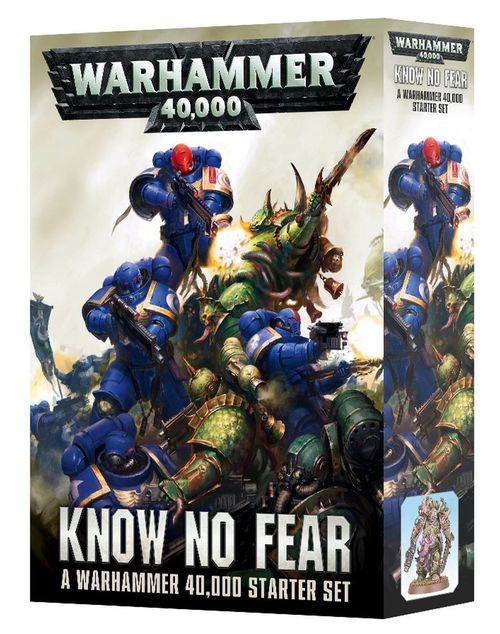
Warhammer 40,000: Know No Fear
Warhammer 40,000: Know No Fear Rulebook
Table of Contents
Table of Contents
Core Rules
Warhammer 40,000 puts you in command of a force of mighty warriors and war machines. The core rules contain the foundation for playing games of Warhammer 40,000 with your Citadel Miniatures collection and to wage glorious battle across the war-torn galaxy.
Models & Datasheets
The rules and characteristics for all models, and some terrain features, are presented on datasheets, which you will need in order to use the models in battle.
Units
Models move and fight in units, made up of one or more models. A unit must be set up and finish any sort of move as a group, with every model within 2" horizontally, and 6" vertically, of at least one other model from their unit: this is called unit coherency. If anything causes a unit to become split up during a battle, it must re-establish its unit coherency the next time it moves.
Tools of War
In order to fight a battle, you will require a tape measure and some dice.
Distances in Warhammer 40,000 are measured in inches (") between the closest points of the bases of the models you're measuring to and from. If a model does not have a base, such is the case with many vehicles, measure to and from the closest point of that model's hull instead. You can measure distances whenever you wish.
Warhammer 40,000 uses six-sided dice, sometimes abbreviated to D6. Some rules refer to 2D6, 3D6 and so on – in such cases, roll that many D6s and add the results together. If a rule requires you to roll a D3, roll a dice and halve the total. When halving any dice roll, round fractions up before applying modifiers (if any) to the result. All modifiers are cumulative. If a rule requires a dice roll of, for example, 3 or more, this is often abbreviated to 3+.
The Battle Round
Warhammer 40,000 is played in a series of battle rounds. During each battle round, both players have a turn. The same player always takes the first turn in each battle round – the mission you are playing will tell you which player this is. Each turn consists of a series of phases, which must be resolved in order. The phases are as follows:
- Movement phase – Move any units that are capable of doing so.
- Psychic phase – Psykers can use powerful mental abilities.
- Shooting phase – Your units may shoot enemy units.
- Charge phase – Your units may move into close combat against enemy units.
- Fight phase – Both players' units pile in and attack with melee weapons.
- Morale phase – Test the courage of depleted units.
Once a player's turn has ended, their opponent then starts their turn. Once both players have completed a turn, the battle round has been completed and the next one begins, and so on, until the battle is concluded.
Rules Notes
The Most Important Rule. In a game as detailed and wide-ranging as Warhammer 40,000, there may be times when you are not sure exactly how to resolve a situation that has come up during play. When this happens, have a quick chat with your opponent and apply the solution that makes the most sense to both of you (or seems the most fun!). If no single solution presents itself, you and your opponent should roll off, and whoever rolls highest gets to choose what happens. Then you can get on with the fighting!
Re-rolls. Some rules allow you to re-roll a dice roll, which means you get to roll some or all of the dice again. You can never re-roll a dice more than once, and re-rolls happen before modifiers (if any) are applied.
Roll-offs. Some rules instruct players to roll off. To do so, both players roll a D6, and whoever scores highest wins the roll-off. In the case of a tie, both players re-roll their D6; this is the only time players can re-roll a re-roll – if the second and subsequent rolls are also tied, keep on rolling until a winner is decided.
Sequencing. While playing Warhammer 40,000, you'll occasionally find that two or more rules are to be resolved at the same time – normally "at the start of the Movement phase" or "before the battle begins". When this happens during the game, the player whose turn it is chooses the order. If these things occur before or after the game, or at the start or end of a battle round, the players roll off and the winner decides in what order the rules are resolved.