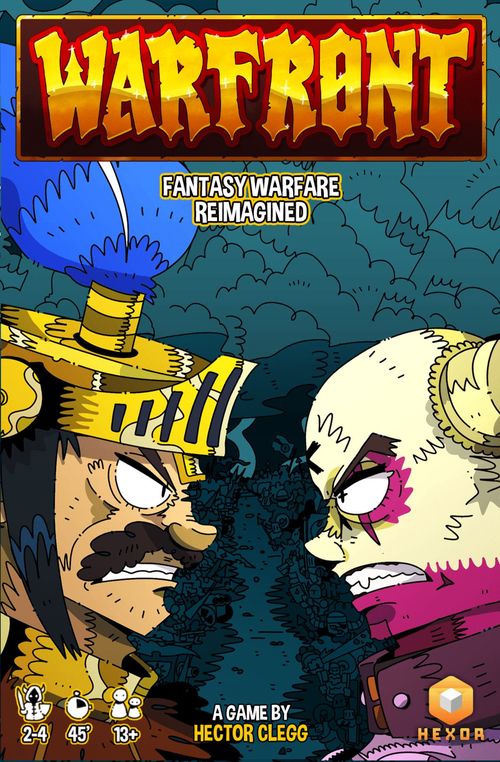
Warfront
Warfront Rulebook
Table of Contents
Table of Contents
Getting Started
- Assemble your army: Select units from your faction list up to an agreed total points cost, normally 60. Select 1-2 'Leader' cards and fill the remaining points with other units. All points costs can be found on the Warfront website. Each unit card has a corresponding stat card.
- Establish the battlefield: A typical battle takes place on a 36x24" playing area, but any similar space works.
- Set up terrain: Place an agreed number of terrain cards (usually four to six) on the battlefield. Terrain cannot interfere with unit deployment.
- Deploy: Players take turns placing unit cards along their respective battlefield edges. Once deployed, flip the cards to reveal your armies.
- First Turn: Roll to see who takes the first activation and roll at the start of each new turn to determine the first activation for the turn.
Turn Order
- Activation Phase
- Consolidation Phase
- Combat Phase
- Consolidation Phase
Source note: the Turn Order page of the official rulebook prints these four entries exactly as shown, with "Consolidation Phase" listed both second and fourth. The rulebook does not explain the fourth entry, so it is reproduced as printed.
Activation Phase
Players alternate activating units. Each activated unit can Move and may be able to Shoot, in either order.
Shooting
- Target a visible enemy within Range, measuring from the centre of the card (the orange arrow) to any part of the enemy unit. This is called "Line of sight".
- Roll dice equal to your unit's Shooting value.
- Score hits on a 4+. The targeted unit may then roll Defensive saves for each hit. Unsaved hits cause damage.
- Units with a Shooting value of 0 cannot shoot.
- You may split your Shooting between two enemy units.
Terrain & Cover
The battlefield can be scattered with different types of terrain. All terrain grants various levels of Cover from Shooting whilst some also have special rules.
If Line of sight to any part of the targeted unit from the centre of the Shooting unit is obscured by a terrain card this unit may have Cover. A targeted unit behind Cover may reduce the number of Shooting dice rolled against it, based on terrain type and visibility.
The source diagram shows three examples: "In Cover" with "Line Of Sight Obscured", "In Cover" with "No Line Of Sight", and "No Cover".
No Line of Sight to Target
- Dense terrain: Cannot be targeted in Shooting.
- Sparse terrain: Reduce Shooting by 2.
- Flat terrain: No reduction in Shooting.
Line of Sight Obscured
- Dense terrain: Reduce Shooting by 2.
- Sparse terrain: Reduce Shooting by 1.
- Flat terrain: No reduction in Shooting.
Enemy units count as sparse terrain for cover purposes.
Moving
- Units move up to their Movement value (in inches), in any direction. Measure from the centre of the card.
- Units can pass through friendly units but not end the movement on top of a friendly unit. They can move through gaps wider than 1 inch.
- Engagement: Moving into contact with an enemy is an engagement and will initiate combat, resolved later in the Combat Phase. Engagement must occur along the front edge of the unit that moved.
- Engaged units cannot leave combat unless using an ability (like Fall Back) but can use their activation to reposition 90 degrees if space allows and they maintain contact with the enemy (a unit in combat with two or more enemy units cannot reposition).
- Engaged units cannot Shoot or be targeted by Shooting.
- Multiple units can be engaged in combat at the same time along different edges.
Combat Phase
Engaged units must Attack and Defend. Players must alternate selecting which combat to resolve first, starting with the player who activated first.
Contact Types
A unit is in:
- FULL CONTACT when it touches the enemy unit across the centre point.
- PARTIAL CONTACT when it touches the enemy without crossing the centre point or via the side flank.
Attacking
- FULL CONTACT: Units in full contact with the enemy make their full number of Attack rolls.
- PARTIAL CONTACT: Units in partial contact make 1 fewer Attack roll.
- Units make no Attacks from their rear and have their Defence reduced by 1 for Attacks received from the rear.
- All units roll Attacks and Defences, if able.
- Hits are successful on a 4+ and will damage units that fail the Defence rolls.
Defending
- Each unit has a Defence value. Roll dice equal to the number of incoming hits. Rolls equal to or below the Defence value negate the hit. Failures deal damage and reduce the status of the unit.
- Track damage using the status cards. Units can take 3 damage before they are 'Broken' and removed in the consolidation phases. 1 damage lowers the status 1 level.
The status card shows the levels Resolute, Shaken, Damaged and Broken.
Consolidation Phase
After both the Activation and Combat phases, remove any Broken units from the battlefield. Broken units are still active during the Activation and Combat phase and can perform actions as normal before being removed in the next Consolidation phase.
Glory Points
Natural rolls of 6 during Attacking, Shooting, or Defending generate Glory Points. Players start with 3 Glory Points and can earn more during the game. These are spent to activate special Glory Abilities listed on the unit cards or the standard abilities below.
Standard Glory Abilities
- [2] CHARGE: Double your unit's Movement value but must engage an enemy.
- [2] FALL BACK: Move 2 inches backwards out of combat unless 'surrounded'*, this glory ability also requires an activation.
- [2] BRACE: Reroll failed Defence rolls if attacked from the front, use at the start of combat before any Attacks are made.
- [2] PRESS THE ATTACK: Gain 2 additional Attacks in combat, use at the start of combat before any Attacks are made.
*A surrounded unit is engaged by 2 or more enemy units.
Standard Glory Abilities cost [2] Glory, increasing by 1 each time used. Multiple Standard Glory Abilities can be used during a turn, but not repeated on or by the same unit until the following turn. Unit specific Glory Abilities which are found on the unit stat cards can be used once per turn only and do not increase in cost.
Declaring a Glory Ability causes a pause in play. Multiple Glory Abilities will create an ability chain.
Ability Chains
Multiple abilities can be declared during the same pause, and either player may declare abilities in the chain. When a glory ability is declared, the opposing player may respond with their own ability, passing initiative back and forth until no further abilities are declared. If the opposing player does not declare an ability in the chain the initiative is passed back to the player who may declare another ability.
Abilities resolve in reverse order, starting with the most recent. Once the chain is activated, abilities can't be interrupted. If an ability can't be performed, it is withdrawn with no glory points spent, and the remaining abilities resolve normally.
Equipment
Leader units may be equipped with Equipment cards. These cards may change the stats of the unit or provide the unit with an additional Glory Ability. When the equipped Leader is removed from the game the Equipment is also removed. The points costs for Equipment can be found on the Warfront website.
Game Modes & Winning the Battle
Warfront can be played in 3 different ways.
Clash
The main way to play, a head-on conflict! Select units up to an agreed points total, normally 60, and battle it out! The winner is the player with the most points across active units after 5 turns.
Area Control
After placing the terrain cards during set up, place the three Objective cards along the centre of the battlefield. At the start of each turn any unit that is within 1 inch of an objective card scores 1 point. At the end of 5 turns whichever player has the most points is declared the winner. Objectives are not battlefield features so units can end their movements overlapping an objective.
Survival
One player attempts to survive until the end of the game. The 'survival' player selects units with half the agreed points total and will win the game if they have one or more units active at the end of 5 turns.
Unit Keywords
Units belong to certain unit types denoted by keywords. Keywords provide certain restrictions based on the unit type.
- LEADER: Required for every army, limit of 2. This unit may be equipped with equipment.
- WIZARD: This unit can cast Spells (this feature is not in the game yet).
- INFANTRY: No restrictions.
- CAVALRY: Cannot use the 'Fall Back' ability.
- MONSTER: Does not gain cover from friendly units unless that unit is a 'Monster'.
- ARTILLERY: Cannot split its shooting attacks between enemy units.
- VEHICLE: Cannot move over friendly units.
- SWARM: Does not provide any cover.
- BEHEMOTH: Unit consists of more than one card that are both activated at the same time. Any effects and damage affect both cards.
Anatomy of a Card
- Unit Name
- Keywords
- Unit Stats
- Glory Abilities
Example card: High General Goddard (keywords LEADER and MONSTER; stats Movement 8, Shooting 0, Range 0, Attack 5, Defence 4; Glory Abilities Inspiring Presence, Shredding Talons, Fly).
Keywords
Each unit can belong to one or more classifications of unit identified by keywords.
Unit Stats
Used to identify the attributes of each unit as follows:
- Movement (M): How far a unit can move in inches.
- Shooting (S): The number of shots the unit can make in the shooting phase.
- Range (R): The distance the unit can shoot in inches.
- Attack (A): The number of 'Attacks' a unit can make in the combat phase.
- Defence (D): The defensive or evasive capability of the unit.
Glory Abilities
Spend Glory Points to use these abilities to influence the game and swing the battle in your favour. The points cost is within different shaped symbols.
- Circle: Can only be activated or negated by the player that controls the unit.
- Triangle: Can only be activated or negated by an opposing player.