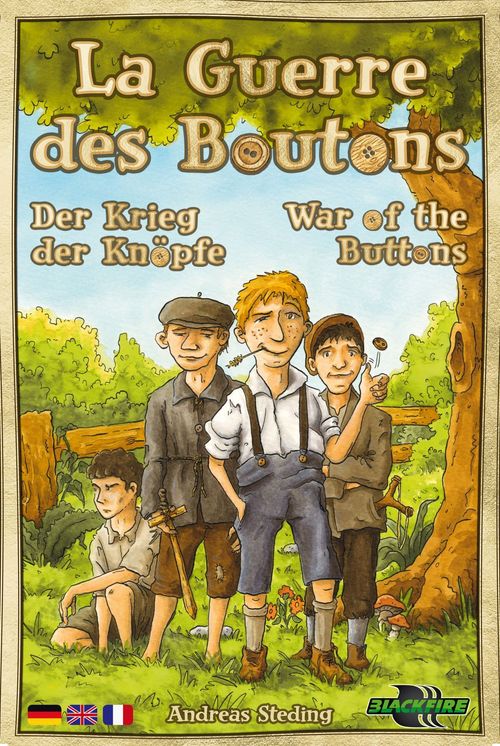
War of the Buttons
War of the Buttons Rulebook
Table of Contents
Table of Contents
Components
Each copy of War of the Buttons contains
- 1 game board
- 38 dice (eight dice in each of the four player colors plus six "neutral" white dice)
- 6 dice track tiles to be placed on the game board
- 40 buttons of two values (32 x 1; 8 x 5)
- 24 wooden sticks ("building material for the players' huts")
- 4 building sites (1 per player each)
- 4 player aids (1 per player)
- 18 cards
- 1 starting player token
- 12 "big brother" markers
- 12 bonus markers
- 24 star markers
- 3 rule books (English, German, French)
The game board
The game board shows three locations from the novel – the quarry, the forest and the meadow. On these locations the players place and displace dice on the various dice tracks.
Displaced dice are stored in the mill in the center of the board.
The neutral white dice are located in the lake on the upper right corner of the board.
The "notebook" in the bottom right corner represents the school building; to the left is the village with the market square – dice may be placed there, but they cannot be displaced.
On the far right there are spaces for up to three cards. Dice can be used to acquire them, but they cannot be displaced (as on the market square).
Dice track tiles
In addition to the values printed on the game board at each of the three locations, six dice track tiles are included in the game. These tiles can be used by the players (if they want to) in order to create more variability.
Player's components
Each player receives eight dice of his color, a player aid (one side is French; the reverse German and English) and a building site for his hut, including spaces for his boys in detention.
Markers, cards, and starting player token
Various markers are used in the game: big brother, bonus and star markers.
The various cards provide opportunities for different kinds of actions during the course of the game.
The start player token is placed in front of the starting player.
Wooden sticks (building material) and buttons (currency)
The players build their huts using wooden sticks, which they place on their building site. A hut consists of six parts ("sections"). A wooden stick is placed on each section.
In War of the Buttons, buttons are the currency – they have a value of "1" or "5".
Set Up
A. The youngest player will be the starting player. He places the starting player token in front of him.
B. The game board is placed in the center of the playing area.
In a two- or three player game, the meadow location is not used.
Players decide whether they want to use the dice track tiles for the locations. If so, they shuffle them and place them on the indicated spaces.
Note: In the first game, players should not use the dice track tiles (and instead use the tracks as printed on the board).
C. Each player takes the eight dice in his color, a player aid and a hut building site. Five of the dice are immediately available, the remaining three are openly rolled and then placed on the designated spaces on the building site as boys in detention.
D. Depending on the number of players, the following number of white (neutral dice) are placed on the game board:
- 2 Players: 4 dice
- 3 Players: 5 dice
- 4 Players: 6 dice
Any remaining white dice are returned to the box.
E. One player shuffles the bonus markers and then places one face up on each of the locations and on the school. The remaining bonus markers are set aside.
F. One player places the star and big brother markers as well as the buttons and the wooden sticks next to the game board.
G. One player shuffles the cards and places two cards in a two or three player game and three cards in a four player game to the right of the game board. The other cards are placed face down next to them into a pile.
Exception: The card 2 buttons if placed on the meadow is only used in a 4-player game.
H. The starting player gets two buttons, the next player in clockwise order three buttons, a third player four and a fourth player five buttons.
Game Play
War of the Buttons is played in rounds. Each player becomes the active player several times during the course of a round. Beginning with the starting player and then in clockwise order, each player conducts an action in his turn. On top of that a player can perform one additional bonus action.
As part of each action, the active player places one or more of his or her dice on one of the three locations, on the school building, next to a card or the market place in the village. Different rules apply to the placement of dice on each location.
A round ends after all players have placed all of their dice. Players may then receive some bonuses at the end of the round.
The game ends when at least one player has completed his or her hut at the end of the round (there are wooden sticks on all six sections) or has collected at least six star markers.
Sequence of play
I. At the beginning of each round
First, players get two buttons per game card they own (i.e. in front of them). It does not matter whether the card is placed face up or face down.
Example: Marion has 2 cards which means she gets 4 buttons.
Beginning with the second round, all bonus markers that may still be in locations or at the school will now be removed. Then one of the players shuffles all the bonus markers and places one marker face up on each of the locations and on the school building.
Beginning with the second round, another player also removes all remaining cards from the game board and places them on the discard pile. He then draws two cards in a two or three player game and three cards in a four player game from the draw pile and places them face up in the appropriate spaces. If the draw pile runs out of cards, the discard pile is shuffled and used as the new draw pile.
II. Rolling the dice!
All players simultaneously take their available dice (in their color) and roll them once.
The starting player also rolls the white dice and then places them on the lake on the game board. In general: All dice are always rolled and placed openly!
III. A turn
The starting player begins by conducting a dice action. He chooses at least one of the dice in front of him and places it/them on a location (see The Three Locations), the school (see The School), the village (see The Village) or next to a card (see Cards). He may also perform one additional bonus action either during or after the dice action.
A player may not pass as long as he has at least one die in front of him.
Now the (in clockwise order) next player becomes the active player. Play continues in this fashion until all players have placed all of their dice.
As players often have a different number of dice available to them and can use different numbers of them per round, they will probably conduct a different number of turns.
A player who does not have a die in front of him at the beginning of his or her turn must pass. To be able to buy another white die (see White Dice) or to own one or more big brother markers (see Big Brother) is not sufficient to become the active player.
IV. End of round & clean up
When all players have placed their dice on the game board, the game round ends. Now the players determine who the snitch is (see The School under snitch) and the bonus markers in the school and the locations are awarded (see The Three Locations and The School under exam).
If there is no winner, the starting player token is handed over to the new starting player.
The next step is clean up. All players will get all their (colored) dice back. The white dice are given to the starting player.
A new round will begin.
The Three Locations
There are three locations in War of the Buttons: the quarry, the forest and the meadow.
Note: The meadow is only used in a 4-person game; if there are two or three players, no dice may be placed here.
The following rules apply when placing dice on these locations:
- Dice are always placed on the leftmost free space of a dice track.
- If a player places several dice at the same time on one space of the dice track, he places them one above the other. These dice must all show the same number!
- The first player to place dice at a location can place a dice of any value (or several dice of identical value, see above).
- If a player wants to place dice at a location where there are already dice, which have been placed either by himself or another player, he must displace them.
- To displace one or more dice from a space of a track, the player must place either more dice of any value on the next empty space of the track or an equal number of dice of higher value.
- All displaced dice are placed on the watermill.
- Any player who inserts or displaces the dice immediately receives the number of buttons specified for the space of the dice track from the supply.
Note: The tracks are "endless"; i.e. it is possible to displace dice from the rightmost space. In this case, the displacing player will occupy the same space and receive the reward of that space again.
The player who has at least one dice at a location at the end of a round receives the bonus marker.
Example: Angelika has placed a 4 on the first space of the forest. Marion displaces the die by placing a 5 on the box to the right and placing Angelica's die on the watermill. Marion receives 4 buttons.
Nicole has two "3s" on the third space of the quarry. Angelika displaces them by placing three "1's" on the space to the right. Angelika receives 1 button.
Marion has two "5s" on the last space of the meadow. She displaces herself by putting two "6's" on this space. Marion receives 1 button.
Example: Marion was clever enough to put one of her red "4" dice on the forest with two white "4" dice to get the four buttons. Since she was not displaced, she receives the bonus marker at the end of the round. If Marion had placed only white dice, she would have received the buttons but not the bonus marker at the end of the round.
The School
There are seven spaces in the school building. On each of them exactly one colored die may be placed. A white die may never be placed in the school building nor may a big brother be used here.
In addition, a die cannot be displaced in the school building. This means that the first die placed in a school space will remain in that space for one round.
A player may not occupy a school space with a die if he cannot implement the effects (for example, he must have at least two buttons to occupy the big brother space).
The different spaces have the following meanings:
Exam: If there is a dice at the end of the game round, the players will check which player got the best exam result.
To do this, the players determine which player has the most dice with the same value of the die on the exam space in the school building, on the other locations and next to the cards. If a colored die of a player is on the exam space, this die counts of course. Dice in the village are not counted. This player receives the bonus marker, which is on the notebook. If several players have the same number of matching dice, nobody will receive the bonus marker this round.
Example: Angelika´s blue "4" die is on the exam space. Angelika also has the most "4s" at school (1x) and at the locations (3x) at the end of the round. Therefore, she now receives the bonus marker on the notebook.
Rescuing the boys in detention: The player who places a die of any value on this space must immediately return eight buttons to the general supply. Afterwards, he may take any of his own boys-in-detention-dice at his hut building site. This die is immediately available but will not be re-rolled!
During the game the boys in detention block the building of the hut. Next to their spots the owner may not place a wooden stick.
If a player has no longer any boys-in-detention-dice, he may not place a die on this space.
Example: Nicole places one of her dice (a "1") on the rescue space and pays 8 buttons into the general supply. She takes her "2" boys in detention die from the hut building site, which she places in front of her. She can still use this die in the same round, quite possibly together with her other "2". During the game she may continue building her hut next to this spot.
Snitch: The player who places a die on this space "rats" on his fellow players to the teacher. As a reward, he may immediately take any of his own boys-in-detention-dice from his hut building site. This die is immediately available but will not be re-rolled!
This behavior, however, has a consequence: You do not play with snitches. The player may not place dice on the locations for the remainder of the turn. He may continue to place dice at the school, in the village or next to cards.
At the end of the round, the players first check which player has the most dice with the number of the die at the snitch space in the school building (the die on the snitch space does not count!), on the locations and next to the game cards. Dice in the village do not count. This player must place any one die of his color in any vacant boy in detention space at his hut site. There may already be a wooden stick as building material on this section. If not, this spot is again blocked for construction for the time being. If all the boy in detention spaces are occupied, nothing happens; a player can have a maximum of 4 boys in detention. If several players have the same number of dice, nothing happens.
Example: Tanja puts one of her dice (a "3") on the free snitch space. She immediately takes one of her boy in detention dice from her hut site and is allowed to use it in this round. At the end of the round, Nicole has the most "3" dice in the school, on the locations or next to cards, and now has to place one of her colored dice on any vacant boy in detention space at her hut building site. She selects the spot next to the already finished building spot.
Starting player: The player who places a die of any value on this space will be the starting player in the following round. If no one places a die here, the starting player does not change!
Big brother: The player who places a die of any value on this space must immediately return two buttons to the supply. He then receives two big brother markers from the supply. He places them in front of him.
Building the hut: The player who places a die of any value on this space must immediately pay five buttons plus one more button for each section of his hut that has already been built.
Then he takes a wooden stick from the supply and places it on any free section of his hut building site. Important: He cannot put a wooden stick on a construction section which is occupied by a boy in detention!
Example: Marion has already completed two sections of her hut and has to pay seven buttons. Then she puts another wooden stick on her hut building site.
Taking a star marker: The player who places a die of any value on this space must immediately pay five buttons plus one more button per star marker that he already has in front of him.
Then he takes a star marker from the supply and places it in front of him.
Cards
In his turn and as part of his action, a player may take several dice and place them next to a card to acquire this card.
At the top, the cards show their costs - two to four dice with identical values. In addition, the player must return as many buttons to the supply as the value of his die.
Then he puts the acquired card in front of him and may use it. In addition, he receives two buttons at the start of each round per owned card.
The cards may be used at different times during a round:
Cards marked with a one-time-use symbol are used by the owner immediately after purchasing the card as a one time effect. Then the player places the card face down in front of him.
Cards marked with an infinity symbol are put in front of the owner and may be used several times per round.
Cards marked with a hand symbol are put in front of the owner and may be used once per round immediately after rolling his dice.
Example: Angelika places three "2" dice next to a face-up card and must immediately return two buttons to the supply. Then she uses the action of the card (construction section) and places the card face down in front of her.
The following 18 cards are available in War of the Buttons:
- Building section (4x): The player immediately receives a wooden stick once, which he must immediately use. If this is not possible due to a boy in detention die, the player may not conduct this action later!
- 2 buttons when placing dice in the school building: The player always gets two buttons when placing a die in the school.
- 2 buttons when placing dice in the forest: The player always gets two buttons when placing one or more dice in the forest.
- 2 buttons when placing dice in the quarry: The player always gets two buttons when placing one or more dice in the quarry.
- 2 buttons when placing dice in the field: The player always receives two buttons when placing one or more dice in the meadow. Note: This card is only used in a 4-player game!
- 1 button when placing in the village: The player always receives a button when placing a die in the village.
- 2 big brothers: The player immediately receives two big brother markers, which he places in front of him.
- 3 big brothers: The player immediately receives three big brother markers, which he places in front of him.
- Identical number of dice and identical value are sufficient to displace: The player may always displace dice, which have an identical value, on locations. In addition, he may always replace an identical number of dice on locations.
- "1's" may be redefined: The player may turn any number of his dice showing a "1" to any other value in each round immediately after rolling his (colored) dice. If more than one player may redefine the value of their dice, they do so in sequence of play, beginning with the starting player.
- "2s" may be redefined: The player may turn any number of his dice showing a "2" to any other value in each round immediately after rolling his (colored) dice. If more than one player may redefine the value of their dice, they do so in sequence of play, beginning with the starting player.
- "3s" may be redefined: The player may turn any number of his dice showing a "3" to any other value in each round immediately after rolling his (colored) dice. If more than one player may redefine the value of their dice, they do so in sequence of play, beginning with the starting player.
- Any dice may be re-rolled: The player may re-roll any number of his dice once in a single turn immediately after rolling his color dice. If more than one player may redefine the value of their dice, they do so in sequence of play, beginning with the starting player.
- 1 star marker: The player immediately receives a star marker as a one time effect.
The Village
Each player may place any number of dice on the village's market place when it is his turn. There is no restriction.
Each die placed here (either in a player's color or in white) rewards the player with a button, which he takes from the supply and places in front of him. Dice are not displaced from here. All dice remain here until the end of the round. The dice in the village are not counted while determining the exam and snitch effects.
Example: Marion needs two buttons for another planned action. She places two of her dice (a "1" and a "3") in the village marketplace and takes two buttons from the supply.
Change the value of your own dice: The player may pay buttons to change the value of one of his dice. This costs one button per point. A player may only change his colored dice and only dice not used up to this point.
Example: Tanja has a "3" and a "5" dice in front of her. There are two "4" dice placed by Marion at the forest location. In order to displace Marion there, Tanja pays two buttons to change the "3" to a "5" die. Now she displaces Marion's dice from the forest.
Rescuing a boy in detention: The player returns one of his cards to the box. He may immediately take any of his boys-in-detention-dice from the hut building site and places it in front of him. He may use this die immediately.
Bonus Actions
At any time during his turn, a player may conduct one of the following three bonus actions in addition to his regular action. Bonus actions are optional.
Take white dice: When placing three buttons in the supply, a player may select one (and only one!) of the white dice in the lake (the die will not be re-rolled!) and places it in front of him. The die may be used immediately. See also White Dice.
White Dice
The white dice are neutral. They are rolled by the starting player at the beginning of each round and are placed on the lake on the game board.
If a player has taken a white die as an additional action, he places it in front of him without re-rolling it. He can now use it on its own or in conjunction with other dice.
White dice may be used in locations, in the village and for cards, but they cannot be placed in the school building.
It is possible to use only white dice on locations. The executing player then receives the reward in buttons according to the space. If there are only white dice on a location at the end of the round, nobody will receive the bonus marker - at least one colored die must be placed on the location in order to receive a bonus marker. In such a case no one happens to remember anymore who had led this particular group of boys.
Example: Angelika has a "3" and a "5" dice and a big brother marker. In the quarry is a "5" die placed by Nicole. Angelika could now define the big brother as "6s" and thus displace Nicole to get the two buttons as a reward. Afterwards, the location would be empty, as the big brother leaves immediately (and the marker remains only to mark the last occupied field).
Thus, Angelika decides to define the big brother as a "3" and to use it together with her "3" die. Even so, she displaces Nicole, but then Angelika's "3" die remains in the forest, as the big brother is about to leave again.
Big Brother
At school, on various bonus markers and by playing certain cards, players receive big brother markers.
Each marker can be used by its owner once. At the end of the player's turn, he returns the marker to the supply (a big brother has really more important things to do ...).
The big brother may be used on all locations, in the village and to obtain cards.
The marker may not be used at school - the teachers are watching!
The big brother marker represents a die of any value. Only one big brother marker can be used per action!
If a big brother marker is used on its own on a location, the player gets the reward in buttons as usual. The location is considered "empty". In this case, the marker is placed on the dice track to mark the position until a player places one or more dice on the space to the marker's right.
Star Markers
Players receive star markers at school, via two bonus markers, and by playing certain cards.
If a player has six or more star markers at the end of a turn, the game is over (see Game End).
Bonus Markers
Bonus markers are randomly placed at the start of the round at the locations and at the school in the appropriate boxes.
Players will receive a bonus marker at the end of the round if they have at least one die at a location or at school if they were successful in the exam.
The effects of bonus markers are immediately implemented when they are received (if possible) and the markers are placed face down next to the bonus markers not used in this round.
The following 12 bonus markers are in War of the Buttons:
- Construction section and 1 star marker (2x): The player takes a wooden stick and places it on a place of his hut which is not occupied by a die. In addition, he receives one star marker from the supply.
- Construction section: The player takes a wooden stick and places it on a place of his hut which is not occupied by a die.
- Construction section and 3 buttons: The player takes a wooden stick and places it on a place of his hut which is not occupied by a die. In addition, he receives three buttons from the supply.
- Construction section and 4 buttons: The player takes a wooden stick and places it on a place of his hut which is not occupied by a die. In addition, he receives four buttons from the supply.
- Construction section and 5 buttons: The player takes a wooden stick and places it on a place of his hut, which is not occupied by a die. In addition, he receives five buttons from the supply.
- Construction section and rescuing a boy in detention: The player takes a wooden stick and places it on a place in his hut that is not occupied by a die. He also takes any of his own boys in detention die from his hut building site.
- Rescuing a boy in detention: The player takes any of his own boys in detention die from his hut building site.
- Rescuing a boy in detention and 3 buttons: The player takes any of his own boys in detention die from his hut building site. In addition, he receives three buttons from the supply.
- 5 buttons: The player receives five buttons from the supply.
- 1 big brother and 3 buttons: The player receives three buttons from the supply. He also receives a big brother marker from the supply.
- 2 big brothers: The player receives two big brother markers from the supply.
End of a Round
A round ends when no player can or wants to use any more dice.
Then the following is done:
- Determine the snitch (see The School),
- Score the exam (see The School) and assign and evaluate bonus markers,
- Pass the starting player token,
- Award and implement bonus markers at the locations (see The Three Locations).
If the game does not end (see Game End), players will regain their colored dice except the boys-in-detention-dice. The starting player also gets the white dice to roll them anew at the start of the next round.
Game End
If at least one player completes all six stages of his hut or has earned six stars at the end of a turn, the game ends.
If only one player has fulfilled one or both of these conditions, he is the winner.
However, if two or more players have met one or both of these conditions, then all players (including those who have neither completed their hut nor have six stars) will count their victory points.
The players receive one victory point for:
- each card,
- each star marker,
- every completed section of the hut,
- each five buttons.
Whoever has the most victory points is the winner! If two or more players have the same number of victory points, the winner is the one with more buttons.
If there is still a tie, there are several winners.