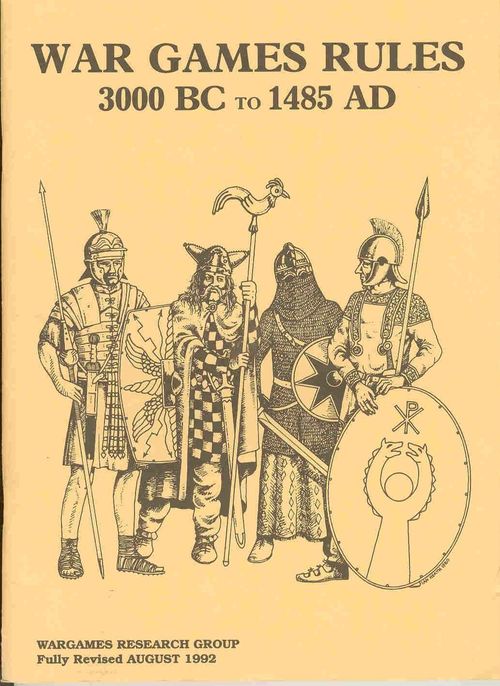
War Games Rules 3000 BC to 1485 AD
War Games Rules 3000 BC to 1485 AD Rulebook
Table of Contents
Table of Contents
- Introduction to the 7th Edition as Revised
- Representational Scales
- Playing Tools
- The Troops
- Weapon Categories
- Depiction of Figures
- Organisation into Elements, Units and Commands
- Standards, Religion and Magic
- Troop Cost
- Setting Up a Game
- Battlefield Conditions
- Permitted Formations
- Sequence of Play
- Command, Control and Communications
- Troop State
- Movement
- Use of Shields, Cover, Defensive Obstacles and Hazards
- Shooting
- Timing
- Ammunition supply
- Target priorities
- Troops entitled to shoot
- Shooting arcs
- Shooting ranges
- Shooting by rear ranks or over another body
- Shooting combined with movement or hand-to-hand combat
- Adjudicating casualties inflicted by shooting
- Shooting random factor
- Shooting weapon factors
- Shooting tactical factors
- Hand-to-Hand Combat
- Casualties
- After Combat
- Broken Troops, Pursuers and Looting
- Winners and Losers
- Field Engineering and Attacks on Fortifications
- Stratagems
- Tactics
- Queries, Arguments and Umpires
- Examples
- Diagram Key
- Reference Sheets
Introduction to the 7th Edition as Revised
The first edition of our original ancient rules appeared in 1969, and were adopted for the British National Wargames Championships of that year. Despite competition from many would-be rival sets, succeeding editions have been used in every important convention worldwide since then, and are used by an overwhelming majority of ancient wargamers. Their mechanisms have become a wargames standard used for every conceivable historical period, including some for which WE consider them unsuitable!
The seventh edition went to the printers in late 1985, and in the seven years since has almost completely taken over from previous editions. Feedback from play by several thousand customers has made it possible to provide free update sheets available in return for a stamped addressed envelope or international reply coupon. A few of the amendments blocked minor loopholes, most clarify meanings, and some incorporate good ideas for improvements suggested and justified by players. All such changes to date are incorporated into the text of this printing of the rule book as Version 7.5.
Seventh was a revolutionary, rather than evolutionary, change from previous editions. It places much more emphasis on realism, the problems of command, terrain and natural conditions, and seeks to distract players from excessive pre-occupation with weapon and armour differences important only if "all things are equal". It is the function of the general to ensure that things are NEVER equal! We also take the view that a putative difference in weapon characteristics that cannot be shown to have influenced tactics in, or the result of, at least one historical battle is likely to be spurious. The tendency among rule writers to show off their knowledge rather than produce the simplest realistic simulation is natural but unhelpful.
The unanimous conclusion of the users is that seventh is far more realistic than other sets and greatly widens the gap between good and poor tacticians. They applaud the end of the "tire work display" with units whizzing off in all directions without getting in each other's way, the increased mobility out of and the reduced manoeuvrability in proximity to the enemy, the need to take conditions, terrain and the chance of a surprise into account when planning, the way the fatigue rules force a proper use of reserves, the way rebased troops no longer fall over in the box, and not least, the discomforture of rule lawyers.
Since its introduction, seventh has been used in the great majority of tournaments around the world, and even passed the fearsome test of the Milton Keynes 36 hour sleepless marathon event. Tournaments normally use the full rules with terrain choice, weather, unusual deployments and unreliable generals without these causing any difficulty or complaint of unfairness. A public demonstration game at Northern Militaire with one player per side each using 3,600 points of 25mm figures on a 6 foot x 4 foot table with plenty of terrain finished with a decisive win in something over two hours. This implies that increased realism has not been achieved at the cost of "playability". Games now play much quicker.
The major difficulty faced by players transfering from the previous editions is one of imagination. It DOES help to plan as if you were commanding a real army, rather than trying to analyse the rules to deduce good tactics. Common mistakes are to leave cavalry at the rear of a marching column instead of scouting in front, keeping the general safe instead of in a position to see, letting an unreliable general continue disobedience instead of correcting him, ignoring terrain difficulties when deploying, with consequent traffic jams when moving out, accepting waver tests instead of avoiding them like the plague, deploying front and rear lines too close so that they become entangled, and leaving front line units to become exhausted or be overwhelmed instead of reinforcing or withdrawing them in good time. Victory with seventh edition goes to the player who has best learned the skills of real historical generals, not he with most grasp of the minutiae of the rules.
Finally, although 7th is simpler than its predecessor and much simpler than its rivals, it is necessarily complex and needs large numbers of figures, a full sized table, and two or more hours to play. For those occasions for which it will not suit, we recommend our other rule set for the period, the very successful "De Bellis Antiquitatis". DBA allows much quicker games with far fewer figures on a 24" square terrain, incorporates a campaign system and army lists, and is especially suitable for beginners, the young, jaded elders, large multi-player games and odd moments.
Representational Scales
Figure and model scale
This is expressed as the height in millimetres of a figure representing a man 6 feet or 1.82 metres tall. 25mm, 15mm and 6mm scales are all in use and all fully compatible with these rules, which have been thoroughly tested with each of them.
25mm was the traditional scale, is best for detailed painting, but is impractical when simulating battles of much more than 25,000 men to each side. It is especially suitable for medievalists. 6mm enables players to fight giant battles such as Gaugamela or Cannae on a single 6x4 foot table, but can be less than ideal when fighting small battles. 15mm offers a reasonable compromise. The smaller scales have suffered in the past from a lack of entirely satisfactory rules, a lack this set will hopefully remedy.
Ground scale
This is the relationship between the distances measured on the table and those represented on a real battlefield. It varies according to the figure and model scale.
- For 25mm: 1" = 25 paces or 1mm = 1 pace. 40 paces = 40mm.
- For 15mm: 1" = 40 paces. 40 paces = 1" or 25mm.
- For 6mm: 1" = 80 paces. 40 paces = 0.5" or 12.5mm.
All distances in the text are quoted in paces of 2.5 feet or 0.75 metres. This is because the length of a man's stride has remained fairly constant throughout history, while such units as cubits, yards and metres come and go. Distances on the table are best measured with a home-made 240 pace measuring card marked in 40 pace increments.
Time scale
Play is divided into bounds. These are not arbitrary divisions of time, but instead reflect initiatives and responses by the two sides. However, dividing known battle durations by the number of discrete phases that can be identified produces consistent enough results for us to define a bound as equivalent to 15 minutes of battle.
Troop representation
A figure usually represents the number of men who would occupy that frontage at four ranks deep, modified by the need to simulate historical units by a convenient number of elements, and by units being understrength. Since we do not remove casualties, replaced in real life from the rear ranks, these further reduce representation.
A cavalry, camelry, or infantry figure represents a full strength average of 50 men including officers and supernumeraries, with maximum range 38-85; except that "E" class irregular figures each represent ten times as many in a deep confused mass. A model represents up to 25 real or dummy elephants or heavy chariots, or 50 light chariots, or 6 artillery pieces, or 10 wagons, or 5 ships.
Note that the first elephant element can represent as few as four real elephants. This variation in elephant representation is due to their battlefield density and sub-division being extremely variable, and their effect largely psychological. They should be thought of as moving in column, but capable of spreading out to exert a more diffuse influence over up to three times the model's frontage. The smaller ratios simulate the practice of stringing out a few at wide intervals, the largest the dense masses fielded with diminishing returns by some Indian kings.
The representation of "E" class irregulars takes into account their minimal fighting power and the impossibility of providing enough figures at the normal scale to match even the minimum totals given by ancient historians.
Troop representation can be halved by using the ground scale intended for the next larger figure scale or 1" = 10 paces for 25mm; or doubled by using the next smaller.
Playing Tools
Two dice marked 233445 (D5), one of which must be red or a distinctive substitute and the other a different colour, and one ordinary die marked 123456 (D6).
Measure marked in 40 pace increments, or expanding inch or metric measuring tape.
Half-postcard size order/record sheet for each command. Pen.
The Troops
Training and morale classes
Troops are divided into two major and nine minor classes defining their training and morale. The major division is into REGULAR and IRREGULAR.
Regular troops are enlisted into permanent units commanded by officers. They learn drill as well as weapon use, and obey orders like "Left wheel!" or "Double ranks!" They are usually, but not always, continuously embodied, paid and uniformed.
Irregular troops are combined into ad hoc units often consisting of relatives and neighbours commanded by a local chieftain or feudal superiors, and can be hired as mercenaries. Their training is largely restricted to weapon handling, and to keeping roughly in line or manoeuvring mounted in small groups. They can only obey orders such as "Follow me!" or "You lot go over there and do so-and-so!" They are not necessarily inferior in fighting power to regulars, often charging harder.
The major classes are then further divided into classes A, B, C, D and E.
- A. Regular guard and household troops of the highest quality. Irregular fanatics and unaccompanied chariot drivers.
- B. Other regulars recognised in their own army as superior to the remainder. Irregulars of noble birth, of a chieftain's personal following, or unusually rash.
- C. The great bulk of trained regulars. Other irregulars who are both willing and possess basic fighting skills.
- D. Regulars of second rate, raw, garrison or citizen militia units. Irregulars unusually reluctant to close, or deficient in hand-to-hand skills.
- E. Irregular forced levies combining low competence and fragile morale.
Troop types
A second division is into types according to rigidity of formation and the amount of armour worn. The three degrees of rigidity used roughly correspond to the hoplites, peltastes, psiloi and cavalry equivalents of ancient military manuals. Some formation and armour combinations did not exist, so are omitted. Those included are adequate to define any historical troop type.
CLOSE FORMATION TROOPS fight shoulder to shoulder, are easily disordered by obstacles or rough ground, march at a walk, and if mounted never go beyond a trot even to charge or pursue. The same influences that prevent them parting formation easily to avoid obstacles also make them resistant to enemy pressure.
LOOSE FORMATION TROOPS may also fight shoulder to shoulder, but are less solid. Foot can open ranks to pass obstacles, mounted to charge or pursue at a gallop, and either to skirmish. Marches may be as much at a trot as at a walk. Includes all "E" class.
OPEN FORMATION TROOPS typically fight as a swarm of individual skirmishers if foot, or small swift dispersed groups if mounted. They are reluctant to fight hand-to-hand unless favoured by terrain or a perceived enemy disability.
-
SHK. SUPER HEAVY KNIGHTS. Loose. European medieval knights in full armour consisting predominantly of steel plate. The men represented by the figure are assumed to be a mixture of barons, bannerets and knights in front, often on armoured horses, with lesser-armoured squires and other men-at-arms filling in behind.
-
EHK. EXTRA HEAVY KNIGHTS. As SHK, except that the front rankers depicted wear full armour predominantly of mail, and mostly ride horses in textile caparisons.
-
HK. HEAVY KNIGHTS. As EHK, except few horses wear caparisons and closed helmets are not always worn. All limbs must be fully armoured.
-
SHC. SUPER HEAVY CAVALRY. Close. Men in metal armour completely covering body, limbs and all extremities, mounted on horses with either metal or extremely thick non-metallic armour all round.
-
EHC. EXTRA HEAVY CAVALRY. Loose. Men in partial metal or horn armour, mounted on horses with metal armour for head, neck and chest, or with lighter metallic or non-metallic protection all round.
-
HC. HEAVY CAVALRY. Loose. Men in partial metal or horn armour mounted on unprotected horses, or men in rawhide armour on similarly protected horses.
-
MC. MEDIUM CAVALRY. Loose. Men in rawhide, lesser, or no armour, riding unprotected horses.
-
LC. LIGHT CAVALRY. Open. Men, usually unarmoured, on unprotected horses.
LC, LCm, LCh and LI are collectively called "light troops". Troops who are currently in wheeled vehicles or riding animals are called "mounted troops". "K" are SHK, EHK and HK.
Mounted infantry are infantry that have been provided with riding animals to move them faster to the place where they are intended to fight on foot. While mounted, EHI, HI or LHI become HC or HCm and MI, LMI or LI become MC or MCm, except that they can only move in column, cannot shoot or use shield or pavise, and fight only with a side arm.
Dismounted cavalry, camelry or charioteers shoot, fight and take casualties as if a corresponding infantry type. SHK dismount as SHI; EHK, HK, SHC and SHCm as EHI; EHC, EHCm, HC, HCm, HCh and LCh as HI; MC, MCm, LC and LCm as MI. All but regulars and charioteers are treated as if one morale class lower. Three elements of chariots, one of SHK, EHK, HK or mounted infantry, or two of other mounted troops exchange for one element of foot. Knights' servants acted as horse holders, and could also add depth dismounted. Where troops dismount in closer formation than similar foot in the same army, this is because their mobility and flexibility are reduced by the need to safeguard the mounts and/or heavier armour, or because skirmishing is not appropriate.
Weapon Categories
Finally, the personal weapons carried are divided into categories. All these assume that in addition the troops carry a side arm intended to be used single-handed, such as a sword, heavy dagger, or light mace or axe, and all of these are assumed to have equivalent effect. It is possible, but unusual, for only such weapons to be carried.
Weapons having their effect at a distance are divided into the following categories:
- Art. Artillery.
- SS. Staff slings.
- S. Slings.
- CB. Crossbows.
- LB. Carduchian, Indian, Japanese, Welsh or English longbows.
- B. Bows.
- D. Darts such as martiobarbuli or atlatl or blowgun missiles, or throw-sticks, or chakram quoits.
- JLS. Javelins, or light spears capable of being both thrust and thrown.
- HG. Hand guns.
Incendiary weapons such as Greek fire projectors or hand-hurled naptha bombs.
Crossbows, Japanese longbows, hand guns, bows and JLS can be used from horse, ass or camel back, and JLS is also a close combat category. The remaining weapons can only be used on foot or from vehicles or elephants and against distant targets.
No distinction is drawn between different types of bow and crossbow except that bows have their maximum range reduced when used mounted, to reflect the training methods used. This is because recent research has demonstrated that the power of the bow used is dependent on the strength of the shooter, the more efficient forms such as the composite bow of horn, sinew and wood merely reducing a bow's size and making it handier. Longbows gain extra armour penetration from their heavier arrows, but the smaller number carried makes them less efficient against unarmoured targets. Crossbows shoot slower than bow or longbow, but are less tiring to draw and use small missiles, partly compensating. Our bow category does not include longbows or crossbows.
Similarly, no distinction is made between lead and stone sling missiles, as the increased striking power of the heavier shot and the increased shooting rate made possible by more readily available ammunition are held to cancel out. We do not accept that shot from hand slings outrange arrows, as in our opinion the comparisons made have been of extreme sling range with effective bowrange. However, we do accept the ancient view that slingshot are more effective than arrows against heavily armoured troops, being capable of causing concussion or bruising without penetration.
Although in general the JLS category can be used both for distant shooting and for close combat, this is not the case when carried together with longer ranged missile weapons or by close formation foot. In these circumstances, the number carried is assumed to be so small that they must be reserved for hand-to-hand combat rather than thrown at distant targets.
Weapons reserved entirely for close combat are divided into the following categories:
- P. Pikes from 15 to 24 feet long, held with both hands to thrust.
- LTS. Long thrusting spears from 8 to 14 feet long, usually wielded in one hand.
- HTW. Heavy throwing weapons such as the pilum, spiculum, angon or francisca, flung only immediately before contact, and so not counting as distant weapons.
- 2HCW. Two-handed cutting or concussive weapon swung with both arms, such as heavy axes, two-handed sword, rhomphaia or falx, or massive clubs.
- 2HCT. Cut-and-thrust pole weapon wielded in both hands such as naginata, yari, bill, halberd, guisarme or partisan.
- SA. Side arms.
- IPW. Improvised peasant weapons such as spade, rake, fork, scythe or cloddenbeatle.
All these categories and JLS can be used by foot. Cavalry, chariotry and camelry can use LTS, 2HCT, JLS, or SA. Elephant crew can use P or JLS, and count missile weapons in hand-to-hand combat as if SA used by other troops. Artillery are restricted to SA. IPW count as if SA, but require both hands.
Weapons have different effects when used by mounted troops instead of by foot. LTS such as the 12 foot xyston or kontos, whether held by one hand or two, and other stout spears normally couched are reclassified as lances "L". However, these are effective only when charging or counter-charging; at other times they merge into the "Other cavalry or camelry weapons or circumstances" category, together with SA, 2HCT, and any arms used by infantry while mounted.
2HCT are similar to 2HCW, but differ in having a longer reach and a point in addition to a chopping edge. They are factored as 2HCT only if used on foot, but whether on foot or mounted on animals or in chariots, they retain the special characteristic of reducing an enemy's fighting power. Instead of doing this by simply holding him at a distance, as do P and LTS, they may also achieve the effect by chopping the ends from enemy weapons, or the legs from their horses.
The JLS category is used in close combat only in combination with infantry LTS, HTW, or 2HCW, or with foot or mounted side arms. It cannot be combined with P, L, or 2HCT. Foot P can only be used in close formation. S cannot be unless from a fortification.
We do not distinguish between the costs of the various weapon categories as the cost of teaching men to use them efficiently must have dwarfed the cost of the weapons and been much the same for each. However, troops with arms of two different categories WOULD require extra training. The basic cost of a figure therefore includes side arms and one other category of distant or close combat weapon. The JLS category counts as one even when useable in both ways. Figures armed with 2HCT cost them as if using two categories. A fanatic berserker or equivalent can have a weapon in each hand as 2SA, fights as if two figures with 1SA, and is costed as armed with two weapon categories. One of his weapons being a spear does not entitle him to shoot or claim a JLS plus. He casts any shield aside when first contacted in a charge during the game, and cannot retrieve it. Figures with SA in one hand and parrying weapon in the other are treated similarly.
SHK who have dismounted as SHI fight as if armed with 2HCW and having left any shields with their horses, regardless of the weapons actually depicted. EHK and HK who have dismounted as EHI all count as shielded and armed with JLS unless otherwise specified by army lists. This reflects the knightly practice of cutting down lances to fight on foot. Other cavalry with lance dismount as LTS.
Spanish falarica HTW and Daylami JLS adapted as incendiaries still count as hand-to-hand weapons, but use incendiary shooting factors against constructions, hand-to-hand factors against troops.
The use of animal weapons such as Inca war dogs, the dummy elephants of oxhide on a camel-carried wicker frame with two archers allegedly used by the semi-mythical Queen Semiramis and Arab conquest armies to frighten elephants or horses, stampeding cattle, incendiary pigs or camel carts to scare elephants, and stampeding cattle, is covered under STRATAGEMS (p.43).
The experimental Late Roman scythed chariot drawn by cataphract lancers counts in all respects as a normal scythed HCh except for having a regular LTS-armed crew.
Depiction of Figures
Troops are assumed to be armed and equipped as depicted by the figure representing them, with three exceptions:
- Officer, standard bearer and musician figures are assumed to represent the body's normal front rank type, as in theory they include one special man and 49 others. A general's figure similarly includes his staff and close escort.
- Figures depicted as armed only with a side arm in one hand can be assumed to have shafted or throwing weapons as well. These will be those normal for their type, so that Roman legionaries will have pila, Britons javelins, or mounted knights a lance.
- Individuals with varied weapons and equipment mixed into a body to improve its appearance are assumed to represent its majority type. For example, a few richer individuals among irregular light cavalry might have a light corslet, so that some figures can be depicted so, but their element still count as unarmoured.
Organisation into Elements, Units and Commands
Troops are combined into elements of several figures of the same type and class and/or one or two models usually fixed to a single base. Since casualties are not removed, part-elements on split bases are needed only in special cases, such as bodies fighting in wedge or rhomboid, or that have an odd number of elements but need two even ranks.
All but staff or expendable elements must be combined into units of 2 to 12 elements, one of which is an easily identifiable command element. A unit can combine elements of different class, type or weapons, but not regulars in the same body with irregulars other than elephants. If any differ by being LI or cavalry, these can be organised into a detachment; if not the unit moves as a single body at the speed of the slowest troops. A separated detachment is treated as an independent body, except that it must not voluntarily go or remain further than its own tactical move from its parent unit, and that it can be re-absorbed into that unit, to then form a single body.
A body can be a unit, a detachment, or a separate staff or expendable (p.43) element.
All bodies are in turn combined into 1 to 6 commands, each controlled by a general. An element including a general is called a staff element. This can either belong to a unit, or be independent. If independent, it can temporarily join another body, and cannot declare charges unless it does. If not, it cannot leave its unit, which in compensation pays no command points. If a mounted body including a staff element forms wedge or rhomboid, the leading part-element must include the general.
Element strengths
The number of figures and/or models per 25mm or 15mm element is as follows. Count a 6mm element for game purposes as that number of figures, but depict it with twice as many singles or models, or two close, one and a half loose, or one open formation blocks.
| Element type | Figures/models per element |
|---|---|
| Close formation troops, regular loose formation foot, herds, dogs | 4 |
| Other loose formation troops, including all "E" class | 3 |
| Open formation troops, pack animals | 2 |
| Light bolt-shooters | 1 or 2 |
| Elephant, chariot, cart + 2 animals, wagon or 4 animals, other Artillery | 1 |
| Optional LI on same base with elephant | +2 |
Element bases
An element's figures or models must be fixed on rectangular bases of card or similar material. It is usual to enhance visual effect by disguising bases with scenic flock or plastic wood, not merely painting them ground colour. Regulars should be evenly distributed along the base in 1 level rank, and irregulars distinguished by being placed more randomly. Base size varies as follows with troop type and figure scale:
| If figure scale is 25mm | 15mm | 6mm | |
|---|---|---|---|
| Frontage | 60mm | 40mm | 40mm |
| Depth for: Close formation infantry | 20mm | 15mm | 10mm |
| Depth for: Loose or open formation infantry | 30mm | 20mm | 15mm |
| Depth for: Cavalry, camelry, transport | 40mm | 30mm | 20mm |
| Depth for: Elephants, chariots, herds, expendables | 80mm | 40mm | 30mm |
| Depth for: Artillery, towers, penthouses, religious | As required | As required | As required |
Since they fight to a flank, transport elements such as draft or pack animals, carts, or wagons, reverse frontage and depth. 6mm wagons and teams can be on half element bases so they can be swapped to form entirely wagon or animal elements when laagered.
There is no objection to bodies consisting of an even number of larger multiple bases 2 to 4 elements in depth but only 1 in frontage. When "E" class are based in this way, elements after the second can be replaced in eastern armies by puffs of dust-coloured cotton wool, suggesting crowds arriving late or leaving early in the murk.
15mm base sizes have been increased to accommodate all current ranges of nominally 15mm figures. You CAN use troops based for previous editions, by making up elements from smaller bases, combining any odd figures into a part element, and spacing out to match correct element frontages, but this forfeits greatly speeded play. It is much better to stick card cut to the correct size under existing bases, and refine these later.
Standards, Religion and Magic
In addition to the standards carried by individual units in some historical armies, each general's element may include his own personal standard, or a standard for the whole army. A personal standard's purpose is to mark the location and movements of its owner over the heads of intervening troops. An army standard is even more conspicuous, and serves to communicate the current success or otherwise of the army.
A personal or army standard may also be believed by your troops to have miraculous or magical properties, or to acquire these by association with a general who is himself a saint or prophet, or is carrying a holy relic. Examples include the True Cross or Holy Lance of crusading armies, the ikon of Our Lady of Blachernae of the later Byzantines, the banners of St.Cuthbert and St.Peter when carried by the Bishop of Durham against invading Scots, the Raven banner of the sons of Ragnar, the banner of Black Douglas if carrying the heart of Bruce against a Moslem foe, or that of Mahommed. They inspire those of their followers who share the appropriate beliefs.
A portable shrine such as the Ark of the Covenant may have the same properties and visibility as a sacred standard. A group of religious or magical non-combatants such as Druids sacrificing on the shores of Mona, or a single one of higher status, shares all characteristics except visibility over other troops. Militant bishops, legates and God-Kings do not qualify, being usually insufficiently holy to encourage followers other than by prowess with a mace.
Troop Cost
Competition games require the opposing armies to be equal in fighting power, though usually of widely varying types and numbers of figures. This is done by allocating an arbitrary points value to each type of figure, model and unit or detachment and to any field defences used. The value of a unit or detachment is that of its troops, plus command points. That of an army is the value of its units, detachments, any expendable elements, generals, defences and engineering supplies. The value of a general includes his mount, even if a chariot or elephant, but any other armed crew figures cost extra.
Regular figures cost more than irregular, but irregulars pay more command points. This is to encourage irregular armies to use larger, less manoeuvrable, units. Irregulars also pay more for weapons of a higher than usual technological content.
| Item | Points if regular | Points if irregular |
|---|---|---|
| Super heavy knight figure | 19 | 17 |
| Super heavy cataphract or extra heavy knight figure | 16 | 14 |
| Extra heavy cavalry or heavy knight figure | 12 | 10 |
| Heavy cavalry figure | 10 | 8 |
| Medium or light cavalry figure | 8 | 6 |
| Extra heavy infantry figure | 8 | 7 |
| Heavy or light heavy infantry figure | 6 | 5 |
| Medium, light medium or light infantry figure | 4 | 3 |
| Item | Points if regular | Points if irregular |
|---|---|---|
| Light man-portable bolt-shooting engine and 2 crew | 20 | 40 |
| Larger bolt-shooter/10 mina stone-thrower, 3 crew, and 2 oxen | 30 | 50 |
| 30 mina engine, 4 crew, and 4 oxen | 40 | 60 |
| 1 talent engine, 5 crew, and 6 oxen | 50 | 80 |
| 3 talent engine, 6 crew, and 8 oxen | 60 | 100 |
| Organ gun or three light single guns, 3 crew, and 2 oxen ea. | 20 | 15 |
| Bombard, 4 crew, and 4 oxen | 40 | 30 |
| Element of 3 rocketeers, with/without launcher/pack animals | 50 |
"E" class figures cost half the value of Irregular "D" similarly equipped.
| Item | Points if regular | Points if irregular |
|---|---|---|
| Pack horse or mule, or such animals used to mount infantry | 2 | 2 |
| Pack camel, or camel used to mount infantry | 5 | 1 |
| Light cart, pair of mules or light horses, and unarmed driver | 10 | 20 |
| Cart or wagon, oxen and unarmed driver, per axle | 10 | 10 |
| Unit command factor | +10 | +25 |
| Detachment command factor | +5 | +10 |
| Commander-in-chief figure | 100 | 100 |
| Subordinate general figure | 50 | 50 |
Items below are paid for after terrain positioning, substituting for an equal value of troops already chosen, which are assumed to be detached to gather materials or guard communications, and can include compulsory choices.
| Section up to 240 paces long of: | Points if regular | Points if irregular |
|---|---|---|
| Wagon laager, strung chains, pits, abatis or plashing | 20 | 20 |
| Ditched palisade for camp | 20 | 30 |
| Brick, turf, timber or dry stone permanent fortification | 30 | 40 |
| Mortared stone permanent fortification | 40 | 50 |
| Dry ditch or wooden boards | 10 | 10 |
| Moat, stone machicolation, or vaulted 2-door gate passage | 20 | 20 |
| Item | Points if regular | Points if irregular |
|---|---|---|
| Fascine or equivalent, for filling ditch or moat | 1 | 2 |
| Extra to give foot element a ladder or drill, or two a ram | 10 | 20 |
| Mantlet to protect two figures | 2 | 2 |
| Mobile tower, penthouse, or up to 80 paces of pontoon bridge | 50 | 80 |
| Corrosive or biological missile, or rocks to drop or roll | 5 | 10 |
| Extra to equip figure with fire projector or naptha bombs | 10 | 15 |
| Extra to give one shot of incendiary missiles to figure using B, S, SS, Spanish HTW or Daylami JLS, or manning stone-thrower | 1 | 2 |
| Herd of incendiary pigs or single incendiary camel cart |
Standards that combine more than one role also combine their cost. That of a standard, shrine or religious group includes all non-combatant figures, equipment and wagons associated with it. Combatant standard bearers are not included in the cost of their standard. The cost of fortifications and siege equipment does not include troops to man them. Fortifications discarded by terrain dicing (p.13) are not paid for.
Setting Up a Game
Competition, scenario or campaign battles
In a competition battle, both sides use armies of identical total points value, and the terrain is mutually agreed or defined by competition organisers. The battle only rarely features armies that were historically opposed. This form of game is almost inevitable for competitions, a useful introduction for beginners, and suits casual friendly games with minimum preparation, but in the past has tended to be over-stylised. This edition remedies that by including new variables in setting up to further test generalship.
In a campaign battle, army composition, terrain and deployment is decided by previous events, so rules for choosing armies and terrain do not apply, but those for night fighting, engineering, sieges and amphibious fighting more often do. Major wargames campaigns such as Tony Bath's "Hyboria" and Bruce Douglas' "Known World" involve large numbers of postal as well as table players and include political and economic as well as purely military factors, but even simple campaigns between a few friends can still offer more varied table battles than most competition games.
Scenario games lie somewhere between the two, being "one-off", but requiring to be prepared by a neutral, and potentially offering even more interesting situations than campaign battles. Original terrain, unequal forces and incomplete information combine to provide an ultimate test of players' skill.
Choosing competition armies
The use of army lists is normal in competition games. These usually restrict choice within each army so that approximately half its troops are fixed and the remainder variable only within defined limits. By hindering the gamesmen specialising in gimmick armies, they improve trust between players who may be strangers, ensure armies bear at least a passing resemblance to their historical prototype, and provide a guide for the beginner planning his army with little previous knowledge.
The army list booklets produced by WRG as a companion to these rules are a consensus of the latest research at the time of writing, compiled from lists submitted to us by wargamers, published in "Slingshot", or in the last resort written from scratch. Since their main purpose is to allow disparate and often historically unopposed armies to meet on level terms, liberties must sometimes be taken with representational scales. For example, a unit of 1,000 men is a small part of a balanced Seleucid army and may have to be represented by say 6 or 8 figures, while it would form a much larger part of a medieval army, needing to be represented by around 24 figures. Each of our lists will in future specify its nominal troop scale.
You should not assume that a player whose army does not conform exactly to a list is necessarily a crook. He may in fact know more about a particular army than did the list's author when he wrote it. Ask him to explain the differences and treat him on his merits. However, we do not accept other commercially produced lists to date as compatible with our rules or as adequately researched and maintained.
Wargames convention armies in the past usually totalled 1,100 or 1,200 points, allowing a finish in two to three hours. 1,500 to 3,000 points gives more balanced armies and games that still finish in an evening, while 10,000 points, sufficient for the largest historical battle, is now quite practicable in an all-day game. Army compositions in non-convention games are chosen after being told the nationality and period of your opponent's army, but before being told its composition or seeing the terrain. Armies can exceed their nominal points total by up to the value of their cheapest element.
Table size and sectors
An adequate size of table for any figure and model scale is 6x4' or 1,800x1,200mm. This is large enough to refight Gaugamela or Cannae with 6mm, or Agincourt with 25mm. Any large increase of size offers diminishing advantage, encourages an unrealistically low ratio of troops to space, and may make reaching inconvenient.
The table is divided into left, central and right sectors, and into two forward zones on each side of the centre line and two rear zones between these and the players' base edges. The central sector is always 1,200 paces wide and rear zones always 240 paces deep. Flank sectors divide the remaining width and forward zones the remaining depth.
Choosing terrain
Aesthetically pleasing and realistic terrain is as important for full enjoyment as properly painted figures. If the terrain is not fixed in advance by a scenario or campaign map, use one of the two following systems of choice. The second is ideal for conventions, since even a basic set of 6 modules provides more than 150 variations.
Feature choosing system
This uses the table surface or a green cloth to depict ground insufficiently contoured or textured to hide troops or to hinder movement in normal conditions. Add table width and depth in 240 pace segments, divide by 5 and round up. Each side chooses that many features. They dice for precedence, then each in turn dices for a feature with a D6, positioning or discarding it according to the score. Armies in a home climate (p.16) add 1 to each die's score. All water features must be diced for before either places other kinds of feature.
Major water feature. Such as the sea, a large lake, or a giant river such as the Rhine, Danube, Nile, Tigris or Euphrates is crossable only by boat, and occupies the table edge half of all zones of one flank sector. Only one can be chosen by each side. For the first, a score of 1,2 = discard, 3,4 = on player's left, 5,6 = on player's right. If one has already been positioned, 1,2,3,4,5 = discard, 6 = on remaining flank.
Minor water feature. Such as a lesser river, a drainage or irrigation canal, or a stream is best depicted by transparent plastic, cut in a series of reversing curves, painted beneath, and flocked at the edge. Only one can be chosen by each side. It must start and end at a table edge or at another water feature. Its length must not exceed 1.5 times that between ends and its width must not exceed 80 paces at the ground scale used. 1 = discard, 2 = runs through all sectors of enemy forward zone, 3 = all sectors of own rear zone, 4,5 = all zones of any flank sector with no more than one zone already occupied by a water feature, 6 = all sectors of own forward or enemy rear zone. The enemy now completes the feature with a permanent bridge or frequented ford.
Open space. Represented by a loop of string 2,000 paces in circumference. This is arranged to enclose any shaped area desired, and then prevents further positioning of terrain within. 1,2 = discard, 3,4,5,6 = anywhere. Remove when positioning completed.
Built-over area. Can be a permanent fortification such as a walled town, fortress, castle, fortified burgh or a barbarian chieftain's dun or hill fort; or unfortified such as an unwalled town, a village with a fence or mud wall fit only to restrain stock, an inhabited oasis, or an isolated abbey, hospice, villa, church, temple or mill, with any surrounding field enclosures. Its maximum on-table size is up to 600 x 240 paces, but it can continue off-table.
Permanent fortification. Is represented by points-bought fortification sections. For the first, 1,2 = discard, 3,4 = own rear zone, 5,6 = in enemy rear zone. Most of it must be within a flank sector. If one is already positioned, a second is discarded, or exchanged for an unfortified built-over area.
Unfortified built-over area. Is marked by a base of felt or similar, or by boundary hedges. Model buildings are placed loose inside, so they can be moved out of the way of troops. 1,2,3 = discard, 4,5 = not in central sector's forward zones, 6 = anywhere.
We distinguish between hills proper and the lower features which we call rises, low ridges and knolls. All must have irregularly curved edges. Slopes are assumed to be continuous, so that troops further in are higher, and can be continuously sculpted or stepped. They are steep if steps are less than 40 paces wide, and are single crested if the top segment is less than that wide, otherwise crested at the top edge.
Hills can be steep all round or have both steep and gentle slopes, and are either rounded or rocky. They must be 120-520 paces across in all directions. 1 = discard, 2 = in enemy rear zone, 3,4,5 = in either flank sector, 6 = anywhere.
Rises, low ridges and knolls are one step high, single crested, and cannot be steep.
- Rise. 240-480 paces across in all directions. 1,2 = discard, 3 = in enemy central sector, 4 = in enemy central forward zone, 5,6 = in own rear zone.
- Low ridge. Up to 120 paces wide and 300-480 paces long. 1,2 = discard, 3 = in enemy central sector, 4,5 = not in own central forward zone, 6 = anywhere.
- Knoll. Up to 120 paces across in all directions. 1,2 = discard, 3 = not in own forward or rear zones, 4 = not in own central forward zone, 5,6 = anywhere.
Gully. A depression sufficiently below table level to conceal any troops except elephants, stone-throwing engines, penthouses or siege towers. It is depicted by an elongated irregular base up to 120 paces wide and 300-600 paces long, slightly built up at the edges with plasticene or similar material. Its bottom is one element wide. Gullies longer than 480 paces must have a 45 degree bend. 1,2,3 = discard, 4,5 = not in central sector, 6 = anywhere.
Other area features consist of an irregular curved base of felt or similar 240-520 paces across in all directions. Sand dunes should have a series of parallel crests modelled in low relief or painted as shadow and highlight. Represent brush or rocky areas by scattering pieces of foam, lichen or chippings on top, marsh by a combination of flock for reed and sphagnum and pools of gloss varnish, boggy areas by bright green flock with flecks of yellow or white for asphodel or bog cotton. Orchards, olives and vineyards have suitable model vegetation arranged in parallel lines. Woods usually have tree models placed loose; but a useful alternative for the smaller scales has a single canopy the same size as the base and meeting it at the edges, which is removed for movement. A wood can have a winding but defined path painted on its base, and is assumed to also have ill-defined paths and animal trails.
- Dunes: 1,2 = discard, 3,4 = left sector, 5,6 = right sector. Discard or substitute brush if no major water feature is present.
- Marshes: 1,2 = discard, 3,4,5,6 = on minor water feature or in flank sector.
- Brush, rocky or boggy areas: 1 = discard, 2,3,4 = not central sector, 5,6 = anywhere.
- Orchards, olive groves or vineyards: 1,2 = discard, 3,4,5,6 = not forward zones.
- Woods: 1,2 = discard, 3,4,5 = not forward zones of central sector, 6 = anywhere.
A road is best represented by light brown cloth tape. It must start and end at a table edge, another road, or a built-over area, and its length cannot exceed that of the table's longest side. 1,2 = discard, 3,4,5,6 = anywhere. If 6 is scored, and the road has been chosen by an army both from and fighting in a cold climate and existing after 1000 AD, the road can be hedged on one or both sides. Roads, bridges and fords are assumed to be one element wide.
Marshes can be placed under minor water features. Woods, vineyards, olives, brush, or built-over areas can be superimposed on rounded hills, or on low rises, ridges or knolls. Brush or permanent fortifications can also be superimposed on rocky hills. Roads can be superimposed on any terrain, except that they cannot cross dunes or steep slopes, or water features except at a bridge or frequented ford. The reverse of these, other superimpositions, and the placing of a feature closer than one element's frontage to another are forbidden. A feature that cannot be positioned is discarded.
Module choosing system
This method involves the use of terrain modules, usually 24" or 600mm square, to which all features are permanently fixed. Commercial modules are of rigid foam, which can be fully sculpted for maximum realism, but soft foam with step hills and spray painted in varied colours is also effective. Features should be off-set from the module's centre, so extra variety is obtained by turning it around.
Players dice for first choice, then alternately choose a module from those available and position it next to modules already placed, so that any features such as rivers are consistent with theirs.
Scouting
An army's battlefield scouting and screening ability is assumed to be in proportion to its suitable troops. Each side counts 3 scouting points for each element of LC or LCm, 1 for each of MC, MCm, HC, HCm, EHC, LCh or mounted infantry, and 0.5 for each of LI. If one side's total is at least three times the other's, it outscouts them. If not, neither is outscouted.
Ambushes
An ambush is a unit concealed within a wood, unfortified built-over area or a gully, or, if LI, in these or a rocky area, marsh or brush. Its location is written down, but it is not placed on-table at deployment time, but when it first moves, shoots, or is seen by enemy. Ambushes cannot be set in your forward zone unless forced-marched into position, and then not if out-scouted or visible from the table centre line.
Deployment
Unless a siege game (p.40) has been agreed on, each side throws a D6.
If both sides score 1 and neither is outscouted, an accidental encounter results. Both are designated as marching armies and write down the order of march of their commands. Dice for the initial gap between each body and that next with a D5 if the latter is regular, a D6 if not. The gap is the score x 20 paces. Add 240 paces if of different commands. An army arrives at the base edge corner its player prefers and continues marching in column towards the diagonally opposite table corner, deviating only for difficult terrain, until any enemy are seen. Deployment and tactical orders are then written, and the game proceeds. Forced marches or ambushes are not allowed.
If one side scores 5 or 6 if out-scouting, or 6 if not, and the other scores 1, the high scorer can choose to attempt an attack on a marching force. He writes deployment and WAIT tactical orders, then deploys. He cannot move any troops or communicate until the third bound or that after his opponent has written orders, whichever is sooner. The low scorer acts as for an accidental encounter. Only the high scorer can forced march or ambush.
If one side scores 6 and the other 2, the high scorer can choose to attempt a night surprise. The low scorer camps his troops in one solid multi-unit block per command asleep with "hold" orders, except that an out-scouter can add pickets in his forward zone equal in scouting points to his scouting advantage. No forced marches or ambush allowed.
Other scores or choices result in a fair and open battle. Both sides write deployment orders. An out-scouted side then deploys all on-table troops, then sides not out-scouted those troops visible from anywhere within the enemy forward zone. Both sides now write tactical orders, then deploy any remaining on-table troops. If deploying together, each alternately places one unit in original order of march.
Unless otherwise stated, on-table troops neither forced marching nor garrisoning a permanent fortification must deploy within their side's rear zone. Forced marchers deploy in the forward zone, but suffer extra fatigue. Units must be deployed in the order in which they are listed, without later adjustment to make room for others. Any that cannot fit on the table deploy heads of columns and move the tail on next bound.
Since figures must accurately depict the troops represented, players need not define them to opponents, who have the same visual clues as real generals.
Baggage, fortified camps and garrisons
All armies have baggage and are unhappy if it is looted. A marching army's baggage is either represented by a transport element or nomads' herds, or assumed to be off-table behind the sector of entry. The baggage of a sleeping army is divided equally between command camps. Other armies keep it in a permanent fortification or fortified camp in their rear zone, or unprotected off-table behind their central sector.
All but marching armies can have a fortified camp of up to 60 points of wagon laager or ditched palisade unspecified by army lists. All permanent fortifications or camps positioned by a player must be garrisoned by a command or unit totalling 1 to 3 elements per on-table section. Garrisons can sally from an on-table gate, but risk having the weakened defences stormed, or being pursued back inside.
Flank marches
Each side in a fair and open battle is permitted one off-table flank march by one command or unit. The flank is written in deployment orders, and a D6 thrown for arrival each bound but the first. A score of 6 allows the force to make a march or approach move that bound from the side edge of the enemy rear zone, 5 from that of the enemy forward zone. The outflanking is assumed to be sufficiently wide to escape discovery by an out-scouting opponent, so although dicing is not concealed, which flank is announced only when 5 or 6 is scored. An arrival on a flank blocked by a major water feature must use boats. Troops arriving before the third bound, or after the fifth, suffer extra fatigue from forced marching, hard rowing, or wandering lost. A C-in-C or baggage cannot flank march.
When an arrival announcement shows that both sides are moving off-table on the same flank, they compare the points values of the outflanking forces. The weaker is assumed to be driven back. Instead of arriving normally, it rallies back disordered that bound from the side edge of its own rear zone. Its opponents arrive in either zone next bound.
Battlefield Conditions
Time of day, potential weather influences, and fordability of water features must be diced for with one D6 at the start of ALL games, unless superseded by alternative campaign or scenario provisions.
Time of day or night
Pre-clock eras did not have a fixed hour length, but divided the time between sunrise and sunset by 12, hence the Roman specification of a day's march as "20 miles in 5 summer hours". Since most battles were fought during summer months and at lower latitudes than in Britain, we have adopted the simplified assumption that daylight is 12 hours of 4 bounds each. Sunrise is at hour 1, noon at 6, sunset at 11, and midnight at -6. From 0 to 1 is dawn, and 11-12 is dusk.
Both sides dice. Unless a night surprise is being attempted, their combined score is the number of hours from first dawn that deployment is completed. If 11 or 12 and both sides agree to do so, dice again.
If a night surprise IS being tried, half the combined score rounded down is the number of hours after midnight. All bodies not on picket sleep around fires until dawn, or prompted by a woken general, or a charge or shooting occurs within 240 paces of them, or any gunpowder weapon is fired anywhere. The alertness of pickets or of sleeping bodies' sentries is tested by dicing to make a counter move while enemy are within sight.
Weather
Type and incidence of weather depend on climatic region. We recognise four of these, which we call Cold, Warm, Dry and Tropical, abbreviated to C, W, D and T.
- Cold applies north of the Pyrenees, Alps, Caucasus and the Central Asian Desert, to the Danube basin, Mongolia, Tibet, Korea, Japan and highland Peru, and to all mountain regions.
- Warm applies to Southern Europe, Africa north of the Atlas mountains, Asia Minor, Syria, and China.
- Dry applies to the Sahara, Libya, Egypt, West and East Sudans, Arabia, Persia, Mesopotamia, the Indo-Persian border, the Central Asian Desert, and Mexico.
- Tropical applies to Africa south of the Sudan, India, South-East Asia, and lowland Central and South America.
If the opposing armies originate from different climatic regions, and their meeting place has not been decided by previous events of a campaign, they are assumed to meet in the home climate of one of them as specified below. The home climate of each army will be specified in future army lists.
C+W in C. C+D in D. C+T in T. W+D in W. W+T in T. D+T in T.
Dice to see if weather can be disregarded. A score of 1 indicates that the weather is already having an effect or may do so. Dice again for the type of weather.
- 1 = Mist from one hour before dawn in Cold or Warm.
- 2 = Minor water obstacles flooded in Cold, Warm or Tropical.
- 3 = Potential for rain in Cold, Warm or Tropical.
- 4 = Thirst in Dry. Bad dust in Dry 4-11 hours, becoming dust storm in strong winds.
- 5 = Sun dazzle 1-3 and 11-12 hours and thirst in Dry or Warm. Fire risk Warm or Cold.
- 6 = All water features frozen and potential for snow in Cold.
If sunrise direction or wind are not known, number the table's sides from 1 to 4, and its corners similarly, then dice again. Scores from 1 to 4 indicate a strong wind blowing directly from that side of the table, or sunrise behind that corner, 5 or 6 no wind or sunrise behind the lower or higher numbered long side.
If a present or potential effect results, dice again each bound.
- A score of 6 makes potential rain or snow actual.
- A score of 1 makes mist clear, floods fall, rain or snow cease and strong winds cease.
An army with a water feature or friendly built-over area to the rear is never thirsty. A frozen water obstacle is always crossable, but still an obstacle.
Fordability
Players positioning a minor water feature now throw a D6 for its normal difficulty. Add or deduct for any of the following while they apply:
-
+1 If in flood.
-
+1 If its difficulty is increased by the state of the tide.
-
-1 If its difficulty is reduced by the state of the tide.
-
8 = Uncrossable except by boat or bridge.
-
7 = Crossable only by swimming cavalry or fording elephants.
-
6 = Fordable by mounted or foot, but banks too steep or soft for wheeled vehicles.
-
5 = Fordable by any.
-
<5 = Does not reduce moves unless in rout, but disorders, can be defended obstacle.
The difficulty of a frequented ford is equivalent to that of the feature itself -3.
Any minor water feature running into an unfrozen major water feature in a Cold or Tropical climate is assumed to be tidal. Dice initially for its state. 1, 3 or 5 = ebbing. 2, 4 or 6 = rising. Dice again next bound, then every three bounds until a 6 is scored. This indicates that an ebb has decreased difficulty, or a rise increased it. Continue dicing every 3 bounds until a further 6 indicates that difficulty has reverted to the previous level, then stop.
Dicing simulates confirmation of information assumed to be available to both sides from prior knowledge, scouting, or from questioning peasants.
Visibility
Generals and troops can only consider facts known to them. We assume they observe all round, but distances at which they see and identify depend on terrain and weather. "Known enemy" are enemy whose position is known to the body concerned because they are visible to some of its men, were previously visible near the same place, or have shot at or disordered it.
Troops in the open within line of sight are visible in daylight and clear weather at 720 paces if both viewer and viewed are on low ground, and at 1,200 paces if either is higher. Dusk and dawn reduce this to 240 paces, moonlight to 120 paces, and a moonless or cloudy night to 80 paces. Dice every night bound for the moon. Scores less than 4 indicate that it has set or is behind cloud. Fires, lit areas, match, gunpowder flash and rocket trails are visible at dusk, night and dawn at daylight distances.
Falling rain halves visibility distance by day or night. Falling snow, mist, or dust storms, or being within 240 paces of troops moving, shooting while skirmishing or fighting hand-to-hand in bad dust reduce maximum vision to 160 paces by day, 80 paces at dawn or dusk, 40 paces by night. Rain, snow, mist or dust combined with strong winds from inside the 90 degree front arc, and sun dazzle from within the same arc, disadvantage troops shooting or fighting hand-to-hand by further hindering vision.
Dust or similar effects prevent any but the nearest rank of troops being seen, except:
- A general can see and be seen over a body of which he is part.
- A personal or army standard can be seen over any troops.
- Elephantry and men on ramparts or mobile towers see and are seen over any troops.
- Routers and their pursuers are visible through each other until contact is broken.
- Troops on a steep slope or any crest or more than 80 paces clear behind on a gentle slope can see or be seen over others.
Troops within a wood or the interior of a built-over area cannot be seen from beyond 40 paces, or those within an orchard or olive grove from beyond 120 paces, unless either disclose their presence by shooting. Troops less than those distances inside the edge see out as if outside. LI halted or making approach moves in vineyards, marsh, rocky areas or brush cannot be seen beyond 120 paces. Intervening hedges or field walls do not conceal.
Troops at least halfway up hills cannot see or be seen from less than 480 paces beyond an intervening rise, ridge, knoll, wood, orchard or olive grove. Those lower on hills cannot see or be seen over these at all. Troops cannot see troops on the same hill at beyond 80 paces, and cannot see any troops that are more than 40 paces away across any crest. A gully can be seen into only from its edge. Troops between the crests of sand dunes cannot be seen from beyond those crests.
The minimum gap between terrain features or troops that can be seen or shot through is one element width.
Permitted Formations
The elements making up a body must stay in base contact unless in rout. The most usual formation is a rectangular block one or more elements deep, with elements usually all facing in exactly the same direction, and an equal number of elements in each rank. This may be modified to depict unsteadiness, line a defended feature, revert from wedge, drop back to pass a gap, expand in a follow-up, reverse rear rank, be joined by staff, or give irregulars an aesthetically uneven rear rank. A block cannot face both front and flank, or curve its front to concentrate shooting. A block one element wide is called a column.
Block is supplemented by testudo, wedge, rhomboid, schiltron and skirmishers. Except for block, only skirmishers can be used while crossing difficult areas, and then only by loose or open formation foot. Testudo, wedge and rhomboid are restricted to those troops specified in WRG army lists as capable of using them.
Testudo (or Byzantine foulkon) is represented by two elements of Roman legionaries or Byzantine Skoutatoi back to back with shields facing outwards. It is assumed to head towards the end nearest its standard. A three-element unit places its command element parallel to and between the others. A four-element unit has three parallel and its command element in front facing forward. All figures count as shielded to shooters who are not behind either flank. It automatically reverts to a column on entering hand-to-hand combat or making any but approach or charge moves.
Wedge includes one complete element at the rear, and part elements positioned in front so as to produce a 4-3-1, 3-2-1 or 2-1 progression with 25mm or 15mm figures, or 8-5-3, 6-4-2 or 4-2 with 6mm. All figures along its "V" shaped forward edge count as front rank figures, and all those in its interior as second rank figures. An extra complete element can be added behind, but cannot fight or shoot. Other larger, and all LC units instead form multiple wedges with the complete elements in base contact. Reverts automatically to a disordered block one element wide per wedge if hand-to-hand opponents do not break-off or rout and it has not broken through.
Rhomboid differs from wedge in having half its split element in front of the complete element and the rest behind it in a tail. Tail figures count as second rank. It reverts to a disordered block one element wide if hand-to-hand opponents do not break-off or rout, but is maintained in an evade, break-off or rally, or in a 90 degree turn. It is allowed only to Thessalian LC and cannot be multiple. (Thessalian HC use wedge instead.)
Orb (or Scots schiltron) is an all-round defensive formation for close formation foot. Its elements face outward in two, three or four directions. It is formed from any block, but reverts only to a column, and cannot move without so reverting. 1/4 of the outside figures can fight in each of four directions counting as front rank, and 1/4 of the inner figures count as second rank. It has no flanks and cannot be overlapped.
Skirmishers represents all the various circulating methods used for shooting, whether javelin-armed cavalry in a chain of circling sub-units, horse archers approaching in relays to shoot while others return to rest and breathe mounts, or swarms of dodging dispersed foot. It differs from a block in having alternate front rank elements facing backwards. It can be formed only if in own shooting range or if enemy approaching second could move to that range, and can have up to two elements more or less frontage than the prior formation. Its front edge represents the distance to which each man in turn comes to shoot and at which shooting is returned. Mounted troops are assumed to be then moving fast, foot to be dodging, and any shields to be facing the enemy. It is retained while wheeling or moving straight back in a counter, but not in other turns. Skirmishers must shoot if a target is available, and must evade if charged, ending in a block of the same frontage facing away. A skirmishing body which declares a charge or ceases skirmishing reverts automatically to a block of the same frontage. Skirmishers is allowed only to HC, HCm, MC, MCm, LC, LCm, LCh, LHI, LMI and LI, and not if exhausted or in a mixed body with troops that cannot.
When a unit reabsorbs a detachment or a mounted staff element joins foot, the new body forms a block with the detachment or staff element as the rearmost rank. A mounted staff element joining mounted troops is placed in the front rank. The new body has the morale and cohesion of that joined, but the original parts record fatigue separately.
If a general with or without an additional bodyguard element intercepts a routing body to rally it, his elements are placed between it and its destination, so that when rallied he is behind it. The two bodies are in contact, but not joined.
Sequence of Play
When starting the game
Unless items are superseded by special provisions of campaign or scenario games:
- Declare nationality and period of competition armies (p.12).
- List units and other bodies by commands in order of march (p.20).
- Choose and position terrain (p.12-14).
- Adjust armies and lists for fortifications or special equipment (p.11).
- Adjudicate scouting (p.14).
- Dice for the character of each general unless already known (p.20).
- Dice for deployment type. Select or reject night or march attack options (p.15).
- Dice for hour of day or night (p.16).
- Dice for potential weather influences (p.16).
- Marching armies write order of command arrival, others deployment orders (p.20).
- Marching armies deploy head of column at table edge. Others deploy first out-scouted, then visible troops (p.15).
- Others write tactical orders (p.20).
- Others deploy remaining on-table troops (p.15), except for any in ambush (p.14).
- Dice for fordability of minor water features (p.17).
- Start first bound.
During each bound
The sequence of play during a bound only approximately corresponds to the real life order of events, which often overlap, but must be followed to avoid confusion.
- Marching armies write orders if enemy now seen. Others can change orders (p.20).
- Dice for general's interpretation of orders successfully communicated (p.20), arrival of off-table outflanking marches (p.15) or returns (p.38), weather (p.16), moon rise or setting (p.17), and progress of fires (p.36).
- Approaches (p.25). Rallying-forward can turn. Steady complete rally (p.26).
- Counters or retirements (p.25).
- Both sides complete 5th march segment, then 4th, 3rd, 2nd, 1st similarly (p.25).
- Preparatory shooting (p.29).
- Charge declarations (p.25).
- Charge response (p.26) and charge (p.25) moves. Rout moves for routers being charged.
- Support shooting (p.29), hand-to-hand combat (p.32), recoils/follow-ups, break-throughs, break-offs, other routs and pursuits (p.26), completing each combat in turn (p.37). Update engineering (p.41).
- Rally-back moves (p.26), staff moves (p.27). Unsteady complete rally (p.26).
Prompts and waver tests are diced for when required, not at any one point in sequence. Shooting and Hand-to-Hand Combat rules must not be consulted except during 6 or 9.
Command, Control and Communications
Generals' commands
The army is split into 1 to 6 commands (medieval "battles"). One or none of these is controlled by the C-in-C, all others by subordinate or allied generals. One of his subordinate generals can be nominated as 2-in-C, to take command if the C-in-C is disabled. An allied general's command includes all of, and only, his own troops.
Order writing
Initial orders are written for each command, including that of a C-in-C. They include a listing of its constituent bodies in order of march; a deployment order defining its initial position, which can be specified relative to other commands or land marks, or by sectors, or as an off-table outflanking move or a forced march by a unit or units; and a tactical order, which must be ATTACK, PROBE, WAIT, HOLD or DELAY. If orders have not been issued, HOLD is assumed. Tactical orders can be changed by communication between the C-in-C and a command's general, then if accepted, between the latter and each of his units.
Effect of generals' characters on their interpretation of tactical orders
Unless specified by an army list, or established earlier in a campaign, a C-in-C's character is defined by the player, and each other general's character is diced for using a D6 after scouting. A score of 6 = rash, 5, 4 or 3 = bold, 2 = cautious, 1 = unreliable. His character may influence his interpretation of his orders, so this is diced for with a D6 at the start of the first bound and when a new order is received. The following combinations of character and score alter or over-ride tactical orders:
- RASH. 4, 5, 6 = Replace order with the next higher on the execution list opposite.
- CAUTIOUS. 1, 2 = Replace order with the next lower on the execution list opposite.
- UNRELIABLE. 1 = Replace order with WAIT, except will not respond to signals. If this remains unchanged when a friendly command becomes demoralised, an unreliable ally whose command has not yet fought hand-to-hand changes sides with his troops, becoming a cautious enemy general with ATTACK orders, and other unreliable generals replace their order permanently with RETREAT. If an enemy command should become demoralised first, an unreliable general changes to bold, and his orders to ATTACK.
If any order is not obeyed to the C-in-C's satisfaction, he can repeat it next bound but one. It is then transmitted again and interpretation diced for as any other order.
Prompting
Some actions are taken by units without orders, some if ordered, some if permitted by orders and then specifically sanctioned, some if insisted upon, others with extreme reluctance or not at all. A prompt is a communication from a general to a unit or body, triggering an action that it will not take on the basis of its orders alone. It may be needed to initiate a charge, a retirement or dismounting, or to start a march. It can be made at any appropriate point in the sequence of play.
Transmitting orders and prompts
A general has 15 minutes per bound to brief messengers or communicate personally with a general or body he is with. This is reduced by the score of two D5 if last bound he charged, fought hand-to-hand, or rallied a broken body. A communication is to a single destination when the C-in-C sends new orders to another general or any general prompts a unit or body; and to as many destinations as accessible units when the C-in-C changes the orders of his own command or when other generals pass on new orders received from him to their own command. Each communication expends the score of one D5 plus:
- 1: For each destination in sight when the communication is despatched.
- 2: For each destination not so.
- 2: For each complete 240 paces to the furthest destination by the quickest on-table route outside enemy charge reach and effective shooting range.
- 3: If changing the orders of an allied general or prompting an irregular body.
If the available communication time is exceeded, the remainder is deducted from next bound's, and receipt is delayed until then. Bodies can only be prompted by their own command's general or by a C-in-C who has joined them. Being already with a body does not remove its need for prompting. Inaccessible troops, that is, any to whom no on-table distance as defined above can be measured, retain their last order.
Audible or visual signals are assumed to be used within a command to cue an awaited action and within regular units to execute spoken preparatory orders. An army can also have a single improvised visual signal written as part of a WAIT order. For example, a detached garrison can be ordered to sally on seeing a certain village burning, or commands change to ATTACK when the C-in-C's banner advances. Such signals must be described to opponents when made, need to be seen by generals of commands required to act on them, and are obeyed even when made inadvertently or accidentally.
Units' execution of their command's orders
The way in which a body executes its command's orders depends on its equipment and normal style of fighting. The constraints placed on actions by orders and troop type are listed below. They may be over-ridden by further constraints imposed by troop state or combat results.
- RUSH. All of those of the command's bodies that are not already in hand-to-hand combat must advance as fast as possible until within charge reach and must declare charges on any legal target. Charges must be impetuous if possible, and cannot avoid hazards or rough areas. Retirements are not permitted. Only skirmishers can evade. Charges and pursuits must add any optional distance. Expendable elements except unignited incendiaries always have RUSH orders instead of those of the remainder of their command.
- ATTACK. At least half of the command's bodies must either advance or already be within 80 paces of visible enemy. Bodies with B, LB, CB, S or SS in their front rank and whose front rank figures do not also have lance cannot declare any charges unprompted. Others can declare charges unprompted only when first eligible to charge during the game, and then must do so if their front rank includes any Irregular "A".
- PROBE. At least half of the command's bodies must either advance or already be within 240 paces of visible enemy. No unprompted charge declarations are permitted, except that bodies entirely of Irregular "A" must charge if they can. Mounted troops cannot frontally charge steady close formation foot who are using pikes or long thrusting spears. Charges and pursuits must deduct any optional distance unless impetuous.
- WAIT. As HOLD, except that charges can only follow 2 CPF from preparatory shooting and then must do so (p.37). Changes to ATTACK when any of command's bodies charge or a pre-defined signal is seen by its general, or unreliability is resolved (p.20). Units obey next bound without re-transmission by messenger.
- HOLD. No voluntary advance beyond table centre-line. Close formation foot cannot declare charges, but may countercharge. Other troops cannot declare charges unless prompted. Only skirmishers can evade. LHI and LMI cannot break-off. Charges and pursuits must deduct any optional distance unless impetuous.
- DELAY. No voluntary advance beyond table centre line. Close or loose formation foot cannot declare charges unless in ambush. Other troops cannot declare charges unprompted. LI other than in a mixed body with mounted troops must evade if charged. LHI and LMI must break-off instead of recoil. Charges and pursuits must deduct any optional distance unless impetuous.
Unless under RUSH orders, the minimum move to qualify as an advance is the maximum march move currently possible or an approach move of at least 40 paces. Artillery and transport are not included in the total of bodies which must advance.
Charges from ambush, or by a body entirely of Irregular "A" troops, or made optional by a preparatory shooting result, or on enemy who are disordered or permit a charge starting from partially behind their flank, and converted charges, can be made unprompted whether or not orders would normally require the charge to be prompted.
Troop State
This is considered under the three headings of morale, which we define as the sum of troops' determination and confidence; cohesion; and fatigue. These are interdependent. Modern research has shown that perception of danger increases fatigue, that fatigue saps determination, and that both can affect cohesion as much as physical factors. A body's morale state is indicated by players' recognition of a situation, cohesion by the relative positioning of its elements, and fatigue by a simple record.
Morale
Troops can be eager, willing, uneasy, shaken, or demoralised.
Eager bodies are so while any of the following apply, unless tired, shaken, exhausted, or demoralised, including a cautious general, or more than one cause of unease.
- Their front rank is entirely Irreg "A" and/or Irreg "B" or includes a rash general.
- Their army standard is within 240 paces of enemy and advancing.
- They are within 480 paces of their sacred standard or equivalent.
- Any enemy body within 240 paces can be seen subject to RETREAT orders or in rout.
Willing includes all bodies not eager, uneasy, shaken, exhausted, or demoralised.
Uneasy bodies become so when any of the following apply, unless any "A" class troops are in their front rank, or they are eager, shaken, exhausted, or demoralised:
- Unbroken enemy visible behind flank within 240 paces.
- Any but K, El, Ch or SHI, if frontally charging steady SHK, SHC, SHCm or SHI.
- Enemy elephants or chariots visible surviving unbroken within 240 paces.
- They consider themselves unsupported.
- Any other friendly body can be seen subject to retreat orders.
Light infantry and elephantry consider themselves unsupported if there is no steady friendly body within 240 paces and directly to their rear. Close or loose formation foot not in orb do so unless both flanks have either steady close or loose formation friends within 80 paces to that flank and also 480 paces to front or rear, or difficult terrain not known as occupied by enemy or an obstacle or shore line within 40 paces. Other troops do so if there is no steady friendly unit anywhere within 240 paces.
Shaken bodies have lost cohesion and morale due to psychological factors. Their state is indicated visually by placing their element bases at a small angle to each other to represent wavering ranks. They cannot move nearer to known enemy. Unless exhausted, recovery occurs when a general intercepting or already part of the body remains with it for a complete bound, or when hand-to-hand opponents recoil, break-off or break.
Bodies become shaken when any part of them becomes exhausted or when broken, or by failing an immediate wavering test made necessary by any or each of:
- Having received 2 casualties per figure from preparatory shooting (p.37).
- Responding to a charge if already shaken before charge declarations.
- Having received a "become disordered" combat result while already disordered.
- Each friendly body within 120 paces seen in rout and/or destroyed and not yet tested for, unless it is entirely of LI or is expendable.
- Being surprised by previously unseen enemy emerging or shooting from concealment in a wood or brush behind their flank within 240 paces, or by accidental explosion.
- Seeing a general in line-of-command disabled or rout within 240 paces (p.34,36).
- Seeing an army or sacred standard lost or equivalent religious group slain (p.36).
- If LHI, LMI or LI responding to charge by mounted unless beyond difficult terrain.
- If mounted troops attempting to counter-charge foot or contacted by expendables.
- Starting a retirement move from within a steady enemy body's charge reach.
- If entirely "D" or at least partially "E", and prompted to charge.
Wavering is tested by throwing one D6 for each of the above that apply, deducting 1 from the score if already uneasy or shaken, adding 1 if all its opponents broke this bound or last. The minimum scores to escape being shaken vary with the body's lowest morale class:
| Morale class | "A" | "B" | "C" | "D" | "E" |
|---|---|---|---|---|---|
| Minimum score | 2 | 2 | 3 | 4 | 5 |
Demoralisation changes an entire command's orders to RETREAT (p.21) when two-thirds of its on-table units are destroyed, broken or shaken. It recovers to HOLD if the balance is corrected by units recovering or returning, but not if only by units leaving.
Cohesion
A body can be steady, disordered, or broken.
Steady is the normal state, in which a body's cohesion and will to fight has not been reduced by physical or psychological factors.
Disorder is a partial loss of cohesion from physical or psychological causes. It is indicated visually with unshaken troops by placing alternate element bases slightly in front or to one side of their neighbours. Manoeuvre and fighting is hindered. Recovery from some causes of disorder is automatic at the end of the first bound after they cease, recovery from others on completing rallying.
Cessation-cured disorder occurs:
- If close formation or mounted troops in or crossing difficult terrain (p.24).
- Having reabsorbed a routing detachment, dismounted, disembarked or mounted this bound.
- When camels, mules, asses or non-Indian horses are within 80 paces of elephants, or non-Arab horses of camels; or any animals are within 40 paces of a fire, or receive 1 CPF from fire syphons, naptha bombs, rockets, or incendiary HTW or JLS.
- If skirmishers whose charge has been pre-empted.
Rally-cured disorder occurs:
- As a result of shooting and/or hand-to-hand combat (p.37), or an explosion (p.36).
- If echeloned forward more than 40 paces in a previous bound's charge (p.25).
- Having been involved in a disordering interpenetration (p.27).
- Having looted on-table baggage (p.38), woken (p.16), or failed a flank march (p.15).
- If shaken, or having ceased to be shaken but not yet completed rallying.
Broken troops become so when their body is destroyed or temporarily or permanently loses all cohesion and will to fight. The latter is indicated visually by turning all elements away and fanning them out in rout. A body becomes broken only as a result of hand-to-hand combat, by being caught while breaking-off, or by failing a wavering test while already shaken, or by failing two wavering tests simultaneously. A destroyed body is removed after waver tests.
Fatigue
Troops can be fresh, tired or exhausted. Rest or cessation of cause does not cancel fatigue, but failure to take opportunities for rest by rallying greatly increases it. Six uninterrupted hours of sleep at night cancels 6 fatigue points.
Fresh is the normal starting state. One or two fatigue points are accumulated for each of the following that applied this bound. Record them as they occur, with vertical strokes grouped in fives. Entries on different lines are cumulative.
- 2 points: For each CPF received by a body including irregular foot from hand-to-hand combat and support shooting combined (p.37). If including mounted who made a charge, counter-charge or converted charge. If forced marched, arrived early or late from flank march, or rout moved. If men or mounts starving due to campaign events (p.12).
- 1 point: For each CPF received in other circumstances (p.37). Having charged impetuously. If SHK, EHK, HK, SHC or HCh charged, counter-charged or converted charge. Having charged, counter-charged or pursued again in consecutive bounds. For each march segment or tactical move on foot if including SHI or EHI. If tired, and march segment or tactical move reduced by difficult terrain. For each segment marched at night. For each bound thirsty after noon unless mounted on camel (p.16). If any of the body shoot*, or spend a normal or siege bound working.
Tired bodies become so by accumulating 5 fatigue points. Exhausted bodies become so by accumulating a further 10 fatigue points.
*Fatigue points from a body's own shooting are recorded separately, and included with other fatigue points only when shooting. It can thus shoot as tired while still fresh.
Movement
Troops are moved as the player wishes except when constrained by their orders, state, or move options available. Each type of move is made during a specific phase of the bound. Movement distances are based on similar moves during specific ancient and medieval battles, supplemented where necessary by surviving Hellenistic, Roman and Byzantine manuals, and for animal transport, by 19th century British manuals.
Moves can be marches to position troops not yet in combat, or tactical moves. Tactical moves can be approaches, counters/retirements, charges, countercharges, evades, and recoil/follow-up, rout/pursuit, break-off, break-through, rally or staff moves. A body can make several moves of different types in one bound.
Move distances
A march move consists of 1 to 5 segments. A segment is 240 paces long if entirely in good terrain, and 120 paces long if partly across a difficult area or an obstacle. Marchers who do not complete an on-table segment to which they are entitled cannot march again or declare charges until next bound.
Tactical moves also vary with troops and terrain, but are not split into segments.
Move entitlement
| Troops | March segments | Tactical moves |
|---|---|---|
| LC, ships under sail | 5 | 200p |
| EHC, HC, MC, LCh, infantry mounted on horses, ships under full oars | 4 | 160p |
| SHK, EHK, HK | 3 | 160p |
| SHC, HCh, regular LHI and LMI, El, light mule carts, pack mules | 3 | 120p |
| LI, ridden camels | 4 | 120p |
| Irregular LHI and LMI, ships joined to fight or carry siege gear | 2 | 120p |
| SHI, EHI, HI, MI, "E" class, wagons, oxen, other pack animals including camels, herds and flocks, religious non-combatants | 2 | 80p |
| Artillery not moved by any above, mobile towers, penthouses |
Difficult terrain
This can take the forms of:
- Difficult areas, which include steep slopes, woods, orchards, olives, vines, marsh, sand dunes except to camels, and built-over unless defending perimeter.
- Obstacles, which include minor water features except at fords, gully sides, road-side but not other hedges, and field defences such as ditches, abatis, plashed wood edges, wagon laagers, or palisades, and can include stakes, chains, or tethered animals.
- Rough areas, which include boggy or rocky ground, or brush.
A march segment or tactical move starting in or crossing a difficult area or obstacle is reduced, and disorders close formation or mounted troops. If across a difficult area, it also restricts all marches except by LI, and all tactical moves that include animals, to a column assumed to follow tracks. Unless the column is on a defined path, throw one D6 on entering the area or subsequently starting a segment or move within it. A score of 1 deviates the column 45 degrees left, 6 right. Rough areas reduce only rout or foot tactical movement and disorder only close formation troops and charging mounted troops. Difficult or rough areas and all obstacles except minor water features are impassable to wheels. Delay ceases when a body's head is clear, the cause of disorder after its tail is clear.
Troops who reach a difficult or rough area or obstacle after exceeding permissible difficult or rough terrain move distance for that segment or tactical move, or who reach an obstacle within a difficult area, or reach a second obstacle, cannot start to cross until next segment or tactical move. Vehicles and mounted troops can cross fortifications and field defences only at gaps, foot only in column unless charging troops defending them.
Movement in column along roads or bridges cancels the effects of any terrain crossed.
Stakes carried and emplaced by infantry, solid lines of tethered animals, and chains across gaps in a wagon laager or protecting artillery count as obstacles to all troops except elephants. Pits, caltrops and spiked pavises are not obvious, so do not deter attackers, but cause casualties, so are classed as hazards, not obstacles.
Marches
March moves are based on actual battles, but correspond to the modern rule of thumb for columns at half the speed of the slowest part. Marches cannot start or go closer than 240 paces to any known enemy. Both players first move any or all bodies entitled to 5 march segments one segment, then repeat this for bodies entitled to 4 or 5, then for those entitled to 3, 4 or 5, and so on. Opposing bodies starting segments that would bring them closer together than permitted move equal distances to end 240 paces apart. All marches after the first bound must be prompted, unless they continue a last bound's march of at least one complete segment with no tactical move since or an off-table flank march, or obey RETREAT orders. Exhausted troops cannot march. Marches must be in column or block.
Approaches
These are used to get into a suitable position from which to shoot or charge. They cannot start further than 480 paces from the nearest known enemy, or end closer than 40 paces to any known enemy, or end further from the nearest known enemy than they started. Dice once each bound for which side's bodies must move first whenever they mutually approach, except that any mounted body can choose whether to move before or after opposing foot.
Counters and retirements
These cannot be made by expendable bodies, or any that made an approach this bound.
Counters are a defensive response to any threatening situation arising before charges. They can be made only by bodies with known enemy within 240 paces, and which successfully dice using one D6 to do so. Deduct 1 from the score unless steady regulars. The minimum scores needed are 2 if the worst troop class is "A" or "B", 3 if "C", 4 if "D", and 5 if "E". Counters cannot end both within 240p of any enemy and closer to that enemy body than before.
Retirements are used to withdraw troops to rest, into reserve, for use elsewhere, or to start a retreat. No element may go nearer to any known enemy within 240 paces and all must end further from all such than they started. Not allowed to troops in hand-to-hand combat, or in RUSH, or that diced to counter. Must be prompted unless in RETREAT.
Charges
Any move intended to result in hand-to-hand combat constitutes a charge, finishing at a trot if SHC, a gallop if other cavalry, or a jog if foot. Artillery, transport and shaken or exhausted troops cannot charge. LC and LCm can charge only light or unsteady troops, artillery, transport, or if starting partially behind the target's flank. LI charge only if LC could, or if in a mixed body with mounted troops.
Charges must be written and formally declared at the correct point in the sequence of play against targets currently in reach, and must be prompted unless under RUSH or sometimes ATTACK orders. A charge can be declared against more than one enemy unit if both can be contacted by echeloning forward charging elements without separating them. A charge declared on specific enemy counts as also declared against other enemy uncovered by its target evading or routing, or moving into its path. A follow-up, break-through or pursuit move that reaches a different enemy body's position is a converted charge. It is not declared, and prevents all shooting at, charges on, waver tests and movement or charge response by either body before any resulting combat is adjudicated next bound.
The declaration can also define a charge as impetuous. Bodies with any "Irregular A" troops in their front rank must do so unless incapable. Elephants, "E" class, regulars on foot, and any troops tired or uneasy at declaration cannot be impetuous. Mounted regulars can be only if a general in line of command charges in a front rank within 240 paces. Troops remain impetuous until shaken, broken or rallied.
Charges are pre-empted and cancelled if a charge is declared against its declarers by enemy not already in or moving into the path of the charge, or if they are non-impetuous foot who have a charge declared on them by mounted or impetuous troops, or if they are elephants or non-impetuous foot and a separate impetuous or mounted body not of elephants declares a charge against the same enemy body.
Charge reach is measured to the point of first contact with the target body. Charges do not stop on the line of first contact, but pivot to conform to the enemy face or faces exposed, extra move being allowed for this if necessary. If possible, chargers must be moved into contact so that the side edges of each full element are opposite the edges of enemy elements. Wedges line up their REAR element. An angled charge cannot hit a flank unless a legal gap exists for it to move or pivot through.
Charge responses
The only responses allowed to an enemy charge are to stand to receive it at the halt without further direction or formation changes, or to counter-charge or evade.
A counter-charge differs from a charge in that it cannot be impetuous, is not declared or prompted, must be against enemy who count as having declared a charge on the unit, and ends half way to the chargers or at half own move distance, whichever is sooner. A body charged by two enemy bodies that cannot counter-charge both counter-charges that permitted by its orders and most directly to its front. Foot cannot counter-charge impetuous or mounted troops. Shaken or exhausted troops cannot counter-charge.
An evade is an attempt to avoid contact possible only to light troops, skirmishers or troops evading last bound. Its direction must be directly to the body's rear or directly away from the charge. Evaders charged simultaneously from more than one direction halve the angle. Chargers can choose to wheel to follow. All evading figures end facing in the direction just moved. Both chargers and evaders throw one D5 if regular, D6 if irregular. Bodies that score 1 or 2 deduct 40 paces from their move, and mounted troops scoring 5 or 6 can choose to add or deduct 80 paces unless charging impetuously, when they must add, or constrained by orders. Troops already in hand-to-hand combat cannot evade.
Recoiling and following-up
Troops who recoil in hand-to-hand combat move away 40 paces facing the same direction. Friendly light troops within 40 paces to their rear must recoil and rally back, other troops halt the recoil, causing disorder. Following-up troops move forward 40 paces.
Rout, break-off, pursuit and break-through moves
Rout moves are compulsory for all broken troops. They are the same length as evades.
Break-off moves differ from initial rout moves in being made by unbroken troops. If pursuers maintain contact, the breakers-off are broken and count as having just made their initial rout move. Break-offs are only permitted if specified by AFTER COMBAT (p.37) or RETREAT orders and not otherwise forbidden (p.21).
Pursuit moves are the same length as a charge at evaders.
Break-through moves differ from pursuit moves in that the opponents have not broken and routed, but are instead penetrated and left in position disordered.
Rallying
Rallying is the collection and/or reorganising of temporarily disordered or dispersed troops around the officers and standards facing the enemy. A rally forward takes place on the present position, a rally back an evade move to the rear, passing gaps between or interpenetrating friends met. A body may rally forward to recover from disorder.
Expendables that survive charging cannot rally, so continue their charge, pursuit or rout straight ahead. Other bodies that destroy all hand-to-hand opponents, evade, break-off, break or are broken through, or cease looting or rout must rally forward, those replaced in hand-to-hand combat or recoiling without follow-up rally back. Those that charge without contact or cease pursuit except by converting it into a charge must rally forward or back.
Troops making a rally back move end it facing the direction from which it came. Those rallying forward can turn 180 degrees to face enemy during the next approach phase. Steady troops are rallied at the end of that phase, others at the end of that bound, provided that they do not move, suffer no new disorder, and rallying is not interrupted by an enemy charge or their own response to such. Routers who rally remain shaken. A body can rally in a block of the same frontage, or in rhomboid or wedge.
Changing direction or formation
Any kind of tactical move or a march segment can follow a winding road or track in column or include one wheel of up to 45 degrees, in both cases measuring the move along its outer arc, or drop back elements to pass a gap or enter difficult terrain in column, or include reverting from any formation but orb to block of similar frontage, without reducing moves. Chargers, countercharges or evaders wheel only at the start of the move. Skirmishers can also move straight back in a counter ending facing opponents. An approach, counter or retirement move can also include, or be replaced by, any of:
- Turn 90 degrees, ending 1 element wide if formerly 1-4 figures or 1 model deep, 2 or 3 if deeper; or 180 degrees.
- Expand or contract a block's frontage in elements by up to 2 elements.
- Form wedge, rhomboid, testudo or skirmishers, or change between orb and block.
- Mount or dismount, forming up in a block of the same depth.
Any one of these four still allows steady regular troops to move their full distance. Two reduces a move to 40 paces. A body cannot both expand and contract. Other troops make only one, and are then similarly limited to 40 paces. Regular foot can also turn the whole of a rear rank as a counter to enemy threatening their rear. They cannot then move, even to recoil or follow-up, until the rear rank reverts with an approach.
Any troops contacted only to flank or rear can turn their entire body to face the new direction with a counter next bound. A follow-up move by loose or open formation troops can include expansion by 1 or 2 element's frontage. No other direction or formation changes are possible while in hand-to-hand combat.
Exchanging ranks, interpenetration or passing gaps
Exchanging a body's front rank with another of its ranks takes a full approach or counter move, unless the body recoils in hand-to-hand combat, it being then assumed that the front rank has fallen back through its supports.
Troops can voluntarily interpenetrate another friendly body directly to their front or rear in any of the following circumstances. Other interpenetrations by friends, including bursting-through by routers, cannot be made voluntarily and disorder both parties.
- Any mounted troops through any light troops.
- LI through any troops.
- Loose formation infantry through chariots, elephants, artillery or LI.
- Any mounted troops through loose formation infantry, if either in rout.
Troops interpenetrating another body to replace it in combat, or to charge enemy not in contact with it, need not be able to see the target body before this. Impetuous troops cannot be replaced in combat. Troops that interpenetrate chariots or moving or disordered troops, or in a charge or counter-charge, or that are interpenetrated except by LI, are disordered. Elements that cannot move clear when interpenetrating, replaced in combat, or bursting or breaking-through, are inserted immediately beyond the first body met.
The minimum passable gap between bodies or terrain features is one element wide. Unless following-up or pursuing, it doubles if any shoulder is unbroken enemy not in hand-to-hand combat.
Moving mounted to fight on foot
Troops normally mounted but also required to fight on foot, and mounted infantry, can have figures duplicated mounted and dismounted, or can be provided dismounted only.
If the latter, their march during their first bound on the table (if a marching force, the first after enemy are sighted) is a full length mounted move, but ends with the troops dismounted in column. Their mounts are then assumed to have been taken too far away for remounting. They are not represented on the table, unless as an obstacle.
Duplicated troops start mounted. Dismounting must be prompted unless mounted infantry. The mounts are represented by one added rear rank transport element, not counting for CPF, of mounts/chariot/holder for each foot element. If such troops break, they remount automatically at the end of their first rout move, unless exhausted and destroyed.
Travel by water
Disembarking and forming-up a ship load of foot over a beach or jetty takes an entire march or approach move, and embarking them an entire march or rout move. Each further march move spent disembarking or embarking lands, mounts and forms-up, or loads, one element's animals, vehicles or artillery per ship it over a beach, two over a jetty.
Night movement
Night moves cannot exceed MI move distance, unless along a road, or lit by torches carried at the head of the body while moving in column. Tactical moves cannot be made if a march move would be legal. Marchers who cannot see the objective of their march throughout the move dice for deviation as if moving in column through an area of difficult terrain. Any deviation starts at the first point where it is not visible.
Staff moves
Staff elements alone or accompanied by one other element; and who have not yet moved this bound and are not in hand-to-hand combat, can make a staff move to get to a new vantage point, or to join or intercept and rally a friendly body.
Use of Shields, Cover, Defensive Obstacles and Hazards
Figures shot at or attacked from the rear or from behind their right flank, or using a weapon requiring both hands such as a bow, longbow, crossbow, staff sling, two-handed cutting or concussive weapon, or two-handed cut and thrust weapon, or who are using hands for climbing, carrying, pushing, rowing or tending sail, and infantry fighting while mounted, are counted as shieldless. Figures using pikes, though these also need both hands, can now count their shields even when pikes are lowered.
This may not apply for the entire bound. For example, axemen need not sling shields until they enter hand-to-hand combat, so can count fully shielded to both preparatory and support shooting. Similarly, an archer shooting at chargers counts as shieldless to enemy shooting, but can then swap bow for shield to fight hand-to-hand. A berserk who fights with a weapon in each hand casts his shield aside when first contacted in a charge during the game, and cannot retrieve it.
Elephants, chariotry and artillery do not count as shieldless, as much of a hostile attack falls on animals or structure, not on men. Charging or counter-charging cavalry or camelry do not count as shieldless to hand-to-hand weapons if opposed by foot, or using lances against cavalry or camelry opponents who are not; and steady foot using pike, LTS, 2HCT or 2HCW cannot count shieldless to frontal opponents' hand-to-hand weapons when charging or being charged. In the first instance, this is because mounts are the primary target, in the others, because longer reach at first negates the disadvantage. Transport targets do not count as shieldless because this is taken account of by the basic factor.
Artillery, incendiary weapons, hand guns, elephants and chariot horses count no one as shieldless, since shields do not reduce their effects. Elephant and chariot crews take normal account of opponents shields, as do artillery crew fighting hand-to-hand.
We do not distinguish between shields of different sizes, as the advantages of light shields more swiftly interposed and heavier shields giving greater static protection largely cancel, and each troop type is assumed to carry a shield appropriate to its function. Close and loose formation foot receive mutual protection from neighbours' shields, so suffer more than other troops when shieldless, and forfeit some shield protection when disordered.
A pavise is a near equivalent to an infantry shield and costs the same. It is assumed to provide superior protection from missiles, but to be too heavy or clumsy to be useful in hand-to-hand combat. It counts as both shield and cover against shooting for its bearer only, but as neither hand-to-hand. A crossbowman or hand gunner with a pavise hung on his back who turns away to prepare his weapon counts as in cover but not shielded when shooting, and as both when moving, when he will be holding it in front. Troops carrying pavises cannot be LHI, LMI or LI, since mobility is reduced.
A mantlet differs from a pavise in cost and in being carried by a separate figure or needing to be set-up, which takes a full approach move. It provides cover for two figures including its bearer. A mantlet on each side provides cover for a pair of draught horses. A larger mantlet for artillery or a drill crew, or on a wagon or wheels as part of a "gulai gorod" provides cover for a whole element, and costs double.
Cover can also include buildings, parapets, palisades, wagons without mantlets if behind not in them, woods, olive groves or orchards, but not brush, hedges or stakes. Troops protected from shooting by cover never count shieldless to it. No cover protects troops from stone-throwing engines or bombards. Pavises, mantlets, palisades or wagons do not protect against bolt-shooters, fire syphons, naptha bombs, rockets, organ guns or handguns. Woods, olive groves and orchards do not protect from JLS or darts.
Portable obstacles include unemplaced stakes, and chains to protect artillery or cover intervals between laagered wagons. Portable hazards include belts of caltrops 40 paces across, represented when laid by silver flecks on a flocked card, and spiked pavises thrown down when enemy approach. Positioning or removing either of these replaces an approach or counter move and prevents preparatory shooting. Other obstacles such as plashed wood edges or solid lines of tethered horses or camels, and hazards such as belts of pits 60 paces across, represented by flocked card spotted with brown, must be prepared before a game in your rear zone. Obstacles reduce attackers' fighting power (p.33), and may also disorder them (p.34). Hazards increase attackers' casualties (p.33).
Shooting
Timing
All shooting by the men represented by a figure is treated as a single event, except that troops who charge can sometimes shoot and be shot at again while doing so. It is either preparatory or support shooting.
Preparatory shooting includes all shooting before charges are declared.
Support shooting includes all shooting at or by bodies which are now charging or being charged, or which were already in base contact with enemy. Artillery that participated in preparatory shooting and JLS of a body in contact with enemy cannot shoot in support.
Ammunition supply
Ammunition limitations are primarily taken into account by assuming a lower shooting rate than theoretically possible, men either shooting steadily to conserve missiles or else rapidly for part only of the bound. Some resupply was normally possible, and such ammunition shortages as did occur in ancient battles were often due to break-downs in organisation. Since all weapons, including fire arms, depended in the last resort on muscle power, fatigue also acted as a brake on shooting rate. For example, a bow can shoot six times as often as a crossbow in 1 minute, but only about twice as often over 15 minutes. We assume that ammunition is depleted and fatigue increased at the same rate and combine the long term effects (p.23).
Target priorities
All troops armed with missile weapons intended for use at a distance must obey the following target priorities.
- Enemy who are charging, being charged by, or already in hand-to-hand combat with the shooters' unit.
- Enemy directly in front of shooters' element and capable of shooting at it.
- Any enemy body specified by a general who has joined the shooting body.
- Enemy elephants.
- Enemy artillery.
- The nearest enemy within arc.
If two targets are equally eligible under one priority, following priorities are used to decide between them. They are applied separately for each shooting element, so an element at one end of a body may have a different priority target than at the other.
Elements in hand-to-hand contact throughout the bound other than only at their base corner except elephants, or of bodies not visible to the shooters or to an element of their own body directly in front of them, are not an eligible target.
Troops entitled to shoot
To shoot, a figure must be within arc, in range, and in a rank entitled to shoot. Each figure armed with an eligible missile weapon except armed chariot or elephant drivers counts as shooting. One crew figure armed with B, LB, CB or JLS of a chariot or elephant model shoots as two figures since its larger ammunition supply permits faster shooting. Each artillery crew figure or rocketeer also shoots as two, but at artillery factors. Since artillery weapons vary in crew, this gives a simple way of varying effect according to the type of machine.
Figures shooting at half effect count as half the actual number rounded up. They are not halved twice if shooting both overhead and at long range, since both these have the same effect of making a high trajectory necessary. They are if rear ranks skirmishing at long range.
Troops wading or swimming water obstacles not classed as "no obstacle" cannot shoot except from elephants.
Shooting arcs
Figures can shoot at an enemy element directly in front of part of their own element's base, or that of an adjacent element prolonging its front. Skirmisher elements turned to the rear to show formation shoot as if facing forward. The last rank of mounted evaders can shoot directly to rear with bow if cavalry, second riders on camels, or chariot crew. Troops on a mobile or fixed tower or a single bolt-shooter on a cart shoot all round.
Shooting ranges
These are based on useful military, rather than extreme, ranges and have been revised in accordance with the latest research. The majority are from ancient and medieval manuals. We distinguish between effective and long range. Ranges are measured from the base edge of each shooting element, or that of an element directly or diagonally contiguous to its front or directly to its side it closer, to its priority target element's base when the shooting is adjudicated. Those for incendiaries such as one-man fire syphons or hand-hurled naptha bombs assume individual men to advance from the figure's nominal position, shoot, then return.
| Weapon | Maximum range | Count as long range beyond |
|---|---|---|
| JLS hurled down from a permanent fortification, darts, hand guns | 80p | |
| Other JLS, all incendiary weapons or missiles except artillery | 40p | |
| Slings | 120p | |
| Mounted bow, cavalry crossbow, cavalry longbow, organ guns | 160p | 80p |
| Other bows, crossbows or longbows, staff sling | 240p | 80p |
| Stone or bolt-shooters, bombards, rockets | 480p | 160p |
All long range shooting is at half effect.
Shooting by rear ranks or over another body
JLS, dart, sling and staff sling shoot over one contiguous rank of figures of their own body at half effect.
Mounted bows and foot crossbows shoot from behind one such rank at full effect.
Foot longbows shoot at half effect over one such rank shooting with longbow at the same target.
Only one rank of foot bows can shoot over other ranks of their own body; at full effect it over only one rank, at half effect it over two to four.
Skirmishers differ in shooting with up to three ranks if mounted or two if foot. All these count as shooting from the front rank's position, but all ranks after the first do so at half effect to compensate for time spent moving.
A wedge or rhomboid counts all front edge figures as shooting from a front rank, and interior or rhomboid tail figures as shooting from a second rank.
Stone-throwers or bolt-shooters can shoot from a ship, vehicle, rise, low ridge or knoll, or from or to a rampart or hill, or any troops from or to a tower, over intervening troops who are at least 40 paces distant from both them and their target.
Disorder does not prevent rear ranks shooting. Rear rank shooting is not possible in woods, orchards and olive groves unless skirmishers, or to "E" class. LI on a common base with elephants, or behind a single rank of other mounted troops of their own unit, shoot as if second rank figures of an entirely LI body. Models cannot otherwise be shot over.
No other overhead shooting is permitted, even if to or from a greater height.
Shooting combined with movement or hand-to-hand combat
Troops who charge or counter-charge can shoot with bow from an elephant, chariot or rear rank. Mounted evaders can shoot behind at their chargers with bow from their last rank.
Troops receiving a charge halted, or prolonging the front of any friendly body being so charged, or projecting forward behind the chargers' final flank, can shoot at the chargers with any weapons except JLS, and can receive support shooting only from them.
No other shooting is allowed at troops currently charging, or at troops being charged unless by troops already in contact with these.
Bodies already in hand-to-hand contact can only shoot at their opponents and then only with bow from a rank of figures not eligible to fight. They can be shot at by those opponents or by third parties. Ranks that fought earlier in the same combat cannot shoot.
Troops who this bound made an approach or counter can shoot unless they are artillery not on a ship, or were interpenetrated by moving friends, or exchanged from a front rank.
Any other movement during a bound except recoils or follow-ups, and any movement last bound or having just forced marched if stone-throwers or bombards, precludes shooting.
Adjudicating casualties inflicted by shooting
This is done by cross-referencing the total of random, weapon and tactical factors against number of figures shooting on the casualty table on p.35.
Shooting random factor
This is used in conjunction with weapon and tactical factors to adjudicate casualties. It differs from the hand-to-hand combat random factor in that dice are thrown for each enemy target body, rather than for each friendly body shooting. The advantages of this are that the accumulation of minor real life influences represented by dice throwing are more dependent on the target and its movements than on the shooters' actions, and that it helps us to amalgamate the shooting effect of several bodies, speeding play.
Random factors are established by throwing one red D5 counting minus, and a different coloured D5 counting plus. Throw the dice before looking up weapon and tactical factors, then leave them by the target until all shooting at it has been adjudicated.
The random factor for "A", "B", "C" or "D" class shooters is the difference between the dice. For "E" class it is again the difference between the dice, but counting a net plus as a net minus. A minus die score of 2 and a plus die score of 4 therefore gives a random factor of +2 in the first case, -2 in the second.
Shooting weapon factors
Factors vary with weapons used and target type. If a target body is of mixed type, count it as the most vulnerable if shooting at skirmishers, otherwise as that of the nearest rank eligible as a target. Artillery counts as a transport target if mounted on a cart or wagon or if it moved earlier in the bound.
Troop target
| Weapon | SHK | EHK | HK | SHC | EHC / HCh | HC | MC / Tr | LC / LCh | SHI | EHI | HI / LHI | MI / LMI | LI | El / Art |
|---|---|---|---|---|---|---|---|---|---|---|---|---|---|---|
| Javelin, dart, bow | 1 | 2 | 3 | -1 | 2 | 4 | 5 | 3 | -2 | -2 | 1 | 2 | 1 | 3 |
| Sling, staff sling, longbow |
Construction target
| Weapon | Wooden; including ships, palisades, penthouses, towers, and all houses | Turf, brick, or dry stone fortification | Mortared stone fortification |
|---|---|---|---|
| Bombards, stone-throwing engines | 4 | 3 | 0 |
| Fire syphons, naptha bombs, rockets | 5 | 0 | – |
| Incendiary-adapted HTW, JLS, B, S or SS | 0 | – | – |
Shooting tactical factors
These are deducted from the weapons factors. Entries separated by a full stop are cumulative. Those separated by a comma are not.
Deduct 1:
- If the target is higher on a hill or higher on a permanent fortification.
- If the shooters are disadvantaged by weather hindering vision (p.17).
Deduct 2:
- If the target body ends the shooting protected by cover; or in hand-to-hand contact with enemy other than across an obstacle; or is skirmishers; or unless shot at with Arty, HG, fire syphons or naptha bombs, is a testudo.
- If rain fell this bound or last if using CB or HG, or this bound if B, LB or Arty.
- If the shooters are disordered or shaken.
- If the shooters are tired.
- If the shooters are exhausted.
Hand-to-Hand Combat
Timing
All hand-to-hand combat, including that initiated by a pursuit, or by conversion of a pursuit or break-through into a charge, is adjudicated together with support shooting after charges. Complete one combat at a time before moving on to the next, in order from the right of the army whose C-in-C is further from its base edge.
Troops entitled to fight
Opposing elements must be lined up exactly opposite each other, with no overlap except in those cases where a flank attack or charge at two units makes one unavoidable. Off-setting or angling elements to represent unsteadiness does not prevent contact.
All armed figures of an element or part element in contact with an enemy to its front fight as front rank figures against the enemy element with which it shares most edge contact. Figures of those prolonging a body's front with contact only at a corner do not fight in the initial bound of a hand-to-hand combat, but do fight in subsequent bounds. Chariot horses are treated as fighting figures only if charging, counter-charging, following up or pursuing. An elephant model counts as five fighting figures. Up to two chariot, elephant or artillery crew figures can fight to the element's front if charging or being charged, any if not or to flank or rear. Unlike their animals, elephant and chariot crew disregard all but shooting CPF, weather, tired or shaken tactical factors.
Figures of an element directly behind an element of their body already entitled may also fight with the same weapons or JLS as further qualified by the following:
- Regular close formation infantry using pikes count all second rank figures at full effect. If charging or countercharging, or if following up recoiling enemy, or if pursuing, they also count third and fourth rank figures at half effect.
- A second rank of foot using LTS fights at full effect if close formation and charging or counter-charging enemy foot, otherwise at half effect.
- A second rank of foot armed with HTW fights at half effect, even if degraded in a second bound of hand-to-hand combat to "other weapons or circumstances".
- Foot armed with JLS in a second rank behind foot, cavalry or chariots fight at half effect against any enemy for which a JLS + currently applies. If no other weapon is eligible, they count as "other weapons" + JLS.
- LI on a common base with an elephant and second riders on a camel do not fight.
- All other figures and models and all "E" class fight only if in a front rank.
Wedges and rhomboids differ from other formations in counting all front edge figures as front rank and interior and rhomboid tail figures as second rank, and in lining up their first complete element with an opposing element.
Count figures fighting at half effect as half that number rounded up.
The ranks of figures allowed to fight is to encourage the use of historical depths, rather than reflect weapon length. Of the four ranks of men represented by the first rank of figures, the first two at most fought in real life. Those behind contributed by their momentum or inertia, missiles, or relief of tired or wounded men.
Eligibility of weapons for use
Some weapons depend on their users momentum, separation from the target, or suitable terrain for effective use, so do not count in all circumstances. These are:
- Lances wielded mounted count only if the figure charged or counter-charged this bound.
- Heavy throwing weapons, and the - for facing foot with P or LTS, count only at first contact i.e. if the element charged, counter-charged, or stood to face a charge this bound.
- The + for JLS counts at first contact, and also in subsequent bounds if fighting against elephants, or if pursuing, or if used by foot not also armed with LTS, 2HCW, 2HCT or HTW, or by chariot or elephant crew.
- Chariot scythes count only if the chariot charged or counter-charged at least 80 paces this bound, or against troops it is pursuing or routing through.
- Lance, pike, LTS or 2HCT cannot be used in a wood, or pikes when defending a rampart or palisade or escalading. Instead count "other weapons", and JLS if they have them.
Adjudicating casualties inflicted by hand-to-hand combat
This is done by cross-referencing the total of weapon, tactical and random factors against number of figures fighting on the casualty table on p.35.
Hand-to-hand weapon factors
Factors vary with weapons used and target type. If the target body's ranks differ in type, count it as having the type and shields of the element in contact if steady, otherwise the type of that immediately behind if worse, but the shields of that in contact.
| Weapon | SHK | EHK | HK | SHC | EHC / HCh | HC | MC / Tr | LC / LCh | SHI | EHI | HI / LHI | MI / LMI | LI | El / Art |
|---|---|---|---|---|---|---|---|---|---|---|---|---|---|---|
| Lance, if charging | 1 | 2 | 2 | 3 | 4 | 4 | 5 | 5 | 3 | 4 | 4 | 4 | 5 | 0 |
| Other cavalry or camelry weapons or circumstances |
Hand-to-hand tactical factors
These are added to or deducted from the weapons factors. Entries separated by a full stop are cumulative. Entries separated by a comma are not.
Add 2:
- If loose or open formation troops who are charging impetuously, or if any mounted troops or their animals who are fighting against artillery or disordered foot or pursuing.
Add 1:
- If close formation troops who are charging impetuously.
- If foot charging or counter-charging enemy foot; or mounted troops or their animals charging or counter-charging any enemy except elephants; or any troops against an enemy body they are following-up or pursuing.
- If steady pike- or LTS-armed foot receiving an impetuous mounted charge.
- If mounted opponents are charging across a hazard (p.24,28).
- If advancing down or from a gentle slope.
Deduct 1:
- For each CPF received from support shooting (p.36,37).
- If not steady foot using HTW; and faced by 2HCT (p.8), or by a partly pike-armed elephant or LTS-armed chariot crew.
- If disordered loose or open formation troops (p.23).
- If disadvantaged by weather hindering vision (p.17).
- If tired (p.23).
Deduct 2:
- If not steady foot using HTW or pike; and faced by non-impetuous pike- or LTS-armed steady foot at contact.
- If fighting to cross a defended obstacle (p.34).
- If opponents are halted on higher ground and did not recoil or follow-up last bound.
- If disordered close formation troops (p.23).
- If shaken or exhausted (p.22,23).
Hand-to-hand random factor
This is added to or deducted from the total of weapon and tactical factors as is the shooting random factor, but differs in that it is established for each friendly body fighting, and applies to all that body's fighting this bound, regardless of how many enemy bodies fought against. It is established by throwing one red D5 counting minus, and a different coloured die counting plus. The plus die is a D5 die if the body is regular, a D6 if it is irregular.
The random factor for "C" class troops is the difference between the dice. Those for other troop classes are calculated in the same way, except that Irregular "A" increase a net plus by 2, other "A" or "B" class reduce a net minus by 1, "D" class reduce a net plus by 1, and "E" class count a net plus as a net minus. Dice scores of -2 and +3 therefore give random factors of +3 for Irregular "A", +1 for "C", 0 for "D" and -1 for "E" class, while scores of -5 and +2 give -2 for "B" and -3 for "C" class.
If the body includes a general fighting in its front rank or as part of a wedge, a net minus random factor is reduced by a further 1. If he is a commander-in-chief, or an allied general fighting with troops of his own nationality, this applies to each bound of combat. If he is a subordinate, it is limited to that in which he enters a combat.
Wargamers often overestimate troop's skill. Only the very best are trained to the standard thought of as normal and kept to it by constant habituation. Good troops are less likely to perform badly, not more likely to perform exceptionally. The contempt for death of Irregular "A" warriors may produce such results, or useless sacrifice.
Attacking a defended obstacle
Troops attacking enemy defending a hedge, plashing, wagon laager, chain, or stakes are not disordered by it until they have forced the defenders to recoil and followed-up. Troops attacking enemy defending the exit bank of a minor water feature or gully, or behind a ditched palisade, abatis or tethered animals, can be disordered by these on entering combat. Troops crossing the shore line of a major water feature count as emerging from difficult terrain rather than attacking or crossing an obstacle. Troops defending a shore line or gully lip, or in wagons also count as on higher ground. Troops defending from behind unoccupied wagons and others defending obstacles do not.
Generals joining units to fight
When a mounted general joins a mounted unit to fight, his staff element is inserted in its front rank. When he joins a unit on foot, his staff element is placed behind. The general is then assumed to be in the front rank of the foot for eagerness, random factor dicing, and risk to him, but neither his own figure or others of his staff element count as fighting except for calculating CPF received (p.36).
Challenges between generals
Although it was not unusual in some eras for a commander-in-chief to challenge his enemy equivalent to "avoid unnecessary effusion of blood" by instead settling the matter at dispute by a personal duel, such challenges were rarely accepted, and the result never honoured unless by demoralisation of the loser's side. The very issue of such a challenge was often regarded as a confession of military inferiority.
Challenges are allowed only in a "fair and open battle" and are made after order writing is completed. If a challenge is made and refused, the challenged are not penalised, and none of the challenger's troops can be eager until they have seen an enemy body recoil, break-off, break or rout. A challenged king can be substituted for by a subordinate general or by a king's champion provided for in army lists.
If a challenge is accepted, both generals' staff elements and other bodyguard elements are placed facing each other at 100 paces distance in the centre of the nearest flat open space to the centre of the table. The duellists are assumed to move forward to fight between them. If one chooses to fight on foot, then his opponent must do so too. The challenge and ensuing duel last throughout the first bound and no other troops can move or arrive on table until the following bound.
Each duellist fights as if a single figure armed as his figure depicts. He can either charge or shoot, not both. A duellist who receives equal or greater casualties than his opponent is wounded and disabled. All friendly troops within 240 paces immediately test wavering, counting a champion in this instance only as if a general in line of command (p.22).
Next bound, unshaken bodyguards charge each other, and the rest of the armies start to obey their orders. If a wounded duellist's bodyguard is broken, he is dead and it is destroyed. If a wounded duellist's bodyguard breaks its opponents, he is rescued, and if a general must be escorted off the table. If it fails to charge because shaken, but its opponents do, he is captured. If both bodyguards fail to charge because shaken, each escorts a general off the table. Champions are not escorted off.
Casualties
Casualty calculation
Having totalled the appropriate weapon factor, any tactical factors that apply, and the random factor, read down the column on the extreme left of the table below until you arrive at the equivalent number. Then read across until you arrive at the column corresponding to the number of your figures shooting or fighting. The number at the intersection is the number of casualties inflicted. You may need to add two of these. The columns headed in bold type are those most frequently used.
| Total of factors: | 1 | 2 | 3 | 4 | 5 | 6 | 7 | 8 | 9 | 10 | 12 | 16 | 18 | 20 | 24 |
|---|---|---|---|---|---|---|---|---|---|---|---|---|---|---|---|
| Less | 0 | 0 | 0 | 0 | 0 | 0 | 0 | 0 | 0 |
Recording and removing casualties
Unlike our previous editions, individual figures are not removed when an equivalent number of casualties have accumulated, but all elements are removed when their body disperses after rout or is destroyed. This is because each figure represents several ranks of men. In real life, gaps in the front ranks were filled by the men behind, so that the formation thinned but frontage did not shrink. When it became too thin, or men too reluctant to take the places of the fallen, it broke.
This did not apply to the troops such as elephantry, chariotry, artillery or wagonry which we represent by models instead of figures. Of these, elephants were difficult to kill, though easier to deter; chariots other than the scythed variety could be partly re-crewed or re-horsed; and artillery or wagons could be repaired or re-crewed, or fires extinguished. This allows them to be treated in the same way.
Accordingly, any casualties received are evaluated for their immediate effect, but no cumulative record need be kept of personnel casualties. Records ARE needed of casualty-equivalent engineering points (EP) inflicted on constructions, since damage to these was progressive rather than sudden.
Casualties per figure
Accumulated personnel casualties are replaced in importance in these rules by the rate at which casualties are received. Casualties received by the body during the current phase are divided by the number of figures or figure equivalents in its first two ranks plus half rounded up of those in subsequent ranks. The result rounded down is expressed as casualties per figure or CPF.
For this purpose, real or dummy elephant, chariot, artillery, transport, religious group or cattle herd models and war dog elements are taken as equivalent to five figures, regardless of the actual number of crew and animals, except that LI figures mounted on a common base are added. Figures manning boats, mobile towers, penthouses or similar constructions are taken as their actual number of foot figures. A body's first two ranks are those nearest the direction it is facing, even when attacked from other directions.
Destroying transport or constructions
A transport target that receives 4 CPF from artillery of any kind, fire syphons or naptha bombs is destroyed. If it receives 4 CPF from shooting other than from those weapons alone, it is instead permanently immobilised by loss of animals, wounds, or terror. If carrying baggage, this remains on the spot available to be looted. Other crew or passengers survive, but recoil.
Constructions such as mobile towers, penthouses, boats, houses or fortifications suffer cumulative damage from artillery, or incendiary or engineer attack, normal casualties being transformed into engineering points or EP (p.42). If moved by men or animals, they can be immobilised like transport, but for one bound only.
Destruction by fire
If any of such EP are from incendiaries, mark the model with a small piece of red material and throw one D6 each subsequent bound. A score of 1 indicates the fire is extinguished and dicing can stop. Add other scores to the EP total. If the fire is not extinguished before destruction is complete, do not remove the model, but add more red material and evacuate occupants. Elephants will not ram a burning object. Rain or snow extinguish fires and prevent later fires starting.
Catastrophes
If a body including a general receives 2 CPF from support shooting and hand-to-hand combat combined, and its hand-to-hand random factor dice score -5 and +1 or +2, the general is killed. Proceed with casualty calculation as if he is still present, then remove the staff element. His disablement is responded to before rout moves.
If preparatory shooting at a body including a general causes 3 CPF and had random dice scores of -2 and +5, the general is wounded. The body cannot charge or counter-charge that bound, and his bodyguard must escort him from the table when it can do so. His disablement is responded to before charge declarations.
If the shooting random factor dice of bombards, organ guns or rocket launchers score -5 and +2, this indicates an accidental explosion. The artillery unit and all other bodies of either side within 40 paces each throw a D6. The artillery receive shooting casualties of ten times its score, and must test wavering. The other bodies receive shooting casualties five times its score. If any includes a general and scores a 6, its general is dead. His disablement is responded to before charge declarations.
If a body, not of LI, routs over a partly wooden bridge or ice, throw 1 D6. A score of 1 indicates that the bridge or ice breaks with the loss of the entire body diced for, another following it on, and any staff element attached to them or between.
A general's personal standard is lost when he is killed or captured. If wounded, it accompanies him off the table. An army standard not also a personal standard, or a relic or shrine is lost when the unit guarding it is broken in hand-to-hand combat. It is rescued if the unit that took it is itself broken in hand-to-hand combat next bound, before they have been able to send it to the rear. As a religious group is lost only by being killed, its loss is permanent.
A disabled or routing general cannot issue or pass on new orders, or issue prompts or signals, or his command respond to signals. A disabled C-in-C can be replaced by a previously nominated 2-in-C after one complete bound's delay.
After Combat
Although the combat results specified below are triggered by a relatively small number of casualties received, the latter should not be taken as having a direct effect, but as affecting the troops' perception of future risk. Both are symptoms of an identical cause, a local enemy superiority suffered by front rankers, but perceived by all.
Results of preparatory shooting
The effect of preparatory shooting is measured in terms of the number of CPF received from it (p.36).
A target body accumulates one fatigue point for each CPF received.
A body receiving at least 2 CPF that can must do one of the following if under WAIT orders, otherwise may do so. If it cannot or chooses not, it must test wavering (p.22).
- If skirmishers or light troops, rally back unless charged first, when evade instead.
- If close or regular loose formation foot counting shielded to all the shooters, or if elephants, halt until the end of the next bound.
- If other mounted troops, charge un-prompted (p.21).
- If loose or close formation foot include Irregular "A", charge un-prompted (p.21).
A body receiving 3 or more CPF becomes disordered.
Results of hand-to-hand combat and support shooting
The effect of hand-to-hand combat depends both on the ratio of hand-to-hand casualties received in total by the body to those it inflicted upon all its opponents, and on how many CPF it received from both hand-to-hand and support shooting merged.
A body accumulates two fatigue points after hand-to-hand combat for each CPF received if it includes irregulars on foot, one if only other troops.
A body that receives more hand-to-hand casualties than it inflicted and at least 1 CPF is destroyed if artillery, or if exhausted. If it is not:
- Foot fighting mounted troops recoil disordered, unless mounted break-off or rout.
- Other light troops must break-off.
- Other mounted or loose formation troops must either break-off or recoil.
- Other pike-armed foot recoil if already disordered, otherwise become disordered.
- Other troops must recoil.
A body that receives either twice as many hand-to-hand casualties than it inflicted and 1 CPF, or 3 CPF, or cannot recoil fully when called upon to do so, becomes disordered. If sufficient CPF are from secondary shooting alone, then disorder but not fatigue precedes hand-to-hand combat.
A body that receives both twice as many hand-to-hand casualties than it inflicted and 3 CPF breaks and routs instead of breaking-off, recoiling or becoming disordered.
Impetuous or mounted bodies must follow up if all of their opponents recoil or if some break or break-off and others recoil, and must pursue if all break-off. Other troops have the option of doing so, except that those standing to receive a mounted charge halted cannot. Breakers-off are broken instead if pursuers maintain contact (p.26).
Non-impetuous regular close formation troops, or regular foot who stood to receive a charge and have not followed up beyond their original position, need not pursue broken opponents. Other regulars must pursue at least once, irregulars twice, impetuous troops until they are outdistanced or the routers are destroyed.
A body inflicting three times as many hand-to-hand casualties than it receives without its opponents breaking can choose to break-through them from front to rear. Chariots fighting loose or open formation troops or troops already unsteady without either side recoiling, breaking-off or being broken have the same option. Troops broken-through or mutually breaking-through count as having suffered a disordering interpenetration.
If neither side receives 1 CPF, bodies that originally charged may break-off. All expendable elements that do not pursue, destroy, break-through or rout are destroyed. Artillery follow-up or pursue a recoiling or routing enemy by shooting at them. Non-combatant religious parties cannot fight, and are destroyed when broken.
Broken Troops, Pursuers and Looting
Broken troops rout with their backs to the enemy until rallied or dispersed. During the first bound of rout, they move directly away from the enemy threatening them, or if partly surrounded, straight through the gap. Next bound, they head for their unit if a detachment, otherwise for their side's original table edge by the quickest route, which may not be the shortest, or if pursuers are still in contact, for terrain within reach that bound which would reduce the pursuers next move to less than their own. If no such routes are available, due to interposing enemy or impassable terrain, they move instead for the nearest accessible base edge. No deduction is made for these direction changes.
Routers other than elephants or scythed chariots who meet friendly troops of a type they can normally interpenetrate will do so. If the friends are not of such a type, the routers attempt to pass around them if there is a gap at least 120 paces wide within 240 paces of straight ahead of the furthest element from it, otherwise burst through them to the full extent of their remaining move. Elephants or scythed chariots always burst through. If the troops burst through are shaken or irregular, they break and rout immediately. If not, they are disordered. A detachment meeting its own unit is re-absorbed into it. The whole is then disordered, but not shaken.
If routers' way to safety is blocked by enemy troops, they try to pass round these as if they were friends. If this is not possible, they will try to break-through. Leave them in contact, and adjudicate the hand-to-hand combat at the usual time next bound, counting the routers as both charging impetuously and as shaken, even if they would normally be forbidden to be impetuous. If they succeed in breaking-through, they continue routing. If not, they are destroyed. The opponents cannot recoil or break. Routers cannot otherwise fight, and can never shoot.
Exhausted troops can rout no further. They are destroyed if pursuers are still in contact, otherwise are removed from the table as dispersed beyond rallying. Routers other than detachments rally if they have no known enemy within 240 paces; and have either been intercepted by a general or have passed within 80 paces of steady friendly close or loose formation foot. Rallied routers are still shaken, except for Irregular "A" unshaken before breaking, who are only disordered. Elephants and scythed chariots cannot rally.
Pursuers follow the pursued, striking at them without reply while still in contact. This is adjudicated next bound as if ordinary hand-to-hand combat. Pursuers move the full distance they are capable of, or the same distance as the pursued, whichever is least. Pursuit ceases when outdistanced or when pursuers who are not impetuous choose.
If the pursued pass through or divert around other troops of their own side, impetuous pursuers must convert their pursuit to a charge into the new enemy. Non-impetuous pursuers have the options of doing so, or of halting either half way to the new enemy or 40 paces short of them, whichever is the shorter move. New enemy who are not passed through or diverted around can be contacted only by expendables. Pursuers still in contact with routers entering defences must dice to follow them inside (p.41).
Pursuers who have a charge declared against them while still in contact with routers continue their pursuit if impetuous, otherwise respond in the normal way.
Looting occurs when on-table enemy baggage is captured and there are no unbroken enemy troops within 240 paces. It continues until a general joins the body, or it has diced successfully to counter move. Looting mounted troops are treated as disordered, but not as dismounted. If enemy baggage is off-table, non-expendable troops that pursue or charge off the table within appropriate sector and remain off for two bounds are assumed to loot it.
Troops leaving the table
When one element leaves the table in an evade, charge, break-off, recoil, difficult area or night deviation, rout, pursuit or under retreat orders, all of its body does so. Troops cannot leave the table voluntarily. Troops whose opponents recoil off the table do not follow-up.
Bodies which left while broken, shaken or retreating cannot return. Others throw a D6 each bound, unless enemy who followed them off have not yet returned. 5 or 6 indicates a return, which must be within 240 paces of the place of leaving. Bodies that return during the bound after that in which they went off must rally forward. Those returning later are assumed to have already rallied.
Winners and Losers
Winning or losing a competition battle
Most competition games are played to a time limit. The time may run from the start of the first bound, or, especially in convention games, from the players' reporting time, which has the virtue of reducing setting-up delays to the minimum. When the time limit is reached, the current bound is finished.
The purpose of battle historically was to destroy a rival political entity's power to resist, and the minimum satisfactory outcome to drive its forces from the battlefield. The winning side's losses were of very secondary importance, especially since most of them would be recovered.
A player's score in a competition game is therefore the original points value of the smaller army, minus the value of unshaken enemy bodies on table at the end of the game and of enemy field defences or fortifications which have not been penetrated or that have been fully recovered, and half those of other unbroken enemy on or off-table, and of his own broken or destroyed troops. Count a minus total as zero.
Add 50 points if all enemy baggage has been looted, and deduct 100 points if all own has, or a proportionate amount if it was divided between night camps not all looted.
A player who concedes adds 1 point per minute early, but counts all his troops off-table.
If one side's score is now 10% of the smaller army's original value greater than its opponents, it has won. If not, the result is a draw. Convention games may distinguish between winning and losing draws.
Using enemy losses as the criterion of success, instead of own survivors as formerly, ensures that a player who fights successful fierce battles is no longer disadvantaged compared with those that skirmish indecisively, minimises draws, and renders terrain objectives unnecessary.
Some convention organisers like a count of both those troops lost and those remaining, as a check that the original army strength was correct. If a player is found to have started with too many points, 3 times the discrepancy is deducted from his score. A player who started with too few has only himself to blame, and keeps his score without any addition.
Winning or losing a scenario or campaign battle
Conditions of victory for a scenario battle are included in the scenario.
There will be no formal counting of points to see who has won a campaign battle, as it will be obvious whether one or other side is victorious and whether the encounter is decisive, and what the participants' next actions must be. One side will often have ended the battle by a voluntary withdrawal intending to save troops for another day.
It will be necessary to establish losses to find out what troops are available for the rest of the campaign. A body that has been destroyed is completely lost. Other bodies lose 5% of their strength for each fatigue point accumulated. Half the cavalry lost survive as unhorsed riders, since fatigue and casualties bear most heavily on mounts.
Whether a side holds the battlefield will be crucial. It will save its wounded, rally its routers and ignores fatigue from thirst, while one that flees will have most of its wounded killed as they hobble away. This is simulated by adding to the fatigue points of each body of the losing army for each plus remaining below after deductions.
- +5 If the winners' fresh cavalry figures are double the losers' steady cavalry.
- +3 If any water feature, however minor, across command's rear.
- +2 For each hour of daylight remaining up to four.
- +1 If local inhabitants are hostile.
- -1 If there is a friendly fortress within one day's march to rear.
- -1 If pursuit is hindered by exceptionally difficult terrain or bad weather.
- -3 If the losers have a fortified camp still holding out at nightfall.
Losers' routing elephants and all their artillery are captured. Their survivors in rout at the end of the battle appear at safe places well to the rear within a month if regular, but disperse to their homes if irregular. Bodies that end the battle unbroken rally at the nearest safe place. If shaken, they remain so for a month.
Field Engineering and Attacks on Fortifications
Most of these rules apply in all games, but the time needed for results makes some actions impractical except in siege games.
Fortress representation
Fortress defences are sub-divided into sections up to 240 paces wide. These can be a gateway with or without flanking towers, or a length of curtain wall, or a single major tower. A tower too small to accommodate an element base is added to the adjoining wall section and can be occupied by specially based artillery. We especially recommend the fortification models produced by Gallia Reproductions, which include alternative ruined and breached sections. A section is assumed to extend in depth both forward and to the rear. Each section is divided in depth into zones. From the interior outward, these are:
- The circuit road.
- The ramparts.
- From the base of the wall to the inner lip of any ditch or moat, or 40 paces if further; "the assault zone".
- From there to 240 paces from the wall; "the missile zone".
- From there until 480 paces from the wall; "the artillery zone".
- From there outward; "the work zone".
There can also be a second wall system inside the first. The interior of the fortress is divided into zones or "quarters" by roads which are taken to be inner zones of gateway sections. Road zones extend from one road junction to the next.
All troops in the same zone and section are treated as a single body.
Siege games
The defender places those terrain features chosen by the attacker as well as his own. The fortress can be of any size and can be placed where he likes without dicing, but must leave at least 600 paces between the defences and the opposing table edge. The 6mm fortress models from Gallia and figure blocks from Irregular Miniatures are ideal.
Whether or not a fortress is entirely on-table, the whole area of the table outside it is divided into sectors nominated by the besieger. These are separated by imaginary lines which can run from an angle of the defences to a table corner, or at a right angle to the circuit. The defender similarly divides his circuit into sectors, and it will usually be convenient to make these correspond to those of the besieger. Each besieging and defending sector is a general's command.
If only part of the fortress is on-table, the off-table part of the defences still requires to be garrisoned by the defender and invested by the besieger, so must be treated as at least one sector. It must be allocated one general per sector, and a quarter of each side's figures.
Play is divided into siege bounds lasting from sunrise to noon, noon to sunset, or sunset to sunrise, and normal 15 minute bounds. Play starts with siege bounds, but changes to normal bounds when troops enter the assault zone other than for engineering work, and reverts to siege bounds when both sides agree. A siege bound interrupted by normal bounds is lost.
Move distances in the main rules are ignored. Instead, all moves, including recoils, charges and routs, are from one zone and section into an adjacent zone or section, except that defenders treat all road zones as one large zone until entering one occupied or flanked by enemy. All besiegers start the game in the work zone.
Resource gathering and construction work
The construction of points-bought field defences, hazards, fascines, scaling ladders, battering rams or fire missiles, or of a pontoon bridge in its owner's rear zone, and the gathering of cattle herds, incendiary pigs or camel carts, or boats, is assumed to be completed before play in a non-siege game starts, and to take one siege bound in a siege game. All other assembly of points-bought equipment such as bridges, penthouses, or of mobile towers not specified by an army list, and all construction, requires engineer work.
Engineer work is assumed to occupy the whole of a bound and prevent other movement, shooting or fighting during it, but is adjudicated at the same time as hand-to-hand combat. The number of figures in the work gang is cross-referenced on the casualty table with the total of work, tactical and random factors to give, not casualties, but engineering points or EP to be recorded cumulatively. As siege bounds are much longer than the normal 15 minute bound, but their tempo lower, multiply their EP by 10.
A work gang consists of 4 to 12 figures from the same body. Other figures of the body can act as guards or cover the work with shooting. Duplicate gangs from the same body are needed if work is to continue by both day and night, one of the two then always counting as asleep or equivalently unavailable.
Work factors are 3 if regular or "E" foot, 2 if other foot, 1 if normally mounted.
Tactical factors are -1:
- For each CPF received from preparatory shooting this bound.
- If disordered.
- If tired at the start of the bound.
- If shaken.
Random factors are identical to those for hand-to-hand combat.
Assembling and deploying a points-bought pontoon bridge outside its owners' rear zone after arrival at the crossing site takes 20 EP for each 40 paces or less of length.
Assembling mantlets to protect an artillery element's front takes 20 EP.
Assembling a penthouse takes 600 EP, and a mobile tower 1,200 EP.
Fitting a penthouse or double scaling ladder to a ship, or a tower to a pair of ships takes 300 EP.
Assembling a section of points-bought projecting wooden hoards on top of a medieval stone fortress wall or tower, building a section of ditched palisade, or blocking a breach with obstacles equivalent to abatis takes 200 EP, building an improvised dry stone or rubble wall 2,000 EP.
Filling an element frontage of fortress ditch or moat by figures each with a points-bought fascine so that others can erect ladders takes 20 EP, with earth to enable a penthouse, ram or mobile tower to cross 400 EP.
Building a 40 paces long section of causeway across marsh or bog, or the first of a mole across deep water or ramp up to fortress walls takes 800 EP. Each extra section of mole or ramp takes double the last. A ramp needs 3 sections to reach a wall on level ground, plus one more if up a gentle slope or two if up a steep slope.
Sinking a mine or counter-mine head takes 2,000 EP.
Digging a 40 pace length of mine or counter-mine tunnel takes 1,000 EP.
Fighting from fortifications
All troops manning or attacking the same section and zone are treated as one body. Defenders count as in cover and higher to enemy who are shooting, or who are escalading by ladder, but have not yet gained a footing on that level. Only one rank can shoot or fight from a rampart, but the usual number from behind a palisade or similar obstacle. Pikes cannot be used from or on a rampart.
Bolt-shooters can shoot from tower or wall tops or from embrasures part-way up towers, other artillery only from tower tops. Bows, longbows, crossbows, handguns and fire syphons can shoot from slits, other weapons only from ramparts.
Defenders of permanent fortifications can have points-bought biological or corrosive weapons such as jars of stinging insects or poisonous reptiles, quick lime, boiling water, red-hot sand or melted lead poured through murder holes in a stone vaulted gate passage, wooden hourdes or stone machicolation, or these or supplies of large stones, dropped vertically from ramparts. All are one-shot weapons. Count those figures with jars, cauldrons, stone road chippings or similar as if artillery crew figures support shooting. Penthouses are proof against all but stones. Figures dropping objects from ramparts instead of murder holes do not count as in cover or shielded while doing so.
Gateways
Large gateways are passed in column at normal speed. Their gates can be breached by ram, 2HCW or an elephant, but not by artillery or fire. A single small postern gate is allowed which cannot be breached and is passable only by foot counting it an obstacle. Pursuers still in contact throw one D6. Add 1 if impetuous, deduct 1 if commanded by cautious general. If the score is now 3, 4 or 5, they follow inside and hold the gate, if 6, the gates are shut behind them if steady enemy still hold the gatehouse.
Escalades, assaults on breaches, and fighting inside defences
Escalades can only be made in normal bounds.
An element escalading by ladder carries this at normal speed, erects it as part of its approach move, climbs without disorder as its charge, and fights as a whole element with "other infantry weapons". It counts as shieldless and its opponents as on higher ground. If not recoiled, it now has a footing on the same level and can use shields and any weapons except pikes. If it recoils during the initial bound of hand-to-hand combat, routs or breaks-off, portable ladders are cast down and each element's ladder [one word illegible in the scan] separately. A score of 1 or 2 indicates that it is destroyed.
A mobile tower is similarly moved into contact with an approach move. Escaladers from a tower or ramp fight on a one element front at the same level, do not count any rear ranks as fighting, but can use shields and any weapons except pikes.
Elements fighting on ramparts disregard the direction nominally faced by the figures. Fighting along a rampart after gaining a footing is assumed to be on a one element front. Escaladers whose opponents recoil can be joined by other elements when there is room. A ship can carry two fixed ladders, or two ships joined together carry a tower. Towers are too high to be escaladed by portable ladders, but can be escaladed from a mobile tower or fixed ship ladders.
A breach counts as a difficult area one element wide. Both sides are on the same level and fight with normal weapons, shields and depth. The section's remaining ramparts cannot be occupied.
Inside the defences, roads and squares are open spaces, the rest built-over areas. Troops within defences can access wall or tower ramparts through towers, or towers from wall ramparts. Troops resisting them count as if defending an obstacle.
Bombardment and breaching
A permanent fortification section can be destroyed by daylight shooting at its base by stone-throwers or bombards, by 2 elements with a ram or one with a drill, usually protected by a penthouse or mantlet, or by a mine. It is then replaced by a damaged tower or breached wall section, which must then be evacuated by all defenders. The destruction of a tower also breaches the wall on its left if a D6 scores 3 or 4, on its right if it scores 5 or 6.
Wooden structures can also be attacked with incendiary weapons, or if at ground level, by one element of men with 2HCW or an elephant counting as 5 irregular figures.
Artillery breaching and the use of incendiaries against constructions are adjudicated as preparatory shooting, but the effect is measured in EP and does not cause casualties to the defenders. Conversely, artillery shooting at defenders does not contribute to breaching. Random bombardment of fortress interior and other built-over areas is also possible to stone-throwers and rockets. Count them as if a house target. 1 CPF on all troops within the area inflicts 1 fatigue point on them. If rockets or naptha missiles are used, they may start fires (p.36,43).
Other modes of attack are treated as engineering work.
Destruction of a section of palisade or wall-top hourdes, house or gate takes 20 EP. That of a mobile tower, penthouse, opening mantlet for artillery or ship takes 50 EP. That of a turf, brick or dry stone fortification takes 200 EP. That of a mortared stone fortification takes 2,000 EP.
Mining and counter-mining
Each side can dig one mine or counter-mine at a time. Indicate the starting point by placing a mine head model and mark the progress of the tunnel.
A counter-mine cannot start until the mine is detected. Throw one D6 each midnight after the mine comes within 240 paces of the fortification. A score of 6 indicates detection. If a counter-mine intersects a mine, the entire work gangs fight disordered with side arms only. A side losing more flees and its tunnels are collapsed. When a mine reaches the defences, throw a D6 for the number of hours later it takes effect. Mining is not possible under water, bog or marsh or against a rocky hill.
A ramp can be counter-mined and wooden debris within it set on fire (p.36,43). It must be abandoned when 50 fire effect EP accumulate. It cannot be re-lit.
Stratagems
Arson
Figures trying to set fires by hand have the same effect as incendiary JLS (p.31,36).
Built-over areas will ignite in any weather unless rain or snow has fallen within 6 hours, but woods, orchards, olive groves and brush only in fire risk weather (p.16). They must be evacuated when 50 EP accumulate and cannot be reoccupied for 24 hours.
Grass fires are only possible if fire risk combines with strong winds (p.16). They are 240 paces wide and spread down wind at 240 paces each shooting phase once 50 or more EP have been accumulated. The ground they cross is passable after half an hour.
Scythed chariots and other expendables
Scythed chariots, and animals similarly intended for a single suicidal charge, are classed as expendable elements. Each element is a body. No command points are needed. All except unignited incendiaries must be in front of the rest of the army and always have RUSH orders.
Stampeding cattle move at herd speed and are a transport target. War dogs have the moves and target class of unshielded LI. Both fight as if an irregular "A" four horse scythed chariot, the dogs assisted by their handler counting as an armed driver.
Incendiary pigs or camel carts accompany troops until ignition, then charge or counter-charge a pack animal or cart move straight ahead. They interpenetrate foot, have the effect on mounted troops or inflammable terrain met of four figures' naptha bombs, die at the end of the bound, and are extinguished by water obstacles but not rain or snow.
Avalanches
An element on a rocky steep slope can roll points-bought rocks directly down it. Each element on its frontage and on the slope or within 40 paces of its foot counts as if under preparatory shooting from five figures at stone-thrower weapon factors. Use the usual random, but no tactical factors. If danger zones of elements on opposite slopes meet, an obstacle is created. Only one attempt is possible at a given position.
Dummy elephants
A dummy elephant model moves, fights and disorders animals as if a two archer camel, causes wavering and unease as would a real elephant, and affects elephants as they do horses.
Tactics
Try to put aside any preconceptions based on previous experience of ancient wargaming, and instead deploy and command your troops as if they were a real army.
Real armies of the period usually fought in successive lines, with units close to or touching each other, moving in the same direction, and keeping at least roughly level. This was for entirely practical reasons, and with these rules it also applies on the wargames table. A second line should be far enough behind to avoid entanglement and can have gaps to permit first line units to retire through. It is difficult to change dispositions and orders, so get them right first time, taking into account what the enemy is likely to try to do and the terrain your units will have to move over.
Light troops should advance quickly to pin down and slow the enemy. This is often more important than the effect of their shooting, which should be regarded as a bonus. Do not be nervous of committing close formation infantry to hand-to-hand combat. Their resisting power is considerable, and a slow decline more likely than a quick defeat. The impetuous charges of barbarian foot are very dangerous if launched at the right time and target. Opponents should seek to trigger them prematurely, partially absorb the impact with semi-expendable troops, or defuse it by making the barbarians uneasy before they charge. A chief value of "A" class is that they are harder to defuse.
Make a plan to capitalise on your army's strengths, your opponent's weaknesses, and any advantages offered by the terrain, and give each command the appropriate order to fit its situation and your intentions. To give all commands the same order implies that the troops must depend on themselves with no help from you. In particular, avoid WAIT orders except to hold a command in reserve until planned preliminary actions are complete. PROBE is often more useful on wings than ATTACK, and DELAY than HOLD. March moves, especially with 25mm, are unlikely to be fully used in a straight advance to contact. Use them to get around an unguarded flank, seize an advantageous position or transfer reserves. Keep a reserve of fresh troops for the crucial moment, but use them when it comes, don't hoard them for a future your army may not have.
Queries, Arguments and Umpires
Beginners should not be overawed by the size and apparent complexity of the rule book. Start by reading right through it and working through the examples, but remember that all the basics are incorporated in the single reminder sheet, so that you will only need to turn to the book when you need a fuller explanation. Experienced players would also do well to read through the rule book occasionally, and should not assume that features familiar from previous editions are necessarily still included. A limited amount of cross-referencing has been provided to help make unfamiliar connections.
I answer postal rule queries accompanied by a stamped addressed envelope in the UK or by an international reply coupon obtainable from your local post office if overseas. However, it may take a long time for your query to rise to the top of my in-tray, the reply will be short, and your description of the problem may not be as much use as seeing the happening on your table. It is always better to read the rules through again and find the answers yourself. If you can't find the right place quickly, make a decision based on military probability and common sense, then check again later.
Few if any of the queries we get could not be solved in that way. Many seek reassurance that the rules do not mean what they say, which they do, or approval of ways to evade part of the rules, which they do not get. I am happy to answer telephone queries [telephone number omitted from transcription], but preferably during working hours, since even rule writers sleep, eat or watch favourite TV. I blench at the sight of several pages of examples on which I am expected to pronounce, and the descriptions of circumstances included often leave out essential information.
If something in the rules seems to contradict a historical account you have read, feel free to phone for an explanation. Write if you must, but in that case don't expect a very detailed answer, because time simply doesn't permit it. You would be unwise to assume that you are the first wargamer to discover a particular source, or to rush into printed condemnation, which can cause later embarrassment. There are few sources available in English, Latin or Greek that the ancient wargaming fraternity have not mined, but new discoveries and insights still turn up, and there are near-virgin seams to explore in Chinese, Arabic, medieval Spanish, and probably other languages.
Finally for beginners, games are won by using appropriate historical tactics, not by expertise in choosing an allegedly "unbeatable" army. Conventions are consistently won by the same players, not the same armies. If some armies are not favoured, convention terrain is often the reason. Choose an army that suits your personality, one that you can love even when it loses!
If an umpire is available, his function under these rules is to decide if a player's actions or expectations, in a specific instance referred to him, accord with the letter and spirit of the rules as he the umpire understands them. The closest parallel is that of the cricket or baseball umpire, who does not have to show a sheaf of legal precedents, or listen to submissions from lawyers, before he gives a decision. Each decision is made on the individual circumstances applying and should not prejudice future decisions. Common sense and maintaining the flow of play should rule, and the umpire's decision is final. An action declared illegal is altered by the minimum needed to make it legal. Discussion or criticism of a decision can wait until after the game. Players are entitled to an honest umpire. Infallible ones are rarer birds!
Problems most often occur because a player has found what he considers to be a clever tactic, impractical in real life but devastating on the table, which he maintains at excessive length is not specifically forbidden by the rules. Neither are machine guns and nuclear weapons! It is imperative that umpires and opponents should not allow him to succeed, since experience shows that this results in all players adopting the new convention to the detriment of historical realism and without lasting benefit to any.
Competition organisers and overall umpires should beware of issuing sheets of examples and interpretations in advance. These can never cover all possible variations of a situation, and the accumulated mass of case law distracts players from the rule book that is the final authority. Local amendments to the rules have proved disastrous in the past and should be avoided. Good rule writing requires fine balance and attention to detail, and even small changes can have large unexpected effects. Collections of rule interpretations issued by competition organisers have often been grossly wrong and have contained unauthorised and fallacious amendments. Only collections specifically approved by the author, such as those issued by Noel Bugeia in Australia, should be regarded as completely reliable.
Examples
Order and record sheet
The printed example is a half-postcard order sheet, with columns for command and orders, units, accumulated fatigue and communication this bound. Fatigue is shown as strokes grouped in fives, with "S" for shooting fatigue points.
| Command and orders | Units | Accumulated fatigue | Communication this bound |
|---|---|---|---|
| Aretes - Bold. Far right. Probe. | Mercenary HC. Prodromoi + general. Peltasts. Macedonian archers. | IIIII (Mercenary HC); S (Macedonian archers) | 6 |
| ALEXANDER - Bold. Near right. Wait. | Agrianian LI. Cretan archers. Companions + general. Hypaspists. | II (Agrianian LI); S (Cretan archers); III (Hypaspists) | |
| Coenus - Bold. Centre. Attack. | Coenus' phalanx. Perdiccas' phalanx. Meleager's phalanx. Polysperchon's phalanx. Hoplites. | II (Coenus' phalanx) | 4+6+11; 6 owed |
| Parmenio - Cautious. Probe replaced by Wait. | Thessalians + general. Mercenary HC. Thracian peltasts. Thracian cavalry. | SI (Thessalians) |
It is part way through the 3rd bound of a simplified refight of Gaugamela. Aretes has tempted the Persian left wing cavalry to his right. The mercenary Greek cavalry have broken-off tired, and he has just prompted the Prodromoi to charge in their support. Prompting was still necessary although he is with them. The die score was 5, +1 for destination. His archers have shot once, so have one shooting fatigue point, but no others.
Alexander is still awaiting the ideal moment to change to attack by prompting the Companions to advance. Persian scythed chariots charged into and broke-through the Agrianians despite Cretan shooting, damaging the Hypaspists before being destroyed.
The centre is advancing in echelon, with Coenus' own unit marching two segments in the first bound and Perdiccas' one. They should both have marched two segments last bound, and Meleager should have marched two and Polysperchon one. This required the latter pair to be prompted, but Coenus' attention was distracted fighting chariots, and his 15 communication minutes reduced by 2 D5 to 11. Prompting Meleager cost a die score of 3, +1 destination, +2 distance, leaving 5. Polysperchon then cost a die score of 4, +1 destination, +6 distance, so his prompting was delayed until next bound with 6 minutes owed, and he fell behind. Persian cavalry have charged through the gap created into the hoplites in rear protecting the baggage.
Parmenion's cautious character and low dice caused him to interpret his probe order as wait. His skirmishing Thessalians are frustrating and wearing down the Persian right.
Combat adjudication
Complex examples have been chosen to cover the widest possible range of problems.
12 skirmishing Thessalian Reg"B" HC in 2 ranks shoot at 18 Persian Irreg"B" HC in 3 ranks. The Thessalians throw -2 +2, the Persians -4 +3. 9 Thessalians @ 4 +1 (shieldless) inflict 36 (2 CPF). 9 Persians @ 4 +1 (shieldless) -2 (skirmishers) -1 (random) inflict 18 (1 CPF). The Thessalians have 1 shooting and 1 ordinary fatigue points. The Persians have 1 shooting and 2 ordinary fatigue points and must charge or take a waver test. They charge impetuously from 40 paces. Basic move for both is 160p. The Persians throw 1 so deduct 40p, the Thessalians 4. No contact is made. The Persians get 3 fatigue points from charging, raising them to 1 shooting and 5 ordinary. This makes them tired, so their next charge cannot be impetuous.
6 Greek mercenary Reg"C" HC are charged by 18 Persian Irreg"B" HC 3 deep and counter-charge. The counter-charge stops the Macedonian archers shooting again in support. The Greek cavalry throw -2 +2, the Persians -4 +3. 6 Greek cavalry @ 3 +1 (JLS) +1 (shieldless) +1 (charging) inflict 30 (2 CPF). 6 Persians @ 3 +1 (JLS) +1 (shieldless) +1 (charging) +2 (impetuous) inflict 45 (7 CPF). The Greeks receive more and 1 CPF, so must break-off or recoil, and 3 CPF, so are disordered. They have 2 fatigue points from charging and 7 from CPF, so are tired. The Persians have 3 from charging and 2 from CPF, so are also tired. They will break the Greeks if they catch them.
An Irreg"A" scythed chariot charges 12 Reg"C" LI JLS,Sh 2 deep. The LI fail the waver test for LHI/LMI/LI charged by mounted in the open, so are shaken and disordered. The chariots throw -5 +5, the LI -3 +3. 8 LI overlap so do not fight. 4 horses @ 0 +1 (scythed) +1 (charging) +2 (impetuous) inflict 12 (1 CPF). 3 LI @ 1 +1 (JLS) -1 (disordered) -2 (shaken) inflict 2. The LI receive twice as many, so are disordered again, but not 3 CPF, so only recoil. They take a waver test for a second disorder and throw 6, so do not break for that either. They have 1 fatigue point. The chariots have inflicted three times as many, so break-through, with 4 fatigue points from charging. Their break-through move takes them into 16 Reg"B" pikemen 4 deep, so this counts as a converted charge next bound. Since they are charging twice, they receive 5 more fatigue points so are tired when they contact. They can still be impetuous, since they were not tired at the start of the charge. The chariots throw -2 +3, the pikes -3 +2. 4 horses @ 2 +4 (scythed) +1 (charging) +2 (impetuous) -2 (facing pikes) -1 (tired) +3 (random) inflict 38 (3 CPF). 8 pikes @ 3 +1 (receiving impetuous) inflict 24 (4 CPF). The pikes receive more and 1 CPF, so are disordered, and also 3 CPF, but are not disordered again because the two are simultaneous. They have 3 fatigue points. The chariots are not broken and have not broken or broken through their opponents, so are destroyed. They would still be destroyed even if the pikes had recoiled.
2 elephants, each with Irreg"C" crew of 1 pike, 1 bow, 1 JLS, and each with 2 LI bow fixed to its base, charge 6 Irreg"C" Thracian LMI with 2HCW, JLS, 2 deep, and 16 Reg"B" MI pikemen 4 deep. The elephants throw -3 +3 for support shooting. Each elephant's crew archer and 2 LI counts as 4 @ 3 -2 (ending in contact), inflicting 6. The elephants throw -4 +3 for hand-to-hand, the Thracians -2 +1, the pikes -3 +3. The elephant against Thracians counts as 5 @ 2 +1 (charging) -1 (random), the pikeman crew figure as 1 @ 2 -1 (random), the JLS crew figure as 1 @ 2 +1 (JLS) -1 (random). Only 2 crew can fight, so nothing is counted for the archer. Elephant and crew inflict 10 + 1 + 2 = 13. The Thracians count 3 @ 3 +2 (JLS) -1 (facing pike) -1 (shooting) -1 (random), and 2 @ 1 +2 (JLS) -1 (facing pike) -1 (shooting) -1 (random), so inflict 6 + 2 = 8. The elephant against pikes counts as 5 @ 2 +1 (charging) -2 (facing pikes) -1 (random), its pike crew figure as 1 @ 2 -1 (random), the JLS figure as 1 @ 2 +1 (JLS) -1 (random). Elephant and crew inflict 5 + 1 + 2 = 8. The pikes count 8 @ 1, so inflict 12. The elephant unit has inflicted 21 and received 20 (1 CPF so 2 fatigue + 2 for charging). The Thracians have inflicted 8 and received 13 H-T-H + 6 shooting (3 CPF so 6 fatigue). This is more H-T-H, but not twice as many, so they recoil disordered and tired. The pikes have inflicted 12 and received 8 H-T-H + 6 shooting (1 CPF), so halt steady.
8 Irreg"C" German MI in a 1-3-4 wedge impetuously charge 8 Late Roman Reg"B" MI with JLS,D 2 deep. The Romans cannot counter-charge. They throw -3 +4 for support shooting, -3 +3 for H-T-H, the Germans -4 +4. 6 Romans throw darts @ 2 -2 (end in contact) +1 (random), so inflict 9 (1 CPF). 7 Germans @ 3 +1 (JLS) +1 (charging) +1 (impetuous) -1 (CPF) inflict 28 (3 CPF). 6 Romans @ 3 +1 (JLS) inflict 18. The Romans receive more and 1 CPF, but not twice, so recoil. They have 3 CPF, so are disordered. 3 CPF gives them 3 fatigue points. The Germans have 9 + 18 = 27 (3 CPF) from support shooting and H-T-H combined, disordering them and adding 6 fatigue points for CPF to 1 for impetuous, so are tired. They must revert from wedge to block. Next bound, the Germans throw -5 +5, the Romans -4 +3. 6 Germans @ 3 +1 (JLS) +1 (follow-up) -1 (tired) -2 (disordered) inflict 12 (1 CPF). 6 Romans @ 3 +1 (JLS) -2 (disordered) also inflict 12 (1 CPF). Neither recoils or is again disordered. The Romans now have 4 fatigue points, the Germans 9. The sides are now equal except for random dicing and fatigue. The Germans will become exhausted sooner unless they break or shake the Romans first.
Suggested unit sizes
Since representation is varied by units being below theoretical full strength and as casualties occur, it is practical to vary it further in the cause of giving units a convenient number of elements. The examples below are intended as a general guide for 25mm and 15mm players, rather than rigid requirements.
| Army and unit | Theoretical strength | Elements x composition | Troop scale |
|---|---|---|---|
| HELLENISTIC | |||
| Cavalry chiliarchia | 1,024 | 4x3EHC/HC or 3x4SHC | 1:84 |
| Cavalry hipparchia | 512 | 2x3HC or 3x2LC or 1x3HC, 1x2+1HC | 1:84 |
| Phalanx chiliarchia | 1,024 | 4x4MI | 1:64 |
| Phalanx telos | 2,048 | 8x4MI | 1:64 |
| Infantry pentakosiarchia | 512 | 2x4LMI or 4x2LI | 1:64 |
Using W.R.G 1981-2 army lists
This requires only the following minor adjustments:
- Players may use more sub-generals than a list specifies and can adjust minimums not an exact number of elements to the next lowest complete element or maximums to that higher.
- Those knights in Book 3 classified as HC but dismounting as EHI now become HK at extra points cost. Those dismounting as HI remain HC.
- Optional equipment substituted after terrain choice in a non-siege game cannot include any artillery type or any expendables not in the army list.
- Field defences, obstacles or hazards included in a list are replaced by the same total value, not the same length, of the same type. Armies with no field defences listed can have an 60 point camp. It should go without saying that no army can use kinds of field defence, fortification or equipment not historically available to it.
- The only points value changes are to some artillery, equipment and defences.
Diagram Key
The printed plate is reproduced here in text form. "0" is a figure that does not fight, "1" a figure fighting at full effect, and "½" a figure fighting at half effect.
Disordered block. Three elements in a line, with alternate element bases set slightly forward or to one side of their neighbours (see p.23).
Shaken block. Three elements in a line, with each element base placed at a small angle to its neighbours to show wavering ranks (see p.22).
Steady skirmishers. Three elements in a line, with alternate elements facing the opposite way (see p.18).
Rout. Elements turned away from the enemy and fanned out (see p.37).
Disordered column. Three elements one behind another, each offset from the one before (see p.23).
Figures fighting at full or half effect with JLS. Plate shows an element of eight figures, two ranks deep, in a block and a column of smaller wedge-shaped sections. In the "at contact" arrangement the front-rank figures fight at full effect, the second rank at half effect, and figures of the rear elements count as 1, ½ or 0 as shown on the plate. In the "later" arrangement, rank counts are shown for the same formation once the bound has moved on (see p.32).
Positioning a flank charge. The plate shows two cases marked NO, where the charging element cannot be placed against the flank of the target, and one case marked YES, where it can. In the YES case the figures of the target's flank element that are in contact are shown as fighting at full effect, and the figures of its rear element as not fighting.
Turning 90 degrees. A line of four elements facing up turns 90 degrees to face left, each element pivoting in place.
Stepped charge to contact two enemy bodies. One charging element is shown moving to contact two enemy bodies, one in front and one at the flank, without separating from its own body. The figures in contact with the front body fight at full effect, and the figures that were not in contact do not fight.
Behind flank. A charge from behind the flank of an enemy body, with the charging element's figures facing the target's flank (see p.25).
Table edges, zones, sectors and corners. The table is numbered as follows. Base edges are 1 (far) and 3 (near). Side edges are 2 (right) and 4 (left). The rear zones are at the base edges and the forward zones on either side of the centre line. The flank sectors are at the side edges and the central sector between them (see p.12).
Reference Sheets
The printed reminder sheets are reproduced below, in the order they appear in the scan.
Play sequence for each bound
- Write new orders.
- Dice for interpretation, arrivals, etc.
- Approaches.
- Counters/retirements.
- Marches, 5th to 1st segment.
- Preparatory shooting.
- Declarations.
- Responses/charges.
- Support shooting, fighting, recoil/follow-up, break-through/off, rout/pursuit.
- Rally-back, staff moves.
Communication
- 15 minutes, less 2 x D5 if charged, fought or rallied.
- 1 x D5, plus 1 for each destination in sight.
- Plus 2 for each destination out of sight.
- Plus 2 for each 240 paces to the furthest destination.
- Plus 3 to ally or to prompt an irregular.
A charge is self-prompted if from ambush, by Irregular "A", to avoid a wavering test, by an unsteady or flank-threatened body, or if converted.
Execution
- RUSH. Half advance at full speed. Charge impetuously. Add move options.
- ATTACK. Half advance if not within 80 paces. Bodies with B (not L, LB, CB, S or SS) in the first rank cannot charge unprompted. Others charge unprompted at first opportunity only.
- PROBE. Half advance if not within 240 paces. No unprompted charges. Mounted cannot charge steady close LTS or P. Deduct options.
- HOLD. No advance beyond the centre. Close foot cannot charge. Others cannot charge unprompted. LHI and LMI cannot break off. Only skirmishers evade. Deduct options.
- DELAY. No advance beyond the centre. Close or loose foot cannot charge. Others cannot charge unprompted. LI must evade. LHI and LMI must break off. Deduct options.
- RETREAT. March or retire off-table. Mounted or light troops break off. Unsteady troops that are charged break.
Morale
- EAGER. If not tired, shaken, exhausted, demoralised, cautious, or subject to two causes of unease, and any of: front rank entirely Irregular "A" and/or "B", or includes a rash general; army standard within 240 paces of enemy and advancing; sacred standard within 480 paces; any enemy within 240 paces subject to retreat orders or in rout.
- WILLING. If not eager, uneasy, shaken, exhausted or demoralised.
- UNEASY. If not "A" and not eager, shaken, exhausted or demoralised; and any of: unbroken enemy behind the flank within 240 paces; enemy elephants or chariots unbroken within 240 paces; any friendly body seen subject to retreat orders; charging SH; feeling unsupported.
- SHAKEN. If exhausted, or if a waver test is failed because of: 2 casualties per figure from preparatory shooting; a second disorder; surprise from cover within 240 paces or by explosion; a standard seen to be lost; mounted countercharging foot or charged by expendables; all "D" or part "E" prompted to charge; charged while shaken; each friendly rout; a general disabled or in rout; LHI, LMI or LI charged by mounted in the open; mounted first seeing an elephant within 120 paces.
Dice score to pass a waver test: "A" 2, "B" 2, "C" 3, "D" 4, "E" 5. Uneasy or shaken: deduct 1.
Cessation-cured and rally-cured disorder
- Cessation-cured. Close or mounted troops in difficult terrain; reabsorbing a routing detachment; elephants, camels or fires.
- Rally-cured. A combat result or explosion; stepping forward more than 40 paces; illegal interpenetration; looting or waking; shaken, or ceased to be shaken.
Fatigue
- 2 fatigue points. Each hand-to-hand or support CPF on irregular foot; mounted that charged or counter-charged; forced marched, early or late, or routed; men or mounts starved.
- 1 fatigue point. Each other CPF; an impetuous charge; SHK, SHC or HCh charged or counter-charged; charged, counter-charged or pursued again; each segment or move by SHI or EHI; tired in difficult terrain; each segment marched at night; each bound thirsty; any shooting or work.
5 fatigue points = tired. 15 fatigue points = exhausted.
Movement
| Troops | March | Tactical |
|---|---|---|
| LC, ships under sail | 5 | 200p |
| EHC, HC, MC, LCh, horsed infantry, ships under full oars | 4 | 160p |
| SHK, EHK, HK | 3 | 160p |
| SHC, HCh, regular LHI and LMI, El, light mule carts, pack mules | 3 | 120p |
| LI, ridden camels | 4 | 120p |
| Irregular LHI and LMI, ships joined to fight or for siege | 2 | 120p |
| SHI, EHI, HI, MI, "E", wagons, oxen, other pack animals including camels | 2 | 80p |
| Artillery not moved by any above, mobile towers, penthouses | 1 |
Shooting target priority and ranges
Target priority. (1) Shooters' hand-to-hand opponents. (2) Shooters directly to front. (3) Specified by general with unit. (4) Elephants. (5) Artillery. (6) Nearest in arc.
Ranges (maximum; long range beyond). JLS from a rampart, darts, hand guns: 80p. Other JLS, incendiary: 40p. Slings: 120p. Mounted bows, cavalry CB or LB, organ guns: 160p (long 80p). Other bows, CB, LB, staff slings: 240p (long 80p). Artillery: 480p (long 160p).
Weapon and tactical factors
The shooting and hand-to-hand weapon factor tables reproduce those in the main text (see pp.31 and 33). The reminder sheet adds these modifiers:
- Shooting tactical factors. Minus 1: target higher; weather hinders vision. Minus 2: cover, contact or skirmishers; rain; disordered or shaken; tired; exhausted.
- Fighting tactical factors. Plus 2: impetuous loose or open troops, or mounted against disordered foot or pursuing. Plus 1: impetuous close troops; charging, following up or pursuing; steady pike or LTS foot against impetuous mounted; mounted opponents charging across a hazard; advancing down or from a gentle slope. Minus 1: each support shooting CPF; not HTW against 2HCT, elephant P or chariot LTS; disordered loose or open troops; weather; tired. Minus 2: not HTW or P foot against P or LTS foot; fighting to cross an obstacle; opponents higher; disordered close troops; shaken or exhausted.
- Hand-to-hand dice modifiers. Net plus: Irregular "A" plus 2; "D" minus 1. Net minus: Regular "A" or "B" plus 1.
Casualty table
The reminder sheet's copy of the casualty table duplicates the table on p.35 of the main text and is not repeated here.
Omitted from this transcription: the printed back-matter page (organisations, magazines, suppliers, W.R.G product list with contact addresses and telephone number, and acknowledgements). It contains publisher contact and credit material rather than rules.